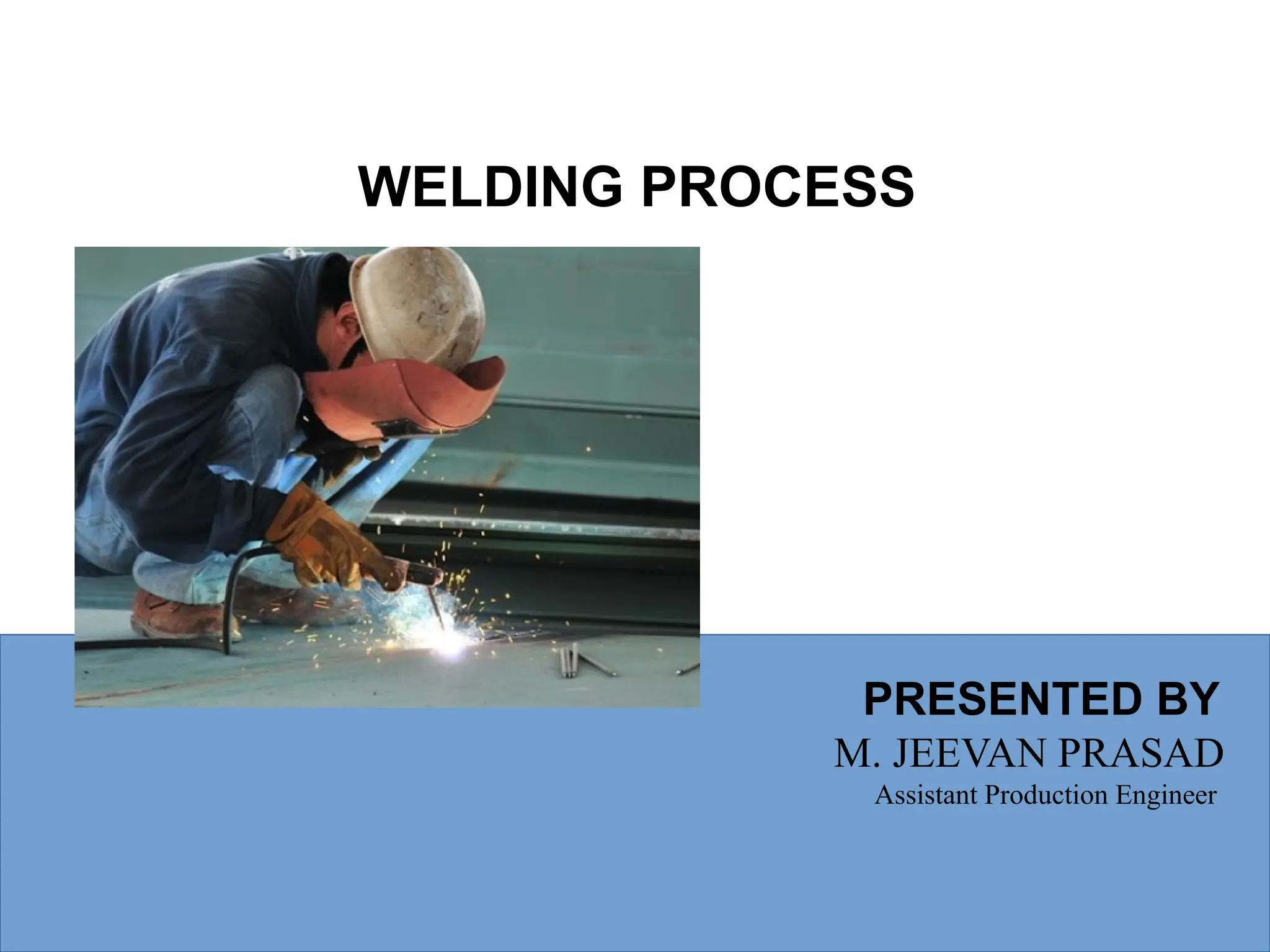
WELDING PROCESS
PRESENTED BY
M. JEEVAN PRASAD
Assistant Production Engineer
2
CONTENTS
1. Introduction
2. Types of Welding
3. Weld Joints
4. Arc Welding Process
5. Electrode Classification
6. SMAW
7. GMAW
8. Welding defects
3
INTRODUCTION
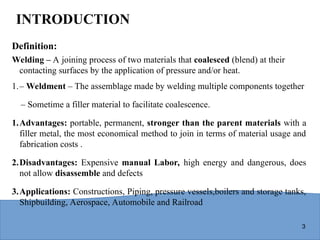
Definition:
Welding – A joining process of two materials that coalesced (blend) at their
contacting surfaces by the application of pressure and/or heat.
1.– Weldment – The assemblage made by welding multiple components together
– Sometime a filler material to facilitate coalescence.
1.Advantages: portable, permanent, stronger than the parent materials with a
filler metal, the most economical method to join in terms of material usage and
fabrication costs .
2.Disadvantages: Expensive manual Labor, high energy and dangerous, does
not allow disassemble and defects
3.Applications: Constructions, Piping, pressure vessels,boilers and storage tanks,
Shipbuilding, Aerospace, Automobile and Railroad
4
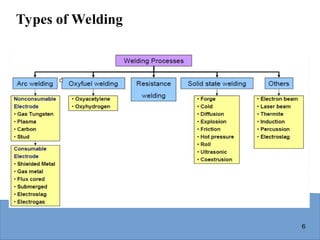
Types of Welding
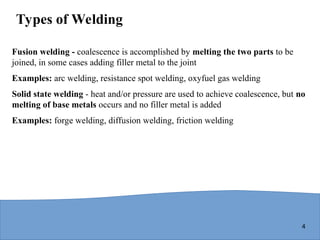
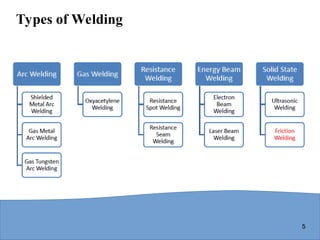
Fusion welding - coalescence is accomplished by melting the two parts to be
joined, in some cases adding filler metal to the joint
Examples: arc welding, resistance spot welding, oxyfuel gas welding
Solid state welding - heat and/or pressure are used to achieve coalescence, but no
melting of base metals occurs and no filler metal is added
Examples: forge welding, diffusion welding, friction welding
5
Types of Welding
6
Types of Welding
7
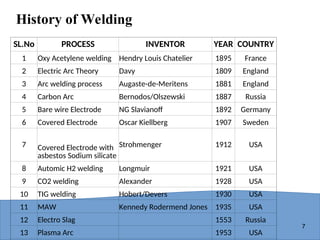
History of Welding
SL.No PROCESS INVENTOR YEAR COUNTRY
1 Oxy Acetylene welding Hendry Louis Chatelier 1895 France
2 Electric Arc Theory Davy 1809 England
3 Arc welding process Augaste-de-Meritens 1881 England
4 Carbon Arc Bernodos/Olszewski 1887 Russia
5 Bare wire Electrode NG Slavianoff 1892 Germany
6 Covered Electrode Oscar Kiellberg 1907 Sweden
7 Covered Electrode with
asbestos Sodium silicate
Strohmenger 1912 USA
8 Automic H2 welding Longmuir 1921 USA
9 CO2 welding Alexander 1928 USA
10 TIG welding Hobert/Devers 1930 USA
11 MAW Kennedy Rodermend Jones 1935 USA
12 Electro Slag 1553 Russia
13 Plasma Arc 1953 USA
8
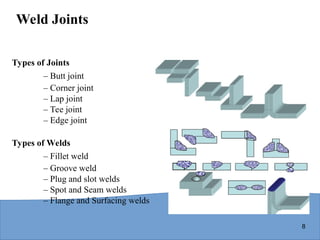
Weld Joints
Types of Joints
– Butt joint
– Corner joint
– Lap joint
– Tee joint
– Edge joint
Types of Welds
– Fillet weld
– Groove weld
– Plug and slot welds
– Spot and Seam welds
– Flange and Surfacing welds
9
Arc Welding Process
1.In arc welding, a welding power supply is used to create an arc between the
base metals (metals to be welded) and electrode.
2.Heat is generated in the base metals causing them to melt and fuse together.
The electrode can either be consumable or non consumable.
3.Filler material may or may not be added to enhance weld quality and protect
the welding area from external contamination.
Following are typical arc welding processes:
–Shielded Metal Arc Welding (SMAW)
–Gas Metal Arc Welding (GMAW)
–Gas Tungsten Arc Welding (GTAW)
10
Arc Welding
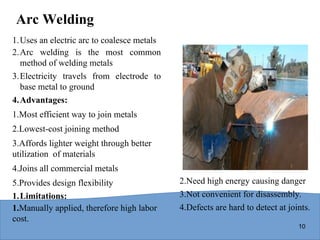
1.Uses an electric arc to coalesce metals
2.Arc welding is the most common
method of welding metals
3.Electricity travels from electrode to
base metal to ground
4.Advantages:
1.Most efficient way to join metals
2.Lowest-cost joining method
3.Affords lighter weight through better
utilization of materials
4.Joins all commercial metals
5.Provides design flexibility
1.Limitations:
1.Manually applied, therefore high labor
cost.
2.Need high energy causing danger
3.Not convenient for disassembly.
4.Defects are hard to detect at joints.
11
THANK YOU

Welding Process, types of welding, welding joints

  • 1.
    WELDING PROCESS PRESENTED BY M.JEEVAN PRASAD Assistant Production Engineer
  • 2.
    2 CONTENTS 1. Introduction 2. Typesof Welding 3. Weld Joints 4. Arc Welding Process 5. Electrode Classification 6. SMAW 7. GMAW 8. Welding defects
  • 3.
    3 INTRODUCTION Definition: Welding – Ajoining process of two materials that coalesced (blend) at their contacting surfaces by the application of pressure and/or heat. 1.– Weldment – The assemblage made by welding multiple components together – Sometime a filler material to facilitate coalescence. 1.Advantages: portable, permanent, stronger than the parent materials with a filler metal, the most economical method to join in terms of material usage and fabrication costs . 2.Disadvantages: Expensive manual Labor, high energy and dangerous, does not allow disassemble and defects 3.Applications: Constructions, Piping, pressure vessels,boilers and storage tanks, Shipbuilding, Aerospace, Automobile and Railroad
  • 4.
    4 Types of Welding Fusionwelding - coalescence is accomplished by melting the two parts to be joined, in some cases adding filler metal to the joint Examples: arc welding, resistance spot welding, oxyfuel gas welding Solid state welding - heat and/or pressure are used to achieve coalescence, but no melting of base metals occurs and no filler metal is added Examples: forge welding, diffusion welding, friction welding
  • 5.
  • 6.
  • 7.
    7 History of Welding SL.NoPROCESS INVENTOR YEAR COUNTRY 1 Oxy Acetylene welding Hendry Louis Chatelier 1895 France 2 Electric Arc Theory Davy 1809 England 3 Arc welding process Augaste-de-Meritens 1881 England 4 Carbon Arc Bernodos/Olszewski 1887 Russia 5 Bare wire Electrode NG Slavianoff 1892 Germany 6 Covered Electrode Oscar Kiellberg 1907 Sweden 7 Covered Electrode with asbestos Sodium silicate Strohmenger 1912 USA 8 Automic H2 welding Longmuir 1921 USA 9 CO2 welding Alexander 1928 USA 10 TIG welding Hobert/Devers 1930 USA 11 MAW Kennedy Rodermend Jones 1935 USA 12 Electro Slag 1553 Russia 13 Plasma Arc 1953 USA
  • 8.
    8 Weld Joints Types ofJoints – Butt joint – Corner joint – Lap joint – Tee joint – Edge joint Types of Welds – Fillet weld – Groove weld – Plug and slot welds – Spot and Seam welds – Flange and Surfacing welds
  • 9.
    9 Arc Welding Process 1.Inarc welding, a welding power supply is used to create an arc between the base metals (metals to be welded) and electrode. 2.Heat is generated in the base metals causing them to melt and fuse together. The electrode can either be consumable or non consumable. 3.Filler material may or may not be added to enhance weld quality and protect the welding area from external contamination. Following are typical arc welding processes: –Shielded Metal Arc Welding (SMAW) –Gas Metal Arc Welding (GMAW) –Gas Tungsten Arc Welding (GTAW)
  • 10.
    10 Arc Welding 1.Uses anelectric arc to coalesce metals 2.Arc welding is the most common method of welding metals 3.Electricity travels from electrode to base metal to ground 4.Advantages: 1.Most efficient way to join metals 2.Lowest-cost joining method 3.Affords lighter weight through better utilization of materials 4.Joins all commercial metals 5.Provides design flexibility 1.Limitations: 1.Manually applied, therefore high labor cost. 2.Need high energy causing danger 3.Not convenient for disassembly. 4.Defects are hard to detect at joints.
  • 11.