MERCHANT BANKING
INTRODUCTION
What is a Merchant Bank?
  Financial institution that specializes in
  acceptance of:
• Bills of Exchange.
• Hire Purchase.
• Installment Buying.
• International Trade Financing.
• Long Term Loans.
• Investment and Portfolio Management.
ADVISORY BODY
Merchant Banks also
  advices on:
• Acquisitions.

• Mergers.

• Takeovers.
HISTORY OF MERCHANT BANKS
• These were the original i.e.: the first banks.
• Invented in the middle ages by Italian Grain
  Merchants.
• Main intention was financing the long trading
  journeys.
• Later on started providing financial assistance
  for production of grains and cereals.
MERCHANT BANK V/S INVESTMENT BANK

MERCHANT BANK                      INVESTMENT BANK

Expand into the field of Securities Participate in Trade Financing
underwriting.                       activities.


Focus on Small Scale Companies     Focus on IPO’s (Initial Public
and offer Creative Equity          Offerings), and Large Public and
Financing, Bridge & Mezzanine      Private Share Offerings.
Financing.
Provide service to Small and       Provide service to Larger
Medium Institutes.                 Institutes
SERVICES OF MERCHANT BANKS
• Project Counseling.
• Loan Syndication.
• Issue Management.
• Portfolio Management.
• NRI Investment.
• Advisory Service Relating
  to Mergers &
  Acquisitions.
• Off- Shore Finance.
PROJECT COUNSELING
• Includes preparation of Project Reports.

• Deciding upon the Financing Pattern.

• Appraising the Project relating to its Technical,
  Commercial and Financial viability.

• Includes filling up forms for obtaining funds from
  Financial Institutions.
LOAN SYNDICATION
• Assistance is rendered
  to Raise Loans for
  Projects, after
  determining Promoter’s
  Contribution.
• These can also be
  obtained from Single
  Institution or a
  Consortium.
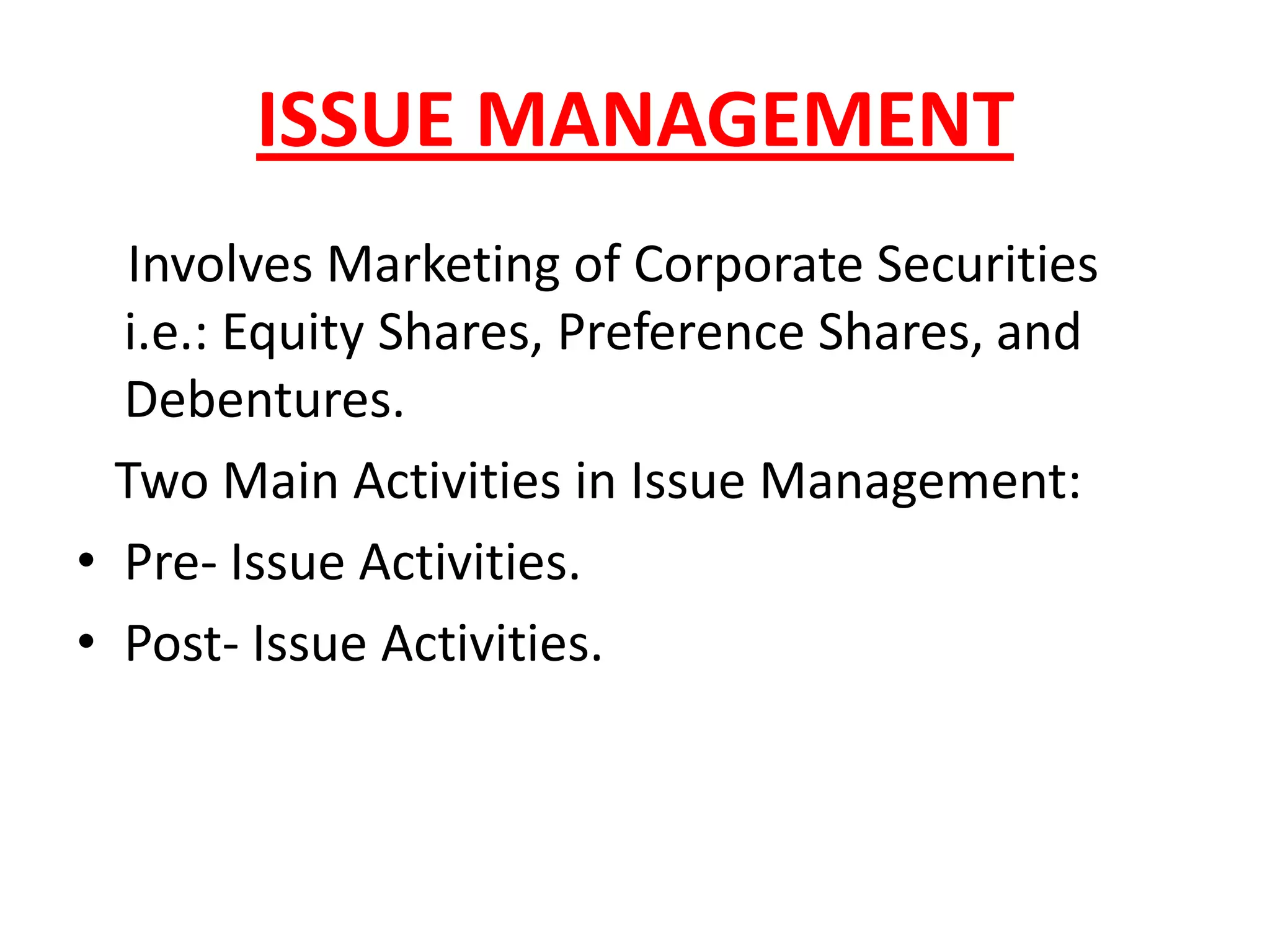
ISSUE MANAGEMENT
   Involves Marketing of Corporate Securities
  i.e.: Equity Shares, Preference Shares, and
  Debentures.
  Two Main Activities in Issue Management:
• Pre- Issue Activities.
• Post- Issue Activities.
Underwriting of Public Issues:

• It is an Insurance to the Company which
  makes Public Issues.

• Raising external Resources becomes easy, if
  the Issues are backed by well known
  Underwriters.
Managers Consultants or Advisers to the Issue:
• SEBI insists that all issues be managed by at
  least one Authorized Merchant Banker.

• For an Issue of 100 crores a max. of Four
  Merchant Banks are appointed.

• They help in Listing of Shares in Stock
  Exchange, Completion of Formalities under
  Companies Act etc.
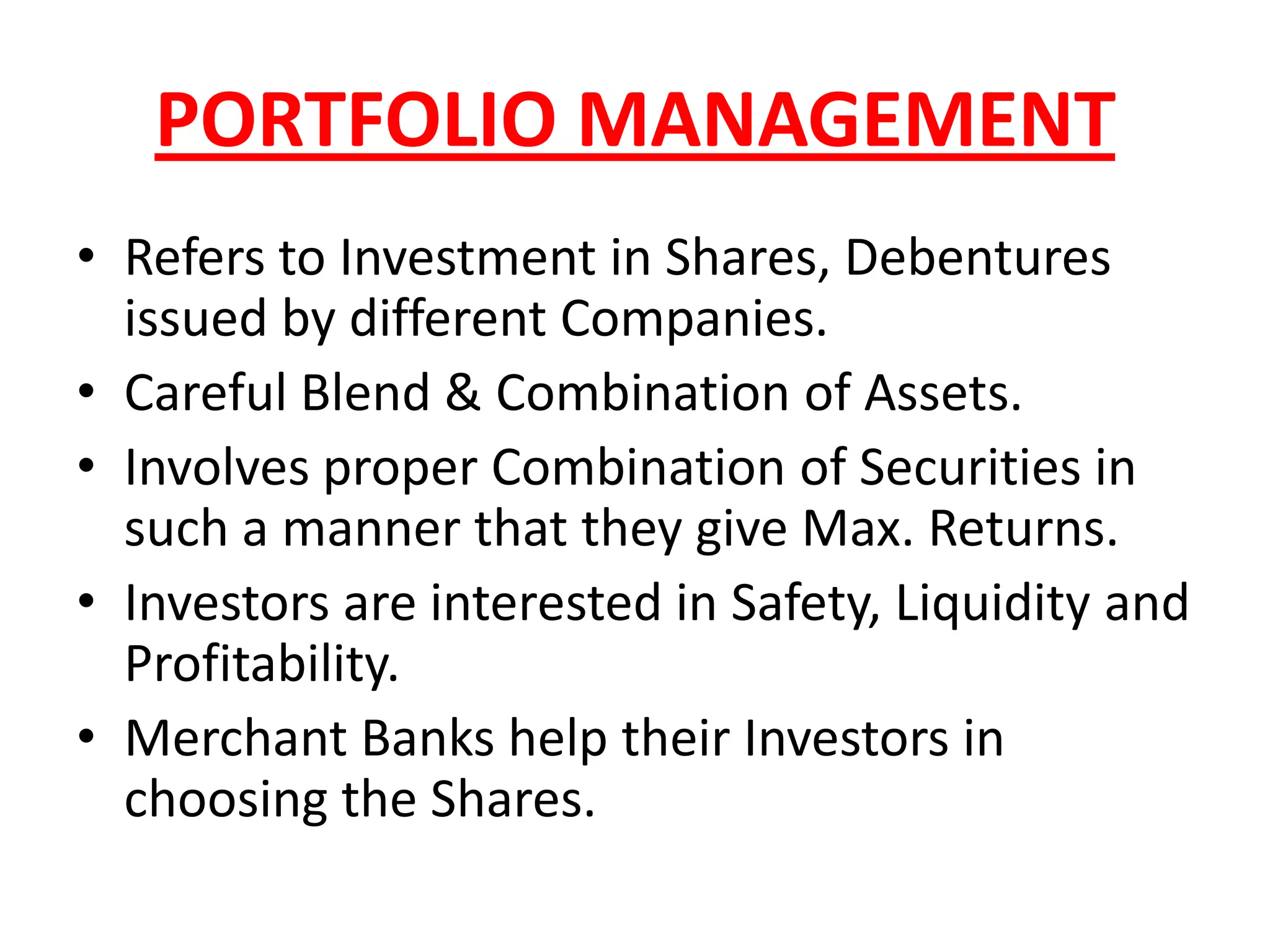
PORTFOLIO MANAGEMENT
• Refers to Investment in Shares, Debentures
  issued by different Companies.
• Careful Blend & Combination of Assets.
• Involves proper Combination of Securities in
  such a manner that they give Max. Returns.
• Investors are interested in Safety, Liquidity and
  Profitability.
• Merchant Banks help their Investors in
  choosing the Shares.
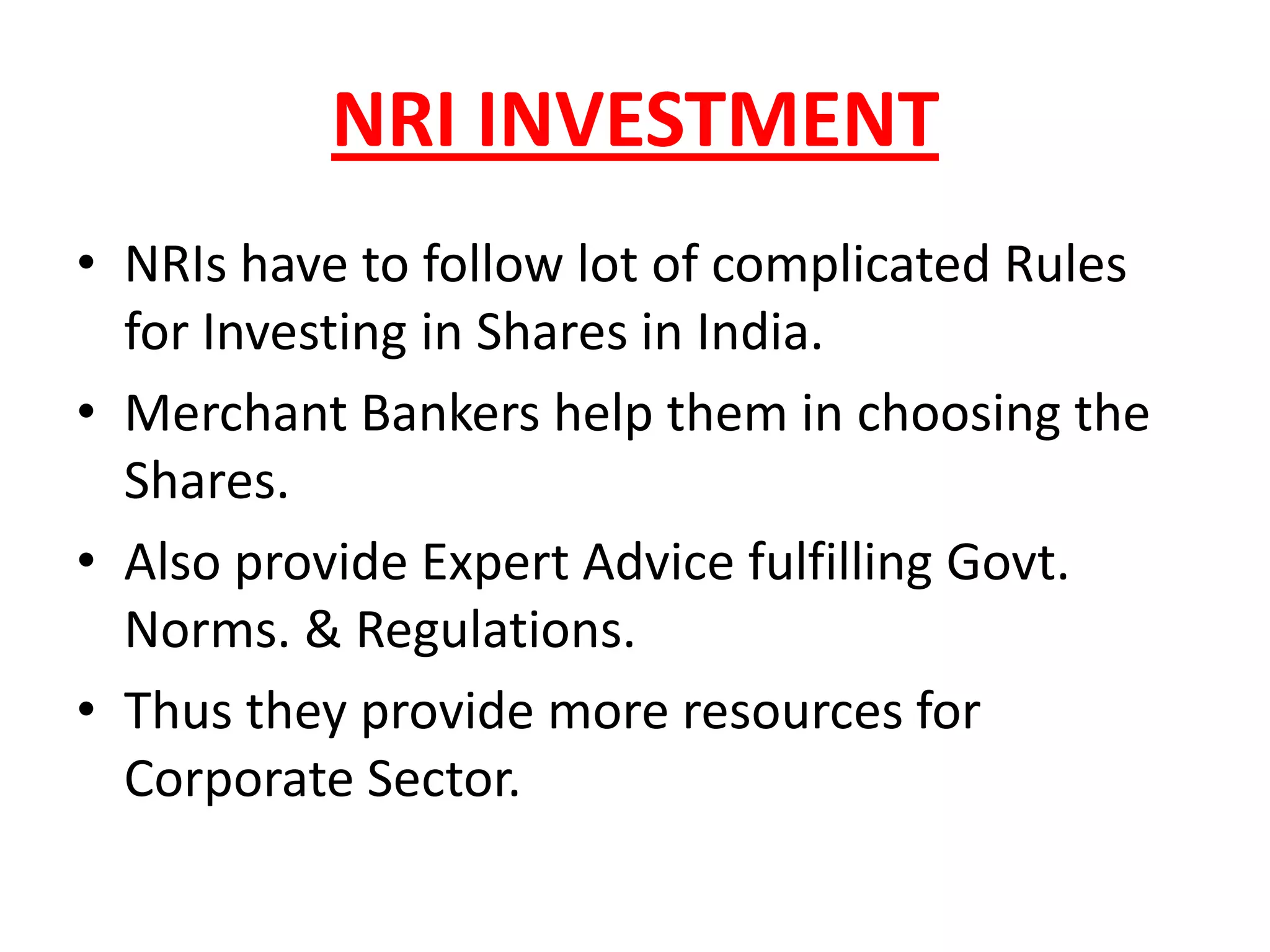
NRI INVESTMENT
• NRIs have to follow lot of complicated Rules
  for Investing in Shares in India.
• Merchant Bankers help them in choosing the
  Shares.
• Also provide Expert Advice fulfilling Govt.
  Norms. & Regulations.
• Thus they provide more resources for
  Corporate Sector.
Advisory Services Relating to Mergers
            & Takeovers
• Merger means combination of two or more
  companies.
• Here one survives, while other loses its
  existence.
• Takeover is the purchase by one Company &
  acquiring controlling Interest in the Share
  Capital of another Company.
• Merchant Banks act as Middlemen between
  the ‘Offeror’ & the ‘Offeree’.
OFF-SHORE FINANCE
• Long Term Foreign
  Currency Loans.

• Joint Ventures Abroad.

• Financing Exports &
  Imports.

• Foreign Collaboration
  Arrangement.
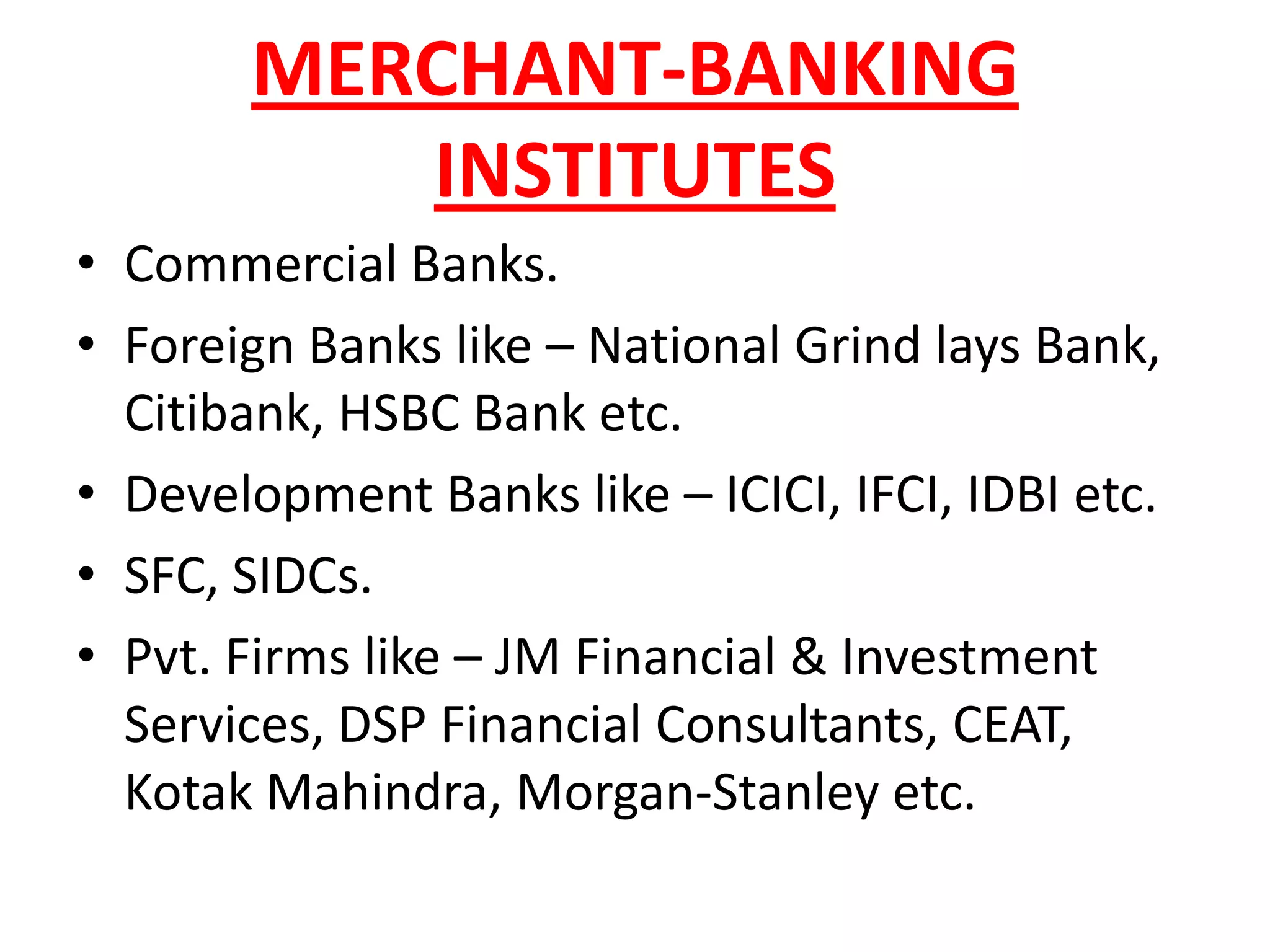
MERCHANT-BANKING
          INSTITUTES
• Commercial Banks.
• Foreign Banks like – National Grind lays Bank,
  Citibank, HSBC Bank etc.
• Development Banks like – ICICI, IFCI, IDBI etc.
• SFC, SIDCs.
• Pvt. Firms like – JM Financial & Investment
  Services, DSP Financial Consultants, CEAT,
  Kotak Mahindra, Morgan-Stanley etc.
Merchant Banking Regulations
    Certificate from SEBI is a must. There are Four
    Types:
•   Category 1 : Act as Issue Managers.
•   Category 2 : Act only as Co- Managers.
•   Category 3 : Can’t undertake Portfolio Mgt.
•   Category 4 : Act merely as Consultant/
    Advisor.
GUIDELINES
• Authorization from SEBI is must.
• Maintaining of Records like Balance Sheets,
  P&L A/c, Statements of Financial Position.
• Half-yearly un-audited result to be submitted
  to SEBI.
• Prohibition from buying Securities based on
  unpublished Price Sensitive info. of their
  Clients.
• Appointment of a ‘Compliance Officer’.
• SEBI has the Right to send Inspecting
  Authority to inspect Books of Accounts,
  Records etc.

• Initial Authorization Fee, an Annual Fee &
  Renewal Fee may be collected by SEBI.

• In case of violation of the Guidelines SEBI has
  the power to suspend/cancel the
  Authorization.
PROBLEMS OF MERCHANT
           BANKERS
• SEBI stipulates high capital adequacy norms
  for authorization.
• Non co-operation of issuing companies in
  timely allotment of securities and refund of
  application of money etc.
• Is vast, but should develop adequate expertise
  to provide a full range of merchant banking
  services.
CONCLUSION
• Merchant Banks and Investment Banks sound
  the same but are totally different.
• Provide advice and guidance to its various
  clientele.
• All Indian Merchant Banks are under the check
  of SEBI.
• Has evolved through the ages.
THANK YOU

Merchant banking

  • 1.
  • 2.
    INTRODUCTION What is aMerchant Bank? Financial institution that specializes in acceptance of: • Bills of Exchange. • Hire Purchase. • Installment Buying. • International Trade Financing. • Long Term Loans. • Investment and Portfolio Management.
  • 3.
    ADVISORY BODY Merchant Banksalso advices on: • Acquisitions. • Mergers. • Takeovers.
  • 4.
    HISTORY OF MERCHANTBANKS • These were the original i.e.: the first banks. • Invented in the middle ages by Italian Grain Merchants. • Main intention was financing the long trading journeys. • Later on started providing financial assistance for production of grains and cereals.
  • 5.
    MERCHANT BANK V/SINVESTMENT BANK MERCHANT BANK INVESTMENT BANK Expand into the field of Securities Participate in Trade Financing underwriting. activities. Focus on Small Scale Companies Focus on IPO’s (Initial Public and offer Creative Equity Offerings), and Large Public and Financing, Bridge & Mezzanine Private Share Offerings. Financing. Provide service to Small and Provide service to Larger Medium Institutes. Institutes
  • 6.
    SERVICES OF MERCHANTBANKS • Project Counseling. • Loan Syndication. • Issue Management. • Portfolio Management. • NRI Investment. • Advisory Service Relating to Mergers & Acquisitions. • Off- Shore Finance.
  • 7.
    PROJECT COUNSELING • Includespreparation of Project Reports. • Deciding upon the Financing Pattern. • Appraising the Project relating to its Technical, Commercial and Financial viability. • Includes filling up forms for obtaining funds from Financial Institutions.
  • 8.
    LOAN SYNDICATION • Assistanceis rendered to Raise Loans for Projects, after determining Promoter’s Contribution. • These can also be obtained from Single Institution or a Consortium.
  • 9.
    ISSUE MANAGEMENT Involves Marketing of Corporate Securities i.e.: Equity Shares, Preference Shares, and Debentures. Two Main Activities in Issue Management: • Pre- Issue Activities. • Post- Issue Activities.
  • 10.
    Underwriting of PublicIssues: • It is an Insurance to the Company which makes Public Issues. • Raising external Resources becomes easy, if the Issues are backed by well known Underwriters.
  • 11.
    Managers Consultants orAdvisers to the Issue: • SEBI insists that all issues be managed by at least one Authorized Merchant Banker. • For an Issue of 100 crores a max. of Four Merchant Banks are appointed. • They help in Listing of Shares in Stock Exchange, Completion of Formalities under Companies Act etc.
  • 12.
    PORTFOLIO MANAGEMENT • Refersto Investment in Shares, Debentures issued by different Companies. • Careful Blend & Combination of Assets. • Involves proper Combination of Securities in such a manner that they give Max. Returns. • Investors are interested in Safety, Liquidity and Profitability. • Merchant Banks help their Investors in choosing the Shares.
  • 13.
    NRI INVESTMENT • NRIshave to follow lot of complicated Rules for Investing in Shares in India. • Merchant Bankers help them in choosing the Shares. • Also provide Expert Advice fulfilling Govt. Norms. & Regulations. • Thus they provide more resources for Corporate Sector.
  • 14.
    Advisory Services Relatingto Mergers & Takeovers • Merger means combination of two or more companies. • Here one survives, while other loses its existence. • Takeover is the purchase by one Company & acquiring controlling Interest in the Share Capital of another Company. • Merchant Banks act as Middlemen between the ‘Offeror’ & the ‘Offeree’.
  • 15.
    OFF-SHORE FINANCE • LongTerm Foreign Currency Loans. • Joint Ventures Abroad. • Financing Exports & Imports. • Foreign Collaboration Arrangement.
  • 16.
    MERCHANT-BANKING INSTITUTES • Commercial Banks. • Foreign Banks like – National Grind lays Bank, Citibank, HSBC Bank etc. • Development Banks like – ICICI, IFCI, IDBI etc. • SFC, SIDCs. • Pvt. Firms like – JM Financial & Investment Services, DSP Financial Consultants, CEAT, Kotak Mahindra, Morgan-Stanley etc.
  • 17.
    Merchant Banking Regulations Certificate from SEBI is a must. There are Four Types: • Category 1 : Act as Issue Managers. • Category 2 : Act only as Co- Managers. • Category 3 : Can’t undertake Portfolio Mgt. • Category 4 : Act merely as Consultant/ Advisor.
  • 18.
    GUIDELINES • Authorization fromSEBI is must. • Maintaining of Records like Balance Sheets, P&L A/c, Statements of Financial Position. • Half-yearly un-audited result to be submitted to SEBI. • Prohibition from buying Securities based on unpublished Price Sensitive info. of their Clients. • Appointment of a ‘Compliance Officer’.
  • 19.
    • SEBI hasthe Right to send Inspecting Authority to inspect Books of Accounts, Records etc. • Initial Authorization Fee, an Annual Fee & Renewal Fee may be collected by SEBI. • In case of violation of the Guidelines SEBI has the power to suspend/cancel the Authorization.
  • 20.
    PROBLEMS OF MERCHANT BANKERS • SEBI stipulates high capital adequacy norms for authorization. • Non co-operation of issuing companies in timely allotment of securities and refund of application of money etc. • Is vast, but should develop adequate expertise to provide a full range of merchant banking services.
  • 21.
    CONCLUSION • Merchant Banksand Investment Banks sound the same but are totally different. • Provide advice and guidance to its various clientele. • All Indian Merchant Banks are under the check of SEBI. • Has evolved through the ages.
  • 22.