INTRODUCTION TO 
HARDWARES 
PROCESSORS
INDEX 
1. What is Processor? 
2. Types of Processor. 
3. Working of Processor. 
4. Vendors of Processor 
5. Performance parameter. 
6. Technology of Parameter. 
7. How to choose Best Processor.
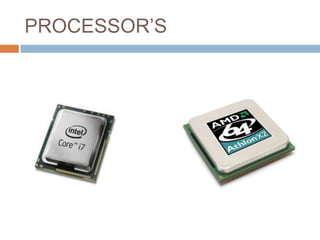
PROCESSOR’S
What Different Types of Processors 
are there? 
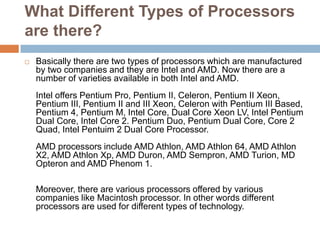
 Basically there are two types of processors which are manufactured 
by two companies and they are Intel and AMD. Now there are a 
number of varieties available in both Intel and AMD. 
Intel offers Pentium Pro, Pentium II, Celeron, Pentium II Xeon, 
Pentium III, Pentium II and III Xeon, Celeron with Pentium III Based, 
Pentium 4, Pentium M, Intel Core, Dual Core Xeon LV, Intel Pentium 
Dual Core, Intel Core 2. Pentium Duo, Pentium Dual Core, Core 2 
Quad, Intel Pentuim 2 Dual Core Processor. 
AMD processors include AMD Athlon, AMD Athlon 64, AMD Athlon 
X2, AMD Athlon Xp, AMD Duron, AMD Sempron, AMD Turion, MD 
Opteron and AMD Phenom 1. 
Moreover, there are various processors offered by various 
companies like Macintosh processor. In other words different 
processors are used for different types of technology.
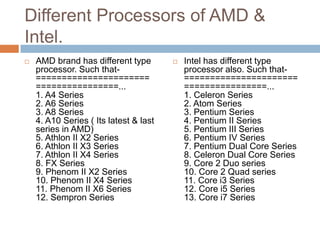
Different Processors of AMD & 
Intel. 
 AMD brand has different type 
processor. Such that- 
====================== 
================... 
1. A4 Series 
2. A6 Series 
3. A8 Series 
4. A10 Series ( Its latest & last 
series in AMD) 
5. Athlon II X2 Series 
6. Athlon II X3 Series 
7. Athlon II X4 Series 
8. FX Series 
9. Phenom II X2 Series 
10. Phenom II X4 Series 
11. Phenom II X6 Series 
12. Sempron Series 
 Intel has different type 
processor also. Such that- 
====================== 
================... 
1. Celeron Series 
2. Atom Series 
3. Pentium Series 
4. Pentium II Series 
5. Pentium III Series 
6. Pentium IV Series 
7. Pentium Dual Core Series 
8. Celeron Dual Core Series 
9. Core 2 Duo series 
10. Core 2 Quad series 
11. Core i3 Series 
12. Core i5 Series 
13. Core i7 Series
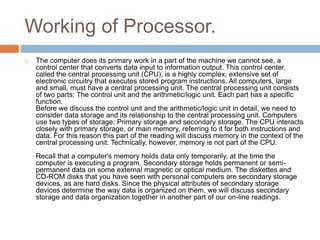
Working of Processor. 
 The computer does its primary work in a part of the machine we cannot see, a 
control center that converts data input to information output. This control center, 
called the central processing unit (CPU), is a highly complex, extensive set of 
electronic circuitry that executes stored program instructions. All computers, large 
and small, must have a central processing unit. The central processing unit consists 
of two parts: The control unit and the arithmetic/logic unit. Each part has a specific 
function. 
Before we discuss the control unit and the arithmetic/logic unit in detail, we need to 
consider data storage and its relationship to the central processing unit. Computers 
use two types of storage: Primary storage and secondary storage. The CPU interacts 
closely with primary storage, or main memory, referring to it for both instructions and 
data. For this reason this part of the reading will discuss memory in the context of the 
central processing unit. Technically, however, memory is not part of the CPU. 
Recall that a computer's memory holds data only temporarily, at the time the 
computer is executing a program. Secondary storage holds permanent or semi-permanent 
data on some external magnetic or optical medium. The diskettes and 
CD-ROM disks that you have seen with personal computers are secondary storage 
devices, as are hard disks. Since the physical attributes of secondary storage 
devices determine the way data is organized on them, we will discuss secondary 
storage and data organization together in another part of our on-line readings.
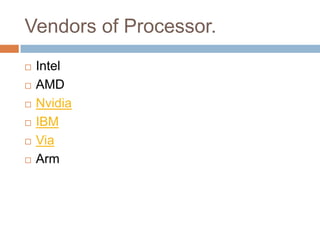
Vendors of Processor. 
 Intel 
 AMD 
 Nvidia 
 IBM 
 Via 
 Arm
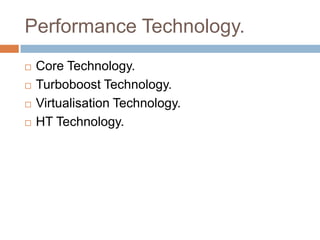
Performance Technology. 
 Core Technology. 
 Turboboost Technology. 
 Virtualisation Technology. 
 HT Technology.

Introduction to hardwares

  • 1.
  • 2.
    INDEX 1. Whatis Processor? 2. Types of Processor. 3. Working of Processor. 4. Vendors of Processor 5. Performance parameter. 6. Technology of Parameter. 7. How to choose Best Processor.
  • 3.
  • 4.
    What Different Typesof Processors are there?  Basically there are two types of processors which are manufactured by two companies and they are Intel and AMD. Now there are a number of varieties available in both Intel and AMD. Intel offers Pentium Pro, Pentium II, Celeron, Pentium II Xeon, Pentium III, Pentium II and III Xeon, Celeron with Pentium III Based, Pentium 4, Pentium M, Intel Core, Dual Core Xeon LV, Intel Pentium Dual Core, Intel Core 2. Pentium Duo, Pentium Dual Core, Core 2 Quad, Intel Pentuim 2 Dual Core Processor. AMD processors include AMD Athlon, AMD Athlon 64, AMD Athlon X2, AMD Athlon Xp, AMD Duron, AMD Sempron, AMD Turion, MD Opteron and AMD Phenom 1. Moreover, there are various processors offered by various companies like Macintosh processor. In other words different processors are used for different types of technology.
  • 5.
    Different Processors ofAMD & Intel.  AMD brand has different type processor. Such that- ====================== ================... 1. A4 Series 2. A6 Series 3. A8 Series 4. A10 Series ( Its latest & last series in AMD) 5. Athlon II X2 Series 6. Athlon II X3 Series 7. Athlon II X4 Series 8. FX Series 9. Phenom II X2 Series 10. Phenom II X4 Series 11. Phenom II X6 Series 12. Sempron Series  Intel has different type processor also. Such that- ====================== ================... 1. Celeron Series 2. Atom Series 3. Pentium Series 4. Pentium II Series 5. Pentium III Series 6. Pentium IV Series 7. Pentium Dual Core Series 8. Celeron Dual Core Series 9. Core 2 Duo series 10. Core 2 Quad series 11. Core i3 Series 12. Core i5 Series 13. Core i7 Series
  • 6.
    Working of Processor.  The computer does its primary work in a part of the machine we cannot see, a control center that converts data input to information output. This control center, called the central processing unit (CPU), is a highly complex, extensive set of electronic circuitry that executes stored program instructions. All computers, large and small, must have a central processing unit. The central processing unit consists of two parts: The control unit and the arithmetic/logic unit. Each part has a specific function. Before we discuss the control unit and the arithmetic/logic unit in detail, we need to consider data storage and its relationship to the central processing unit. Computers use two types of storage: Primary storage and secondary storage. The CPU interacts closely with primary storage, or main memory, referring to it for both instructions and data. For this reason this part of the reading will discuss memory in the context of the central processing unit. Technically, however, memory is not part of the CPU. Recall that a computer's memory holds data only temporarily, at the time the computer is executing a program. Secondary storage holds permanent or semi-permanent data on some external magnetic or optical medium. The diskettes and CD-ROM disks that you have seen with personal computers are secondary storage devices, as are hard disks. Since the physical attributes of secondary storage devices determine the way data is organized on them, we will discuss secondary storage and data organization together in another part of our on-line readings.
  • 7.
    Vendors of Processor.  Intel  AMD  Nvidia  IBM  Via  Arm
  • 8.
    Performance Technology. Core Technology.  Turboboost Technology.  Virtualisation Technology.  HT Technology.