Processors
What is a Processor?
A small chip which is heart of a computer
which performs the functions like Addition,
subtraction, multiplication, division, etc.
which is also known as “microprocessor” .
History of a Processors
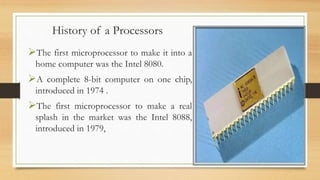
The first microprocessor to make it into a
home computer was the Intel 8080.
A complete 8-bit computer on one chip,
introduced in 1974 .
The first microprocessor to make a real
splash in the market was the Intel 8088,
introduced in 1979,
History of Processors
Then the 16 bit processors arrived in the market.
The life of 16 bit Processors in market was short.
More advanced iterations like the Motorola 6800
found their way into early Macintosh systems and
others.
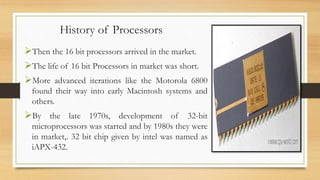
By the late 1970s, development of 32-bit
microprocessors was started and by 1980s they were
in market,. 32 bit chip given by intel was named as
iAPX-432.
Working of Processor
Using its ALU (Arithmetic/Logic Unit), a microprocessor can perform
mathematical operations like addition, subtraction.
Modern microprocessors contain complete floating point processors that
can perform extremely sophisticated operations on large floating point
numbers.
A microprocessor can move data from one memory location to another.
A microprocessor can make decisions and jump to a new set of
instructions based on those decisions.
Working Explained with Diagram
An address bus (that may be 8, 16 or 32
bits wide) that sends an address to
memory
A data bus (that may be 8, 16 or 32 bits
wide) that can send data to memory or
receive data from memory
An RD (read) and WR (write) line to tell
the memory whether it wants to set or get
the addressed location
Terms Associated with Processor
A clock line that lets a clock pulse sequence the
Processor.
A reset line that resets the program counter to zero (or
whatever) and restarts execution
The digital chips on a motherboard are keep in sync with
each other by the clock signal (a stream of pulses) of the
motherboard. Its is called Clock Speed.
Uses of Processor
Without Processor computers can not be imagined.
Processor’s hast two primary task.
i) Processing Data
ii) Executing Operations
Computer contains quartz clock. Every time the clock ticks processes one
task.
However, it processes the instructions so quickly that it appears to be
multitasking.
Uses of Processors
A CPU with a clock speed of 3 GHz, for example, can process
three billion process in a second.
While the CPU is busy processing instructions for the program,
devices such as a DVD drive,or camera, a device signals an
interrupt.
When the processor is interrupted, it stores its current state in
memory, executes instructions for the device, and then restores its
prior state and continues running the program where it left off.
Some Problems faced during the use of
Processors
1) The Problem With Cache
A cache is a representation of memory but is much faster than memory. Its
purpose is to act as a buffer between main memory and the processor.
The idea is that when the processor wants something from memory it is
already in the cache so to the processor it appears the memory is as fast as
the cache.
If the data required is not in the cache the data has to be fetched from main
memory and this can take hundreds of cycles, in this case the processor will
stall and will get no work done.
Some Problems faced during the use of
Processors
2) The Problem With Memory
This Problem is faced while using core processors.
Having a large number of processor cores means that memory will now have
to be shared between them. To ensure the memory requests are efficient
they will be reordered.
This sharing and reordering hardware takes time to do it’s job so any
memory requests going through it will be subject to latency from it. The
more cores there are the more complex it will become and the greater the
latency. And many more problems.
Top manufacturers
1. Intel.
2. AMD.
3. Qualcomm.
4. NVIDIA.
5. IBM
Intel-Core i7-7600U
AMD-FX-8800P
Qualcomm-800 series
NVIDIA- GeFORCE Series
IBM-POWER9
Price Range of Processors
• Prices of Processors changes according to it’s clock speed
and cache.
• It also varies from company to company.
• According to online prices the intel core 2 processor have
price of only 1700 rs.
• Whereas same companies processor intel i7 have price of
1,39,000.
THANK YOU!
Prepared & Presented by - Krunal Astik

Processors

  • 1.
  • 2.
    What is aProcessor? A small chip which is heart of a computer which performs the functions like Addition, subtraction, multiplication, division, etc. which is also known as “microprocessor” .
  • 3.
    History of aProcessors The first microprocessor to make it into a home computer was the Intel 8080. A complete 8-bit computer on one chip, introduced in 1974 . The first microprocessor to make a real splash in the market was the Intel 8088, introduced in 1979,
  • 4.
    History of Processors Thenthe 16 bit processors arrived in the market. The life of 16 bit Processors in market was short. More advanced iterations like the Motorola 6800 found their way into early Macintosh systems and others. By the late 1970s, development of 32-bit microprocessors was started and by 1980s they were in market,. 32 bit chip given by intel was named as iAPX-432.
  • 5.
    Working of Processor Usingits ALU (Arithmetic/Logic Unit), a microprocessor can perform mathematical operations like addition, subtraction. Modern microprocessors contain complete floating point processors that can perform extremely sophisticated operations on large floating point numbers. A microprocessor can move data from one memory location to another. A microprocessor can make decisions and jump to a new set of instructions based on those decisions.
  • 6.
    Working Explained withDiagram An address bus (that may be 8, 16 or 32 bits wide) that sends an address to memory A data bus (that may be 8, 16 or 32 bits wide) that can send data to memory or receive data from memory An RD (read) and WR (write) line to tell the memory whether it wants to set or get the addressed location
  • 7.
    Terms Associated withProcessor A clock line that lets a clock pulse sequence the Processor. A reset line that resets the program counter to zero (or whatever) and restarts execution The digital chips on a motherboard are keep in sync with each other by the clock signal (a stream of pulses) of the motherboard. Its is called Clock Speed.
  • 8.
    Uses of Processor WithoutProcessor computers can not be imagined. Processor’s hast two primary task. i) Processing Data ii) Executing Operations Computer contains quartz clock. Every time the clock ticks processes one task. However, it processes the instructions so quickly that it appears to be multitasking.
  • 9.
    Uses of Processors ACPU with a clock speed of 3 GHz, for example, can process three billion process in a second. While the CPU is busy processing instructions for the program, devices such as a DVD drive,or camera, a device signals an interrupt. When the processor is interrupted, it stores its current state in memory, executes instructions for the device, and then restores its prior state and continues running the program where it left off.
  • 10.
    Some Problems facedduring the use of Processors 1) The Problem With Cache A cache is a representation of memory but is much faster than memory. Its purpose is to act as a buffer between main memory and the processor. The idea is that when the processor wants something from memory it is already in the cache so to the processor it appears the memory is as fast as the cache. If the data required is not in the cache the data has to be fetched from main memory and this can take hundreds of cycles, in this case the processor will stall and will get no work done.
  • 11.
    Some Problems facedduring the use of Processors 2) The Problem With Memory This Problem is faced while using core processors. Having a large number of processor cores means that memory will now have to be shared between them. To ensure the memory requests are efficient they will be reordered. This sharing and reordering hardware takes time to do it’s job so any memory requests going through it will be subject to latency from it. The more cores there are the more complex it will become and the greater the latency. And many more problems.
  • 12.
    Top manufacturers 1. Intel. 2.AMD. 3. Qualcomm. 4. NVIDIA. 5. IBM
  • 13.
  • 14.
  • 15.
  • 16.
  • 17.
  • 18.
    Price Range ofProcessors • Prices of Processors changes according to it’s clock speed and cache. • It also varies from company to company. • According to online prices the intel core 2 processor have price of only 1700 rs. • Whereas same companies processor intel i7 have price of 1,39,000.
  • 19.
    THANK YOU! Prepared &Presented by - Krunal Astik