June, 2021 © Haramaya University, CHMS,
Department of Emergency and Critical Care Nursing
Basic First Aid and Emergency Care
By:- Ame Mehadi (BSc, MSc)
HARAMAYA UNIVERSITY
Collage of Health & Medical Sciences
School of Nursing & Midwifery
Department of Emergency & Critical Care Nursing
FIRST AID & ACCIDENT PREVENTION
BY AME M. (BSc, MSc)
ECCN Lecturer
BEC and PoNT Trainer
1
June, 2021 © Haramaya University, CHMS,
Department of Emergency and Critical Care Nursing
Basic First Aid and Emergency Care
By:- Ame Mehadi (BSc, MSc)
INTRODUCTION TO BASIC FIRST AID TRAINING
June, 2021 © Haramaya University, CHMS,
Department of Emergency and Critical Care Nursing
Basic First Aid and Emergency Care
By:- Ame Mehadi (BSc, MSc)
Basic First Aid
Case scenario
Formulate a group, read the following case scenario and reflect your idea to
the questions provided.
►You are arriving at the following accident scene just alone.
… scenario
The questions;
►What is your immediate action that should you do?
►What is the most important interventions that did you think in this scenario?
►What kinds of injury you may suspect to occur to the indicated passenger?
►What SHOULD YOU take to such accident scene always?
Think!!!
What knowledge and skills you will acquire from this course?
June, 2021 © Haramaya University, CHMS,
Department of Emergency and Critical Care Nursing
Basic First Aid and Emergency Care
By:- Ame Mehadi (BSc, MSc)
Learning Objectives
At the end of this lesson student will be able to;
►define first aid
►explain responsibilities of first aider
►explain values for first aid training
►determine the purposes and principles of first aid
►discus general directions to provide first aid
►discuss priority measures for any patient with an emergency situation.
►identify basic first aid equipment
►describe principles of accident prevention
June, 2021 © Haramaya University, CHMS,
Department of Emergency and Critical Care Nursing
Basic First Aid and Emergency Care
By:- Ame Mehadi (BSc, MSc)
Introduction
Human populations are rapidly growing. As a results
►disturbances in environmental conditions & habits happening, this leads to;
 rising occurrence of natural & man-made disasters
►there is an alterations in natural resource consumptions and land usage taking place.
 leads to rising conflicts & violence among people
►there is an advancement in technologies and increased use of its products also
occurring.
 leads to rising amount of injuries/illness as a systems made by human itself become
out of his control
Thus more peoples facing a sudden injuries and acute illness
June, 2021 © Haramaya University, CHMS,
Department of Emergency and Critical Care Nursing
Basic First Aid and Emergency Care
By:- Ame Mehadi (BSc, MSc)
Introduction…
June, 2021 © Haramaya University, CHMS,
Department of Emergency and Critical Care Nursing
Basic First Aid and Emergency Care
By:- Ame Mehadi (BSc, MSc)
Introduction: The need for emergency care
Statistics shows that
►incidence of accidental injuries and acute illness is raising.
The raising burdens of accidental injuries and acute illness leads to;
►Increasing the annual cost of medical attention,
►the loss of earning ability due to temporary or permanent impairment,
►the direct property damage costs billions of dollars each year
►the toll in pain, suffering, disability, and personal tragedy.
June, 2021 © Haramaya University, CHMS,
Department of Emergency and Critical Care Nursing
Basic First Aid and Emergency Care
By:- Ame Mehadi (BSc, MSc)
Introduction……
Definitions: First aid
►is the provision of immediate assistance or an initial care given to a victim with an
injury or sudden illness before a person gets expert medical help, usually using
locally available materials or materials at hand.
►is a temporary and immediate care given to an injured or suddenly ill person before
the arrival of emergency medial care.
►is helping behavior & initial care:- it includes well‒ selected words of
encouragement, sign of willingness to help and promotion of self‒confidence
A first aider – is someone with a formal training
►or first people on an emergency scene
June, 2021 © Haramaya University, CHMS,
Department of Emergency and Critical Care Nursing
Basic First Aid and Emergency Care
By:- Ame Mehadi (BSc, MSc)
Introduction……
Further first Aid
►is skilled application of accepted principle of treatment on the occurrence of
accident or sudden illness.
►includes home or work place based care
►doesn't replace definitive care by professionals
►can save lives in the critical time:‒ only given for life‒and‒death situations
►can also prevent an injury or illness from becoming worse and provide comfort and
reassurance to a casualty
►can be performed by a bystander or by victim
►is both preventing and treating sudden illness or injury.
►is caring for large numbers of causalities in a natural disaster.
June, 2021 © Haramaya University, CHMS,
Department of Emergency and Critical Care Nursing
Basic First Aid and Emergency Care
By:- Ame Mehadi (BSc, MSc)
RESPONDING TO EMERGENCIES
June, 2021 © Haramaya University, CHMS,
Department of Emergency and Critical Care Nursing
Basic First Aid and Emergency Care
By:- Ame Mehadi (BSc, MSc)
Responding to Emergencies
Has the following basic steps:
1. Preparing to Respond
2. Recognizing that an Emergency Exists
3. Willingness to Act
4. Approach and Action – responding
June, 2021 © Haramaya University, CHMS,
Department of Emergency and Critical Care Nursing
Basic First Aid and Emergency Care
By:- Ame Mehadi (BSc, MSc)
1. Preparing to Respond
have a first aid kit and supplies that will help respond to an emergency,
make sure first aid kit is easy accessible,
make sure the first aid kit has all of the items that may need,
perform regular maintenance and safety checks on all first aid kits and
equipment.
Remove and/or replace any broken, expired, discolored, or contaminated
items.
► e.g., a sterile tool in a torn package.
decontaminate any reusable equipment that has been used.
June, 2021 © Haramaya University, CHMS,
Department of Emergency and Critical Care Nursing
Basic First Aid and Emergency Care
By:- Ame Mehadi (BSc, MSc)
1. Preparing to Respond……
Preparing For Emergencies at Home
►Keep important information in a handy place.
►Post the numbers of the police, fire dep’t & EMS in the home and save
these numbers in your mobile phone’s contacts list.
►Teach children how to call for help.
►Keep first aid kits handy in your home and car.
►Make sure everyone in the family knows where they are and what is in
them.
►Review and practice the first aid skills that you learn so that you will
have the confidence and knowledge to respond in an emergency.
June, 2021 © Haramaya University, CHMS,
Department of Emergency and Critical Care Nursing
Basic First Aid and Emergency Care
By:- Ame Mehadi (BSc, MSc)
1. Preparing to Respond……
Preparing For Emergencies
►Keep important information.
►Keep medical and insurance records.
►Find out a local emergency telephone number; Keep it listed/posted
and saved in the contact list.
►Keep a first aid kit readily available.
►Learn and stay up to date on first aid and CPR skills.
June, 2021 © Haramaya University, CHMS,
Department of Emergency and Critical Care Nursing
Basic First Aid and Emergency Care
By:- Ame Mehadi (BSc, MSc)
1. Preparing to Respond……
The best way to prepare for emergencies is
►to be certified in first aid basic skills such as;
 Airway & respiratory intervention
 Cardiopulmonary resuscitation (CPR)
 Bleeding control and special wound care
 Stabilization of injuries and splinting of fractures
Hence, first aid training should be universal:
►everyone can/should learn and
►everyone should give first aid
June, 2021 © Haramaya University, CHMS,
Department of Emergency and Critical Care Nursing
Basic First Aid and Emergency Care
By:- Ame Mehadi (BSc, MSc)
2. Recognizing that an Emergency Exists
sometimes it is obvious that an emergency exists. e.g,
►a scream or cry for help,
►an unpleasant or unusual odor, or
►the sight of someone bleeding severely or
►lying motionless on the ground
But other times, the signs of an emergency may be more
subtle, such as
►a slight change in a person’s normal appearance or behavior,
or
►an unusual silence.
June, 2021 © Haramaya University, CHMS,
Department of Emergency and Critical Care Nursing
Basic First Aid and Emergency Care
By:- Ame Mehadi (BSc, MSc)
2. Recognizing an Emergency…….
Signs of an Emergency
UNUSUAL ODORS
►A foul or unusually strong
chemical odor
►The smell of smoke
►The smell of gas
►An unrecognizable odor
►An inappropriate odor
 e.g., a sickly-sweet odor on a
person's breath
UNUSUAL SOUNDS
►Screaming, moaning, shouting,
or calls for help
►Sudden loud noises such as
breaking glass, clashing metal, or
screeching tires
►A change in the sound made by
machinery or equipment
►An unusual silence
June, 2021 © Haramaya University, CHMS,
Department of Emergency and Critical Care Nursing
Basic First Aid and Emergency Care
By:- Ame Mehadi (BSc, MSc)
2. Recognizing an Emergency…….
Signs of an Emergency
UNUSUAL SIGHTS
►A stopped vehicle on the roadside or a
car that has run off of the road
►Downed electrical wires
►Sparks, smoke, or fire
►A person who suddenly collapses or is
lying motionless
►S/Sx of illness or injury, such as
profuse sweating for no apparent
reason or an uncharacteristic skin
color.
UNUSUAL BEHAVIORS
►Confusion in a person who is normally
alert
►Unusual drowsiness
►Personality or mood changes
 e.g., agitation in a person who is
normally calm
June, 2021 © Haramaya University, CHMS,
Department of Emergency and Critical Care Nursing
Basic First Aid and Emergency Care
By:- Ame Mehadi (BSc, MSc)
3. Willingness to Act
Sometimes people don’t want to get involved in an emergency.
The four most common reasons are:
A. The Bystander Effect
B. Unpleasant injuries or illnesses
C. Catching a disease
D. Doing something wrong, or causing more harm
June, 2021 © Haramaya University, CHMS,
Department of Emergency and Critical Care Nursing
Basic First Aid and Emergency Care
By:- Ame Mehadi (BSc, MSc)
A. The Bystander Effect:
thinking others can take care of the emergency, if there are other people at
the scene.
However, never assume someone has taken action and is providing first aid
just because there is a lot of people.
Remember that there are many important jobs that you can do.
You can help control the crowd, direct the actions of bystanders, call EMS,
get supplies, or provide care to the ill or injured person.
If you are unsure of what to do, ask others at the scene how you can help.
June, 2021 © Haramaya University, CHMS,
Department of Emergency and Critical Care Nursing
Basic First Aid and Emergency Care
By:- Ame Mehadi (BSc, MSc)
B. Unpleasant injuries or illnesses:
Some people may feel faint, up set, or nauseated when they see blood,
vomit, or visible injuries.
If this happens to you, close your eyes or turn away for a moment and take
a few deep breaths to calm yourself before you deal with the situation.
If you are still unable to give care, you can volunteer to help in other ways,
such as by calling EMS and bringing necessary equipment and supplies to
the scene.
June, 2021 © Haramaya University, CHMS,
Department of Emergency and Critical Care Nursing
Basic First Aid and Emergency Care
By:- Ame Mehadi (BSc, MSc)
C. Catching a disease:
You might be concerned that performing first aid will put you at risk of
infection, but there are many ways to reduce this risk.
If you take simple precautions to limit contact with the ill or injured person—
such as wearing gloves and using a CPR breathing barrier—you can limit
the possibility of catching a disease.
►Remember that EMS personnel provide care for ill and injured people every
day without incident.
June, 2021 © Haramaya University, CHMS,
Department of Emergency and Critical Care Nursing
Basic First Aid and Emergency Care
By:- Ame Mehadi (BSc, MSc)
D. Doing something wrong, or causing more harm:
afraid of being sued if make a mistake.
don’t worry, as long as you act reasonably.
All countries have laws to protect bystanders who give emergency help.
Getting trained in first aid can give you confidence, knowledge and skills you
need to respond appropriately to an emergency.
Do not act beyond your level of qualifications
Use your good judgment and stay within the realm of the skills in which you were
trained.
Once start giving first aid, keep providing until EMS personnel arrive.
If unsure of what to do, call EMS & follow EMS dispatcher’s instructions.
The most harmful thing you can do is to do nothing at all.
Thinking about these things now and mentally preparing yourself for an
emergency will help you overcome your fears.
June, 2021 © Haramaya University, CHMS,
Department of Emergency and Critical Care Nursing
Basic First Aid and Emergency Care
By:- Ame Mehadi (BSc, MSc)
Legal Issues Around First Aid
Good Samaritan Laws
►protect First Aiders from financial liability,
►developed to encourage people to help others in emergency situations.
►assume a First Aider will do his/her best to save a life or prevent further
injury.
►require the First Aider to use common sense and a reasonable level of skill, as
well as to give only the type of emergency care that is within his/her training.
►usually protect First Aiders who act in the same manner as a "reasonable and
prudent person" would in the same situation.
June, 2021 © Haramaya University, CHMS,
Department of Emergency and Critical Care Nursing
Basic First Aid and Emergency Care
By:- Ame Mehadi (BSc, MSc)
Legal Issues ……
Good Samaritan Laws ……
►For example, a reasonable and prudent person would:
 Move a person only if the person’s life was in danger.
 Ask for permission to help (consent) before giving care
• a responsive person (or the parent, guardian, or care giver of a child or baby)
 Check a person for life-threatening conditions before giving further care.
 Call EMS.
 Continue to give care until more highly trained personnel take over.
Good Samaritan laws may not protect the First Aider,
►If a First Aider’s actions are grossly negligent or reckless, or
►if the First Aider abandons the person after starting care.
June, 2021 © Haramaya University, CHMS,
Department of Emergency and Critical Care Nursing
Basic First Aid and Emergency Care
By:- Ame Mehadi (BSc, MSc)
Legal Issues ………
Getting Permission to Help
►Once you decide to act, you need to get the ill or injured person’s permission (also
known as consent) to assist.
►To get permission:
1. Tell the person who you are.
2. Tell the person that you are here to help.
3. Ask the person if that is okay.
►If a baby or a child is ill or injured:
 Ask the parent, guardian, or caregiver for permission.
 If the child or baby is alone, you can assume you have permission to give first
aid.
June, 2021 © Haramaya University, CHMS,
Department of Emergency and Critical Care Nursing
Basic First Aid and Emergency Care
By:- Ame Mehadi (BSc, MSc)
Special Situations
The Person is
►unresponsive/confused, or
►has a mental impairment or
►a child/baby (if parent, guardian, or caregiver not present)
the law assumes the person would give permission if he/she were able
to do so.
►This is called implied consent.
June, 2021 © Haramaya University, CHMS,
Department of Emergency and Critical Care Nursing
Basic First Aid and Emergency Care
By:- Ame Mehadi (BSc, MSc)
Special Situations
If the Person Refuses Care
►You must honor the person’s wishes.
►Explain to the person why you believe care is necessary, but do not touch or give
care to the person, and never attempt to give the person help by force.
►Remember, you should never put yourself in any danger.
►Stay nearby, if possible, in case the person later decides to accept your help or
becomes unresponsive.
►If you believe the condition is life-threatening, call EMS & communicate that s/he
requires medical assistance but is refusing help.
►The EMS personnel who arrive will deal with the situation.
►If the person gives consent initially but then withdraws it, stop giving care and call
EMS if you have not already done so.
June, 2021 © Haramaya University, CHMS,
Department of Emergency and Critical Care Nursing
Basic First Aid and Emergency Care
By:- Ame Mehadi (BSc, MSc)
Special Situations
You and the Person Do Not Speak the Same Language
►Find out if someone else at the scene can serve as a translator.
►If a translator is not available, do your best to communicate with the person by
using gestures and facial expressions.
►When you call EMS, explain that you are having difficulty communicating with the
person, and tell the dispatcher which language you believe the person speaks.
June, 2021 © Haramaya University, CHMS,
Department of Emergency and Critical Care Nursing
Basic First Aid and Emergency Care
By:- Ame Mehadi (BSc, MSc)
Special Situations
Duty to Report Child Abuse or Neglect
►a legal duty to report child abuse or neglect to child protection and/or police.
 if you think a child is being harmed,
►Even if you are unsure, child protection needs to be informed and needs to guide the
next steps.
►Also share your concerns with the EMS personnel who respond to the situation.
Responding to Disclosures of Violence
June, 2021 © Haramaya University, CHMS,
Department of Emergency and Critical Care Nursing
Basic First Aid and Emergency Care
By:- Ame Mehadi (BSc, MSc)
Important things that help First Aiders
►Knowing the Chain of Survival Behaviors
►Understanding your role as a First Aider
►Understanding First Aider Role in the EMS System
June, 2021 © Haramaya University, CHMS,
Department of Emergency and Critical Care Nursing
Basic First Aid and Emergency Care
By:- Ame Mehadi (BSc, MSc)
Knowing the Chain of Survival Behaviors
Reaction Time
 If CPR/Artificial respiration is administered
 Chance of brain damage
0 to 4 minutes -
4 to 6 minutes -
6 to 10 minutes-
10 minutes + -
Recovery rate of victim if
has artificial respiration
done immediately
Oxygenated blood flow
must get to brain
HU, CHMS Department of ECCN
36
Speed is Essential
• CPR if Commenced within 3 Minutes of Arrest can Prevent
Permanent Brain Damage
• Buys Time to Allow Successful Defibrillation by Trained personnel
36
© 2002 Abertay Nationwide Training
June, 2021 © Haramaya University, CHMS,
Department of Emergency and Critical Care Nursing
Basic First Aid and Emergency Care
By:- Ame Mehadi (BSc, MSc)
Knowing the Chain of Survival Behaviors
The Chain of Survival Behaviors is a series of
steps that help ensure a positive outcome for
an ill or injured person.
In order for a person to survive:
Early Access Early CPR or
First Aid
You
Early
Defibrillation
EMS on scene
Early Advanced
Care
Hospital
June, 2021 © Haramaya University, CHMS,
Department of Emergency and Critical Care Nursing
Basic First Aid and Emergency Care
By:- Ame Mehadi (BSc, MSc)
Understanding Your Role
as a First Aider
1. Recognize the emergency.
2. Protect yourself, the ill or injured person, and bystanders.
3. Access help (e.g., call EMS).
4. Act according to your skills, knowledge, and comfort level.
 in the EMS System
1. Recognizing that an emergency exists
2. Deciding to help/take action/willingness to act
3. Activating the EMS system
4. Giving care until EMS personnel take over
June, 2021 © Haramaya University, CHMS,
Department of Emergency and Critical Care Nursing
Basic First Aid and Emergency Care
By:- Ame Mehadi (BSc, MSc)
4. Approach and Action –
responding to Emergency
HU, CHMS Department of ECCN
40
Approach and Action
• Assess the situation
• Telephone for help
• Assess any further danger
– Can you cope
– Do you need assistance
• Begin Treatment
40
© 2002 Abertay Nationwide Training
June, 2021 © Haramaya University, CHMS,
Department of Emergency and Critical Care Nursing
Basic First Aid and Emergency Care
By:- Ame Mehadi (BSc, MSc)
Emergency Action Steps
• Follow the emergency
action steps:
 CHECK
 CALL
 CARE
June, 2021 © Haramaya University, CHMS,
Department of Emergency and Critical Care Nursing
Basic First Aid and Emergency Care
By:- Ame Mehadi (BSc, MSc)
Check the Scene
Check the scene for safety,
►Before rushing to help an ill or injured person, stop and take
a good look at the scene.
►This will form an initial impression.
►Try to answer these questions:
 Is the scene safe for you, the ill or injured person,
and any bystanders?
• Enter a scene only if it is safe to do so.
 What happened? How did it happen?
 How many ill or injured people are there?
• Look carefully for more than one ill or injured person.
 Is there someone to help?
June, 2021 © Haramaya University, CHMS,
Department of Emergency and Critical Care Nursing
Basic First Aid and Emergency Care
By:- Ame Mehadi (BSc, MSc)
Securing the Scene
 Before performing any First Aid, Check for:
 Electrical hazards
 Chemical hazards
 Noxious & Toxic gases
 Ground hazards
 Fire
 Unstable equipment
June, 2021 © Haramaya University, CHMS,
Department of Emergency and Critical Care Nursing
Basic First Aid and Emergency Care
By:- Ame Mehadi (BSc, MSc)
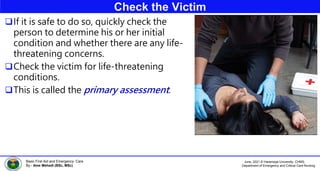
Check the Victim
If it is safe to do so, quickly check the
person to determine his or her initial
condition and whether there are any life-
threatening concerns.
Check the victim for life-threatening
conditions.
This is called the primary assessment.
June, 2021 © Haramaya University, CHMS,
Department of Emergency and Critical Care Nursing
Basic First Aid and Emergency Care
By:- Ame Mehadi (BSc, MSc)
Primary Assessment
Responses of your casualty
Danger your present environment
Airway
Breathing
Circulation
Disability
Exposure
June, 2021 © Haramaya University, CHMS,
Department of Emergency and Critical Care Nursing
Basic First Aid and Emergency Care
By:- Ame Mehadi (BSc, MSc)
Activating EMS 7605
CALL
►the local emergency number.
One of the simplest and most important ways of
providing first aid is to call for help (EMS)
June, 2021 © Haramaya University, CHMS,
Department of Emergency and Critical Care Nursing
Basic First Aid and Emergency Care
By:- Ame Mehadi (BSc, MSc)
Activating Emergency Services 7605
Always Give the Following Information:
►Your name
►Exact location
►Type of incident
►Seriousness of incident
►Number of casualties
►Condition of casualties
►Any hazards
►Description of any injuries
DON'T HANG UP THE PHONE UNTIL
YOU ARE TOLD TO DO SO !
June, 2021 © Haramaya University, CHMS,
Department of Emergency and Critical Care Nursing
Basic First Aid and Emergency Care
By:- Ame Mehadi (BSc, MSc)
CARE
CARE
►For the victim until EMS personnel arrive.
Secondary Survey
Monitor Vital Signs
►Breathing
►Pulse
►Skin Colour
►Temperature
►Level of response
Complete Top to Toe Survey
Complete Definitive
Treatments
June, 2021 © Haramaya University, CHMS,
Department of Emergency and Critical Care Nursing
Basic First Aid and Emergency Care
By:- Ame Mehadi (BSc, MSc)
Secondary Assessment
June, 2021 © Haramaya University, CHMS,
Department of Emergency and Critical Care Nursing
Basic First Aid and Emergency Care
By:- Ame Mehadi (BSc, MSc)
June, 2021 © Haramaya University, CHMS,
Department of Emergency and Critical Care Nursing
Basic First Aid and Emergency Care
By:- Ame Mehadi (BSc, MSc)
Making a Diagnosis Top to Toe Survey
June, 2021 © Haramaya University, CHMS,
Department of Emergency and Critical Care Nursing
Basic First Aid and Emergency Care
By:- Ame Mehadi (BSc, MSc)
External Clues
If casualty is Unconscious
Look for Clues
June, 2021 © Haramaya University, CHMS,
Department of Emergency and Critical Care Nursing
Basic First Aid and Emergency Care
By:- Ame Mehadi (BSc, MSc)
First Aid for Western Wild life?? Emergency medical service in
Africa ??
June, 2021 © Haramaya University, CHMS,
Department of Emergency and Critical Care Nursing
Basic First Aid and Emergency Care
By:- Ame Mehadi (BSc, MSc)
1.3. Principal Aims of First Aid
Generally the 3 P’s of principles of first aid are;
Preserving life
►the principal aim of first aid is to save life,
►it is to make difference between life & death.
►e.g. Rescue breathing.
 Preventing the condition getting worse/complications
►prevent temporary & permanent disabilities
►prevent any further injury.
►e.g. stop bleeding or immobilization of fractured bone etc.
 Promoting recovery healing and recovery
►facilitate rapid recovery & shortens hospitalization.
June, 2021 © Haramaya University, CHMS,
Department of Emergency and Critical Care Nursing
Basic First Aid and Emergency Care
By:- Ame Mehadi (BSc, MSc)
Aims of first Aid
The key aims of first aid includes:
►To recognize life-threatening situations.
►To activate the EMS system.
►To sustain/preserve life – e.g. Artificial respiration, CPR
►To prevent worsening of the problem/complications
 e.g. Immobilizing the fractured bone.
►To prevent disabilities (temporary Vs permanent)
►To prevent any further injury
►To preserve vitality & further resistance. e.g. Control bleeding...
►To provide pain relief e.g. use of ice packs or applying of sling
►To provide reassurances.
►To protect any unconscious victim.
June, 2021 © Haramaya University, CHMS,
Department of Emergency and Critical Care Nursing
Basic First Aid and Emergency Care
By:- Ame Mehadi (BSc, MSc)
1.4. Values of first aid training
June, 2021 © Haramaya University, CHMS,
Department of Emergency and Critical Care Nursing
Basic First Aid and Emergency Care
By:- Ame Mehadi (BSc, MSc)
1.4. Values of first aid training
the need for first aid training is greater than ever due to;
►rising magnitudes of sudden illness & injuries as a result of
1. rapid growth of world population and
2. increased use of technological products such as
 mechanical & electrical appliances
Further, there is growing demand for first aid training/knowledge/skill for ;
►a personal use and to be certified as first-aiders;
►institution as a part of industrial & commercial establishments.
June, 2021 © Haramaya University, CHMS,
Department of Emergency and Critical Care Nursing
Basic First Aid and Emergency Care
By:- Ame Mehadi (BSc, MSc)
… Values of First Aid Training
Why first aid skills for a personal use? Because
►sudden illness & injuries can happen anytime,
 hence basic skills of first aids helps for rescuing, perhaps saving lives and
minimizing injury at events of an urgency.
►you need to use those skills on the job, at home, and elsewhere in the community.
►a better handling of tragic emergencies,
 can make the difference between life and death
 may an event that minimize the need to hospital care
June, 2021 © Haramaya University, CHMS,
Department of Emergency and Critical Care Nursing
Basic First Aid and Emergency Care
By:- Ame Mehadi (BSc, MSc)
Values of first aid training
1. Self-Help:
►Skillful person
 can be able to care for him/herself in case of injury or sudden illness.
 better care for him/herself during emergency.
 Even, his/her she/he can direct others in her/his behalf.
 can direct others in his/her behave, in carrying out correct
procedures to follow if affected and if condition permits.
2. Help for Others:
►it is an obligation on a humanitarian basis to assist the traumatized and
helpless.
►saving life and/or relieve suffering is greater satisfaction
June, 2021 © Haramaya University, CHMS,
Department of Emergency and Critical Care Nursing
Basic First Aid and Emergency Care
By:- Ame Mehadi (BSc, MSc)
Values of first aid training
3. Preparation for Disaster prevention and management:
►Knowing what to do during disaster
►particular importance, when;
 delayed medical services
 limited hospital services
4. Safety Awareness:
►helps others to develop safety awareness and habits that promote safety;
 at home, at work, during recreation, and
 on the streets and highways.
June, 2021 © Haramaya University, CHMS,
Department of Emergency and Critical Care Nursing
Basic First Aid and Emergency Care
By:- Ame Mehadi (BSc, MSc)
1.5. Role and responsibility of First Aider
First aider
►is someone who trained to provide initial emergency
medical care using a limited amount of equipment.
What can first aid provider do?
►can perform primary assessment and intervention while
awaiting arrival of EMS personnel.
Who can be first aid provider?
►is someone with a formal training; including:
 First aider, First responder, Paramedic,
 Police men or fireman;
►or first people on an emergency scene
June, 2021 © Haramaya University, CHMS,
Department of Emergency and Critical Care Nursing
Basic First Aid and Emergency Care
By:- Ame Mehadi (BSc, MSc)
Responsibilities as a First Aider
First Aider expected to
►respond to emergencies that you have been trained to handle
►assess the situation quickly and safely and summon appropriate help
►protect casualties and others at the scene from possible danger
►identify, as far as possible, the nature of illness or injury affecting casualty.
►give each casualty early and appropriate treatment, treating the most serious
condition first.
►arrange for the casualty’s removal to hospital
►remain with a casualty until definitive care or handover
►report his/her observations to those taking care of the casualty, and to give further
assistance if required.
June, 2021 © Haramaya University, CHMS,
Department of Emergency and Critical Care Nursing
Basic First Aid and Emergency Care
By:- Ame Mehadi (BSc, MSc)
Responsibilities of First Aider
 as a First Aider
1. Recognize the emergency.
2. Protect yourself, the ill or injured person, and bystanders.
3. Access help (e.g., call EMS).
4. Act according to your skills, knowledge, and comfort level.
 in the EMS System
1. Recognizing that an emergency exists
2. Deciding to help/take action/willingness to act
3. Activating the EMS system
4. Giving care until EMS personnel take over
June, 2021 © Haramaya University, CHMS,
Department of Emergency and Critical Care Nursing
Basic First Aid and Emergency Care
By:- Ame Mehadi (BSc, MSc)
Rules ...
 Be calm and confident (safety first)
► Calm the injured person
► Give a confidence that you know what you are doing.
 Seek medical attention immediately
 Examine the victim gently and treat the most life-threatening conditions first.
 Handle with care
►Protect from harm – Aware that further injury may happen during caring for victim
 Do not move injured victim.
►Treat the victim on spot unless dangerous to do so.
►Keep the victim lying down
►Keep victim warm & comfortable.
 Do not touch open wounds or burns with fingers
 Avoid allowing a victim to see his own injury
 Keep NPO, for unconscious victims
 Do not try to arouse an unconscious person.
 Continue to watch for changes in the person’s condition.
June, 2021 © Haramaya University, CHMS,
Department of Emergency and Critical Care Nursing
Basic First Aid and Emergency Care
By:- Ame Mehadi (BSc, MSc)
Characteristics of a First Aider
1. Resourceful
►using who ever near to and what ever at hand, to
prevent further damage.
2. Tactful
►without unnecessary questions, understand the
symptoms and history of the case, and secure the
confidence of the causality, and the bystanders in the
Tx of the causality.
3. Dexterous
►handle a causality without causing unnecessary
pain and use appliances efficiently, effectively and
quickly.
4. Explicit
►having clear instruction and clear communication
with the causality and the bystanders.
5. Persevering
►able to continue the efforts,
though not at first successful,
until relieved by other
authorized personnel, or death
of the causality is known.
6. Discriminating
►decide which causality/victim
should be treated first.
7. Sympathetic
►give real comfort and
encouragement to the
suffering, first principles of
humanity.
June, 2021 © Haramaya University, CHMS,
Department of Emergency and Critical Care Nursing
Basic First Aid and Emergency Care
By:- Ame Mehadi (BSc, MSc)
1.6. General directions to provide first aid
Basic plan of action are:
- observe scene upon approach.
- Keep yourself & others at scene safe.
- Gain access to the victim, and determine immediate threats to
life.
/CALL for help.
to those whose lives are threatened (to those most
seriously injured first).
only if necessary
►Arrange for the of the casualty
June, 2021 © Haramaya University, CHMS,
Department of Emergency and Critical Care Nursing
Basic First Aid and Emergency Care
By:- Ame Mehadi (BSc, MSc)
Directions to provide first Aid
The general directions to provide first aid are;
1. Assess the situation quickly and calmly
►Safety –any danger to you or the casualty?
 if yes put on your safety first and deal any danger when it is safe.
►Scene – cause of the accident?
►Situation: What’s happened? Condition of victim?
2. Protect yourself and the victims from any danger
►Only move the victim to safety if leaving them would cause them more harm.
3.Prevent infection between you and the victim
4.Comfort and reassure – make rapport and reassure the victim
June, 2021 © Haramaya University, CHMS,
Department of Emergency and Critical Care Nursing
Basic First Aid and Emergency Care
By:- Ame Mehadi (BSc, MSc)
Directions to provide first aid…
5.Assess the casualty - Start with the primary survey to deal with any
life-threatening conditions
►Use ABCDE approach
6. Provide first aid care
►Prioritize the most life‒threatening conditions then move on to less serious ones
►Get help from others if possible
7.Arrange for the right kind of help – call for ambulance
►Stay with them until you can leave
June, 2021 © Haramaya University, CHMS,
Department of Emergency and Critical Care Nursing
Basic First Aid and Emergency Care
By:- Ame Mehadi (BSc, MSc)
I. Assessing the casualty…
Assessing the casualty (identifying the problem)
►A detailed evaluations is not essential
►Checking for medical alert tags
►Prioritize care
 treat the greatest threat to life first
To assessing - Carryout a rapid primary Survey
►“ABCDE” approach of primary Survey is key to identify life threatening conditions.
Once a life threatening condition is discovered actions should not be
delayed
►If a victim’s condition is instantly life threatening, perform first aid immediately.
June, 2021 © Haramaya University, CHMS,
Department of Emergency and Critical Care Nursing
Basic First Aid and Emergency Care
By:- Ame Mehadi (BSc, MSc)
A) Primary Survey
Most crucial assessment tool in acute illness and injuries care
►About 1-2 minutes is MAX!
►Designed to identify and immediately correct life threatening problems
ACCURATELY
►Establish priorities
►Provide simultaneous interventions.
Po survey often referred as Basic Life Support/BLS
►BLS is maintaining of airway patency, and supporting breathing & circulation without
the use of equipment other than a protective device.
►BLS interventions including CPR (Chest compressions & artificial ventilation)
 can be performed by anyone who knows how to do it, anywhere, immediately,
without any other equipment
June, 2021 © Haramaya University, CHMS,
Department of Emergency and Critical Care Nursing
Basic First Aid and Emergency Care
By:- Ame Mehadi (BSc, MSc)
Primary Survey… Steps of BLS
Steps of Po Survey in basic life support (BLS/ CPR)
1. Approach safely
2. Check for response
3. Shout for help
4. Open airway
5. Check breathing
6. Call for EMS 7605 and ask for AED
7. Provide 30 chest compressions
8. Give 2 rescue breaths
June, 2021 © Haramaya University, CHMS,
Department of Emergency and Critical Care Nursing
Basic First Aid and Emergency Care
By:- Ame Mehadi (BSc, MSc)
Primary Survey…
ABCDEs of care are (Primary survey )
►A Airway (with c-spine protection in trauma)
►B Breathing (with giving ventilation)
►C Circulation (with bleeding control)
►D Disability (checking neurologic status)
►E Exposure (Environmental control)
Always, precede with evaluation of the
►danger (D) and response (R);
►change it to DR- ABCDE method
►follow each step logically, deal with it in order of priority
June, 2021 © Haramaya University, CHMS,
Department of Emergency and Critical Care Nursing
Basic First Aid and Emergency Care
By:- Ame Mehadi (BSc, MSc)
D- Danger
Safety –is first rule of first aid
►is primary concern in first aid
►before starting to provide any care,
 make sure the scene is safe for you, casualty and
any bystanders.
►Assess the scene/situation for presence of any
DANGER;
 Are there any risks to you or the casualty?
►If the incident is too dangerous to approach,
 stay back and call for emergency help.
June, 2021 © Haramaya University, CHMS,
Department of Emergency and Critical Care Nursing
Basic First Aid and Emergency Care
By:- Ame Mehadi (BSc, MSc)
D - DANGER:
If someone needs help, before you go up to them check – is it safe?
No:
►If you can see or hear any danger
nearby, for you or them, like
broken glass or oncoming traffic,
►then make the situation safe before
you get closer
 Yes:
►If you can’t see or hear any
danger then it is safe to go up
to them.
Staying safe is your first priority.
Don’t enter an unsafe situation without proper training and equipment.
If there is no risk, assess the casualty responsiveness(R
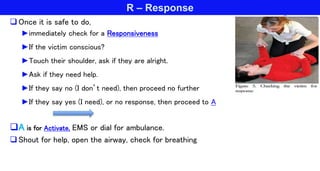
R – Response
Once it is safe to do,
►immediately check for a Responsiveness
►If the victim conscious?
►Touch their shoulder, ask if they are alright.
►Ask if they need help.
►If they say no (I don’t need), then proceed no further
►If they say yes (I need), or no response, then proceed to A
A is for Activate, EMS or dial for ambulance.
Shout for help, open the airway, check for breathing
June, 2021 © Haramaya University, CHMS,
Department of Emergency and Critical Care Nursing
Basic First Aid and Emergency Care
By:- Ame Mehadi (BSc, MSc)
R- RESPONSE:
Do they respond when you ask them:
►‘Are you alright? or if you say: ‘Open your eyes!’
No:
If they don't respond,
 Adult- pinch their ear lobe/ gently
shake shoulder.
 Child, baby ?
 If they still don’t respond, then you
can presume they’re unresponsive
& move on to the next stage 
Airway.
Yes: -
►If they respond by making eye
contact or some gesture with you
then they’re responsive & you
can move on to the next stage 
Airway.
NB- Unresponsive victim should always take priority treat them first & as quickly as
possible.
June, 2021 © Haramaya University, CHMS,
Department of Emergency and Critical Care Nursing
Basic First Aid and Emergency Care
By:- Ame Mehadi (BSc, MSc)
Activating Emergency Medical Services – 7605
Call for help /EMS/ –
►Getting assistance from a companion;
Call a trained person certified in first aid to the
scene or those who have been designated as
emergency first responders, if you can’t handle
yourself.
►if you are alone – determine the seriousness of
the injury and may need to provide immediate
firs aid  then leave victim to call for help/EMS
NB:- Administration of first aid must not delay activation
of the EMS
June, 2021 © Haramaya University, CHMS,
Department of Emergency and Critical Care Nursing
Basic First Aid and Emergency Care
By:- Ame Mehadi (BSc, MSc)
Activating Emergency Medical Services – 7605
How to call for help
►Things you need to remember when making a
call:
 Your name
 The emergency situation
 The location of the emergency
 Condition of the victim
 Number of victims
►If the area is remote/difficult to access,
consider sending someone to meet the
EMS in known location
DON'T HANG UP THE PHONE UNTIL
YOU ARE TOLD TO DO SO !
When to Call EMS
 If unsure whether EMS personnel are needed,
 If there is a danger to you or others, or if the
ill or injured person has any of the following
conditions:
►Unresponsiveness or an AMS(e.g., LOC)
►Difficulty breathing or no signs of breathing
►Persistent chest pain or pressure
►Life-threatening or uncontrollable bleeding
►Seizures
►Abnormal speech
►Injuries to the head, neck, or back
►Blood in the vomit or urine
►An apparent mental health crisis
►Imminent childbirth
 If the ill or injured person is
not easily accessible, or if the
situation involves any of the
following:
►Fire
►An explosion
►A motor vehicle collision
►Hazardous materials
►Downed electrical wires
►Swift-moving water
June, 2021 © Haramaya University, CHMS,
Department of Emergency and Critical Care Nursing
Basic First Aid and Emergency Care
By:- Ame Mehadi (BSc, MSc)
When should EMS be called?
Check the victim for responsiveness.
If they do not respond or if they tell you
that they need help, then contact EMS.
if you suspect that the problem needs
medical attention.
June, 2021 © Haramaya University, CHMS,
Department of Emergency and Critical Care Nursing
Basic First Aid and Emergency Care
By:- Ame Mehadi (BSc, MSc)
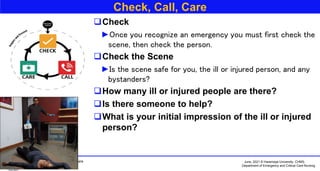
Check, Call, Care
Check
►Once you recognize an emergency you must first check the
scene, then check the person.
Check the Scene
►Is the scene safe for you, the ill or injured person, and any
bystanders?
How many ill or injured people are there?
Is there someone to help?
What is your initial impression of the ill or injured
person?
June, 2021 © Haramaya University, CHMS,
Department of Emergency and Critical Care Nursing
Basic First Aid and Emergency Care
By:- Ame Mehadi (BSc, MSc)
Check, Call, Care
Check the Person (Primary Assessment)
Check the person to see if he or she is responsive:
►Does the person respond when you talk to him or her (e.g., does
the person open his or her eyes, move, moan, or talk to you)?
►Does the person respond when tapped on the shoulder?
►A person who does not respond at all is considered to be
unresponsive.
Check the person’s ABCs: Airway, Breathing, and
Circulation
Checking the ABCs is a rapid assessment and should be
done as quickly as possible.
June, 2021 © Haramaya University, CHMS,
Department of Emergency and Critical Care Nursing
Basic First Aid and Emergency Care
By:- Ame Mehadi (BSc, MSc)
Call First or Care First
The emergency action steps: CHECK—CALL—CARE will guide your
actions in any emergency.
If you are in a situation in which you are the only person other than the
victim, you must make a decision to Call First or Care First:
►Call First situations are generally cardiac-related emergencies.
►Care First situations are usually breathing-related emergencies.
June, 2021 © Haramaya University, CHMS,
Department of Emergency and Critical Care Nursing
Basic First Aid and Emergency Care
By:- Ame Mehadi (BSc, MSc)
If You Are Alone: Call First or Care First?
Call first in the following situations:
►The person has life-threatening bleeding
►The person is an unresponsive child or baby who is not breathing.
►An unconscious adult victim or adolescent age 12 years or older.
►An unconscious infant or child whose sudden collapse was witnessed.
►An unconscious infant or child known to be at a high risk for heart problems.
Care First provide 2 minutes of care, then call EMS for:
►An unconscious victim <12 yrs whose collapse was not witnessed.
►Any victim of drowning.
June, 2021 © Haramaya University, CHMS,
Department of Emergency and Critical Care Nursing
Basic First Aid and Emergency Care
By:- Ame Mehadi (BSc, MSc)
A = Check the Airway
Your first job is to make sure the person has an open airway.
The airway is the pathway that connects the mouth and nose to the lungs.
If it is closed or blocked, air cannot get in.
The airway is most commonly blocked by the tongue.
If the person is speaking, moaning, or crying, the person’s airway is open.
If the person is unresponsive, perform a head-tilt/chin-lift.
The head-tilt moves the back of the tongue away from the airway, and the chin-lift
opens the epiglottis.
Before opening the airway (check) for any obstructions and remove (clear) them if
possible.
By tilting the head back and lifting the chin forward, the tongue is drawn away
(open) from the back of the throat.
Suspected Spinal injuries will differ, majority are conscious.
In an unconsciousness casualty the tongue may fall back to block the airway.
June, 2021 © Haramaya University, CHMS,
Department of Emergency and Critical Care Nursing
Basic First Aid and Emergency Care
By:- Ame Mehadi (BSc, MSc)
A - Airway
check airway for patency.
►Is the victim able to communicate verbally?
►Inspect for any foreign bodies
►Look for stridor, gurgling, pooled secretions or blood
►sweep the mouth to remove any visible object.
 Using your finger or cloths
►If this fails, then perform the abdominal thrusts.
►Performing the Head-Tilt/Chin-Lift
Assume cervical (C-spine) injury in patients with
multiple trauma
►C- spine protection should remain in place
How to assess & open the airway?
… Airway:
Is their airway open and clear?
No:
►Responsive: If they’re responsive, yet
blocked airway treat (e.g. choking)
►Unresponsive: tilt their head and lift their
chin to open their airway.
Yes:
►If the airway is open and clear, move
on to the next stage – Breathing.
 NB 
►Only move on to the next stage –
once their airway is open and clear.
June, 2021 © Haramaya University, CHMS,
Department of Emergency and Critical Care Nursing
Basic First Aid and Emergency Care
By:- Ame Mehadi (BSc, MSc)
A = Check the Airway
Performing the Head-Tilt/Chin-Lift
►To perform a head-tilt/chin-lift, place one hand on the person’s forehead and 2 or
3 fingers under the chin.
►Gently tilt the head back until the chin is pointing upward.
© 2019, Jimma University
School of Nursing and Midwifery.
Basic First Aid and Emergency Care
By:- Ame Mehadi (BSc, MSc) 89
HU, CHMS Department of ECCN
89 Airway
OPEN
AIRWAY
89
June, 2021 © Haramaya University, CHMS,
Department of Emergency and Critical Care Nursing
Basic First Aid and Emergency Care
By:- Ame Mehadi (BSc, MSc)
… Airway techniques
Head-tilt/Chin-lift Maneuver Jaw-thrust Maneuver
June, 2021 © Haramaya University, CHMS,
Department of Emergency and Critical Care Nursing
Basic First Aid and Emergency Care
By:- Ame Mehadi (BSc, MSc)
B = Check Breathing
Next, check for breathing.
Someone who can speak or cry is breathing.
Check for normal breathing for 5 to 10
seconds.
To assess breathing, put your cheek close to
the person’s face so that you can hear and feel
air coming out of the person’s nose and mouth
while you watch the chest rising and falling.
A person is breathing normally if air is moving
in and out of the lungs and the chest is rising
and falling in a normal, regular pattern.
June, 2021 © Haramaya University, CHMS,
Department of Emergency and Critical Care Nursing
Basic First Aid and Emergency Care
By:- Ame Mehadi (BSc, MSc)
B- Breathing
Airway patency alone does not ensure adequate
ventilation
Look, listen and feel for breathing (LLF).
►Look – for chest movement
 by watching the chest and placing your cheek a
few inches above the mouth of the victim to sense
any mov’t of air.
►Listen – air movement
►Feel – for incoming air
►If the victim is breathing, place in recovery position
and deal for ambulance
►If the victim is not breathing, the head may need
repositioning.
© 2019, Jimma University
School of Nursing and Midwifery.
Basic First Aid and Emergency Care
By:- Ame Mehadi (BSc, MSc) 93
HU, CHMS Department of ECCN
93 Breathing
IF ABSENT BREATHE FOR YOUR CASUALTY !
93
Look, Listen & Feel up to 10 seconds
June, 2021 © Haramaya University, CHMS,
Department of Emergency and Critical Care Nursing
Basic First Aid and Emergency Care
By:- Ame Mehadi (BSc, MSc)
Recovery position
B- Breathing …
Are they breathing normally?
No  Unresponsive:
►If they’re unresponsive and not breathing,
call EMS or get someone else to call if
possible, and start giving chest
compressions and rescue breaths (CPR)
►If this happens you won’t move on to the
next stage as casualty needs CPR
No  Responsive:
►If they’re conscious, treat them for
whatever is stopping them breathing,
for example, an obstructed airway.
Yes  breathing
►If they are breathing normally, move
on to the next stage – circulation.
Breathing …
No - Breathing Interventions
Unresponsive:
►start giving artificial ventilation
►chest compressions and rescue breaths
/CPR
chest compressions & rescue breaths
Artificial ventilation
C- Circulation:
check pulse
►If no pulse start CPR.
►the carotid artery is best place to check a pulse
quickly looking at the person from head to toe for signs of life-
threatening external bleeding.
Are there any signs of severe bleeding?
Yes:
►If there is severe bleeding, control
the bleeding with your gloved
fingers, dressing or clothing, call
EMS and treat them to reduce the
risk of shock.
No:
►If not bleeding, and you’re
sure you have dealt with any
life-threatening conditions,
then you can move on to the
disability.
June, 2021 © Haramaya University, CHMS,
Department of Emergency and Critical Care Nursing
Basic First Aid and Emergency Care
By:- Ame Mehadi (BSc, MSc)
… Circulation Interventions
Hemorrhagic shock should be assumed in any
hypotensive trauma patient
►Check for skin color and check pulses in four
extremities (for rate and strength)
Controlling of External Hemorrhage
►Apply direct pressure to sites of bleeding
►Elevation
►Compression of pressure points (arteries, veins)
►AVOID tourniquets…can compromise loss of
circulation and loss of limb
June, 2021 © Haramaya University, CHMS,
Department of Emergency and Critical Care Nursing
Basic First Aid and Emergency Care
By:- Ame Mehadi (BSc, MSc)
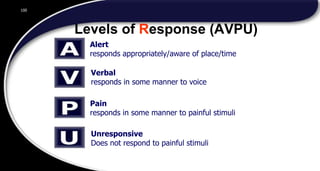
D- Disability
Disability is all about neurological conditions
►Check level of consciousness –
 Level of consciousness
 Motor and sensory function
►abbreviated neurological status
 AVPU or GCS (Glasgow coma scale)
 Utilized to determine severity of injury
►Never offer any fluid (anything) orally for unconscious or victims with altered
mentation
►Immobilize the victim
 If spinal cord injury or Pelvic Fractures ???
© Business & Legal Reports, Inc. 1110
HU, CHMS Department of ECCN 100
Alert
responds appropriately/aware of place/time
Verbal
responds in some manner to voice
Pain
responds in some manner to painful stimuli
Unresponsive
Does not respond to painful stimuli
Levels of Response (AVPU)
100
June, 2021 © Haramaya University, CHMS,
Department of Emergency and Critical Care Nursing
Basic First Aid and Emergency Care
By:- Ame Mehadi (BSc, MSc)
Obvious Signs of Death
Obvious signs of death include:
►Torso transection (torso cut into two pieces)
►Decapitation (detached head)
►Decomposition
If you encounter a person with one or more of these signs, call EMS and
follow the dispatcher’s instructions.
Leave the body and scene exactly as they were found, as the area could be
considered a crime scene.
June, 2021 © Haramaya University, CHMS,
Department of Emergency and Critical Care Nursing
Basic First Aid and Emergency Care
By:- Ame Mehadi (BSc, MSc)
E- Exposure
Expose the victims
►Completely undress the victim
►Logroll to inspect back
►Warm blankets/external warming device to prevent hypothermia
giving comfort measures… pain control, reassurance to causality
inspect for hidden injuries-log roll patient to inspect posterior aspect.
June, 2021 © Haramaya University, CHMS,
Department of Emergency and Critical Care Nursing
Basic First Aid and Emergency Care
By:- Ame Mehadi (BSc, MSc)
Always Inspect the Back
June, 2021 © Haramaya University, CHMS,
Department of Emergency and Critical Care Nursing
Basic First Aid and Emergency Care
By:- Ame Mehadi (BSc, MSc)
Secondary Survey
Monitor Vital Signs
►Breathing
►Pulse
►Skin Colour
►Temperature
►Level of response
Complete Top to Toe Survey
Complete Definitive Treatments
© 2019, Jimma University
School of Nursing and Midwifery.
Basic First Aid and Emergency Care
By:- Ame Mehadi (BSc, MSc) 105
HU, CHMS Department of ECCN
105 Making a Diagnosis
105
© 2002 Abertay Nationwide Training
© 2019, Jimma University
School of Nursing and Midwifery.
Basic First Aid and Emergency Care
By:- Ame Mehadi (BSc, MSc) 106
HU, CHMS Department of ECCN
106 Top to Toe Survey
Sequence of examination.
3. Chest
1. Head
8. Lower Limbs
2. Neck
7. Pelvis Lower Back
6. Abdomen
5. Upper Limbs
4. Shoulders
106
© 2002 Abertay Nationwide Training
© 2019, Jimma University
School of Nursing and Midwifery.
Basic First Aid and Emergency Care
By:- Ame Mehadi (BSc, MSc) 107
HU, CHMS Department of ECCN
107 External Clues
If casualty is Unconscious
Look for Clues
107
© 2002 Abertay Nationwide Training
II. Moving the victim
 When to Move a victim/an Injured Person?
 Move an ill or injured person only if:
►The person’s position stops you from giving care for a life-threatening injury or illness.
►The person is blocking access to someone with a more serious injury or illness.
►only if absolutely necessary to prevent further injury from a hazard at the scene.
►The scene is becoming unsafe.
 RECOVERY POSITION
►For people who are unconscious, or semiconscious, but are still breathing.
►If there are spinal or neck injuries, do not attempt to place the casualty in the recovery position.
►NOTE: Leaving the victim in this position for long periods may cause them to experience nerve
compression.
 Conduct frequent reassessment of victims conditions while considering for transfer or
transporting
III. Transport of victims
 The time from injury to definitive care
is a determinant of survival,
particularly those with major internal
hemorrhage.
 Careful attention must be given to the
airway with cervical spine
immobilization, breathing and
circulation. (ABC’s)
►How is it decided?
♫ Travel time
♫ Topography
♫ Availability of air or ground
transport
♫ Capability of personnel
♫ Weather
What if Non-accidental injuries?
Key is SUSPICION!!!
Incongruent stories of mechanisms of injury
Delay in seeking help
Multiple stages of injuries
Patterns of Injuries
►Injury mechanism beyond the scope of the age of child (6week old rolled over off the
bed)
►Bite marks, submersion injury, cigarette burns
Priority (Hurry) cases
Airway
►Airway blockage
Breathing
►Stoppage of Breathing
►(respiratory arrest)
Circulations
►Severe Bleeding
►Heart attack
►Shock, and Fainting
Disability
►Fracture
►Burns and Scalds
►seizures
►Poisoning – (including ingested &
injected poisons / snake bite).
HU, CHMS Department of ECCN
112
Immediate Care Conditions
• Lack of Airway
• Lack of Breathing
• Lack of Pulse
• Suspected Spinal Injury
• Shock
112
© 2002 Abertay Nationwide Training
HU, CHMS Department of ECCN
113
Life Threatening Conditions
• Asphyxia
• Bleeding
• Cardiac arrest
• Shock
113
© 2002 Abertay Nationwide Training
Priority Interventions
Ensure patent airway
Maintaining adequate ventilation
Adequate gas exchange
Then:
►Control bleeding,
►restore tissue perfusion
HU, CHMS Department of ECCN
115
Treatment Priorities
• A B C
• Maintain airway (Recovery position)
• Bleeding
• Treat large wounds and burns
• Immobilise bone and joint injuries
• Other injuries/Conditions
• Regularly monitor casualty ABC
115
© 2002 Abertay Nationwide Training
Precautions …
While caring for ABCs Infectious Disease issues ….
Safety is first priority.
Case scenario
A young man involved in a high speed motorcycle accident. He was not
wearing a helmet. He is response status, is drowsy but arousable to voice.
He has large bleeding from scalp, obvious deformity to Left ankle
►What are the intervention priorities at this time?
►What are the interventions that need to happen now?
Summary
First aid is temporary, immediate care for
a person who is injured or who becomes suddenly ill.
►It does not replace care of a physician, or professional
A primary principle is to assure safety and activate the EMS system.
There is increasing needs to first aid trainings
Care should always be provided to the most seriously injured victims first.
Follow primary survey steps (ABCDE)
Staying safe is your first priority.
PRINCIPLES OF ACCIDENT PREVENTION
Section II
Introduction
Definitions
►Accident is unfortunate harm or injury that results in psychological or physical
damage or hurt; and subsequent alterations in health and lifestyle
Traumatic injuries –
►are injuries that occur as a result of energy transfer from external source to human
body
Accident proneness
Certain personality characteristics and other several factors can predispose
to accidents
►Accident proneness is a tendency toward involvement in accidents; are factors
affecting safety
Personal safety is influenced by several factors:
►Age, - adolescents are more prone
►sensory & perceptual alterations, (elders)
►lifestyle,
►mobility, and emotional state.
Traumatic injuries
Classifications, based on
►Severity of injury
►Causes of injury
►Mechanisms of injury
Mechanisms of injury as
►Is vital to the initial assessment and may
raise suspicions about the patients injury
pattern.
►Blunt vs. Penetrating trauma
►Causes of injury
♫ Intentional Vs Unintentional
►Severity of injury
♫ Minor Vs Major trauma
Extent of the injury is determined
by
♫ Type of energy applied
♫ How quickly it is applied
♫ To what part of the body it is applied
HU, CHMS Department of ECCN
123
Road Traffic Accidents
Make the accident site safe
123
© 2002 Abertay Nationwide Training
Speed Kills
HU, CHMS Department of ECCN
124
Multiple Casualties
Assess Danger
Remove Danger
Assess Casualties responses
Assess Casualties A.B.C
4 X B’s
124
© 2002 Abertay Nationwide Training
Trauma severity ….
Minor trauma
 single system injury that does not
pose threat to life or limb and can be
appropriately treated at a basic
emergency care .
Major trauma
 serious multisystem injuries that require
immediate intervention to prevent
disability.
 The major causes of death following accidents (trauma) are head injury, chest
injury, and major vascular injury.
Distributions of Deaths and prevention approach
Peak Environment Injuries Approaches to Reduce Mortality
First
peak
Instantly at Pre-
hospital(golden
hour)
Devastating head
and vascular
injuries
Comprehensive injury prevention
program:
Safe road construction
Seat belt, helmet, drunk driving laws
Handgun control
Violence prevention
Second
peak
Minutes to Hrs
after hospital
arrival
Major head, chest,
and abdominal
injuries
Rapid transport to appropriate hospital,
prompt resuscitation and identification of
injuries needing surgical intervention
Third
peak
occurs several
days to weeks
most often the
result of sepsis
and multiple organ
failure.
At this stage, outcomes are affected by
care previously provided.
Injury prevention ….
is an effort to prevent or reduce the severity of bodily injuries caused by
external mechanisms, such as accidents, before they occur.
is a component of safety and public health, and its goal is to improve the
health of the population by preventing injuries and hence improving quality
of life.
safety interventions has demonstrated that its techniques are effective in reducing
accident rates and promoting efficiency.
Injury prevention…
Injury prevention can be directed at human factors (behavioral issues),
vectors of injury, and/or environmental factors and implemented according
to the four Es of injury prevention
►Education
►Enforcement
►Engineering
►Economics (incentives)
Recently added E’s - evaluation and empowerment.
Injury prevention …
Prevention can be considered as primary, secondary or tertiary.
►Primary prevention refers to elimination of the trauma incident completely.
►Secondary prevention recognizes that an injury may occur but serves to reduce the
severity of the injury sustained.
►Tertiary prevention involves reducing the consequences of the injury after it has
occurred.
Common types of injury prevention
Traffic and automobile safety - are a major component of injury prevention.
►Engineering: vehicle crash worthiness, seat belts, airbags, locking seat belts for child
seats.
►Education: promote seat belt use, discourage impaired driving, promote child safety
seats.
►Enforcement and enactment: passage and enforcement of primary seat belt laws,
speed limits, impaired driving enforcement
Pedestrian safety - is the focus of both epidemiological and psychological
injury prevention
Cont’d…
Bicycle safety
Boat and water safety
Child passenger safety
Consumer product safety
Firearm safety
Fire and burn safety
Home safety
3.Others - The following are some common focus areas of injury
prevention efforts:
GENERAL SAFETY RULES TO PREVENT ACCIDENTS AND OTHER EMERGENCIES
General Safety Rules
Walk in halls and on stairs - never
run
Keep to the right-hand side of the
hall
Approach swinging doors with
caution
Use handrails going up and down
stairs
Keep halls and stairs free of
obstacles
Check labels on all containers
prior to using contents
General Safety Rules
Pick up litter and place it in the
proper container
Follow instructions of your
supervisor for resident care
Report injuries promptly
Never use damaged or frayed
electrical cords
Ask for an explanation of things you
don’t understand
Wipe up spilled liquids immediately
General Safety Rules
Elevate side rails for residents at risk of
falling, per facility policy
Check linen for personal items
contained in folds prior to sending to
the laundry
Never use malfunctioning equipment
Report unsafe conditions immediately
Elevate side rails for residents
at risk of falling
HU, CHMS Department of ECCN
136
Self Protection
ALWAYS
WEAR GLOVES
When dealing with blood or body fluids
136
© 2002 Abertay Nationwide Training
HU, CHMS Department of ECCN
137
Staying Safe during First Aid
• Blood and Bodily Fluid
– HIV
– Hepatitis B
– Always
wear protective gloves and goggles
when dealing with blood and body fluids
• Environmental Hazards
– Traffic
– Electrical Wires
– Gas Leak
137
© 2002 Abertay Nationwide Training
June, 2021 © Haramaya University, CHMS,
Department of Emergency and Critical Care Nursing
Basic First Aid and Emergency Care
By:- Ame Mehadi (BSc, MSc)
When to Stop Giving Care
Once you begin providing care to an injured or ill person, you must continue
to give the appropriate care until:
►Another trained First Aider or EMS personnel takes over.
►You are too exhausted to continue.
►The scene becomes unsafe.
June, 2021 © Haramaya University, CHMS,
Department of Emergency and Critical Care Nursing
Basic First Aid and Emergency Care
By:- Ame Mehadi (BSc, MSc)
End the
First Aid for Western Wild life?? Emergency medical service in
Africa ??

Introduction to general First Aid

  • 1.
    June, 2021 ©Haramaya University, CHMS, Department of Emergency and Critical Care Nursing Basic First Aid and Emergency Care By:- Ame Mehadi (BSc, MSc) HARAMAYA UNIVERSITY Collage of Health & Medical Sciences School of Nursing & Midwifery Department of Emergency & Critical Care Nursing FIRST AID & ACCIDENT PREVENTION BY AME M. (BSc, MSc) ECCN Lecturer BEC and PoNT Trainer 1
  • 2.
    June, 2021 ©Haramaya University, CHMS, Department of Emergency and Critical Care Nursing Basic First Aid and Emergency Care By:- Ame Mehadi (BSc, MSc) INTRODUCTION TO BASIC FIRST AID TRAINING
  • 3.
    June, 2021 ©Haramaya University, CHMS, Department of Emergency and Critical Care Nursing Basic First Aid and Emergency Care By:- Ame Mehadi (BSc, MSc) Basic First Aid
  • 4.
    Case scenario Formulate agroup, read the following case scenario and reflect your idea to the questions provided. ►You are arriving at the following accident scene just alone.
  • 5.
    … scenario The questions; ►Whatis your immediate action that should you do? ►What is the most important interventions that did you think in this scenario? ►What kinds of injury you may suspect to occur to the indicated passenger? ►What SHOULD YOU take to such accident scene always?
  • 6.
    Think!!! What knowledge andskills you will acquire from this course?
  • 7.
    June, 2021 ©Haramaya University, CHMS, Department of Emergency and Critical Care Nursing Basic First Aid and Emergency Care By:- Ame Mehadi (BSc, MSc) Learning Objectives At the end of this lesson student will be able to; ►define first aid ►explain responsibilities of first aider ►explain values for first aid training ►determine the purposes and principles of first aid ►discus general directions to provide first aid ►discuss priority measures for any patient with an emergency situation. ►identify basic first aid equipment ►describe principles of accident prevention
  • 8.
    June, 2021 ©Haramaya University, CHMS, Department of Emergency and Critical Care Nursing Basic First Aid and Emergency Care By:- Ame Mehadi (BSc, MSc) Introduction Human populations are rapidly growing. As a results ►disturbances in environmental conditions & habits happening, this leads to;  rising occurrence of natural & man-made disasters ►there is an alterations in natural resource consumptions and land usage taking place.  leads to rising conflicts & violence among people ►there is an advancement in technologies and increased use of its products also occurring.  leads to rising amount of injuries/illness as a systems made by human itself become out of his control Thus more peoples facing a sudden injuries and acute illness
  • 9.
    June, 2021 ©Haramaya University, CHMS, Department of Emergency and Critical Care Nursing Basic First Aid and Emergency Care By:- Ame Mehadi (BSc, MSc) Introduction…
  • 10.
    June, 2021 ©Haramaya University, CHMS, Department of Emergency and Critical Care Nursing Basic First Aid and Emergency Care By:- Ame Mehadi (BSc, MSc) Introduction: The need for emergency care Statistics shows that ►incidence of accidental injuries and acute illness is raising. The raising burdens of accidental injuries and acute illness leads to; ►Increasing the annual cost of medical attention, ►the loss of earning ability due to temporary or permanent impairment, ►the direct property damage costs billions of dollars each year ►the toll in pain, suffering, disability, and personal tragedy.
  • 11.
    June, 2021 ©Haramaya University, CHMS, Department of Emergency and Critical Care Nursing Basic First Aid and Emergency Care By:- Ame Mehadi (BSc, MSc) Introduction…… Definitions: First aid ►is the provision of immediate assistance or an initial care given to a victim with an injury or sudden illness before a person gets expert medical help, usually using locally available materials or materials at hand. ►is a temporary and immediate care given to an injured or suddenly ill person before the arrival of emergency medial care. ►is helping behavior & initial care:- it includes well‒ selected words of encouragement, sign of willingness to help and promotion of self‒confidence A first aider – is someone with a formal training ►or first people on an emergency scene
  • 12.
    June, 2021 ©Haramaya University, CHMS, Department of Emergency and Critical Care Nursing Basic First Aid and Emergency Care By:- Ame Mehadi (BSc, MSc) Introduction…… Further first Aid ►is skilled application of accepted principle of treatment on the occurrence of accident or sudden illness. ►includes home or work place based care ►doesn't replace definitive care by professionals ►can save lives in the critical time:‒ only given for life‒and‒death situations ►can also prevent an injury or illness from becoming worse and provide comfort and reassurance to a casualty ►can be performed by a bystander or by victim ►is both preventing and treating sudden illness or injury. ►is caring for large numbers of causalities in a natural disaster.
  • 13.
    June, 2021 ©Haramaya University, CHMS, Department of Emergency and Critical Care Nursing Basic First Aid and Emergency Care By:- Ame Mehadi (BSc, MSc) RESPONDING TO EMERGENCIES
  • 14.
    June, 2021 ©Haramaya University, CHMS, Department of Emergency and Critical Care Nursing Basic First Aid and Emergency Care By:- Ame Mehadi (BSc, MSc) Responding to Emergencies Has the following basic steps: 1. Preparing to Respond 2. Recognizing that an Emergency Exists 3. Willingness to Act 4. Approach and Action – responding
  • 15.
    June, 2021 ©Haramaya University, CHMS, Department of Emergency and Critical Care Nursing Basic First Aid and Emergency Care By:- Ame Mehadi (BSc, MSc) 1. Preparing to Respond have a first aid kit and supplies that will help respond to an emergency, make sure first aid kit is easy accessible, make sure the first aid kit has all of the items that may need, perform regular maintenance and safety checks on all first aid kits and equipment. Remove and/or replace any broken, expired, discolored, or contaminated items. ► e.g., a sterile tool in a torn package. decontaminate any reusable equipment that has been used.
  • 16.
    June, 2021 ©Haramaya University, CHMS, Department of Emergency and Critical Care Nursing Basic First Aid and Emergency Care By:- Ame Mehadi (BSc, MSc) 1. Preparing to Respond…… Preparing For Emergencies at Home ►Keep important information in a handy place. ►Post the numbers of the police, fire dep’t & EMS in the home and save these numbers in your mobile phone’s contacts list. ►Teach children how to call for help. ►Keep first aid kits handy in your home and car. ►Make sure everyone in the family knows where they are and what is in them. ►Review and practice the first aid skills that you learn so that you will have the confidence and knowledge to respond in an emergency.
  • 17.
    June, 2021 ©Haramaya University, CHMS, Department of Emergency and Critical Care Nursing Basic First Aid and Emergency Care By:- Ame Mehadi (BSc, MSc) 1. Preparing to Respond…… Preparing For Emergencies ►Keep important information. ►Keep medical and insurance records. ►Find out a local emergency telephone number; Keep it listed/posted and saved in the contact list. ►Keep a first aid kit readily available. ►Learn and stay up to date on first aid and CPR skills.
  • 18.
    June, 2021 ©Haramaya University, CHMS, Department of Emergency and Critical Care Nursing Basic First Aid and Emergency Care By:- Ame Mehadi (BSc, MSc) 1. Preparing to Respond…… The best way to prepare for emergencies is ►to be certified in first aid basic skills such as;  Airway & respiratory intervention  Cardiopulmonary resuscitation (CPR)  Bleeding control and special wound care  Stabilization of injuries and splinting of fractures Hence, first aid training should be universal: ►everyone can/should learn and ►everyone should give first aid
  • 19.
    June, 2021 ©Haramaya University, CHMS, Department of Emergency and Critical Care Nursing Basic First Aid and Emergency Care By:- Ame Mehadi (BSc, MSc) 2. Recognizing that an Emergency Exists sometimes it is obvious that an emergency exists. e.g, ►a scream or cry for help, ►an unpleasant or unusual odor, or ►the sight of someone bleeding severely or ►lying motionless on the ground But other times, the signs of an emergency may be more subtle, such as ►a slight change in a person’s normal appearance or behavior, or ►an unusual silence.
  • 20.
    June, 2021 ©Haramaya University, CHMS, Department of Emergency and Critical Care Nursing Basic First Aid and Emergency Care By:- Ame Mehadi (BSc, MSc) 2. Recognizing an Emergency……. Signs of an Emergency UNUSUAL ODORS ►A foul or unusually strong chemical odor ►The smell of smoke ►The smell of gas ►An unrecognizable odor ►An inappropriate odor  e.g., a sickly-sweet odor on a person's breath UNUSUAL SOUNDS ►Screaming, moaning, shouting, or calls for help ►Sudden loud noises such as breaking glass, clashing metal, or screeching tires ►A change in the sound made by machinery or equipment ►An unusual silence
  • 21.
    June, 2021 ©Haramaya University, CHMS, Department of Emergency and Critical Care Nursing Basic First Aid and Emergency Care By:- Ame Mehadi (BSc, MSc) 2. Recognizing an Emergency……. Signs of an Emergency UNUSUAL SIGHTS ►A stopped vehicle on the roadside or a car that has run off of the road ►Downed electrical wires ►Sparks, smoke, or fire ►A person who suddenly collapses or is lying motionless ►S/Sx of illness or injury, such as profuse sweating for no apparent reason or an uncharacteristic skin color. UNUSUAL BEHAVIORS ►Confusion in a person who is normally alert ►Unusual drowsiness ►Personality or mood changes  e.g., agitation in a person who is normally calm
  • 22.
    June, 2021 ©Haramaya University, CHMS, Department of Emergency and Critical Care Nursing Basic First Aid and Emergency Care By:- Ame Mehadi (BSc, MSc) 3. Willingness to Act Sometimes people don’t want to get involved in an emergency. The four most common reasons are: A. The Bystander Effect B. Unpleasant injuries or illnesses C. Catching a disease D. Doing something wrong, or causing more harm
  • 23.
    June, 2021 ©Haramaya University, CHMS, Department of Emergency and Critical Care Nursing Basic First Aid and Emergency Care By:- Ame Mehadi (BSc, MSc) A. The Bystander Effect: thinking others can take care of the emergency, if there are other people at the scene. However, never assume someone has taken action and is providing first aid just because there is a lot of people. Remember that there are many important jobs that you can do. You can help control the crowd, direct the actions of bystanders, call EMS, get supplies, or provide care to the ill or injured person. If you are unsure of what to do, ask others at the scene how you can help.
  • 24.
    June, 2021 ©Haramaya University, CHMS, Department of Emergency and Critical Care Nursing Basic First Aid and Emergency Care By:- Ame Mehadi (BSc, MSc) B. Unpleasant injuries or illnesses: Some people may feel faint, up set, or nauseated when they see blood, vomit, or visible injuries. If this happens to you, close your eyes or turn away for a moment and take a few deep breaths to calm yourself before you deal with the situation. If you are still unable to give care, you can volunteer to help in other ways, such as by calling EMS and bringing necessary equipment and supplies to the scene.
  • 25.
    June, 2021 ©Haramaya University, CHMS, Department of Emergency and Critical Care Nursing Basic First Aid and Emergency Care By:- Ame Mehadi (BSc, MSc) C. Catching a disease: You might be concerned that performing first aid will put you at risk of infection, but there are many ways to reduce this risk. If you take simple precautions to limit contact with the ill or injured person— such as wearing gloves and using a CPR breathing barrier—you can limit the possibility of catching a disease. ►Remember that EMS personnel provide care for ill and injured people every day without incident.
  • 26.
    June, 2021 ©Haramaya University, CHMS, Department of Emergency and Critical Care Nursing Basic First Aid and Emergency Care By:- Ame Mehadi (BSc, MSc) D. Doing something wrong, or causing more harm: afraid of being sued if make a mistake. don’t worry, as long as you act reasonably. All countries have laws to protect bystanders who give emergency help. Getting trained in first aid can give you confidence, knowledge and skills you need to respond appropriately to an emergency. Do not act beyond your level of qualifications Use your good judgment and stay within the realm of the skills in which you were trained. Once start giving first aid, keep providing until EMS personnel arrive. If unsure of what to do, call EMS & follow EMS dispatcher’s instructions. The most harmful thing you can do is to do nothing at all. Thinking about these things now and mentally preparing yourself for an emergency will help you overcome your fears.
  • 27.
    June, 2021 ©Haramaya University, CHMS, Department of Emergency and Critical Care Nursing Basic First Aid and Emergency Care By:- Ame Mehadi (BSc, MSc) Legal Issues Around First Aid Good Samaritan Laws ►protect First Aiders from financial liability, ►developed to encourage people to help others in emergency situations. ►assume a First Aider will do his/her best to save a life or prevent further injury. ►require the First Aider to use common sense and a reasonable level of skill, as well as to give only the type of emergency care that is within his/her training. ►usually protect First Aiders who act in the same manner as a "reasonable and prudent person" would in the same situation.
  • 28.
    June, 2021 ©Haramaya University, CHMS, Department of Emergency and Critical Care Nursing Basic First Aid and Emergency Care By:- Ame Mehadi (BSc, MSc) Legal Issues …… Good Samaritan Laws …… ►For example, a reasonable and prudent person would:  Move a person only if the person’s life was in danger.  Ask for permission to help (consent) before giving care • a responsive person (or the parent, guardian, or care giver of a child or baby)  Check a person for life-threatening conditions before giving further care.  Call EMS.  Continue to give care until more highly trained personnel take over. Good Samaritan laws may not protect the First Aider, ►If a First Aider’s actions are grossly negligent or reckless, or ►if the First Aider abandons the person after starting care.
  • 29.
    June, 2021 ©Haramaya University, CHMS, Department of Emergency and Critical Care Nursing Basic First Aid and Emergency Care By:- Ame Mehadi (BSc, MSc) Legal Issues ……… Getting Permission to Help ►Once you decide to act, you need to get the ill or injured person’s permission (also known as consent) to assist. ►To get permission: 1. Tell the person who you are. 2. Tell the person that you are here to help. 3. Ask the person if that is okay. ►If a baby or a child is ill or injured:  Ask the parent, guardian, or caregiver for permission.  If the child or baby is alone, you can assume you have permission to give first aid.
  • 30.
    June, 2021 ©Haramaya University, CHMS, Department of Emergency and Critical Care Nursing Basic First Aid and Emergency Care By:- Ame Mehadi (BSc, MSc) Special Situations The Person is ►unresponsive/confused, or ►has a mental impairment or ►a child/baby (if parent, guardian, or caregiver not present) the law assumes the person would give permission if he/she were able to do so. ►This is called implied consent.
  • 31.
    June, 2021 ©Haramaya University, CHMS, Department of Emergency and Critical Care Nursing Basic First Aid and Emergency Care By:- Ame Mehadi (BSc, MSc) Special Situations If the Person Refuses Care ►You must honor the person’s wishes. ►Explain to the person why you believe care is necessary, but do not touch or give care to the person, and never attempt to give the person help by force. ►Remember, you should never put yourself in any danger. ►Stay nearby, if possible, in case the person later decides to accept your help or becomes unresponsive. ►If you believe the condition is life-threatening, call EMS & communicate that s/he requires medical assistance but is refusing help. ►The EMS personnel who arrive will deal with the situation. ►If the person gives consent initially but then withdraws it, stop giving care and call EMS if you have not already done so.
  • 32.
    June, 2021 ©Haramaya University, CHMS, Department of Emergency and Critical Care Nursing Basic First Aid and Emergency Care By:- Ame Mehadi (BSc, MSc) Special Situations You and the Person Do Not Speak the Same Language ►Find out if someone else at the scene can serve as a translator. ►If a translator is not available, do your best to communicate with the person by using gestures and facial expressions. ►When you call EMS, explain that you are having difficulty communicating with the person, and tell the dispatcher which language you believe the person speaks.
  • 33.
    June, 2021 ©Haramaya University, CHMS, Department of Emergency and Critical Care Nursing Basic First Aid and Emergency Care By:- Ame Mehadi (BSc, MSc) Special Situations Duty to Report Child Abuse or Neglect ►a legal duty to report child abuse or neglect to child protection and/or police.  if you think a child is being harmed, ►Even if you are unsure, child protection needs to be informed and needs to guide the next steps. ►Also share your concerns with the EMS personnel who respond to the situation. Responding to Disclosures of Violence
  • 34.
    June, 2021 ©Haramaya University, CHMS, Department of Emergency and Critical Care Nursing Basic First Aid and Emergency Care By:- Ame Mehadi (BSc, MSc) Important things that help First Aiders ►Knowing the Chain of Survival Behaviors ►Understanding your role as a First Aider ►Understanding First Aider Role in the EMS System
  • 35.
    June, 2021 ©Haramaya University, CHMS, Department of Emergency and Critical Care Nursing Basic First Aid and Emergency Care By:- Ame Mehadi (BSc, MSc) Knowing the Chain of Survival Behaviors Reaction Time  If CPR/Artificial respiration is administered  Chance of brain damage 0 to 4 minutes - 4 to 6 minutes - 6 to 10 minutes- 10 minutes + - Recovery rate of victim if has artificial respiration done immediately Oxygenated blood flow must get to brain
  • 36.
    HU, CHMS Departmentof ECCN 36 Speed is Essential • CPR if Commenced within 3 Minutes of Arrest can Prevent Permanent Brain Damage • Buys Time to Allow Successful Defibrillation by Trained personnel 36 © 2002 Abertay Nationwide Training
  • 37.
    June, 2021 ©Haramaya University, CHMS, Department of Emergency and Critical Care Nursing Basic First Aid and Emergency Care By:- Ame Mehadi (BSc, MSc) Knowing the Chain of Survival Behaviors The Chain of Survival Behaviors is a series of steps that help ensure a positive outcome for an ill or injured person. In order for a person to survive: Early Access Early CPR or First Aid You Early Defibrillation EMS on scene Early Advanced Care Hospital
  • 38.
    June, 2021 ©Haramaya University, CHMS, Department of Emergency and Critical Care Nursing Basic First Aid and Emergency Care By:- Ame Mehadi (BSc, MSc) Understanding Your Role as a First Aider 1. Recognize the emergency. 2. Protect yourself, the ill or injured person, and bystanders. 3. Access help (e.g., call EMS). 4. Act according to your skills, knowledge, and comfort level.  in the EMS System 1. Recognizing that an emergency exists 2. Deciding to help/take action/willingness to act 3. Activating the EMS system 4. Giving care until EMS personnel take over
  • 39.
    June, 2021 ©Haramaya University, CHMS, Department of Emergency and Critical Care Nursing Basic First Aid and Emergency Care By:- Ame Mehadi (BSc, MSc) 4. Approach and Action – responding to Emergency
  • 40.
    HU, CHMS Departmentof ECCN 40 Approach and Action • Assess the situation • Telephone for help • Assess any further danger – Can you cope – Do you need assistance • Begin Treatment 40 © 2002 Abertay Nationwide Training
  • 41.
    June, 2021 ©Haramaya University, CHMS, Department of Emergency and Critical Care Nursing Basic First Aid and Emergency Care By:- Ame Mehadi (BSc, MSc) Emergency Action Steps • Follow the emergency action steps:  CHECK  CALL  CARE
  • 42.
    June, 2021 ©Haramaya University, CHMS, Department of Emergency and Critical Care Nursing Basic First Aid and Emergency Care By:- Ame Mehadi (BSc, MSc) Check the Scene Check the scene for safety, ►Before rushing to help an ill or injured person, stop and take a good look at the scene. ►This will form an initial impression. ►Try to answer these questions:  Is the scene safe for you, the ill or injured person, and any bystanders? • Enter a scene only if it is safe to do so.  What happened? How did it happen?  How many ill or injured people are there? • Look carefully for more than one ill or injured person.  Is there someone to help?
  • 43.
    June, 2021 ©Haramaya University, CHMS, Department of Emergency and Critical Care Nursing Basic First Aid and Emergency Care By:- Ame Mehadi (BSc, MSc) Securing the Scene  Before performing any First Aid, Check for:  Electrical hazards  Chemical hazards  Noxious & Toxic gases  Ground hazards  Fire  Unstable equipment
  • 44.
    June, 2021 ©Haramaya University, CHMS, Department of Emergency and Critical Care Nursing Basic First Aid and Emergency Care By:- Ame Mehadi (BSc, MSc) Check the Victim If it is safe to do so, quickly check the person to determine his or her initial condition and whether there are any life- threatening concerns. Check the victim for life-threatening conditions. This is called the primary assessment.
  • 45.
    June, 2021 ©Haramaya University, CHMS, Department of Emergency and Critical Care Nursing Basic First Aid and Emergency Care By:- Ame Mehadi (BSc, MSc) Primary Assessment Responses of your casualty Danger your present environment Airway Breathing Circulation Disability Exposure
  • 46.
    June, 2021 ©Haramaya University, CHMS, Department of Emergency and Critical Care Nursing Basic First Aid and Emergency Care By:- Ame Mehadi (BSc, MSc) Activating EMS 7605 CALL ►the local emergency number. One of the simplest and most important ways of providing first aid is to call for help (EMS)
  • 47.
    June, 2021 ©Haramaya University, CHMS, Department of Emergency and Critical Care Nursing Basic First Aid and Emergency Care By:- Ame Mehadi (BSc, MSc) Activating Emergency Services 7605 Always Give the Following Information: ►Your name ►Exact location ►Type of incident ►Seriousness of incident ►Number of casualties ►Condition of casualties ►Any hazards ►Description of any injuries DON'T HANG UP THE PHONE UNTIL YOU ARE TOLD TO DO SO !
  • 48.
    June, 2021 ©Haramaya University, CHMS, Department of Emergency and Critical Care Nursing Basic First Aid and Emergency Care By:- Ame Mehadi (BSc, MSc) CARE CARE ►For the victim until EMS personnel arrive. Secondary Survey Monitor Vital Signs ►Breathing ►Pulse ►Skin Colour ►Temperature ►Level of response Complete Top to Toe Survey Complete Definitive Treatments
  • 49.
    June, 2021 ©Haramaya University, CHMS, Department of Emergency and Critical Care Nursing Basic First Aid and Emergency Care By:- Ame Mehadi (BSc, MSc) Secondary Assessment
  • 50.
    June, 2021 ©Haramaya University, CHMS, Department of Emergency and Critical Care Nursing Basic First Aid and Emergency Care By:- Ame Mehadi (BSc, MSc)
  • 51.
    June, 2021 ©Haramaya University, CHMS, Department of Emergency and Critical Care Nursing Basic First Aid and Emergency Care By:- Ame Mehadi (BSc, MSc) Making a Diagnosis Top to Toe Survey
  • 52.
    June, 2021 ©Haramaya University, CHMS, Department of Emergency and Critical Care Nursing Basic First Aid and Emergency Care By:- Ame Mehadi (BSc, MSc) External Clues If casualty is Unconscious Look for Clues
  • 53.
    June, 2021 ©Haramaya University, CHMS, Department of Emergency and Critical Care Nursing Basic First Aid and Emergency Care By:- Ame Mehadi (BSc, MSc) First Aid for Western Wild life?? Emergency medical service in Africa ??
  • 54.
    June, 2021 ©Haramaya University, CHMS, Department of Emergency and Critical Care Nursing Basic First Aid and Emergency Care By:- Ame Mehadi (BSc, MSc) 1.3. Principal Aims of First Aid Generally the 3 P’s of principles of first aid are; Preserving life ►the principal aim of first aid is to save life, ►it is to make difference between life & death. ►e.g. Rescue breathing.  Preventing the condition getting worse/complications ►prevent temporary & permanent disabilities ►prevent any further injury. ►e.g. stop bleeding or immobilization of fractured bone etc.  Promoting recovery healing and recovery ►facilitate rapid recovery & shortens hospitalization.
  • 55.
    June, 2021 ©Haramaya University, CHMS, Department of Emergency and Critical Care Nursing Basic First Aid and Emergency Care By:- Ame Mehadi (BSc, MSc) Aims of first Aid The key aims of first aid includes: ►To recognize life-threatening situations. ►To activate the EMS system. ►To sustain/preserve life – e.g. Artificial respiration, CPR ►To prevent worsening of the problem/complications  e.g. Immobilizing the fractured bone. ►To prevent disabilities (temporary Vs permanent) ►To prevent any further injury ►To preserve vitality & further resistance. e.g. Control bleeding... ►To provide pain relief e.g. use of ice packs or applying of sling ►To provide reassurances. ►To protect any unconscious victim.
  • 56.
    June, 2021 ©Haramaya University, CHMS, Department of Emergency and Critical Care Nursing Basic First Aid and Emergency Care By:- Ame Mehadi (BSc, MSc) 1.4. Values of first aid training
  • 57.
    June, 2021 ©Haramaya University, CHMS, Department of Emergency and Critical Care Nursing Basic First Aid and Emergency Care By:- Ame Mehadi (BSc, MSc) 1.4. Values of first aid training the need for first aid training is greater than ever due to; ►rising magnitudes of sudden illness & injuries as a result of 1. rapid growth of world population and 2. increased use of technological products such as  mechanical & electrical appliances Further, there is growing demand for first aid training/knowledge/skill for ; ►a personal use and to be certified as first-aiders; ►institution as a part of industrial & commercial establishments.
  • 58.
    June, 2021 ©Haramaya University, CHMS, Department of Emergency and Critical Care Nursing Basic First Aid and Emergency Care By:- Ame Mehadi (BSc, MSc) … Values of First Aid Training Why first aid skills for a personal use? Because ►sudden illness & injuries can happen anytime,  hence basic skills of first aids helps for rescuing, perhaps saving lives and minimizing injury at events of an urgency. ►you need to use those skills on the job, at home, and elsewhere in the community. ►a better handling of tragic emergencies,  can make the difference between life and death  may an event that minimize the need to hospital care
  • 59.
    June, 2021 ©Haramaya University, CHMS, Department of Emergency and Critical Care Nursing Basic First Aid and Emergency Care By:- Ame Mehadi (BSc, MSc) Values of first aid training 1. Self-Help: ►Skillful person  can be able to care for him/herself in case of injury or sudden illness.  better care for him/herself during emergency.  Even, his/her she/he can direct others in her/his behalf.  can direct others in his/her behave, in carrying out correct procedures to follow if affected and if condition permits. 2. Help for Others: ►it is an obligation on a humanitarian basis to assist the traumatized and helpless. ►saving life and/or relieve suffering is greater satisfaction
  • 60.
    June, 2021 ©Haramaya University, CHMS, Department of Emergency and Critical Care Nursing Basic First Aid and Emergency Care By:- Ame Mehadi (BSc, MSc) Values of first aid training 3. Preparation for Disaster prevention and management: ►Knowing what to do during disaster ►particular importance, when;  delayed medical services  limited hospital services 4. Safety Awareness: ►helps others to develop safety awareness and habits that promote safety;  at home, at work, during recreation, and  on the streets and highways.
  • 61.
    June, 2021 ©Haramaya University, CHMS, Department of Emergency and Critical Care Nursing Basic First Aid and Emergency Care By:- Ame Mehadi (BSc, MSc) 1.5. Role and responsibility of First Aider First aider ►is someone who trained to provide initial emergency medical care using a limited amount of equipment. What can first aid provider do? ►can perform primary assessment and intervention while awaiting arrival of EMS personnel. Who can be first aid provider? ►is someone with a formal training; including:  First aider, First responder, Paramedic,  Police men or fireman; ►or first people on an emergency scene
  • 62.
    June, 2021 ©Haramaya University, CHMS, Department of Emergency and Critical Care Nursing Basic First Aid and Emergency Care By:- Ame Mehadi (BSc, MSc) Responsibilities as a First Aider First Aider expected to ►respond to emergencies that you have been trained to handle ►assess the situation quickly and safely and summon appropriate help ►protect casualties and others at the scene from possible danger ►identify, as far as possible, the nature of illness or injury affecting casualty. ►give each casualty early and appropriate treatment, treating the most serious condition first. ►arrange for the casualty’s removal to hospital ►remain with a casualty until definitive care or handover ►report his/her observations to those taking care of the casualty, and to give further assistance if required.
  • 63.
    June, 2021 ©Haramaya University, CHMS, Department of Emergency and Critical Care Nursing Basic First Aid and Emergency Care By:- Ame Mehadi (BSc, MSc) Responsibilities of First Aider  as a First Aider 1. Recognize the emergency. 2. Protect yourself, the ill or injured person, and bystanders. 3. Access help (e.g., call EMS). 4. Act according to your skills, knowledge, and comfort level.  in the EMS System 1. Recognizing that an emergency exists 2. Deciding to help/take action/willingness to act 3. Activating the EMS system 4. Giving care until EMS personnel take over
  • 64.
    June, 2021 ©Haramaya University, CHMS, Department of Emergency and Critical Care Nursing Basic First Aid and Emergency Care By:- Ame Mehadi (BSc, MSc) Rules ...  Be calm and confident (safety first) ► Calm the injured person ► Give a confidence that you know what you are doing.  Seek medical attention immediately  Examine the victim gently and treat the most life-threatening conditions first.  Handle with care ►Protect from harm – Aware that further injury may happen during caring for victim  Do not move injured victim. ►Treat the victim on spot unless dangerous to do so. ►Keep the victim lying down ►Keep victim warm & comfortable.  Do not touch open wounds or burns with fingers  Avoid allowing a victim to see his own injury  Keep NPO, for unconscious victims  Do not try to arouse an unconscious person.  Continue to watch for changes in the person’s condition.
  • 65.
    June, 2021 ©Haramaya University, CHMS, Department of Emergency and Critical Care Nursing Basic First Aid and Emergency Care By:- Ame Mehadi (BSc, MSc) Characteristics of a First Aider 1. Resourceful ►using who ever near to and what ever at hand, to prevent further damage. 2. Tactful ►without unnecessary questions, understand the symptoms and history of the case, and secure the confidence of the causality, and the bystanders in the Tx of the causality. 3. Dexterous ►handle a causality without causing unnecessary pain and use appliances efficiently, effectively and quickly. 4. Explicit ►having clear instruction and clear communication with the causality and the bystanders. 5. Persevering ►able to continue the efforts, though not at first successful, until relieved by other authorized personnel, or death of the causality is known. 6. Discriminating ►decide which causality/victim should be treated first. 7. Sympathetic ►give real comfort and encouragement to the suffering, first principles of humanity.
  • 66.
    June, 2021 ©Haramaya University, CHMS, Department of Emergency and Critical Care Nursing Basic First Aid and Emergency Care By:- Ame Mehadi (BSc, MSc) 1.6. General directions to provide first aid Basic plan of action are: - observe scene upon approach. - Keep yourself & others at scene safe. - Gain access to the victim, and determine immediate threats to life. /CALL for help. to those whose lives are threatened (to those most seriously injured first). only if necessary ►Arrange for the of the casualty
  • 67.
    June, 2021 ©Haramaya University, CHMS, Department of Emergency and Critical Care Nursing Basic First Aid and Emergency Care By:- Ame Mehadi (BSc, MSc) Directions to provide first Aid The general directions to provide first aid are; 1. Assess the situation quickly and calmly ►Safety –any danger to you or the casualty?  if yes put on your safety first and deal any danger when it is safe. ►Scene – cause of the accident? ►Situation: What’s happened? Condition of victim? 2. Protect yourself and the victims from any danger ►Only move the victim to safety if leaving them would cause them more harm. 3.Prevent infection between you and the victim 4.Comfort and reassure – make rapport and reassure the victim
  • 68.
    June, 2021 ©Haramaya University, CHMS, Department of Emergency and Critical Care Nursing Basic First Aid and Emergency Care By:- Ame Mehadi (BSc, MSc) Directions to provide first aid… 5.Assess the casualty - Start with the primary survey to deal with any life-threatening conditions ►Use ABCDE approach 6. Provide first aid care ►Prioritize the most life‒threatening conditions then move on to less serious ones ►Get help from others if possible 7.Arrange for the right kind of help – call for ambulance ►Stay with them until you can leave
  • 69.
    June, 2021 ©Haramaya University, CHMS, Department of Emergency and Critical Care Nursing Basic First Aid and Emergency Care By:- Ame Mehadi (BSc, MSc) I. Assessing the casualty… Assessing the casualty (identifying the problem) ►A detailed evaluations is not essential ►Checking for medical alert tags ►Prioritize care  treat the greatest threat to life first To assessing - Carryout a rapid primary Survey ►“ABCDE” approach of primary Survey is key to identify life threatening conditions. Once a life threatening condition is discovered actions should not be delayed ►If a victim’s condition is instantly life threatening, perform first aid immediately.
  • 70.
    June, 2021 ©Haramaya University, CHMS, Department of Emergency and Critical Care Nursing Basic First Aid and Emergency Care By:- Ame Mehadi (BSc, MSc) A) Primary Survey Most crucial assessment tool in acute illness and injuries care ►About 1-2 minutes is MAX! ►Designed to identify and immediately correct life threatening problems ACCURATELY ►Establish priorities ►Provide simultaneous interventions. Po survey often referred as Basic Life Support/BLS ►BLS is maintaining of airway patency, and supporting breathing & circulation without the use of equipment other than a protective device. ►BLS interventions including CPR (Chest compressions & artificial ventilation)  can be performed by anyone who knows how to do it, anywhere, immediately, without any other equipment
  • 71.
    June, 2021 ©Haramaya University, CHMS, Department of Emergency and Critical Care Nursing Basic First Aid and Emergency Care By:- Ame Mehadi (BSc, MSc) Primary Survey… Steps of BLS Steps of Po Survey in basic life support (BLS/ CPR) 1. Approach safely 2. Check for response 3. Shout for help 4. Open airway 5. Check breathing 6. Call for EMS 7605 and ask for AED 7. Provide 30 chest compressions 8. Give 2 rescue breaths
  • 72.
    June, 2021 ©Haramaya University, CHMS, Department of Emergency and Critical Care Nursing Basic First Aid and Emergency Care By:- Ame Mehadi (BSc, MSc) Primary Survey… ABCDEs of care are (Primary survey ) ►A Airway (with c-spine protection in trauma) ►B Breathing (with giving ventilation) ►C Circulation (with bleeding control) ►D Disability (checking neurologic status) ►E Exposure (Environmental control) Always, precede with evaluation of the ►danger (D) and response (R); ►change it to DR- ABCDE method ►follow each step logically, deal with it in order of priority
  • 73.
    June, 2021 ©Haramaya University, CHMS, Department of Emergency and Critical Care Nursing Basic First Aid and Emergency Care By:- Ame Mehadi (BSc, MSc) D- Danger Safety –is first rule of first aid ►is primary concern in first aid ►before starting to provide any care,  make sure the scene is safe for you, casualty and any bystanders. ►Assess the scene/situation for presence of any DANGER;  Are there any risks to you or the casualty? ►If the incident is too dangerous to approach,  stay back and call for emergency help.
  • 74.
    June, 2021 ©Haramaya University, CHMS, Department of Emergency and Critical Care Nursing Basic First Aid and Emergency Care By:- Ame Mehadi (BSc, MSc) D - DANGER: If someone needs help, before you go up to them check – is it safe? No: ►If you can see or hear any danger nearby, for you or them, like broken glass or oncoming traffic, ►then make the situation safe before you get closer  Yes: ►If you can’t see or hear any danger then it is safe to go up to them. Staying safe is your first priority. Don’t enter an unsafe situation without proper training and equipment. If there is no risk, assess the casualty responsiveness(R
  • 75.
    R – Response Onceit is safe to do, ►immediately check for a Responsiveness ►If the victim conscious? ►Touch their shoulder, ask if they are alright. ►Ask if they need help. ►If they say no (I don’t need), then proceed no further ►If they say yes (I need), or no response, then proceed to A A is for Activate, EMS or dial for ambulance. Shout for help, open the airway, check for breathing
  • 76.
    June, 2021 ©Haramaya University, CHMS, Department of Emergency and Critical Care Nursing Basic First Aid and Emergency Care By:- Ame Mehadi (BSc, MSc) R- RESPONSE: Do they respond when you ask them: ►‘Are you alright? or if you say: ‘Open your eyes!’ No: If they don't respond,  Adult- pinch their ear lobe/ gently shake shoulder.  Child, baby ?  If they still don’t respond, then you can presume they’re unresponsive & move on to the next stage  Airway. Yes: - ►If they respond by making eye contact or some gesture with you then they’re responsive & you can move on to the next stage  Airway. NB- Unresponsive victim should always take priority treat them first & as quickly as possible.
  • 77.
    June, 2021 ©Haramaya University, CHMS, Department of Emergency and Critical Care Nursing Basic First Aid and Emergency Care By:- Ame Mehadi (BSc, MSc) Activating Emergency Medical Services – 7605 Call for help /EMS/ – ►Getting assistance from a companion; Call a trained person certified in first aid to the scene or those who have been designated as emergency first responders, if you can’t handle yourself. ►if you are alone – determine the seriousness of the injury and may need to provide immediate firs aid  then leave victim to call for help/EMS NB:- Administration of first aid must not delay activation of the EMS
  • 78.
    June, 2021 ©Haramaya University, CHMS, Department of Emergency and Critical Care Nursing Basic First Aid and Emergency Care By:- Ame Mehadi (BSc, MSc) Activating Emergency Medical Services – 7605 How to call for help ►Things you need to remember when making a call:  Your name  The emergency situation  The location of the emergency  Condition of the victim  Number of victims ►If the area is remote/difficult to access, consider sending someone to meet the EMS in known location DON'T HANG UP THE PHONE UNTIL YOU ARE TOLD TO DO SO !
  • 79.
    When to CallEMS  If unsure whether EMS personnel are needed,  If there is a danger to you or others, or if the ill or injured person has any of the following conditions: ►Unresponsiveness or an AMS(e.g., LOC) ►Difficulty breathing or no signs of breathing ►Persistent chest pain or pressure ►Life-threatening or uncontrollable bleeding ►Seizures ►Abnormal speech ►Injuries to the head, neck, or back ►Blood in the vomit or urine ►An apparent mental health crisis ►Imminent childbirth  If the ill or injured person is not easily accessible, or if the situation involves any of the following: ►Fire ►An explosion ►A motor vehicle collision ►Hazardous materials ►Downed electrical wires ►Swift-moving water
  • 80.
    June, 2021 ©Haramaya University, CHMS, Department of Emergency and Critical Care Nursing Basic First Aid and Emergency Care By:- Ame Mehadi (BSc, MSc) When should EMS be called? Check the victim for responsiveness. If they do not respond or if they tell you that they need help, then contact EMS. if you suspect that the problem needs medical attention.
  • 81.
    June, 2021 ©Haramaya University, CHMS, Department of Emergency and Critical Care Nursing Basic First Aid and Emergency Care By:- Ame Mehadi (BSc, MSc) Check, Call, Care Check ►Once you recognize an emergency you must first check the scene, then check the person. Check the Scene ►Is the scene safe for you, the ill or injured person, and any bystanders? How many ill or injured people are there? Is there someone to help? What is your initial impression of the ill or injured person?
  • 82.
    June, 2021 ©Haramaya University, CHMS, Department of Emergency and Critical Care Nursing Basic First Aid and Emergency Care By:- Ame Mehadi (BSc, MSc) Check, Call, Care Check the Person (Primary Assessment) Check the person to see if he or she is responsive: ►Does the person respond when you talk to him or her (e.g., does the person open his or her eyes, move, moan, or talk to you)? ►Does the person respond when tapped on the shoulder? ►A person who does not respond at all is considered to be unresponsive. Check the person’s ABCs: Airway, Breathing, and Circulation Checking the ABCs is a rapid assessment and should be done as quickly as possible.
  • 83.
    June, 2021 ©Haramaya University, CHMS, Department of Emergency and Critical Care Nursing Basic First Aid and Emergency Care By:- Ame Mehadi (BSc, MSc) Call First or Care First The emergency action steps: CHECK—CALL—CARE will guide your actions in any emergency. If you are in a situation in which you are the only person other than the victim, you must make a decision to Call First or Care First: ►Call First situations are generally cardiac-related emergencies. ►Care First situations are usually breathing-related emergencies.
  • 84.
    June, 2021 ©Haramaya University, CHMS, Department of Emergency and Critical Care Nursing Basic First Aid and Emergency Care By:- Ame Mehadi (BSc, MSc) If You Are Alone: Call First or Care First? Call first in the following situations: ►The person has life-threatening bleeding ►The person is an unresponsive child or baby who is not breathing. ►An unconscious adult victim or adolescent age 12 years or older. ►An unconscious infant or child whose sudden collapse was witnessed. ►An unconscious infant or child known to be at a high risk for heart problems. Care First provide 2 minutes of care, then call EMS for: ►An unconscious victim <12 yrs whose collapse was not witnessed. ►Any victim of drowning.
  • 85.
    June, 2021 ©Haramaya University, CHMS, Department of Emergency and Critical Care Nursing Basic First Aid and Emergency Care By:- Ame Mehadi (BSc, MSc) A = Check the Airway Your first job is to make sure the person has an open airway. The airway is the pathway that connects the mouth and nose to the lungs. If it is closed or blocked, air cannot get in. The airway is most commonly blocked by the tongue. If the person is speaking, moaning, or crying, the person’s airway is open. If the person is unresponsive, perform a head-tilt/chin-lift. The head-tilt moves the back of the tongue away from the airway, and the chin-lift opens the epiglottis. Before opening the airway (check) for any obstructions and remove (clear) them if possible. By tilting the head back and lifting the chin forward, the tongue is drawn away (open) from the back of the throat. Suspected Spinal injuries will differ, majority are conscious. In an unconsciousness casualty the tongue may fall back to block the airway.
  • 86.
    June, 2021 ©Haramaya University, CHMS, Department of Emergency and Critical Care Nursing Basic First Aid and Emergency Care By:- Ame Mehadi (BSc, MSc) A - Airway check airway for patency. ►Is the victim able to communicate verbally? ►Inspect for any foreign bodies ►Look for stridor, gurgling, pooled secretions or blood ►sweep the mouth to remove any visible object.  Using your finger or cloths ►If this fails, then perform the abdominal thrusts. ►Performing the Head-Tilt/Chin-Lift Assume cervical (C-spine) injury in patients with multiple trauma ►C- spine protection should remain in place How to assess & open the airway?
  • 87.
    … Airway: Is theirairway open and clear? No: ►Responsive: If they’re responsive, yet blocked airway treat (e.g. choking) ►Unresponsive: tilt their head and lift their chin to open their airway. Yes: ►If the airway is open and clear, move on to the next stage – Breathing.  NB  ►Only move on to the next stage – once their airway is open and clear.
  • 88.
    June, 2021 ©Haramaya University, CHMS, Department of Emergency and Critical Care Nursing Basic First Aid and Emergency Care By:- Ame Mehadi (BSc, MSc) A = Check the Airway Performing the Head-Tilt/Chin-Lift ►To perform a head-tilt/chin-lift, place one hand on the person’s forehead and 2 or 3 fingers under the chin. ►Gently tilt the head back until the chin is pointing upward.
  • 89.
    © 2019, JimmaUniversity School of Nursing and Midwifery. Basic First Aid and Emergency Care By:- Ame Mehadi (BSc, MSc) 89 HU, CHMS Department of ECCN 89 Airway OPEN AIRWAY 89
  • 90.
    June, 2021 ©Haramaya University, CHMS, Department of Emergency and Critical Care Nursing Basic First Aid and Emergency Care By:- Ame Mehadi (BSc, MSc) … Airway techniques Head-tilt/Chin-lift Maneuver Jaw-thrust Maneuver
  • 91.
    June, 2021 ©Haramaya University, CHMS, Department of Emergency and Critical Care Nursing Basic First Aid and Emergency Care By:- Ame Mehadi (BSc, MSc) B = Check Breathing Next, check for breathing. Someone who can speak or cry is breathing. Check for normal breathing for 5 to 10 seconds. To assess breathing, put your cheek close to the person’s face so that you can hear and feel air coming out of the person’s nose and mouth while you watch the chest rising and falling. A person is breathing normally if air is moving in and out of the lungs and the chest is rising and falling in a normal, regular pattern.
  • 92.
    June, 2021 ©Haramaya University, CHMS, Department of Emergency and Critical Care Nursing Basic First Aid and Emergency Care By:- Ame Mehadi (BSc, MSc) B- Breathing Airway patency alone does not ensure adequate ventilation Look, listen and feel for breathing (LLF). ►Look – for chest movement  by watching the chest and placing your cheek a few inches above the mouth of the victim to sense any mov’t of air. ►Listen – air movement ►Feel – for incoming air ►If the victim is breathing, place in recovery position and deal for ambulance ►If the victim is not breathing, the head may need repositioning.
  • 93.
    © 2019, JimmaUniversity School of Nursing and Midwifery. Basic First Aid and Emergency Care By:- Ame Mehadi (BSc, MSc) 93 HU, CHMS Department of ECCN 93 Breathing IF ABSENT BREATHE FOR YOUR CASUALTY ! 93 Look, Listen & Feel up to 10 seconds
  • 94.
    June, 2021 ©Haramaya University, CHMS, Department of Emergency and Critical Care Nursing Basic First Aid and Emergency Care By:- Ame Mehadi (BSc, MSc) Recovery position
  • 95.
    B- Breathing … Arethey breathing normally? No  Unresponsive: ►If they’re unresponsive and not breathing, call EMS or get someone else to call if possible, and start giving chest compressions and rescue breaths (CPR) ►If this happens you won’t move on to the next stage as casualty needs CPR No  Responsive: ►If they’re conscious, treat them for whatever is stopping them breathing, for example, an obstructed airway. Yes  breathing ►If they are breathing normally, move on to the next stage – circulation.
  • 96.
    Breathing … No -Breathing Interventions Unresponsive: ►start giving artificial ventilation ►chest compressions and rescue breaths /CPR chest compressions & rescue breaths Artificial ventilation
  • 97.
    C- Circulation: check pulse ►Ifno pulse start CPR. ►the carotid artery is best place to check a pulse quickly looking at the person from head to toe for signs of life- threatening external bleeding. Are there any signs of severe bleeding? Yes: ►If there is severe bleeding, control the bleeding with your gloved fingers, dressing or clothing, call EMS and treat them to reduce the risk of shock. No: ►If not bleeding, and you’re sure you have dealt with any life-threatening conditions, then you can move on to the disability.
  • 98.
    June, 2021 ©Haramaya University, CHMS, Department of Emergency and Critical Care Nursing Basic First Aid and Emergency Care By:- Ame Mehadi (BSc, MSc) … Circulation Interventions Hemorrhagic shock should be assumed in any hypotensive trauma patient ►Check for skin color and check pulses in four extremities (for rate and strength) Controlling of External Hemorrhage ►Apply direct pressure to sites of bleeding ►Elevation ►Compression of pressure points (arteries, veins) ►AVOID tourniquets…can compromise loss of circulation and loss of limb
  • 99.
    June, 2021 ©Haramaya University, CHMS, Department of Emergency and Critical Care Nursing Basic First Aid and Emergency Care By:- Ame Mehadi (BSc, MSc) D- Disability Disability is all about neurological conditions ►Check level of consciousness –  Level of consciousness  Motor and sensory function ►abbreviated neurological status  AVPU or GCS (Glasgow coma scale)  Utilized to determine severity of injury ►Never offer any fluid (anything) orally for unconscious or victims with altered mentation ►Immobilize the victim  If spinal cord injury or Pelvic Fractures ???
  • 100.
    © Business &Legal Reports, Inc. 1110 HU, CHMS Department of ECCN 100 Alert responds appropriately/aware of place/time Verbal responds in some manner to voice Pain responds in some manner to painful stimuli Unresponsive Does not respond to painful stimuli Levels of Response (AVPU) 100
  • 101.
    June, 2021 ©Haramaya University, CHMS, Department of Emergency and Critical Care Nursing Basic First Aid and Emergency Care By:- Ame Mehadi (BSc, MSc) Obvious Signs of Death Obvious signs of death include: ►Torso transection (torso cut into two pieces) ►Decapitation (detached head) ►Decomposition If you encounter a person with one or more of these signs, call EMS and follow the dispatcher’s instructions. Leave the body and scene exactly as they were found, as the area could be considered a crime scene.
  • 102.
    June, 2021 ©Haramaya University, CHMS, Department of Emergency and Critical Care Nursing Basic First Aid and Emergency Care By:- Ame Mehadi (BSc, MSc) E- Exposure Expose the victims ►Completely undress the victim ►Logroll to inspect back ►Warm blankets/external warming device to prevent hypothermia giving comfort measures… pain control, reassurance to causality inspect for hidden injuries-log roll patient to inspect posterior aspect.
  • 103.
    June, 2021 ©Haramaya University, CHMS, Department of Emergency and Critical Care Nursing Basic First Aid and Emergency Care By:- Ame Mehadi (BSc, MSc) Always Inspect the Back
  • 104.
    June, 2021 ©Haramaya University, CHMS, Department of Emergency and Critical Care Nursing Basic First Aid and Emergency Care By:- Ame Mehadi (BSc, MSc) Secondary Survey Monitor Vital Signs ►Breathing ►Pulse ►Skin Colour ►Temperature ►Level of response Complete Top to Toe Survey Complete Definitive Treatments
  • 105.
    © 2019, JimmaUniversity School of Nursing and Midwifery. Basic First Aid and Emergency Care By:- Ame Mehadi (BSc, MSc) 105 HU, CHMS Department of ECCN 105 Making a Diagnosis 105 © 2002 Abertay Nationwide Training
  • 106.
    © 2019, JimmaUniversity School of Nursing and Midwifery. Basic First Aid and Emergency Care By:- Ame Mehadi (BSc, MSc) 106 HU, CHMS Department of ECCN 106 Top to Toe Survey Sequence of examination. 3. Chest 1. Head 8. Lower Limbs 2. Neck 7. Pelvis Lower Back 6. Abdomen 5. Upper Limbs 4. Shoulders 106 © 2002 Abertay Nationwide Training
  • 107.
    © 2019, JimmaUniversity School of Nursing and Midwifery. Basic First Aid and Emergency Care By:- Ame Mehadi (BSc, MSc) 107 HU, CHMS Department of ECCN 107 External Clues If casualty is Unconscious Look for Clues 107 © 2002 Abertay Nationwide Training
  • 108.
    II. Moving thevictim  When to Move a victim/an Injured Person?  Move an ill or injured person only if: ►The person’s position stops you from giving care for a life-threatening injury or illness. ►The person is blocking access to someone with a more serious injury or illness. ►only if absolutely necessary to prevent further injury from a hazard at the scene. ►The scene is becoming unsafe.  RECOVERY POSITION ►For people who are unconscious, or semiconscious, but are still breathing. ►If there are spinal or neck injuries, do not attempt to place the casualty in the recovery position. ►NOTE: Leaving the victim in this position for long periods may cause them to experience nerve compression.  Conduct frequent reassessment of victims conditions while considering for transfer or transporting
  • 109.
    III. Transport ofvictims  The time from injury to definitive care is a determinant of survival, particularly those with major internal hemorrhage.  Careful attention must be given to the airway with cervical spine immobilization, breathing and circulation. (ABC’s) ►How is it decided? ♫ Travel time ♫ Topography ♫ Availability of air or ground transport ♫ Capability of personnel ♫ Weather
  • 110.
    What if Non-accidentalinjuries? Key is SUSPICION!!! Incongruent stories of mechanisms of injury Delay in seeking help Multiple stages of injuries Patterns of Injuries ►Injury mechanism beyond the scope of the age of child (6week old rolled over off the bed) ►Bite marks, submersion injury, cigarette burns
  • 111.
    Priority (Hurry) cases Airway ►Airwayblockage Breathing ►Stoppage of Breathing ►(respiratory arrest) Circulations ►Severe Bleeding ►Heart attack ►Shock, and Fainting Disability ►Fracture ►Burns and Scalds ►seizures ►Poisoning – (including ingested & injected poisons / snake bite).
  • 112.
    HU, CHMS Departmentof ECCN 112 Immediate Care Conditions • Lack of Airway • Lack of Breathing • Lack of Pulse • Suspected Spinal Injury • Shock 112 © 2002 Abertay Nationwide Training
  • 113.
    HU, CHMS Departmentof ECCN 113 Life Threatening Conditions • Asphyxia • Bleeding • Cardiac arrest • Shock 113 © 2002 Abertay Nationwide Training
  • 114.
    Priority Interventions Ensure patentairway Maintaining adequate ventilation Adequate gas exchange Then: ►Control bleeding, ►restore tissue perfusion
  • 115.
    HU, CHMS Departmentof ECCN 115 Treatment Priorities • A B C • Maintain airway (Recovery position) • Bleeding • Treat large wounds and burns • Immobilise bone and joint injuries • Other injuries/Conditions • Regularly monitor casualty ABC 115 © 2002 Abertay Nationwide Training
  • 116.
    Precautions … While caringfor ABCs Infectious Disease issues …. Safety is first priority.
  • 117.
    Case scenario A youngman involved in a high speed motorcycle accident. He was not wearing a helmet. He is response status, is drowsy but arousable to voice. He has large bleeding from scalp, obvious deformity to Left ankle ►What are the intervention priorities at this time? ►What are the interventions that need to happen now?
  • 118.
    Summary First aid istemporary, immediate care for a person who is injured or who becomes suddenly ill. ►It does not replace care of a physician, or professional A primary principle is to assure safety and activate the EMS system. There is increasing needs to first aid trainings Care should always be provided to the most seriously injured victims first. Follow primary survey steps (ABCDE) Staying safe is your first priority.
  • 119.
    PRINCIPLES OF ACCIDENTPREVENTION Section II
  • 120.
    Introduction Definitions ►Accident is unfortunateharm or injury that results in psychological or physical damage or hurt; and subsequent alterations in health and lifestyle Traumatic injuries – ►are injuries that occur as a result of energy transfer from external source to human body
  • 121.
    Accident proneness Certain personalitycharacteristics and other several factors can predispose to accidents ►Accident proneness is a tendency toward involvement in accidents; are factors affecting safety Personal safety is influenced by several factors: ►Age, - adolescents are more prone ►sensory & perceptual alterations, (elders) ►lifestyle, ►mobility, and emotional state.
  • 122.
    Traumatic injuries Classifications, basedon ►Severity of injury ►Causes of injury ►Mechanisms of injury Mechanisms of injury as ►Is vital to the initial assessment and may raise suspicions about the patients injury pattern. ►Blunt vs. Penetrating trauma ►Causes of injury ♫ Intentional Vs Unintentional ►Severity of injury ♫ Minor Vs Major trauma Extent of the injury is determined by ♫ Type of energy applied ♫ How quickly it is applied ♫ To what part of the body it is applied
  • 123.
    HU, CHMS Departmentof ECCN 123 Road Traffic Accidents Make the accident site safe 123 © 2002 Abertay Nationwide Training Speed Kills
  • 124.
    HU, CHMS Departmentof ECCN 124 Multiple Casualties Assess Danger Remove Danger Assess Casualties responses Assess Casualties A.B.C 4 X B’s 124 © 2002 Abertay Nationwide Training
  • 125.
    Trauma severity …. Minortrauma  single system injury that does not pose threat to life or limb and can be appropriately treated at a basic emergency care . Major trauma  serious multisystem injuries that require immediate intervention to prevent disability.  The major causes of death following accidents (trauma) are head injury, chest injury, and major vascular injury.
  • 126.
    Distributions of Deathsand prevention approach Peak Environment Injuries Approaches to Reduce Mortality First peak Instantly at Pre- hospital(golden hour) Devastating head and vascular injuries Comprehensive injury prevention program: Safe road construction Seat belt, helmet, drunk driving laws Handgun control Violence prevention Second peak Minutes to Hrs after hospital arrival Major head, chest, and abdominal injuries Rapid transport to appropriate hospital, prompt resuscitation and identification of injuries needing surgical intervention Third peak occurs several days to weeks most often the result of sepsis and multiple organ failure. At this stage, outcomes are affected by care previously provided.
  • 127.
    Injury prevention …. isan effort to prevent or reduce the severity of bodily injuries caused by external mechanisms, such as accidents, before they occur. is a component of safety and public health, and its goal is to improve the health of the population by preventing injuries and hence improving quality of life. safety interventions has demonstrated that its techniques are effective in reducing accident rates and promoting efficiency.
  • 128.
    Injury prevention… Injury preventioncan be directed at human factors (behavioral issues), vectors of injury, and/or environmental factors and implemented according to the four Es of injury prevention ►Education ►Enforcement ►Engineering ►Economics (incentives) Recently added E’s - evaluation and empowerment.
  • 129.
    Injury prevention … Preventioncan be considered as primary, secondary or tertiary. ►Primary prevention refers to elimination of the trauma incident completely. ►Secondary prevention recognizes that an injury may occur but serves to reduce the severity of the injury sustained. ►Tertiary prevention involves reducing the consequences of the injury after it has occurred.
  • 130.
    Common types ofinjury prevention Traffic and automobile safety - are a major component of injury prevention. ►Engineering: vehicle crash worthiness, seat belts, airbags, locking seat belts for child seats. ►Education: promote seat belt use, discourage impaired driving, promote child safety seats. ►Enforcement and enactment: passage and enforcement of primary seat belt laws, speed limits, impaired driving enforcement Pedestrian safety - is the focus of both epidemiological and psychological injury prevention
  • 131.
    Cont’d… Bicycle safety Boat andwater safety Child passenger safety Consumer product safety Firearm safety Fire and burn safety Home safety 3.Others - The following are some common focus areas of injury prevention efforts:
  • 132.
    GENERAL SAFETY RULESTO PREVENT ACCIDENTS AND OTHER EMERGENCIES
  • 133.
    General Safety Rules Walkin halls and on stairs - never run Keep to the right-hand side of the hall Approach swinging doors with caution Use handrails going up and down stairs Keep halls and stairs free of obstacles Check labels on all containers prior to using contents
  • 134.
    General Safety Rules Pickup litter and place it in the proper container Follow instructions of your supervisor for resident care Report injuries promptly Never use damaged or frayed electrical cords Ask for an explanation of things you don’t understand Wipe up spilled liquids immediately
  • 135.
    General Safety Rules Elevateside rails for residents at risk of falling, per facility policy Check linen for personal items contained in folds prior to sending to the laundry Never use malfunctioning equipment Report unsafe conditions immediately Elevate side rails for residents at risk of falling
  • 136.
    HU, CHMS Departmentof ECCN 136 Self Protection ALWAYS WEAR GLOVES When dealing with blood or body fluids 136 © 2002 Abertay Nationwide Training
  • 137.
    HU, CHMS Departmentof ECCN 137 Staying Safe during First Aid • Blood and Bodily Fluid – HIV – Hepatitis B – Always wear protective gloves and goggles when dealing with blood and body fluids • Environmental Hazards – Traffic – Electrical Wires – Gas Leak 137 © 2002 Abertay Nationwide Training
  • 138.
    June, 2021 ©Haramaya University, CHMS, Department of Emergency and Critical Care Nursing Basic First Aid and Emergency Care By:- Ame Mehadi (BSc, MSc) When to Stop Giving Care Once you begin providing care to an injured or ill person, you must continue to give the appropriate care until: ►Another trained First Aider or EMS personnel takes over. ►You are too exhausted to continue. ►The scene becomes unsafe.
  • 139.
    June, 2021 ©Haramaya University, CHMS, Department of Emergency and Critical Care Nursing Basic First Aid and Emergency Care By:- Ame Mehadi (BSc, MSc) End the First Aid for Western Wild life?? Emergency medical service in Africa ??