









Gamification For
Your Brand

The Promises and the Pitfalls
So, why am I talking about
     Gamification?
        and
 more importantly,
   why should you care?
So what is
Gamification?
What it is not...


         Video Games
Gamification:
The process of
using gamethinking
and game mechanics
to solve problems and engage users.
Gamification:
Is a recent trend that stems
from the popularity and replay
value of console and social
video games.
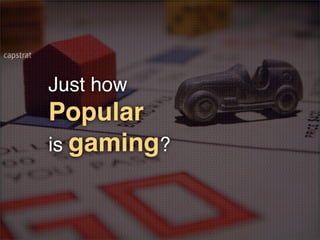
Just how
Popular
is gaming?
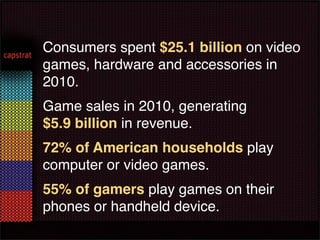
Consumers spent $25.1 billion on video
games, hardware and accessories in
2010.
Game sales in 2010, generating
$5.9 billion in revenue.
72% of American households play
computer or video games.
55% of gamers play games on their
phones or handheld device.
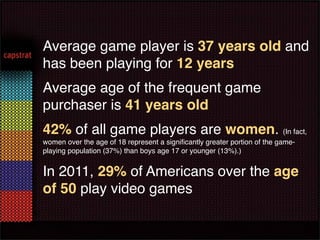
Average game player is 37 years old and
has been playing for 12 years
Average age of the frequent game
purchaser is 41 years old
42% of all game players are women. (In fact,
women over the age of 18 represent a significantly greater portion of the game-
playing population (37%) than boys age 17 or younger (13%).)


In 2011, 29% of Americans over the age
of 50 play video games
Gamification:
The process of figuring
out what elements of game play
keep players hooked over
time and then...
Gamification:
Apply those elements to regular
tasks, scenarios, and problems –
essentially turning   any activity
into a game.
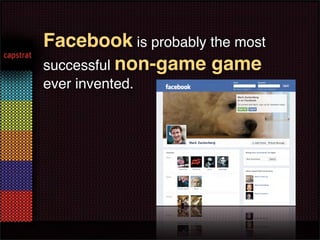
Facebook is probably the most
successful non-game game
ever invented.
So how do you know that
gamification works?

It is based on Science.
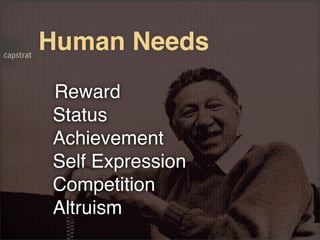
Human Needs
!
    Reward
!   Status
!   Achievement
!   Self Expression
!   Competition
!   Altruism
Game designers call
these fundamental needs and
desires,   game dynamics.
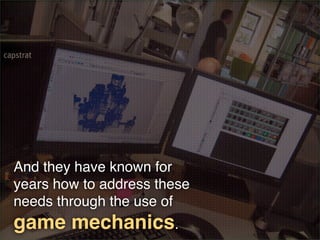
And they have known for
years how to address these
needs through the use of
game mechanics.
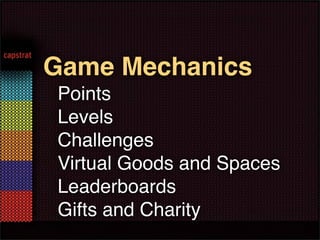
Game Mechanics
!   Points
!   Levels
!   Challenges
!   Virtual Goods and Spaces
!   Leaderboards
!   Gifts and Charity
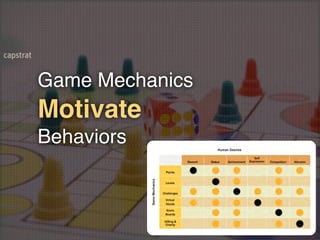
Game Mechanics
Motivate
Behaviors
Gamification now
enables these dynamics
to be applied more
broadly.
Overall Goal:
Engagement
Why should
you Care about
Gamification?
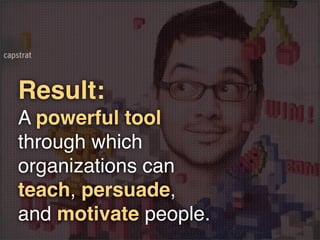
Result:
A powerful tool
through which
organizations can
teach, persuade,
and motivate people.
Examples
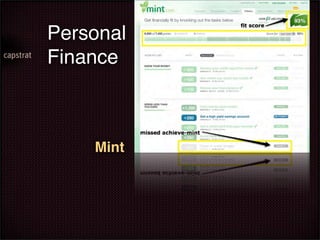
Personal
Finance


    Mint
Learning


     Khan
  Academy
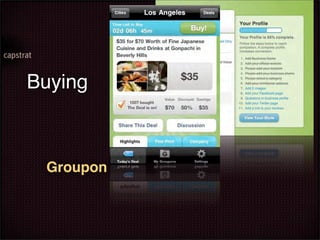
Buying


 Groupon
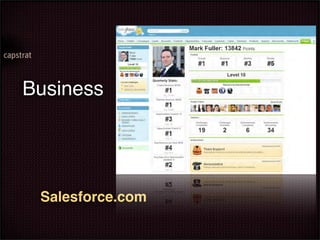
Business


 Salesforce.com
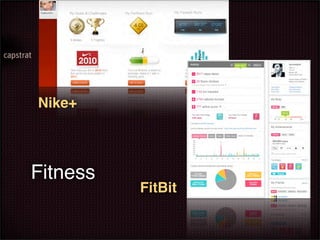
Nike+


Fitness
          FitBit
Gamification tactics do not
need to involve digital technology...


                     CrossFit Workouts
So what does the future of
Gamification look like?
According to the statistics...

Gartner, predicts that “by 2015,
more than 50% of organizations
that manage innovation processes
will gamify those processes”

By 2014, a gamified service
for consumer goods marketing
and customer retention will become
as important as Facebook, eBay
or Amazon
or as envisioned by...
Professor Jesse Schell
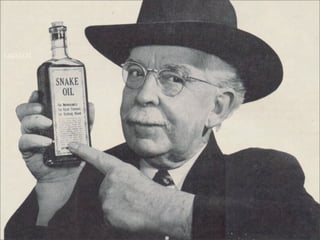
Wait a minute…
this all seems a little fishy.
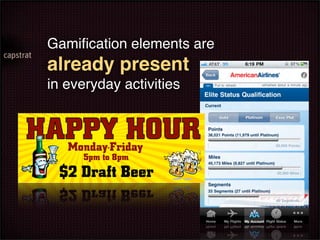
This isnʼt new...


many of its techniques
have been in place for a long time.
Gamification elements are
already present
in everyday activities
For business purposes,
gamification is invalid,
faddish, exploitative
and simplistic
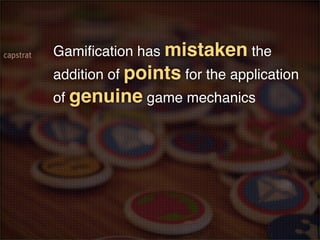
Gamification has mistaken the
addition of points for the application
of genuine game mechanics
Misconception 1
Gamification is about
badges and points.
Misconception 2
All gamification activities
have to be fun.
Misconception 3
Gamification activities
are not appropriate
in the workplace
So how can you
bring gamification
 concepts for your
       brand?
Is the Product
Compelling?
What is the Context?
What is the Timeframe?
How soon to Market?
What does Success
look like?
In Summary
Questions
Thank you
Jon Barlow
Vice President, Senior Creative Technologist

e. jbarlow@capstrat.com
t. @jon_barlow

Gamification Discussion