Environmental Health, Safety,Environmental Health, Safety,
and Risk Managementand Risk Management
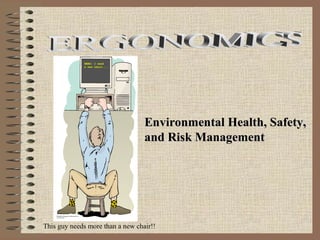
This guy needs more than a new chair!!
Occupational Risk Factors
• There are four main risk factors people
may experience when dealing with
computer work.
• Even though risk factors may be present,
this does not mean you are destined to
suffer an injury.
• You will benefit from being aware of the
risk factors and how to minimize the risk
as much as possible.
Occupational Risk Factors…
• Repetition – task or series of motions
performed over & over.
• Forceful Exertions - amount of physical effort
required to complete task.
• Awkward Postures - reaching, twisting,
bending, holding fixed positions.
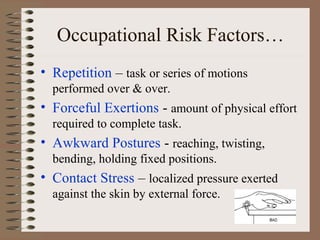
• Contact Stress – localized pressure exerted
against the skin by external force.
Repetition
• If you find yourself doing a job task over
and over, you should take adequate breaks
from the repetitive motion. This means:
– Get up and move around (move your printer to
a location where you have to get up.)
– During a break - roll your wrist and hands, this
will help if you’ve been typing for a long time.
– Try to vary your tasks as much as possible so
you aren’t in a position where you have to
keep doing repetitive motions.
Forceful Exertion
• To minimize forceful exertion - do not
type with much force, use as light a touch
as possible.
• With everything we pick up, or push
against, we should try and do it with as
little force as possible.
– This means no pounding the keyboard!!
Awkward Posture
• The location of the telephone may cause
you to have an awkward posture that you
may not be aware of…..
– Make sure your telephone is within easy reach.
– Make sure you do not have to twist (awkward
posture) at the waist to reach the phone.
Contact Stress
• There are a couple of places you may feel contact
stress:
– If you are resting your wrist on a sharp edge you are
creating a contact stress.
• To fix - do not rest your wrists on anything that will leave an
indent mark on your skin.
– If the chair you are sitting in has a seat pan that pushes
against the back of your knees you are experiencing a
contact stress.
• You may need to get a chair with a sliding seat pan to give
you enough room between the edge of the seat and the back
of your knees.
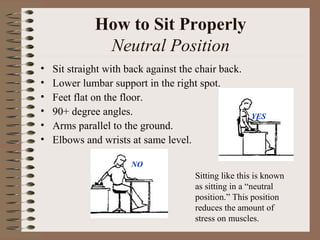
How to Sit Properly
Neutral Position
• Sit straight with back against the chair back.
• Lower lumbar support in the right spot.
• Feet flat on the floor.
• 90+ degree angles.
• Arms parallel to the ground.
• Elbows and wrists at same level.
NO
Sitting like this is known
as sitting in a “neutral
position.” This position
reduces the amount of
stress on muscles.
YES
Neutral vs. Non-Neutral Hand
Positions
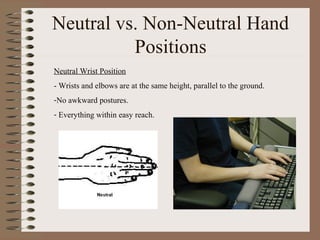
Neutral Wrist Position
- Wrists and elbows are at the same height, parallel to the ground.
-No awkward postures.
- Everything within easy reach.
Safe Computing
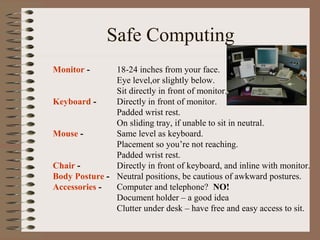
Monitor - 18-24 inches from your face.
Eye level,or slightly below.
Sit directly in front of monitor.
Keyboard - Directly in front of monitor.
Padded wrist rest.
On sliding tray, if unable to sit in neutral.
Mouse - Same level as keyboard.
Placement so you’re not reaching.
Padded wrist rest.
Chair - Directly in front of keyboard, and inline with monitor.
Body Posture - Neutral positions, be cautious of awkward postures.
Accessories - Computer and telephone? NO!
Document holder – a good idea
Clutter under desk – have free and easy access to sit.
Arranging Your Workspace
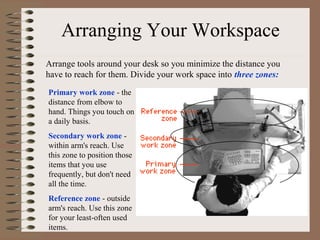
Arrange tools around your desk so you minimize the distance you
have to reach for them. Divide your work space into three zones:
Primary work zone - the
distance from elbow to
hand. Things you touch on
a daily basis.
Secondary work zone -
within arm's reach. Use
this zone to position those
items that you use
frequently, but don't need
all the time.
Reference zone - outside
arm's reach. Use this zone
for your least-often used
items.
Ergonomic Chairs
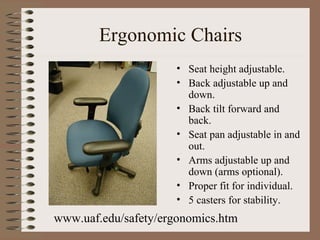
• Seat height adjustable.
• Back adjustable up and
down.
• Back tilt forward and
back.
• Seat pan adjustable in and
out.
• Arms adjustable up and
down (arms optional).
• Proper fit for individual.
• 5 casters for stability.
www.uaf.edu/safety/ergonomics.htm
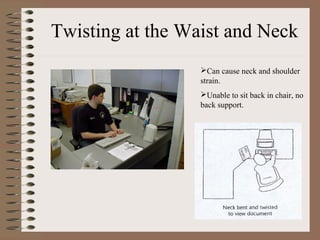
Twisting at the Waist and Neck
Can cause neck and shoulder
strain.
Unable to sit back in chair, no
back support.
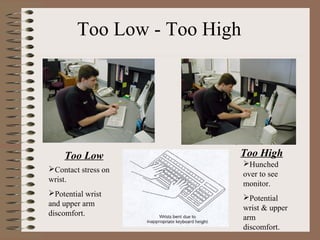
Too Low - Too High
Too Low Too High
Contact stress on
wrist.
Potential wrist
and upper arm
discomfort.
Hunched
over to see
monitor.
Potential
wrist & upper
arm
discomfort.
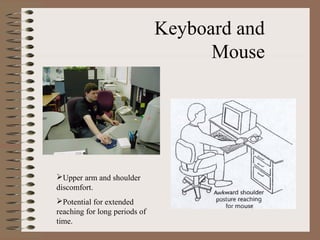
Keyboard and
Mouse
Upper arm and shoulder
discomfort.
Potential for extended
reaching for long periods of
time.
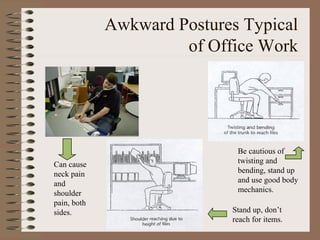
Awkward Postures Typical
of Office Work
Stand up, don’t
reach for items.
Be cautious of
twisting and
bending, stand up
and use good body
mechanics.
Can cause
neck pain
and
shoulder
pain, both
sides.
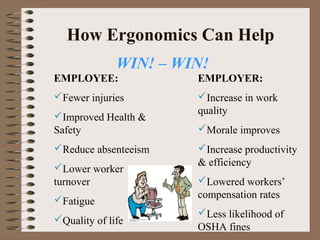
How Ergonomics Can Help
EMPLOYEE:
Fewer injuries
Improved Health &
Safety
Reduce absenteeism
Lower worker
turnover
Fatigue
Quality of life
EMPLOYER:
Increase in work
quality
Morale improves
Increase productivity
& efficiency
Lowered workers’
compensation rates
Less likelihood of
OSHA fines
WIN! – WIN!
Injured – What to do
• If you are in pain seek medical attention - the
quicker you do, the better the chances are of
fixing the problems.
• Contact Carol at EHS&RM for an evaluation.
• Fill out an incident report. www.uaf.edu/safety
• Once dr. establishes injury/pain, etc., is work
related - fill out Workers’ Compensation
paperwork.
• Be sure to communicate with your supervisor
that you are having problems at your workstation.
EHS/RM Web Page -
Ergonomics
• What is Ergonomics?
• UAF Ergonomic Program
• Potential Hazards & Possible Solutions
• Avoiding the “Mouse Trap”
• Workstation Checklists
• Ergonomic Evaluation Request Form
• Web Links
• UAF Approved Chairs
• Laboratory Ergonomics
• Workstation Discomfort Systems & Solutions
www.uaf.edu/safety
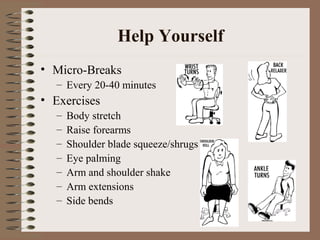
Help Yourself
• Micro-Breaks
– Every 20-40 minutes
• Exercises
– Body stretch
– Raise forearms
– Shoulder blade squeeze/shrugs
– Eye palming
– Arm and shoulder shake
– Arm extensions
– Side bends
Summary
• Avoid postures where you have to
maintain non-neutral positions.
• Avoid extreme positions of body
parts/joints.
• If it doesn’t feel right, it’s probably not
right.
• Maintain proper sitting postures.
• Keep an open mind!

Ergo powerpoint

  • 1.
    Environmental Health, Safety,EnvironmentalHealth, Safety, and Risk Managementand Risk Management This guy needs more than a new chair!!
  • 2.
    Occupational Risk Factors •There are four main risk factors people may experience when dealing with computer work. • Even though risk factors may be present, this does not mean you are destined to suffer an injury. • You will benefit from being aware of the risk factors and how to minimize the risk as much as possible.
  • 3.
    Occupational Risk Factors… •Repetition – task or series of motions performed over & over. • Forceful Exertions - amount of physical effort required to complete task. • Awkward Postures - reaching, twisting, bending, holding fixed positions. • Contact Stress – localized pressure exerted against the skin by external force.
  • 4.
    Repetition • If youfind yourself doing a job task over and over, you should take adequate breaks from the repetitive motion. This means: – Get up and move around (move your printer to a location where you have to get up.) – During a break - roll your wrist and hands, this will help if you’ve been typing for a long time. – Try to vary your tasks as much as possible so you aren’t in a position where you have to keep doing repetitive motions.
  • 5.
    Forceful Exertion • Tominimize forceful exertion - do not type with much force, use as light a touch as possible. • With everything we pick up, or push against, we should try and do it with as little force as possible. – This means no pounding the keyboard!!
  • 6.
    Awkward Posture • Thelocation of the telephone may cause you to have an awkward posture that you may not be aware of….. – Make sure your telephone is within easy reach. – Make sure you do not have to twist (awkward posture) at the waist to reach the phone.
  • 7.
    Contact Stress • Thereare a couple of places you may feel contact stress: – If you are resting your wrist on a sharp edge you are creating a contact stress. • To fix - do not rest your wrists on anything that will leave an indent mark on your skin. – If the chair you are sitting in has a seat pan that pushes against the back of your knees you are experiencing a contact stress. • You may need to get a chair with a sliding seat pan to give you enough room between the edge of the seat and the back of your knees.
  • 8.
    How to SitProperly Neutral Position • Sit straight with back against the chair back. • Lower lumbar support in the right spot. • Feet flat on the floor. • 90+ degree angles. • Arms parallel to the ground. • Elbows and wrists at same level. NO Sitting like this is known as sitting in a “neutral position.” This position reduces the amount of stress on muscles. YES
  • 9.
    Neutral vs. Non-NeutralHand Positions Neutral Wrist Position - Wrists and elbows are at the same height, parallel to the ground. -No awkward postures. - Everything within easy reach.
  • 10.
    Safe Computing Monitor -18-24 inches from your face. Eye level,or slightly below. Sit directly in front of monitor. Keyboard - Directly in front of monitor. Padded wrist rest. On sliding tray, if unable to sit in neutral. Mouse - Same level as keyboard. Placement so you’re not reaching. Padded wrist rest. Chair - Directly in front of keyboard, and inline with monitor. Body Posture - Neutral positions, be cautious of awkward postures. Accessories - Computer and telephone? NO! Document holder – a good idea Clutter under desk – have free and easy access to sit.
  • 11.
    Arranging Your Workspace Arrangetools around your desk so you minimize the distance you have to reach for them. Divide your work space into three zones: Primary work zone - the distance from elbow to hand. Things you touch on a daily basis. Secondary work zone - within arm's reach. Use this zone to position those items that you use frequently, but don't need all the time. Reference zone - outside arm's reach. Use this zone for your least-often used items.
  • 12.
    Ergonomic Chairs • Seatheight adjustable. • Back adjustable up and down. • Back tilt forward and back. • Seat pan adjustable in and out. • Arms adjustable up and down (arms optional). • Proper fit for individual. • 5 casters for stability. www.uaf.edu/safety/ergonomics.htm
  • 13.
    Twisting at theWaist and Neck Can cause neck and shoulder strain. Unable to sit back in chair, no back support.
  • 14.
    Too Low -Too High Too Low Too High Contact stress on wrist. Potential wrist and upper arm discomfort. Hunched over to see monitor. Potential wrist & upper arm discomfort.
  • 15.
    Keyboard and Mouse Upper armand shoulder discomfort. Potential for extended reaching for long periods of time.
  • 16.
    Awkward Postures Typical ofOffice Work Stand up, don’t reach for items. Be cautious of twisting and bending, stand up and use good body mechanics. Can cause neck pain and shoulder pain, both sides.
  • 17.
    How Ergonomics CanHelp EMPLOYEE: Fewer injuries Improved Health & Safety Reduce absenteeism Lower worker turnover Fatigue Quality of life EMPLOYER: Increase in work quality Morale improves Increase productivity & efficiency Lowered workers’ compensation rates Less likelihood of OSHA fines WIN! – WIN!
  • 18.
    Injured – Whatto do • If you are in pain seek medical attention - the quicker you do, the better the chances are of fixing the problems. • Contact Carol at EHS&RM for an evaluation. • Fill out an incident report. www.uaf.edu/safety • Once dr. establishes injury/pain, etc., is work related - fill out Workers’ Compensation paperwork. • Be sure to communicate with your supervisor that you are having problems at your workstation.
  • 19.
    EHS/RM Web Page- Ergonomics • What is Ergonomics? • UAF Ergonomic Program • Potential Hazards & Possible Solutions • Avoiding the “Mouse Trap” • Workstation Checklists • Ergonomic Evaluation Request Form • Web Links • UAF Approved Chairs • Laboratory Ergonomics • Workstation Discomfort Systems & Solutions www.uaf.edu/safety
  • 20.
    Help Yourself • Micro-Breaks –Every 20-40 minutes • Exercises – Body stretch – Raise forearms – Shoulder blade squeeze/shrugs – Eye palming – Arm and shoulder shake – Arm extensions – Side bends
  • 21.
    Summary • Avoid postureswhere you have to maintain non-neutral positions. • Avoid extreme positions of body parts/joints. • If it doesn’t feel right, it’s probably not right. • Maintain proper sitting postures. • Keep an open mind!