Energy Audits
Presentation Outline
About Qeraton Arabia
What is Energy Audit, its objectives and benefits
Major Areas of Inspection
Energy Audit Activities
Energy Audit Procedure and Methodology
Instruments / Gadgets to be used
Deliverables
Post Audit Activities
About Qeraton Arabia
• Qeraton Arabia offers specialized and niche services that address energy
management, infrared thermography, power system studies and renewable
energy services.
The main services provided by Qeraton Arabia includes:
• Energy Services
– Energy Audit
– Energy Verification
– Thermal Insulation Inspection
• Electrical Services
– Electrical Safety Verification
– Power system studies
– Thermography
• Renewable Energy Services
What is Energy Audit?
• An energy audit is an inspection, survey and analysis
of energy flows for energy conservation in a facility, process
or system to reduce the amount of energy input into the
system without negatively affecting the output(s).
Benefits of Energy Audit
• Give a better understanding of the
energy consumption
• Identify and reduce energy wastage
and inefficiencies
• Reduce the energy costs
• Increase your comfort, health and
safety
• Reduce your carbon emission
footprint
• Each action is a step toward
addressing climate change
Major Areas for Inspection
• Electrical Distribution System
• Energy Use Analysis - Electrical Bills
• Power Factor Measurement
• Process Efficiency - Idle operation of Machines
• Heating Ventilation and Air Conditioning / Chillers
• Motors
• Compressors – Air Leakages
• Hot water Systems
• Lighting
• Renewable Energy Sources
Energy Audit Activities
• Thermography / Thermal Imaging
• Power / energy logging
• Energy assessment of HVAC / Chillers
• Energy assessment of compressed air system
• Energy assessment of Motors
• Energy assessment of Lighting
• Others…
Thermography / Thermal
Imaging
• The audit team will
perform thermography to
identify the “hot spots” in
the electrical system
where energy is being
wasted.
• This activity will also
identify areas in electrical
system where there are
safety issues and the
actions needed rectify the
faults.
Building Envelope
• Thermal Insulation and U-
value measurement
• Studies in Saudi Arabia and
other GCC countries have
shown that up to 33
percent of annual energy
consumption can be saved
by proper insulation. [Ref:
Al-Rabghi and Al-Johani,
1997]
Power / Energy Logging
• Energy logging to
develop baseline
for power
consumption
• Power logging to
determine power
quality parameters
such as power
factor, harmonics,
voltage drops etc.
Energy Efficiency of HVAC
system
• The audit team will evaluate:
–Efficiency of HVAC
–Optimization of HVAC
–COP of Chillers
–Performance assessment
of AHUs
Energy Efficient Motors
• The audit team will identify
feasible opportunities for
Energy Efficient Motors
• Optimize the motor
efficiency by variable speed
drives
• Financial Analysis with
quantification of savings.
Lighting System
• Lux measurement and
comparison with international
best practices
• Energy efficient lighting designs
• Recommendations about latest
and most feasible energy efficient
lighting technologies
• Recommendations about lighting
controls including occupancy
controls, dimmers, timers etc.
Compressed Air Systems
Compressed air has many opportunities for energy
savings:
– Identification of leakages by UE-Ultrasound equipment
– Compressor efficiency
– Automation opportunities in compressors
– Pressure optimization etc.
Smart Meters
• Energy measurement
and monitoring
• Benchmarking
• Manage your energy
use
• Remote communication
Smart Meters
Renewable Energy
• Identify possible opportunities for installing
renewable energy technologies with special
emphasis on solar PV and solar water heating
Energy Efficiency opportunities
in other equipment
• Electrical heaters
• Packaged / single unit Acs
• Fans and pumps
• Etc.
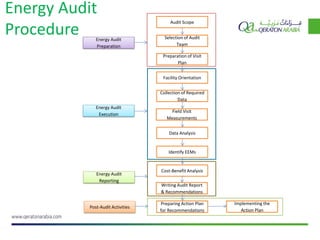
Audit Scope
Selection of Audit
Team
Preparation of Visit
Plan
Facility Orientation
Collection of Required
Data
Field Visit
Measurements
Data Analysis
Identify EEMs
Cost-Benefit Analysis
Writing Audit Report
& Recommendations
Preparing Action Plan
for Recommendations
Implementing the
Action Plan
Post-Audit Activities
Energy Audit
Reporting
Energy Audit
Execution
Energy Audit
Preparation
Energy Audit
Procedure
Energy Audit Methodology
Setup Phase
Pre-Audit Data
Collection Kick off meeting
Detailed
Investigation
Phase
Data collection Data analysis
Conclusion Phase Preliminary audit report
and recommendations
Final energy audit
report
STEP-1: Project Initiation
and Setup Phase
• Pre-Audit Data Collection
– To study the energy usage and demand of the facility
– Data collection at pre-audit stage will help the audit team to focus on the most critical areas
– The pre audit data collection will include:
• Electrical / Mechanical (HVAC) drawings
• Lighting specifications and layout
• Occupancy data and facilities / system operational hours
• Kick off Meeting
– This meeting will be aimed at
following:
• Achieve a common ground of
understanding of various issues of
the assignment which includes
scope of audit, review schedule of
activities and clarify role and
responsibilities
• Share Schedule and Plan of
“Detailed Investigation phase”
STEP-1: Project Initiation and
Setup Phase
Step-2: Detailed
Investigation Phase
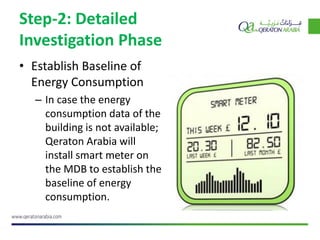
• Establish Baseline of
Energy Consumption
– In case the energy
consumption data of the
building is not available;
Qeraton Arabia will
install smart meter on
the MDB to establish the
baseline of energy
consumption.
Step-2: Detailed
Investigation Phase
• Data Collection
– The audit team will tour the
facility focusing on major
energy consuming systems
including electrical, mechanical
system, lighting, ventilation
system, architecture and other
equipment
– Onsite measurement including
power consumption
measurement, U-value, lux, air
flows measurement and
thermography will be
performed in this phase.
Step-2: Detailed
Investigation Phase
• Data Analysis
– The audit data and collected
documents will be reviewed
and examined to identify
energy saving potentials in the
facility.
– All measures will be analyzed
with regard to their economic
analysis and technical
feasibility, starting with
measures of short payback
periods to those having a mid
to long-term payback period.
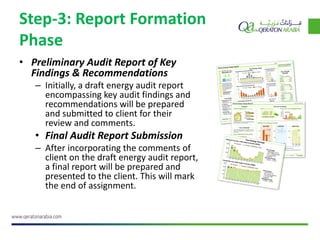
Step-3: Report Formation
Phase
• Preliminary Audit Report of Key
Findings & Recommendations
– Initially, a draft energy audit report
encompassing key audit findings and
recommendations will be prepared
and submitted to client for their
review and comments.
• Final Audit Report Submission
– After incorporating the comments of
client on the draft energy audit report,
a final report will be prepared and
presented to the client. This will mark
the end of assignment.
Instruments / Gadgets to
be used
• Power Logger / Energy Analyzer
• Power clamp meter
• Thermal Imaging Camera
• Boiler / Stack Analyzer
• Ultrasound Air borne scanning
• Lux meter
• IR Temperature Gun
• Hygro – Thermo – Anemometer
• U – value meter
• Air flow kit (static pressure /
velocity measurement)
Post Audit Activities
• Detailed action plan and its implementation
– Create performance targets
– Set timelines
– Establish a monitoring system
• Determine roles and resources
– Identify internal roles
– Identify external roles
Deliverables Of Energy
Audit
• Debriefing Presentation: Including the executive
summary of the findings of the audit and
recommendations
• Energy Audit Report: Energy audit reports will be
submitted to the client meeting all requirements
including:
– Executive summary
– Baseline data
– List of major energy end uses
– Itemized list of recommended energy efficiency measures
that will capture cost-effective energy and demand savings
– Assessment methodologies and calculations
– Detailed energy analysis including all technical assumption,
capital and installation cost estimates, annual energy and
demand saving estimates, payback calculations
Presentation_Energy Audit_2.1

Presentation_Energy Audit_2.1

  • 1.
  • 2.
    Presentation Outline About QeratonArabia What is Energy Audit, its objectives and benefits Major Areas of Inspection Energy Audit Activities Energy Audit Procedure and Methodology Instruments / Gadgets to be used Deliverables Post Audit Activities
  • 3.
    About Qeraton Arabia •Qeraton Arabia offers specialized and niche services that address energy management, infrared thermography, power system studies and renewable energy services. The main services provided by Qeraton Arabia includes: • Energy Services – Energy Audit – Energy Verification – Thermal Insulation Inspection • Electrical Services – Electrical Safety Verification – Power system studies – Thermography • Renewable Energy Services
  • 4.
    What is EnergyAudit? • An energy audit is an inspection, survey and analysis of energy flows for energy conservation in a facility, process or system to reduce the amount of energy input into the system without negatively affecting the output(s).
  • 5.
    Benefits of EnergyAudit • Give a better understanding of the energy consumption • Identify and reduce energy wastage and inefficiencies • Reduce the energy costs • Increase your comfort, health and safety • Reduce your carbon emission footprint • Each action is a step toward addressing climate change
  • 6.
    Major Areas forInspection • Electrical Distribution System • Energy Use Analysis - Electrical Bills • Power Factor Measurement • Process Efficiency - Idle operation of Machines • Heating Ventilation and Air Conditioning / Chillers • Motors • Compressors – Air Leakages • Hot water Systems • Lighting • Renewable Energy Sources
  • 7.
    Energy Audit Activities •Thermography / Thermal Imaging • Power / energy logging • Energy assessment of HVAC / Chillers • Energy assessment of compressed air system • Energy assessment of Motors • Energy assessment of Lighting • Others…
  • 8.
    Thermography / Thermal Imaging •The audit team will perform thermography to identify the “hot spots” in the electrical system where energy is being wasted. • This activity will also identify areas in electrical system where there are safety issues and the actions needed rectify the faults.
  • 9.
    Building Envelope • ThermalInsulation and U- value measurement • Studies in Saudi Arabia and other GCC countries have shown that up to 33 percent of annual energy consumption can be saved by proper insulation. [Ref: Al-Rabghi and Al-Johani, 1997]
  • 10.
    Power / EnergyLogging • Energy logging to develop baseline for power consumption • Power logging to determine power quality parameters such as power factor, harmonics, voltage drops etc.
  • 11.
    Energy Efficiency ofHVAC system • The audit team will evaluate: –Efficiency of HVAC –Optimization of HVAC –COP of Chillers –Performance assessment of AHUs
  • 12.
    Energy Efficient Motors •The audit team will identify feasible opportunities for Energy Efficient Motors • Optimize the motor efficiency by variable speed drives • Financial Analysis with quantification of savings.
  • 13.
    Lighting System • Luxmeasurement and comparison with international best practices • Energy efficient lighting designs • Recommendations about latest and most feasible energy efficient lighting technologies • Recommendations about lighting controls including occupancy controls, dimmers, timers etc.
  • 14.
    Compressed Air Systems Compressedair has many opportunities for energy savings: – Identification of leakages by UE-Ultrasound equipment – Compressor efficiency – Automation opportunities in compressors – Pressure optimization etc.
  • 15.
    Smart Meters • Energymeasurement and monitoring • Benchmarking • Manage your energy use • Remote communication
  • 16.
  • 17.
    Renewable Energy • Identifypossible opportunities for installing renewable energy technologies with special emphasis on solar PV and solar water heating
  • 18.
    Energy Efficiency opportunities inother equipment • Electrical heaters • Packaged / single unit Acs • Fans and pumps • Etc.
  • 19.
    Audit Scope Selection ofAudit Team Preparation of Visit Plan Facility Orientation Collection of Required Data Field Visit Measurements Data Analysis Identify EEMs Cost-Benefit Analysis Writing Audit Report & Recommendations Preparing Action Plan for Recommendations Implementing the Action Plan Post-Audit Activities Energy Audit Reporting Energy Audit Execution Energy Audit Preparation Energy Audit Procedure
  • 20.
    Energy Audit Methodology SetupPhase Pre-Audit Data Collection Kick off meeting Detailed Investigation Phase Data collection Data analysis Conclusion Phase Preliminary audit report and recommendations Final energy audit report
  • 21.
    STEP-1: Project Initiation andSetup Phase • Pre-Audit Data Collection – To study the energy usage and demand of the facility – Data collection at pre-audit stage will help the audit team to focus on the most critical areas – The pre audit data collection will include: • Electrical / Mechanical (HVAC) drawings • Lighting specifications and layout • Occupancy data and facilities / system operational hours
  • 22.
    • Kick offMeeting – This meeting will be aimed at following: • Achieve a common ground of understanding of various issues of the assignment which includes scope of audit, review schedule of activities and clarify role and responsibilities • Share Schedule and Plan of “Detailed Investigation phase” STEP-1: Project Initiation and Setup Phase
  • 23.
    Step-2: Detailed Investigation Phase •Establish Baseline of Energy Consumption – In case the energy consumption data of the building is not available; Qeraton Arabia will install smart meter on the MDB to establish the baseline of energy consumption.
  • 24.
    Step-2: Detailed Investigation Phase •Data Collection – The audit team will tour the facility focusing on major energy consuming systems including electrical, mechanical system, lighting, ventilation system, architecture and other equipment – Onsite measurement including power consumption measurement, U-value, lux, air flows measurement and thermography will be performed in this phase.
  • 25.
    Step-2: Detailed Investigation Phase •Data Analysis – The audit data and collected documents will be reviewed and examined to identify energy saving potentials in the facility. – All measures will be analyzed with regard to their economic analysis and technical feasibility, starting with measures of short payback periods to those having a mid to long-term payback period.
  • 26.
    Step-3: Report Formation Phase •Preliminary Audit Report of Key Findings & Recommendations – Initially, a draft energy audit report encompassing key audit findings and recommendations will be prepared and submitted to client for their review and comments. • Final Audit Report Submission – After incorporating the comments of client on the draft energy audit report, a final report will be prepared and presented to the client. This will mark the end of assignment.
  • 27.
    Instruments / Gadgetsto be used • Power Logger / Energy Analyzer • Power clamp meter • Thermal Imaging Camera • Boiler / Stack Analyzer • Ultrasound Air borne scanning • Lux meter • IR Temperature Gun • Hygro – Thermo – Anemometer • U – value meter • Air flow kit (static pressure / velocity measurement)
  • 28.
    Post Audit Activities •Detailed action plan and its implementation – Create performance targets – Set timelines – Establish a monitoring system • Determine roles and resources – Identify internal roles – Identify external roles
  • 29.
    Deliverables Of Energy Audit •Debriefing Presentation: Including the executive summary of the findings of the audit and recommendations • Energy Audit Report: Energy audit reports will be submitted to the client meeting all requirements including: – Executive summary – Baseline data – List of major energy end uses – Itemized list of recommended energy efficiency measures that will capture cost-effective energy and demand savings – Assessment methodologies and calculations – Detailed energy analysis including all technical assumption, capital and installation cost estimates, annual energy and demand saving estimates, payback calculations