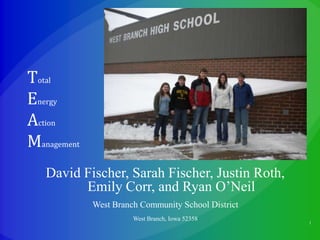
David Fischer, Sarah Fischer, Justin Roth, Emily Corr, and Ryan O’NeilWest Branch Community School DistrictWest Branch, Iowa 523581TotalEnergyActionManagement
What’s the environmental issue?Energy inefficiency results in pollution emission into the environment as coal is burned to produce electricity.  Seventy-one percent of our state’s electricity is generated by coal burning power plants.  Burning coal releases harmful pollutants such as carbon dioxide (a greenhouse gas), nitric oxide (acid rain), sulfur dioxide (smog), and mercury.There are numerous businesses in our community of 2,200 people using inefficient T12 fluorescent lighting systems.West Branch High School should include efficient technologies and renewable energy sources in the new gym addition being added on to our school.  Energy efficient upgrades should be made in the existing school building.
Team Member Responsibilities
Measuring successOur team’s success will be measured through the difference we make in energy savings in our community.  Each business that upgrades from T12 to T8 fluorescent lighting will be a success.Each energy efficient technology used in the new school addition shows success.Each energy efficient upgrade in the high school shows success.Each article published on the topic will be a success for public education.
Quantifying impactWe will quantify our impact by using calculation systems to determine energy decrease, savings in coal burned and pollutants emitted, savings per month and pay back in months.  We will use this for each business that upgrades to an efficient T8 lighting system.  We will quantify our impact by the number of energy efficient technologies that are utilized in the new building addition at the high school. We will also quantify our impact through the number of energy efficient technologies that are upgraded in the 34 year old high school building.
Implementing Our IdeasWe educated ourselves on solar energy and wind energy, including the use of photovoltaic systems and wind turbines as alternative energy sources.  We met with local and state expertsChris Crull, Crescent Electric Company, to learn about theoretical formulas for financial and environmental savings and verify their accuracyLocal Bank loan officer, Ed Larew, of Community State Bank to learn about self liquidating loans for businesses improvement projectsCurt Klaassen, Iowa Energy Center, and Linda King, Iowa Office of Energy Independence, to learn about retrofitting programs in IowaLarry Young, A-Tec Recycling, to learn cost of recycling T12 bulbs and magnetic ballastsI-Renew person to learn about photovoltaic cellsKristin Cohenour, Alliant Energy, to learn about West Branch High School’s energy consumptionDavid Werner, Michaels Engineering, to identify energy savings in our school through an energy auditWest Branch Community School’s Maintenance Director, Chad Federlien, to learn about the inner workings of the high school and how systems work
Implementing Our Ideas (Continued)We learned about software that computes savings when switching from less to more efficient lighting systems.  Additionally, we used three mathematical methods to verify the theoretical calculations.  We visited all 19 businesses in our community to conduct a lighting survey to determine use of inefficient T12 fluorescent lighting systems.  We then calculated the potential energy saving opportunities and the environmental impact of implementing efficient T8 fluorescent lighting for these businesses using General Electric’s Eco Estimator Software.We met with a loan officer to learn about self-liquidating loans based on the saving differences between lighting systems that could be used to help interested businesses upgrade their lighting systems.  We contacted an electric utility company that conducted an energy audit at the high school.   Through this audit we worked to identify changes that could be made throughout the school, but especially in the planning of the new addition.  We met with architects designing the new gym addition to the West Branch High School to discuss energy saving ideas for the addition.
Sharing What We LearnedSharing what we learned:Sarah Fischer, news editor of the school newspaper, wrote three articles to share information about these opportunities.The West Branch Times carried two articles about our team’s activities, providing further community educationOur team presented energy audit findings along with recommendations to the school boardOur team set up an environmental and  energy legislative summit to present our ideas to our legislators like state legislators Jeff Kaufmann and Congressman Dave Loebsack. Our team is developing a document to share with other schools that encourages conduction of energy audits and energy saving activities could be implemented in those schoolsWe developed a website   https://sites.google.com/site/totalenergyactionmanagement/We presented to the City Council about the inefficient T12 lights in city buildings and the opportunity to upgrade to more efficient lighting as well as developing a city code requiring new construction to install energy efficient lighting.
The ResultsWe have identified 13 businesses with T12 lights and persuaded 3 of them to retrofitOur efforts have saved the Animal Clinic around  7000 kilowatts and $830 per yearBrightness at the Animal Clinic has increased on average 235% across the facilityHy-Vee  has taken action too, saving about $65,000 and 1.3 million kWh per yearWe have found $9,620 and 68,510 kWh in savings each year with our energy audit at the high school.
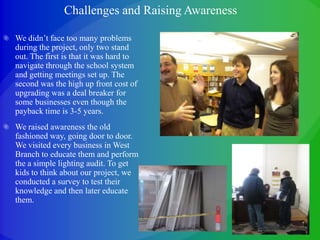
Challenges and Raising AwarenessWe didn’t face too many problems during the project, only two stand out. The first is that it was hard to navigate through the school system and getting meetings set up. The second was the high up front cost of upgrading was a deal breaker for some businesses even though the payback time is 3-5 years.We raised awareness the old fashioned way, going door to door. We visited every business in West Branch to educate them and perform the a simple lighting audit. To get kids to think about our project, we conducted a survey to test their knowledge and then later educate them.
What We LearnedWhat we learned:27% of energy used in schools is from light use.
West Branch High School uses 12% more energy than similar buildings.
33% of all businesses still have inefficient lighting.
Iowa generates 71% of its electricity from coal.
Burning coal produces mercury, carbon dioxide, nitric oxide and sulfur dioxide.

Lexus air climate generic version

  • 1.
    David Fischer, SarahFischer, Justin Roth, Emily Corr, and Ryan O’NeilWest Branch Community School DistrictWest Branch, Iowa 523581TotalEnergyActionManagement
  • 2.
    What’s the environmentalissue?Energy inefficiency results in pollution emission into the environment as coal is burned to produce electricity. Seventy-one percent of our state’s electricity is generated by coal burning power plants. Burning coal releases harmful pollutants such as carbon dioxide (a greenhouse gas), nitric oxide (acid rain), sulfur dioxide (smog), and mercury.There are numerous businesses in our community of 2,200 people using inefficient T12 fluorescent lighting systems.West Branch High School should include efficient technologies and renewable energy sources in the new gym addition being added on to our school. Energy efficient upgrades should be made in the existing school building.
  • 3.
  • 4.
    Measuring successOur team’ssuccess will be measured through the difference we make in energy savings in our community. Each business that upgrades from T12 to T8 fluorescent lighting will be a success.Each energy efficient technology used in the new school addition shows success.Each energy efficient upgrade in the high school shows success.Each article published on the topic will be a success for public education.
  • 5.
    Quantifying impactWe willquantify our impact by using calculation systems to determine energy decrease, savings in coal burned and pollutants emitted, savings per month and pay back in months. We will use this for each business that upgrades to an efficient T8 lighting system. We will quantify our impact by the number of energy efficient technologies that are utilized in the new building addition at the high school. We will also quantify our impact through the number of energy efficient technologies that are upgraded in the 34 year old high school building.
  • 6.
    Implementing Our IdeasWeeducated ourselves on solar energy and wind energy, including the use of photovoltaic systems and wind turbines as alternative energy sources. We met with local and state expertsChris Crull, Crescent Electric Company, to learn about theoretical formulas for financial and environmental savings and verify their accuracyLocal Bank loan officer, Ed Larew, of Community State Bank to learn about self liquidating loans for businesses improvement projectsCurt Klaassen, Iowa Energy Center, and Linda King, Iowa Office of Energy Independence, to learn about retrofitting programs in IowaLarry Young, A-Tec Recycling, to learn cost of recycling T12 bulbs and magnetic ballastsI-Renew person to learn about photovoltaic cellsKristin Cohenour, Alliant Energy, to learn about West Branch High School’s energy consumptionDavid Werner, Michaels Engineering, to identify energy savings in our school through an energy auditWest Branch Community School’s Maintenance Director, Chad Federlien, to learn about the inner workings of the high school and how systems work
  • 7.
    Implementing Our Ideas(Continued)We learned about software that computes savings when switching from less to more efficient lighting systems. Additionally, we used three mathematical methods to verify the theoretical calculations. We visited all 19 businesses in our community to conduct a lighting survey to determine use of inefficient T12 fluorescent lighting systems. We then calculated the potential energy saving opportunities and the environmental impact of implementing efficient T8 fluorescent lighting for these businesses using General Electric’s Eco Estimator Software.We met with a loan officer to learn about self-liquidating loans based on the saving differences between lighting systems that could be used to help interested businesses upgrade their lighting systems. We contacted an electric utility company that conducted an energy audit at the high school. Through this audit we worked to identify changes that could be made throughout the school, but especially in the planning of the new addition. We met with architects designing the new gym addition to the West Branch High School to discuss energy saving ideas for the addition.
  • 8.
    Sharing What WeLearnedSharing what we learned:Sarah Fischer, news editor of the school newspaper, wrote three articles to share information about these opportunities.The West Branch Times carried two articles about our team’s activities, providing further community educationOur team presented energy audit findings along with recommendations to the school boardOur team set up an environmental and energy legislative summit to present our ideas to our legislators like state legislators Jeff Kaufmann and Congressman Dave Loebsack. Our team is developing a document to share with other schools that encourages conduction of energy audits and energy saving activities could be implemented in those schoolsWe developed a website https://sites.google.com/site/totalenergyactionmanagement/We presented to the City Council about the inefficient T12 lights in city buildings and the opportunity to upgrade to more efficient lighting as well as developing a city code requiring new construction to install energy efficient lighting.
  • 9.
    The ResultsWe haveidentified 13 businesses with T12 lights and persuaded 3 of them to retrofitOur efforts have saved the Animal Clinic around 7000 kilowatts and $830 per yearBrightness at the Animal Clinic has increased on average 235% across the facilityHy-Vee has taken action too, saving about $65,000 and 1.3 million kWh per yearWe have found $9,620 and 68,510 kWh in savings each year with our energy audit at the high school.
  • 10.
    Challenges and RaisingAwarenessWe didn’t face too many problems during the project, only two stand out. The first is that it was hard to navigate through the school system and getting meetings set up. The second was the high up front cost of upgrading was a deal breaker for some businesses even though the payback time is 3-5 years.We raised awareness the old fashioned way, going door to door. We visited every business in West Branch to educate them and perform the a simple lighting audit. To get kids to think about our project, we conducted a survey to test their knowledge and then later educate them.
  • 11.
    What We LearnedWhatwe learned:27% of energy used in schools is from light use.
  • 12.
    West Branch HighSchool uses 12% more energy than similar buildings.
  • 13.
    33% of allbusinesses still have inefficient lighting.
  • 14.
    Iowa generates 71%of its electricity from coal.
  • 15.
    Burning coal producesmercury, carbon dioxide, nitric oxide and sulfur dioxide.