13.801 ENERGY MANAGEMENT (MP)
Teaching Scheme: 2(L)-1(T)-0(P) Credits: 3
Course Objective: The main objective of this course is
 To provide students with a general awareness on the importance of energy and its
conservation, its impact on society, various energy sources, energy conversion processes,
energy management, energy audit and energy conservation measures.
Module I
Energy resources, Energy conversion processes and devices – Energy conversion plants –
Conventional - Thermal, Hydro, Nuclear fission , and Non – conventional – Solar, Wind
Biomass, Fuel cells, Magneto Hydrodynamics and Nuclear fusion. Energy from waste, Energy
plantation.
Module II
Energy storage and Distribution – Electrical energy route – Load curves – Energy
conversionplants for Base load , Intermediate load, Peak load and Energy displacement
– Energy storage plants
Energy Scenario – Global and Indian –Impact of Energy on economy, development and
environment, Energy policies, Energy strategy for future
Module III
Energy Management – Definitions and significance – objectives –Characterizing of energy usage
– Energy Management program – Energy strategies and energy planning Energy Audit – Types
and Procedure – Optimum performance of existing facilities – Energy management control
systems – Computer applications in Energy management
Module IV
Energy conservation – Principles – Energy economics – Energy conservation technologies –
cogeneration – Waste heat recovery – Combined cycle power generation – Heat Recuperators –
Heat regenerators – Heat pipes – Heat pumps – Pinch Technology
Energy Conservation Opportunities – Electrical ECOs – Thermodynamic ECOs in chemical
process industry – ECOs in residential and commercial buildings – Energy Conservation
Measures.
References:
1. Amlan Chakrabarti, Energy Engineering and Management, Prentice hall India 2011
2. T.D.Eastop and D.R. Croft, Energy Efficiency for Engineers & Technologists, Longman,1990.
3. Albert Thumann, P.E, C.E.M and Wlliam.J.Younger, C E.M, Handbook of Energy Audits,
Fairmont Press Ltd,2009.
4. Wayne.C.Turner ,Energy Management Hand book, Fairmont Press Ltd.,2012
5. S.Rao and Dr.B.B.Parulekar, Energy Technology, Khanna Publishers,2012
6. G.D. Rai, Non – Conventional Energy Sources, Khanna Publishers,2010
Internal Continuous Assessment (Maximum Marks-50)
50% - Tests (minimum 2)
30% - Assignments (minimum 2) such as home work, problem solving, quiz, literature survey,
seminar, term-project, software exercises, etc.
20% - Regularity in the class
University Examination Pattern:
Examination duration: 3 hours Maximum Total Marks: 100
The question paper shall consist of 2 parts.
Part A (20 marks) - Ten Short answer questions of 2 marks each. All questions are compulsory.
There should be at least two question from each module and not more than three questions from
any module.
Part B (80 Marks) - Candidates have to answer one full question out of the two from each
module. Each question carries 20 marks.
Course outcomes:
After completion of this course the students will be able
 To have an understanding of the impact of energy on society, the need for sustainable
energy, global and Indian energy policies.
 To gain knowledge on various techniques of energy management and conservation.
 To gain the basic ideas of conducting energy audit
Module I
Energy resources, Energy conversion processes and devices – Energy conversion plants –
Conventional - Thermal, Hydro, Nuclear fission , and Non – conventional – Solar, Wind
Biomass, Fuel cells, Magneto Hydrodynamics and Nuclear fusion. Energy from waste, Energy
plantation.
Energy Resources
Energy is the main ‘fuel’ for social and economic development of a nation. World energy
resources are the estimated maximum capacity for energy production given all available
resources on Earth. They can be divided by type into fossil fuel, nuclear fuel and renewable
resources.
1. Fossil fuel
Coal
Oil
Natural gas
2. Nuclear fuel
Nuclear energy
Nuclear fusion
3. Renewable resources
Solar energy
Wind power
Wave and tidal power
Geothermal
Biomass
Hydropower
Energy conversion
Energy conversion is the transformation of energy from forms provided by nature to forms that
can be used by humans.
Over the centuries a wide array of devices and systems has been developed for this
purpose. Some of these energy converters are quite simple. The early windmills, for example,
transformed the kinetic energy of wind into mechanical energy for pumping water and grinding
grain. Other energy-conversion systems are decidedly more complex, particularly those that take
raw energy from fossil fuels and nuclear fuels to generate electrical power. Systems of this kind
require multiple steps or processes in which energy undergoes a whole series of transformations
through various intermediate forms.
Many of the energy converters widely used today involve the transformation of thermal
energy into electrical energy. The efficiency of such systems is, however, subject to fundamental
limitations, as dictated by the laws of thermodynamics and other scientific principles. In recent
years, considerable attention has been devoted to certain direct energy-conversion devices,
notably solar cells and fuel cells, that bypass the intermediate step of conversion to heat energy
in electrical power generation.
The concept of energy conservation
A fundamental law that has been observed to hold for all natural phenomena requires the
conservation of energy—i.e., that the total energy does not change in all the many changes that
occur in nature. The conservation of energy is not a description of any process going on in
nature, but rather it is a statement that the quantity called energy remains constant regardless of
when it is evaluated or what processes—possibly including transformations of energy from one
form into another—go on between successive evaluations.
The law of conservation of energy is applied not only to nature as a whole but to closed or
isolated systems within nature as well. Thus, if the boundaries of a system can be defined in such
a way that no energy is either added to or removed from the system, then energy must be
conserved within that system regardless of the details of the processes going on inside the system
boundaries. A corollary of this closed-system statement is that whenever the energy of a system
as determined in two successive evaluations is not the same, the difference is a measure of the
quantity of energy that has been either added to or removed from the system in the time interval
elapsing between the two evaluations.
Energy can exist in many forms within a system and may be converted from one form to another
within the constraint of the conservation law. These different forms include gravitational, kinetic,
thermal, elastic, electrical, chemical, radiant, nuclear, and mass energy. It is the universal
applicability of the concept of energy, as well as the completeness of the law of its conservation
within different forms, that makes it so attractive and useful.
HISTORY OF ENERGY-CONVERSION TECHNOLOGY
1. Early attempts to harness natural forms of energy
Early humans first made controlled use of an external, nonanimal energy source when they
discovered how to use fire. Burning dried plant matter (primarily wood) and animal waste, they
employed the energy from this biomass for heating and cooking. The generation of mechanical
energy to supplant human or animal power came very much later—only about 2,000 years ago—
with the development of simple devices to harness the energy of flowing water and of wind.
2. Waterwheels
The earliest machines were waterwheels, first used for grinding grain. They were subsequently
adopted to drive sawmills and pumps, to provide the bellows action for furnaces and forges, to
drive tilt hammers or trip-hammers for forging iron, and to provide direct mechanical power for
textile mills. Until the development of steam power during the Industrial Revolution at the end of
the 18th century, waterwheels were the primary means of mechanical power production, rivaled
only occasionally by windmills.
3. Windmills
Windmills, like waterwheels, were among the original prime movers that replaced animal muscle
as a source of power. They were used for centuries in various parts of the world, converting the
energy of the wind into mechanical energy for grinding grain, pumping water, and draining
lowland areas. The earliest known references to wind-driven grain mills, found in Arabic
writings of the 9th
century.
Wind-driven pumps remain important today in many rural parts of the world. They
continued to be used in large numbers, even in the United States, well into the 20th century until
low-cost electric power became readily available in rural areas. Although rather inefficient, they
are rugged and reliable, need little attention, and remain a prime source for pumping small
amounts of water wherever electricity is not economically available.
DEVELOPMENTS OF THE INDUSTRIAL REVOLUTION
1. Steam engines
The rapid growth of industry in Britain from about the mid-18th century (and somewhat later in
various other countries) created a need for new sources of motive power, particularly those
independent of geographic location and weather conditions. This situation, together with certain
other factors, set the stage for the development and widespread use of the steam engine, the first
practical device for converting thermal energy to mechanical energy.
2. Internal-combustion engines
While the steam engine remained dominant in industry and transportation during much of the
19th century, engineers and scientists began developing other sources and converters of energy.
One of the most important of these was the internal-combustion engine. In such a device a fuel
and oxidizer are burned within the engine and the products of combustion act directly on piston
or rotor surfaces. By contrast, an external-combustion device, such as the steam engine, employs
a secondary working fluid that is interposed between the combustion chamber and power-
producing elements. By the early 1900s the internal-combustion engine had replaced the steam
engine as the most broadly applied power-generating system not only because of its higher
thermal efficiency (there is no transfer of heat from combustion gases to a secondary working
fluid that results in losses in efficiency) but also because it provided a low-weight, reasonably
compact, self-contained power plant.
3. Electric generators and motors
Other important energy-conversion devices emerged during the 19th century. During the early
1830s the English physicist and chemist Michael Faraday discovered a means by which to
convert mechanical energy into electricity on a large scale. While engaged in experimental work
on magnetism, Faraday found that moving a permanent magnet into and out of a coil of wire
induced an electric current in the wire. This process, called electromagnetic induction, provided
the working principle for electric generators.
4. Direct energy-conversion devices
Most of these energy converters, sometimes called static energy-conversion devices, use
electrons as their “working fluid” in place of the vapour or gas employed by such dynamic heat
engines as the external-combustion and internal-combustion engines mentioned above. In recent
years, direct energy-conversion devices have received much attention because of the necessity to
develop more efficient ways of transforming available forms of primary energy into electric
power. Four such devices—the electric battery, the fuel cell, the thermoelectric generator (or at
least its working principle), and the solar cell—had their origins in the early 1800s.
MODERN DEVELOPMENTS
The 20th century brought a host of important scientific discoveries and technological advances,
including new and better materials and improved methods of fabrication. These developments
permitted the enhancement and refinement of many of the energy-conversion devices and
systems that had been introduced during the previous century, as exemplified by the remarkable
evolution of jet engines and rockets. They also gave rise to entirely new technologies.
1. Fission reactors
Scientists first learned of the tremendous energy bound in the nucleus of the atom during the
early years of the century. In 1942 they succeeded in unleashing that energy on a large scale by
means of what was called an atomic pile. This was the first nuclear fission reactor, a device
designed to induce a self-sustaining and controlled series of fission reactions that split heavy
nuclei to release their energy.
In a power-generation system of this kind, much of the energy released by the fissioning
of heavy nuclei (principally those of the radioactive isotope uranium-235) takes the form of heat,
which is used to produce steam. This steam drives a turbine, the mechanical energy of which is
converted to electricity by a generator.
2. Fusion reactors
In the late 1930s Hans A. Bethe, a German-born physicist, recognized that the fusion of
hydrogen nuclei to form deuterium releases energy. Since that time scientists have sought to
harness such thermonuclear reactions for practical energy production. Much of their work has
centred on the use of magnetic fields and electromagnetic forces to confine plasma, an
exceedingly hot gas composed of unbound electrons, ions, and neutral atoms and molecules.
Plasma is the only state of matter in which thermonuclear reactions can be induced and sustained
to generate usable amounts of thermal energy. The difficulty is in confining plasma long enough
for this to happen. Although researchers have made significant headway toward constructing
fusion reactors capable of such confinement, no device of this kind has been developed
sufficiently for commercial application.
3. Other conversion technologies
Energy requirements for space vehicles led to an intensive investigation, from 1955 on, of all
possible energy sources. Direct energy-conversion devices are of interest for providing electric
power in spacecraft because of their reliability and their lack of moving parts. As have solar
cells, fuel cells, and thermoelectric generators, thermionic power converters have received
considerable attention for space applications. Thermionic generators are designed to convert
thermal energy directly into electricity. The required heat energy may be supplied by chemical,
solar, or nuclear sources, the latter being the preferred choice for current experimental units.
Another direct energy converter with considerable potential is the magnetohydrodynamic (MHD)
power generator. This system produces electricity directly from a high-temperature, high-
pressure electrically conductive fluid—usually an ionized gas—moving through a strong
magnetic field. The hot fluid may be derived from the combustion of coal or other fossil fuel.
The first successful MHD generator was built and tested during the 1950s.
Thermal Power Plant
1. Steam turbine power plant (Coal Based)
At present 54% of total electricity production in India is from Coal Based Thermal Power
Station. A coal based thermal power plant converts the chemical energy of the coal into electrical
energy. This is achieved by raising the steam in the boilers, expanding it through the turbine and
coupling the turbines to the generators which converts mechanical energy into electrical energy.
In a coal based power plant coal is transported from coal mines to the power plant by
railway in wagons. Coal is unloaded from the wagons to a moving underground conveyor belt.
This coal from the mines is of no uniform size. So it is taken to the Crusher house and crushed to
a size of 20mm. From the crusher house the coal is either stored in dead storage( generally 40
days coal supply) which serves as coal supply in case of coal supply bottleneck or to the live
storage(8 hours coal supply) in the raw coal bunker in the boiler house. Raw coal from the raw
coal bunker is supplied to the Coal Mills by a Raw Coal Feeder. The Coal Mills or pulverizer
pulverizes the coal. The powdered coal from the coal mills is carried to the boiler in coal pipes
by high pressure hot air. The pulverized coal air mixture is burnt in the boiler in the combustion
zone.
Generally in modern boilers tangential firing system is used i.e. the coal nozzles/ guns
form tangent to a circle. The temperature in fire ball is of the order of 1300 o
C. Water is
converted to steam in the boiler and steam is separated from water in the boiler Drum. The
saturated steam from the boiler drum is taken to the Superheater for superheating. The
superheated steam from the superheater is taken to the High Pressure Steam Turbine (HPT). In
the HPT the steam pressure is utilized to rotate the turbine and the resultant is rotational energy.
From the HPT the out coming steam is taken to the Reheater in the boiler to increase its
temperature as the steam becomes wet at the HPT outlet. After reheating this steam is taken to
the Intermediate Pressure Turbine (IPT) and then to the Low Pressure Turbine (LPT). The outlet
of the LPT is sent to the condenser for condensing back to water by a cooling water system. This
condensed water is collected in the Hotwell and is again sent to the boiler in a closed cycle. The
rotational energy imparted to the turbine by high pressure steam is converted to electrical energy
in the Generator.
Components of Coal Fired Thermal Power Station
1. Coal Preparation
Fuel preparation system: In coal-fired power stations, the raw feed coal from the coal storage
area is first crushed into small pieces and then conveyed to the coal feed hoppers at the boilers.
The coal is next pulverized into a very fine powder, so that coal will undergo complete
combustion during combustion process.
Dryers: they are used in order to remove the excess moisture from coal mainly wetted during
transport. As the presence of moisture will result in fall in efficiency due to incomplete
combustion and also result in CO emission.
Magnetic separators: coal which is brought may contain iron particles. These iron particles may
result in wear and tear. The iron particles may include bolts, nuts wire fish plates etc. so these are
unwanted and so are removed with the help of magnetic separators.
Fuel storage: Fuel storage is insurance from failure of normal operating supplies to arrive
2. Economiser
It is located below the LPSH in the boiler and above pre heater. It is there to improve the
efficiency of boiler by extracting heat from flue gases to heat water and send it to boiler drum.
3. Air Preheater
The heat carried out with the flue gases coming out of economiser are further utilized for
preheating the air before supplying to the combustion chamber. It is a necessary equipment for
supply of hot air for drying the coal in pulverized fuel systems to facilitate grinding and
satisfactory combustion of fuel in the furnace.
4. Reheater
Power plant furnaces may have a reheater section containing tubes heated by hot flue
gases outside the tubes. Exhaust steam from the high pressure turbine is rerouted to go inside the
reheater tubes to pickup more energy to go drive intermediate or lower pressure turbines.
5. Steam turbines
Steam turbines have been used predominantly as prime mover in all thermal power
stations. The steam turbines are mainly divided into two groups: - Impulse turbine and Impulse-
reaction turbine.
The turbine generator consists of a series of steam turbines interconnected to each other
and a generator on a common shaft. There is a high pressure turbine at one end, followed by an
intermediate pressure turbine, two low pressure turbines, and the generator.
6. Condenser
The condenser condenses the steam from the exhaust of the turbine into liquid to allow it
to be pumped. The functions of a condenser are: (1) To provide lowest economic heat rejection
temperature for steam. (2) To convert exhaust steam to water for reserve thus saving on feed
water requirement. (3) To introduce make up water.
7. Boiler feed pump
Boiler feed pump is a multi-stage pump provided for pumping feed water to economiser.
8. Ash handling system
The disposal of ash from a large capacity power station is of same importance as ash is
produced in large quantities. Ash handling is a major problem. Different types are Manual
handling, Mechanical handling and Electrostatic precipitator.
9. Generator
Generator or Alternator is the electrical end of a turbo-generator set. It is generally known
as the piece of equipment that converts the mechanical energy of turbine into electricity. The
generation of electricity is based on the principle of electromagnetic induction.
Advantages of coal based thermal Power Plant
 They can respond to rapidly changing loads without difficulty
 A portion of the steam generated can be used as a process steam in different industries
 Steam engines and turbines can work under 25 % of overload continuously
 Fuel used is cheaper
 Cheaper in production cost in comparison with that of diesel power stations
Disadvantages of coal based thermal Power Plant
 Maintenance and operating costs are high
 Long time required for erection and putting into action
 A large quantity of water is required
 Great difficulty experienced in coal handling
 Presence of troubles due to smoke and heat in the plant
 Unavailability of good quality coal
 Maximum of heat energy lost
 Problem of ash removing
Note:
The major portion of the coal available in India is of low quality, high ash content and
low calorific value. The traditional grate fuel firing systems have got limitations and are techno-
economically unviable to meet the challenges of future. Fluidized bed combustion has emerged
as a viable alternative and has significant advantages over conventional firing system and offers
multiple benefits – compact boiler design, fuel flexibility, higher combustion efficiency and
reduced emission of noxious pollutants such as SOx and NOx. The fuels burnt in these boilers
include coal, washery rejects, rice husk, bagasse & other agricultural wastes.
Fluidized Bed Combustion (FBC) boilers
In which evenly distributed air or gas is passed upward through a finely divided bed of
solid particles such as sand supported on a fine mesh, the particles are undisturbed at low
velocity. As air velocity is gradually increased, a stage is reached when the individual particles
are suspended in the air stream – the bed is called “fluidized”. With further increase in air
velocity, there is bubble formation, vigorous turbulence, rapid mixing and formation of dense
defined bed surface. The bed of solid particles exhibits the properties of a boiling liquid and
assumes the appearance of a fluid – “bubbling fluidized bed”. At higher velocities, bubbles
disappear, and particles are blown out of the bed. Therefore, some amounts of particles have to
be recirculated to maintain a stable system – “circulating fluidised bed”.
If sand particles in a fluidized state is heated to the ignition temperatures of coal, and coal
is injected continuously into the bed, the coal will burn rapidly and bed attains a uniform
temperature. The fluidized bed combustion (FBC) takes place at about 840OC to 950OC. Since
this temperature is much below the ash fusion temperature, melting of ash and associated
problems are avoided.
2. Gas turbine power plant
Gas turbine is a rotary type internal combustion thermal prime mover. The gas turbine plant work
on gas power cycle. Of the various means of producing mechanical power, the gas turbine is in
many respects the most satisfactory one. Its outstanding advantages are:
- exceptional reliability,
- freedom from vibration,
- ability to utilize grades of fuel not suitable for high performance spark-ignition engines,
and
- ability to produce large bulk of power from units of comparatively small size and
weight.
Three major elements (components) required to execute its power cycle are:
- a compressor,
- a combustion chamber, and
- a turbine.
The main operations of a gas turbine plant consists of
- compression of cool air in a rotary compressor,
- heating of this air by the combustion of fuel in the combustion chamber, and
- expansion of this hot high pressure gas in a turbine.
In continuous-combustion gas turbine, the fuel is burnt at constant pressure. In this gas
turbine, combustion being continuous process, valves are not necessary, and it is now generally
accepted that this type of turbine has greater possibilities for turbine used in industry and in aero
engines. Continuous-combustion gas turbine, is further classified as open cycle and closed cycle.
In the more common open cycle gas turbine, fresh atmospheric air is drawn into the circuit
continuously and heat is added by the combustion of fuel in the working fluid itself. In this case
the products of combustion are expanded through the turbine and exhausted to atmosphere. In
the closed cycle, the same working fluid, be it air or some other gas, is repeatedly re-circulated
through the plant components.
Principles of working of Ideal Open Cycle gas Turbine
Figure shows flow diagram, P-V diagram and T-S diagram of a simple continuous-
combustion (constant pressure) open cycle gas turbine.
Air from surrounding atmosphere is drawn into the compressor at point 1 and is compressed to
the combustion pressure of about 400 KN/m. The air is then delivered at point 2 to the annular
combustion chamber. This chamber consists of inner and outer casings. The inner casing acts as a
combustion chamber. Out of the total air delivered by the compressor about one-fourth, known as
primary air, is used for the combustion of fuel. The oil enters the combustion chamber (inner
casing) through a burner. The purpose of the burner is to inject fuel oil into combustion chamber
at constant pressure. The remaining three-fourth air, known as secondary air, flows through the
annular space between the inner casing and outer casing. The temperature of combustion
products with minimum supply of air would be approximately 1,800°C to 2, 000°C. Since the
temperature that can be used in the turbine blading is only 650°C to 900°C, the hot gases must be
cooled by admitting additional compressed air, i.e. admitting 300 to 600 per cent excess air. The
high pressure mixture of air and combustion products now enter the turbine at point 3 and flow
through the blade rings. While passing over the rotor blades, the gas is continuously expanding,
its pressure energy being converted into kinetic energy, which in turn, is absorbed by the turbine
rotor. The gases on leaving the turbine at point 4 pass away to exhaust.
The part of the power developed by the turbine is used to drive the compressor and the remainder
is available for driving the alternator or the propeller of other unit according to the application
for which plant is used. The plant is started by an electric motor.
Principles of working of Ideal Closed Cycle gas Turbine
In the closed cycle gas turbine, compressed air leaves the compressor and passes via the
heat exchanger through the air heater. In the air heater there are tubes. Through which the
compressed air passes. The air is therefore further heated in the heater. This hot high pressure air
then passes through the blade rings. While passing over the rotor blades, the air is continuously
expanding, its pressure energy being converted into kinetic energy, which in turn, is absorbed by
the turbine motor. The hot air on leaving the turbine passes through the heat exchanger. As the air
is still at a high temperature, it is cooled in a pre-cooler before entering the compressor.
Part of the power developed by the turbine is used to drive he compressor and the
remainder in driving the alternator. The turbine is started by an electric motor.
3. Combined Cycle Power Plant/ Combined Cycle Gas Turbine (CCGT) Plant
The Combined Cycle Power Plant or combined cycle gas turbine, a gas turbine generator
generates electricity and waste heat is used to make steam to generate additional electricity via a
steam turbine. More recently, as simple cycle efficiencies have improved and as natural gas
prices have fallen, gas turbines have been more widely adopted for base load power generation,
especially in combined cycle mode, where waste heat is recovered in waste heat boilers, and the
steam used to produce additional electricity.
Combined cycle power plant as in name suggests, it combines existing gas and steam
technologies into one unit, yielding significant improvements in thermal efficiency over
conventional steam plant. In a CCGT plant the thermal efficiency is extended to approximately
50-60 per cent, by piping the exhaust gas from the gas turbine into a heat recovery steam
generator.
Working principle of CCTG plant
First step is the same as the simple cycle gas turbine plant. An open circuit gas turbine
has a compressor, a combustor and a turbine. For this type of cycle the input temperature to
turbine is very high. The output temperature of flue gases is also very high. This is to provide
heat for a second cycle which uses steam as the working medium.
This air is drawn though the large air inlet section where it is cleaned cooled and
controlled. Heavy-duty gas turbines are able to operate successfully in a wide variety of climates
and environments due to inlet air filtration systems that are specifically designed to suit the plant
location.
Under normal conditions the inlet system has the capability to process the air by
removing contaminants to levels below those that are harmful to the compressor and turbine. The
contaminants are removed by passing through various types of filters which are present on the
way. Gas phase contaminants such as ammonia or sulfur cannot be removed by filtration. Special
methods are involved for this purpose. The air which is purified then compressed and mixed with
natural gas and ignited, which causes it to expand. The pressure created from the expansion spins
the turbine blades, which are attached to a shaft and a generator, creating electricity.
In second step the heat of the gas turbine’s exhaust is used to generate steam by passing it
through a heat recovery steam generator (HRSG) with a live steam temperature between 420 and
580°C. In Heat Recovery Steam Generator highly purified water flows in tubes and the hot gases
passes a around that and thus producing steam .The steam then rotates the steam turbine and
coupled generator to produce Electricity. The hot gases leave the HRSG at around 140 degrees
centigrade and are discharged into the atmosphere.
As with single cycle thermal units, combined cycle units may also deliver low
temperature heat energy for industrial processes, district heating and other uses. This is called
cogeneration and such power plants are often referred to as a Combined Heat and Power (CHP)
plant.
Merits
1. Fuel efficiency
In conventional power plants turbines have a fuel conversion efficiency of 33% which
means two thirds of the fuel burned to drive the turbine off. The turbines in combined cycle
power plant have a fuel conversion efficiency of 50% or more, which means they burn about half
amount of fuel as a conventional plant to generate same amount of electricity.
2. Low capital costs
The capital cost for building a combined cycle unit is two thirds the capital cost of a
comparable coal plant.
3. Commercial availability
Combined cycle units are commercially available from suppliers anywhere in the world.
They are easily manufactured, shipped and transported.
4. Abundant fuel sources
The turbines used in combined cycle plants are fuelled with natural gas, which is more
versatile than a coal or oil and can be used in 90% of energy publications. To meet the energy
demand now a day’s plants are not only using natural gas but also using other alternatives like
bio gas derived from agriculture.
5. Reduced emission and fuel consumption
Combined cycle plants use less fuel per kWh and produce fewer emissions than
conventional thermal power plants, thereby reducing the environmental damage caused by
electricity production. Comparable with coal fired power plant burning of natural gas in CCPT is
much cleaner.
6. Potential applications in developing countries
The potential for combined cycle plant is with industries that requires electricity and heat
or stem. For example providing electricity and steam to a Sugar refining mill.
Demerits
The gas turbine can only use Natural gas or high grade oils like diesel fuel.
Because of this the combined cycle can be operated only in locations where these fuels are
available and cost effective.
4. Integrated Gasification Combined Cycle (IGCC)
An integrated gasification combined cycle (IGCC) is a technology that uses a high
pressure gasifier to turn coal and other carbon based fuels into pressurized gas—synthesis gas
(syngas). It can then remove impurities from the syngas prior to the power generation cycle.
Some of these pollutants, such as sulfur, can be turned into re-usable byproducts through the
Claus process. This results in lower emissions of sulfur dioxide, particulates, mercury, and in
some cases carbon dioxide. With additional process equipment, a water-gas shift reaction can
increase gasification efficiency and reduce carbon monoxide emissions by converting it to
carbon dioxide. The resulting carbon dioxide from the shift reaction can be separated,
compressed, and stored through sequestration. Excess heat from the primary combustion and
syngas fired generation is then passed to a steam cycle, similar to a combined cycle gas turbine.
This process results in improved thermodynamic efficiency compared to conventional pulverized
coal combustion.
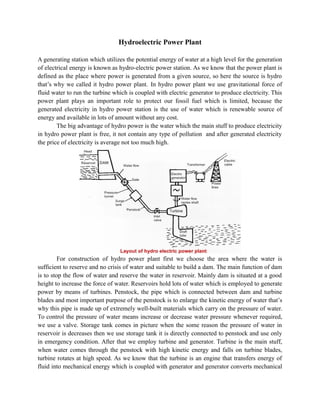
Hydroelectric Power Plant
A generating station which utilizes the potential energy of water at a high level for the generation
of electrical energy is known as hydro-electric power station. As we know that the power plant is
defined as the place where power is generated from a given source, so here the source is hydro
that’s why we called it hydro power plant. In hydro power plant we use gravitational force of
fluid water to run the turbine which is coupled with electric generator to produce electricity. This
power plant plays an important role to protect our fossil fuel which is limited, because the
generated electricity in hydro power station is the use of water which is renewable source of
energy and available in lots of amount without any cost.
The big advantage of hydro power is the water which the main stuff to produce electricity
in hydro power plant is free, it not contain any type of pollution and after generated electricity
the price of electricity is average not too much high.
For construction of hydro power plant first we choose the area where the water is
sufficient to reserve and no crisis of water and suitable to build a dam. The main function of dam
is to stop the flow of water and reserve the water in reservoir. Mainly dam is situated at a good
height to increase the force of water. Reservoirs hold lots of water which is employed to generate
power by means of turbines. Penstock, the pipe which is connected between dam and turbine
blades and most important purpose of the penstock is to enlarge the kinetic energy of water that’s
why this pipe is made up of extremely well-built materials which carry on the pressure of water.
To control the pressure of water means increase or decrease water pressure whenever required,
we use a valve. Storage tank comes in picture when the some reason the pressure of water in
reservoir is decreases then we use storage tank it is directly connected to penstock and use only
in emergency condition. After that we employ turbine and generator. Turbine is the main stuff,
when water comes through the penstock with high kinetic energy and falls on turbine blades,
turbine rotates at high speed. As we know that the turbine is an engine that transfers energy of
fluid into mechanical energy which is coupled with generator and generator converts mechanical
energy into electrical energy which we utilize at the end. In hydro power plant we also add
switchgears and protections which control and protect the whole process inside the plant. The
control equipments consists control circuits, control devices, warning, instrumentation etc and
connect to main control board. After generating electricity at low voltage, we use step up
transformer to enlarge the level of voltage (generally 132 KV, 220 KV, 400 KV and above) as per
our requirement. After that we transmit the electric power to the load center, and then we step
down the voltage for industrial and large consumer and then again we step down the voltage to
distribute electricity at domestic level which we used at home.
This is the whole process of generating electricity by the means of hydro (hydro power
plant) and then transmitting and distributing electricity.
Nuclear Fission Power Plant
Nuclear plants, like plants that burn coal, oil and natural gas, produce electricity by boiling water
into steam. This steam then turns turbines to produce electricity. The difference is that nuclear
plants do not burn anything. Instead, they use uranium fuel, consisting of solid ceramic pellets, to
produce electricity through a process called fission.
Nuclear power plants obtain the heat needed to produce steam through a physical process.
This process, called fission, entails the splitting of atoms of uranium in a nuclear reactor. The
uranium fuel consists of small, hard ceramic pellets that are packaged into long, vertical tubes.
Bundles of this fuel are inserted into the reactor.
Nuclear fuel consists of two types of uranium, U-238 and U-235. Most of the uranium in
nuclear fuel is U-238, but U-235 splits—or fissions—easily. In U-235 atoms, the nucleus, which
is composed of protons and neutrons, is unstable. As the nuclei break up, they release neutrons.
When the neutrons hit other uranium atoms, those atoms also split, releasing neutrons of their
own, along with heat. These neutrons strike other atoms, splitting them. One fission reaction
triggers others, which triggers still more until there is a chain reaction. When that happens,
fission becomes self-sustaining.
Rods inserted among the tubes holding the uranium fuel control the nuclear reaction.
Control rods, inserted or withdrawn to varying degrees, slow or accelerate the reaction. Water
separates fuel tubes in the reactor. The heat produced by fission turns this water into steam. The
steam drives a turbine, which spins a generator to create electricity.
Three types of reactors are used: (1) Pressurised Water Reactors [PWRs] (2) Boiling Water
Reactors [BWRs] and (3) Pressurised Heavy Water Reactors [PHWRs]
1. Pressurised Water Reactors (PWRs)
PWRs use light water (ordinary water) for neutron moderation (Moderation slows down
the speed of the neutrons so that fission may take place with U235 at a low enrichment) and
reactor heat removal. The water inside the primary cooling circuit of PWR is under high
pressure, and it will not turn into steam even under high temperature. The primary circuit and the
secondary circuit are completely separated, and heat energy will be transferred from the primary
circuit to the secondary circuit. With a lower pressure in the secondary circuit, steam is raised to
drive a turbine-generator to produce electricity. These reactors use U235 of a typically 3%-4.5%
enrichment.
PWR's two cooling systems separate the reactor cooling water and steam for power
generation. In the event of necessary venting, steam released will be free from radioactive
products.
2. Boiling Water Reactors (BWRs)
BWRs use light water for neutron moderation and reactor heat removal. The heat raises
steam directly in their reactor pressure vessel to drive a turbine-generator to produce electricity.
BWR's basic design is similar to that of PWR, except that it uses only one single circuit
in which the water is at lower pressure. As the water around the core of the reactor always
contains some traces of radionuclides, should necessary venting occur, any steam released could
contain radioactive products.
3. Pressurised Heavy Water Reactors [PHWRs]
This type of reactor uses Uranium at its natural level of around 0.7% U235 concentration
with no enrichment. It uses heavy water [Heavy water refers to water in which the ordinary
hydrogen atoms (containing only 1 proton in the nucleus) are replaced by heavier hydrogen
atoms (containing 1 proton and 1 neutron in the nucleus), which can help achieve a more
efficient fission process.] for neutron moderation and reactor heat removal. Heavy water absorbs
the fewest neutrons among common moderator material so that it will least suppress the chain
reaction. This heavy water flows inside pressure tubes filled with Uranium, taking away reactor
heat and delivering it to an adjoining circuit to raise steam and drive a turbine-generator for
production of electricity.
PWHR's pressurised tube design enables refueling of the reactor during operation, by
isolating individual pressure tubes from the cooling circuit.
Solar Power Plant
Solar power is attractive because it is abundant and offers a solution to fossil fuel emissions and
global climate change. Earth receives solar energy at the rate of approximately 1,73,000 TW.
This enormously exceeds both the current annual global energy consumption rate of about 15
TW, and any conceivable requirement in the future. India is both densely populated and has high
solar insolation, providing an ideal combination for solar power in India. India is already a leader
in wind power generation. In solar energy sector, some large projects have been proposed, and a
35,000 km² area of the Thar Desert has been set aside for solar power projects, sufficient to
generate 700 to 2,100 GW.
SOLAR THERMAL
Solar Energy ——>>> Heated Water ——->>> Electricity
Solar thermal electricity technologies produce electric power by converting the sun’s energy into
high-temperature heat using various mirror configurations, which is then channeled to an on-site
power plant and used to make electricity through traditional heat-conversion technologies. The
plant essentially consists of two parts; one that collects Solar energy and converts it to heat, and
another that converts the heat energy to electricity.
TYPES OF HEAT COLLECTORS:
Evacuated Glass Collector - Evacuated-tube collector consists of parallel rows of glass tubes
connected to a header pipe. Each tube has the air removed from it to eliminate heat loss through
convection and radiation. Evacuated-tube collectors fall into two main groups.
Direct-flow evacuated-tube collectors - These consist of a group of glass tubes inside each of
which is a flat or curved aluminium fin attached to a metal (usually copper) or glass absorber
pipe. The fin is covered with a selective coating that absorbs solar radiation well but inhibits
radiative heat loss. The heat transfer fluid is water and circulates through the pipes, one for inlet
fluid and the other for outlet fluid.
Heat pipe evacuated-tube collectors - These consist of a metal (copper) heat pipe, to which is
attached a black copper absorber plate, inside a vacuum-sealed solar tube. The heat pipe is
hollow and the space inside, like that of the solar tube, is evacuated. The reason for evacuating
the heat pipe, however, is not insulation but to promote a change of state of the liquid it contains.
Inside the heat pipe is a small quantity of liquid, such as alcohol or purified water plus special
additives. The vacuum enables the liquid to boil (i.e. turn from liquid to vapor) at a much lower
temperature than it would at normal atmospheric pressure. When solar radiation falls on the
surface of the absorber, the liquid within the heat tube quickly turns to hot vapor rises to the top
of the pipe. Water, or glycol, flows through a manifold and picks up the heat, while the fluid in
the heat pipe condenses and flows back down the tube for the process to be repeated.
Flat Plate Collector - Flat-plate collectors are the most common solar collectors for use in solar
water-heating systems in homes and in solar space heating. A flat-plate collector basically
consists of an insulated metal box with a glass or plastic cover (the glazing) and a dark-colored
absorber plate. Solar radiation is absorbed by the absorber plate and transferred to a fluid that
circulates through the collector in tubes. In an air-based collector the circulating fluid is air,
whereas in a liquid-based collector it is usually water.
Flat-plate collectors heat the circulating fluid to a temperature considerably less than that of the
boiling point of water and are best suited to applications where the demand temperature is 30-
70°C (86-158°F) and/or for applications that require heat during the winter months.
Air-based collectors are typically used for heating buildings and drying crops. Liquid-based may
be glazed or unglazed. Glazed liquid collectors are the commonest type of solar collector for
providing domestic and commercial water and for heating indoor swimming pools. Unglazed
collectors are often used for heating outdoor pools. A special type of unglazed collector called a
perforated plate collector is used to preheat ventilation air for commercial buildings or, in some
cases, for drying crops.
Flat collectors can be mounted in a variety of ways, depending on the type of building,
application, and size of collector. Options include mounting on a roof, in the roof itself, or free-
standing.
SOLAR PV
Solar Energy ——>>> Electricity
Solar Cell - A solar cell is a semiconductor device that transforms sunlight into electricity.
Semiconductor material is placed between two electrodes. When sunshine reaches the cell, free
negatively charged electrons are discharged from the material, enabling conversion to electricity.
This is the so-called photovoltaic effect. In theory, a solar cell made from one semiconductor
material only can convert about 30 percent of the solar radiation energy it is exposed to into
electricity. Commercial cells today, depending on technology, typically have an efficiency of 5
-12 percent for thin films and 13 – 21 percent for crystalline silicon based cells.
Efficiencies up to 25 percent have been reached by the use of laboratory processes. By using
multiple solar cells, efficiencies above 35 percent have been achieved.
Solar Photovoltaics - Photovoltaics has been derived from the combination of two words, Photo
means Light and Voltaic means electricity. It is a technology that converts light directly into
electricity. Photovoltaic material, most commonly utilizing highly-purified silicon, converts
sunlight directly into electricity.
The photovoltaic effect is the basic physical process through which a PV cell converts sunlight
into electricity. Sunlight is composed of photons, or particles of solar energy. These photons
contain various amounts of energy corresponding to the different wavelengths of the solar
spectrum. When photons strike a PV cell, they may be reflected or absorbed, or they may pass
right through. Only the absorbed photons generate electricity. When this happens, the energy of
the photon is transferred to an electron in an atom of the cell (which is actually a semiconductor).
With its newfound energy, the electron is able to escape from its normal position associated with
that atom to become part of the current in an electrical circuit. By leaving this position, the
electron causes a hole to form. Special electrical properties of the PV cell-a built-in electric field-
provide the voltage needed to drive the current through an external load (such as a light bulb).
To induce the electric field within a PV cell, two separate semiconductors are sandwiched
together. The p and n types of semiconductors correspond to positive and negative because of
their abundance of holes or electrons (the extra electrons make an n type because an electron has
a negative charge).Although both materials are electrically neutral, n-type silicon has excess
electrons and p-type silicon has excess holes. Sandwiching these together creates a p/n junction
at their interface, thereby creating an electric field. When the p-type and n-type semiconductors
are sandwiched together, the excess electrons in the n-type material flow to the p-type, and the
holes thereby vacated during this process flow to the n-type. (The concept of a hole moving is
somewhat like looking at a bubble in a liquid. Although it’s the liquid that is actually moving, it’s
easier to describe the motion of the bubble as it moves in the opposite direction.) Through this
electron and hole flow, the two semiconductors act as a battery, creating an electric field at the
surface where they meet (known as the junction). It’s this field that causes the electrons to jump
from the semiconductor out toward the surface and make them available for the electrical circuit.
At this same time, the holes move in the opposite direction, toward the positive surface, where
they await incoming electrons.
Wind Power Plant
Wind power is continuously growing in the world and acting as mainstream power supplier in
many countries instead of it is viewed as a intermittent source of energy. Wind Energy plays a
significance role in electricity supply. It contributes around 430 TWh to world electricity supply,
~ 2.5 % of global electricity demand in 2010.
Essential requirements for a wind farm
An area where a number of wind electric generators are installed is known as a wind farm. The
essential requirements for establishment of a wind farm for optimal exploitation of the wind are
1. High wind resource at particular site
2. Adequate land availability
3. Suitable terrain and good soil condition
4. Proper approach to site
5. Suitable power grid nearby
6. Techno-economic selection of WEGs
7. Scientifically prepared layout
Wind turbine Components
Rotor
The blades and the hub together are called the rotor. It is the rotating component which converts
kinetic energy available in the wind to mechanical energy. The rotor hub connects the rotor
blades to the rotor shaft. It is also the place where the power of the turbine is controlled
physically by pitching (A method of controlling the speed of a wind turbine by varying the
orientation, or pitch, of the blades, and thereby altering its aerodynamics and efficiency) the
blades. Hub is one of the critical components of the rotor requiring high strength qualities.
Blades
Blade is a rotating component designed aerodynamically to work on the principle of lift and drag
to convert kinetic energy of wind into mechanical energy which is transferred through shaft then
converted to electrical energy using generator. Most turbines have either two or three blades.
Wind blowing over the blades causes the blades to “lift” and rotate. Mechanical applications like
pumping water, grinding uses more number of blades as it requires more torque. Blade length is
key factor determining power generation capacity of a wind turbine.
Nacelle
The nacelle is an enclosure that sits atop the tower and contains the gear box, low-speed shaft
and high-speed shaft, generator, controller, and brake. Some nacelles are large enough for a
helicopter to land on. The nacelle also protects turbine components from atmospheric weather
conditions and reduces noise.
Low-speed shaft
Low-speed shaft is the principle-rotating element which transfers torque from the rotor to the rest
of drive train. It also supports the weight of the rotor. It is connected to the gear box to increase
the rpm.
Gear box
Gear box steps up the speed according to the requirement of the electric generator. Gears connect
the low-speed shaft to the high-speed shaft and increase the rotational speeds from about 30 to 60
rotations per minute (rpm) to about 1000 to 1800 rpm, the rotational speed required by most
generators to produce electricity. The gear box is one of the costliest (and heavy) parts of the
wind turbine and there are also “direct-drive” generators that operate at lower rotational speeds
and don’t need gear boxes.
High-speed shaft
Transmits the speed & torque from the gearbox and drives the generator.
Brake
During the periods of extremely high winds and maintenance, brakes are used to stop the wind
turbine for its safety.
Generator
Generator converts the rotational mechanical energy into electrical energy. Usually wind
electricgenerator produces 50-cycle AC electricity.
Types: i) Synchronous generator (Electrically excited, permanent magnet), ii) asynchronous
generator (Squirrel cage, Slipring)
Controller
The controller starts up the machine at cut-in wind speed (generally 3 m/s) and shuts off the
machine at cut-out wind speed (generally 25 m/s) as per the design requirement. The controllers
also operate the turbine to produce grid-quality electricity. The controller measures and controls
parameters like Voltage, current, frequency, Temperature inside nacelle, Wind direction, Wind
speed, The direction of yawing, shaft speed, Over-heating of the generator, Hydraulic pressure
level, Correct valve function, Vibration level, Twisting of the power cable, Emergency brake
circuit, Overheating of small electric motors for the yawing, hydraulic pumps, Brake-caliper
adjustment etc.
Anemometer
Anemometer is a sensor used for measuring the wind speed. Other than using it for wind
resource assessment, it is normally fixed on top of the wind turbine to provide input to the
controller for power regulation and braking beyond the cut out & survival wind speed .
Tower
The tower enables wind energy utilization at sufficient heights above ground, to absorb and
securely discharge static and dynamic stress exerted on the rotor, the power train and the nacelle
into the ground.
Types of Towers:
i) Tubular steel tower: Area of contact is more–hence more loading but evenly distribution–
attractive–cost is more.
ii) Tubular concrete: Area of contact is more– high elasticity – loading high but even
distribution–cost slightly less.
iii) Lattice tower: Area of contact is less–less loading –load distribution is uneven –
transportation / fabrication easy.
iv) Three legged tower: Area of contact is less–less loading –load distribution is uneven–
transportation / fabrication easy.
v) Guy wired tower: Area of contact is less – less loading – load distribution even –
transportation / fabrication easy and not suitable for huge wind turbines.
vi) Hybrid tower: A combination of tubular and lattice- Less obstruction- Strong
The main advantages of power generation from wind energy are:
1. The capital cost is comparable with conventional power plants. For a wind farm, the capital
cost ranges between 4.5 crores to 6.85 crores per MW, depending up on the type of turbine,
technology, size and location.
2. Construction time is less.
3. Fuel cost is zero.
4. O & M cost is very low.
5. Capacity addition can be in modular form.
6. There is no adverse effect on global environment. The whole system is pollution free and
environment friendly.
Limitation
1. Wind machines must be located where strong, dependable winds are available most of the
time.
2. Because winds do not blow strongly enough to produce power all the time, energy from wind
machines is considered “intermittent,” that is, it comes and goes. Therefore, electricity from wind
machines must have a back-up supply from another source.
3. As wind power is “intermittent,” utility companies can use it for only part of their total energy
needs.
4. Wind towers and turbine blades are subject to damage from high winds and lighting. Rotating
parts, which are located high off the ground can be difficult and expensive to repair.
5. Electricity produced by wind power sometimes fluctuates in voltage and power factor, which
can cause difficulties in linking its power to a utility system.
6. The noise made by rotating wind machine blades can be annoying to nearby neighbors.
7. People have complained about aesthetics of and avian mortality from wind machines.
Biomass Power
Biomass is defined as any organic matter that is available on a renewable or recurring basis. It
includes all plants and plant derived materials, including agricultural crops and trees, wood and
wood residues, grasses, aquatic plants, animal manure, municipal residues, and other residue
materials. Plants (on land or in water) use the light energy from the sun to convert water and
carbon dioxide to carbohydrates, fats, and proteins along with small amounts of minerals. The
carbohydrate component includes cellulose and hemi-cellulose fibers which gives strength to
plant structures and lignin which binds the fibers together. Some plants store starches and fats
(oils) in seeds or roots and simple sugars can be found in plant tissues.
Biomass is a renewable energy resource derived from the carbonaceous waste of various
human and natural activities. It is derived from numerous sources, including the by-products
from the timber industry, agricultural crops, raw material from the forest, major parts of
household waste and wood.
Industrial biomass can be grown from numerous types of plants including miscanthus,
switchgrass, hemp, corn, poplar, willow, sorgham, sugarcane, and a variety of tree species,
ranging from eucalyptus to oil palm (palm oil). The particular plant used is usually not important
to the end products, but it does affect the processing of the raw material.
Biomass is carbon, hydrogen and oxygen based. Nitrogen and small quantities of other
atoms, including alkali, alkaline earth and heavy metals can be found as well. Metals are often
found in functional molecules such as the porphyrins which include chlorophyll which contains
magnesium.
The chemical composition of biomass varies among different species, but in general
biomass consists of :
25% lignin
75% carbohydrates or sugars.
Within this range of lignin and carbohydrates most species also contain about 5% of a third
portion of smaller molecular fragments called extractives.
- Biomass does not add carbon dioxide to the atmosphere as it absorbs the same amount of
carbon in growing as it releases when consumed as a fuel. Its advantage is that it can be used to
generate electricity with the same equipment or power plants that are now burning fossil fuels.
Biomass is an important source of energy and the most important fuel worldwide after coal, oil
and natural gas.
- Although fossil fuels have their origin in ancient biomass, they are not considered biomass by
the generally accepted definition because they contain carbon that has been “out” of the carbon
cycle for a very long time. Their combustion therefore disturbs the carbon dioxide content in the
atmosphere
- Traditional use of biomass is more than its use in modern application. In the developed world
biomass is again becoming important for applications such as combined heat and power
generation. In addition, biomass energy is gaining significance as a source of clean heat for
domestic heating and community heating applications. In fact in countries like Finland, USA and
Sweden the per capita biomass energy used is higher than it is in India, China or in Asia.
- Instead of burning the loose biomass fuel directly, it is more practical to compress it into
briquettes (compressing them through a process to form blocks of different shapes) and thereby
improve its utility and convenience of use. Such biomass in the dense briquetted form can either
be used directly as fuel instead of coal in the traditional chulhas and furnaces or in the gasifier.
Gasifier converts solid fuel into a more convenient-to-use gaseous form of fuel called producer
gas.
- Biomass is renewable, as we’re going to carry on making waste products anyway. We can
always plant & grow more sugar cane and more trees, so those are renewable too.
There are five fundamental forms of biomass energy use:
(1) the “traditional domestic” use in developing countries (fuelwood, charcoal and
agricultural residues) for household cooking (e.g. the “three stone fire”), lighting and space-
heating. In this role-the efficiency of conversion of the biomass to useful energy generally lies
between 5% and 15%.
(2) the “traditional industrial” use of biomass for the processing of tobacco, tea, pig iron,
bricks & tiles, etc, where the biomass feedstock is often regarded as a “free” energy source.
There is generally little incentive to use the biomass efficiently so conversion of the feedstock to
useful energy commonly occurs at an efficiency of 15% or less.
(3) “Modern industrial.” Industries are experimenting with technologically advanced
thermal conversion technologies which are itemised below. Expected conversion efficiencies are
between 30 and 55%.
(4) newer “chemical conversion” technologies (“fuel cell”) which are capable of by-
passing the entropy-dictated Carnot limit which describes the maximum theoretical conversion
efficiencies of thermal units.
(5) “biological conversion” techniques, including anaerobic digestion for biogas
production and fermentation for alcohol.
In general, biomass-to-energy conversion technologies have to deal with a feedstock
which can be highly variable in mass and energy density, size, moisture content, and intermittent
supply. Therefore, modern industrial technologies are often hybrid fossil-fuel/biomass
technologies which use the fossil fuel for drying, preheating and maintaining fuel supply when
the biomass supply is interrupted.
Bioenergy conversion technologies
1. Direct combustion processes
Feedstocks used are often residues such as woodchips, sawdust, bark, hogfuel, black liquor,
bagasse, straw, municipal solid waste (MSW), and wastes from the food industry.
Direct combustion furnaces can be divided into two broad categories and are used for producing
either direct heat or steam. Dutch ovens, spreader-stoker and fuel cell furnaces employ two-
stages. The first stage is for drying and possible partial gasification, and the second for complete
combustion. More advanced versions of these systems use rotating or vibrating grates to
facilitate ash removal, with some requiring water cooling.
The second group, include suspension and fluidised bed furnaces which are generally
used with fine particle biomass feedstocks and liquids. In suspension furnaces the particles are
burnt whilst being kept in suspension by the injection of turbulent preheated air which may
already have the biomass particles mixed in it. In fluidised bed combustors, a boiling bed of pre-
heated sand (at temperatures of 500 to 900°C) provides the combustion medium, into which the
biomass fuel is either dropped (if it is dense enough to sink into the boiling sand) or injected if
particulate or fluid. These systems obviate the need for grates, but require methods of preheating
the air or sand, and may require water cooled injection systems for less bulky biomass feedstocks
and liquids.
i) Co-firing
A modern practice which has allowed biomass feedstocks an early and cheap entry point into the
energy market is the practice of co-firing a fossil-fuel (usually coal) with a biomass feedstock.
Co-firing has a number of advantages, especially where electricity production is an output.
Firstly, where the conversion facility is situated near an agro-industrial or forestry product
processing plant, large quantities of low cost biomass residues are available. These residues can
represent a low cost fuel feedstock although there may be other opportunity costs. Secondly, it is
now widely accepted that fossil-fuel power plants are usually highly polluting in terms of
sulphur, CO2 and other GHGs. Using the existing equipment, perhaps with some modifications,
and co-firing with biomass may represent a cost-effective means for meeting more stringent
emissions targets. Biomass fuel’s low sulphur and nitrogen (relative to coal) content and nearly
zero net CO2 emission levels allows biomass to offset the higher sulphur and carbon contents of
the fossil fuel. Thirdly, if an agro-industrial or forestry processing plant wishes to make more
efficient use of the residues generated by co-producing electricity, but has a highly seasonal
component to its operating schedule, co-firing with a fossil fuel may allow the economic
generation of electricity all year round. Agro-industrial processors such as the sugarcane sugar
industry can produce large amounts of electricity during the harvesting and processing season,
however, during the off-season the plant will remain idle. This has two drawbacks, firstly, it is an
inefficient use of equipment which has a limited life-time, and secondly, electrical distribution
utilities will not pay the full premium for electrical supplies which can’t be relied on for year
round production. In other words the distribution utility needs to guarantee year round supply
and may therefore, have to invest in its own production capacity to cover the off-season gap in
supply with associated costs in equipment and fuel. If however, the agro-processor can guarantee
electrical supply year-round through the burning of alternative fuel supplies then it will make
efficient use of its equipment and will receive premium payments for its electricity by the
distribution facility.
ii) Fluidized Bed Technology
The major portion of the coal available in India is of low quality, high ash content and low
calorific value. The traditional grate fuel firing systems have got limitations and are techno-
economically unviable to meet the challenges of future. Fluidized bed combustion has emerged
as a viable alternative and has significant advantages over conventional firing system and offers
multiple benefits – compact boiler design, fuel flexibility, higher combustion efficiency and
reduced emission of noxious pollutants such as SOx and NOx. The fuels burnt in these boilers
include coal, washery rejects, rice husk, bagasse and other agricultural wastes. The fluidized bed
boilers have a wide capacity range- 0.5 T/hr to over 100 T/hr.
2. Thermochemical processes
These processes do not necessarily produce useful energy directly, but under controlled
temperature and oxygen conditions are used to convert the original biomass feedstock into more
convenient forms of energy carriers, such as producer gas, oils or methanol. These carriers are
either more energy dense and therefore reduce transport costs, or have more predictable and
convenient combustion characteristics allowing them to be used in internal combustion engines
and gas turbine.
Gasification
A Biomass Gasifier converts solid fuel such as Wood Waste, Saw Dust briquettes and agro-
residues converted into briquettes into a gaseous fuel through a thermo-chemical process and the
resultant gas can be used for heat and power generation applications. The overall thermal
efficiency of this process is more than 75%. The combustible gas mixture, known as ‘producer
gas’, typically contains carbon monoxide (20% – 22%), hydrogen (12% – 15%), nitrogen (50% –
54%), carbon dioxide (9% – 11%) and methane (2% – 3%). The producer gas has relatively low
calorific value, ranging from 1000 to 1100 kCal.Nm3 (5500 MJ/Nm3).
High temperatures and a controlled environment leads to virtually all the raw material
being converted to gas. This takes place in two stages. In the first stage, the biomass is partially
combusted to form producer gas and charcoal. In the second stage, the C02 and H2O produced in
the first stage is chemically reduced by the charcoal, forming CO and H2. These stages are
spatially separated in the gasifier, with gasifier design very much dependant on the feedstock
characteristics. Gasification requires temperatures of about 800°C and is carried out in closed top
or open top gasifiers.
A major future role is envisaged for electricity production from biomass plantations and
agricultural residues using large scale gasifiers with direct coupling to gas turbines. The potential
gains in efficiency using such hybrid gasifier/gas turbine systems make them extremely attractive
for electricity generation once commercial viability has been demonstrated. Such systems take
advantage of low grade and cheap feedstocks (residues and wood produced using short rotation
techniques) and the high efficiencies of modern gas turbines to produce electricity at comparable
or less cost than fossil-fuel derived electricity. Net atmospheric CO2 emissions are avoided if
growth of the biomass is managed to match consumption. The use of BIG/STIG (Biomass
Integrated Gasifier Steam Injected Gas turbine) initially and BIG/GTCC (Biomass integrated
Gasifier Gas Turbine Combined Cycle) as the technology matures, is predicted to allow energy
conversion efficiencies of 40% to 55%. Modern coal electrical plants have efficiencies of about
35% or less. Combined Heat and Power systems could eventually provide energy at efficiencies
of between 50% to 80%. The use of low-grade feedstocks combined with high conversion
efficiencies makes these systems economically competitive with cheap coal-based plants and
energetically competitive with natural gas-based plants.
The gasification process comprises four stages:
Drying
Pyrolysis
Oxidation
Reduction
Type of Gas Engines used with Gasifiers :
For generating the power through Biomass Gasification, two type of engines are used :
100% Producer Gas Engines: These are Spark Ignition Gas Engines . These engines are
available in the market for natural gas application. We change the air manifold gas carburization
system to run the natural gas engine on Producer Gas. Number of Indian and overseas
manufacturers are also offering gas engines for producer gas applications, such as Cummins,
Greaves, Kohler etc.
Diesel Engine: The existing Diesel engine can be used for Duel Fuel applications. The Diesel
engine can be operated anytime on full diesel mode. So, one can run the diesel engine on full
Diesel mode or on Duel Fuel mode at his option.
We have the results of 5000 hours of running the diesel engine on Duel Fuel mode and we
found that wear & tear is less comparing to full diesel mode. Also emission is cleaner than 100%
diesel option.
Advantages of Biomass Gasification
 Low cost: 4 Kg. biomass replaces 1 liter petro-fuel. You can easily find out the per day
savings by installing the biomass gasifier.
 Extremely Clean Fuel: If you compare the emissions from the petro-fuels with the emissions
from producer gas, you will found SO2 free emission from gasifier.
 Reduces wood consumption up to 50% for institutional & industrial application, where still
wood is being used for thermal application
 Environmentally sound technology
 Easy to operate and maintain
 Provides energy security
 Generates local employment
 Replace the fossil fuels.
 Being renewable energy product, gasifiers are eligible for Carbon Credits under CDM
mechanism.
Magneto Hydrodynamic Power Generation
Principle of Operation
The basic principle of operation is based on Faraday’s law of electro magnetic induction,
which states an e.m.f. is induced in a conductor moving in magnetic field. The conductor may be
a soild, liquid or a gaseous one. The study of the dynamics of an electrically conducting fluid
interacting with a magnetic field, is called magneto hydro dynamics. In this method (Fig. 1.9)
gases at about 2500°C are passed through the MHD duct across which a strong magnetic field
has been applied. Since the gases are hot, and partly ionized they form an electrically conducting
conductor moving in the magnetic field. An e.m.f. (directcurrent) is thus induced, which can be
collected at suitable electrodes. Ionisation of the gas is done by thermal means (by elevated
temperature) or by seeding with substances like cesium or potassium vapours which ionize at
relatively low temperatures.
In practical MHD convertor systems, the energy of motion of the conducting fluid is derived
from heat obtained by burning a fossil fuel.For large power outputs,the gas must have a high
velocity,103 m/s and the applied magnetic field density must be as large as possible. Thermal
efficiency of about 50 to 60 percent shuold be possible if MHD conversion can be used as
topping cycle for a conventional steam power plant .
An electric conductor moving through a magnetic field experience a retarding force as well as an
induced electric field and current. This effect is a result of Faraday’s law of electromagnetic
induction. The induced emf is given by,
Eind= ⃗u×⃗B
Where, ⃗u =velocity of conductor and
⃗B = Magnetic field intensity.
The induced current density is given by,
⃗Jind = σ
⃗Eind , where σ is the electrical conductivity.
The retarding force on the conductor is the Lorentz force given by,
⃗Find=⃗Jind ×⃗B
The electro magnetic principle eed not be limited to solid conductors, can be usedfor electric
energy conversion when a conducting fluid is used(gas or liquid) and the technique is called
MHD energy conversion.
There are two types of cycle in Magnetohydrodynamic generation:
1 Open cycle MHD generation
2 Closed cycle MHD generation.
Open Cycle MHD Generation
The figure shows open cycle MHD generation consisting of a MHD generator resembles
shape of a rocket engine. Coal or natural gas is burned into combustor to produce hot gases. The
hot gas is then seeded with alkaline metals (cesium or potassium) to increase electrical
conductivity of of the gas. This gas then enters into a MHD generator which rocket engine is
shaped in which gas expands and electrical power is generated by accelerating gas ions towards
electrode and strong magnet.
Air preheater is used to preheat the air which is used as input hot air to the combustor.
Later on seed material is recovered from the gas and next on Nitrogen and Sulphur is extracted
from the gas to avoid air pollution and then flue gases are exhausted to the atmosphere with the
help of stack. The output of MHD generator which is surrounded by the huge magnet is in the
form of DC and then that DC is converted into AC with the help of inverter.
Closed cycle MHD Power Genaration
 HX1& HX2 - Heat exchanger 1 & 2
 S.T. - Steam Turbine
 CP - Compressor Product
 P - Removal of Nitrogen and Sulphur
 CS - Cessium injection
Closed cycle MHD generation consist of three distinct part but interlocked with each other. In
figure, at very left side heating loop in which air, coal and steam is used to be converted into
gasifier form at a temperature of 520℃ and this heated gas is then fed to the combustor in which
Argon gas is heated. The combustor product passes through the air preheater which preheats the
air and then fed as input to the combustor. After air preheater removal of Nitrogen and Sulphur
from the flue gases to decrease the air pollution and then this gas is exhausted to the atmosphere
through stack. Heated Argon gas is fed to the MHD generator which resembles rocket engine
shape surrounded by the huge magnet. During the expansion of the Argon gas into MHD
generator, conversion of mechanical energy into electrical energy take place and then converted
into 3Ø AC with the help of inverter. The speed of the gas is slowed down with the help of
diffuser and then heat of the gas is utilized in heat exchanger 2 and water get get converted into
steam. Steam is partially used to drive compressor and partially used to generate electrical power
with the help of alternator. The Argon gas is recycled and fed back to heat exchanger 1 through
the compressor and intercooler.
Advantages og MHD systems
 Conversion efficiency of about 50% .
 Less fuel consumption.
 Large amount of pollution free power generated .
 Ability to reach full power level as soon as started.
 Plant size is considerably smaller than conventional fossil fuel plants .
 Less overall generation cost.
 No moving parts, so more reliable
Disadvantages
 Suffers from reverse flow (short circuits) of electrons through the conducting fluids
around the ends of the magnetic field.
 Needs very large magnets and this is a major expense.
 High friction and heat transfer losses.
 High operating temperature.
 Coal used as fuel poses problem of molten ash which may short circuit the
electrodes. Hence, oil or natural gas are much better fuels for MHDs.
Restriction on use of fuel makes the operation more expensive.
Applications
 Power generation in space craft.
 Hypersonic wind tunnel experiments.
 Defense application.
FUEL CELL
A fuel cell is like a battery in that it generates electricity from an electrochemical
reaction. A fuel celluses an external supply of chemical energy and can run indefinitely, as long
as it is supplied with a source of hydrogen and a source of oxygen (usually air). The source of
hydrogen is generally referred to as the fuel and this gives the fuel cell its name, although there is
no combustion involved. Oxidation of the hydrogen instead takes place electrochemically in a
very efficient way. During oxidation, hydrogen atoms react with oxygen atoms to form water; in
the process electrons are released and flow through an external circuit as an electric current.
Basic energy conversion of a fuel cell was described as:
Chemical energy of fuel = Electrical energy + Heat energy
At the negative electrode,
H2=H+
+ 2e-
H2 atoms react with hydroxyl group in electrolyte to form water and when the cell is operating,
the electrons flow through the external load to the positive terminal and interact with the oxygen
and water from electrolyte to form hydroxyl ions,
1
2 O2+H2O+2e-
=2OH-
Also,
H+
+OH-
=H2O
The overall reaction during the process can be expressed as,
H2+
1
2 O2=H2O
Fuel cells can vary from tiny devices producing only a few watts of electricity, right up to
large power plants producing megawatts. All fuel cells are based around a central design using
two electrodes separated by a solid or liquid electrolyte that carries electrically charged particles
between them. A catalyst is often used to speed up the reactions at the electrodes. Fuel cell types
are generally classified according to the nature of the electrolyte they use. Each type requires
particular materials and fuels and is suitable for different applications.
Classification of fuel cell
I.Based on the temperature range in which they operate
Low temperature(25-1000
)
Medium temperature(100-5000
C)
High temperature(above 10000
C
II.Based on the physical state of fuel
Gas- hydrogen and lower hydrocarbons
Liquid- alcohols, hydrazine, higher hydrocarbons
Solid- metals
Another classification is primary and secondary fuel cell.
Primary FC is one in which the reactants are passed through the cell only once and the
products of reaction being discarded(eg: H2 –O2 fuel cell). Secondary FC one in which the
reactants are passed through the cell many times because they are regenerated from the products
by thermal, electrical, photochemical methods( eg:Nitric oxide-chlorine fuel cell)
Types of fuel cell
1 Hydrogen FC
2 Fossil FC(PAC,MCFC,SOFC)
3 Hydrocarbon FC
4 Alcohol FC
5 Hydrazine FC
PAFC – Phosphoric Acid Fuel Cells
Electrolyte: liquid phosphoric acid in a bonded silicon carbide matrix
Use a finely dispersed platinum catalyst on carbon
Quite resistant to poisoning by carbon monoxide
Operate at around 180oC
Electrical efficiency is relatively low, but overall efficiency can be over 80% if the heat is used
Used in stationary power generators (100 kW to 400 kW)
ALKALINE FUEL CELL (AFC)
Electrolyte: alkaline solution such as potassium hydroxide in water
Commonly use a nickel catalyst
Generally fuelled with pure hydrogen and oxygen as they are very sensitive to poisoning
Typical operating temperatures are around 70oC
Can offer high electrical efficiencies
Tend to have relatively large footprints
Used on NASA shuttles throughout the space programme
SOLID OXIDE FUEL CELL (SOFC)
Electrolyte: solid ceramic, such as stabilised zirconium oxide
A precious metal catalyst is not necessary
Can run on hydrocarbon fuels such as methane
Operate at very high temperatures, around 800oC to 1,000oC
Best run continuously due to the high operating temperature
Popular in stationary power generation
MOLTEN CARBONATE FUEL CELL (MCFC)
Electrolyte: a molten carbonate salt suspended in a porous ceramic matrix
A precious metal catalyst is not necessary
Can run on hydrocarbon fuels such as methane
Operate at around 650oC
Best run continuously due to the high operating temperature
Most fuel cell power plants of megawatt capacity use MCFCs, as do large combined heat and
power plants
FUEL CELL PERFORMANCE
The performance of a fuel cell is governed by its Polarization Curve.
This type of performance curve shows the DC voltage delivered at the cell terminals as a
function of the current density (current per unit area of membrane) being drawn by the external
load.
In practical fuel cell, the theoretical voltage is not attained. The difference between the
theoretical and the actual voltage is known as polarisaton. Three types of polarization are,
1 Activation polarization(Chemical polrisation): At low current densities significant
number of electrons are not emitted,which result in this type of loss. This process requires
that certain minimum activation energy supplies so that sufficient number of electrons are
emitted.
2 Resistance polarization: Voltage reduction is due to the internal resistance composed of
electrode resistance,interface contact resistance between electrode and electrolyte etc.
3 Concentration polarization: Electrode side polarization is due to slow diffusion in the
electrolyte causing a change in concentration at the electrode. Effect can be minimized by
increasing electrolyte concentration or by stirring or circulating the electrode. Gas side
polarization is caused from slow diffusion of reactants through a porous electrode to the
reaction site, or slow diffusion of products away from reaction site.
All the losses can be decreased by increasing temperature
Voltage efficiency,
η v=
Operatingvoltage
theoritical voltage =
onload voltage
opencicuitvoltage =
V
E
where, V=operating voltage at a given current density
E= the theoretical open circuit voltage
In an analogus manner if we are taking the heat input for the electrochemical energy
convertor should be taken as the enthalpy of the reaction (∆H). The work output in an
electrochemical energy convertor which operates at thermodynamic reversible potential of
the cell is the free energy change of the reaction (∆Wmax=∆G), The ideal efficiency of an
electrochemical convertor can be defind as,
ηi =
∆G
∆ H =-
nFE
∆ H
where, n=no. of electrons transferred per molecule of the reactant.
F= Faraday’s constant
E= e.m.f of the cell
Generally, ∆G is quite close to ∆H and hence the efficiency will be close to unity. In practical
fuel cells, the terminal potential decreases with increasing current density drawn from the
cell.due to the polarization effects.
When the terminal potential is E, the energy output during the formation of 1mole of products in
the cell becomes nFE. Under these conditions, efficiency,
η m= -
nFE
∆ H
The magnitude of each type of over potential increases with current density drawn from the cell
and the terminal voltage, thereby decreasing the efficiency.
The loss in efficiency may also be due to incomplete conversion of the reactants at each
electrode to their corresponding products.
Nuclear Fusion Power Plant
Fusion power is energy generated by nuclear fusion. Fusion reactions fuse two lighter
atomic nuclei to form a heavier nucleus. It is a major area of plasma physics research that
attempts to harness such reactions as a source of large scale sustainable energy. Fusion reactions
are how stars transmute matter into energy. In most large scale commercial programs, heat from
neutron scattering in a controlled reaction is used to operate a steam turbine that drives electric
generators. Many fusion concepts are under investigation. Nuclear fusion is similar to nuclear
fission. Once the fusion process is achieved, the way both fusion and fission power plants
generate electricity is somewhat similar.
Mechanism
Fusion reactions occur when two (or more) atomic nuclei come close enough for long
enough that the strong nuclear force pulling them together exceeds the electrostatic force pushing
them apart, fusing them into heavier nuclei. For nuclei lighter than iron-56, the reaction is
exothermic, releasing energy. For nuclei heavier than iron-56, the reaction is endothermic,
requiring an external source of energy. Hence, nuclei smaller than iron-56 are more likely to fuse
while those heavier than iron-56 are more likely to break apart.
The strong force acts only over short distances. The repulsive electrostatic force acts over longer
distances, so kinetic energy is needed to overcome this "Coulomb barrier" before the reaction can
take place. Ways of doing this include speeding up atoms in a particle accelerator, or heating
them to high temperatures.
Once an atom is heated above its ionization energy, its electrons are stripped away (it is ionized),
leaving just the bare nucleus (the ion). The result is a hot cloud of ions and the electrons formerly
attached to them. This cloud is known as a plasma. Because the charges are separated, plasmas
are electrically conductive and magnetically controllable. Many fusion devices take advantage of
this to control the particles as they are heated.
Power production
Steam turbines It has been proposed that steam turbines be used to convert the heat from the
fusion chamber into electricity. The heat is transferred into a working fluid that turns into steam,
driving electric generators.
(Refer nuclear fission reactors)
Energy from waste
Waste-to-energy uses trash as a fuel for generating power, just as other power plants use coal, oil,
or natural gas. The burning fuel heats water into steam that drives a turbine to create electricity.
The process can reduce a community’s landfill volume by up to 90 percent, and prevent one ton
of carbon dioxide release for every ton of waste burned.
Using waste as a combustion material can reduce landfill volumes by more than 90
percent. Waste to Energy prevents one ton of CO2 release for every ton of waste burned and
eliminates methane that would have leaked with landfill disposal.
Best practices rely on the "three Rs": Reuse, Reduce, Recycle. Recycling plastics, glass,
paper, metals, and wood from the waste stream reduces the carbon and pollutants created in the
burn process. Materials such as kitchen refuse, bio waste, and commercial garbage are ideal for
combustion
Material Process
Waste material is received in an enclosed receiving area, where it is more thoroughly mixed in
preparation for combustion. Negative airflow will carry dust and odor into the combustion
chamber from the receiving area, along with the waste to eliminate its spread outside the facility.
Efficient Combustion
Mixed waste enters the combustion chamber on a timed moving grate, which turns it over
repeatedly to keep it exposed and burning—the way turning over or poking a fireplace log
brightens the fire. A measured injection of oxygen and fumes drawn from the receiving area
makes for a more complete burn.
Fly Ash Capture
Although fly ash is captured throughout the process, the finest airborne particulates are removed
in the filter baghouse, where an induction fan draws air through fabric bags toward the stack or
chimney. This process removes 96 percent of any remaining particulates. The bags are vibrated at
intervals to shake loose particulates caked on their inner and outer surfaces. Captured fly ash is
often returned to landfills.
Acid Gas Treatment
The acidic combustion gasses are neutralized with an injection of lime or sodium hydroxide. The
chemical reaction produces gypsum. This process removes 94 percent of the hydrochloric acid.
Bottom Ash Recycling
The unburned remains of combustion—"bottom ash"—are passed by magnets and eddy current
separators to remove both ferrous (steel and iron) and other metals—such as copper, brass,
nickel, and aluminum—for recycling. The remaining ash can be used as aggregate for roadbeds
and rail embankments. Ash is generated at a ratio of about 10 percent of the waste’s original
volume and 30 percent of the waste’s original weight.
Steam Power Generation
Highly efficient superheated steam powers the steam turbine generator. The cooling steam is
cycled back into water through the condensor or diverted as a heat source for buildings or
desalinization plants. Cooled stream is reheated in the economizer and superheater to complete
the steam cycle.
Mercury and Heavy Metal Capture
Activated carbon (charcoal treated with oxygen to increase its porosity) is injected into the hot
gases to absorb and remove heavy metals, such as mercury and cadmium.
NOX Treatment Dioxins/Furans Treatment
Nitrogen oxide in the rising burn gases is neutralized by the injection of ammonia or urea.
Dioxins and furans are destroyed by exposing flue gases to a sustained temperature of
1,562°F/850°C for two seconds. This process removes more than 99 percent of dioxins and
furans.
Electric Power and Heat
A 1,000 ton-per-day WTE plant produces enough electricity for 15,000 households. Each ton of
waste can power a household for a month. If combined with a cogeneration plant design, WTE
plants can, while producing electricity, also supply heat for nearby businesses, desalination
plants and other purposes.
Energy Plantations
Technically speaking, energy plantation means growing select species of trees and shrubs
which are harvestable in a comparably shorter time and are specifically meant for fuel. The
fuel wood may be used either directly in wood burning stoves and boilers or processed into
methanol, ethanol and producer gas. These plantations help provide wood either for cooking in
homes or for industrial use, so as to satisfy local energy needs in a decentralised manner.
The energy plantations provide almost inexhaustible renewable sources (with total time
constant of 3-8 years only for each cycle) of energy which are essentially local and
independent of unreliable and finite sources of fuel . The attractive features of energy
plantations are: (a) heat content of wood is similar to that of Indian coal, (b) wood is low in
sulphur and not likely to pollute the atmosphere, (c) ash from burnt wood is a valuable
fertiliser, (d) utilisation of erosion prone land for raising these plantations helps to reduce wind
and water erosion, thereby minimising hazards from floods, siltation, and loss of nitrogen and
minerals from soil and (e) help in rural employment generation - it is estimated that an hectare
of energy plantation is estimated to provide employment for at least seven persons regularly.
Selection of multipurpose species provides a number of by-products like oils, organic
compounds, fruits, edible leaves, forage for livestock, etc.
Energy plantations / forests as a source of raw materials which strived itself has many
advantages, among others :
1. Energy plantations can be made so that the internal control of raw material for wood pellet
business easier, as fluctuations in supply, changes in market prices, irrespective of the sources of
waste wood and so on.
2. Byproducts of energy plantations as the leaves can be used for livestock such as cattle or
sheep, and honey bee farm that utilizes the flowers of energy crops.
3. Wood pellet mill site could be very close or even in the midst of the energy plantations (raw
material oriented), so the cost / price of cheap raw materials.
4. Energy plantations also absorb CO2 from the atmosphere (Carbon negative), application of
wood pellets is carbon neutral activity that can be included in carbon trading, climate change
mitigation through afforestation (planting / addition of carbon stocks), and the construction unit
of SFM (Sustainable Forest Management)
5. The pattern of mixed supply of raw materials with partly from energy plantations owned
company (the core) and others belonging to the community (plasma) can be done. This pattern
will include the role of the community and develop it.
6.Additional income by utilizing the sidelines of energy crops with other crops (agroforestry
models) so that the cultivation of polyculture are more resistant to disease.
7. Uncultivated land or marginal land that the millions of hectares can be utilized effectively.
8. Fertilize and improve soil conditions, including the prevention of erosion. Calliandra plant
roots in the form of a pimple is able to bind nitrogen that fertilizes the soil.
9. Short crop harvest and grow again, without the need for replanting. Energy crops such as
calliandra only be planted once and then grow again after the cut (harvest) for decades, more
results and very easy maintenance.
10. Development or enlargement wood pellet plant capacity is possible as long as the land is still
available. And this time there are still millions of hectares of potential for the creation of the
energy plantations.
Module II
Energy storage and Distribution – Electrical energy route – Load curves – Energy
conversionplants for Base load , Intermediate load, Peak load and Energy displacement
– Energy storage plants
Energy Scenario – Global and Indian –Impact of Energy on economy, development and
environment, Energy policies, Energy strategy for future
Energy storage for power systems
A typical electricity bulk supply power system consists of central generating stations
(supply side) connected to a transmission system. This bulk supply system is joined to the
distribution system which comprises a sub transmission system of primarily distribution feeders
and secondary circuits. An energy storage unit can be connected to the transmission, sub
transmission or distribution system in a manner similar to customer-owned conventional or
renewable generation facilities such as gas or wind turbines. These dispersed sources are able to
change the character of a typical electricity power system completely.
Consider the typical weekly load curve with and without energy storage, as shown in Fig.
As illustrated by the upper curve, the intermediate and peaking power involves extensive
generating capacity. If large-scale energy storage were available, as illustrated by the lower curve
of Fig., then the relatively efficient and economical base power plants could be used to charge
the storage units during off-peak demand (lower shaded areas in Fig.)
Discharge of the stored energy (upper shaded areas) during periods of peak load demand would
then reduce or replace fuel-burning peaking plant capacity, thus conserving (mostly oil-based)
fuel resources. Use of energy storage to generate peaking power in this manner is termed 'peak
shaving'. The higher base-load level may replace part of the intermediate generation thus
performing load leveling and enabling the more extensive use of storage to eliminate most or all
conventional intermediate cycling equipment. Assuming that new base load plants use non-oil
based fuel, there are further savings of both cost and of oil resources.
Energy Storage Techniques
1. Thermal Energy Storage
Direct storage of heat in insulated solids or fluids is possible even at comparatively low
temperatures, but energy can only be recovered effectively as heat. Hot rocks and fireplace
bricks have served as primitive heat storage devices from ancient times. This is still the case in
industrial furnaces and in the baker's electric oven, where cheap electricity is used to heat the
oven during the night. High temperature thermal storage can be used both to utilise heat in
industrial processes and for heat engines. One recent example is the power supply for Stirling
engines.
There are two thermal energy storage (TES) mechanisms:
(i) Sensible heat storage, based on the heat capacity of the storage medium; and
(ii) Latent heat storage, based on the energy associated with a change of phase for the
storage medium (melting, evaporation or structural change).
Energy can be stored as sensible heat by virtue of a rise in temperature of the storage
medium. Water is excellent for this purpose, not only because of its low cost but also because of
its high heat capacity (4180 J/kg/°C).
Another large class of storage media is phase-change materials. These are materials
which melt and freeze at a particular temperature of interest and have a large latent heat of fusion
and crystallisation. They have the advantage over sensible heat storage of a higher energy density
of storage per degree of temperature change, over the limited temperature range surrounding the
fusion point, and can essentially supply heat at constant temperature.
2. Flywheel Storage
Storing energy in the form of mechanical kinetic energy (for comparatively short periods of
time) in flywheels has been known for centuries, and is now being considered again for a much
wider field of utilisation, competing with electrochemical batteries. In inertial energy storage
systems, energy is stored in the rotating mass of a flywheel. The rotating mass stores the short
energy input so that rotation can be maintained at a fairly constant rate. Flywheels have been
applied in steam and combustion engines for the same purpose.
3. Pumped Hydro Storage
Pumped hydro storage is the only large energy storage technique widely used in power systems.
For decades, utilities have used pumped hydro storage as an economical way to utilise off-peak
energy, by pumping water to a reservoir at a higher level. During peak load periods the stored
water is discharged through the pumps, then acting as turbines, to generate electricity to meet the
peak demand. Thus, the main idea is conceptually simple. Energy is stored as hydraulic potential
energy by pumping water from a low-level into a higher level reservoir. When discharge of the
energy is required, the water is returned to the lower reservoir through turbines which drive
electricity generators. Pumped hydro storage usually comprises the following parts: an upper
reservoir, waterways, a pump, a turbine, a motor, a generator and a lower reservoir, shown
schematically in Fig.
4. Compressed Air Energy Storage
Simple-Cycle Gas Turbine Modified
To CAES Configuration
1 cooler
2 compressor
3 air
4 clutch
5 generator/motor
6 power supply
7 turbine
8 combustor
9 fuel
10 valve
11 air storage cavity
In this case, compressed gas is the medium which allows us to use mechanical energy storage.
When a piston is used to compress a gas, energy is stored in it which can be released when
necessary to perform useful work by reversing the movement of the piston. Pressurised gas
therefore acts as an energy storage medium.
Load profile/ Load Curve
A load profile is a graph of the variation in the electrical load versus time. A load profile will
vary according to customer type (typical examples include residential, commercial and
industrial), temperature and holiday seasons. Power producers use this information to plan how
much electricity they will need to make available at any given time.
In a power system, a load curve or load profile is a chart illustrating the variation in
demand/electrical load over a specific time. Generation companies use this information to plan
how much power they will need to generate at any given time. A load duration curve is similar to
a load curve. The information is the same but is presented in a different form. These curves are
useful in the selection of generator units for supplying electricity.
Types of load curves
1 Daily load curve –Load variations during the whole day
2 Monthly load curve – Load curve obtained from the daily load curve
3 Yearly load curve - Load curve obtained from the monthly load curve
BASE LOAD:
The unvarying load which occurs almost the whole day on the station
PEAK LOAD:
The various peak demands of load of the station
Connected Load
It is the sum of continuous ratings of all the equipment connected to supply system
Maximum Demand
It is the greatest demand of load on the power station during a given period
Demand Factor
It is the ratio of maximum demand on the power station to its connected load
Average load
The average of loads occurring on the power station in a given period (day or month or year)
Daily average load = (No of units KWh generated in a day)/(24 hours)
Monthly average load = (No of units KWh generated in a day)/(Number of hours in a month)
Yearly average load = (No of units KWh generated in a day)/(8760 hours)
Load factor
The ratio of average load to the maximum demand during a given period.
Load factor = (Average load) / (Maximum demand)
Diversity factor
The ratio of the sum of individual maximum demands to the maximum demand on power station.
Diversity factor = (Sum of individual maximum demands) / (Max demand on power station)
Plant capacity factor
It is the ratio of actual energy produced to the maximum possible energy that could have been
produced during a given period.
Plant capacity factor = (Actual energy produced) / (Max energy that could have been produced)
Plant use factor
It is the ratio of kWh generated to the product of plant capacity and the number of hours for
which the plant was in operation.
Plant use factor = (Station output in kWh) / (Plant capacity X Hours of use)
Load Forecasting
 Estimating power demand at the various load buses ahead of time
 Required for planning and operational applications.
 Make a statistical analysis of previous load data and set up a suitable model of the
demand pattern.
 Utilize the identified load model for making a prediction of the estimated demand for the
selected load time.
 Forecasting interval – Few seconds to few years.
Electrical Power Transmission System
Electrical power is generated at different generating stations. These generating stations are not
necessarily situated at the load center. During construction of generating station number of
factors are to be considered from economical point of view. These all factors may not be easily
available at load center; hence generating stations are not normally situated very nearer to load
center. Load center is the place where maximum power is consumed. Hence there must be some
means by which the generated power must be transmitted to the load center. Electrical
transmission system is the means of transmitting power from generating station to different load
centers.
Factor to be Considered for Constructing a Generating Station
During planning of construction of generating station the following factors to be considered for
economical generation of electrical power.
1 Easy availability of water for thermal power generating station.
2 Easy availability of land for construction of power station.
3 For hydro power station there must be a dam on river. So proper place on the river must
be chosen in such a way that the construction of the dam can be done in most optimum
way.
4 For thermal power station easy availability of fuel is one of the most important factors to
be considered.
5 Better communication for goods as well as employees of the power station also to be kept
into consideration.
6 For transporting very big spare parts of turbines, alternators etc, there must be wide road
ways, train communication, and deep and wide river must pass away nearby the power
station.
7 For nuclear power plant, it must be situated in such a distance from common location so
that there may be any effect from nuclear reaction the heath of common people.
The power generated at generating station is in low voltage level as low voltage power
generation has some economical values. Low voltage power generation is more economical than
high voltage power generation. At low voltage level, both weight and insulation is less in the
alternator, this directly reduces the cost and size of alternator. But this low voltage level power
cannot be transmitted directly to the consumer end as because this low voltage power
transmission is not at all economical. Hence although low voltage power generation is
economical but low voltage electrical power transmission is not economical. Electrical power is
directly proportional to the product of electrical current and voltage of system. So for
transmitting certain electrical power from one place to another, if the voltage of the power is
increased then associated current of this power is reduced. Reduced current means less I2
R loss
in the system, less cross sectional area of the conductor means less capital involvement and
decreased current causes improvement in voltage regulation of power transmission system and
improved voltage regulation indicates quality power. Because of these three reasons electrical
power mainly transmitted at high voltage level. Again at distribution end for efficient distribution
of the transmitted power, it is stepped down to its desired low voltage level. So it can be
concluded that first the electrical power is generated at low voltage level then it stepped up to
high voltage for efficient transmission of electrical energy. Lastly for distribution of electrical
energy or power to different consumers it is stepped down to desired low voltage level.
Transmission of Electrical Energy
Fundamentally there are two systems by which electrical energy can be transmitted.
1 High voltage DC electrical transmission system.
2 High AC electrical transmission system.
There are some advantages in using DC transmission system-
 Only two conductors are required for DC transmission system. It is further possible to use
only one conductor of DC transmission system if earth is utilized as return path of the
system.
 The potential stress on the insulator of DC transmission system is about 70 % of same
voltage AC transmission system. Hence, less insulation cost is involved in DC
transmission system.
 Inductance, capacitance, phase displacement and surge problems can be eliminated in DC
system.
Even having these advantages in DC system, generally electrical energy is transmitted by three
(3) phase AC transmission system.
 The alternating voltages can easily be stepped up and down, which is not possible in DC
transmission system.
 Maintenance of AC substation is quite easy and economical compared to DC.
But AC transmission system also has some disadvantages like,
 The volume of conductor used in AC system is much higher than that of DC.
 The reactance of the line, affects the voltage regulation of electrical power transmission
system.
 Problems of skin effects and proximity effects only found in AC system.
 AC transmission system is more likely to be affected by corona effect than DC system.
 Construction of AC electrical power transmission network is more completed than DC
system.
 Proper synchronizing is required before inter connecting two or more transmission lines
together, synchronizing can totally be omitted in DC transmission system.
Base Load and Peak Load
Load, in electrical engineering, is the amount of current being drawn by all the components
(appliances, motors, machines, etc.).
Load is further categorised as base load and peak load depending upon the nature of the electrical
components connected. As you may be familiar, all electrical appliances at your home do not run
at all times.
 A toaster or microwave oven may be used for a few minutes,
 A television or computer may be used for a few hours
 Lighting in the house is only required during the evening and so on.
There are several appliances which keep running at all the times, no matter what. The
refrigerator, for example, has to be plugged in at all the times. Another such example are the
heating, ventilation and cooling systems in the house (HVAC system).
Base load is the minimum level of electricity demand required over a period of 24 hours. It is
needed to provide power to components that keep running at all times (also referred as
continuous load).
Peak load is the time of high demand. These peaking demands are often for only shorter
durations. In mathematical terms, peak demand could be understood as the difference between
the base demand and the highest demand.
Now going back to the examples of household loads: microwave oven, toaster and television are
examples of peak demand, whereas refrigerator and HVAC systems are examples of base
demand.
Now on a broader perspective, it could be assumed that the electrical grid is a big household.
Under normal circumstances, the power required by the electrical grid is fairly constant during
various period of the day.
This constant power, which is required at all times, is called the base loading. But during a
special event, like the final match of World Cup, the demand will be more, as a lot of people will
watch TV. This short, high demand period is considered to be a peak loading.
Plants that are running continuously over extended periods of time are said to be base load power
plant.
The power from these plants is used to cater the base demand of the grid. A power plant may run
as a base load power plant due to various factors (long starting time requirement, fuel
requirements, etc.).
Examples of base load power plants are:
1 Nuclear power plant
2 Coal power plant
3 Hydroelectric plant
4 Geothermal plant
5 Biogas plant
6 Biomass plant
7 Solar thermal with storage
8 Ocean thermal energy conversion
To cater the demand peaks, peak load power plants are used. They are started up whenever there
is a spike in demand and stopped when the demand recedes.
Examples of gas load power plants are:
1 Gas plant
2 Solar power plants
3 Wind turbines
4 Diesel generators
Energy Scenario – Global and Indian
Energy is one of the major inputs for the economic development of any country. In the case of
the developing countries, the energy sector assumes a critical importance in view of the ever
increasing energy needs requiring huge investments to meet them.
Energy can be classified into several types based on the following criteria:
• Primary and Secondary energy
• Commercial and Non commercial energy
• Renewable and Non-Renewable energy
Primary and Secondary Energy
Primary energy sources are those that are either found or stored in nature. Common primary
energy sources are coal, oil, natural gas, and biomass (such as wood). Other primary energy
sources available include nuclear energy from radioactive substances, thermal energy stored in
earth's interior, and potential energy due to earth's gravity. The major primary and secondary
energy sources are shown in Figure.
Primary energy sources are mostly converted in industrial utilities into secondary energy sources;
for example coal, oil or gas converted into steam and electricity. Primary energy can also be used
directly. Some energy sources have non-energy uses, for example coal or natural gas can be used
as a feedstock in fertiliser plants.
Commercial Energy and Non Commercial Energy
Commercial Energy
The energy sources that are available in the market for a definite price are known as
commercial energy. By far the most important forms of commercial energy are electricity, coal
and refined petroleum products. Commercial energy forms the basis of industrial, agricultural,
transport and commercial development in the modern world. In the industrialized countries,
commercialized fuels are predominant source not only for economic production, but also for
many household tasks of general population. Examples: Electricity, lignite, coal, oil, natural gas
etc.
Non-Commercial Energy
The energy sources that are not available in the commercial market for a price are
classified as non-commercial energy. Non-commercial energy sources include fuels such as
firewood, cattle dung and agricultural wastes, which are traditionally gathered, and not bought at
a price used especially in rural households. These are also called traditional fuels. Non-
commercial energy is often ignored in energy accounting. Example: Firewood, agro waste in
rural areas; solar energy for water heating.
Renewable and Non-Renewable Energy
Renewable energy is energy obtained from sources that are essentially inexhaustible.
Examples of renewable resources include wind power, solar power, geothermal energy, tidal
power and hydroelectric power The most important feature of renewable energy is that it can be
harnessed without the release of harmful pollutants.
Non-renewable energy is the conventional fossil fuels such as coal, oil and gas, which are
likely to deplete with time.
Global Primary Energy Consumption
The global primary energy consumption at the end of 2012 was equivalent to 12500 million
tonnes of oil equivalent (Mtoe). The Figure shows in what proportions the sources mentioned
above contributed to this global figure.
The primary energy consumption for few of the developed and developing countries is shown in
Table. It may be seen that India's absolute primary energy consumption is only 1/29th
of the
world, 1/7th
of USA, 1/1.6th
time of Japan but 1.1, 1.3, 1.5 times that of Canada, France and U.K
respectively.
Energy Distribution Between Developed and Developing Countries
Although 80 percent of the world's population lies in the developing countries (a fourfold
population increase in the past 25 years), their energy consumption amounts to only 40 percent
of the world total energy consumption. The high standards of living in the developed countries
are attributable to high energy consumption levels. Also, the rapid population growth in the
developing countries has kept the per capita energy consumption low compared with that of
highly industrialized developed countries. The world average energy consumption per person is
equivalent to 2.2 tonnes of coal. In industrialized countries, people use four to five times more
than the world average and nine times more than the average for the developing countries. An
American uses 32 times more commercial energy than an Indian.
Indian Energy Scenario
Coal dominates the energy mix in India, contributing to 55% of the total primary energy
production. Over the years, there has been a marked increase in the share of natural gas in
primary energy production from 10% in 1994 to 13% in 1999. There has been a decline in the
share of oil in primary energy production from 20% to 17% during the same period.
Energy Supply Coal
Supply India has huge coal reserves, at least 84,396 million tonnes of proven recoverable
reserves (at the end of 2003). This amounts to almost 8.6% of the world reserves and it may last
for about 230 years at the current Reserve to Production (R/P) ratio. In contrast, the world's
proven coal reserves are expected to last only for 192 years at the current R/P ratio.
India is the fourth largest producer of coal and lignite in the world. Coal production is
concentrated in these states (Andhra Pradesh, Uttar Pradesh, Bihar, Madhya Pradesh,
Maharashtra, Orissa, Jharkhand, West Bengal).
Oil Supply
Oil accounts for about 36 % of India's total energy consumption. India today is one of the top ten
oil-guzzling nations in the world and will soon overtake Korea as the third largest consumer of
oil in Asia after China and Japan. The country's annual crude oil production is peaked at about 32
million tonne as against the current peak demand of about 110 million tonne. India imports 70%
of its crude needs mainly from gulf nations. The majority of India's roughly 5.4 billion barrels in
oil reserves are located in the Bombay High, upper Assam, Cambay, Krishna-Godavari. In terms
of sector wise petroleum product consumption, transport accounts for 42% followed by domestic
and industry with 24% and 24% respectively.
Natural Gas Supply
Natural gas accounts for about 8.9 per cent of energy consumption in the country. The current
demand for natural gas is about 96 million cubic metres per day (mcmd) as against availability of
67 mcmd. Natural gas reserves are estimated at 660 billion cubic meters.
Electrical Energy Supply
The all India installed capacity of electric power generating stations under utilities was 1,12,581
MW as on 31st May 2004, consisting of 28,860 MW- hydro, 77,931 MW - thermal and 2,720
MW- nuclear and 1,869 MW- wind (Ministry of Power).
Nuclear Power Supply
Nuclear Power contributes to about 2.4 per cent of electricity generated in India. India has ten
nuclear power reactors at five nuclear power stations producing electricity. More nuclear reactors
have also been approved for construction.
Hydro Power Supply
India is endowed with a vast and viable hydro potential for power generation of which only 15%
has been harnessed so far. The share of hydropower in the country's total generated units has
steadily decreased and it presently stands at 25%. It is assessed that exploitable potential at 60%
load factor is 84,000 MW.
Final Energy Consumption
Final energy consumption is the actual energy demand at the user end. This is the difference
between primary energy consumption and the losses that takes place in transport, transmission &
distribution and refinement. The actual final energy consumption is given in Table.
Sector Wise Energy Consumption in India
The major commercial energy consuming sectors in the country are classified as shown in the
Figure. As seen from the figure, industry remains the biggest consumer of commercial energy
and its share in the overall consumption is 49%.
Energy Needs for Economic Development
Energy is the lifeblood of the global economy – a crucial input to nearly all of the goods
and services of the modern world. Stable, reasonably priced energy supplies are central to
maintaining and improving the living standards of billions of people.
Economic growth is desirable for developing countries, and energy is essential for
economic growth. However, the relationship between economic growth and increased energy
demand is not always a straightforward linear one. For example, under present conditions, 6%
increase in India's Gross Domestic Product (GDP) would impose an increased demand of 9 % on
its energy sector. In this context, the ratio of energy demand to GDP is a useful indicator. A high
ratio reflects energy dependence and a strong influence of energy on GDP growth. The
developed countries, by focusing on energy efficiency and lower energy-intensive routes,
maintain their energy to GDP ratios at values of less than 1. The ratios for developing countries
are much higher.
Labour and Employment
The energy sector directly employs fewer people than might be expected given its share of GDP,
especially when compared to other industries. Energy-related industries do not have a large need
for labour, but the workers they hire are relatively highly skilled and highly paid. As a result of
their high salaries, employees of the energy industry contribute more absolute spending per
capita to the economy than the average worker. High wages in the sector reflect the fact that
energy industry workers are much more productive than average, contributing a larger share of
GDP per worker than most other workers in the economy.
Capital and Investment
The energy industry is one of the most capital-consuming industries in the world. These large
capital expenditures flow through the economy, creating additional jobs, tax revenues and GDP
by creating demand for intermediate goods and services.
Role of Energy Prices in the Economy
In addition to the energy sector’s economic contributions in general, relatively lower and stable
energy prices help stimulate the economy. First, lower energy prices reduce expenses for
consumers and businesses, increasing disposable income that can be spent in other ways. Second,
lower energy prices reduce input costs for nearly all goods and services in the economy, thus
making them more affordable.
Stable Tax and Fiscal Schemes to Support Development
Countries make different decisions about how to generate revenue from the energy industry,
ranging from direct investments through national oil companies to the hands-off approach of an
income tax.
Energy and Environment
The usage of energy resources in industry leads to environmental damages by polluting the
atmosphere. Few of examples of air pollution are sulphur dioxide (SO2), nitrous oxide (NOX) and
carbon monoxide (CO) emissions from boilers and furnaces, chloro-fluro carbons (CFC)
emissions from refrigerants use, etc. In chemical and fertilizers industries, toxic gases are
released. Cement plants and power plants spew out particulate matter.
Air Pollution
A variety of air pollutants have known or suspected harmful effects on human health and the
environment. These air pollutants are basically the products of combustion from fossil fuel use.
Air pollutants from these sources may not only create problems near to these sources but also can
cause problems far away. Air pollutants can travel long distances, chemically react in the
atmosphere to produce secondary pollutants such as acid rain or ozone.
Climatic Change
Human activities, particularly the combustion of fossil fuels, have made the blanket of
greenhouse gases (water vapour, carbon dioxide, methane, ozone etc.) around the earth thicker.
The resulting increase in global temperature is altering the complex web of systems that allow
life to thrive on earth such as rainfall, wind patterns, ocean currents and distribution of plant and
animal species.
Acid Rain
Acid rain is caused by release of SOX and NOX from combustion of fossil fuels, which then mix
with water vapour in atmosphere to form sulphuric and nitric acids respectively
Heavy Metals and Lead
Particulate metals in air result from activities such as fossil fuel combustion (including vehicles),
metal processing industries and waste incineration. There are currently no emission standards for
metals other than lead. Lead is a cumulative poison to the central nervous system, particularly
detrimental to the mental development of children. Lead is the most widely used non-ferrous
metal and has a large number of industrial applications. Its single largest industrial use
worldwide is in the manufacture of batteries and it is also used in paints, glazes, alloys, radiation
shielding, tank lining and piping. As tetraethyl lead, it has been used for many years as an
additive in petrol; with the increasing use of unleaded petrol, however, emissions and
concentrations in air have reduced steadily in recent years.
TOMPs (Toxic Organic Micropollutants)
TOMPs are produced by the incomplete combustion of fuels. They comprise a complex range of
chemicals some of which, although they are emitted in very small quantities, are highly toxic or
and carcinogenic.
Energy policy of India
The energy policy of India is largely defined by the country's expanding energy deficit and
increased focus on developing alternative sources of energy, particularly nuclear, solar and wind
energy.
The primary energy consumption in India is the third biggest after China and USA with 5.3%
global share in 2015. The total primary energy consumption from crude oil (29.45%), natural gas
(7.7%), coal (54.5%), nuclear energy (1.26%), hydro electricity (5.0%), wind power, biomass
electricity and solar power is 595 Mtoe (millions of tonnes of oil equivalent) (excluding
traditional biomass use) in 2013. In 2013, India's net imports are nearly 144.3 million tons of
crude oil, 16 Mtoe of LNG and 95 Mtoe coal totalling to 255.3 Mtoe of primary energy which is
equal to 42.9% of total primary energy consumption. About 70% of India's electricity generation
capacity is from fossil fuels. India is largely dependent on fossil fuel imports to meet its energy
demands — by 2030, India's dependence on energy imports is expected to exceed 53% of the
country's total energy consumption. In 2009-10, the country imported 159.26 million tonnes of
crude oil which amounts to 80% of its domestic crude oil consumption and 31% of the country's
total imports are oil imports. By the end of calendar year 2015, India has become a power
surplus country with huge power generation capacity idling for want of electricity demand.
Due to rapid economic expansion, India has one of the world's fastest growing energy markets
and is expected to be the second-largest contributor to the increase in global energy demand by
2035, accounting for 18% of the rise in global energy consumption. Given India's growing
energy demands and limited domestic fossil fuel reserves, the country has ambitious plans to
expand its renewable and most worked out nuclear power programme. India has the world's fifth
largest wind power market and also plans to add about 100,000 MW of solar power capacity by
2020. India also envisages to increase the contribution of nuclear power to overall electricity
generation capacity from 4.2% to 9% within 25 years. The country has five nuclear reactors
under construction (third highest in the world) and plans to construct 18 additional nuclear
reactors (second highest in the world) by 2025.
Energy Strategy for the Future
The energy strategy for the future could be classified into immediate, medium-term and long
term strategy. The various components of these strategies are listed below:
Immediate-term strategy:
• Rationalizing the tariff structure of various energy products.
• Optimum utilization of existing assets
• Efficiency in production systems and reduction in distribution losses, including those in
traditional energy sources.
• Promoting R&D, transfer and use of technologies and practices for environmentally sound
energy systems, including new and renewable energy sources.
Medium-term strategy:
• Demand management through greater conservation of energy, optimum fuel mix, structural
changes in the economy, an appropriate model mix in the transport sector, i.e. greater
dependence on rail than on road for the movement of goods and passengers and a shift away
from private modes to public modes for passenger transport; changes in design of different
products to reduce the material intensity of those products, recycling, etc.
• There is need to shift to less energy-intensive modes of transport. This would include measures
to improve the transport infrastructure viz. roads, better design of vehicles, use of compressed
natural gas (CNG) and synthetic fuel, etc. Similarly, better urban planning would also reduce
the demand for energy use in the transport sector.
• There is need to move away from non-renewable to renewable energy sources viz. solar, wind,
biomass energy, etc.
Long-term strategy:
 Efficient generation of energy resources
• Efficient production of coal, oil and natural gas
• Reduction of natural gas flaring
 Improving energy infrastructure
• Building new refineries
• Creation of urban gas transmission and distribution network
• Maximizing efficiency of rail transport of coal production.
• Building new coal and gas fired power stations.
 Enhancing energy efficiency
• Improving energy efficiency in accordance with national, socio-economic, and
environmental priorities
• Promoting of energy efficiency and emission standards
• Labeling programmes for products and adoption of energy efficient technologies in large
industries
 Deregulation and privatization of energy sector
• Reducing cross subsidies on oil products and electricity tariffs
• Decontrolling coal prices and making natural gas prices competitive
• Privatization of oil, coal and power sectors for improved efficiency.
 Investment legislation to attract foreign investments.
• Streamlining approval process for attracting private sector participation in power
generation, transmission and distribution.

Energy management notes

  • 1.
    13.801 ENERGY MANAGEMENT(MP) Teaching Scheme: 2(L)-1(T)-0(P) Credits: 3 Course Objective: The main objective of this course is  To provide students with a general awareness on the importance of energy and its conservation, its impact on society, various energy sources, energy conversion processes, energy management, energy audit and energy conservation measures. Module I Energy resources, Energy conversion processes and devices – Energy conversion plants – Conventional - Thermal, Hydro, Nuclear fission , and Non – conventional – Solar, Wind Biomass, Fuel cells, Magneto Hydrodynamics and Nuclear fusion. Energy from waste, Energy plantation. Module II Energy storage and Distribution – Electrical energy route – Load curves – Energy conversionplants for Base load , Intermediate load, Peak load and Energy displacement – Energy storage plants Energy Scenario – Global and Indian –Impact of Energy on economy, development and environment, Energy policies, Energy strategy for future Module III Energy Management – Definitions and significance – objectives –Characterizing of energy usage – Energy Management program – Energy strategies and energy planning Energy Audit – Types and Procedure – Optimum performance of existing facilities – Energy management control systems – Computer applications in Energy management Module IV Energy conservation – Principles – Energy economics – Energy conservation technologies – cogeneration – Waste heat recovery – Combined cycle power generation – Heat Recuperators – Heat regenerators – Heat pipes – Heat pumps – Pinch Technology Energy Conservation Opportunities – Electrical ECOs – Thermodynamic ECOs in chemical process industry – ECOs in residential and commercial buildings – Energy Conservation Measures. References: 1. Amlan Chakrabarti, Energy Engineering and Management, Prentice hall India 2011 2. T.D.Eastop and D.R. Croft, Energy Efficiency for Engineers & Technologists, Longman,1990. 3. Albert Thumann, P.E, C.E.M and Wlliam.J.Younger, C E.M, Handbook of Energy Audits, Fairmont Press Ltd,2009. 4. Wayne.C.Turner ,Energy Management Hand book, Fairmont Press Ltd.,2012 5. S.Rao and Dr.B.B.Parulekar, Energy Technology, Khanna Publishers,2012 6. G.D. Rai, Non – Conventional Energy Sources, Khanna Publishers,2010
  • 2.
    Internal Continuous Assessment(Maximum Marks-50) 50% - Tests (minimum 2) 30% - Assignments (minimum 2) such as home work, problem solving, quiz, literature survey, seminar, term-project, software exercises, etc. 20% - Regularity in the class University Examination Pattern: Examination duration: 3 hours Maximum Total Marks: 100 The question paper shall consist of 2 parts. Part A (20 marks) - Ten Short answer questions of 2 marks each. All questions are compulsory. There should be at least two question from each module and not more than three questions from any module. Part B (80 Marks) - Candidates have to answer one full question out of the two from each module. Each question carries 20 marks. Course outcomes: After completion of this course the students will be able  To have an understanding of the impact of energy on society, the need for sustainable energy, global and Indian energy policies.  To gain knowledge on various techniques of energy management and conservation.  To gain the basic ideas of conducting energy audit
  • 3.
    Module I Energy resources,Energy conversion processes and devices – Energy conversion plants – Conventional - Thermal, Hydro, Nuclear fission , and Non – conventional – Solar, Wind Biomass, Fuel cells, Magneto Hydrodynamics and Nuclear fusion. Energy from waste, Energy plantation. Energy Resources Energy is the main ‘fuel’ for social and economic development of a nation. World energy resources are the estimated maximum capacity for energy production given all available resources on Earth. They can be divided by type into fossil fuel, nuclear fuel and renewable resources. 1. Fossil fuel Coal Oil Natural gas 2. Nuclear fuel Nuclear energy Nuclear fusion 3. Renewable resources Solar energy Wind power Wave and tidal power Geothermal Biomass Hydropower Energy conversion Energy conversion is the transformation of energy from forms provided by nature to forms that can be used by humans. Over the centuries a wide array of devices and systems has been developed for this purpose. Some of these energy converters are quite simple. The early windmills, for example, transformed the kinetic energy of wind into mechanical energy for pumping water and grinding grain. Other energy-conversion systems are decidedly more complex, particularly those that take raw energy from fossil fuels and nuclear fuels to generate electrical power. Systems of this kind require multiple steps or processes in which energy undergoes a whole series of transformations through various intermediate forms. Many of the energy converters widely used today involve the transformation of thermal energy into electrical energy. The efficiency of such systems is, however, subject to fundamental limitations, as dictated by the laws of thermodynamics and other scientific principles. In recent
  • 4.
    years, considerable attentionhas been devoted to certain direct energy-conversion devices, notably solar cells and fuel cells, that bypass the intermediate step of conversion to heat energy in electrical power generation. The concept of energy conservation A fundamental law that has been observed to hold for all natural phenomena requires the conservation of energy—i.e., that the total energy does not change in all the many changes that occur in nature. The conservation of energy is not a description of any process going on in nature, but rather it is a statement that the quantity called energy remains constant regardless of when it is evaluated or what processes—possibly including transformations of energy from one form into another—go on between successive evaluations. The law of conservation of energy is applied not only to nature as a whole but to closed or isolated systems within nature as well. Thus, if the boundaries of a system can be defined in such a way that no energy is either added to or removed from the system, then energy must be conserved within that system regardless of the details of the processes going on inside the system boundaries. A corollary of this closed-system statement is that whenever the energy of a system as determined in two successive evaluations is not the same, the difference is a measure of the quantity of energy that has been either added to or removed from the system in the time interval elapsing between the two evaluations. Energy can exist in many forms within a system and may be converted from one form to another within the constraint of the conservation law. These different forms include gravitational, kinetic, thermal, elastic, electrical, chemical, radiant, nuclear, and mass energy. It is the universal applicability of the concept of energy, as well as the completeness of the law of its conservation within different forms, that makes it so attractive and useful. HISTORY OF ENERGY-CONVERSION TECHNOLOGY 1. Early attempts to harness natural forms of energy Early humans first made controlled use of an external, nonanimal energy source when they discovered how to use fire. Burning dried plant matter (primarily wood) and animal waste, they employed the energy from this biomass for heating and cooking. The generation of mechanical energy to supplant human or animal power came very much later—only about 2,000 years ago— with the development of simple devices to harness the energy of flowing water and of wind. 2. Waterwheels The earliest machines were waterwheels, first used for grinding grain. They were subsequently adopted to drive sawmills and pumps, to provide the bellows action for furnaces and forges, to drive tilt hammers or trip-hammers for forging iron, and to provide direct mechanical power for textile mills. Until the development of steam power during the Industrial Revolution at the end of
  • 5.
    the 18th century,waterwheels were the primary means of mechanical power production, rivaled only occasionally by windmills. 3. Windmills Windmills, like waterwheels, were among the original prime movers that replaced animal muscle as a source of power. They were used for centuries in various parts of the world, converting the energy of the wind into mechanical energy for grinding grain, pumping water, and draining lowland areas. The earliest known references to wind-driven grain mills, found in Arabic writings of the 9th century. Wind-driven pumps remain important today in many rural parts of the world. They continued to be used in large numbers, even in the United States, well into the 20th century until low-cost electric power became readily available in rural areas. Although rather inefficient, they are rugged and reliable, need little attention, and remain a prime source for pumping small amounts of water wherever electricity is not economically available. DEVELOPMENTS OF THE INDUSTRIAL REVOLUTION 1. Steam engines The rapid growth of industry in Britain from about the mid-18th century (and somewhat later in various other countries) created a need for new sources of motive power, particularly those independent of geographic location and weather conditions. This situation, together with certain other factors, set the stage for the development and widespread use of the steam engine, the first practical device for converting thermal energy to mechanical energy. 2. Internal-combustion engines While the steam engine remained dominant in industry and transportation during much of the 19th century, engineers and scientists began developing other sources and converters of energy. One of the most important of these was the internal-combustion engine. In such a device a fuel and oxidizer are burned within the engine and the products of combustion act directly on piston or rotor surfaces. By contrast, an external-combustion device, such as the steam engine, employs a secondary working fluid that is interposed between the combustion chamber and power- producing elements. By the early 1900s the internal-combustion engine had replaced the steam engine as the most broadly applied power-generating system not only because of its higher thermal efficiency (there is no transfer of heat from combustion gases to a secondary working fluid that results in losses in efficiency) but also because it provided a low-weight, reasonably compact, self-contained power plant. 3. Electric generators and motors Other important energy-conversion devices emerged during the 19th century. During the early 1830s the English physicist and chemist Michael Faraday discovered a means by which to convert mechanical energy into electricity on a large scale. While engaged in experimental work on magnetism, Faraday found that moving a permanent magnet into and out of a coil of wire
  • 6.
    induced an electriccurrent in the wire. This process, called electromagnetic induction, provided the working principle for electric generators. 4. Direct energy-conversion devices Most of these energy converters, sometimes called static energy-conversion devices, use electrons as their “working fluid” in place of the vapour or gas employed by such dynamic heat engines as the external-combustion and internal-combustion engines mentioned above. In recent years, direct energy-conversion devices have received much attention because of the necessity to develop more efficient ways of transforming available forms of primary energy into electric power. Four such devices—the electric battery, the fuel cell, the thermoelectric generator (or at least its working principle), and the solar cell—had their origins in the early 1800s. MODERN DEVELOPMENTS The 20th century brought a host of important scientific discoveries and technological advances, including new and better materials and improved methods of fabrication. These developments permitted the enhancement and refinement of many of the energy-conversion devices and systems that had been introduced during the previous century, as exemplified by the remarkable evolution of jet engines and rockets. They also gave rise to entirely new technologies. 1. Fission reactors Scientists first learned of the tremendous energy bound in the nucleus of the atom during the early years of the century. In 1942 they succeeded in unleashing that energy on a large scale by means of what was called an atomic pile. This was the first nuclear fission reactor, a device designed to induce a self-sustaining and controlled series of fission reactions that split heavy nuclei to release their energy. In a power-generation system of this kind, much of the energy released by the fissioning of heavy nuclei (principally those of the radioactive isotope uranium-235) takes the form of heat, which is used to produce steam. This steam drives a turbine, the mechanical energy of which is converted to electricity by a generator. 2. Fusion reactors In the late 1930s Hans A. Bethe, a German-born physicist, recognized that the fusion of hydrogen nuclei to form deuterium releases energy. Since that time scientists have sought to harness such thermonuclear reactions for practical energy production. Much of their work has centred on the use of magnetic fields and electromagnetic forces to confine plasma, an exceedingly hot gas composed of unbound electrons, ions, and neutral atoms and molecules. Plasma is the only state of matter in which thermonuclear reactions can be induced and sustained to generate usable amounts of thermal energy. The difficulty is in confining plasma long enough for this to happen. Although researchers have made significant headway toward constructing fusion reactors capable of such confinement, no device of this kind has been developed sufficiently for commercial application.
  • 7.
    3. Other conversiontechnologies Energy requirements for space vehicles led to an intensive investigation, from 1955 on, of all possible energy sources. Direct energy-conversion devices are of interest for providing electric power in spacecraft because of their reliability and their lack of moving parts. As have solar cells, fuel cells, and thermoelectric generators, thermionic power converters have received considerable attention for space applications. Thermionic generators are designed to convert thermal energy directly into electricity. The required heat energy may be supplied by chemical, solar, or nuclear sources, the latter being the preferred choice for current experimental units. Another direct energy converter with considerable potential is the magnetohydrodynamic (MHD) power generator. This system produces electricity directly from a high-temperature, high- pressure electrically conductive fluid—usually an ionized gas—moving through a strong magnetic field. The hot fluid may be derived from the combustion of coal or other fossil fuel. The first successful MHD generator was built and tested during the 1950s.
  • 8.
    Thermal Power Plant 1.Steam turbine power plant (Coal Based) At present 54% of total electricity production in India is from Coal Based Thermal Power Station. A coal based thermal power plant converts the chemical energy of the coal into electrical energy. This is achieved by raising the steam in the boilers, expanding it through the turbine and coupling the turbines to the generators which converts mechanical energy into electrical energy. In a coal based power plant coal is transported from coal mines to the power plant by railway in wagons. Coal is unloaded from the wagons to a moving underground conveyor belt. This coal from the mines is of no uniform size. So it is taken to the Crusher house and crushed to a size of 20mm. From the crusher house the coal is either stored in dead storage( generally 40 days coal supply) which serves as coal supply in case of coal supply bottleneck or to the live storage(8 hours coal supply) in the raw coal bunker in the boiler house. Raw coal from the raw coal bunker is supplied to the Coal Mills by a Raw Coal Feeder. The Coal Mills or pulverizer pulverizes the coal. The powdered coal from the coal mills is carried to the boiler in coal pipes by high pressure hot air. The pulverized coal air mixture is burnt in the boiler in the combustion zone. Generally in modern boilers tangential firing system is used i.e. the coal nozzles/ guns form tangent to a circle. The temperature in fire ball is of the order of 1300 o C. Water is converted to steam in the boiler and steam is separated from water in the boiler Drum. The saturated steam from the boiler drum is taken to the Superheater for superheating. The
  • 9.
    superheated steam fromthe superheater is taken to the High Pressure Steam Turbine (HPT). In the HPT the steam pressure is utilized to rotate the turbine and the resultant is rotational energy. From the HPT the out coming steam is taken to the Reheater in the boiler to increase its temperature as the steam becomes wet at the HPT outlet. After reheating this steam is taken to the Intermediate Pressure Turbine (IPT) and then to the Low Pressure Turbine (LPT). The outlet of the LPT is sent to the condenser for condensing back to water by a cooling water system. This condensed water is collected in the Hotwell and is again sent to the boiler in a closed cycle. The rotational energy imparted to the turbine by high pressure steam is converted to electrical energy in the Generator. Components of Coal Fired Thermal Power Station 1. Coal Preparation Fuel preparation system: In coal-fired power stations, the raw feed coal from the coal storage area is first crushed into small pieces and then conveyed to the coal feed hoppers at the boilers. The coal is next pulverized into a very fine powder, so that coal will undergo complete combustion during combustion process. Dryers: they are used in order to remove the excess moisture from coal mainly wetted during transport. As the presence of moisture will result in fall in efficiency due to incomplete combustion and also result in CO emission. Magnetic separators: coal which is brought may contain iron particles. These iron particles may result in wear and tear. The iron particles may include bolts, nuts wire fish plates etc. so these are unwanted and so are removed with the help of magnetic separators. Fuel storage: Fuel storage is insurance from failure of normal operating supplies to arrive 2. Economiser It is located below the LPSH in the boiler and above pre heater. It is there to improve the efficiency of boiler by extracting heat from flue gases to heat water and send it to boiler drum. 3. Air Preheater The heat carried out with the flue gases coming out of economiser are further utilized for preheating the air before supplying to the combustion chamber. It is a necessary equipment for supply of hot air for drying the coal in pulverized fuel systems to facilitate grinding and satisfactory combustion of fuel in the furnace. 4. Reheater Power plant furnaces may have a reheater section containing tubes heated by hot flue gases outside the tubes. Exhaust steam from the high pressure turbine is rerouted to go inside the reheater tubes to pickup more energy to go drive intermediate or lower pressure turbines. 5. Steam turbines Steam turbines have been used predominantly as prime mover in all thermal power stations. The steam turbines are mainly divided into two groups: - Impulse turbine and Impulse- reaction turbine.
  • 10.
    The turbine generatorconsists of a series of steam turbines interconnected to each other and a generator on a common shaft. There is a high pressure turbine at one end, followed by an intermediate pressure turbine, two low pressure turbines, and the generator. 6. Condenser The condenser condenses the steam from the exhaust of the turbine into liquid to allow it to be pumped. The functions of a condenser are: (1) To provide lowest economic heat rejection temperature for steam. (2) To convert exhaust steam to water for reserve thus saving on feed water requirement. (3) To introduce make up water. 7. Boiler feed pump Boiler feed pump is a multi-stage pump provided for pumping feed water to economiser. 8. Ash handling system The disposal of ash from a large capacity power station is of same importance as ash is produced in large quantities. Ash handling is a major problem. Different types are Manual handling, Mechanical handling and Electrostatic precipitator. 9. Generator Generator or Alternator is the electrical end of a turbo-generator set. It is generally known as the piece of equipment that converts the mechanical energy of turbine into electricity. The generation of electricity is based on the principle of electromagnetic induction. Advantages of coal based thermal Power Plant  They can respond to rapidly changing loads without difficulty  A portion of the steam generated can be used as a process steam in different industries  Steam engines and turbines can work under 25 % of overload continuously  Fuel used is cheaper  Cheaper in production cost in comparison with that of diesel power stations Disadvantages of coal based thermal Power Plant  Maintenance and operating costs are high  Long time required for erection and putting into action  A large quantity of water is required  Great difficulty experienced in coal handling  Presence of troubles due to smoke and heat in the plant  Unavailability of good quality coal  Maximum of heat energy lost  Problem of ash removing Note: The major portion of the coal available in India is of low quality, high ash content and low calorific value. The traditional grate fuel firing systems have got limitations and are techno- economically unviable to meet the challenges of future. Fluidized bed combustion has emerged
  • 11.
    as a viablealternative and has significant advantages over conventional firing system and offers multiple benefits – compact boiler design, fuel flexibility, higher combustion efficiency and reduced emission of noxious pollutants such as SOx and NOx. The fuels burnt in these boilers include coal, washery rejects, rice husk, bagasse & other agricultural wastes. Fluidized Bed Combustion (FBC) boilers In which evenly distributed air or gas is passed upward through a finely divided bed of solid particles such as sand supported on a fine mesh, the particles are undisturbed at low velocity. As air velocity is gradually increased, a stage is reached when the individual particles are suspended in the air stream – the bed is called “fluidized”. With further increase in air velocity, there is bubble formation, vigorous turbulence, rapid mixing and formation of dense defined bed surface. The bed of solid particles exhibits the properties of a boiling liquid and assumes the appearance of a fluid – “bubbling fluidized bed”. At higher velocities, bubbles disappear, and particles are blown out of the bed. Therefore, some amounts of particles have to be recirculated to maintain a stable system – “circulating fluidised bed”. If sand particles in a fluidized state is heated to the ignition temperatures of coal, and coal is injected continuously into the bed, the coal will burn rapidly and bed attains a uniform temperature. The fluidized bed combustion (FBC) takes place at about 840OC to 950OC. Since this temperature is much below the ash fusion temperature, melting of ash and associated problems are avoided.
  • 12.
    2. Gas turbinepower plant Gas turbine is a rotary type internal combustion thermal prime mover. The gas turbine plant work on gas power cycle. Of the various means of producing mechanical power, the gas turbine is in many respects the most satisfactory one. Its outstanding advantages are: - exceptional reliability, - freedom from vibration, - ability to utilize grades of fuel not suitable for high performance spark-ignition engines, and - ability to produce large bulk of power from units of comparatively small size and weight. Three major elements (components) required to execute its power cycle are: - a compressor, - a combustion chamber, and - a turbine. The main operations of a gas turbine plant consists of - compression of cool air in a rotary compressor, - heating of this air by the combustion of fuel in the combustion chamber, and - expansion of this hot high pressure gas in a turbine. In continuous-combustion gas turbine, the fuel is burnt at constant pressure. In this gas turbine, combustion being continuous process, valves are not necessary, and it is now generally accepted that this type of turbine has greater possibilities for turbine used in industry and in aero engines. Continuous-combustion gas turbine, is further classified as open cycle and closed cycle. In the more common open cycle gas turbine, fresh atmospheric air is drawn into the circuit continuously and heat is added by the combustion of fuel in the working fluid itself. In this case the products of combustion are expanded through the turbine and exhausted to atmosphere. In the closed cycle, the same working fluid, be it air or some other gas, is repeatedly re-circulated through the plant components. Principles of working of Ideal Open Cycle gas Turbine Figure shows flow diagram, P-V diagram and T-S diagram of a simple continuous- combustion (constant pressure) open cycle gas turbine. Air from surrounding atmosphere is drawn into the compressor at point 1 and is compressed to the combustion pressure of about 400 KN/m. The air is then delivered at point 2 to the annular combustion chamber. This chamber consists of inner and outer casings. The inner casing acts as a combustion chamber. Out of the total air delivered by the compressor about one-fourth, known as primary air, is used for the combustion of fuel. The oil enters the combustion chamber (inner casing) through a burner. The purpose of the burner is to inject fuel oil into combustion chamber at constant pressure. The remaining three-fourth air, known as secondary air, flows through the annular space between the inner casing and outer casing. The temperature of combustion
  • 13.
    products with minimumsupply of air would be approximately 1,800°C to 2, 000°C. Since the temperature that can be used in the turbine blading is only 650°C to 900°C, the hot gases must be cooled by admitting additional compressed air, i.e. admitting 300 to 600 per cent excess air. The high pressure mixture of air and combustion products now enter the turbine at point 3 and flow through the blade rings. While passing over the rotor blades, the gas is continuously expanding, its pressure energy being converted into kinetic energy, which in turn, is absorbed by the turbine rotor. The gases on leaving the turbine at point 4 pass away to exhaust. The part of the power developed by the turbine is used to drive the compressor and the remainder is available for driving the alternator or the propeller of other unit according to the application for which plant is used. The plant is started by an electric motor. Principles of working of Ideal Closed Cycle gas Turbine In the closed cycle gas turbine, compressed air leaves the compressor and passes via the heat exchanger through the air heater. In the air heater there are tubes. Through which the
  • 14.
    compressed air passes.The air is therefore further heated in the heater. This hot high pressure air then passes through the blade rings. While passing over the rotor blades, the air is continuously expanding, its pressure energy being converted into kinetic energy, which in turn, is absorbed by the turbine motor. The hot air on leaving the turbine passes through the heat exchanger. As the air is still at a high temperature, it is cooled in a pre-cooler before entering the compressor. Part of the power developed by the turbine is used to drive he compressor and the remainder in driving the alternator. The turbine is started by an electric motor. 3. Combined Cycle Power Plant/ Combined Cycle Gas Turbine (CCGT) Plant The Combined Cycle Power Plant or combined cycle gas turbine, a gas turbine generator generates electricity and waste heat is used to make steam to generate additional electricity via a steam turbine. More recently, as simple cycle efficiencies have improved and as natural gas prices have fallen, gas turbines have been more widely adopted for base load power generation, especially in combined cycle mode, where waste heat is recovered in waste heat boilers, and the steam used to produce additional electricity. Combined cycle power plant as in name suggests, it combines existing gas and steam technologies into one unit, yielding significant improvements in thermal efficiency over conventional steam plant. In a CCGT plant the thermal efficiency is extended to approximately 50-60 per cent, by piping the exhaust gas from the gas turbine into a heat recovery steam generator. Working principle of CCTG plant First step is the same as the simple cycle gas turbine plant. An open circuit gas turbine has a compressor, a combustor and a turbine. For this type of cycle the input temperature to turbine is very high. The output temperature of flue gases is also very high. This is to provide heat for a second cycle which uses steam as the working medium.
  • 15.
    This air isdrawn though the large air inlet section where it is cleaned cooled and controlled. Heavy-duty gas turbines are able to operate successfully in a wide variety of climates and environments due to inlet air filtration systems that are specifically designed to suit the plant location. Under normal conditions the inlet system has the capability to process the air by removing contaminants to levels below those that are harmful to the compressor and turbine. The contaminants are removed by passing through various types of filters which are present on the way. Gas phase contaminants such as ammonia or sulfur cannot be removed by filtration. Special methods are involved for this purpose. The air which is purified then compressed and mixed with natural gas and ignited, which causes it to expand. The pressure created from the expansion spins the turbine blades, which are attached to a shaft and a generator, creating electricity. In second step the heat of the gas turbine’s exhaust is used to generate steam by passing it through a heat recovery steam generator (HRSG) with a live steam temperature between 420 and 580°C. In Heat Recovery Steam Generator highly purified water flows in tubes and the hot gases passes a around that and thus producing steam .The steam then rotates the steam turbine and coupled generator to produce Electricity. The hot gases leave the HRSG at around 140 degrees centigrade and are discharged into the atmosphere. As with single cycle thermal units, combined cycle units may also deliver low temperature heat energy for industrial processes, district heating and other uses. This is called cogeneration and such power plants are often referred to as a Combined Heat and Power (CHP) plant. Merits 1. Fuel efficiency In conventional power plants turbines have a fuel conversion efficiency of 33% which means two thirds of the fuel burned to drive the turbine off. The turbines in combined cycle power plant have a fuel conversion efficiency of 50% or more, which means they burn about half amount of fuel as a conventional plant to generate same amount of electricity. 2. Low capital costs The capital cost for building a combined cycle unit is two thirds the capital cost of a comparable coal plant. 3. Commercial availability Combined cycle units are commercially available from suppliers anywhere in the world. They are easily manufactured, shipped and transported. 4. Abundant fuel sources The turbines used in combined cycle plants are fuelled with natural gas, which is more versatile than a coal or oil and can be used in 90% of energy publications. To meet the energy demand now a day’s plants are not only using natural gas but also using other alternatives like bio gas derived from agriculture.
  • 16.
    5. Reduced emissionand fuel consumption Combined cycle plants use less fuel per kWh and produce fewer emissions than conventional thermal power plants, thereby reducing the environmental damage caused by electricity production. Comparable with coal fired power plant burning of natural gas in CCPT is much cleaner. 6. Potential applications in developing countries The potential for combined cycle plant is with industries that requires electricity and heat or stem. For example providing electricity and steam to a Sugar refining mill. Demerits The gas turbine can only use Natural gas or high grade oils like diesel fuel. Because of this the combined cycle can be operated only in locations where these fuels are available and cost effective. 4. Integrated Gasification Combined Cycle (IGCC) An integrated gasification combined cycle (IGCC) is a technology that uses a high pressure gasifier to turn coal and other carbon based fuels into pressurized gas—synthesis gas (syngas). It can then remove impurities from the syngas prior to the power generation cycle. Some of these pollutants, such as sulfur, can be turned into re-usable byproducts through the Claus process. This results in lower emissions of sulfur dioxide, particulates, mercury, and in some cases carbon dioxide. With additional process equipment, a water-gas shift reaction can increase gasification efficiency and reduce carbon monoxide emissions by converting it to carbon dioxide. The resulting carbon dioxide from the shift reaction can be separated, compressed, and stored through sequestration. Excess heat from the primary combustion and syngas fired generation is then passed to a steam cycle, similar to a combined cycle gas turbine. This process results in improved thermodynamic efficiency compared to conventional pulverized coal combustion.
  • 17.
    Hydroelectric Power Plant Agenerating station which utilizes the potential energy of water at a high level for the generation of electrical energy is known as hydro-electric power station. As we know that the power plant is defined as the place where power is generated from a given source, so here the source is hydro that’s why we called it hydro power plant. In hydro power plant we use gravitational force of fluid water to run the turbine which is coupled with electric generator to produce electricity. This power plant plays an important role to protect our fossil fuel which is limited, because the generated electricity in hydro power station is the use of water which is renewable source of energy and available in lots of amount without any cost. The big advantage of hydro power is the water which the main stuff to produce electricity in hydro power plant is free, it not contain any type of pollution and after generated electricity the price of electricity is average not too much high. For construction of hydro power plant first we choose the area where the water is sufficient to reserve and no crisis of water and suitable to build a dam. The main function of dam is to stop the flow of water and reserve the water in reservoir. Mainly dam is situated at a good height to increase the force of water. Reservoirs hold lots of water which is employed to generate power by means of turbines. Penstock, the pipe which is connected between dam and turbine blades and most important purpose of the penstock is to enlarge the kinetic energy of water that’s why this pipe is made up of extremely well-built materials which carry on the pressure of water. To control the pressure of water means increase or decrease water pressure whenever required, we use a valve. Storage tank comes in picture when the some reason the pressure of water in reservoir is decreases then we use storage tank it is directly connected to penstock and use only in emergency condition. After that we employ turbine and generator. Turbine is the main stuff, when water comes through the penstock with high kinetic energy and falls on turbine blades, turbine rotates at high speed. As we know that the turbine is an engine that transfers energy of fluid into mechanical energy which is coupled with generator and generator converts mechanical
  • 18.
    energy into electricalenergy which we utilize at the end. In hydro power plant we also add switchgears and protections which control and protect the whole process inside the plant. The control equipments consists control circuits, control devices, warning, instrumentation etc and connect to main control board. After generating electricity at low voltage, we use step up transformer to enlarge the level of voltage (generally 132 KV, 220 KV, 400 KV and above) as per our requirement. After that we transmit the electric power to the load center, and then we step down the voltage for industrial and large consumer and then again we step down the voltage to distribute electricity at domestic level which we used at home. This is the whole process of generating electricity by the means of hydro (hydro power plant) and then transmitting and distributing electricity.
  • 19.
    Nuclear Fission PowerPlant Nuclear plants, like plants that burn coal, oil and natural gas, produce electricity by boiling water into steam. This steam then turns turbines to produce electricity. The difference is that nuclear plants do not burn anything. Instead, they use uranium fuel, consisting of solid ceramic pellets, to produce electricity through a process called fission. Nuclear power plants obtain the heat needed to produce steam through a physical process. This process, called fission, entails the splitting of atoms of uranium in a nuclear reactor. The uranium fuel consists of small, hard ceramic pellets that are packaged into long, vertical tubes. Bundles of this fuel are inserted into the reactor. Nuclear fuel consists of two types of uranium, U-238 and U-235. Most of the uranium in nuclear fuel is U-238, but U-235 splits—or fissions—easily. In U-235 atoms, the nucleus, which is composed of protons and neutrons, is unstable. As the nuclei break up, they release neutrons. When the neutrons hit other uranium atoms, those atoms also split, releasing neutrons of their own, along with heat. These neutrons strike other atoms, splitting them. One fission reaction triggers others, which triggers still more until there is a chain reaction. When that happens, fission becomes self-sustaining. Rods inserted among the tubes holding the uranium fuel control the nuclear reaction. Control rods, inserted or withdrawn to varying degrees, slow or accelerate the reaction. Water separates fuel tubes in the reactor. The heat produced by fission turns this water into steam. The steam drives a turbine, which spins a generator to create electricity. Three types of reactors are used: (1) Pressurised Water Reactors [PWRs] (2) Boiling Water Reactors [BWRs] and (3) Pressurised Heavy Water Reactors [PHWRs] 1. Pressurised Water Reactors (PWRs)
  • 20.
    PWRs use lightwater (ordinary water) for neutron moderation (Moderation slows down the speed of the neutrons so that fission may take place with U235 at a low enrichment) and reactor heat removal. The water inside the primary cooling circuit of PWR is under high pressure, and it will not turn into steam even under high temperature. The primary circuit and the secondary circuit are completely separated, and heat energy will be transferred from the primary circuit to the secondary circuit. With a lower pressure in the secondary circuit, steam is raised to drive a turbine-generator to produce electricity. These reactors use U235 of a typically 3%-4.5% enrichment. PWR's two cooling systems separate the reactor cooling water and steam for power generation. In the event of necessary venting, steam released will be free from radioactive products. 2. Boiling Water Reactors (BWRs) BWRs use light water for neutron moderation and reactor heat removal. The heat raises steam directly in their reactor pressure vessel to drive a turbine-generator to produce electricity. BWR's basic design is similar to that of PWR, except that it uses only one single circuit in which the water is at lower pressure. As the water around the core of the reactor always contains some traces of radionuclides, should necessary venting occur, any steam released could contain radioactive products. 3. Pressurised Heavy Water Reactors [PHWRs] This type of reactor uses Uranium at its natural level of around 0.7% U235 concentration with no enrichment. It uses heavy water [Heavy water refers to water in which the ordinary hydrogen atoms (containing only 1 proton in the nucleus) are replaced by heavier hydrogen atoms (containing 1 proton and 1 neutron in the nucleus), which can help achieve a more
  • 21.
    efficient fission process.]for neutron moderation and reactor heat removal. Heavy water absorbs the fewest neutrons among common moderator material so that it will least suppress the chain reaction. This heavy water flows inside pressure tubes filled with Uranium, taking away reactor heat and delivering it to an adjoining circuit to raise steam and drive a turbine-generator for production of electricity. PWHR's pressurised tube design enables refueling of the reactor during operation, by isolating individual pressure tubes from the cooling circuit.
  • 22.
    Solar Power Plant Solarpower is attractive because it is abundant and offers a solution to fossil fuel emissions and global climate change. Earth receives solar energy at the rate of approximately 1,73,000 TW. This enormously exceeds both the current annual global energy consumption rate of about 15 TW, and any conceivable requirement in the future. India is both densely populated and has high solar insolation, providing an ideal combination for solar power in India. India is already a leader in wind power generation. In solar energy sector, some large projects have been proposed, and a 35,000 km² area of the Thar Desert has been set aside for solar power projects, sufficient to generate 700 to 2,100 GW. SOLAR THERMAL Solar Energy ——>>> Heated Water ——->>> Electricity Solar thermal electricity technologies produce electric power by converting the sun’s energy into high-temperature heat using various mirror configurations, which is then channeled to an on-site power plant and used to make electricity through traditional heat-conversion technologies. The plant essentially consists of two parts; one that collects Solar energy and converts it to heat, and another that converts the heat energy to electricity. TYPES OF HEAT COLLECTORS: Evacuated Glass Collector - Evacuated-tube collector consists of parallel rows of glass tubes connected to a header pipe. Each tube has the air removed from it to eliminate heat loss through convection and radiation. Evacuated-tube collectors fall into two main groups. Direct-flow evacuated-tube collectors - These consist of a group of glass tubes inside each of which is a flat or curved aluminium fin attached to a metal (usually copper) or glass absorber pipe. The fin is covered with a selective coating that absorbs solar radiation well but inhibits radiative heat loss. The heat transfer fluid is water and circulates through the pipes, one for inlet fluid and the other for outlet fluid. Heat pipe evacuated-tube collectors - These consist of a metal (copper) heat pipe, to which is attached a black copper absorber plate, inside a vacuum-sealed solar tube. The heat pipe is hollow and the space inside, like that of the solar tube, is evacuated. The reason for evacuating the heat pipe, however, is not insulation but to promote a change of state of the liquid it contains. Inside the heat pipe is a small quantity of liquid, such as alcohol or purified water plus special additives. The vacuum enables the liquid to boil (i.e. turn from liquid to vapor) at a much lower temperature than it would at normal atmospheric pressure. When solar radiation falls on the surface of the absorber, the liquid within the heat tube quickly turns to hot vapor rises to the top of the pipe. Water, or glycol, flows through a manifold and picks up the heat, while the fluid in the heat pipe condenses and flows back down the tube for the process to be repeated.
  • 23.
    Flat Plate Collector- Flat-plate collectors are the most common solar collectors for use in solar water-heating systems in homes and in solar space heating. A flat-plate collector basically consists of an insulated metal box with a glass or plastic cover (the glazing) and a dark-colored absorber plate. Solar radiation is absorbed by the absorber plate and transferred to a fluid that circulates through the collector in tubes. In an air-based collector the circulating fluid is air, whereas in a liquid-based collector it is usually water. Flat-plate collectors heat the circulating fluid to a temperature considerably less than that of the boiling point of water and are best suited to applications where the demand temperature is 30- 70°C (86-158°F) and/or for applications that require heat during the winter months. Air-based collectors are typically used for heating buildings and drying crops. Liquid-based may be glazed or unglazed. Glazed liquid collectors are the commonest type of solar collector for providing domestic and commercial water and for heating indoor swimming pools. Unglazed collectors are often used for heating outdoor pools. A special type of unglazed collector called a perforated plate collector is used to preheat ventilation air for commercial buildings or, in some cases, for drying crops. Flat collectors can be mounted in a variety of ways, depending on the type of building, application, and size of collector. Options include mounting on a roof, in the roof itself, or free- standing. SOLAR PV Solar Energy ——>>> Electricity Solar Cell - A solar cell is a semiconductor device that transforms sunlight into electricity. Semiconductor material is placed between two electrodes. When sunshine reaches the cell, free negatively charged electrons are discharged from the material, enabling conversion to electricity. This is the so-called photovoltaic effect. In theory, a solar cell made from one semiconductor material only can convert about 30 percent of the solar radiation energy it is exposed to into electricity. Commercial cells today, depending on technology, typically have an efficiency of 5 -12 percent for thin films and 13 – 21 percent for crystalline silicon based cells. Efficiencies up to 25 percent have been reached by the use of laboratory processes. By using multiple solar cells, efficiencies above 35 percent have been achieved. Solar Photovoltaics - Photovoltaics has been derived from the combination of two words, Photo means Light and Voltaic means electricity. It is a technology that converts light directly into electricity. Photovoltaic material, most commonly utilizing highly-purified silicon, converts sunlight directly into electricity.
  • 24.
    The photovoltaic effectis the basic physical process through which a PV cell converts sunlight into electricity. Sunlight is composed of photons, or particles of solar energy. These photons contain various amounts of energy corresponding to the different wavelengths of the solar spectrum. When photons strike a PV cell, they may be reflected or absorbed, or they may pass right through. Only the absorbed photons generate electricity. When this happens, the energy of the photon is transferred to an electron in an atom of the cell (which is actually a semiconductor). With its newfound energy, the electron is able to escape from its normal position associated with that atom to become part of the current in an electrical circuit. By leaving this position, the electron causes a hole to form. Special electrical properties of the PV cell-a built-in electric field- provide the voltage needed to drive the current through an external load (such as a light bulb). To induce the electric field within a PV cell, two separate semiconductors are sandwiched together. The p and n types of semiconductors correspond to positive and negative because of their abundance of holes or electrons (the extra electrons make an n type because an electron has a negative charge).Although both materials are electrically neutral, n-type silicon has excess electrons and p-type silicon has excess holes. Sandwiching these together creates a p/n junction at their interface, thereby creating an electric field. When the p-type and n-type semiconductors are sandwiched together, the excess electrons in the n-type material flow to the p-type, and the holes thereby vacated during this process flow to the n-type. (The concept of a hole moving is somewhat like looking at a bubble in a liquid. Although it’s the liquid that is actually moving, it’s easier to describe the motion of the bubble as it moves in the opposite direction.) Through this electron and hole flow, the two semiconductors act as a battery, creating an electric field at the surface where they meet (known as the junction). It’s this field that causes the electrons to jump from the semiconductor out toward the surface and make them available for the electrical circuit. At this same time, the holes move in the opposite direction, toward the positive surface, where they await incoming electrons.
  • 25.
    Wind Power Plant Windpower is continuously growing in the world and acting as mainstream power supplier in many countries instead of it is viewed as a intermittent source of energy. Wind Energy plays a significance role in electricity supply. It contributes around 430 TWh to world electricity supply, ~ 2.5 % of global electricity demand in 2010. Essential requirements for a wind farm An area where a number of wind electric generators are installed is known as a wind farm. The essential requirements for establishment of a wind farm for optimal exploitation of the wind are 1. High wind resource at particular site 2. Adequate land availability 3. Suitable terrain and good soil condition 4. Proper approach to site 5. Suitable power grid nearby 6. Techno-economic selection of WEGs 7. Scientifically prepared layout Wind turbine Components Rotor The blades and the hub together are called the rotor. It is the rotating component which converts kinetic energy available in the wind to mechanical energy. The rotor hub connects the rotor blades to the rotor shaft. It is also the place where the power of the turbine is controlled physically by pitching (A method of controlling the speed of a wind turbine by varying the orientation, or pitch, of the blades, and thereby altering its aerodynamics and efficiency) the blades. Hub is one of the critical components of the rotor requiring high strength qualities. Blades Blade is a rotating component designed aerodynamically to work on the principle of lift and drag to convert kinetic energy of wind into mechanical energy which is transferred through shaft then converted to electrical energy using generator. Most turbines have either two or three blades. Wind blowing over the blades causes the blades to “lift” and rotate. Mechanical applications like pumping water, grinding uses more number of blades as it requires more torque. Blade length is key factor determining power generation capacity of a wind turbine. Nacelle The nacelle is an enclosure that sits atop the tower and contains the gear box, low-speed shaft and high-speed shaft, generator, controller, and brake. Some nacelles are large enough for a helicopter to land on. The nacelle also protects turbine components from atmospheric weather conditions and reduces noise.
  • 26.
    Low-speed shaft Low-speed shaftis the principle-rotating element which transfers torque from the rotor to the rest of drive train. It also supports the weight of the rotor. It is connected to the gear box to increase the rpm. Gear box Gear box steps up the speed according to the requirement of the electric generator. Gears connect the low-speed shaft to the high-speed shaft and increase the rotational speeds from about 30 to 60 rotations per minute (rpm) to about 1000 to 1800 rpm, the rotational speed required by most generators to produce electricity. The gear box is one of the costliest (and heavy) parts of the wind turbine and there are also “direct-drive” generators that operate at lower rotational speeds and don’t need gear boxes. High-speed shaft Transmits the speed & torque from the gearbox and drives the generator. Brake During the periods of extremely high winds and maintenance, brakes are used to stop the wind turbine for its safety. Generator Generator converts the rotational mechanical energy into electrical energy. Usually wind electricgenerator produces 50-cycle AC electricity. Types: i) Synchronous generator (Electrically excited, permanent magnet), ii) asynchronous generator (Squirrel cage, Slipring) Controller The controller starts up the machine at cut-in wind speed (generally 3 m/s) and shuts off the machine at cut-out wind speed (generally 25 m/s) as per the design requirement. The controllers also operate the turbine to produce grid-quality electricity. The controller measures and controls parameters like Voltage, current, frequency, Temperature inside nacelle, Wind direction, Wind speed, The direction of yawing, shaft speed, Over-heating of the generator, Hydraulic pressure level, Correct valve function, Vibration level, Twisting of the power cable, Emergency brake circuit, Overheating of small electric motors for the yawing, hydraulic pumps, Brake-caliper adjustment etc. Anemometer Anemometer is a sensor used for measuring the wind speed. Other than using it for wind resource assessment, it is normally fixed on top of the wind turbine to provide input to the controller for power regulation and braking beyond the cut out & survival wind speed . Tower
  • 27.
    The tower enableswind energy utilization at sufficient heights above ground, to absorb and securely discharge static and dynamic stress exerted on the rotor, the power train and the nacelle into the ground. Types of Towers: i) Tubular steel tower: Area of contact is more–hence more loading but evenly distribution– attractive–cost is more. ii) Tubular concrete: Area of contact is more– high elasticity – loading high but even distribution–cost slightly less. iii) Lattice tower: Area of contact is less–less loading –load distribution is uneven – transportation / fabrication easy. iv) Three legged tower: Area of contact is less–less loading –load distribution is uneven– transportation / fabrication easy. v) Guy wired tower: Area of contact is less – less loading – load distribution even – transportation / fabrication easy and not suitable for huge wind turbines. vi) Hybrid tower: A combination of tubular and lattice- Less obstruction- Strong The main advantages of power generation from wind energy are: 1. The capital cost is comparable with conventional power plants. For a wind farm, the capital cost ranges between 4.5 crores to 6.85 crores per MW, depending up on the type of turbine, technology, size and location. 2. Construction time is less. 3. Fuel cost is zero. 4. O & M cost is very low.
  • 28.
    5. Capacity additioncan be in modular form. 6. There is no adverse effect on global environment. The whole system is pollution free and environment friendly. Limitation 1. Wind machines must be located where strong, dependable winds are available most of the time. 2. Because winds do not blow strongly enough to produce power all the time, energy from wind machines is considered “intermittent,” that is, it comes and goes. Therefore, electricity from wind machines must have a back-up supply from another source. 3. As wind power is “intermittent,” utility companies can use it for only part of their total energy needs. 4. Wind towers and turbine blades are subject to damage from high winds and lighting. Rotating parts, which are located high off the ground can be difficult and expensive to repair. 5. Electricity produced by wind power sometimes fluctuates in voltage and power factor, which can cause difficulties in linking its power to a utility system. 6. The noise made by rotating wind machine blades can be annoying to nearby neighbors. 7. People have complained about aesthetics of and avian mortality from wind machines.
  • 29.
    Biomass Power Biomass isdefined as any organic matter that is available on a renewable or recurring basis. It includes all plants and plant derived materials, including agricultural crops and trees, wood and wood residues, grasses, aquatic plants, animal manure, municipal residues, and other residue materials. Plants (on land or in water) use the light energy from the sun to convert water and carbon dioxide to carbohydrates, fats, and proteins along with small amounts of minerals. The carbohydrate component includes cellulose and hemi-cellulose fibers which gives strength to plant structures and lignin which binds the fibers together. Some plants store starches and fats (oils) in seeds or roots and simple sugars can be found in plant tissues. Biomass is a renewable energy resource derived from the carbonaceous waste of various human and natural activities. It is derived from numerous sources, including the by-products from the timber industry, agricultural crops, raw material from the forest, major parts of household waste and wood. Industrial biomass can be grown from numerous types of plants including miscanthus, switchgrass, hemp, corn, poplar, willow, sorgham, sugarcane, and a variety of tree species, ranging from eucalyptus to oil palm (palm oil). The particular plant used is usually not important to the end products, but it does affect the processing of the raw material. Biomass is carbon, hydrogen and oxygen based. Nitrogen and small quantities of other atoms, including alkali, alkaline earth and heavy metals can be found as well. Metals are often found in functional molecules such as the porphyrins which include chlorophyll which contains magnesium. The chemical composition of biomass varies among different species, but in general biomass consists of : 25% lignin 75% carbohydrates or sugars. Within this range of lignin and carbohydrates most species also contain about 5% of a third portion of smaller molecular fragments called extractives. - Biomass does not add carbon dioxide to the atmosphere as it absorbs the same amount of carbon in growing as it releases when consumed as a fuel. Its advantage is that it can be used to generate electricity with the same equipment or power plants that are now burning fossil fuels. Biomass is an important source of energy and the most important fuel worldwide after coal, oil and natural gas. - Although fossil fuels have their origin in ancient biomass, they are not considered biomass by the generally accepted definition because they contain carbon that has been “out” of the carbon cycle for a very long time. Their combustion therefore disturbs the carbon dioxide content in the atmosphere - Traditional use of biomass is more than its use in modern application. In the developed world biomass is again becoming important for applications such as combined heat and power generation. In addition, biomass energy is gaining significance as a source of clean heat for
  • 30.
    domestic heating andcommunity heating applications. In fact in countries like Finland, USA and Sweden the per capita biomass energy used is higher than it is in India, China or in Asia. - Instead of burning the loose biomass fuel directly, it is more practical to compress it into briquettes (compressing them through a process to form blocks of different shapes) and thereby improve its utility and convenience of use. Such biomass in the dense briquetted form can either be used directly as fuel instead of coal in the traditional chulhas and furnaces or in the gasifier. Gasifier converts solid fuel into a more convenient-to-use gaseous form of fuel called producer gas. - Biomass is renewable, as we’re going to carry on making waste products anyway. We can always plant & grow more sugar cane and more trees, so those are renewable too. There are five fundamental forms of biomass energy use: (1) the “traditional domestic” use in developing countries (fuelwood, charcoal and agricultural residues) for household cooking (e.g. the “three stone fire”), lighting and space- heating. In this role-the efficiency of conversion of the biomass to useful energy generally lies between 5% and 15%. (2) the “traditional industrial” use of biomass for the processing of tobacco, tea, pig iron, bricks & tiles, etc, where the biomass feedstock is often regarded as a “free” energy source. There is generally little incentive to use the biomass efficiently so conversion of the feedstock to useful energy commonly occurs at an efficiency of 15% or less. (3) “Modern industrial.” Industries are experimenting with technologically advanced thermal conversion technologies which are itemised below. Expected conversion efficiencies are between 30 and 55%. (4) newer “chemical conversion” technologies (“fuel cell”) which are capable of by- passing the entropy-dictated Carnot limit which describes the maximum theoretical conversion efficiencies of thermal units. (5) “biological conversion” techniques, including anaerobic digestion for biogas production and fermentation for alcohol. In general, biomass-to-energy conversion technologies have to deal with a feedstock which can be highly variable in mass and energy density, size, moisture content, and intermittent supply. Therefore, modern industrial technologies are often hybrid fossil-fuel/biomass technologies which use the fossil fuel for drying, preheating and maintaining fuel supply when the biomass supply is interrupted. Bioenergy conversion technologies 1. Direct combustion processes Feedstocks used are often residues such as woodchips, sawdust, bark, hogfuel, black liquor, bagasse, straw, municipal solid waste (MSW), and wastes from the food industry.
  • 31.
    Direct combustion furnacescan be divided into two broad categories and are used for producing either direct heat or steam. Dutch ovens, spreader-stoker and fuel cell furnaces employ two- stages. The first stage is for drying and possible partial gasification, and the second for complete combustion. More advanced versions of these systems use rotating or vibrating grates to facilitate ash removal, with some requiring water cooling. The second group, include suspension and fluidised bed furnaces which are generally used with fine particle biomass feedstocks and liquids. In suspension furnaces the particles are burnt whilst being kept in suspension by the injection of turbulent preheated air which may already have the biomass particles mixed in it. In fluidised bed combustors, a boiling bed of pre- heated sand (at temperatures of 500 to 900°C) provides the combustion medium, into which the biomass fuel is either dropped (if it is dense enough to sink into the boiling sand) or injected if particulate or fluid. These systems obviate the need for grates, but require methods of preheating the air or sand, and may require water cooled injection systems for less bulky biomass feedstocks and liquids. i) Co-firing A modern practice which has allowed biomass feedstocks an early and cheap entry point into the energy market is the practice of co-firing a fossil-fuel (usually coal) with a biomass feedstock. Co-firing has a number of advantages, especially where electricity production is an output. Firstly, where the conversion facility is situated near an agro-industrial or forestry product processing plant, large quantities of low cost biomass residues are available. These residues can represent a low cost fuel feedstock although there may be other opportunity costs. Secondly, it is now widely accepted that fossil-fuel power plants are usually highly polluting in terms of sulphur, CO2 and other GHGs. Using the existing equipment, perhaps with some modifications, and co-firing with biomass may represent a cost-effective means for meeting more stringent emissions targets. Biomass fuel’s low sulphur and nitrogen (relative to coal) content and nearly zero net CO2 emission levels allows biomass to offset the higher sulphur and carbon contents of the fossil fuel. Thirdly, if an agro-industrial or forestry processing plant wishes to make more efficient use of the residues generated by co-producing electricity, but has a highly seasonal component to its operating schedule, co-firing with a fossil fuel may allow the economic generation of electricity all year round. Agro-industrial processors such as the sugarcane sugar industry can produce large amounts of electricity during the harvesting and processing season, however, during the off-season the plant will remain idle. This has two drawbacks, firstly, it is an inefficient use of equipment which has a limited life-time, and secondly, electrical distribution utilities will not pay the full premium for electrical supplies which can’t be relied on for year round production. In other words the distribution utility needs to guarantee year round supply and may therefore, have to invest in its own production capacity to cover the off-season gap in supply with associated costs in equipment and fuel. If however, the agro-processor can guarantee electrical supply year-round through the burning of alternative fuel supplies then it will make efficient use of its equipment and will receive premium payments for its electricity by the distribution facility.
  • 32.
    ii) Fluidized BedTechnology The major portion of the coal available in India is of low quality, high ash content and low calorific value. The traditional grate fuel firing systems have got limitations and are techno- economically unviable to meet the challenges of future. Fluidized bed combustion has emerged as a viable alternative and has significant advantages over conventional firing system and offers multiple benefits – compact boiler design, fuel flexibility, higher combustion efficiency and reduced emission of noxious pollutants such as SOx and NOx. The fuels burnt in these boilers include coal, washery rejects, rice husk, bagasse and other agricultural wastes. The fluidized bed boilers have a wide capacity range- 0.5 T/hr to over 100 T/hr. 2. Thermochemical processes These processes do not necessarily produce useful energy directly, but under controlled temperature and oxygen conditions are used to convert the original biomass feedstock into more convenient forms of energy carriers, such as producer gas, oils or methanol. These carriers are either more energy dense and therefore reduce transport costs, or have more predictable and convenient combustion characteristics allowing them to be used in internal combustion engines and gas turbine. Gasification A Biomass Gasifier converts solid fuel such as Wood Waste, Saw Dust briquettes and agro- residues converted into briquettes into a gaseous fuel through a thermo-chemical process and the resultant gas can be used for heat and power generation applications. The overall thermal efficiency of this process is more than 75%. The combustible gas mixture, known as ‘producer gas’, typically contains carbon monoxide (20% – 22%), hydrogen (12% – 15%), nitrogen (50% – 54%), carbon dioxide (9% – 11%) and methane (2% – 3%). The producer gas has relatively low calorific value, ranging from 1000 to 1100 kCal.Nm3 (5500 MJ/Nm3). High temperatures and a controlled environment leads to virtually all the raw material being converted to gas. This takes place in two stages. In the first stage, the biomass is partially combusted to form producer gas and charcoal. In the second stage, the C02 and H2O produced in the first stage is chemically reduced by the charcoal, forming CO and H2. These stages are spatially separated in the gasifier, with gasifier design very much dependant on the feedstock characteristics. Gasification requires temperatures of about 800°C and is carried out in closed top or open top gasifiers. A major future role is envisaged for electricity production from biomass plantations and agricultural residues using large scale gasifiers with direct coupling to gas turbines. The potential gains in efficiency using such hybrid gasifier/gas turbine systems make them extremely attractive for electricity generation once commercial viability has been demonstrated. Such systems take advantage of low grade and cheap feedstocks (residues and wood produced using short rotation techniques) and the high efficiencies of modern gas turbines to produce electricity at comparable or less cost than fossil-fuel derived electricity. Net atmospheric CO2 emissions are avoided if growth of the biomass is managed to match consumption. The use of BIG/STIG (Biomass
  • 33.
    Integrated Gasifier SteamInjected Gas turbine) initially and BIG/GTCC (Biomass integrated Gasifier Gas Turbine Combined Cycle) as the technology matures, is predicted to allow energy conversion efficiencies of 40% to 55%. Modern coal electrical plants have efficiencies of about 35% or less. Combined Heat and Power systems could eventually provide energy at efficiencies of between 50% to 80%. The use of low-grade feedstocks combined with high conversion efficiencies makes these systems economically competitive with cheap coal-based plants and energetically competitive with natural gas-based plants. The gasification process comprises four stages: Drying Pyrolysis Oxidation Reduction Type of Gas Engines used with Gasifiers : For generating the power through Biomass Gasification, two type of engines are used : 100% Producer Gas Engines: These are Spark Ignition Gas Engines . These engines are available in the market for natural gas application. We change the air manifold gas carburization system to run the natural gas engine on Producer Gas. Number of Indian and overseas manufacturers are also offering gas engines for producer gas applications, such as Cummins, Greaves, Kohler etc. Diesel Engine: The existing Diesel engine can be used for Duel Fuel applications. The Diesel engine can be operated anytime on full diesel mode. So, one can run the diesel engine on full Diesel mode or on Duel Fuel mode at his option. We have the results of 5000 hours of running the diesel engine on Duel Fuel mode and we found that wear & tear is less comparing to full diesel mode. Also emission is cleaner than 100% diesel option. Advantages of Biomass Gasification  Low cost: 4 Kg. biomass replaces 1 liter petro-fuel. You can easily find out the per day savings by installing the biomass gasifier.  Extremely Clean Fuel: If you compare the emissions from the petro-fuels with the emissions from producer gas, you will found SO2 free emission from gasifier.  Reduces wood consumption up to 50% for institutional & industrial application, where still wood is being used for thermal application  Environmentally sound technology  Easy to operate and maintain  Provides energy security  Generates local employment  Replace the fossil fuels.  Being renewable energy product, gasifiers are eligible for Carbon Credits under CDM mechanism.
  • 34.
    Magneto Hydrodynamic PowerGeneration Principle of Operation The basic principle of operation is based on Faraday’s law of electro magnetic induction, which states an e.m.f. is induced in a conductor moving in magnetic field. The conductor may be a soild, liquid or a gaseous one. The study of the dynamics of an electrically conducting fluid interacting with a magnetic field, is called magneto hydro dynamics. In this method (Fig. 1.9) gases at about 2500°C are passed through the MHD duct across which a strong magnetic field has been applied. Since the gases are hot, and partly ionized they form an electrically conducting conductor moving in the magnetic field. An e.m.f. (directcurrent) is thus induced, which can be collected at suitable electrodes. Ionisation of the gas is done by thermal means (by elevated temperature) or by seeding with substances like cesium or potassium vapours which ionize at relatively low temperatures. In practical MHD convertor systems, the energy of motion of the conducting fluid is derived from heat obtained by burning a fossil fuel.For large power outputs,the gas must have a high velocity,103 m/s and the applied magnetic field density must be as large as possible. Thermal efficiency of about 50 to 60 percent shuold be possible if MHD conversion can be used as topping cycle for a conventional steam power plant . An electric conductor moving through a magnetic field experience a retarding force as well as an induced electric field and current. This effect is a result of Faraday’s law of electromagnetic induction. The induced emf is given by, Eind= ⃗u×⃗B Where, ⃗u =velocity of conductor and ⃗B = Magnetic field intensity. The induced current density is given by, ⃗Jind = σ ⃗Eind , where σ is the electrical conductivity. The retarding force on the conductor is the Lorentz force given by, ⃗Find=⃗Jind ×⃗B
  • 35.
    The electro magneticprinciple eed not be limited to solid conductors, can be usedfor electric energy conversion when a conducting fluid is used(gas or liquid) and the technique is called MHD energy conversion. There are two types of cycle in Magnetohydrodynamic generation: 1 Open cycle MHD generation 2 Closed cycle MHD generation. Open Cycle MHD Generation The figure shows open cycle MHD generation consisting of a MHD generator resembles shape of a rocket engine. Coal or natural gas is burned into combustor to produce hot gases. The hot gas is then seeded with alkaline metals (cesium or potassium) to increase electrical conductivity of of the gas. This gas then enters into a MHD generator which rocket engine is shaped in which gas expands and electrical power is generated by accelerating gas ions towards electrode and strong magnet.
  • 36.
    Air preheater isused to preheat the air which is used as input hot air to the combustor. Later on seed material is recovered from the gas and next on Nitrogen and Sulphur is extracted from the gas to avoid air pollution and then flue gases are exhausted to the atmosphere with the help of stack. The output of MHD generator which is surrounded by the huge magnet is in the form of DC and then that DC is converted into AC with the help of inverter. Closed cycle MHD Power Genaration
  • 37.
     HX1& HX2- Heat exchanger 1 & 2  S.T. - Steam Turbine  CP - Compressor Product  P - Removal of Nitrogen and Sulphur  CS - Cessium injection Closed cycle MHD generation consist of three distinct part but interlocked with each other. In figure, at very left side heating loop in which air, coal and steam is used to be converted into gasifier form at a temperature of 520℃ and this heated gas is then fed to the combustor in which Argon gas is heated. The combustor product passes through the air preheater which preheats the air and then fed as input to the combustor. After air preheater removal of Nitrogen and Sulphur from the flue gases to decrease the air pollution and then this gas is exhausted to the atmosphere through stack. Heated Argon gas is fed to the MHD generator which resembles rocket engine shape surrounded by the huge magnet. During the expansion of the Argon gas into MHD generator, conversion of mechanical energy into electrical energy take place and then converted into 3Ø AC with the help of inverter. The speed of the gas is slowed down with the help of diffuser and then heat of the gas is utilized in heat exchanger 2 and water get get converted into steam. Steam is partially used to drive compressor and partially used to generate electrical power with the help of alternator. The Argon gas is recycled and fed back to heat exchanger 1 through the compressor and intercooler. Advantages og MHD systems  Conversion efficiency of about 50% .  Less fuel consumption.  Large amount of pollution free power generated .  Ability to reach full power level as soon as started.  Plant size is considerably smaller than conventional fossil fuel plants .  Less overall generation cost.  No moving parts, so more reliable Disadvantages  Suffers from reverse flow (short circuits) of electrons through the conducting fluids around the ends of the magnetic field.  Needs very large magnets and this is a major expense.  High friction and heat transfer losses.  High operating temperature.  Coal used as fuel poses problem of molten ash which may short circuit the electrodes. Hence, oil or natural gas are much better fuels for MHDs. Restriction on use of fuel makes the operation more expensive. Applications  Power generation in space craft.  Hypersonic wind tunnel experiments.
  • 38.
  • 39.
    FUEL CELL A fuelcell is like a battery in that it generates electricity from an electrochemical reaction. A fuel celluses an external supply of chemical energy and can run indefinitely, as long as it is supplied with a source of hydrogen and a source of oxygen (usually air). The source of hydrogen is generally referred to as the fuel and this gives the fuel cell its name, although there is no combustion involved. Oxidation of the hydrogen instead takes place electrochemically in a very efficient way. During oxidation, hydrogen atoms react with oxygen atoms to form water; in the process electrons are released and flow through an external circuit as an electric current. Basic energy conversion of a fuel cell was described as: Chemical energy of fuel = Electrical energy + Heat energy At the negative electrode, H2=H+ + 2e- H2 atoms react with hydroxyl group in electrolyte to form water and when the cell is operating, the electrons flow through the external load to the positive terminal and interact with the oxygen and water from electrolyte to form hydroxyl ions, 1 2 O2+H2O+2e- =2OH- Also, H+ +OH- =H2O The overall reaction during the process can be expressed as, H2+ 1 2 O2=H2O Fuel cells can vary from tiny devices producing only a few watts of electricity, right up to large power plants producing megawatts. All fuel cells are based around a central design using two electrodes separated by a solid or liquid electrolyte that carries electrically charged particles between them. A catalyst is often used to speed up the reactions at the electrodes. Fuel cell types
  • 40.
    are generally classifiedaccording to the nature of the electrolyte they use. Each type requires particular materials and fuels and is suitable for different applications. Classification of fuel cell I.Based on the temperature range in which they operate Low temperature(25-1000 ) Medium temperature(100-5000 C) High temperature(above 10000 C II.Based on the physical state of fuel Gas- hydrogen and lower hydrocarbons Liquid- alcohols, hydrazine, higher hydrocarbons Solid- metals Another classification is primary and secondary fuel cell. Primary FC is one in which the reactants are passed through the cell only once and the products of reaction being discarded(eg: H2 –O2 fuel cell). Secondary FC one in which the reactants are passed through the cell many times because they are regenerated from the products by thermal, electrical, photochemical methods( eg:Nitric oxide-chlorine fuel cell) Types of fuel cell 1 Hydrogen FC 2 Fossil FC(PAC,MCFC,SOFC) 3 Hydrocarbon FC 4 Alcohol FC 5 Hydrazine FC PAFC – Phosphoric Acid Fuel Cells Electrolyte: liquid phosphoric acid in a bonded silicon carbide matrix Use a finely dispersed platinum catalyst on carbon Quite resistant to poisoning by carbon monoxide Operate at around 180oC Electrical efficiency is relatively low, but overall efficiency can be over 80% if the heat is used Used in stationary power generators (100 kW to 400 kW) ALKALINE FUEL CELL (AFC) Electrolyte: alkaline solution such as potassium hydroxide in water Commonly use a nickel catalyst Generally fuelled with pure hydrogen and oxygen as they are very sensitive to poisoning Typical operating temperatures are around 70oC Can offer high electrical efficiencies Tend to have relatively large footprints Used on NASA shuttles throughout the space programme SOLID OXIDE FUEL CELL (SOFC)
  • 41.
    Electrolyte: solid ceramic,such as stabilised zirconium oxide A precious metal catalyst is not necessary Can run on hydrocarbon fuels such as methane Operate at very high temperatures, around 800oC to 1,000oC Best run continuously due to the high operating temperature Popular in stationary power generation MOLTEN CARBONATE FUEL CELL (MCFC) Electrolyte: a molten carbonate salt suspended in a porous ceramic matrix A precious metal catalyst is not necessary Can run on hydrocarbon fuels such as methane Operate at around 650oC Best run continuously due to the high operating temperature Most fuel cell power plants of megawatt capacity use MCFCs, as do large combined heat and power plants FUEL CELL PERFORMANCE The performance of a fuel cell is governed by its Polarization Curve. This type of performance curve shows the DC voltage delivered at the cell terminals as a function of the current density (current per unit area of membrane) being drawn by the external load. In practical fuel cell, the theoretical voltage is not attained. The difference between the theoretical and the actual voltage is known as polarisaton. Three types of polarization are, 1 Activation polarization(Chemical polrisation): At low current densities significant number of electrons are not emitted,which result in this type of loss. This process requires that certain minimum activation energy supplies so that sufficient number of electrons are emitted. 2 Resistance polarization: Voltage reduction is due to the internal resistance composed of electrode resistance,interface contact resistance between electrode and electrolyte etc.
  • 42.
    3 Concentration polarization:Electrode side polarization is due to slow diffusion in the electrolyte causing a change in concentration at the electrode. Effect can be minimized by increasing electrolyte concentration or by stirring or circulating the electrode. Gas side polarization is caused from slow diffusion of reactants through a porous electrode to the reaction site, or slow diffusion of products away from reaction site. All the losses can be decreased by increasing temperature Voltage efficiency, η v= Operatingvoltage theoritical voltage = onload voltage opencicuitvoltage = V E where, V=operating voltage at a given current density E= the theoretical open circuit voltage In an analogus manner if we are taking the heat input for the electrochemical energy convertor should be taken as the enthalpy of the reaction (∆H). The work output in an electrochemical energy convertor which operates at thermodynamic reversible potential of the cell is the free energy change of the reaction (∆Wmax=∆G), The ideal efficiency of an electrochemical convertor can be defind as, ηi = ∆G ∆ H =- nFE ∆ H where, n=no. of electrons transferred per molecule of the reactant. F= Faraday’s constant E= e.m.f of the cell Generally, ∆G is quite close to ∆H and hence the efficiency will be close to unity. In practical fuel cells, the terminal potential decreases with increasing current density drawn from the cell.due to the polarization effects. When the terminal potential is E, the energy output during the formation of 1mole of products in the cell becomes nFE. Under these conditions, efficiency, η m= - nFE ∆ H The magnitude of each type of over potential increases with current density drawn from the cell and the terminal voltage, thereby decreasing the efficiency. The loss in efficiency may also be due to incomplete conversion of the reactants at each electrode to their corresponding products.
  • 43.
    Nuclear Fusion PowerPlant Fusion power is energy generated by nuclear fusion. Fusion reactions fuse two lighter atomic nuclei to form a heavier nucleus. It is a major area of plasma physics research that attempts to harness such reactions as a source of large scale sustainable energy. Fusion reactions are how stars transmute matter into energy. In most large scale commercial programs, heat from neutron scattering in a controlled reaction is used to operate a steam turbine that drives electric generators. Many fusion concepts are under investigation. Nuclear fusion is similar to nuclear fission. Once the fusion process is achieved, the way both fusion and fission power plants generate electricity is somewhat similar. Mechanism Fusion reactions occur when two (or more) atomic nuclei come close enough for long enough that the strong nuclear force pulling them together exceeds the electrostatic force pushing them apart, fusing them into heavier nuclei. For nuclei lighter than iron-56, the reaction is exothermic, releasing energy. For nuclei heavier than iron-56, the reaction is endothermic, requiring an external source of energy. Hence, nuclei smaller than iron-56 are more likely to fuse while those heavier than iron-56 are more likely to break apart. The strong force acts only over short distances. The repulsive electrostatic force acts over longer distances, so kinetic energy is needed to overcome this "Coulomb barrier" before the reaction can take place. Ways of doing this include speeding up atoms in a particle accelerator, or heating them to high temperatures. Once an atom is heated above its ionization energy, its electrons are stripped away (it is ionized), leaving just the bare nucleus (the ion). The result is a hot cloud of ions and the electrons formerly attached to them. This cloud is known as a plasma. Because the charges are separated, plasmas are electrically conductive and magnetically controllable. Many fusion devices take advantage of this to control the particles as they are heated. Power production Steam turbines It has been proposed that steam turbines be used to convert the heat from the fusion chamber into electricity. The heat is transferred into a working fluid that turns into steam, driving electric generators. (Refer nuclear fission reactors)
  • 44.
    Energy from waste Waste-to-energyuses trash as a fuel for generating power, just as other power plants use coal, oil, or natural gas. The burning fuel heats water into steam that drives a turbine to create electricity. The process can reduce a community’s landfill volume by up to 90 percent, and prevent one ton of carbon dioxide release for every ton of waste burned. Using waste as a combustion material can reduce landfill volumes by more than 90 percent. Waste to Energy prevents one ton of CO2 release for every ton of waste burned and eliminates methane that would have leaked with landfill disposal. Best practices rely on the "three Rs": Reuse, Reduce, Recycle. Recycling plastics, glass, paper, metals, and wood from the waste stream reduces the carbon and pollutants created in the burn process. Materials such as kitchen refuse, bio waste, and commercial garbage are ideal for combustion Material Process Waste material is received in an enclosed receiving area, where it is more thoroughly mixed in preparation for combustion. Negative airflow will carry dust and odor into the combustion chamber from the receiving area, along with the waste to eliminate its spread outside the facility. Efficient Combustion Mixed waste enters the combustion chamber on a timed moving grate, which turns it over repeatedly to keep it exposed and burning—the way turning over or poking a fireplace log brightens the fire. A measured injection of oxygen and fumes drawn from the receiving area makes for a more complete burn.
  • 45.
    Fly Ash Capture Althoughfly ash is captured throughout the process, the finest airborne particulates are removed in the filter baghouse, where an induction fan draws air through fabric bags toward the stack or chimney. This process removes 96 percent of any remaining particulates. The bags are vibrated at intervals to shake loose particulates caked on their inner and outer surfaces. Captured fly ash is often returned to landfills. Acid Gas Treatment The acidic combustion gasses are neutralized with an injection of lime or sodium hydroxide. The chemical reaction produces gypsum. This process removes 94 percent of the hydrochloric acid. Bottom Ash Recycling The unburned remains of combustion—"bottom ash"—are passed by magnets and eddy current separators to remove both ferrous (steel and iron) and other metals—such as copper, brass, nickel, and aluminum—for recycling. The remaining ash can be used as aggregate for roadbeds and rail embankments. Ash is generated at a ratio of about 10 percent of the waste’s original volume and 30 percent of the waste’s original weight. Steam Power Generation Highly efficient superheated steam powers the steam turbine generator. The cooling steam is cycled back into water through the condensor or diverted as a heat source for buildings or desalinization plants. Cooled stream is reheated in the economizer and superheater to complete the steam cycle. Mercury and Heavy Metal Capture Activated carbon (charcoal treated with oxygen to increase its porosity) is injected into the hot gases to absorb and remove heavy metals, such as mercury and cadmium. NOX Treatment Dioxins/Furans Treatment Nitrogen oxide in the rising burn gases is neutralized by the injection of ammonia or urea. Dioxins and furans are destroyed by exposing flue gases to a sustained temperature of 1,562°F/850°C for two seconds. This process removes more than 99 percent of dioxins and furans. Electric Power and Heat A 1,000 ton-per-day WTE plant produces enough electricity for 15,000 households. Each ton of waste can power a household for a month. If combined with a cogeneration plant design, WTE plants can, while producing electricity, also supply heat for nearby businesses, desalination plants and other purposes.
  • 46.
    Energy Plantations Technically speaking,energy plantation means growing select species of trees and shrubs which are harvestable in a comparably shorter time and are specifically meant for fuel. The fuel wood may be used either directly in wood burning stoves and boilers or processed into methanol, ethanol and producer gas. These plantations help provide wood either for cooking in homes or for industrial use, so as to satisfy local energy needs in a decentralised manner. The energy plantations provide almost inexhaustible renewable sources (with total time constant of 3-8 years only for each cycle) of energy which are essentially local and independent of unreliable and finite sources of fuel . The attractive features of energy plantations are: (a) heat content of wood is similar to that of Indian coal, (b) wood is low in sulphur and not likely to pollute the atmosphere, (c) ash from burnt wood is a valuable fertiliser, (d) utilisation of erosion prone land for raising these plantations helps to reduce wind and water erosion, thereby minimising hazards from floods, siltation, and loss of nitrogen and minerals from soil and (e) help in rural employment generation - it is estimated that an hectare of energy plantation is estimated to provide employment for at least seven persons regularly. Selection of multipurpose species provides a number of by-products like oils, organic compounds, fruits, edible leaves, forage for livestock, etc. Energy plantations / forests as a source of raw materials which strived itself has many advantages, among others : 1. Energy plantations can be made so that the internal control of raw material for wood pellet business easier, as fluctuations in supply, changes in market prices, irrespective of the sources of waste wood and so on. 2. Byproducts of energy plantations as the leaves can be used for livestock such as cattle or sheep, and honey bee farm that utilizes the flowers of energy crops. 3. Wood pellet mill site could be very close or even in the midst of the energy plantations (raw material oriented), so the cost / price of cheap raw materials. 4. Energy plantations also absorb CO2 from the atmosphere (Carbon negative), application of wood pellets is carbon neutral activity that can be included in carbon trading, climate change mitigation through afforestation (planting / addition of carbon stocks), and the construction unit of SFM (Sustainable Forest Management) 5. The pattern of mixed supply of raw materials with partly from energy plantations owned company (the core) and others belonging to the community (plasma) can be done. This pattern will include the role of the community and develop it. 6.Additional income by utilizing the sidelines of energy crops with other crops (agroforestry models) so that the cultivation of polyculture are more resistant to disease. 7. Uncultivated land or marginal land that the millions of hectares can be utilized effectively. 8. Fertilize and improve soil conditions, including the prevention of erosion. Calliandra plant roots in the form of a pimple is able to bind nitrogen that fertilizes the soil.
  • 47.
    9. Short cropharvest and grow again, without the need for replanting. Energy crops such as calliandra only be planted once and then grow again after the cut (harvest) for decades, more results and very easy maintenance. 10. Development or enlargement wood pellet plant capacity is possible as long as the land is still available. And this time there are still millions of hectares of potential for the creation of the energy plantations.
  • 48.
    Module II Energy storageand Distribution – Electrical energy route – Load curves – Energy conversionplants for Base load , Intermediate load, Peak load and Energy displacement – Energy storage plants Energy Scenario – Global and Indian –Impact of Energy on economy, development and environment, Energy policies, Energy strategy for future Energy storage for power systems A typical electricity bulk supply power system consists of central generating stations (supply side) connected to a transmission system. This bulk supply system is joined to the distribution system which comprises a sub transmission system of primarily distribution feeders and secondary circuits. An energy storage unit can be connected to the transmission, sub transmission or distribution system in a manner similar to customer-owned conventional or renewable generation facilities such as gas or wind turbines. These dispersed sources are able to change the character of a typical electricity power system completely. Consider the typical weekly load curve with and without energy storage, as shown in Fig. As illustrated by the upper curve, the intermediate and peaking power involves extensive generating capacity. If large-scale energy storage were available, as illustrated by the lower curve of Fig., then the relatively efficient and economical base power plants could be used to charge the storage units during off-peak demand (lower shaded areas in Fig.) Discharge of the stored energy (upper shaded areas) during periods of peak load demand would then reduce or replace fuel-burning peaking plant capacity, thus conserving (mostly oil-based) fuel resources. Use of energy storage to generate peaking power in this manner is termed 'peak
  • 49.
    shaving'. The higherbase-load level may replace part of the intermediate generation thus performing load leveling and enabling the more extensive use of storage to eliminate most or all conventional intermediate cycling equipment. Assuming that new base load plants use non-oil based fuel, there are further savings of both cost and of oil resources. Energy Storage Techniques 1. Thermal Energy Storage Direct storage of heat in insulated solids or fluids is possible even at comparatively low temperatures, but energy can only be recovered effectively as heat. Hot rocks and fireplace bricks have served as primitive heat storage devices from ancient times. This is still the case in industrial furnaces and in the baker's electric oven, where cheap electricity is used to heat the oven during the night. High temperature thermal storage can be used both to utilise heat in industrial processes and for heat engines. One recent example is the power supply for Stirling engines. There are two thermal energy storage (TES) mechanisms: (i) Sensible heat storage, based on the heat capacity of the storage medium; and (ii) Latent heat storage, based on the energy associated with a change of phase for the storage medium (melting, evaporation or structural change). Energy can be stored as sensible heat by virtue of a rise in temperature of the storage medium. Water is excellent for this purpose, not only because of its low cost but also because of its high heat capacity (4180 J/kg/°C). Another large class of storage media is phase-change materials. These are materials which melt and freeze at a particular temperature of interest and have a large latent heat of fusion and crystallisation. They have the advantage over sensible heat storage of a higher energy density of storage per degree of temperature change, over the limited temperature range surrounding the fusion point, and can essentially supply heat at constant temperature. 2. Flywheel Storage Storing energy in the form of mechanical kinetic energy (for comparatively short periods of time) in flywheels has been known for centuries, and is now being considered again for a much wider field of utilisation, competing with electrochemical batteries. In inertial energy storage systems, energy is stored in the rotating mass of a flywheel. The rotating mass stores the short energy input so that rotation can be maintained at a fairly constant rate. Flywheels have been applied in steam and combustion engines for the same purpose. 3. Pumped Hydro Storage Pumped hydro storage is the only large energy storage technique widely used in power systems. For decades, utilities have used pumped hydro storage as an economical way to utilise off-peak energy, by pumping water to a reservoir at a higher level. During peak load periods the stored water is discharged through the pumps, then acting as turbines, to generate electricity to meet the
  • 50.
    peak demand. Thus,the main idea is conceptually simple. Energy is stored as hydraulic potential energy by pumping water from a low-level into a higher level reservoir. When discharge of the energy is required, the water is returned to the lower reservoir through turbines which drive electricity generators. Pumped hydro storage usually comprises the following parts: an upper reservoir, waterways, a pump, a turbine, a motor, a generator and a lower reservoir, shown schematically in Fig. 4. Compressed Air Energy Storage
  • 51.
    Simple-Cycle Gas TurbineModified To CAES Configuration 1 cooler 2 compressor 3 air 4 clutch 5 generator/motor 6 power supply 7 turbine 8 combustor 9 fuel 10 valve 11 air storage cavity In this case, compressed gas is the medium which allows us to use mechanical energy storage. When a piston is used to compress a gas, energy is stored in it which can be released when necessary to perform useful work by reversing the movement of the piston. Pressurised gas therefore acts as an energy storage medium.
  • 52.
    Load profile/ LoadCurve A load profile is a graph of the variation in the electrical load versus time. A load profile will vary according to customer type (typical examples include residential, commercial and industrial), temperature and holiday seasons. Power producers use this information to plan how much electricity they will need to make available at any given time. In a power system, a load curve or load profile is a chart illustrating the variation in demand/electrical load over a specific time. Generation companies use this information to plan how much power they will need to generate at any given time. A load duration curve is similar to a load curve. The information is the same but is presented in a different form. These curves are useful in the selection of generator units for supplying electricity. Types of load curves 1 Daily load curve –Load variations during the whole day 2 Monthly load curve – Load curve obtained from the daily load curve
  • 53.
    3 Yearly loadcurve - Load curve obtained from the monthly load curve BASE LOAD: The unvarying load which occurs almost the whole day on the station PEAK LOAD: The various peak demands of load of the station Connected Load It is the sum of continuous ratings of all the equipment connected to supply system Maximum Demand It is the greatest demand of load on the power station during a given period Demand Factor It is the ratio of maximum demand on the power station to its connected load
  • 54.
    Average load The averageof loads occurring on the power station in a given period (day or month or year) Daily average load = (No of units KWh generated in a day)/(24 hours) Monthly average load = (No of units KWh generated in a day)/(Number of hours in a month) Yearly average load = (No of units KWh generated in a day)/(8760 hours) Load factor The ratio of average load to the maximum demand during a given period. Load factor = (Average load) / (Maximum demand) Diversity factor The ratio of the sum of individual maximum demands to the maximum demand on power station. Diversity factor = (Sum of individual maximum demands) / (Max demand on power station) Plant capacity factor It is the ratio of actual energy produced to the maximum possible energy that could have been produced during a given period. Plant capacity factor = (Actual energy produced) / (Max energy that could have been produced) Plant use factor It is the ratio of kWh generated to the product of plant capacity and the number of hours for which the plant was in operation. Plant use factor = (Station output in kWh) / (Plant capacity X Hours of use) Load Forecasting  Estimating power demand at the various load buses ahead of time  Required for planning and operational applications.  Make a statistical analysis of previous load data and set up a suitable model of the demand pattern.  Utilize the identified load model for making a prediction of the estimated demand for the selected load time.  Forecasting interval – Few seconds to few years.
  • 56.
    Electrical Power TransmissionSystem Electrical power is generated at different generating stations. These generating stations are not necessarily situated at the load center. During construction of generating station number of factors are to be considered from economical point of view. These all factors may not be easily available at load center; hence generating stations are not normally situated very nearer to load center. Load center is the place where maximum power is consumed. Hence there must be some means by which the generated power must be transmitted to the load center. Electrical transmission system is the means of transmitting power from generating station to different load centers. Factor to be Considered for Constructing a Generating Station During planning of construction of generating station the following factors to be considered for economical generation of electrical power. 1 Easy availability of water for thermal power generating station. 2 Easy availability of land for construction of power station. 3 For hydro power station there must be a dam on river. So proper place on the river must be chosen in such a way that the construction of the dam can be done in most optimum way. 4 For thermal power station easy availability of fuel is one of the most important factors to be considered. 5 Better communication for goods as well as employees of the power station also to be kept into consideration. 6 For transporting very big spare parts of turbines, alternators etc, there must be wide road ways, train communication, and deep and wide river must pass away nearby the power station. 7 For nuclear power plant, it must be situated in such a distance from common location so that there may be any effect from nuclear reaction the heath of common people. The power generated at generating station is in low voltage level as low voltage power generation has some economical values. Low voltage power generation is more economical than high voltage power generation. At low voltage level, both weight and insulation is less in the alternator, this directly reduces the cost and size of alternator. But this low voltage level power cannot be transmitted directly to the consumer end as because this low voltage power transmission is not at all economical. Hence although low voltage power generation is economical but low voltage electrical power transmission is not economical. Electrical power is directly proportional to the product of electrical current and voltage of system. So for transmitting certain electrical power from one place to another, if the voltage of the power is
  • 57.
    increased then associatedcurrent of this power is reduced. Reduced current means less I2 R loss in the system, less cross sectional area of the conductor means less capital involvement and decreased current causes improvement in voltage regulation of power transmission system and improved voltage regulation indicates quality power. Because of these three reasons electrical power mainly transmitted at high voltage level. Again at distribution end for efficient distribution of the transmitted power, it is stepped down to its desired low voltage level. So it can be concluded that first the electrical power is generated at low voltage level then it stepped up to high voltage for efficient transmission of electrical energy. Lastly for distribution of electrical energy or power to different consumers it is stepped down to desired low voltage level. Transmission of Electrical Energy Fundamentally there are two systems by which electrical energy can be transmitted. 1 High voltage DC electrical transmission system. 2 High AC electrical transmission system. There are some advantages in using DC transmission system-  Only two conductors are required for DC transmission system. It is further possible to use only one conductor of DC transmission system if earth is utilized as return path of the system.  The potential stress on the insulator of DC transmission system is about 70 % of same voltage AC transmission system. Hence, less insulation cost is involved in DC transmission system.  Inductance, capacitance, phase displacement and surge problems can be eliminated in DC system. Even having these advantages in DC system, generally electrical energy is transmitted by three (3) phase AC transmission system.  The alternating voltages can easily be stepped up and down, which is not possible in DC transmission system.  Maintenance of AC substation is quite easy and economical compared to DC. But AC transmission system also has some disadvantages like,  The volume of conductor used in AC system is much higher than that of DC.  The reactance of the line, affects the voltage regulation of electrical power transmission system.
  • 58.
     Problems ofskin effects and proximity effects only found in AC system.  AC transmission system is more likely to be affected by corona effect than DC system.  Construction of AC electrical power transmission network is more completed than DC system.  Proper synchronizing is required before inter connecting two or more transmission lines together, synchronizing can totally be omitted in DC transmission system. Base Load and Peak Load Load, in electrical engineering, is the amount of current being drawn by all the components (appliances, motors, machines, etc.). Load is further categorised as base load and peak load depending upon the nature of the electrical components connected. As you may be familiar, all electrical appliances at your home do not run at all times.  A toaster or microwave oven may be used for a few minutes,  A television or computer may be used for a few hours  Lighting in the house is only required during the evening and so on. There are several appliances which keep running at all the times, no matter what. The refrigerator, for example, has to be plugged in at all the times. Another such example are the heating, ventilation and cooling systems in the house (HVAC system). Base load is the minimum level of electricity demand required over a period of 24 hours. It is needed to provide power to components that keep running at all times (also referred as continuous load). Peak load is the time of high demand. These peaking demands are often for only shorter durations. In mathematical terms, peak demand could be understood as the difference between the base demand and the highest demand.
  • 59.
    Now going backto the examples of household loads: microwave oven, toaster and television are examples of peak demand, whereas refrigerator and HVAC systems are examples of base demand. Now on a broader perspective, it could be assumed that the electrical grid is a big household. Under normal circumstances, the power required by the electrical grid is fairly constant during various period of the day. This constant power, which is required at all times, is called the base loading. But during a special event, like the final match of World Cup, the demand will be more, as a lot of people will watch TV. This short, high demand period is considered to be a peak loading. Plants that are running continuously over extended periods of time are said to be base load power plant. The power from these plants is used to cater the base demand of the grid. A power plant may run as a base load power plant due to various factors (long starting time requirement, fuel requirements, etc.). Examples of base load power plants are: 1 Nuclear power plant 2 Coal power plant 3 Hydroelectric plant 4 Geothermal plant 5 Biogas plant 6 Biomass plant 7 Solar thermal with storage 8 Ocean thermal energy conversion To cater the demand peaks, peak load power plants are used. They are started up whenever there is a spike in demand and stopped when the demand recedes. Examples of gas load power plants are: 1 Gas plant 2 Solar power plants
  • 60.
    3 Wind turbines 4Diesel generators
  • 61.
    Energy Scenario –Global and Indian Energy is one of the major inputs for the economic development of any country. In the case of the developing countries, the energy sector assumes a critical importance in view of the ever increasing energy needs requiring huge investments to meet them. Energy can be classified into several types based on the following criteria: • Primary and Secondary energy • Commercial and Non commercial energy • Renewable and Non-Renewable energy Primary and Secondary Energy Primary energy sources are those that are either found or stored in nature. Common primary energy sources are coal, oil, natural gas, and biomass (such as wood). Other primary energy sources available include nuclear energy from radioactive substances, thermal energy stored in earth's interior, and potential energy due to earth's gravity. The major primary and secondary energy sources are shown in Figure. Primary energy sources are mostly converted in industrial utilities into secondary energy sources; for example coal, oil or gas converted into steam and electricity. Primary energy can also be used directly. Some energy sources have non-energy uses, for example coal or natural gas can be used as a feedstock in fertiliser plants.
  • 62.
    Commercial Energy andNon Commercial Energy Commercial Energy The energy sources that are available in the market for a definite price are known as commercial energy. By far the most important forms of commercial energy are electricity, coal and refined petroleum products. Commercial energy forms the basis of industrial, agricultural, transport and commercial development in the modern world. In the industrialized countries, commercialized fuels are predominant source not only for economic production, but also for many household tasks of general population. Examples: Electricity, lignite, coal, oil, natural gas etc. Non-Commercial Energy The energy sources that are not available in the commercial market for a price are classified as non-commercial energy. Non-commercial energy sources include fuels such as firewood, cattle dung and agricultural wastes, which are traditionally gathered, and not bought at a price used especially in rural households. These are also called traditional fuels. Non- commercial energy is often ignored in energy accounting. Example: Firewood, agro waste in rural areas; solar energy for water heating. Renewable and Non-Renewable Energy Renewable energy is energy obtained from sources that are essentially inexhaustible. Examples of renewable resources include wind power, solar power, geothermal energy, tidal power and hydroelectric power The most important feature of renewable energy is that it can be harnessed without the release of harmful pollutants. Non-renewable energy is the conventional fossil fuels such as coal, oil and gas, which are likely to deplete with time. Global Primary Energy Consumption The global primary energy consumption at the end of 2012 was equivalent to 12500 million tonnes of oil equivalent (Mtoe). The Figure shows in what proportions the sources mentioned above contributed to this global figure.
  • 63.
    The primary energyconsumption for few of the developed and developing countries is shown in Table. It may be seen that India's absolute primary energy consumption is only 1/29th of the world, 1/7th of USA, 1/1.6th time of Japan but 1.1, 1.3, 1.5 times that of Canada, France and U.K respectively. Energy Distribution Between Developed and Developing Countries Although 80 percent of the world's population lies in the developing countries (a fourfold population increase in the past 25 years), their energy consumption amounts to only 40 percent of the world total energy consumption. The high standards of living in the developed countries are attributable to high energy consumption levels. Also, the rapid population growth in the developing countries has kept the per capita energy consumption low compared with that of highly industrialized developed countries. The world average energy consumption per person is equivalent to 2.2 tonnes of coal. In industrialized countries, people use four to five times more than the world average and nine times more than the average for the developing countries. An American uses 32 times more commercial energy than an Indian. Indian Energy Scenario Coal dominates the energy mix in India, contributing to 55% of the total primary energy production. Over the years, there has been a marked increase in the share of natural gas in primary energy production from 10% in 1994 to 13% in 1999. There has been a decline in the share of oil in primary energy production from 20% to 17% during the same period.
  • 64.
    Energy Supply Coal SupplyIndia has huge coal reserves, at least 84,396 million tonnes of proven recoverable reserves (at the end of 2003). This amounts to almost 8.6% of the world reserves and it may last for about 230 years at the current Reserve to Production (R/P) ratio. In contrast, the world's proven coal reserves are expected to last only for 192 years at the current R/P ratio. India is the fourth largest producer of coal and lignite in the world. Coal production is concentrated in these states (Andhra Pradesh, Uttar Pradesh, Bihar, Madhya Pradesh, Maharashtra, Orissa, Jharkhand, West Bengal). Oil Supply Oil accounts for about 36 % of India's total energy consumption. India today is one of the top ten oil-guzzling nations in the world and will soon overtake Korea as the third largest consumer of oil in Asia after China and Japan. The country's annual crude oil production is peaked at about 32 million tonne as against the current peak demand of about 110 million tonne. India imports 70% of its crude needs mainly from gulf nations. The majority of India's roughly 5.4 billion barrels in oil reserves are located in the Bombay High, upper Assam, Cambay, Krishna-Godavari. In terms of sector wise petroleum product consumption, transport accounts for 42% followed by domestic and industry with 24% and 24% respectively. Natural Gas Supply Natural gas accounts for about 8.9 per cent of energy consumption in the country. The current demand for natural gas is about 96 million cubic metres per day (mcmd) as against availability of 67 mcmd. Natural gas reserves are estimated at 660 billion cubic meters. Electrical Energy Supply The all India installed capacity of electric power generating stations under utilities was 1,12,581 MW as on 31st May 2004, consisting of 28,860 MW- hydro, 77,931 MW - thermal and 2,720 MW- nuclear and 1,869 MW- wind (Ministry of Power). Nuclear Power Supply Nuclear Power contributes to about 2.4 per cent of electricity generated in India. India has ten nuclear power reactors at five nuclear power stations producing electricity. More nuclear reactors have also been approved for construction. Hydro Power Supply India is endowed with a vast and viable hydro potential for power generation of which only 15% has been harnessed so far. The share of hydropower in the country's total generated units has steadily decreased and it presently stands at 25%. It is assessed that exploitable potential at 60% load factor is 84,000 MW.
  • 65.
    Final Energy Consumption Finalenergy consumption is the actual energy demand at the user end. This is the difference between primary energy consumption and the losses that takes place in transport, transmission & distribution and refinement. The actual final energy consumption is given in Table. Sector Wise Energy Consumption in India The major commercial energy consuming sectors in the country are classified as shown in the Figure. As seen from the figure, industry remains the biggest consumer of commercial energy and its share in the overall consumption is 49%. Energy Needs for Economic Development Energy is the lifeblood of the global economy – a crucial input to nearly all of the goods and services of the modern world. Stable, reasonably priced energy supplies are central to maintaining and improving the living standards of billions of people. Economic growth is desirable for developing countries, and energy is essential for economic growth. However, the relationship between economic growth and increased energy demand is not always a straightforward linear one. For example, under present conditions, 6% increase in India's Gross Domestic Product (GDP) would impose an increased demand of 9 % on its energy sector. In this context, the ratio of energy demand to GDP is a useful indicator. A high ratio reflects energy dependence and a strong influence of energy on GDP growth. The developed countries, by focusing on energy efficiency and lower energy-intensive routes,
  • 66.
    maintain their energyto GDP ratios at values of less than 1. The ratios for developing countries are much higher. Labour and Employment The energy sector directly employs fewer people than might be expected given its share of GDP, especially when compared to other industries. Energy-related industries do not have a large need for labour, but the workers they hire are relatively highly skilled and highly paid. As a result of their high salaries, employees of the energy industry contribute more absolute spending per capita to the economy than the average worker. High wages in the sector reflect the fact that energy industry workers are much more productive than average, contributing a larger share of GDP per worker than most other workers in the economy. Capital and Investment The energy industry is one of the most capital-consuming industries in the world. These large capital expenditures flow through the economy, creating additional jobs, tax revenues and GDP by creating demand for intermediate goods and services. Role of Energy Prices in the Economy In addition to the energy sector’s economic contributions in general, relatively lower and stable energy prices help stimulate the economy. First, lower energy prices reduce expenses for consumers and businesses, increasing disposable income that can be spent in other ways. Second, lower energy prices reduce input costs for nearly all goods and services in the economy, thus making them more affordable. Stable Tax and Fiscal Schemes to Support Development Countries make different decisions about how to generate revenue from the energy industry, ranging from direct investments through national oil companies to the hands-off approach of an income tax.
  • 67.
    Energy and Environment Theusage of energy resources in industry leads to environmental damages by polluting the atmosphere. Few of examples of air pollution are sulphur dioxide (SO2), nitrous oxide (NOX) and carbon monoxide (CO) emissions from boilers and furnaces, chloro-fluro carbons (CFC) emissions from refrigerants use, etc. In chemical and fertilizers industries, toxic gases are released. Cement plants and power plants spew out particulate matter. Air Pollution A variety of air pollutants have known or suspected harmful effects on human health and the environment. These air pollutants are basically the products of combustion from fossil fuel use. Air pollutants from these sources may not only create problems near to these sources but also can cause problems far away. Air pollutants can travel long distances, chemically react in the atmosphere to produce secondary pollutants such as acid rain or ozone. Climatic Change Human activities, particularly the combustion of fossil fuels, have made the blanket of greenhouse gases (water vapour, carbon dioxide, methane, ozone etc.) around the earth thicker. The resulting increase in global temperature is altering the complex web of systems that allow life to thrive on earth such as rainfall, wind patterns, ocean currents and distribution of plant and animal species. Acid Rain Acid rain is caused by release of SOX and NOX from combustion of fossil fuels, which then mix with water vapour in atmosphere to form sulphuric and nitric acids respectively Heavy Metals and Lead Particulate metals in air result from activities such as fossil fuel combustion (including vehicles), metal processing industries and waste incineration. There are currently no emission standards for metals other than lead. Lead is a cumulative poison to the central nervous system, particularly detrimental to the mental development of children. Lead is the most widely used non-ferrous metal and has a large number of industrial applications. Its single largest industrial use worldwide is in the manufacture of batteries and it is also used in paints, glazes, alloys, radiation shielding, tank lining and piping. As tetraethyl lead, it has been used for many years as an additive in petrol; with the increasing use of unleaded petrol, however, emissions and concentrations in air have reduced steadily in recent years. TOMPs (Toxic Organic Micropollutants) TOMPs are produced by the incomplete combustion of fuels. They comprise a complex range of chemicals some of which, although they are emitted in very small quantities, are highly toxic or and carcinogenic.
  • 68.
    Energy policy ofIndia The energy policy of India is largely defined by the country's expanding energy deficit and increased focus on developing alternative sources of energy, particularly nuclear, solar and wind energy. The primary energy consumption in India is the third biggest after China and USA with 5.3% global share in 2015. The total primary energy consumption from crude oil (29.45%), natural gas (7.7%), coal (54.5%), nuclear energy (1.26%), hydro electricity (5.0%), wind power, biomass electricity and solar power is 595 Mtoe (millions of tonnes of oil equivalent) (excluding traditional biomass use) in 2013. In 2013, India's net imports are nearly 144.3 million tons of crude oil, 16 Mtoe of LNG and 95 Mtoe coal totalling to 255.3 Mtoe of primary energy which is equal to 42.9% of total primary energy consumption. About 70% of India's electricity generation capacity is from fossil fuels. India is largely dependent on fossil fuel imports to meet its energy demands — by 2030, India's dependence on energy imports is expected to exceed 53% of the country's total energy consumption. In 2009-10, the country imported 159.26 million tonnes of crude oil which amounts to 80% of its domestic crude oil consumption and 31% of the country's total imports are oil imports. By the end of calendar year 2015, India has become a power surplus country with huge power generation capacity idling for want of electricity demand. Due to rapid economic expansion, India has one of the world's fastest growing energy markets and is expected to be the second-largest contributor to the increase in global energy demand by 2035, accounting for 18% of the rise in global energy consumption. Given India's growing energy demands and limited domestic fossil fuel reserves, the country has ambitious plans to expand its renewable and most worked out nuclear power programme. India has the world's fifth largest wind power market and also plans to add about 100,000 MW of solar power capacity by 2020. India also envisages to increase the contribution of nuclear power to overall electricity generation capacity from 4.2% to 9% within 25 years. The country has five nuclear reactors under construction (third highest in the world) and plans to construct 18 additional nuclear reactors (second highest in the world) by 2025.
  • 69.
    Energy Strategy forthe Future The energy strategy for the future could be classified into immediate, medium-term and long term strategy. The various components of these strategies are listed below: Immediate-term strategy: • Rationalizing the tariff structure of various energy products. • Optimum utilization of existing assets • Efficiency in production systems and reduction in distribution losses, including those in traditional energy sources. • Promoting R&D, transfer and use of technologies and practices for environmentally sound energy systems, including new and renewable energy sources. Medium-term strategy: • Demand management through greater conservation of energy, optimum fuel mix, structural changes in the economy, an appropriate model mix in the transport sector, i.e. greater dependence on rail than on road for the movement of goods and passengers and a shift away from private modes to public modes for passenger transport; changes in design of different products to reduce the material intensity of those products, recycling, etc. • There is need to shift to less energy-intensive modes of transport. This would include measures to improve the transport infrastructure viz. roads, better design of vehicles, use of compressed natural gas (CNG) and synthetic fuel, etc. Similarly, better urban planning would also reduce the demand for energy use in the transport sector. • There is need to move away from non-renewable to renewable energy sources viz. solar, wind, biomass energy, etc. Long-term strategy:  Efficient generation of energy resources • Efficient production of coal, oil and natural gas • Reduction of natural gas flaring  Improving energy infrastructure • Building new refineries • Creation of urban gas transmission and distribution network • Maximizing efficiency of rail transport of coal production. • Building new coal and gas fired power stations.  Enhancing energy efficiency • Improving energy efficiency in accordance with national, socio-economic, and environmental priorities • Promoting of energy efficiency and emission standards • Labeling programmes for products and adoption of energy efficient technologies in large industries  Deregulation and privatization of energy sector • Reducing cross subsidies on oil products and electricity tariffs
  • 70.
    • Decontrolling coalprices and making natural gas prices competitive • Privatization of oil, coal and power sectors for improved efficiency.  Investment legislation to attract foreign investments. • Streamlining approval process for attracting private sector participation in power generation, transmission and distribution.