Micros (small) skopos (to look at) = microscope
O.2 mm 0.2 m 0.2 nm
Resolving power
The ability to make points or lines which
are closely adjacent in an object distinguishable in
an image.
Why use electrons?
The “resolving power” of our naked eyes is ~ 0.1-0.2 mm.
Image resolution (R) in TEM in terms of the classical
Rayleigh Criterion:
R  1

λ = wavelength of radiation
λ in the Visible = 400 - 800 nm R ~ 200 - 400 nm
SEM Image of a CD
Cd
Dvd
HD Dvd
Blue ray
800 nm
400 nm
200 nm
150 nm
Some fundamental properties of electrons
In the TEM we impart momentum to the electron byaccelerating
them it through a potential drop (V),giving it a kinetic energy:
Based on de Broglie’s ideas of the wave-particle duality,
we can relate the particle momentum (p) to its wavelength(λ)
through Plank’sconstant:
V = Acceleratingpotential
m0= electron mass
v = velocity
  h
p
2
m 2
eV  0v
We also knowthat: p=m0v
So: p  2m0eV
This leads to the relationship between the electronwavelength
and the acceleration voltage:
h
2m0eV

By increasing the acceleration voltage we decrease the
wavelength of the electrons, therefore increasing theresolution
If we want to include the relativisticeffects:











2
0 
0
2m c
eV
2m eV 1
h

- 1.602 X 10⁻¹⁹ C
1.602 X 10⁻¹⁹ J
9.109 X 10⁻³¹kg
511 keV
1.602 X 10⁻¹⁹ N m (for 1 volt potential)
6.626 X 10⁻³⁴ N m s
Charge(e)
1 eV
Rest mass (m0)
Rest energy (m0c2)
Kinetic energy (charge X voltage)
Planck’s constant (h)
Speed of light in vacuum (c) 2.998 X 10⁸ m/sec
Fundamental Constants and Definitions
Electron at 100 kV
have the wavelength
and the
resolution of
We cannot make
perfect electron lenses
for getting this
resolution
Voltage Relativistic
100 kV
120 kV
200 kV
300 kV
0.0037 nm
0.0034 nm
0.0025 nm
0.0020 nm
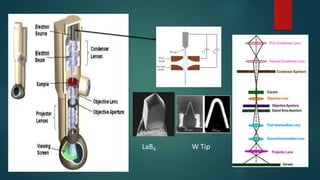
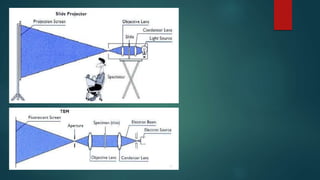
TEM
Vibration isolation
W Tip
LaB6
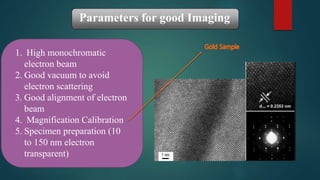
1. High monochromatic
electron beam
2. Good vacuum to avoid
electron scattering
3. Good alignment of electron
beam
4. Magnification Calibration
5. Specimen preparation (10
to 150 nm electron
transparent)
Parameters for good Imaging
User-Mechanical
Examples of Environmental “Artifacts”
Aperiodic - Vibrational
Periodic - EM Fields
User-Acoustic
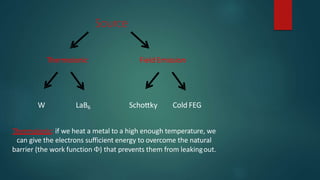
Source
Thermoionic Field Emission
W
Thermoionic: if we heat a metal to a high enough temperature, we
can give the electrons sufficient energy to overcome the natural
barrier (the work function ) that prevents them from leakingout.
LaB6 Schottky Cold FEG
kT
 
J  AT 2
e
J = current density from the source
T = operating temperature (K)
A = Richardson’s constant (A/m2 K2) – (it depends on thematerial)
k = Boltzmann’s constant (8.6 X 10⁻⁵eV/K)
Φ – Work Function of the materials
Thermoionic sourcesare:
-High melting point materials (i.e. WTm=3660K)
-Low low work function materials (i.e. LaB6 or W)
(ΦW= 4.5eV;ΦLaB6=2.4eV
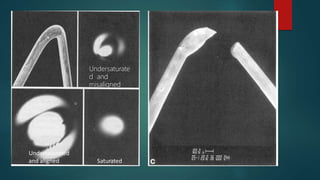
Undersaturated
and aligned Saturated
Undersaturate
d and
misaligned
Field Emission Guns
The strength of an electric field E is considerably increasedat
sharp points.
If we have a voltage V applied to a point of radiusr:
E  V
r
Toallow field emission, the surface has to be pristine (freeof
contaminants and oxides)
i.e. We operate in UHV (<10-11 Torr,10-8 Pa)
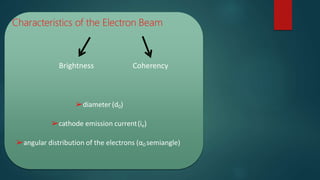
Characteristics of the Electron Beam
Brightness Coherency
➢diameter(d0)
➢cathode emission current(ie)
➢angular distribution of the electrons (α0 semiangle)
Brightness:
0
2
(
d0 )2
( )2
ie
 
Source solid angle
Beam Current Density
i.e. intensity
(current/unit area)
The higher is β:
- the more information we can get (more electrons in a beam of a give size)
- The more damage we can produce in the sample
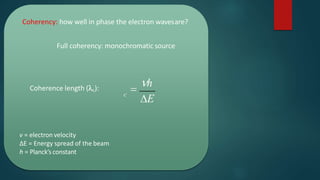
Coherency: how well in phase the electron wavesare?
Full coherency: monochromatic source
Coherence length (c):
c
E

h
v = electron velocity
ΔE = Energy spread of the beam
h = Planck’s constant
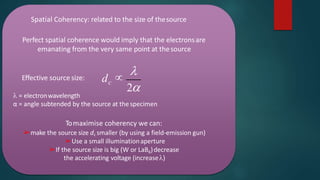
Spatial Coherency: related to the size of thesource
Perfect spatial coherence would imply that the electronsare
emanating from the very same point at thesource
Effective source size: dc


the accelerating voltage (increase)
2
 = electronwavelength
α = angle subtended by the source at the specimen
Tomaximise coherency we can:
➢make the source size dc smaller (by using a field-emission gun)
➢Use a small illuminationaperture
➢If the source size is big (W or LaB6)decrease
TEM Grids
SAED Pattern
Sample Preparation
Diamond wheel saw
• Diamond wheel saw is used to cut ~
0.2 to 0.5 mm thick pieces from
sample
• A diamond wafering blade along with
cooling/lubrication system is used for
this purpose
• Lubrication is used for optimum
cooling at high cutting speeds for
extremely hard or tough materials
References:-
1]Transmission Electron Microscopy: A Textbook for Materials Science, by C. Barry Carter
and David L. Phillips
2] Conventional transmission electron microscopy, by Mark Winey and Thomas H.
Giddings, doi: 10.1091/mbc.E12-12-0863
3] Web resources
Thank you

Introduction to electron microscope

  • 2.
    Micros (small) skopos(to look at) = microscope O.2 mm 0.2 m 0.2 nm Resolving power The ability to make points or lines which are closely adjacent in an object distinguishable in an image.
  • 3.
    Why use electrons? The“resolving power” of our naked eyes is ~ 0.1-0.2 mm. Image resolution (R) in TEM in terms of the classical Rayleigh Criterion: R  1  λ = wavelength of radiation λ in the Visible = 400 - 800 nm R ~ 200 - 400 nm SEM Image of a CD Cd Dvd HD Dvd Blue ray 800 nm 400 nm 200 nm 150 nm
  • 4.
    Some fundamental propertiesof electrons In the TEM we impart momentum to the electron byaccelerating them it through a potential drop (V),giving it a kinetic energy: Based on de Broglie’s ideas of the wave-particle duality, we can relate the particle momentum (p) to its wavelength(λ) through Plank’sconstant: V = Acceleratingpotential m0= electron mass v = velocity   h p 2 m 2 eV  0v
  • 5.
    We also knowthat:p=m0v So: p  2m0eV This leads to the relationship between the electronwavelength and the acceleration voltage: h 2m0eV  By increasing the acceleration voltage we decrease the wavelength of the electrons, therefore increasing theresolution
  • 6.
    If we wantto include the relativisticeffects:            2 0  0 2m c eV 2m eV 1 h  - 1.602 X 10⁻¹⁹ C 1.602 X 10⁻¹⁹ J 9.109 X 10⁻³¹kg 511 keV 1.602 X 10⁻¹⁹ N m (for 1 volt potential) 6.626 X 10⁻³⁴ N m s Charge(e) 1 eV Rest mass (m0) Rest energy (m0c2) Kinetic energy (charge X voltage) Planck’s constant (h) Speed of light in vacuum (c) 2.998 X 10⁸ m/sec Fundamental Constants and Definitions Electron at 100 kV have the wavelength and the resolution of We cannot make perfect electron lenses for getting this resolution Voltage Relativistic 100 kV 120 kV 200 kV 300 kV 0.0037 nm 0.0034 nm 0.0025 nm 0.0020 nm
  • 8.
  • 9.
  • 11.
    1. High monochromatic electronbeam 2. Good vacuum to avoid electron scattering 3. Good alignment of electron beam 4. Magnification Calibration 5. Specimen preparation (10 to 150 nm electron transparent) Parameters for good Imaging
  • 12.
    User-Mechanical Examples of Environmental“Artifacts” Aperiodic - Vibrational Periodic - EM Fields User-Acoustic
  • 13.
    Source Thermoionic Field Emission W Thermoionic:if we heat a metal to a high enough temperature, we can give the electrons sufficient energy to overcome the natural barrier (the work function ) that prevents them from leakingout. LaB6 Schottky Cold FEG
  • 14.
    kT   J AT 2 e J = current density from the source T = operating temperature (K) A = Richardson’s constant (A/m2 K2) – (it depends on thematerial) k = Boltzmann’s constant (8.6 X 10⁻⁵eV/K) Φ – Work Function of the materials Thermoionic sourcesare: -High melting point materials (i.e. WTm=3660K) -Low low work function materials (i.e. LaB6 or W) (ΦW= 4.5eV;ΦLaB6=2.4eV
  • 15.
  • 16.
    Field Emission Guns Thestrength of an electric field E is considerably increasedat sharp points. If we have a voltage V applied to a point of radiusr: E  V r Toallow field emission, the surface has to be pristine (freeof contaminants and oxides) i.e. We operate in UHV (<10-11 Torr,10-8 Pa)
  • 17.
    Characteristics of theElectron Beam Brightness Coherency ➢diameter(d0) ➢cathode emission current(ie) ➢angular distribution of the electrons (α0 semiangle)
  • 18.
    Brightness: 0 2 ( d0 )2 ( )2 ie  Source solid angle Beam Current Density i.e. intensity (current/unit area) The higher is β: - the more information we can get (more electrons in a beam of a give size) - The more damage we can produce in the sample
  • 19.
    Coherency: how wellin phase the electron wavesare? Full coherency: monochromatic source Coherence length (c): c E  h v = electron velocity ΔE = Energy spread of the beam h = Planck’s constant
  • 20.
    Spatial Coherency: relatedto the size of thesource Perfect spatial coherence would imply that the electronsare emanating from the very same point at thesource Effective source size: dc   the accelerating voltage (increase) 2  = electronwavelength α = angle subtended by the source at the specimen Tomaximise coherency we can: ➢make the source size dc smaller (by using a field-emission gun) ➢Use a small illuminationaperture ➢If the source size is big (W or LaB6)decrease
  • 22.
  • 24.
  • 25.
  • 26.
    Diamond wheel saw •Diamond wheel saw is used to cut ~ 0.2 to 0.5 mm thick pieces from sample • A diamond wafering blade along with cooling/lubrication system is used for this purpose • Lubrication is used for optimum cooling at high cutting speeds for extremely hard or tough materials
  • 35.
    References:- 1]Transmission Electron Microscopy:A Textbook for Materials Science, by C. Barry Carter and David L. Phillips 2] Conventional transmission electron microscopy, by Mark Winey and Thomas H. Giddings, doi: 10.1091/mbc.E12-12-0863 3] Web resources
  • 36.