Science & Astronomy club of NIT Trichy
Department of Physics
Introduction to celestial objects-II
G Antilen Jacob
Research Scholar & Project fellow
Department of Physics
NIT-Trichy
Answers
Andromeda Galaxy (M31) Butterfly Galaxy Needle Galaxy (NGC
4565)
M63 M104
Tadpole Galaxy Cigar Galaxy NGC 1427A IC 2006 Cartwheel galaxy
spiral galaxy Interacting
spiral galaxy
lenticular galaxy
spiral galaxy
spiral galaxy
lenticular galaxy
spiral galaxy Irregular Galaxy elliptical galaxy ring galaxy
Pre-Newtonian theory
• 2nd century CE, the Greek astronomer Claudius Ptolemy, epicycles
and deferents, it explains the observation that time
• 1543 Copernicus published his book, de Revolutionibus Orbium
Caelestium, heliocentric,
• Tyco Brahe notes analyzed by a young mathematician, He became
quite proficient at predicting Mercury’s transit.(7 November 1631).
• Middle of the 17th century, kinematic data on planetary paths were
fairly accurately known
3
• 1642, studied in Cambridge, plague (1665), rock
twirling.
• Arrived at Kepler's law (shapes of orbit).
• In 1757, Alexis-Claude Clairault, of France predicted
the Halley comet. (33 days error)
• William Hanover, 1738, discovered Uranus, follows
elliptical orbit
• Jean Joseph Le Verriere, 1811, predicted 1845 transit
of the Sun to within 16 seconds
• lag in Uranus’ orbit (unknown mass) similar research
John Couch Adams.
• deviation is only 55 arc minutes from Le Verriere’s
calculation, and 2.5 degrees from Adams
4
Newton universal law of gravitation
Jean joseph Le verrier
Halley’s comet
Our solar system
• We have 8 planets 5 dwarf planet
• 200+ moons, 3654 comets and nearly
989,631 Asteroids in our solar system
• There are many planetary systems like
ours in the universe, with planets
orbiting a host star
• Our planetary system is located in an
outer spiral arm of the Milky Way
galaxy
• Our solar system orbits the center of
the Milky Way Galaxy at about 828,000
kph
Dwarf planet
Pluto, Eris, Ceres, Haumea and Makemake
Mercury
• Mercury is the closest planet to the Sun and the
smallest planet in the solar system
• Mercury never strays more than 27 degrees from the
Sun
• Mercury has a very eccentric orbit which changes its
radius from 46 to 70 million kilometers
• Mercury for the apparent diameter of the disk varies
between 4.8'' and 13.3''
• The Caloris basin was formed by an asteroid impact or
comet
• This colorful image of the Caloris basin and adjacent
regions shows orange shades in the Caloris basin, which
indicate these locations volcanic.
Giant Caloris Basin of Mercury
photographed by Messenger spacecraft
flew NASA
*credit NASA messenger satellite
Mercury surface
Parameter Values
Rotation period 58.6 days
Orbital period 88 days
Temperature min : -183°C
max : 427°C
Mean radius 2439.7 km
Image Credit: NASA/Johns Hopkins
University Applied Physics
Laboratory/Carnegie Institution of
Washington.
• Venus is a second interior planet and it is the third brightest
object in the sky after the Sun and the Moon
• The size and density of the planet Venus are similar to those
of Earth
• This atmosphere is so dense that it traps the sun's rays and
create a greenhouse effect, the ground temperature is 470 ° C,
the surface temperature is hot enough to melt lead
• Containing water and corrosive gases, such as hydrochloric
acid and sulfuric acid
• One day on Venus lasts 243 Earth days because Venus spins
backwards, with its sun rising in the west and setting in the
east
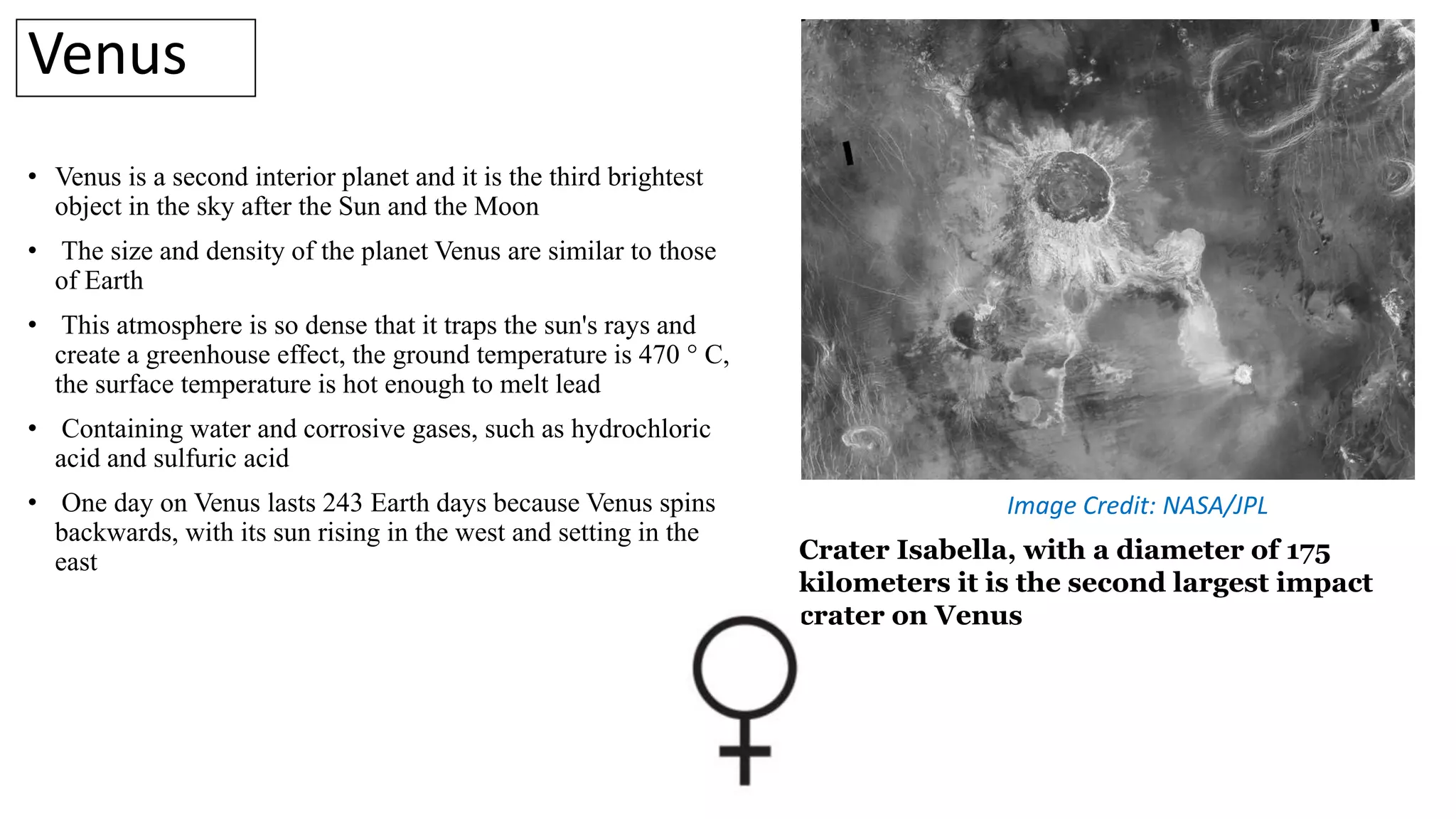
Venus
Crater Isabella, with a diameter of 175
kilometers it is the second largest impact
crater on Venus
Image Credit: NASA/JPL
Earth
Apollo 11 astronauts took this photo of Earth
• The Earth is a supernatural blue point
• The age of the Earth is at present esteemed at
4550 million years
• Interstellar dusts are the bricks of planets
• The dry air is made up of 78.08% nitrogen,
20.95% oxygen, 0.93% argon, 0.038% carbon
dioxide and traces of other gases
• The orbital eccentricity is 0.017
Image: Aurora
by Gilles Boutin
T α
1
𝑅
= 𝑘 𝑅
1
2
𝑑𝑇
𝑇
= −
1
2
𝑑𝑅
𝑅
1
Perihelion radius 𝑅 = 𝑎(1 − 𝑒)
𝑅 = 𝑎(1 + 𝑒)
Aphelion radius
𝑑𝑅 = 2𝑎𝑒
T=255 K dT= 4 K
• It is the only planet the ground of which we
see well. Mars is smaller than the Earth, its
diameter is 6500 km
• Its revolution around the Sun lasts about
700 days. The duration of day is nearby of
ours 24H 37 min. Its axis of rotation is close
of our 25°
• Its poles show themselves snowy, this snow
bottom almost completely vanishes during
the Martian summers
• The two moons of Mars are Phobos and
Deimos
• These moons of Mars may well be captured
asteroids from the main asteroid belt
between Mars and Jupiter. They orbit around
the planet
Mars
In this picture you can see the snowy
north pole of Mars. This small planet
is only 0.0068% of the total mass of
the solar system
The volcanic Tharsis dome,
on which the Martian
volcano
CO2 95.3%
N2 2.7%
Ar 1.6%
O2 0.13%
Phobos Deimos
• Gas giant planet made up to 93% hydrogen and
7% helium. It represents 71% of the total mass of
the planets of the solar system
• Number of satellites 79
• Jupiter has acted as a shield, protecting life on
our planet
Jupiter
Four Galilean moons of Jupiter, from top to
bottom: Io, Europa, Ganymede and Calisto
• Irradiate more energy in the space which it receives from it of the
Sun. Most of this supplementary energy are generated by the
mechanism Kelvin-Helmholtz, quite as for Jupiter.
• Two important rings ( A and B) and a weaker ring ( C ) can be
observed by the Earth.
• The interval between rings A and B is called division of Cassini.
Saturn
Temperature -191°C - 130°C
Number of satellites 82 moons 13 of which
have diameters larger than 50 km
Orbital period 29.4571 yr
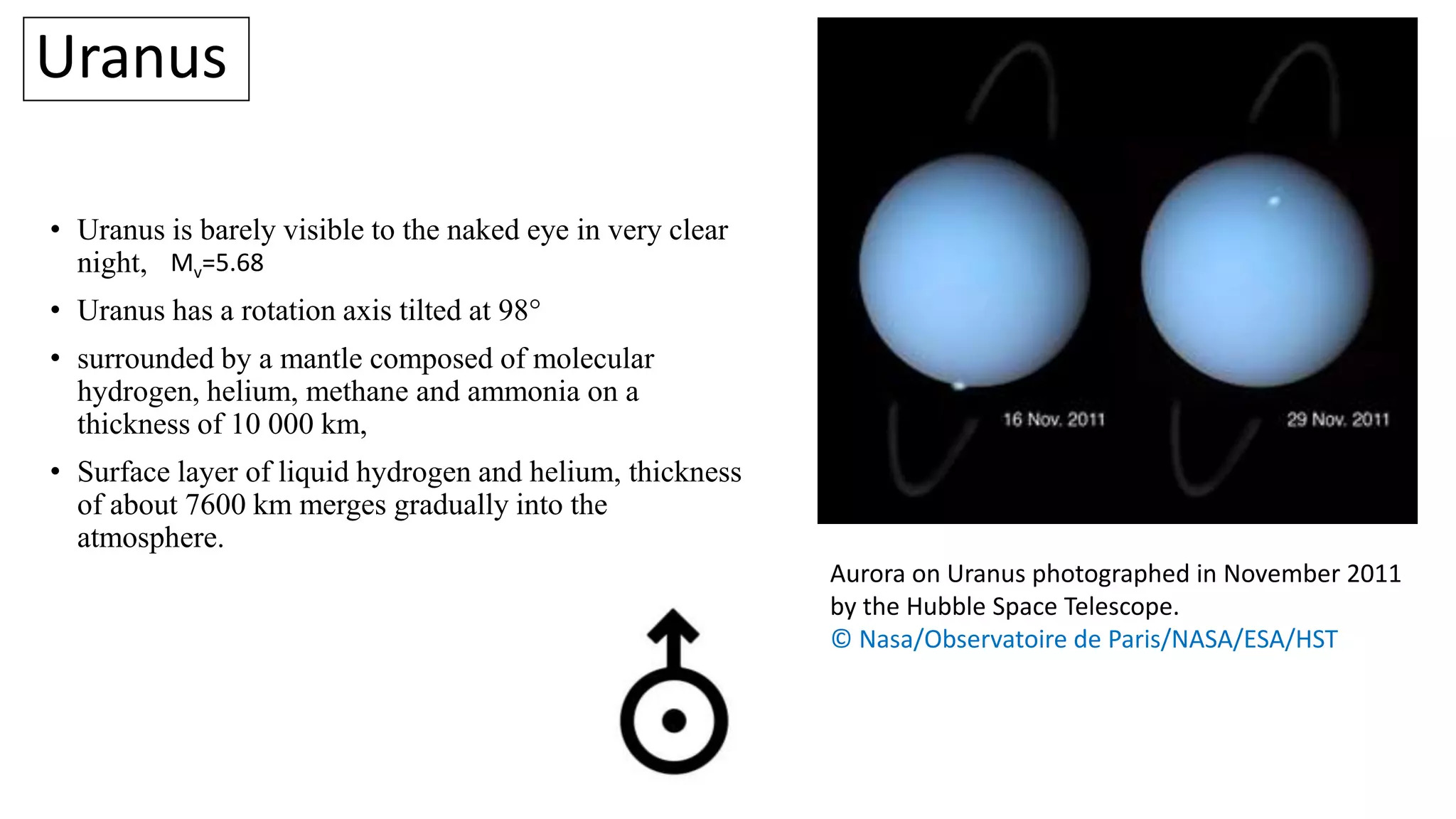
Uranus
• Uranus is barely visible to the naked eye in very clear
night,
• Uranus has a rotation axis tilted at 98°
• surrounded by a mantle composed of molecular
hydrogen, helium, methane and ammonia on a
thickness of 10 000 km,
• Surface layer of liquid hydrogen and helium, thickness
of about 7600 km merges gradually into the
atmosphere.
Aurora on Uranus photographed in November 2011
by the Hubble Space Telescope.
© Nasa/Observatoire de Paris/NASA/ESA/HST
Mv=5.68
Neptune
Image of storms in the windy atmosphere of Neptune
Image Credit : NASA
• Neptune (Poseidon in Greek sea god) is the eighth and last
planet in our solar system and appears with powerful
instruments.
• The French astronomer Urbain Le Verrier calculated the
hypothetical position in the sky, the eighth planet, which
was called Neptune.
• The blue color of Neptune is the result of absorption of red
light by methane in its atmosphere
• The atmosphere of Neptune has a thickness of more than 8
000 km. It is composed primarily of hydrogen (H2) for
85%, helium (He) for 13% and methane (CH4) to 2%.
Kuiper belt and Oort clouds
• A donut-shaped region of icy bodies beyond the orbit of
Neptune. There may be millions of these icy objects
known as KBOs or TNOs
• Similar to the asteroid belt, the Kuiper Belt is a region of
leftovers from the solar system's early history
• The Kuiper Belt shouldn't be confused with the Oort
Cloud, Both the Oort Cloud and the Kuiper Belt are
thought to be sources of comets.
• Unlike the planets they do not necessarily travel in the
same direction in a shared orbital plane around the Sun,
Hence, they’re called the Oort Cloud rather than the Oort
Belt
Exoplanets
Are we alone?
May be not
Exoplanet detection methods
• Radial velocity (Doppler method)
• Transits
• Gravitational microlensing
• Pulsar planets
• Astrometric
• Optical imaging
• Infrared interferometry
Doppler method
Transit method
Gravitational microlensing
Four planets are in orbit around a star
129 light-years away in the constellation
of Pegasus.
Credit: Jason Wang and Christian Marois
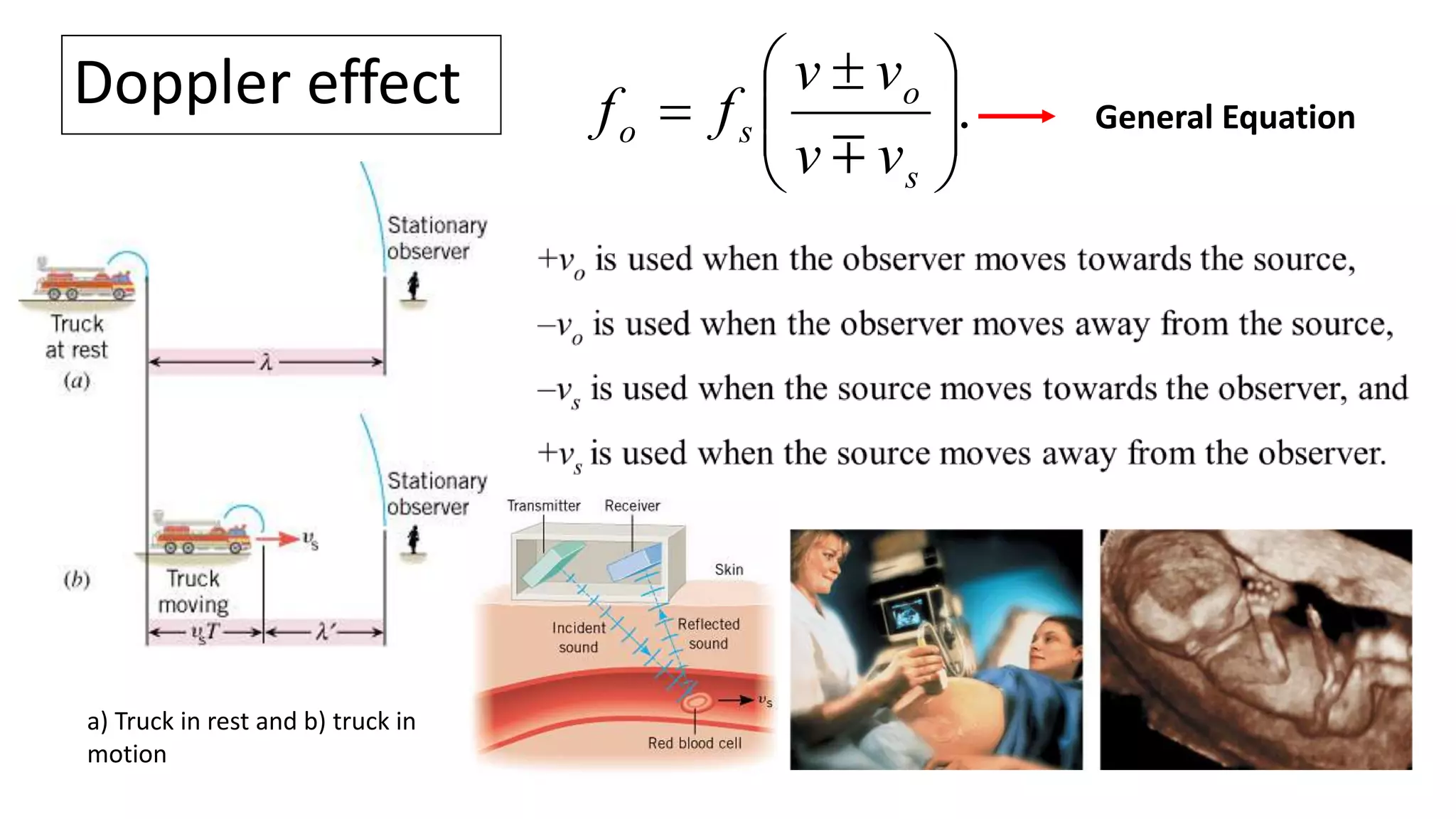
Doppler effect
a) Truck in rest and b) truck in
motion
.







 

s
o
s
o
v
v
v
v
f
f

General Equation
Radial velocity
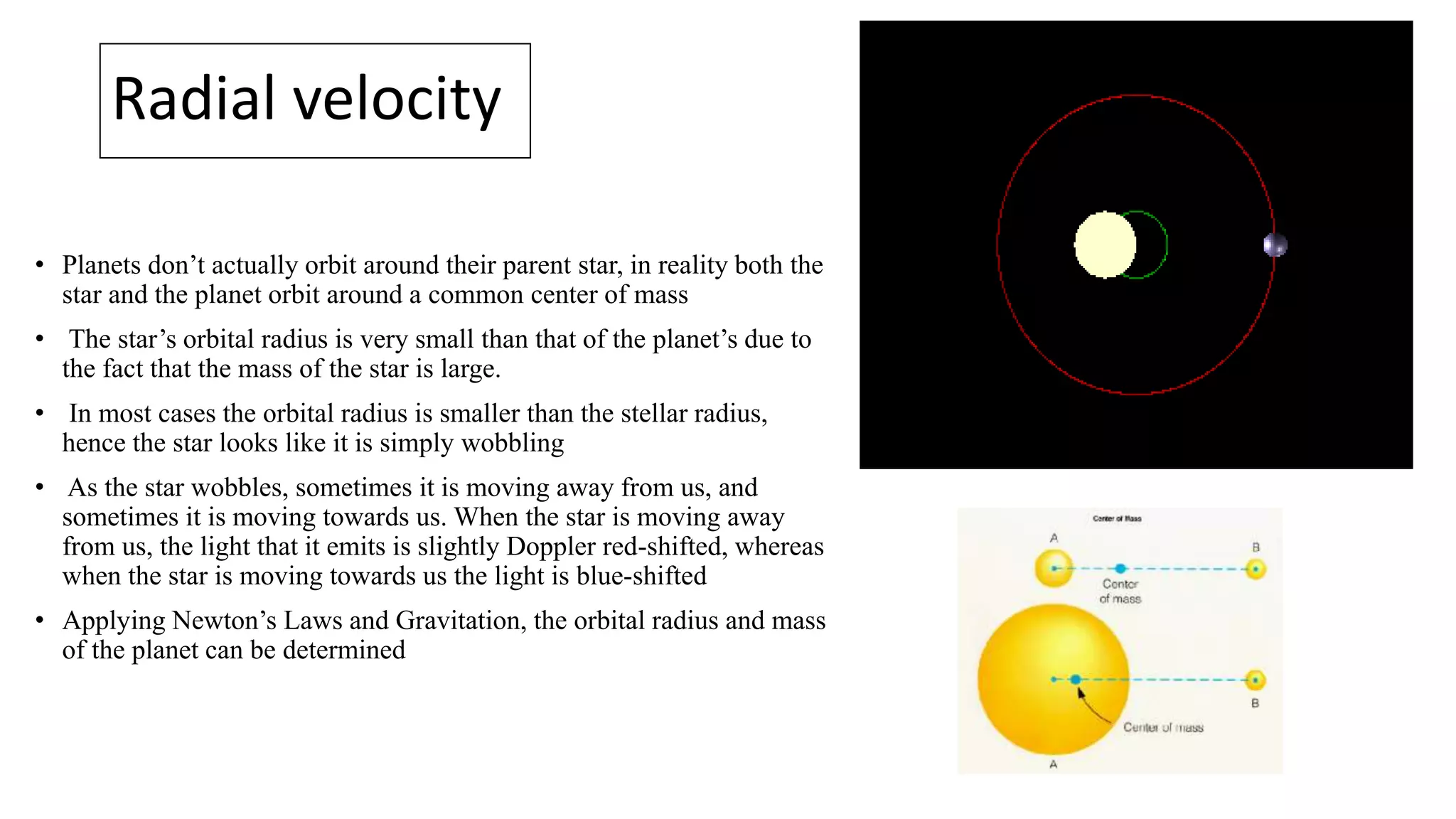
• Planets don’t actually orbit around their parent star, in reality both the
star and the planet orbit around a common center of mass
• The star’s orbital radius is very small than that of the planet’s due to
the fact that the mass of the star is large.
• In most cases the orbital radius is smaller than the stellar radius,
hence the star looks like it is simply wobbling
• As the star wobbles, sometimes it is moving away from us, and
sometimes it is moving towards us. When the star is moving away
from us, the light that it emits is slightly Doppler red-shifted, whereas
when the star is moving towards us the light is blue-shifted
• Applying Newton’s Laws and Gravitation, the orbital radius and mass
of the planet can be determined
Stellar wobble
• 810 planets have been detected with this
method
• Before 2009 nearly all planets were detected
with this method
• A star's 'wobble' can tell us if a star has
planets, how many there are, and how big
they are
• Small planets like Earth make their stars only
wobble a tiny bit. Bigger planets like Jupiter
have a much stronger effect
• The radial velocity method was one of the
first successful ways to find exoplanets
Transit Method
• When the planets passes directly between it’s
star and the observer it dims the star light by a
measureable amount.
• 3187 planets discovered using this method
• The size and length of a transit can tell us a lot
about the planet that's causing the transit.
Bigger planets block more light, so they create
deeper light curves
• The transit method isn't just useful for finding
planets, it can also give us information about
the composition of a planet's atmosphere or its
temperature.
Nature 494(7438):452-4
spectrum of Kepler-‐37
Gravitational
microlensing
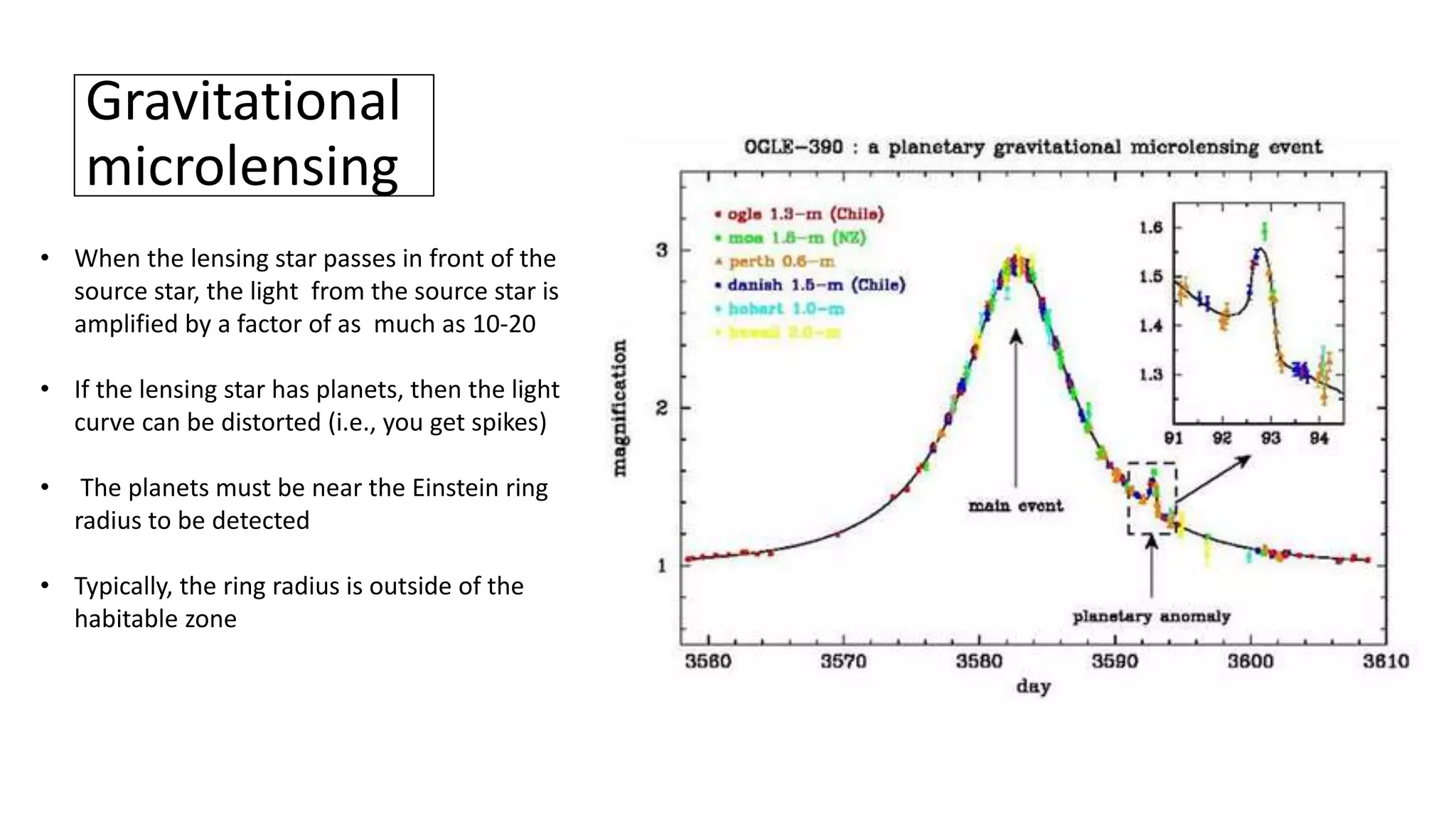
• When the lensing star passes in front of the
source star, the light from the source star is
amplified by a factor of as much as 10-20
• If the lensing star has planets, then the light
curve can be distorted (i.e., you get spikes)
• The planets must be near the Einstein ring
radius to be detected
• Typically, the ring radius is outside of the
habitable zone
Astrometric method
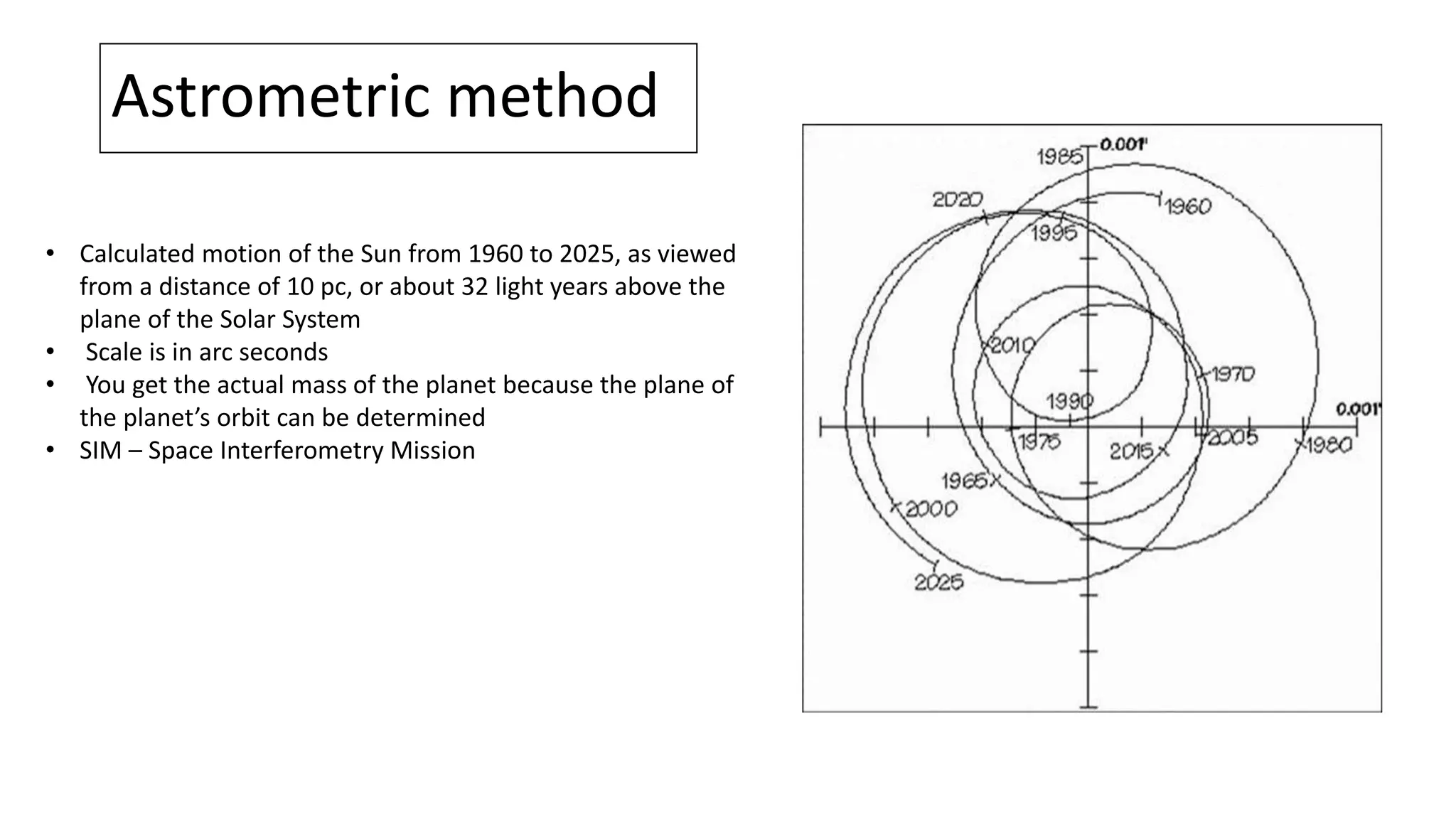
• Calculated motion of the Sun from 1960 to 2025, as viewed
from a distance of 10 pc, or about 32 light years above the
plane of the Solar System
• Scale is in arc seconds
• You get the actual mass of the planet because the plane of
the planet’s orbit can be determined
• SIM – Space Interferometry Mission
To be continued…..

Science and astronomy club (types of celestrial objects)

  • 1.
    Science & Astronomyclub of NIT Trichy Department of Physics Introduction to celestial objects-II G Antilen Jacob Research Scholar & Project fellow Department of Physics NIT-Trichy
  • 2.
    Answers Andromeda Galaxy (M31)Butterfly Galaxy Needle Galaxy (NGC 4565) M63 M104 Tadpole Galaxy Cigar Galaxy NGC 1427A IC 2006 Cartwheel galaxy spiral galaxy Interacting spiral galaxy lenticular galaxy spiral galaxy spiral galaxy lenticular galaxy spiral galaxy Irregular Galaxy elliptical galaxy ring galaxy
  • 3.
    Pre-Newtonian theory • 2ndcentury CE, the Greek astronomer Claudius Ptolemy, epicycles and deferents, it explains the observation that time • 1543 Copernicus published his book, de Revolutionibus Orbium Caelestium, heliocentric, • Tyco Brahe notes analyzed by a young mathematician, He became quite proficient at predicting Mercury’s transit.(7 November 1631). • Middle of the 17th century, kinematic data on planetary paths were fairly accurately known 3
  • 4.
    • 1642, studiedin Cambridge, plague (1665), rock twirling. • Arrived at Kepler's law (shapes of orbit). • In 1757, Alexis-Claude Clairault, of France predicted the Halley comet. (33 days error) • William Hanover, 1738, discovered Uranus, follows elliptical orbit • Jean Joseph Le Verriere, 1811, predicted 1845 transit of the Sun to within 16 seconds • lag in Uranus’ orbit (unknown mass) similar research John Couch Adams. • deviation is only 55 arc minutes from Le Verriere’s calculation, and 2.5 degrees from Adams 4 Newton universal law of gravitation Jean joseph Le verrier Halley’s comet
  • 5.
    Our solar system •We have 8 planets 5 dwarf planet • 200+ moons, 3654 comets and nearly 989,631 Asteroids in our solar system • There are many planetary systems like ours in the universe, with planets orbiting a host star • Our planetary system is located in an outer spiral arm of the Milky Way galaxy • Our solar system orbits the center of the Milky Way Galaxy at about 828,000 kph Dwarf planet Pluto, Eris, Ceres, Haumea and Makemake
  • 6.
    Mercury • Mercury isthe closest planet to the Sun and the smallest planet in the solar system • Mercury never strays more than 27 degrees from the Sun • Mercury has a very eccentric orbit which changes its radius from 46 to 70 million kilometers • Mercury for the apparent diameter of the disk varies between 4.8'' and 13.3'' • The Caloris basin was formed by an asteroid impact or comet • This colorful image of the Caloris basin and adjacent regions shows orange shades in the Caloris basin, which indicate these locations volcanic. Giant Caloris Basin of Mercury photographed by Messenger spacecraft flew NASA *credit NASA messenger satellite Mercury surface Parameter Values Rotation period 58.6 days Orbital period 88 days Temperature min : -183°C max : 427°C Mean radius 2439.7 km Image Credit: NASA/Johns Hopkins University Applied Physics Laboratory/Carnegie Institution of Washington.
  • 7.
    • Venus isa second interior planet and it is the third brightest object in the sky after the Sun and the Moon • The size and density of the planet Venus are similar to those of Earth • This atmosphere is so dense that it traps the sun's rays and create a greenhouse effect, the ground temperature is 470 ° C, the surface temperature is hot enough to melt lead • Containing water and corrosive gases, such as hydrochloric acid and sulfuric acid • One day on Venus lasts 243 Earth days because Venus spins backwards, with its sun rising in the west and setting in the east Venus Crater Isabella, with a diameter of 175 kilometers it is the second largest impact crater on Venus Image Credit: NASA/JPL
  • 8.
    Earth Apollo 11 astronautstook this photo of Earth • The Earth is a supernatural blue point • The age of the Earth is at present esteemed at 4550 million years • Interstellar dusts are the bricks of planets • The dry air is made up of 78.08% nitrogen, 20.95% oxygen, 0.93% argon, 0.038% carbon dioxide and traces of other gases • The orbital eccentricity is 0.017 Image: Aurora by Gilles Boutin T α 1 𝑅 = 𝑘 𝑅 1 2 𝑑𝑇 𝑇 = − 1 2 𝑑𝑅 𝑅 1 Perihelion radius 𝑅 = 𝑎(1 − 𝑒) 𝑅 = 𝑎(1 + 𝑒) Aphelion radius 𝑑𝑅 = 2𝑎𝑒 T=255 K dT= 4 K
  • 9.
    • It isthe only planet the ground of which we see well. Mars is smaller than the Earth, its diameter is 6500 km • Its revolution around the Sun lasts about 700 days. The duration of day is nearby of ours 24H 37 min. Its axis of rotation is close of our 25° • Its poles show themselves snowy, this snow bottom almost completely vanishes during the Martian summers • The two moons of Mars are Phobos and Deimos • These moons of Mars may well be captured asteroids from the main asteroid belt between Mars and Jupiter. They orbit around the planet Mars In this picture you can see the snowy north pole of Mars. This small planet is only 0.0068% of the total mass of the solar system The volcanic Tharsis dome, on which the Martian volcano CO2 95.3% N2 2.7% Ar 1.6% O2 0.13% Phobos Deimos
  • 10.
    • Gas giantplanet made up to 93% hydrogen and 7% helium. It represents 71% of the total mass of the planets of the solar system • Number of satellites 79 • Jupiter has acted as a shield, protecting life on our planet Jupiter Four Galilean moons of Jupiter, from top to bottom: Io, Europa, Ganymede and Calisto
  • 11.
    • Irradiate moreenergy in the space which it receives from it of the Sun. Most of this supplementary energy are generated by the mechanism Kelvin-Helmholtz, quite as for Jupiter. • Two important rings ( A and B) and a weaker ring ( C ) can be observed by the Earth. • The interval between rings A and B is called division of Cassini. Saturn Temperature -191°C - 130°C Number of satellites 82 moons 13 of which have diameters larger than 50 km Orbital period 29.4571 yr
  • 12.
    Uranus • Uranus isbarely visible to the naked eye in very clear night, • Uranus has a rotation axis tilted at 98° • surrounded by a mantle composed of molecular hydrogen, helium, methane and ammonia on a thickness of 10 000 km, • Surface layer of liquid hydrogen and helium, thickness of about 7600 km merges gradually into the atmosphere. Aurora on Uranus photographed in November 2011 by the Hubble Space Telescope. © Nasa/Observatoire de Paris/NASA/ESA/HST Mv=5.68
  • 13.
    Neptune Image of stormsin the windy atmosphere of Neptune Image Credit : NASA • Neptune (Poseidon in Greek sea god) is the eighth and last planet in our solar system and appears with powerful instruments. • The French astronomer Urbain Le Verrier calculated the hypothetical position in the sky, the eighth planet, which was called Neptune. • The blue color of Neptune is the result of absorption of red light by methane in its atmosphere • The atmosphere of Neptune has a thickness of more than 8 000 km. It is composed primarily of hydrogen (H2) for 85%, helium (He) for 13% and methane (CH4) to 2%.
  • 14.
    Kuiper belt andOort clouds • A donut-shaped region of icy bodies beyond the orbit of Neptune. There may be millions of these icy objects known as KBOs or TNOs • Similar to the asteroid belt, the Kuiper Belt is a region of leftovers from the solar system's early history • The Kuiper Belt shouldn't be confused with the Oort Cloud, Both the Oort Cloud and the Kuiper Belt are thought to be sources of comets. • Unlike the planets they do not necessarily travel in the same direction in a shared orbital plane around the Sun, Hence, they’re called the Oort Cloud rather than the Oort Belt
  • 15.
  • 16.
    Exoplanet detection methods •Radial velocity (Doppler method) • Transits • Gravitational microlensing • Pulsar planets • Astrometric • Optical imaging • Infrared interferometry Doppler method Transit method Gravitational microlensing Four planets are in orbit around a star 129 light-years away in the constellation of Pegasus. Credit: Jason Wang and Christian Marois
  • 17.
    Doppler effect a) Truckin rest and b) truck in motion .           s o s o v v v v f f  General Equation
  • 18.
    Radial velocity • Planetsdon’t actually orbit around their parent star, in reality both the star and the planet orbit around a common center of mass • The star’s orbital radius is very small than that of the planet’s due to the fact that the mass of the star is large. • In most cases the orbital radius is smaller than the stellar radius, hence the star looks like it is simply wobbling • As the star wobbles, sometimes it is moving away from us, and sometimes it is moving towards us. When the star is moving away from us, the light that it emits is slightly Doppler red-shifted, whereas when the star is moving towards us the light is blue-shifted • Applying Newton’s Laws and Gravitation, the orbital radius and mass of the planet can be determined
  • 19.
    Stellar wobble • 810planets have been detected with this method • Before 2009 nearly all planets were detected with this method • A star's 'wobble' can tell us if a star has planets, how many there are, and how big they are • Small planets like Earth make their stars only wobble a tiny bit. Bigger planets like Jupiter have a much stronger effect • The radial velocity method was one of the first successful ways to find exoplanets
  • 20.
    Transit Method • Whenthe planets passes directly between it’s star and the observer it dims the star light by a measureable amount. • 3187 planets discovered using this method • The size and length of a transit can tell us a lot about the planet that's causing the transit. Bigger planets block more light, so they create deeper light curves • The transit method isn't just useful for finding planets, it can also give us information about the composition of a planet's atmosphere or its temperature. Nature 494(7438):452-4 spectrum of Kepler-‐37
  • 21.
    Gravitational microlensing • When thelensing star passes in front of the source star, the light from the source star is amplified by a factor of as much as 10-20 • If the lensing star has planets, then the light curve can be distorted (i.e., you get spikes) • The planets must be near the Einstein ring radius to be detected • Typically, the ring radius is outside of the habitable zone
  • 22.
    Astrometric method • Calculatedmotion of the Sun from 1960 to 2025, as viewed from a distance of 10 pc, or about 32 light years above the plane of the Solar System • Scale is in arc seconds • You get the actual mass of the planet because the plane of the planet’s orbit can be determined • SIM – Space Interferometry Mission
  • 23.