Introduction to
Disciplined Agile Delivery (DAD)
Presented by:
Dr. Sanjay Saxena, CDAC, CDAI, SPC4, CSM, PSM, PMI-ACP, PMP, PgMP, CSSBB
Agile Coach @ Barclays, ssjpr@yahoo.com
Objective of this session
Agenda
•Introduction to Disciplined Agile Delivery (DAD)
•Disciplined Agile Certification
•Q&A
Introduction to
Disciplined Agile
Delivery (DAD)
Disciplined Agile Delivery (DAD) is
a process decision framework
The key characteristics of DAD:
– People-first
– Goal-driven
– Hybrid agile
– Learning-oriented
– Full delivery lifecycle
– Solution focused
– Risk-value lifecycle
– Enterprise aware
© Disciplined Agile Consortium 5
Scrum
Extreme
Programming
LeanKanban
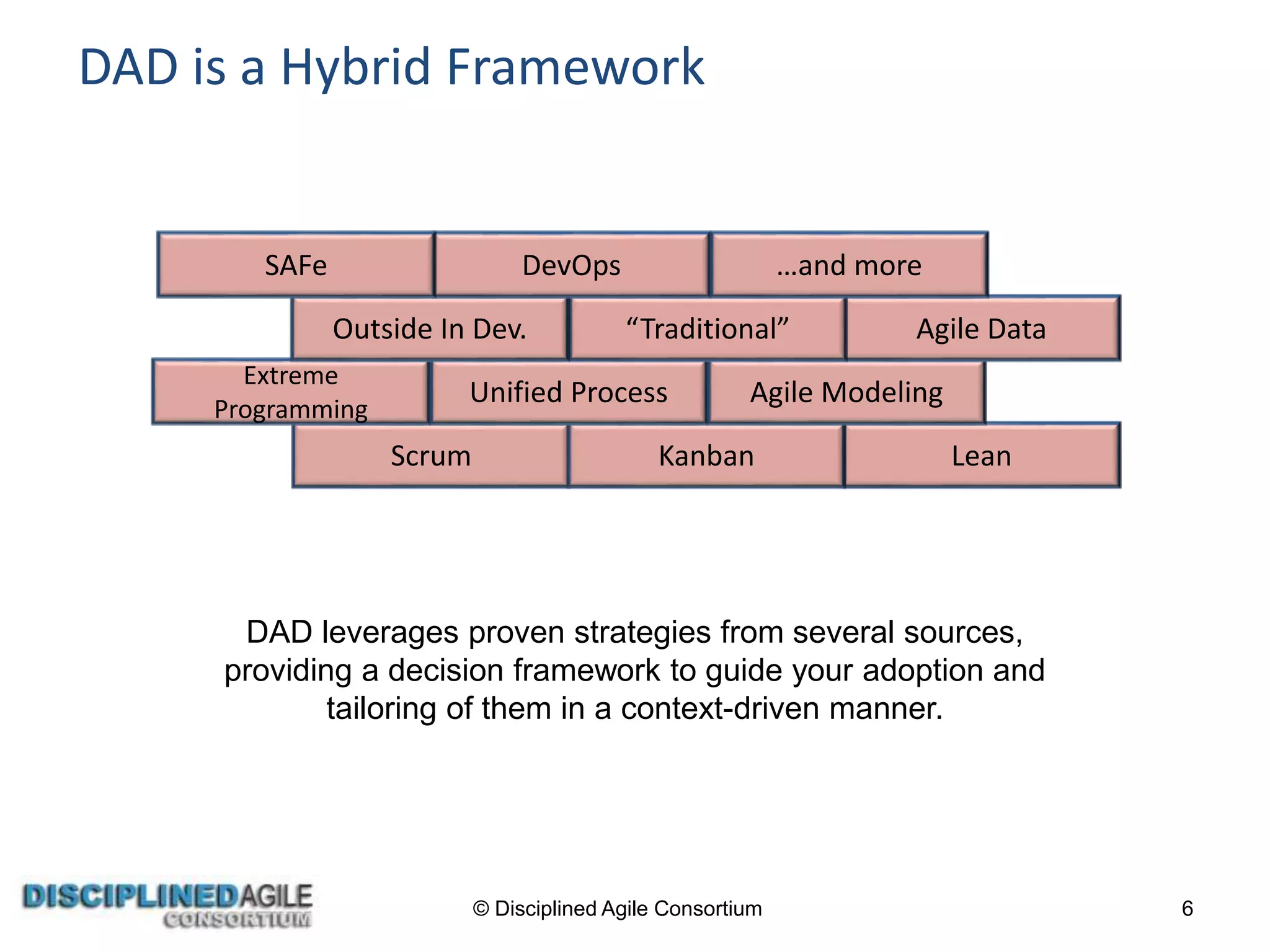
DAD is a Hybrid Framework
© Disciplined Agile Consortium 6
Unified Process Agile Modeling
Agile Data“Traditional”Outside In Dev.
DevOps …and more
DAD leverages proven strategies from several sources,
providing a decision framework to guide your adoption and
tailoring of them in a context-driven manner.
SAFe
A High Level Lifecycle
© Disciplined Agile Consortium 7
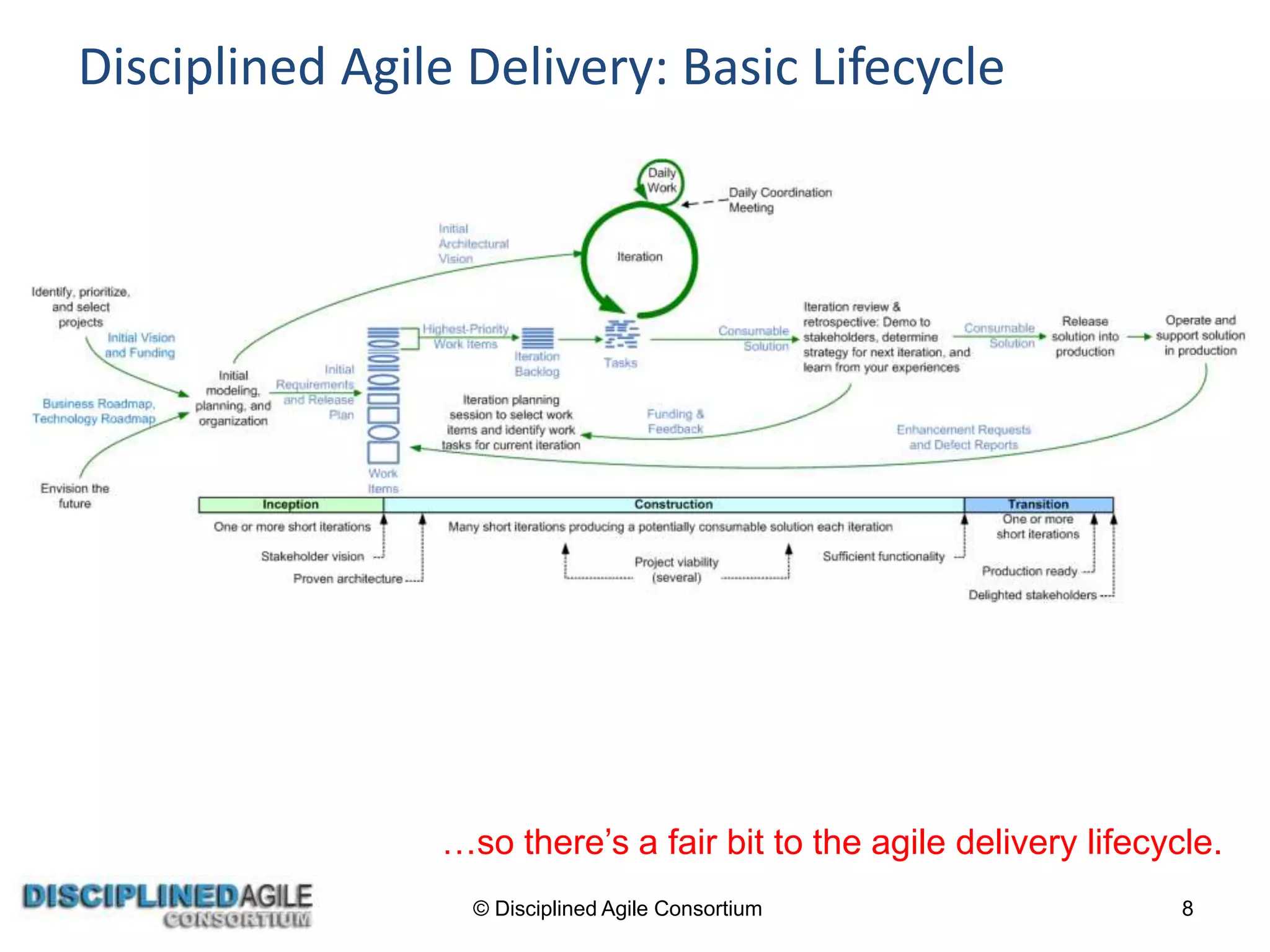
Disciplined Agile Delivery: Basic Lifecycle
© Disciplined Agile Consortium 8
…so there’s a fair bit to the agile delivery lifecycle.
Disciplined Agile Delivery: Lean Lifecycle
© Disciplined Agile Consortium 9
DAD doesn’t prescribe a single lifecycle…
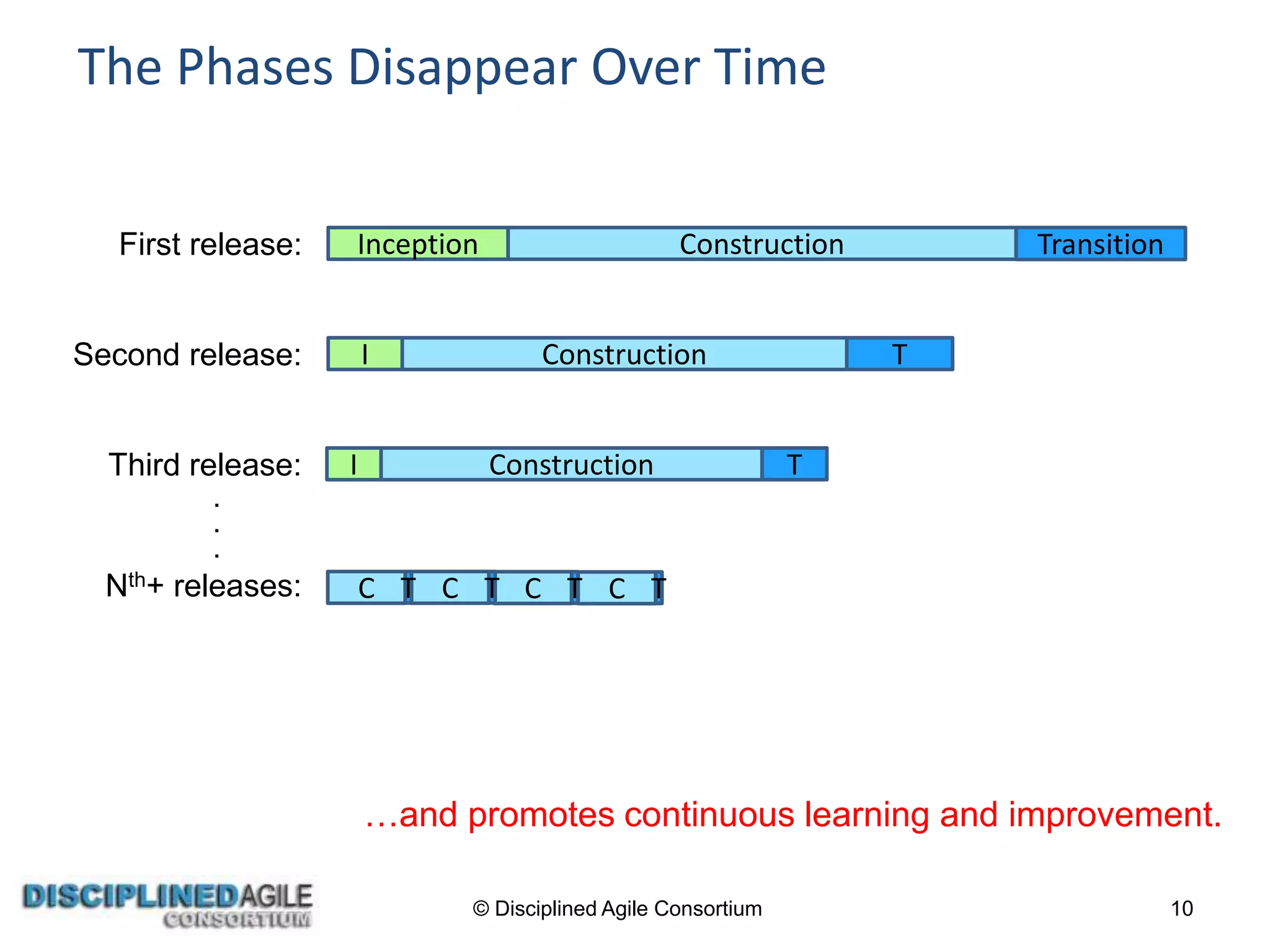
The Phases Disappear Over Time
© Disciplined Agile Consortium 10
First release: Inception Construction Transition
Second release: I Construction T
Third release: I Construction T
Nth+ releases: C CT C C TT T
.
.
.
…and promotes continuous learning and improvement.
Disciplined Agile Delivery: Lean Continuous Delivery
Lifecycle
© Disciplined Agile Consortium 11
A good
end goal
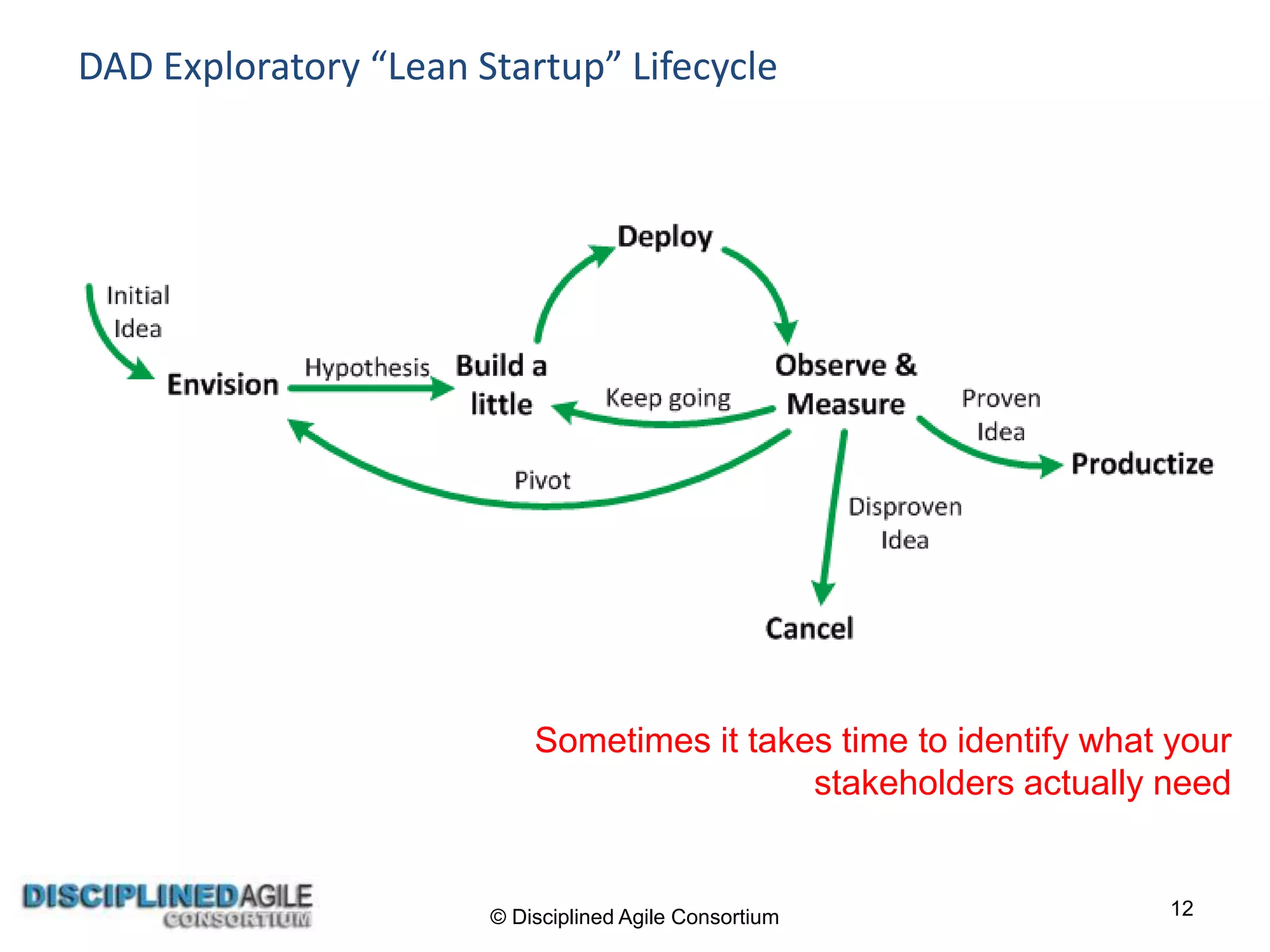
DAD Exploratory “Lean Startup” Lifecycle
12
Sometimes it takes time to identify what your
stakeholders actually need
© Disciplined Agile Consortium
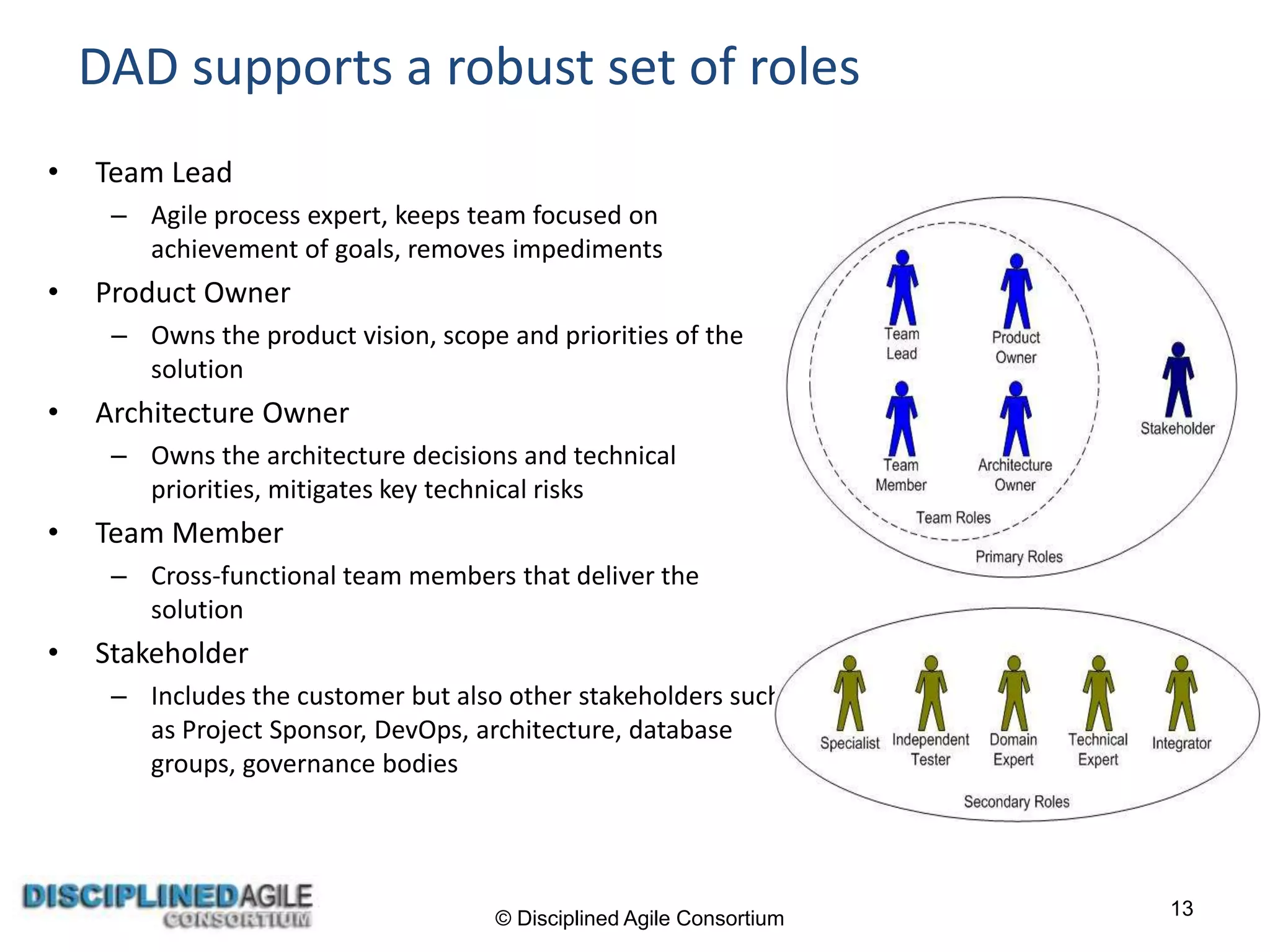
DAD supports a robust set of roles
• Team Lead
– Agile process expert, keeps team focused on
achievement of goals, removes impediments
• Product Owner
– Owns the product vision, scope and priorities of the
solution
• Architecture Owner
– Owns the architecture decisions and technical
priorities, mitigates key technical risks
• Team Member
– Cross-functional team members that deliver the
solution
• Stakeholder
– Includes the customer but also other stakeholders such
as Project Sponsor, DevOps, architecture, database
groups, governance bodies
© Disciplined Agile Consortium 13
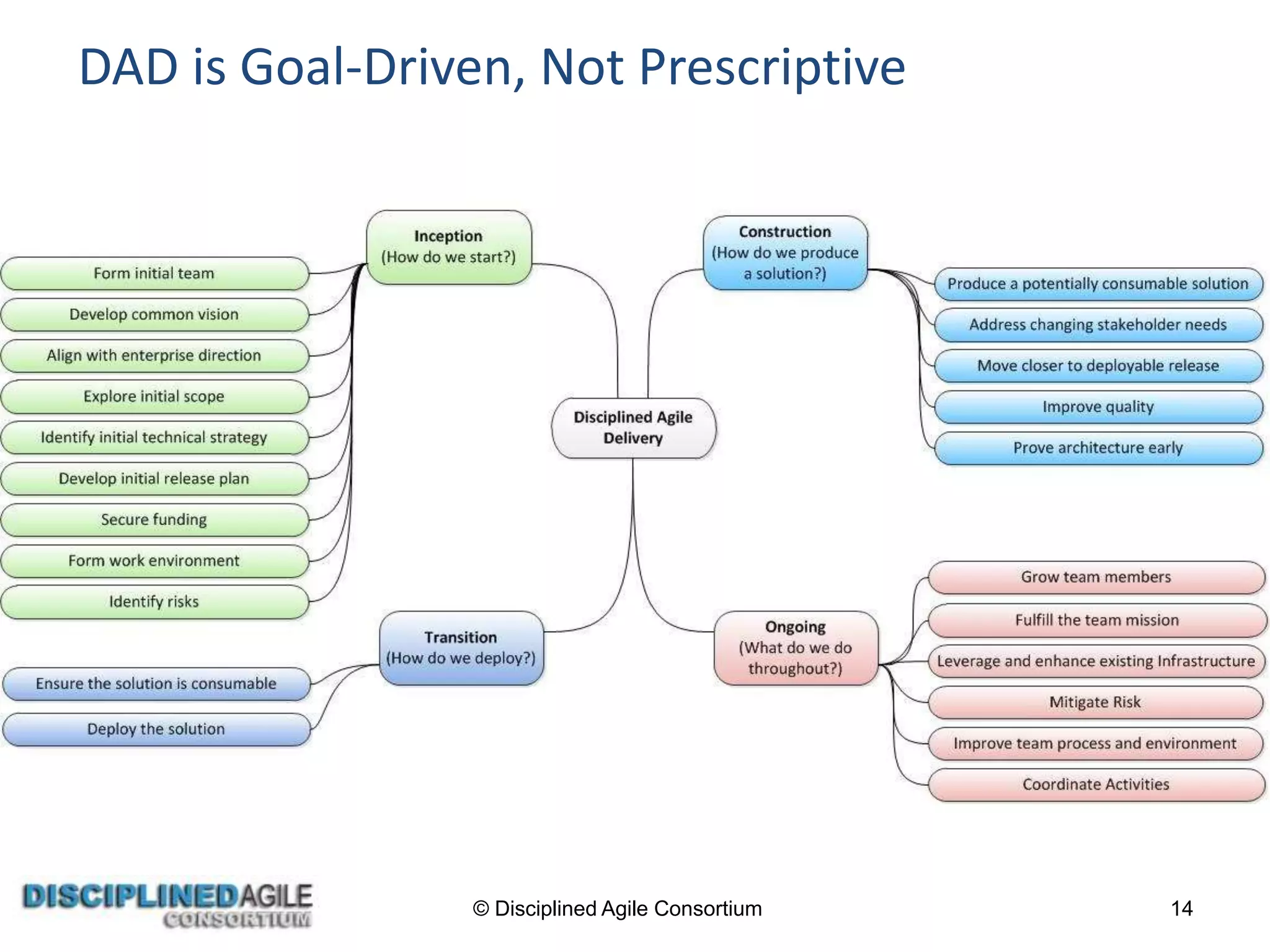
DAD is Goal-Driven, Not Prescriptive
© Disciplined Agile Consortium 14
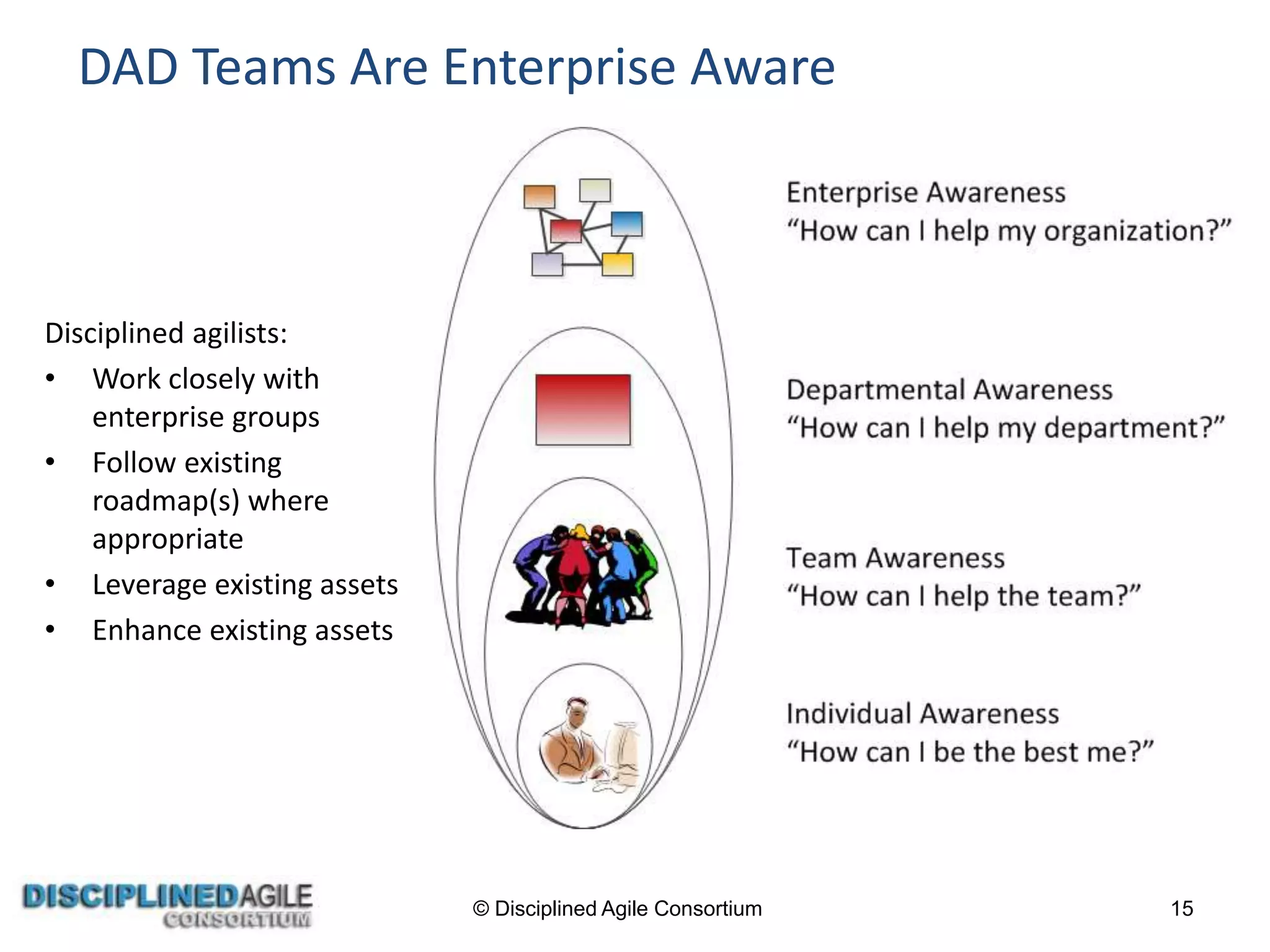
DAD Teams Are Enterprise Aware
Disciplined agilists:
• Work closely with
enterprise groups
• Follow existing
roadmap(s) where
appropriate
• Leverage existing assets
• Enhance existing assets
© Disciplined Agile Consortium 15
Context Counts – Tailoring and Scaling Agile
© Disciplined Agile Consortium 16
Agile
Disciplined
Agile
Delivery
Agility
at Scale
• Construction focus
• Value driven lifecycle
• Self-organizing teams
• Prescriptive
• Project team aware
• Delivery focus
• Risk-value driven lifecycle
• Self-organization with appropriate governance
• Goal driven
• Enterprise aware
DAD provides the foundation from which to scale:
• Large teams
• Geographically distributed teams
• Compliance
• Domain complexity
• Technical complexity
• Organizational distribution
17
Governance is Built Into DAD
• Governance strategies built into DAD:
– Risk-value lifecycle
– Light-weight milestone reviews
– “Standard” opportunities for increased visibility and to steer the team
provided by agile
– Enterprise awareness
– Robust stakeholder definition
© Disciplined Agile Consortium
Disciplined Agile Delivery (DAD)
Disciplined Agile Delivery:
The Foundation for Scaling Agile
© Disciplined Agile Consortium 18
Scrum LeanKanban
XP Agile Modeling
And more…SAFeOutside In Dev.
Team Size
Geographic
Distribution
Compliance Domain Complexity
Technical
Complexity
Organizational
Distribution
DAD leverages proven strategies from several sources,
providing a decision framework to guide your adoption and
tailoring of them in a context-driven manner.
What Does it Mean to Be
Disciplined?
• In general, it requires discipline to
follow many agile practices and
philosophies
• But, it also requires discipline to:
– Reduce the feedback cycle
– Learn continuously
– Deliver solutions incrementally
– Be goal driven
– Enterprise aware
– Streamline Inception and
Transition efforts
– Adopt agile governance strategies
© Disciplined Agile Consortium 19
Certification
Our Principles
1. Certifications must:
– Provide value
– Be earned
– Be respectable
– Be focused
2. Certification is part of your learning process
3. Certified professionals have a responsibility to
share their knowledge
© Disciplined Agile Consortium 21
Shuhari and Disciplined Agile Certification
At the shu stage you are beginning to learn
the techniques and philosophies of
disciplined agile development. Your goal is
to build a strong foundation from which to
build upon.
At the ha stage you reflect upon and
question why disciplined agile strategies
work, seeking to understand the range of
strategies available to you and when they
are best applied.
At the ri stage you seek to extend and
improve upon disciplined agile techniques,
sharing your learnings with others.
© Disciplined Agile Consortium
Interest
Proven Knowledge
+ Proven Experience
+ Giveback
Disciplined Agile Certification in a Nutshell
© Disciplined Agile Consortium 23
• How to earn this designation:
– You must attend a Disciplined Agile workshop or webinar
• Cost: Free
• What this tells employers:
– You have an interest in Disciplined Agile strategies
• DisciplinedAgileConsortium.org/DA
© Disciplined Agile Consortium 24
• How to earn this certification:
– Learn about Disciplined Agile by either taking a workshop or by reading the
book Disciplined Agile Delivery
– Pass the CDA certification test ($100 US to take)
• What this tells employers:
– Indicates that you are eager to learn strategies that enable you to increase
your skills and abilities as a software professional
• DisciplinedAgileConsortium.org/CDA
© Disciplined Agile Consortium 25
• How to earn this certification:
– Be a CDA in good standing
– Have at least two years of agile experience
– Pass the CDAP test ($200 US to take)
– Provide at least two references from agile teams
– Provide proof of agile learning
• What this tells employers:
– You are knowledgeable about Disciplined Agile
– You are experienced at agile solution delivery and are on your way to becoming a
generalizing specialist
– You have the potential to be a “junior coach” under the guidance of a senior coach
(someone who is likely a CDAC)
• DisciplinedAgileConsortium.org/CDAP
© Disciplined Agile Consortium 26
• How to earn this certification:
– Be a CDAP in good standing
– Have at least five years of agile experience
– Have at least two years of agile coaching experience and one year of agile
transformation experience
– Provide references for above
– Pass a peer interview with other CDACs
– Cost is $500 US (one time fee)
• What this tells employers:
– You are a trusted expert with significant proficiency at Disciplined Agile
– You can coach other people in disciplined agile strategies
– You can advise organizations in the adoption and tailoring of the Disciplined Agile
process decision framework
• DisciplinedAgileConsortium.org/CDAC
© Disciplined Agile Consortium 27
DAD Resources
• Disciplined Agile Delivery: A Practitioner’s Guide, by Scott Ambler & Mark Lines
• DAD Blog: www.DisciplinedAgileDelivery.com
• DAD Certification: www.DisciplinedAgileConsortium.org
• DAD LinkedIn Discussion Group:
– http://www.linkedin.com/groups/Disciplined-Agile-Delivery-4685263

Introduction to Disciplined Agile Delivery (DAD) : Presented by Dr. Sanjay Saxena

  • 1.
    Introduction to Disciplined AgileDelivery (DAD) Presented by: Dr. Sanjay Saxena, CDAC, CDAI, SPC4, CSM, PSM, PMI-ACP, PMP, PgMP, CSSBB Agile Coach @ Barclays, ssjpr@yahoo.com
  • 2.
  • 3.
    Agenda •Introduction to DisciplinedAgile Delivery (DAD) •Disciplined Agile Certification •Q&A
  • 4.
  • 5.
    Disciplined Agile Delivery(DAD) is a process decision framework The key characteristics of DAD: – People-first – Goal-driven – Hybrid agile – Learning-oriented – Full delivery lifecycle – Solution focused – Risk-value lifecycle – Enterprise aware © Disciplined Agile Consortium 5
  • 6.
    Scrum Extreme Programming LeanKanban DAD is aHybrid Framework © Disciplined Agile Consortium 6 Unified Process Agile Modeling Agile Data“Traditional”Outside In Dev. DevOps …and more DAD leverages proven strategies from several sources, providing a decision framework to guide your adoption and tailoring of them in a context-driven manner. SAFe
  • 7.
    A High LevelLifecycle © Disciplined Agile Consortium 7
  • 8.
    Disciplined Agile Delivery:Basic Lifecycle © Disciplined Agile Consortium 8 …so there’s a fair bit to the agile delivery lifecycle.
  • 9.
    Disciplined Agile Delivery:Lean Lifecycle © Disciplined Agile Consortium 9 DAD doesn’t prescribe a single lifecycle…
  • 10.
    The Phases DisappearOver Time © Disciplined Agile Consortium 10 First release: Inception Construction Transition Second release: I Construction T Third release: I Construction T Nth+ releases: C CT C C TT T . . . …and promotes continuous learning and improvement.
  • 11.
    Disciplined Agile Delivery:Lean Continuous Delivery Lifecycle © Disciplined Agile Consortium 11 A good end goal
  • 12.
    DAD Exploratory “LeanStartup” Lifecycle 12 Sometimes it takes time to identify what your stakeholders actually need © Disciplined Agile Consortium
  • 13.
    DAD supports arobust set of roles • Team Lead – Agile process expert, keeps team focused on achievement of goals, removes impediments • Product Owner – Owns the product vision, scope and priorities of the solution • Architecture Owner – Owns the architecture decisions and technical priorities, mitigates key technical risks • Team Member – Cross-functional team members that deliver the solution • Stakeholder – Includes the customer but also other stakeholders such as Project Sponsor, DevOps, architecture, database groups, governance bodies © Disciplined Agile Consortium 13
  • 14.
    DAD is Goal-Driven,Not Prescriptive © Disciplined Agile Consortium 14
  • 15.
    DAD Teams AreEnterprise Aware Disciplined agilists: • Work closely with enterprise groups • Follow existing roadmap(s) where appropriate • Leverage existing assets • Enhance existing assets © Disciplined Agile Consortium 15
  • 16.
    Context Counts –Tailoring and Scaling Agile © Disciplined Agile Consortium 16 Agile Disciplined Agile Delivery Agility at Scale • Construction focus • Value driven lifecycle • Self-organizing teams • Prescriptive • Project team aware • Delivery focus • Risk-value driven lifecycle • Self-organization with appropriate governance • Goal driven • Enterprise aware DAD provides the foundation from which to scale: • Large teams • Geographically distributed teams • Compliance • Domain complexity • Technical complexity • Organizational distribution
  • 17.
    17 Governance is BuiltInto DAD • Governance strategies built into DAD: – Risk-value lifecycle – Light-weight milestone reviews – “Standard” opportunities for increased visibility and to steer the team provided by agile – Enterprise awareness – Robust stakeholder definition © Disciplined Agile Consortium
  • 18.
    Disciplined Agile Delivery(DAD) Disciplined Agile Delivery: The Foundation for Scaling Agile © Disciplined Agile Consortium 18 Scrum LeanKanban XP Agile Modeling And more…SAFeOutside In Dev. Team Size Geographic Distribution Compliance Domain Complexity Technical Complexity Organizational Distribution DAD leverages proven strategies from several sources, providing a decision framework to guide your adoption and tailoring of them in a context-driven manner.
  • 19.
    What Does itMean to Be Disciplined? • In general, it requires discipline to follow many agile practices and philosophies • But, it also requires discipline to: – Reduce the feedback cycle – Learn continuously – Deliver solutions incrementally – Be goal driven – Enterprise aware – Streamline Inception and Transition efforts – Adopt agile governance strategies © Disciplined Agile Consortium 19
  • 20.
  • 21.
    Our Principles 1. Certificationsmust: – Provide value – Be earned – Be respectable – Be focused 2. Certification is part of your learning process 3. Certified professionals have a responsibility to share their knowledge © Disciplined Agile Consortium 21
  • 22.
    Shuhari and DisciplinedAgile Certification At the shu stage you are beginning to learn the techniques and philosophies of disciplined agile development. Your goal is to build a strong foundation from which to build upon. At the ha stage you reflect upon and question why disciplined agile strategies work, seeking to understand the range of strategies available to you and when they are best applied. At the ri stage you seek to extend and improve upon disciplined agile techniques, sharing your learnings with others. © Disciplined Agile Consortium
  • 23.
    Interest Proven Knowledge + ProvenExperience + Giveback Disciplined Agile Certification in a Nutshell © Disciplined Agile Consortium 23
  • 24.
    • How toearn this designation: – You must attend a Disciplined Agile workshop or webinar • Cost: Free • What this tells employers: – You have an interest in Disciplined Agile strategies • DisciplinedAgileConsortium.org/DA © Disciplined Agile Consortium 24
  • 25.
    • How toearn this certification: – Learn about Disciplined Agile by either taking a workshop or by reading the book Disciplined Agile Delivery – Pass the CDA certification test ($100 US to take) • What this tells employers: – Indicates that you are eager to learn strategies that enable you to increase your skills and abilities as a software professional • DisciplinedAgileConsortium.org/CDA © Disciplined Agile Consortium 25
  • 26.
    • How toearn this certification: – Be a CDA in good standing – Have at least two years of agile experience – Pass the CDAP test ($200 US to take) – Provide at least two references from agile teams – Provide proof of agile learning • What this tells employers: – You are knowledgeable about Disciplined Agile – You are experienced at agile solution delivery and are on your way to becoming a generalizing specialist – You have the potential to be a “junior coach” under the guidance of a senior coach (someone who is likely a CDAC) • DisciplinedAgileConsortium.org/CDAP © Disciplined Agile Consortium 26
  • 27.
    • How toearn this certification: – Be a CDAP in good standing – Have at least five years of agile experience – Have at least two years of agile coaching experience and one year of agile transformation experience – Provide references for above – Pass a peer interview with other CDACs – Cost is $500 US (one time fee) • What this tells employers: – You are a trusted expert with significant proficiency at Disciplined Agile – You can coach other people in disciplined agile strategies – You can advise organizations in the adoption and tailoring of the Disciplined Agile process decision framework • DisciplinedAgileConsortium.org/CDAC © Disciplined Agile Consortium 27
  • 28.
    DAD Resources • DisciplinedAgile Delivery: A Practitioner’s Guide, by Scott Ambler & Mark Lines • DAD Blog: www.DisciplinedAgileDelivery.com • DAD Certification: www.DisciplinedAgileConsortium.org • DAD LinkedIn Discussion Group: – http://www.linkedin.com/groups/Disciplined-Agile-Delivery-4685263