(In Agile)
Where Do All
The Managers
Go?
Scott W. Ambler
•  Pioneered Agile Modeling and Agile Database
techniques in the early 2000s
•  Co-creator of the Disciplined Agile Delivery
(DAD) framework
•  Executive Transformation Coach
•  scott [at] scottambler.com
•  @scottwambler
© Disciplined Agile Consortium
Helps IT departments around the world become awesome
2
Our strategy:
Observe what
happens in practice
© Disciplined Agile Consortium 3
Let’s explore
three important questions….
What important trends are happening?
Where do managers fit into agile?
What can you do?
© Disciplined Agile Consortium 4
Important
Trends
© Disciplined Agile Consortium 5
Trend #1: Technical management tasks
are performed by the team
© Disciplined Agile Consortium 6
Trend #2: Leadership is addressed by
new roles
© Disciplined Agile Consortium
Team Lead Architecture
Owner
Product Owner
7
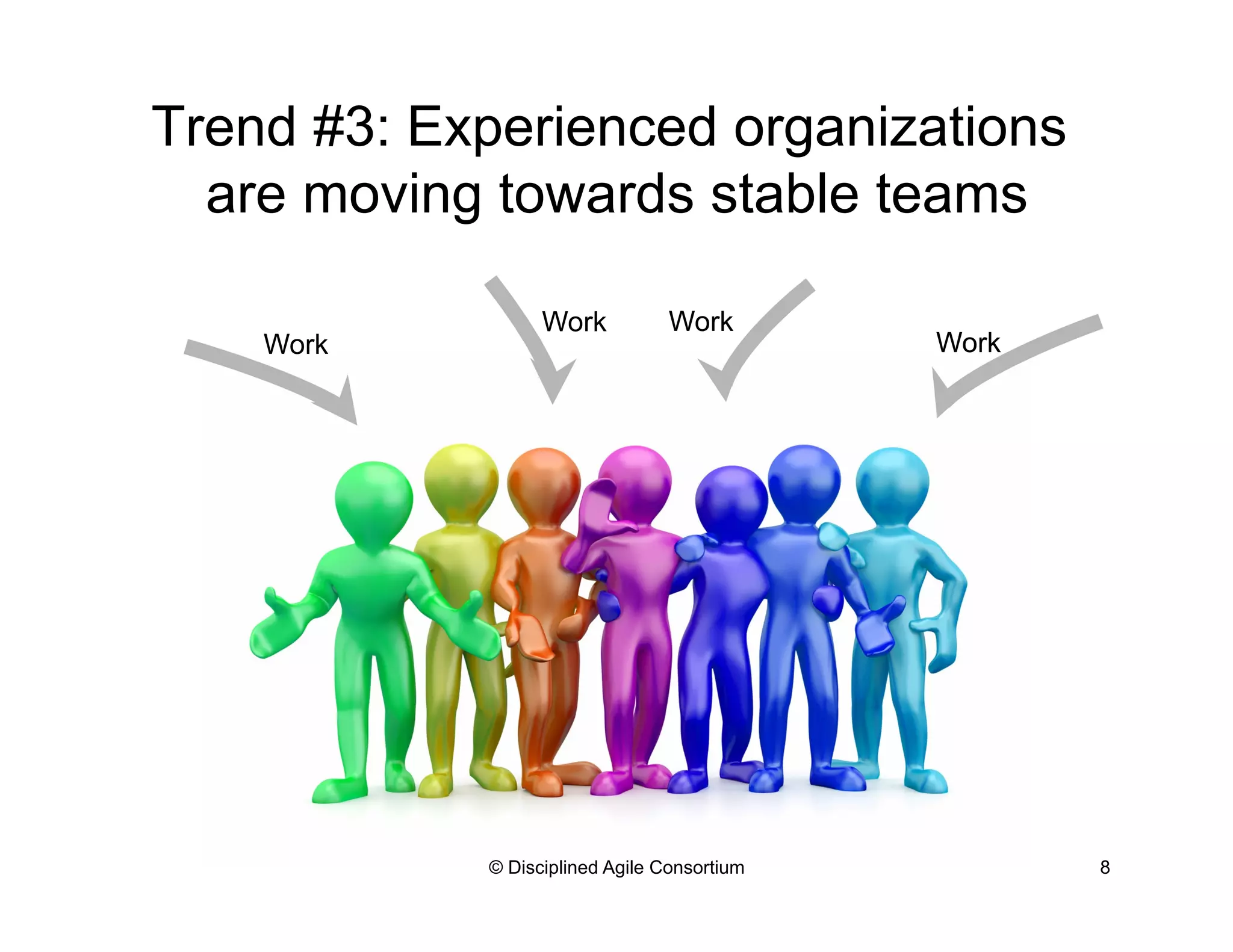
Trend #3: Experienced organizations
are moving towards stable teams
© Disciplined Agile Consortium
Work
Work Work
Work
8
Trend #4: Status reporting is being
automated away
© Disciplined Agile Consortium 9
Implications for Existing Managers
1.  Empowered teams
è Less work for managers to do
2.  New leadership roles
è Leadership is the responsibility of non-managers
3.  Stable teams
è Much less “resource management” is required
è Budgeting is greatly simplified
4.  Automated status reporting
è Less work for managers to do
© Disciplined Agile Consortium 10
Where do managers fit
into agile?
© Disciplined Agile Consortium 11
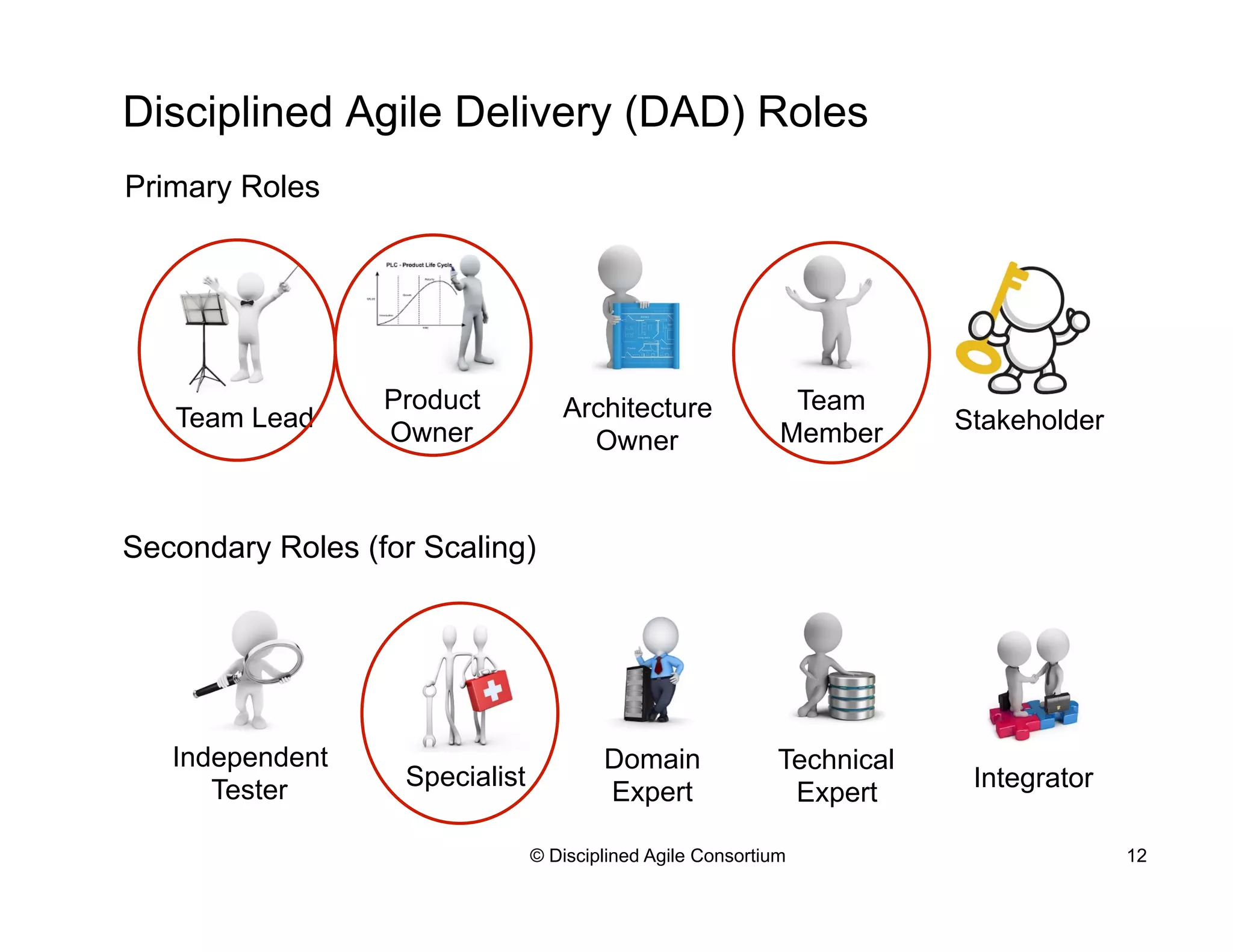
Disciplined Agile Delivery (DAD) Roles
© Disciplined Agile Consortium 12
Primary Roles
Secondary Roles (for Scaling)
Team Lead
Independent
Tester
Architecture
Owner
Product
Owner
Team
Member
Technical
Expert
IntegratorSpecialist
Domain
Expert
Stakeholder
Team Lead
•  Responsible for the effectiveness and continuous
improvement of the team’s process
•  Facilitates close collaboration between team members
•  Keeps the team focused on the project vision and goals
•  Removes impediments for the team and escalates
organizational impediments
•  Protects the team from interruptions and external
interference
•  Maintains honest communication between everyone on the
project
•  Coaches others in the use of agile practices
•  Prompts the team to discuss and think through issues when
they are identified
•  Facilitates decision making (but does not make decisions or
mandate internal team activity)
13
© Disciplined Agile Consortium
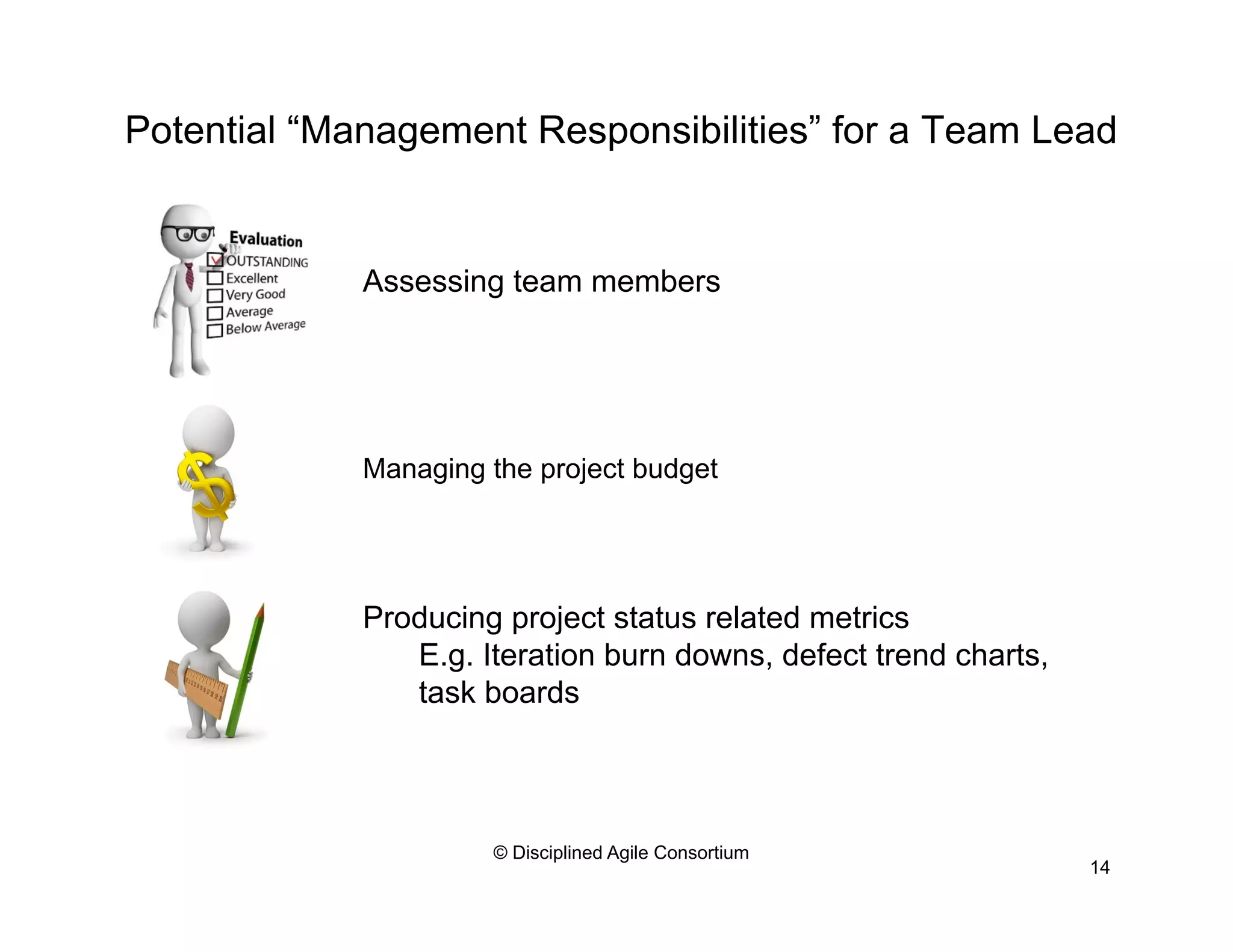
Potential “Management Responsibilities” for a Team Lead
14
© Disciplined Agile Consortium
Managing the project budget
Producing project status related metrics
E.g. Iteration burn downs, defect trend charts,
task boards
Assessing team members
Product Owner
•  The Stakeholder “proxy”
•  Go-to person for information on the solution
requirements
•  Prioritizes all work for the team
•  Participant in modeling and acceptance testing
•  Has access to expert stakeholders
•  Facilitates requirements envisioning and
modeling
•  Educates team in business domain
•  May demonstrate solution to key stakeholders
•  Monitors and communicates status to
stakeholders
•  Negotiates priorities, scope, funding, and
schedule
15
© Disciplined Agile Consortium
Team Member
•  Is a cross-functional, generalizing specialist
•  On small teams every team member is typically a
developer, but on larger teams non-developers may
appear
•  Volunteers to do any work that allows the team to most
efficiently deliver the work committed to for the
iteration
•  Seeks to both learn about other specialties as well as
coach others on their own specialty
•  Goes to the product owner for domain information and
decisions
•  Works with the architecture owner to evolve the
architecture
•  Follows enterprise conventions and leverages and
enhances the existing infrastructure
16
© Disciplined Agile Consortium
At scale you may need a few
people in specialized
management
roles
© Disciplined Agile Consortium 17
Potential Management Roles at Scale
•  Community of Excellence (CoE) Lead
•  Community of Practice (CoP) Lead
•  Data Manager
•  Functional Manager
•  Governor
•  Operations Manager
•  Portfolio Manager
•  Program Manager
•  Release Manager
•  Support (Help Desk) Manager
© Disciplined Agile Consortium 18
The Bad News: There Are Fewer
Management Positions in Agile Orgs
Before Agile
© Disciplined Agile Consortium
After Agile
19
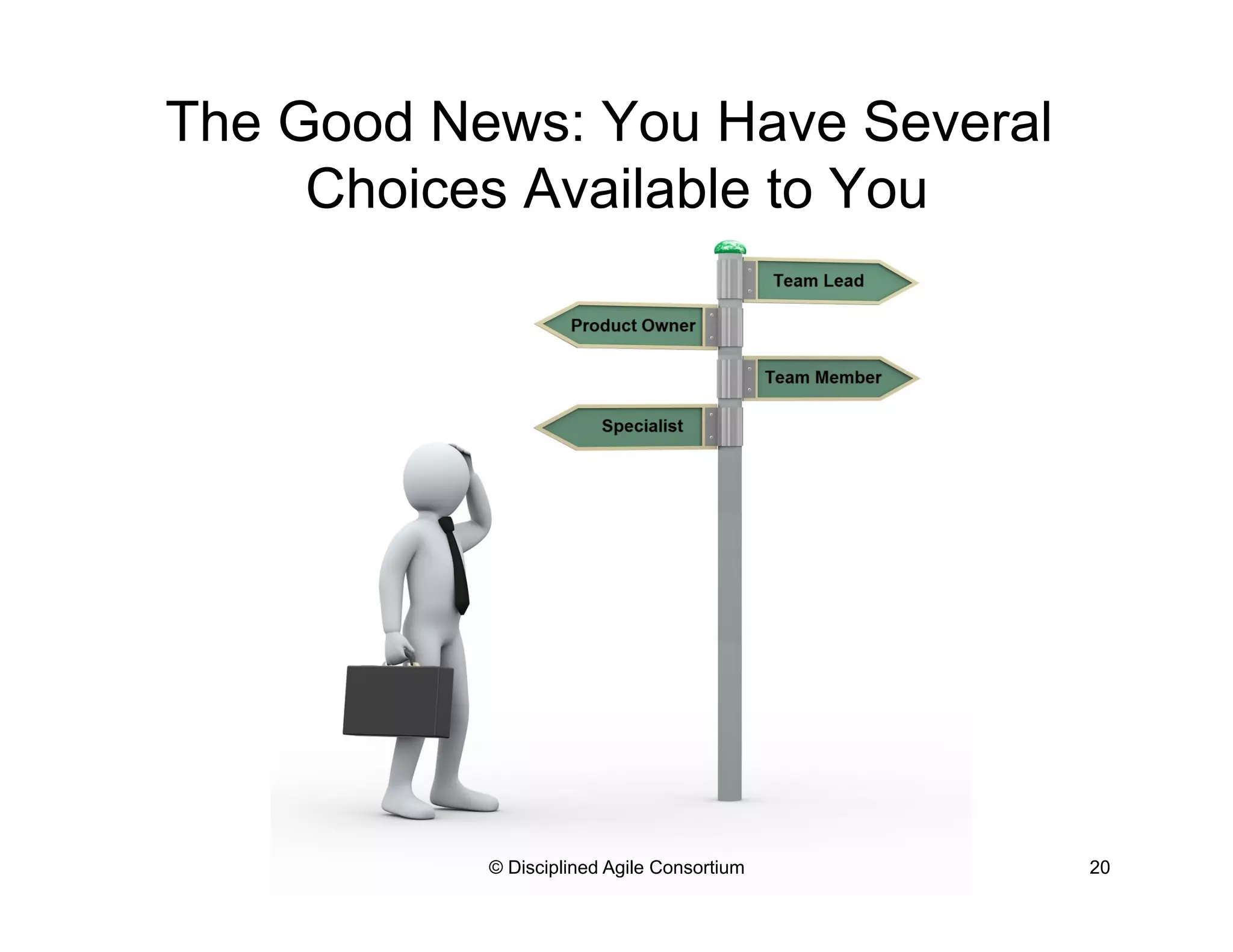
The Good News: You Have Several
Choices Available to You
© Disciplined Agile Consortium 20
What can you do?
© Disciplined Agile Consortium 21
Observe what is actually happening
© Disciplined Agile Consortium 22
Be flexible
© Disciplined Agile Consortium 23
Choose to evolve
© Disciplined Agile Consortium 24
Questions and Answers
•  During the webinar on February 23, 2016 we received numerous
questions. We answered many of them during the webinar but did
not get to all of them.
•  We have written a blog answering the questions in detail at
http://www.disciplinedagiledelivery.com/where-managers-go/
•  There is also a recording of the webinar available from the
Disciplined Agile YouTube channel at
https://www.youtube.com/channel/UCcWJ20C86Mzxcsqb73AReHQ
© Disciplined Agile Consortium 25
Thank You!
scott [at] scottambler.com
@scottwambler
AgileModeling.com
AgileData.org
Ambysoft.com
DisciplinedAgileConsortium.org
DisciplinedAgileDelivery.com
ScottAmbler.com
Disciplined Agile Delivery
© Disciplined Agile Consortium 26
Disciplined Agile Delivery
(DAD) is a process decision
framework
The key characteristics of DAD:
–  People-first
–  Goal-driven
–  Hybrid agile
–  Learning-oriented
–  Full delivery lifecycle
–  Solution focused
–  Risk-value lifecycle
–  Enterprise aware
© Disciplined Agile Consortium 27
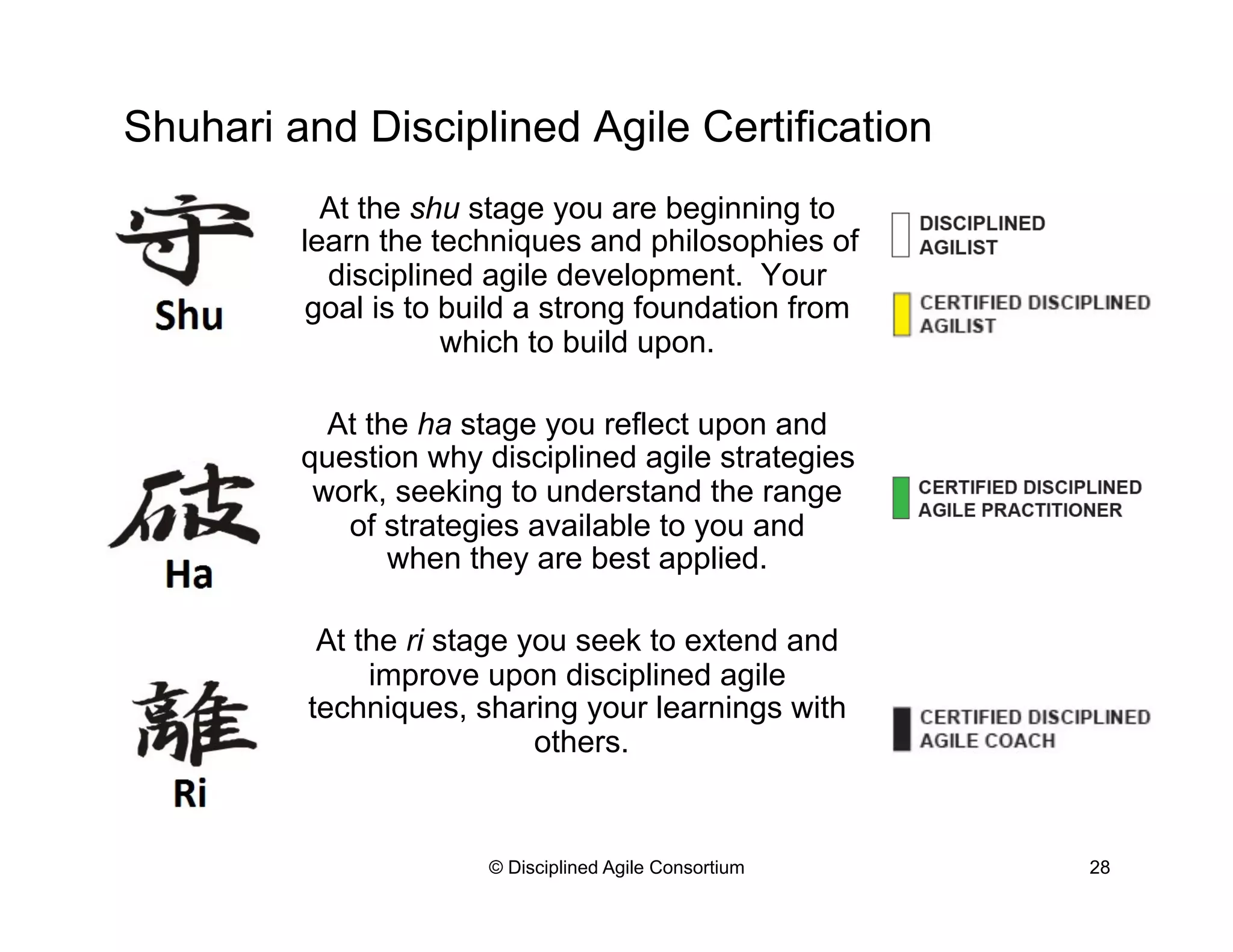
Shuhari and Disciplined Agile Certification
At the shu stage you are beginning to
learn the techniques and philosophies of
disciplined agile development. Your
goal is to build a strong foundation from
which to build upon.
At the ha stage you reflect upon and
question why disciplined agile strategies
work, seeking to understand the range
of strategies available to you and
when they are best applied.
At the ri stage you seek to extend and
improve upon disciplined agile
techniques, sharing your learnings with
others.
© Disciplined Agile Consortium 28
Would You Like This Presented
to Your Organization?
Contact us at ScottAmbler.com
© Disciplined Agile Consortium 29
Scott Ambler + Associates is the thought leader behind the Disciplined
Agile Delivery (DAD) framework and its application. We are a boutique
IT management consulting firm that advises organizations to be more
effective applying disciplined agile and lean processes within the
context of your business.
Our website is ScottAmbler.com
We can help
© Disciplined Agile Consortium 30

(In Agile) Where Do All The Managers Go?

  • 1.
    (In Agile) Where DoAll The Managers Go?
  • 2.
    Scott W. Ambler • Pioneered Agile Modeling and Agile Database techniques in the early 2000s •  Co-creator of the Disciplined Agile Delivery (DAD) framework •  Executive Transformation Coach •  scott [at] scottambler.com •  @scottwambler © Disciplined Agile Consortium Helps IT departments around the world become awesome 2
  • 3.
    Our strategy: Observe what happensin practice © Disciplined Agile Consortium 3
  • 4.
    Let’s explore three importantquestions…. What important trends are happening? Where do managers fit into agile? What can you do? © Disciplined Agile Consortium 4
  • 5.
  • 6.
    Trend #1: Technicalmanagement tasks are performed by the team © Disciplined Agile Consortium 6
  • 7.
    Trend #2: Leadershipis addressed by new roles © Disciplined Agile Consortium Team Lead Architecture Owner Product Owner 7
  • 8.
    Trend #3: Experiencedorganizations are moving towards stable teams © Disciplined Agile Consortium Work Work Work Work 8
  • 9.
    Trend #4: Statusreporting is being automated away © Disciplined Agile Consortium 9
  • 10.
    Implications for ExistingManagers 1.  Empowered teams è Less work for managers to do 2.  New leadership roles è Leadership is the responsibility of non-managers 3.  Stable teams è Much less “resource management” is required è Budgeting is greatly simplified 4.  Automated status reporting è Less work for managers to do © Disciplined Agile Consortium 10
  • 11.
    Where do managersfit into agile? © Disciplined Agile Consortium 11
  • 12.
    Disciplined Agile Delivery(DAD) Roles © Disciplined Agile Consortium 12 Primary Roles Secondary Roles (for Scaling) Team Lead Independent Tester Architecture Owner Product Owner Team Member Technical Expert IntegratorSpecialist Domain Expert Stakeholder
  • 13.
    Team Lead •  Responsiblefor the effectiveness and continuous improvement of the team’s process •  Facilitates close collaboration between team members •  Keeps the team focused on the project vision and goals •  Removes impediments for the team and escalates organizational impediments •  Protects the team from interruptions and external interference •  Maintains honest communication between everyone on the project •  Coaches others in the use of agile practices •  Prompts the team to discuss and think through issues when they are identified •  Facilitates decision making (but does not make decisions or mandate internal team activity) 13 © Disciplined Agile Consortium
  • 14.
    Potential “Management Responsibilities”for a Team Lead 14 © Disciplined Agile Consortium Managing the project budget Producing project status related metrics E.g. Iteration burn downs, defect trend charts, task boards Assessing team members
  • 15.
    Product Owner •  TheStakeholder “proxy” •  Go-to person for information on the solution requirements •  Prioritizes all work for the team •  Participant in modeling and acceptance testing •  Has access to expert stakeholders •  Facilitates requirements envisioning and modeling •  Educates team in business domain •  May demonstrate solution to key stakeholders •  Monitors and communicates status to stakeholders •  Negotiates priorities, scope, funding, and schedule 15 © Disciplined Agile Consortium
  • 16.
    Team Member •  Isa cross-functional, generalizing specialist •  On small teams every team member is typically a developer, but on larger teams non-developers may appear •  Volunteers to do any work that allows the team to most efficiently deliver the work committed to for the iteration •  Seeks to both learn about other specialties as well as coach others on their own specialty •  Goes to the product owner for domain information and decisions •  Works with the architecture owner to evolve the architecture •  Follows enterprise conventions and leverages and enhances the existing infrastructure 16 © Disciplined Agile Consortium
  • 17.
    At scale youmay need a few people in specialized management roles © Disciplined Agile Consortium 17
  • 18.
    Potential Management Rolesat Scale •  Community of Excellence (CoE) Lead •  Community of Practice (CoP) Lead •  Data Manager •  Functional Manager •  Governor •  Operations Manager •  Portfolio Manager •  Program Manager •  Release Manager •  Support (Help Desk) Manager © Disciplined Agile Consortium 18
  • 19.
    The Bad News:There Are Fewer Management Positions in Agile Orgs Before Agile © Disciplined Agile Consortium After Agile 19
  • 20.
    The Good News:You Have Several Choices Available to You © Disciplined Agile Consortium 20
  • 21.
    What can youdo? © Disciplined Agile Consortium 21
  • 22.
    Observe what isactually happening © Disciplined Agile Consortium 22
  • 23.
    Be flexible © DisciplinedAgile Consortium 23
  • 24.
    Choose to evolve ©Disciplined Agile Consortium 24
  • 25.
    Questions and Answers • During the webinar on February 23, 2016 we received numerous questions. We answered many of them during the webinar but did not get to all of them. •  We have written a blog answering the questions in detail at http://www.disciplinedagiledelivery.com/where-managers-go/ •  There is also a recording of the webinar available from the Disciplined Agile YouTube channel at https://www.youtube.com/channel/UCcWJ20C86Mzxcsqb73AReHQ © Disciplined Agile Consortium 25
  • 26.
    Thank You! scott [at]scottambler.com @scottwambler AgileModeling.com AgileData.org Ambysoft.com DisciplinedAgileConsortium.org DisciplinedAgileDelivery.com ScottAmbler.com Disciplined Agile Delivery Disciplined Agile Delivery © Disciplined Agile Consortium 26
  • 27.
    Disciplined Agile Delivery (DAD)is a process decision framework The key characteristics of DAD: –  People-first –  Goal-driven –  Hybrid agile –  Learning-oriented –  Full delivery lifecycle –  Solution focused –  Risk-value lifecycle –  Enterprise aware © Disciplined Agile Consortium 27
  • 28.
    Shuhari and DisciplinedAgile Certification At the shu stage you are beginning to learn the techniques and philosophies of disciplined agile development. Your goal is to build a strong foundation from which to build upon. At the ha stage you reflect upon and question why disciplined agile strategies work, seeking to understand the range of strategies available to you and when they are best applied. At the ri stage you seek to extend and improve upon disciplined agile techniques, sharing your learnings with others. © Disciplined Agile Consortium 28
  • 29.
    Would You LikeThis Presented to Your Organization? Contact us at ScottAmbler.com © Disciplined Agile Consortium 29
  • 30.
    Scott Ambler +Associates is the thought leader behind the Disciplined Agile Delivery (DAD) framework and its application. We are a boutique IT management consulting firm that advises organizations to be more effective applying disciplined agile and lean processes within the context of your business. Our website is ScottAmbler.com We can help © Disciplined Agile Consortium 30