
The Art of Doing Effective Scrum
by
Mohammed Javid
PSM, CSM, PMI-ACP, CSP, Safe Agilist
What is Scrum?
Scrum is a framework for developing
and sustaining complex products.
• Lightweight
• Simple to understand
• Difficult to Master
It is a framework within which people
can address complex adaptive
problems, while productively and
creatively delivering products of the
highest possible value.
2
Scrum Framework
Scrum employs an iterative,
incremental approach to optimize
predictability and control risk
Maximizing opportunities for
feedback
The team model in Scrum is
designed to optimize flexibility,
creativity and productivity.
Scrum has roles, events, artifacts
and rules that bind them
3
What is Scrum Theory?
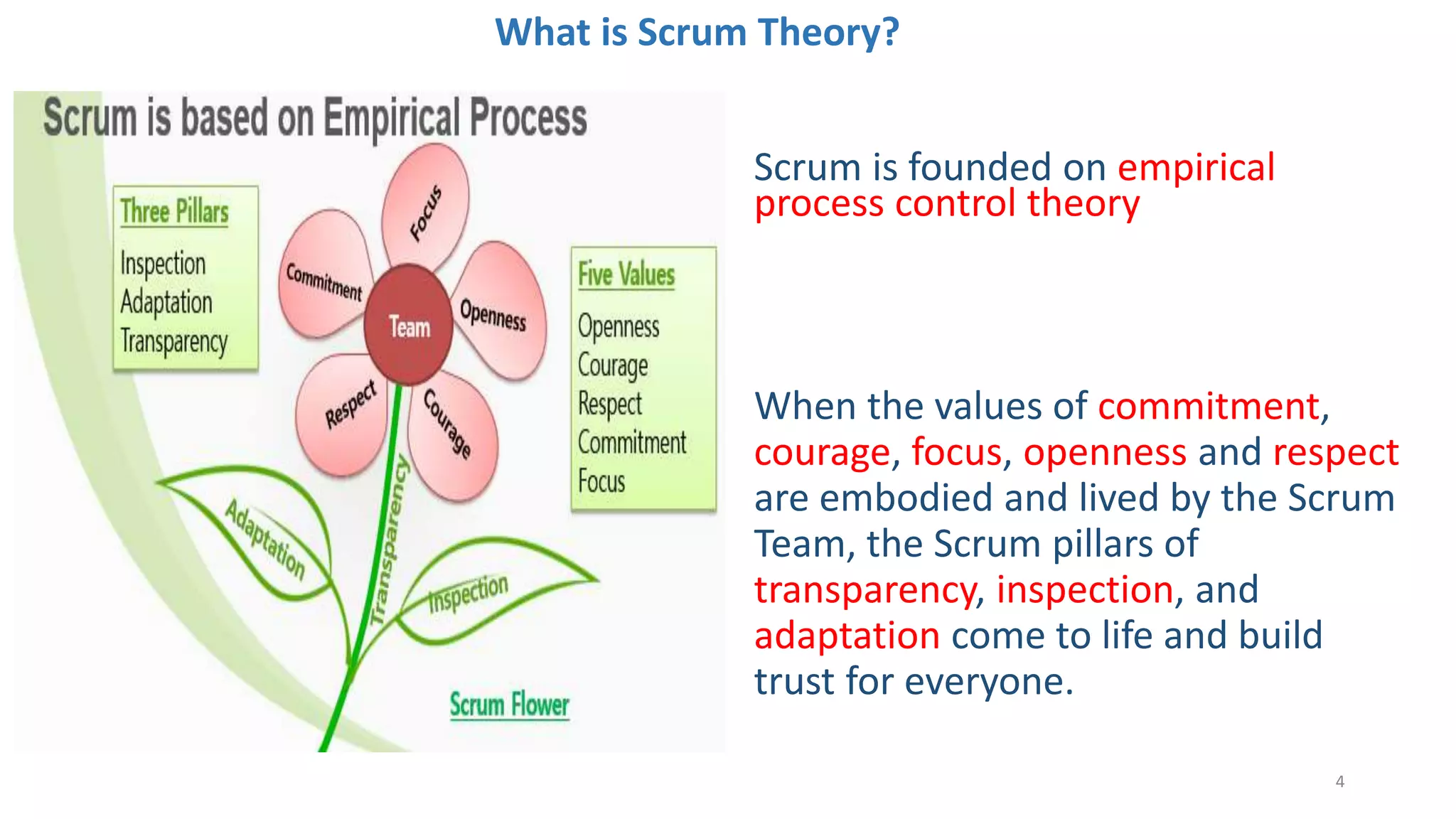
Scrum is founded on empirical
process control theory
4
When the values of commitment,
courage, focus, openness and respect
are embodied and lived by the Scrum
Team, the Scrum pillars of
transparency, inspection, and
adaptation come to life and build
trust for everyone.
Is Scrum a Process?
Scrum is not a defined process, it is a
process framework.
It is not a process or a technique.
5
It is a framework within which you can
employ various processes and
techniques.
It is a simple framework, do not
overload it.
What is the use of Scrum?
6
Scrum makes clear the relative
efficacy of your product management
and development practices so that
you can improve.
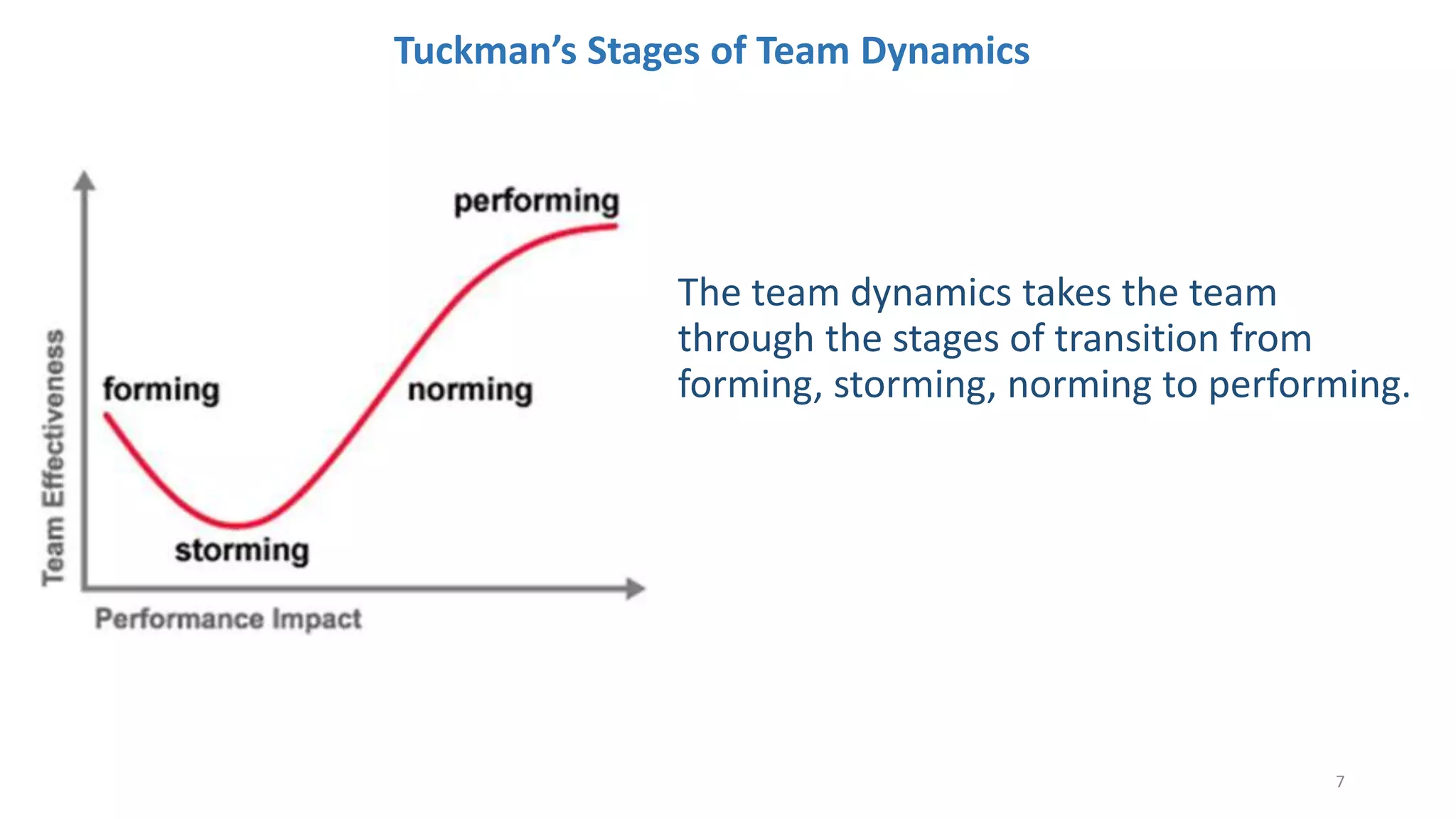
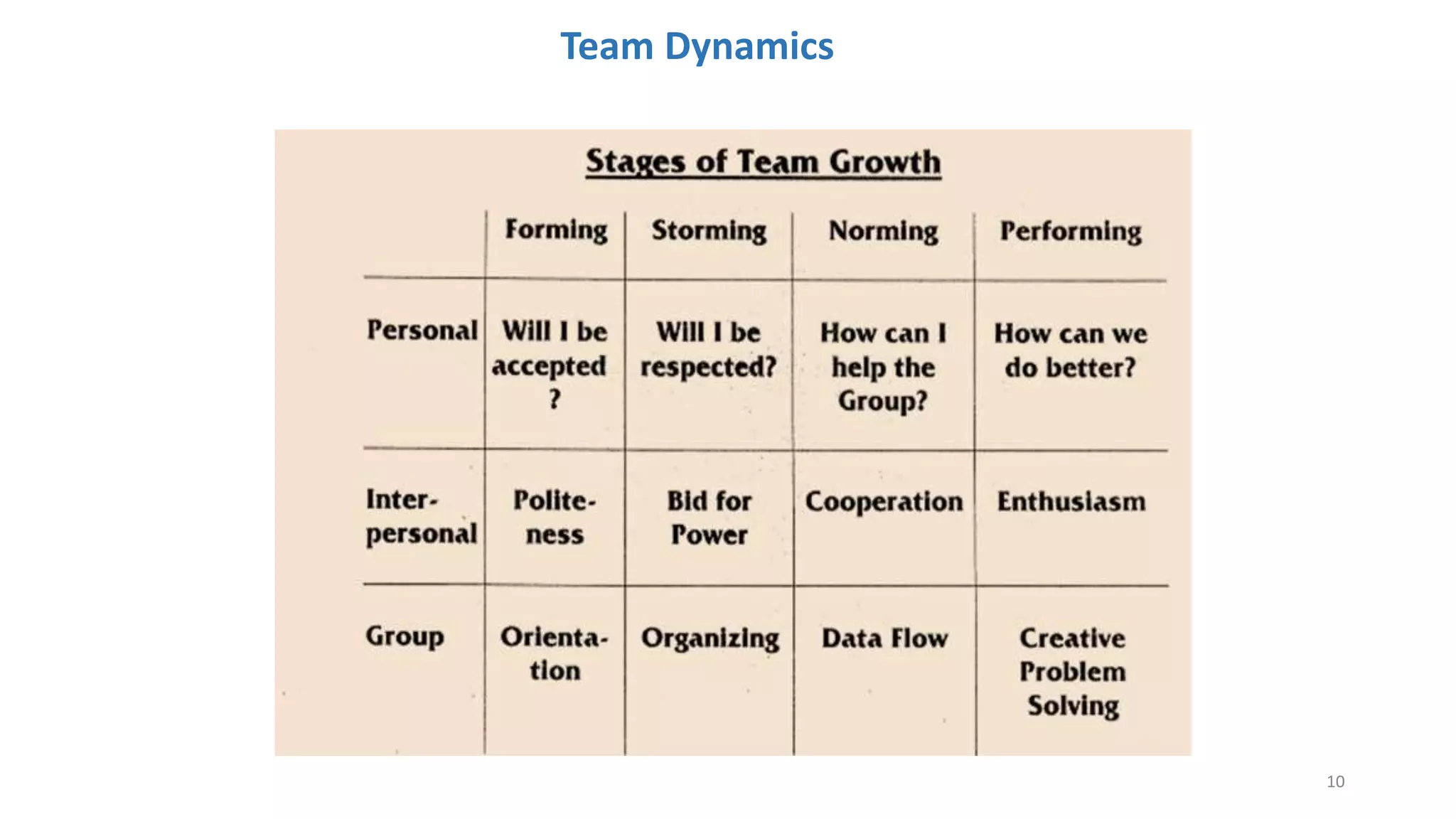
Tuckman’s Stages of Team Dynamics
The team dynamics takes the team
through the stages of transition from
forming, storming, norming to performing.
7
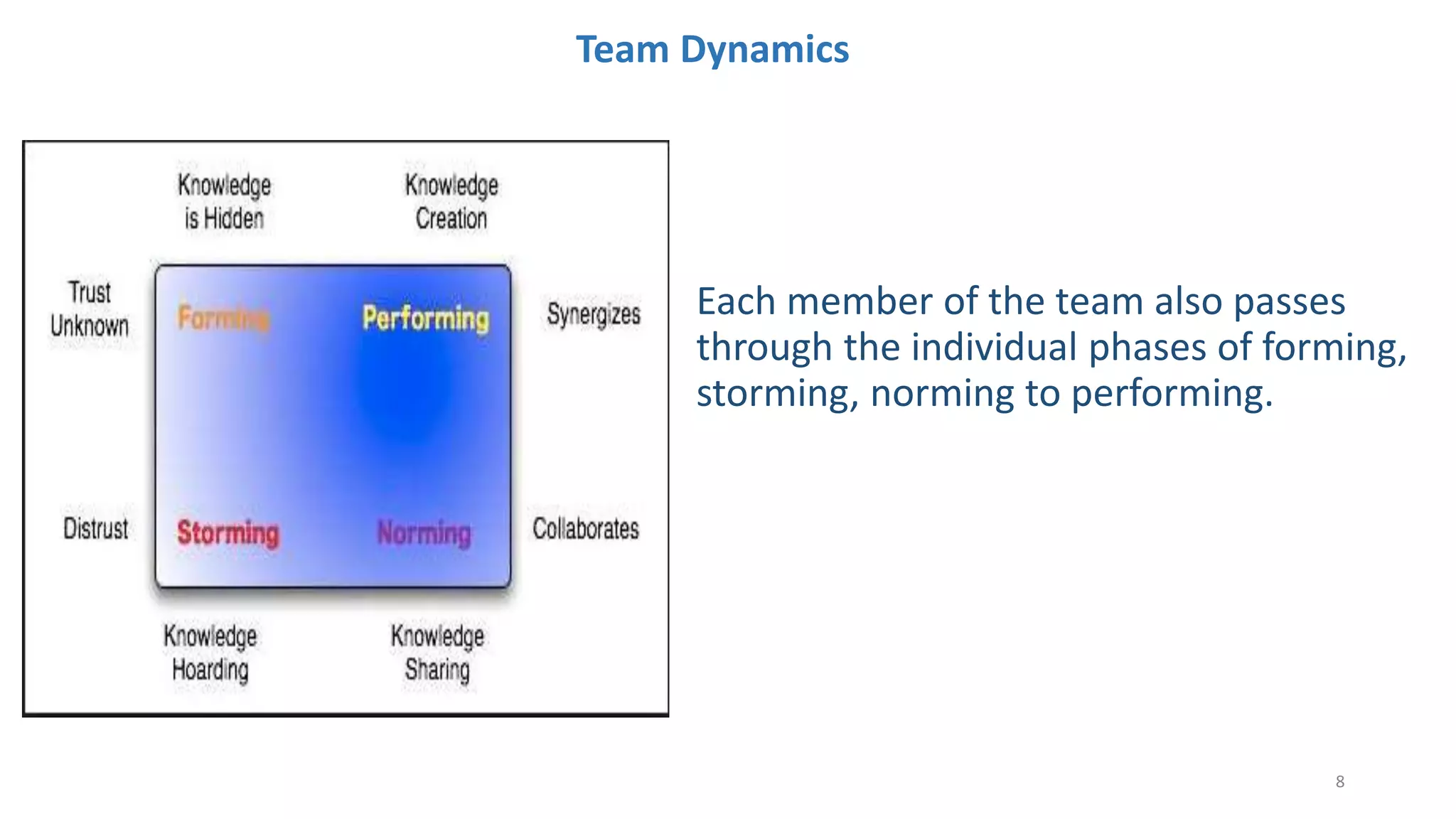
Team Dynamics
8
Each member of the team also passes
through the individual phases of forming,
storming, norming to performing.
Effective Scrum
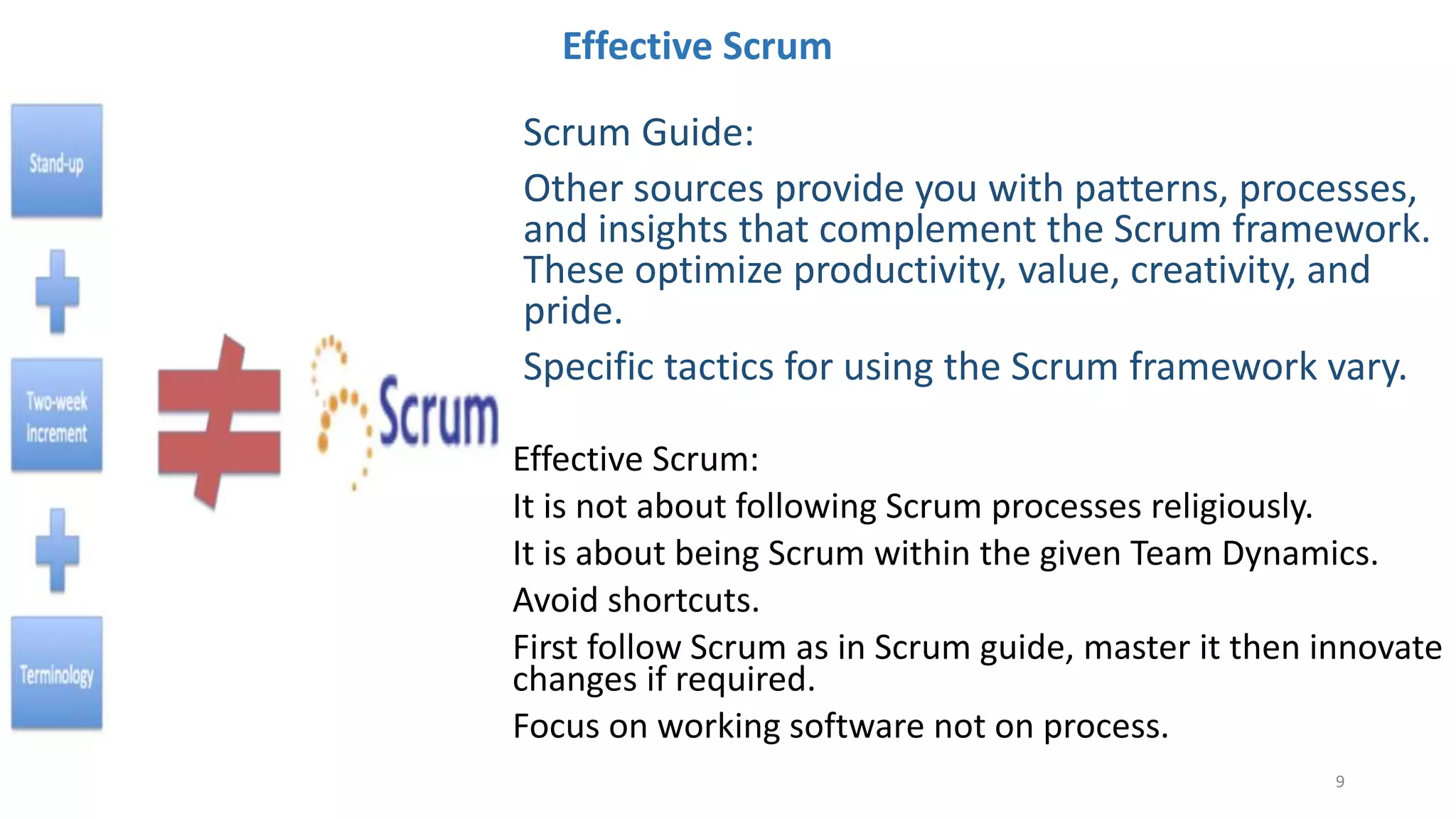
Effective Scrum:
It is not about following Scrum processes religiously.
It is about being Scrum within the given Team Dynamics.
Avoid shortcuts.
First follow Scrum as in Scrum guide, master it then innovate
changes if required.
Focus on working software not on process.
Scrum Guide:
Other sources provide you with patterns, processes,
and insights that complement the Scrum framework.
These optimize productivity, value, creativity, and
pride.
Specific tactics for using the Scrum framework vary.
9
Team Dynamics
10
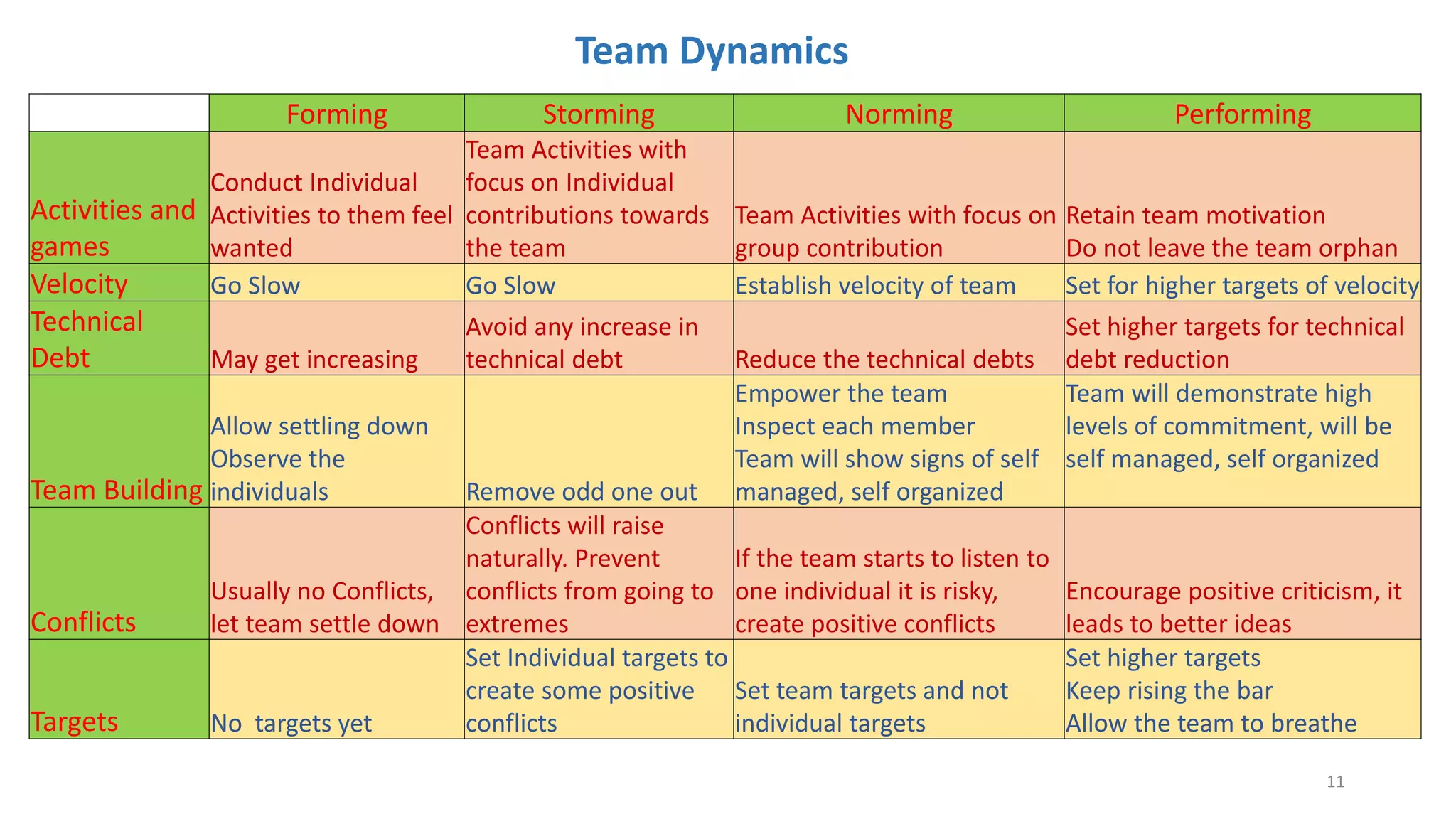
Team Dynamics
Forming Storming Norming Performing
Activities and
games
Conduct Individual
Activities to them feel
wanted
Team Activities with
focus on Individual
contributions towards
the team
Team Activities with focus on
group contribution
Retain team motivation
Do not leave the team orphan
Velocity Go Slow Go Slow Establish velocity of team Set for higher targets of velocity
Technical
Debt May get increasing
Avoid any increase in
technical debt Reduce the technical debts
Set higher targets for technical
debt reduction
Team Building
Allow settling down
Observe the
individuals Remove odd one out
Empower the team
Inspect each member
Team will show signs of self
managed, self organized
Team will demonstrate high
levels of commitment, will be
self managed, self organized
Conflicts
Usually no Conflicts,
let team settle down
Conflicts will raise
naturally. Prevent
conflicts from going to
extremes
If the team starts to listen to
one individual it is risky,
create positive conflicts
Encourage positive criticism, it
leads to better ideas
Targets No targets yet
Set Individual targets to
create some positive
conflicts
Set team targets and not
individual targets
Set higher targets
Keep rising the bar
Allow the team to breathe
11
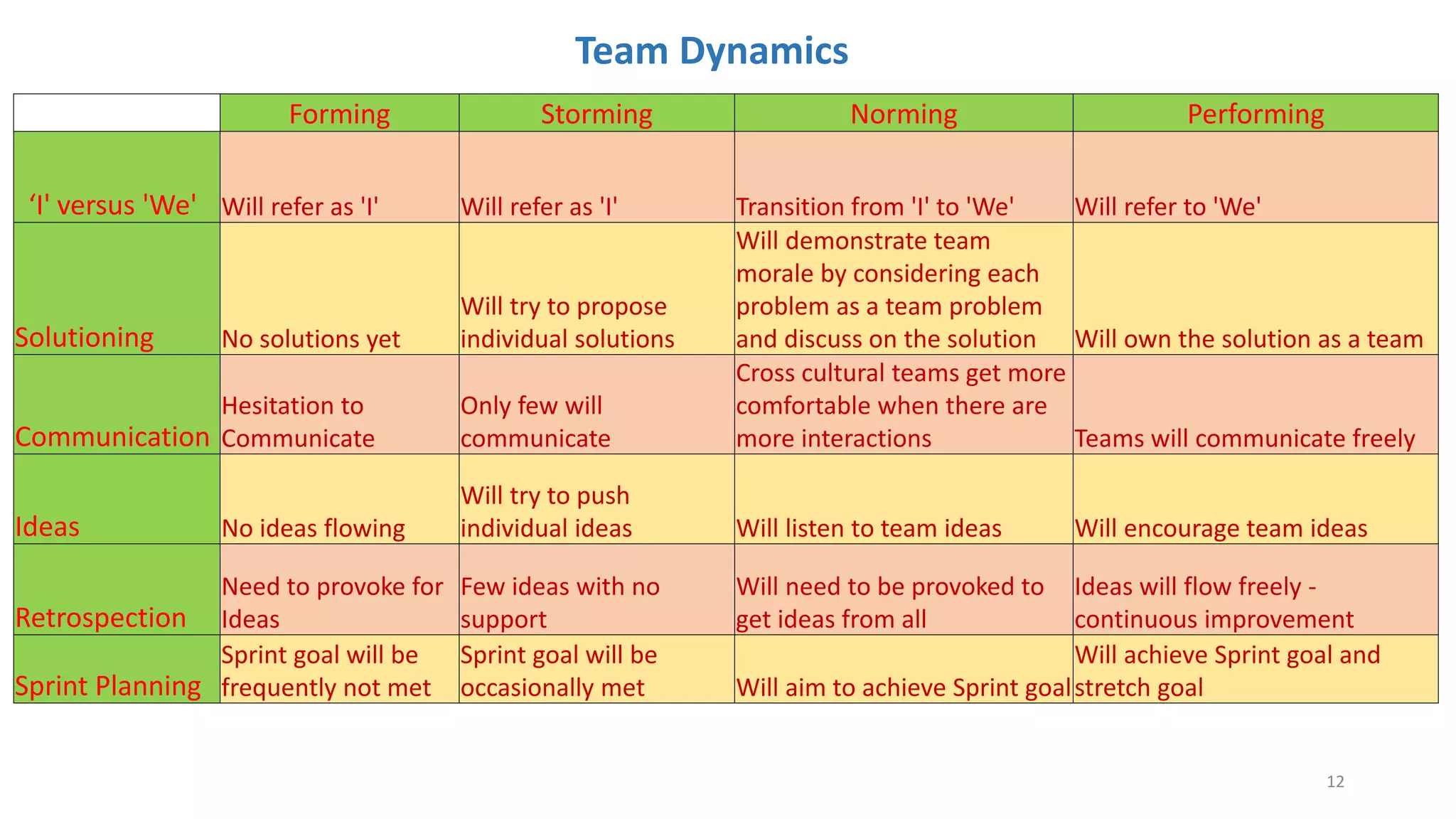
Team Dynamics
Forming Storming Norming Performing
‘I' versus 'We' Will refer as 'I' Will refer as 'I' Transition from 'I' to 'We' Will refer to 'We'
Solutioning No solutions yet
Will try to propose
individual solutions
Will demonstrate team
morale by considering each
problem as a team problem
and discuss on the solution Will own the solution as a team
Communication
Hesitation to
Communicate
Only few will
communicate
Cross cultural teams get more
comfortable when there are
more interactions Teams will communicate freely
Ideas No ideas flowing
Will try to push
individual ideas Will listen to team ideas Will encourage team ideas
Retrospection
Need to provoke for
Ideas
Few ideas with no
support
Will need to be provoked to
get ideas from all
Ideas will flow freely -
continuous improvement
Sprint Planning
Sprint goal will be
frequently not met
Sprint goal will be
occasionally met Will aim to achieve Sprint goal
Will achieve Sprint goal and
stretch goal
12
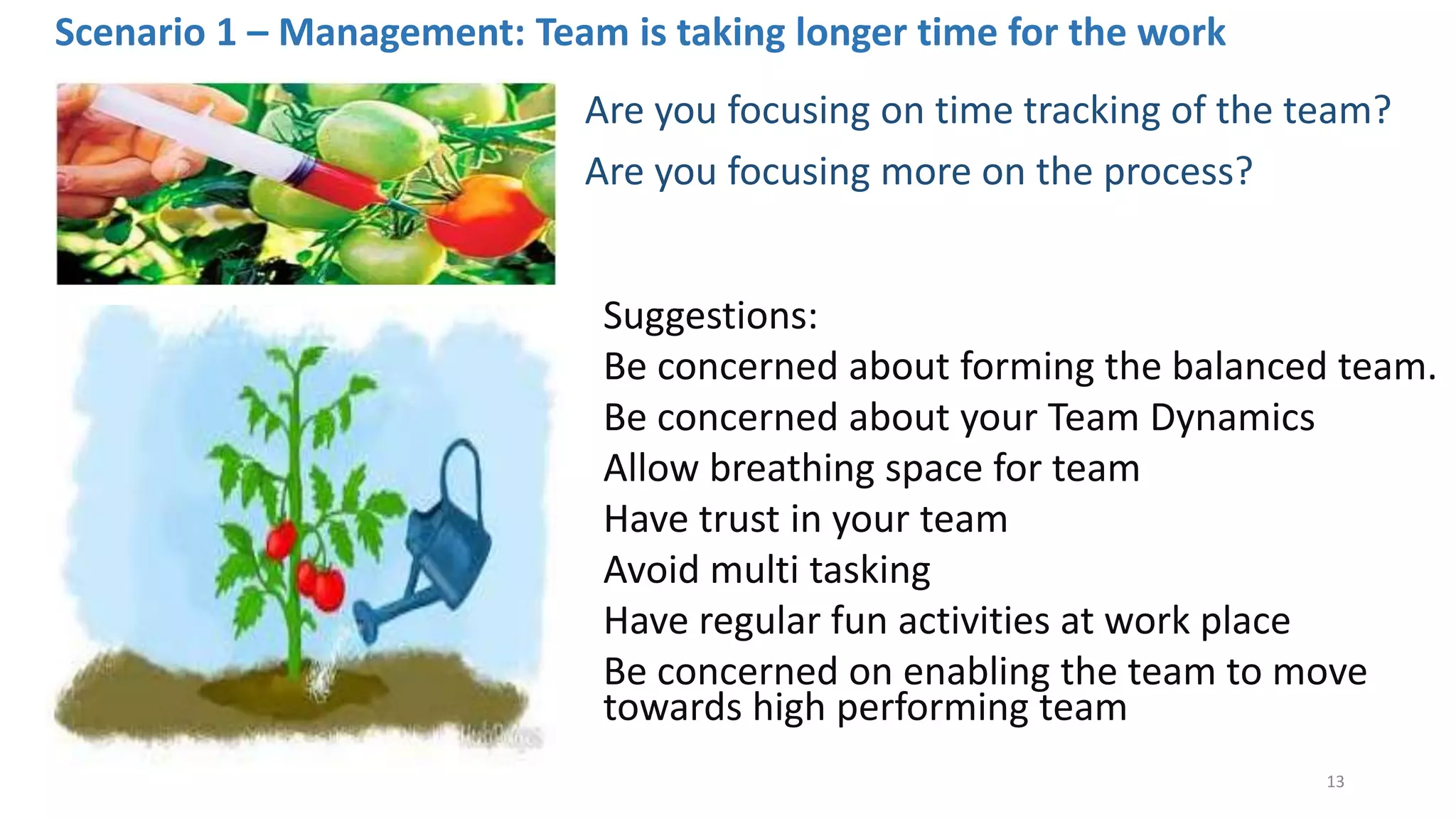
Scenario 1 – Management: Team is taking longer time for the work
Are you focusing on time tracking of the team?
Are you focusing more on the process?
Suggestions:
Be concerned about forming the balanced team.
Be concerned about your Team Dynamics
Allow breathing space for team
Have trust in your team
Avoid multi tasking
Have regular fun activities at work place
Be concerned on enabling the team to move
towards high performing team
13
Scenario 2 – Product Owner: I do not believe in Story Points estimate
Scrum Guide:
The number of items selected from the
Product Backlog for the Sprint is solely up to
the Development Team. Only the
Development Team can assess what it can
accomplish over the upcoming Sprint.
Suggestions:
Focus on whether the team has understood
the requirements
Create user stories with acceptance criteria
Create stories adhering to INVEST mnemonic
Measure the Product Backlog after each Sprint
14
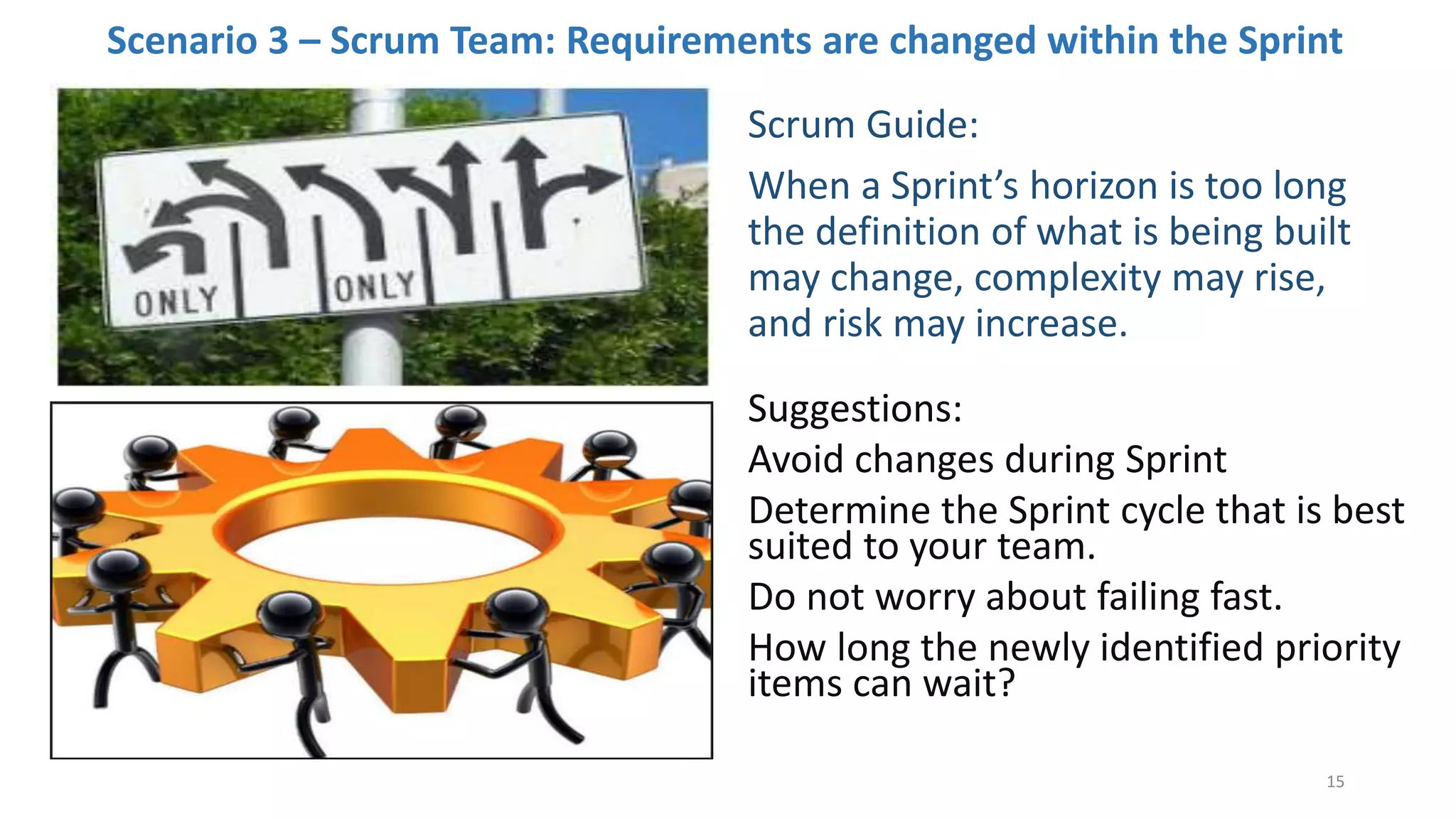
Scenario 3 – Scrum Team: Requirements are changed within the Sprint
Scrum Guide:
When a Sprint’s horizon is too long
the definition of what is being built
may change, complexity may rise,
and risk may increase.
Suggestions:
Avoid changes during Sprint
Determine the Sprint cycle that is best
suited to your team.
Do not worry about failing fast.
How long the newly identified priority
items can wait?
15
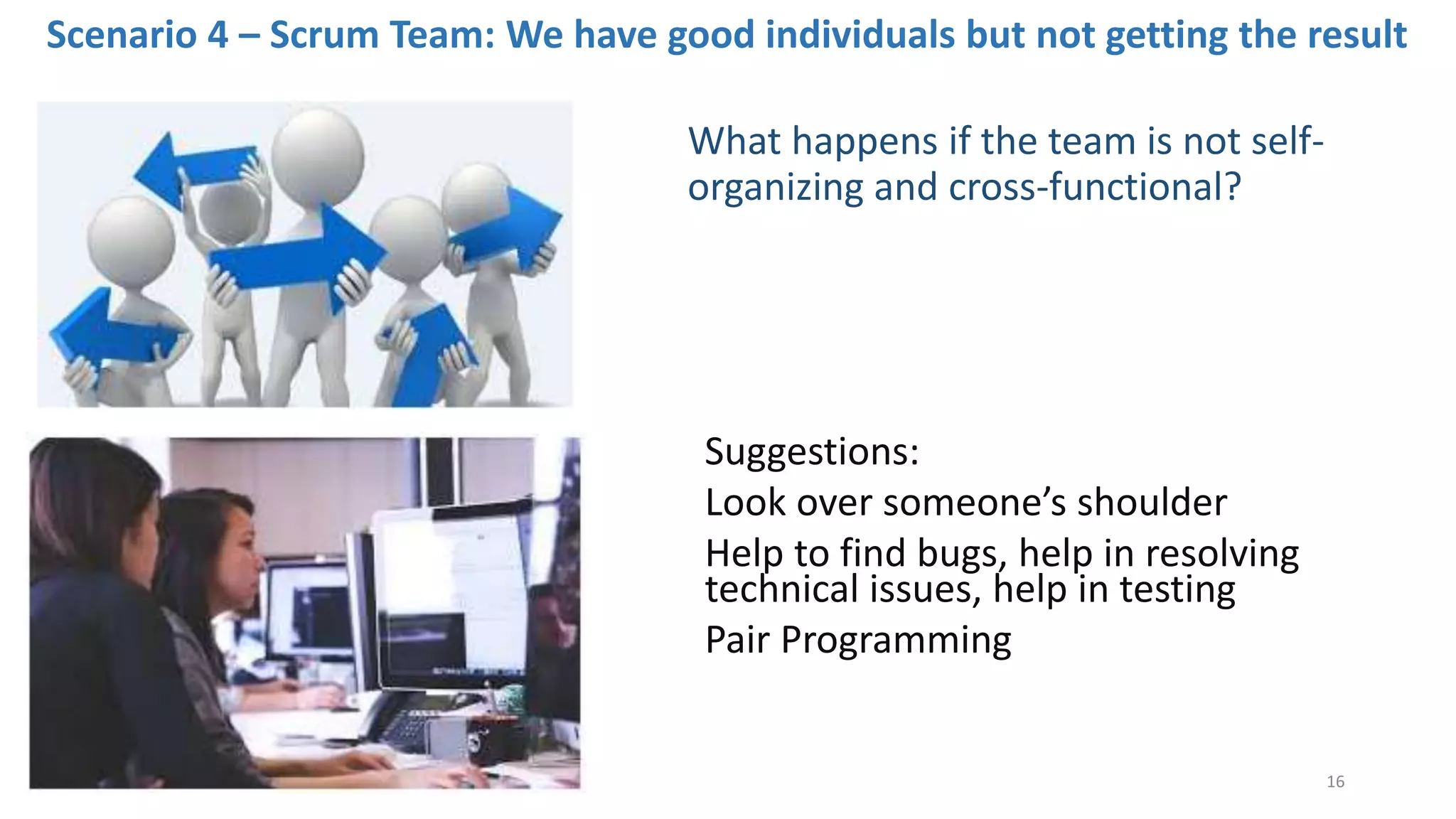
Scenario 4 – Scrum Team: We have good individuals but not getting the result
Suggestions:
Look over someone’s shoulder
Help to find bugs, help in resolving
technical issues, help in testing
Pair Programming
What happens if the team is not self-
organizing and cross-functional?
16
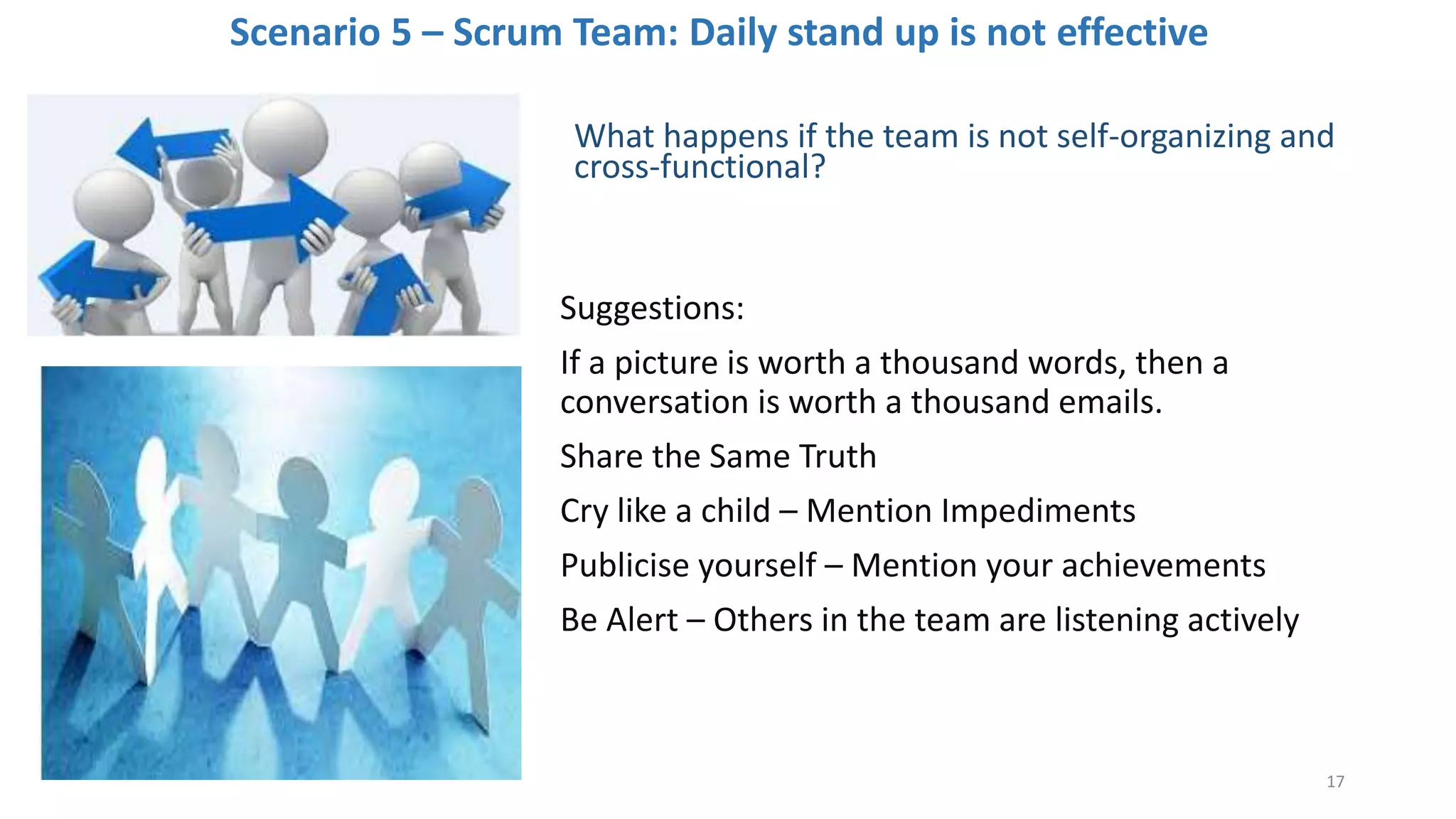
Scenario 5 – Scrum Team: Daily stand up is not effective
What happens if the team is not self-organizing and
cross-functional?
Suggestions:
If a picture is worth a thousand words, then a
conversation is worth a thousand emails.
Share the Same Truth
Cry like a child – Mention Impediments
Publicise yourself – Mention your achievements
Be Alert – Others in the team are listening actively
17
Scenario 6 – Scrum Master: Retrospection is not effective
Suggestions:
Start by thanking for efforts of the team in last Sprint
Break the initial silence in the team
Act as a mirror to the team
Ensure atleast 1 priority retrospection findings is closed in each Sprint
In case of distributed teams have the retrospection through Video
Conference calls which increases interactions between members
18
Scenario 7 – General: Scrum Master role is clubbed with other roles of Scrum
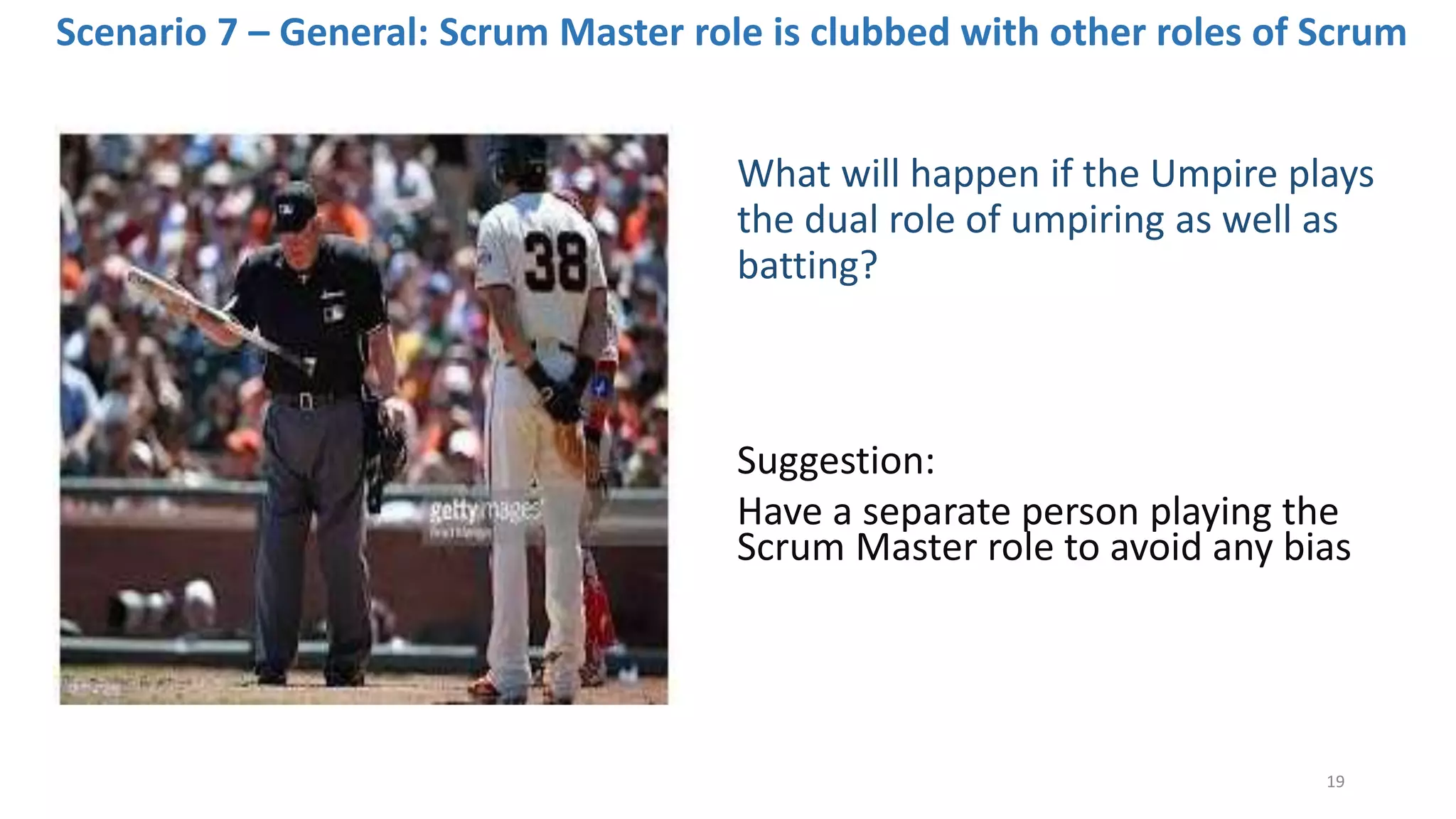
What will happen if the Umpire plays
the dual role of umpiring as well as
batting?
Suggestion:
Have a separate person playing the
Scrum Master role to avoid any bias
19
Scenario 8 – General: Sprints Completed but Product is not Ready
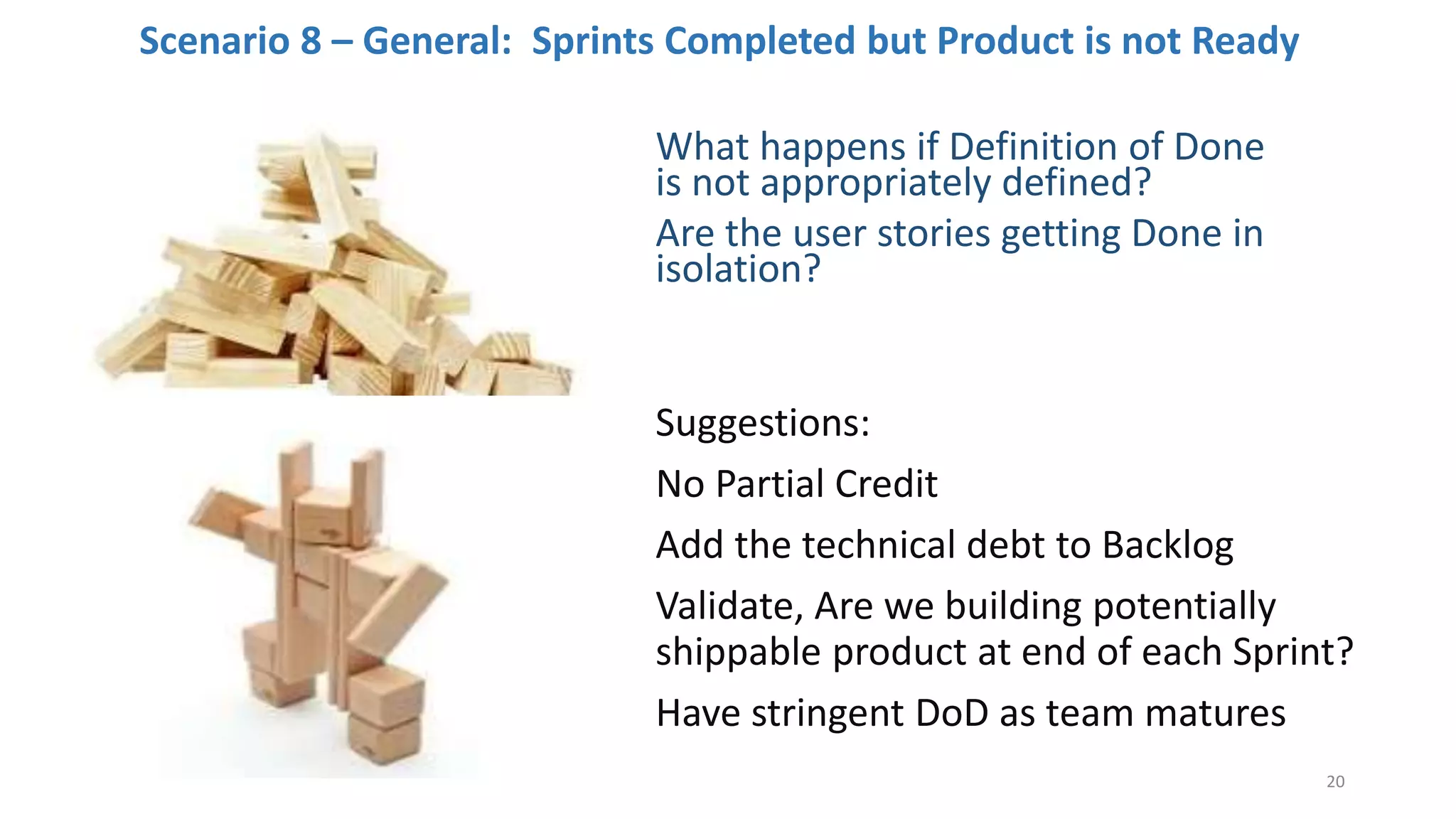
What happens if Definition of Done
is not appropriately defined?
Are the user stories getting Done in
isolation?
Suggestions:
No Partial Credit
Add the technical debt to Backlog
Validate, Are we building potentially
shippable product at end of each Sprint?
Have stringent DoD as team matures
20
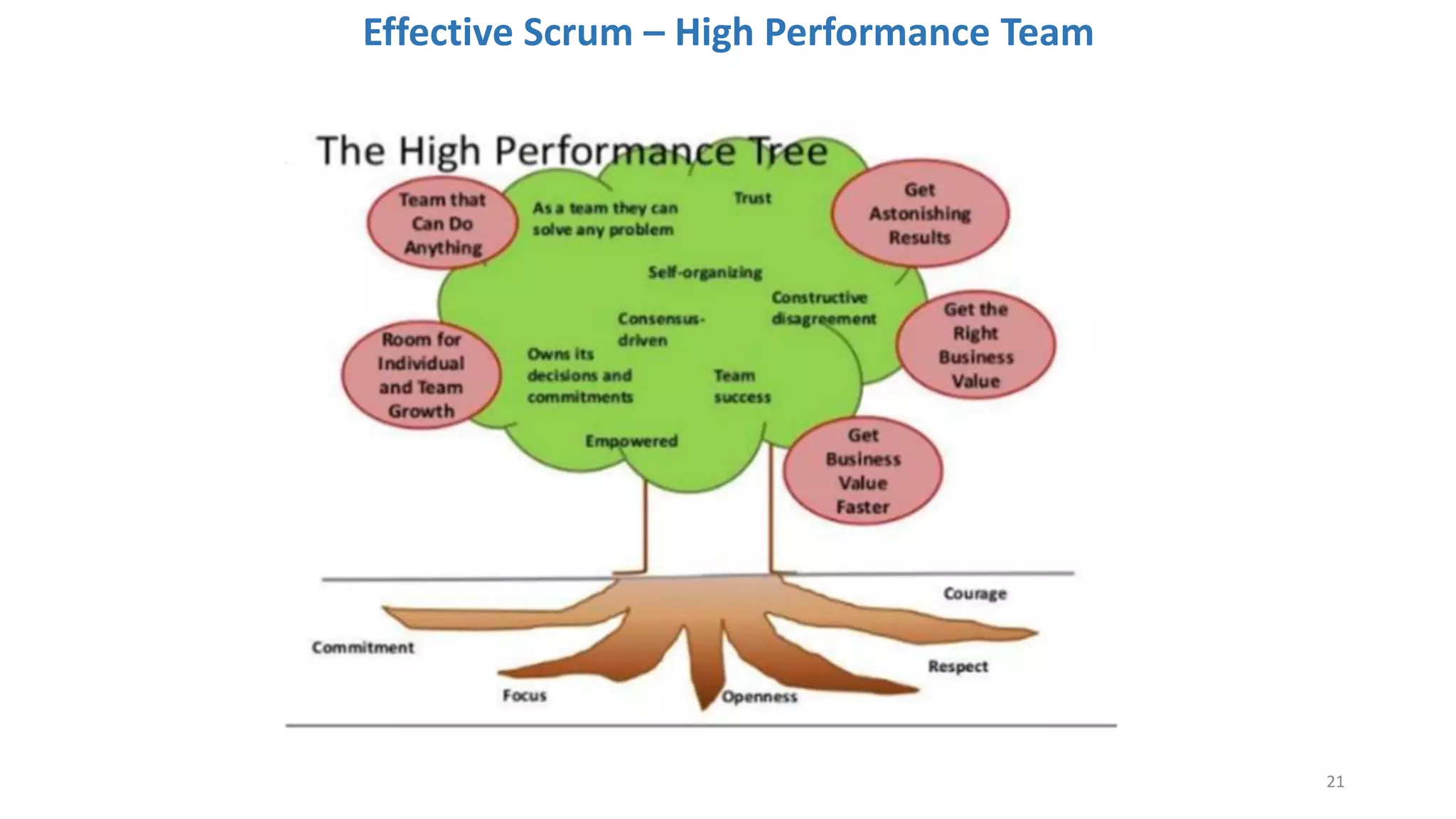
Effective Scrum – High Performance Team
21
?
22
Questions
Thank You
23

Art of Doing Effective Scrum : Presented by Mohammed Javid

  • 1.
    The Art ofDoing Effective Scrum by Mohammed Javid PSM, CSM, PMI-ACP, CSP, Safe Agilist
  • 2.
    What is Scrum? Scrumis a framework for developing and sustaining complex products. • Lightweight • Simple to understand • Difficult to Master It is a framework within which people can address complex adaptive problems, while productively and creatively delivering products of the highest possible value. 2
  • 3.
    Scrum Framework Scrum employsan iterative, incremental approach to optimize predictability and control risk Maximizing opportunities for feedback The team model in Scrum is designed to optimize flexibility, creativity and productivity. Scrum has roles, events, artifacts and rules that bind them 3
  • 4.
    What is ScrumTheory? Scrum is founded on empirical process control theory 4 When the values of commitment, courage, focus, openness and respect are embodied and lived by the Scrum Team, the Scrum pillars of transparency, inspection, and adaptation come to life and build trust for everyone.
  • 5.
    Is Scrum aProcess? Scrum is not a defined process, it is a process framework. It is not a process or a technique. 5 It is a framework within which you can employ various processes and techniques. It is a simple framework, do not overload it.
  • 6.
    What is theuse of Scrum? 6 Scrum makes clear the relative efficacy of your product management and development practices so that you can improve.
  • 7.
    Tuckman’s Stages ofTeam Dynamics The team dynamics takes the team through the stages of transition from forming, storming, norming to performing. 7
  • 8.
    Team Dynamics 8 Each memberof the team also passes through the individual phases of forming, storming, norming to performing.
  • 9.
    Effective Scrum Effective Scrum: Itis not about following Scrum processes religiously. It is about being Scrum within the given Team Dynamics. Avoid shortcuts. First follow Scrum as in Scrum guide, master it then innovate changes if required. Focus on working software not on process. Scrum Guide: Other sources provide you with patterns, processes, and insights that complement the Scrum framework. These optimize productivity, value, creativity, and pride. Specific tactics for using the Scrum framework vary. 9
  • 10.
  • 11.
    Team Dynamics Forming StormingNorming Performing Activities and games Conduct Individual Activities to them feel wanted Team Activities with focus on Individual contributions towards the team Team Activities with focus on group contribution Retain team motivation Do not leave the team orphan Velocity Go Slow Go Slow Establish velocity of team Set for higher targets of velocity Technical Debt May get increasing Avoid any increase in technical debt Reduce the technical debts Set higher targets for technical debt reduction Team Building Allow settling down Observe the individuals Remove odd one out Empower the team Inspect each member Team will show signs of self managed, self organized Team will demonstrate high levels of commitment, will be self managed, self organized Conflicts Usually no Conflicts, let team settle down Conflicts will raise naturally. Prevent conflicts from going to extremes If the team starts to listen to one individual it is risky, create positive conflicts Encourage positive criticism, it leads to better ideas Targets No targets yet Set Individual targets to create some positive conflicts Set team targets and not individual targets Set higher targets Keep rising the bar Allow the team to breathe 11
  • 12.
    Team Dynamics Forming StormingNorming Performing ‘I' versus 'We' Will refer as 'I' Will refer as 'I' Transition from 'I' to 'We' Will refer to 'We' Solutioning No solutions yet Will try to propose individual solutions Will demonstrate team morale by considering each problem as a team problem and discuss on the solution Will own the solution as a team Communication Hesitation to Communicate Only few will communicate Cross cultural teams get more comfortable when there are more interactions Teams will communicate freely Ideas No ideas flowing Will try to push individual ideas Will listen to team ideas Will encourage team ideas Retrospection Need to provoke for Ideas Few ideas with no support Will need to be provoked to get ideas from all Ideas will flow freely - continuous improvement Sprint Planning Sprint goal will be frequently not met Sprint goal will be occasionally met Will aim to achieve Sprint goal Will achieve Sprint goal and stretch goal 12
  • 13.
    Scenario 1 –Management: Team is taking longer time for the work Are you focusing on time tracking of the team? Are you focusing more on the process? Suggestions: Be concerned about forming the balanced team. Be concerned about your Team Dynamics Allow breathing space for team Have trust in your team Avoid multi tasking Have regular fun activities at work place Be concerned on enabling the team to move towards high performing team 13
  • 14.
    Scenario 2 –Product Owner: I do not believe in Story Points estimate Scrum Guide: The number of items selected from the Product Backlog for the Sprint is solely up to the Development Team. Only the Development Team can assess what it can accomplish over the upcoming Sprint. Suggestions: Focus on whether the team has understood the requirements Create user stories with acceptance criteria Create stories adhering to INVEST mnemonic Measure the Product Backlog after each Sprint 14
  • 15.
    Scenario 3 –Scrum Team: Requirements are changed within the Sprint Scrum Guide: When a Sprint’s horizon is too long the definition of what is being built may change, complexity may rise, and risk may increase. Suggestions: Avoid changes during Sprint Determine the Sprint cycle that is best suited to your team. Do not worry about failing fast. How long the newly identified priority items can wait? 15
  • 16.
    Scenario 4 –Scrum Team: We have good individuals but not getting the result Suggestions: Look over someone’s shoulder Help to find bugs, help in resolving technical issues, help in testing Pair Programming What happens if the team is not self- organizing and cross-functional? 16
  • 17.
    Scenario 5 –Scrum Team: Daily stand up is not effective What happens if the team is not self-organizing and cross-functional? Suggestions: If a picture is worth a thousand words, then a conversation is worth a thousand emails. Share the Same Truth Cry like a child – Mention Impediments Publicise yourself – Mention your achievements Be Alert – Others in the team are listening actively 17
  • 18.
    Scenario 6 –Scrum Master: Retrospection is not effective Suggestions: Start by thanking for efforts of the team in last Sprint Break the initial silence in the team Act as a mirror to the team Ensure atleast 1 priority retrospection findings is closed in each Sprint In case of distributed teams have the retrospection through Video Conference calls which increases interactions between members 18
  • 19.
    Scenario 7 –General: Scrum Master role is clubbed with other roles of Scrum What will happen if the Umpire plays the dual role of umpiring as well as batting? Suggestion: Have a separate person playing the Scrum Master role to avoid any bias 19
  • 20.
    Scenario 8 –General: Sprints Completed but Product is not Ready What happens if Definition of Done is not appropriately defined? Are the user stories getting Done in isolation? Suggestions: No Partial Credit Add the technical debt to Backlog Validate, Are we building potentially shippable product at end of each Sprint? Have stringent DoD as team matures 20
  • 21.
    Effective Scrum –High Performance Team 21
  • 22.
  • 23.