Scott W. Ambler
Senior Consulting Partner
scott [at] scottambler.com
Copyright 2014 Scott Ambler + Associates
Twitter: @scottwambler 1
Disciplined Agile Business Analysis
Twitter: @scottwambler
2
We’re going to
cover a lot of
ground
Let’s explore
three important questions….
How does disciplined agile software development work?
How does agile analysis work?
How do business analysts fit on agile teams?
Twitter: @scottwambler
3
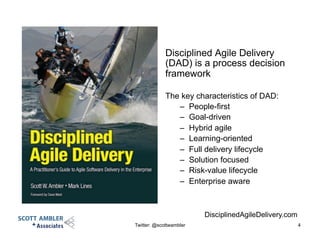
Disciplined Agile Delivery
(DAD) is a process decision
framework
The key characteristics of DAD:
–  People-first
–  Goal-driven
–  Hybrid agile
–  Learning-oriented
–  Full delivery lifecycle
–  Solution focused
–  Risk-value lifecycle
–  Enterprise aware
Twitter: @scottwambler 4
DisciplinedAgileDelivery.com
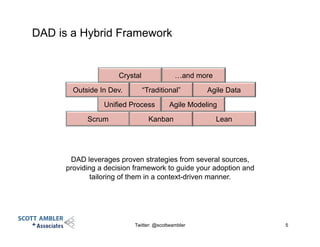
Scrum LeanKanban
DAD is a Hybrid Framework
Twitter: @scottwambler 5
Unified Process Agile Modeling
Agile Data“Traditional”Outside In Dev.
Crystal …and more
DAD leverages proven strategies from several sources,
providing a decision framework to guide your adoption and
tailoring of them in a context-driven manner.
DAD supports several
agile/lean lifecycles
Twitter: @scottwambler 6
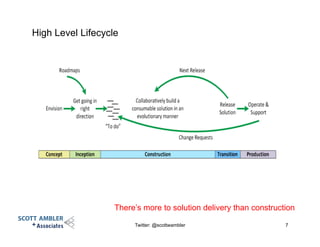
High Level Lifecycle
Twitter: @scottwambler 7
There’s more to solution delivery than construction
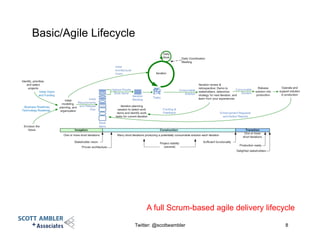
Basic/Agile Lifecycle
Twitter: @scottwambler 8
A full Scrum-based agile delivery lifecycle
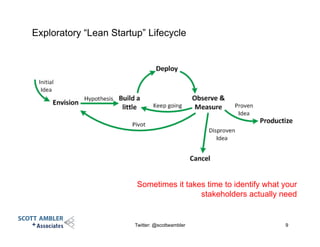
Exploratory “Lean Startup” Lifecycle
Twitter: @scottwambler 9
Sometimes it takes time to identify what your
stakeholders actually need
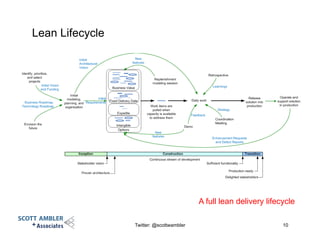
Lean Lifecycle
Twitter: @scottwambler 10
A full lean delivery lifecycle
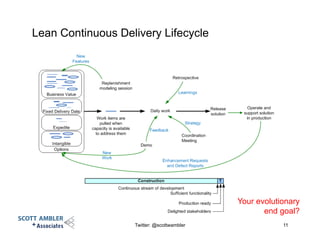
Lean Continuous Delivery Lifecycle
Twitter: @scottwambler 11
Your evolutionary
end goal?
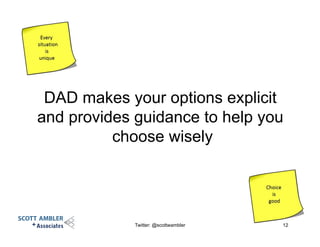
DAD makes your options explicit
and provides guidance to help you
choose wisely
Twitter: @scottwambler 12
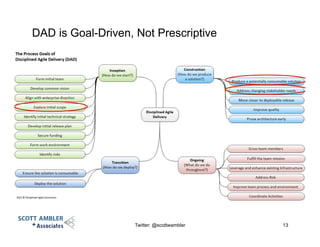
DAD is Goal-Driven, Not Prescriptive
Twitter: @scottwambler 13
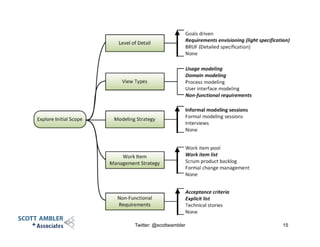
DAD supports many strategies to
explore the initial scope
Twitter: @scottwambler 14
Twitter: @scottwambler 15
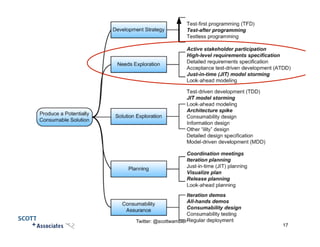
DAD supports many strategies to
explore detailed requirements
throughout Construction
Twitter: @scottwambler 16
17
Twitter: @scottwambler
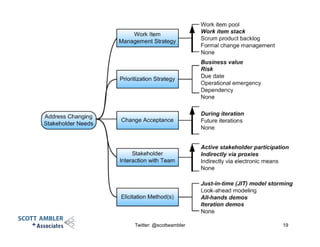
DAD supports many strategies to
address changing stakeholder
needs throughout Construction
Twitter: @scottwambler 18
Twitter: @scottwambler 19
Twitter: @scottwambler 20
How Does
Agile
Analysis
Work?
Observations About Agile Analysis
•  Analysis is so important we do it throughout the entire lifecycle, BUT
we might not have full-time analysis work every day
•  The artifacts are generally lighter
–  User stories over use cases
–  Sketches over detailed models
•  Analysis artifacts are often transitory
–  Conversations over documents
–  Sketches over detailed models
•  On advanced teams, requirements “specifications” are executable
–  Acceptance tests over specification documents
Twitter: @scottwambler 21
DAD promotes the idea that you
need to be prepared to apply
multiple model types to explore the
problem space
Twitter: @scottwambler 22
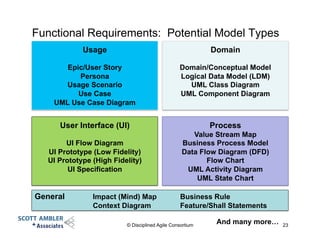
Functional Requirements: Potential Model Types
© Disciplined Agile Consortium 23
Usage
Epic/User Story
Persona
Usage Scenario
Use Case
UML Use Case Diagram
Domain
Domain/Conceptual Model
Logical Data Model (LDM)
UML Class Diagram
UML Component Diagram
Process
Value Stream Map
Business Process Model
Data Flow Diagram (DFD)
Flow Chart
UML Activity Diagram
UML State Chart
User Interface (UI)
UI Flow Diagram
UI Prototype (Low Fidelity)
UI Prototype (High Fidelity)
UI Specification
And many more…
General Impact (Mind) Map Business Rule
Context Diagram Feature/Shall Statements
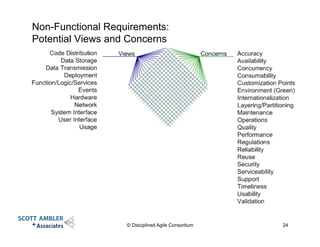
Non-Functional Requirements:
Potential Views and Concerns
© Disciplined Agile Consortium 24
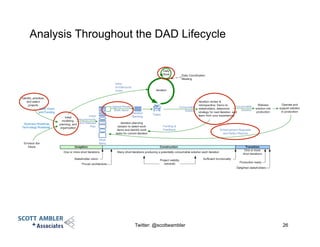
DAD promotes analysis techniques
throughout the entire lifecycle
Twitter: @scottwambler 25
Twitter: @scottwambler 26
Analysis Throughout the DAD Lifecycle
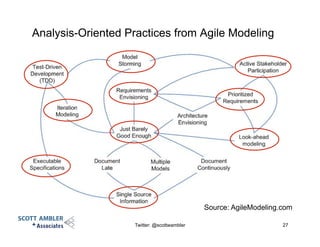
Analysis-Oriented Practices from Agile Modeling
Twitter: @scottwambler 27
Source: AgileModeling.com
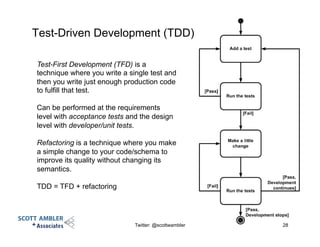
Test-Driven Development (TDD)
Twitter: @scottwambler 28
Test-First Development (TFD) is a
technique where you write a single test and
then you write just enough production code
to fulfill that test.
Can be performed at the requirements
level with acceptance tests and the design
level with developer/unit tests.
Refactoring is a technique where you make
a simple change to your code/schema to
improve its quality without changing its
semantics.
TDD = TFD + refactoring
How Do Business Analysts Fit
On Agile Teams?
Twitter: @scottwambler 29
Characteristics of Disciplined Agile Team Members
•  We strive to be “generalizing specialists”
–  We want to gain a wide range of skills so that we’re more productive
•  We are willing to share our skills
–  We learn from each other
•  We are flexible
–  We realize that there is always more than one way of doing things
•  We are collaborative
–  We work together as a team, not as a group of individuals
•  We are enterprise aware
–  We want to do what’s best for the organization, not just for ourselves
Twitter: @scottwambler 30
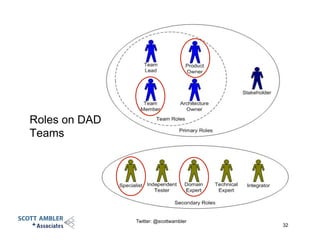
DAD explicitly includes several
roles that an existing business
analyst may choose to grow into
Twitter: @scottwambler 31
Roles on DAD
Teams
32
Twitter: @scottwambler
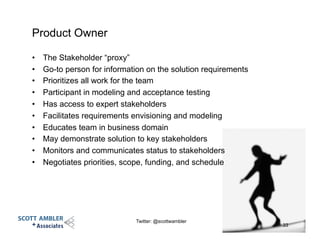
Product Owner
•  The Stakeholder “proxy”
•  Go-to person for information on the solution requirements
•  Prioritizes all work for the team
•  Participant in modeling and acceptance testing
•  Has access to expert stakeholders
•  Facilitates requirements envisioning and modeling
•  Educates team in business domain
•  May demonstrate solution to key stakeholders
•  Monitors and communicates status to stakeholders
•  Negotiates priorities, scope, funding, and schedule
33
Twitter: @scottwambler
At scale you may need someone in
a specialized business analyst role,
but these situations are rare
Twitter: @scottwambler 34
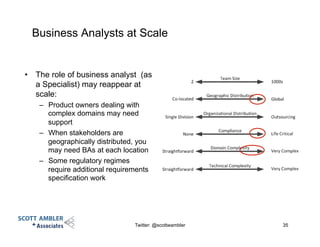
Business Analysts at Scale
•  The role of business analyst (as
a Specialist) may reappear at
scale:
–  Product owners dealing with
complex domains may need
support
–  When stakeholders are
geographically distributed, you
may need BAs at each location
–  Some regulatory regimes
require additional requirements
specification work
Twitter: @scottwambler 35
My parting advice….
Twitter: @scottwambler 36
Recognize that Agile and Lean
require a paradigm shift
Be open minded and flexible
Be prepared to share your skills
Collaboration and evolution, not
documentation and “freezing”, is
now the focus
Thank You!
scott [at] scottambler.com
@scottwambler
AgileModeling.com
AgileData.org
Ambysoft.com
DisciplinedAgileConsortium.org
DisciplinedAgileDelivery.com
ScottAmbler.com
Disciplined Agile Delivery
Twitter: @scottwambler 37
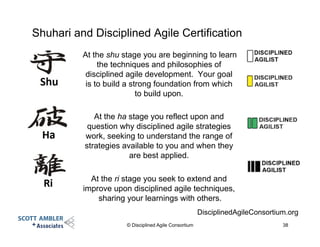
Shuhari and Disciplined Agile Certification
At the shu stage you are beginning to learn
the techniques and philosophies of
disciplined agile development. Your goal
is to build a strong foundation from which
to build upon.
At the ha stage you reflect upon and
question why disciplined agile strategies
work, seeking to understand the range of
strategies available to you and when they
are best applied.
At the ri stage you seek to extend and
improve upon disciplined agile techniques,
sharing your learnings with others.
© Disciplined Agile Consortium 38
DisciplinedAgileConsortium.org
Scott Ambler + Associates is the thought leader behind the Disciplined
Agile Delivery (DAD) framework and its application. We are a boutique
IT management consulting firm that advises organizations to be more
effective applying disciplined agile and lean processes within the
context of your business.
Our website is ScottAmbler.com
We can help
Twitter: @scottwambler 39

Disciplined Agile Business Analysis

  • 1.
    Scott W. Ambler SeniorConsulting Partner scott [at] scottambler.com Copyright 2014 Scott Ambler + Associates Twitter: @scottwambler 1 Disciplined Agile Business Analysis
  • 2.
  • 3.
    Let’s explore three importantquestions…. How does disciplined agile software development work? How does agile analysis work? How do business analysts fit on agile teams? Twitter: @scottwambler 3
  • 4.
    Disciplined Agile Delivery (DAD)is a process decision framework The key characteristics of DAD: –  People-first –  Goal-driven –  Hybrid agile –  Learning-oriented –  Full delivery lifecycle –  Solution focused –  Risk-value lifecycle –  Enterprise aware Twitter: @scottwambler 4 DisciplinedAgileDelivery.com
  • 5.
    Scrum LeanKanban DAD isa Hybrid Framework Twitter: @scottwambler 5 Unified Process Agile Modeling Agile Data“Traditional”Outside In Dev. Crystal …and more DAD leverages proven strategies from several sources, providing a decision framework to guide your adoption and tailoring of them in a context-driven manner.
  • 6.
    DAD supports several agile/leanlifecycles Twitter: @scottwambler 6
  • 7.
    High Level Lifecycle Twitter:@scottwambler 7 There’s more to solution delivery than construction
  • 8.
    Basic/Agile Lifecycle Twitter: @scottwambler8 A full Scrum-based agile delivery lifecycle
  • 9.
    Exploratory “Lean Startup”Lifecycle Twitter: @scottwambler 9 Sometimes it takes time to identify what your stakeholders actually need
  • 10.
    Lean Lifecycle Twitter: @scottwambler10 A full lean delivery lifecycle
  • 11.
    Lean Continuous DeliveryLifecycle Twitter: @scottwambler 11 Your evolutionary end goal?
  • 12.
    DAD makes youroptions explicit and provides guidance to help you choose wisely Twitter: @scottwambler 12
  • 13.
    DAD is Goal-Driven,Not Prescriptive Twitter: @scottwambler 13
  • 14.
    DAD supports manystrategies to explore the initial scope Twitter: @scottwambler 14
  • 15.
  • 16.
    DAD supports manystrategies to explore detailed requirements throughout Construction Twitter: @scottwambler 16
  • 17.
  • 18.
    DAD supports manystrategies to address changing stakeholder needs throughout Construction Twitter: @scottwambler 18
  • 19.
  • 20.
    Twitter: @scottwambler 20 HowDoes Agile Analysis Work?
  • 21.
    Observations About AgileAnalysis •  Analysis is so important we do it throughout the entire lifecycle, BUT we might not have full-time analysis work every day •  The artifacts are generally lighter –  User stories over use cases –  Sketches over detailed models •  Analysis artifacts are often transitory –  Conversations over documents –  Sketches over detailed models •  On advanced teams, requirements “specifications” are executable –  Acceptance tests over specification documents Twitter: @scottwambler 21
  • 22.
    DAD promotes theidea that you need to be prepared to apply multiple model types to explore the problem space Twitter: @scottwambler 22
  • 23.
    Functional Requirements: PotentialModel Types © Disciplined Agile Consortium 23 Usage Epic/User Story Persona Usage Scenario Use Case UML Use Case Diagram Domain Domain/Conceptual Model Logical Data Model (LDM) UML Class Diagram UML Component Diagram Process Value Stream Map Business Process Model Data Flow Diagram (DFD) Flow Chart UML Activity Diagram UML State Chart User Interface (UI) UI Flow Diagram UI Prototype (Low Fidelity) UI Prototype (High Fidelity) UI Specification And many more… General Impact (Mind) Map Business Rule Context Diagram Feature/Shall Statements
  • 24.
    Non-Functional Requirements: Potential Viewsand Concerns © Disciplined Agile Consortium 24
  • 25.
    DAD promotes analysistechniques throughout the entire lifecycle Twitter: @scottwambler 25
  • 26.
    Twitter: @scottwambler 26 AnalysisThroughout the DAD Lifecycle
  • 27.
    Analysis-Oriented Practices fromAgile Modeling Twitter: @scottwambler 27 Source: AgileModeling.com
  • 28.
    Test-Driven Development (TDD) Twitter:@scottwambler 28 Test-First Development (TFD) is a technique where you write a single test and then you write just enough production code to fulfill that test. Can be performed at the requirements level with acceptance tests and the design level with developer/unit tests. Refactoring is a technique where you make a simple change to your code/schema to improve its quality without changing its semantics. TDD = TFD + refactoring
  • 29.
    How Do BusinessAnalysts Fit On Agile Teams? Twitter: @scottwambler 29
  • 30.
    Characteristics of DisciplinedAgile Team Members •  We strive to be “generalizing specialists” –  We want to gain a wide range of skills so that we’re more productive •  We are willing to share our skills –  We learn from each other •  We are flexible –  We realize that there is always more than one way of doing things •  We are collaborative –  We work together as a team, not as a group of individuals •  We are enterprise aware –  We want to do what’s best for the organization, not just for ourselves Twitter: @scottwambler 30
  • 31.
    DAD explicitly includesseveral roles that an existing business analyst may choose to grow into Twitter: @scottwambler 31
  • 32.
  • 33.
    Product Owner •  TheStakeholder “proxy” •  Go-to person for information on the solution requirements •  Prioritizes all work for the team •  Participant in modeling and acceptance testing •  Has access to expert stakeholders •  Facilitates requirements envisioning and modeling •  Educates team in business domain •  May demonstrate solution to key stakeholders •  Monitors and communicates status to stakeholders •  Negotiates priorities, scope, funding, and schedule 33 Twitter: @scottwambler
  • 34.
    At scale youmay need someone in a specialized business analyst role, but these situations are rare Twitter: @scottwambler 34
  • 35.
    Business Analysts atScale •  The role of business analyst (as a Specialist) may reappear at scale: –  Product owners dealing with complex domains may need support –  When stakeholders are geographically distributed, you may need BAs at each location –  Some regulatory regimes require additional requirements specification work Twitter: @scottwambler 35
  • 36.
    My parting advice…. Twitter:@scottwambler 36 Recognize that Agile and Lean require a paradigm shift Be open minded and flexible Be prepared to share your skills Collaboration and evolution, not documentation and “freezing”, is now the focus
  • 37.
    Thank You! scott [at]scottambler.com @scottwambler AgileModeling.com AgileData.org Ambysoft.com DisciplinedAgileConsortium.org DisciplinedAgileDelivery.com ScottAmbler.com Disciplined Agile Delivery Disciplined Agile Delivery Twitter: @scottwambler 37
  • 38.
    Shuhari and DisciplinedAgile Certification At the shu stage you are beginning to learn the techniques and philosophies of disciplined agile development. Your goal is to build a strong foundation from which to build upon. At the ha stage you reflect upon and question why disciplined agile strategies work, seeking to understand the range of strategies available to you and when they are best applied. At the ri stage you seek to extend and improve upon disciplined agile techniques, sharing your learnings with others. © Disciplined Agile Consortium 38 DisciplinedAgileConsortium.org
  • 39.
    Scott Ambler +Associates is the thought leader behind the Disciplined Agile Delivery (DAD) framework and its application. We are a boutique IT management consulting firm that advises organizations to be more effective applying disciplined agile and lean processes within the context of your business. Our website is ScottAmbler.com We can help Twitter: @scottwambler 39