Disciplined Agile Outsourcing:
Making it Work for Both the Customer and the Service
Provider
Scott W. Ambler
Senior Consulting Partner
scott [at] scottambler.com
@scottwambler
© 2015-2016 Disciplined Agile Consortium
Agenda
•  Some Housekeeping
•  Agile and Outsourcing? Really?
•  Disciplined Agile Delivery (DAD)
•  Common Agile Outsourcing Pitfalls
•  Intuition Fails You
•  Disciplined Agile Outsourcing Strategies
•  Parting Thoughts
For the Certified Disciplined Agilists among us…
This webinar counts as one hour towards your education time
to maintain your certification
See DisciplinedAgileConsortium.org/certification for details
© 2015-2016 Disciplined Agile Consortium
•  Everyone is on mute
•  To ask a question, please submit it into
the chat box
•  At the end of the webinar I will answer
as many questions as I can
•  It is likely that I won’t get to all of your
questions. In that case I will soon post
a blog at DisciplinedAgileDelivery.com
answering them
© 2015-2016 Disciplined Agile Consortium
The Survey Results Shared in This Presentation
•  All surveys were performed in an
open manner
•  The questions as they were
asked, the source data, and a
summary slide deck can be
downloaded free of charge from
Ambysoft.com/surveys/
© 2015-2016 Disciplined Agile Consortium
Some Assumptions
•  For the most part I’ll be speaking from the point of view
of:
–  A customer in North America or Europe
–  A project being outsourced to an Indian service provider
•  But, I will still cover:
–  The service provider perspective
–  Outsourcing in general, not just offshoring
© 2015-2016 Disciplined Agile Consortium
Agile and Outsourcing?
Really?
Why Agile Outsourcing? Customer’s Viewpoint
•  Augmenting their ability to deliver
•  Better, faster, cheaper IT delivery
•  Want similar or better quality than what their own IT
people would deliver
•  The solution must work in their environment
© 2015-2016 Disciplined Agile Consortium
Why Agile Outsourcing? Service Provider’s Viewpoint
•  Increase business
•  Deliver what was promised
•  Reduce development costs
•  Retain staff
© 2015-2016 Disciplined Agile Consortium
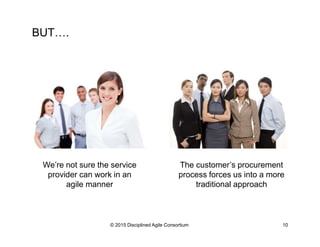
BUT….
© 2015-2016 Disciplined Agile Consortium
We’re not sure the service
provider can work in an
agile manner
The customer’s procurement
process forces us into a more
traditional approach
The IT Outsourcing Market in General
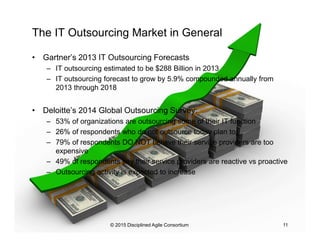
•  Computer Economics Inc. 2015 IT Outsourcing Statistics:
–  Large organizations spend 7.8% of their IT budget on outsourcing
–  Mid-size organizations spend 6.7%
–  65% of organizations that are outsourcing application hosting intend to
increase spending on that
•  Deloitte’s 2014 Global Outsourcing Survey:
–  53% of organizations are outsourcing some of their IT function
–  26% of respondents who do not outsource today plan to
–  79% of respondents DO NOT believe their service providers are too
expensive
–  49% of respondents say their service providers are reactive vs proactive
–  Outsourcing activity is expected to increase
© 2015-2016 Disciplined Agile Consortium
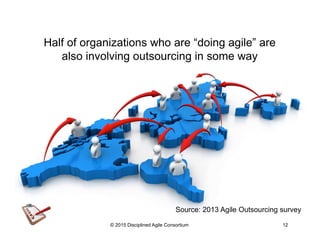
Half of organizations who are “doing agile” are
also involving outsourcing in some way
© 2015-2016 Disciplined Agile Consortium
Source: 2013 Agile Outsourcing survey
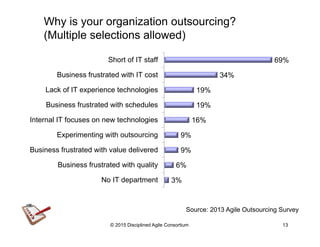
Why is your organization outsourcing?
(Multiple selections allowed)
3%
6%
9%
9%
16%
19%
19%
34%
69%
No IT department
Business frustrated with quality
Business frustrated with value delivered
Experimenting with outsourcing
Internal IT focuses on new technologies
Business frustrated with schedules
Lack of IT experience technologies
Business frustrated with IT cost
Short of IT staff
© 2015-2016 Disciplined Agile Consortium
Source: 2013 Agile Outsourcing Survey
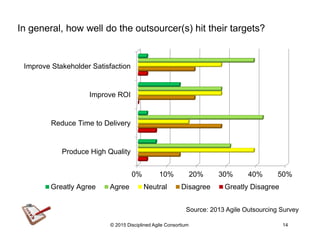
In general, how well do the outsourcer(s) hit their targets?
0% 5% 10% 15% 20% 25% 30% 35% 40% 45%
Produce High Quality
Reduce Time to Delivery
Improve ROI
Improve Stakeholder Satisfaction
Greatly Agree Agree Neutral Disagree Greatly Disagree
© 2015-2016 Disciplined Agile Consortium
Source: 2013 Agile Outsourcing Survey
Common Outsourcing Pitfalls
•  Organizational culture differences
•  Expectations mismatch between the customer and the service provider
•  The customer underestimates difficulty of managing outsourced projects
•  Total cost of the solution isn’t considered
•  Total value of the solution isn’t considered
•  Transition to the operations team is mismanaged
•  Over-reliance on documentation
•  Software licensing issues
•  Learning curve for service provider underestimated
•  The service provider is understaffed
•  Some aspects, e.g. security, cannot be outsourced
•  Intellectual property (IP) rights
•  Technology connectivity
•  Solution doesn’t fit into organizational ecosystem
© 2015-2016 Disciplined Agile Consortium
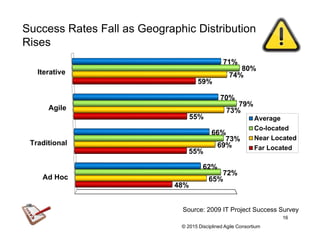
Ad Hoc
Traditional
Agile
Iterative
48%
55%
55%
59%
65%
69%
73%
74%
72%
73%
79%
80%
62%
66%
70%
71%
Average
Co-located
Near Located
Far Located
Success Rates Fall as Geographic Distribution
Rises
Source: 2009 IT Project Success Survey
Common Agile Outsourcing Pitfalls
•  The customer procures the “agile” project via traditional
strategies
•  The customer takes a Water-Scrum-Fall approach
•  The customer governs the service provider via a traditional
approach
•  The customer really isn’t agile
•  The service provider really isn’t agile
•  Neither are agile
•  Agile is based on trust, yet it behooves you to not trust the
service provider
© 2015-2016 Disciplined Agile Consortium
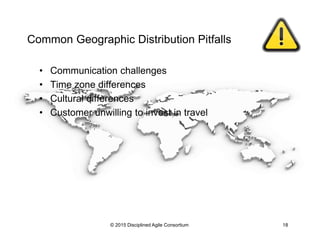
Common Geographic Distribution Pitfalls
•  Communication challenges
•  Time zone differences
•  Cultural differences
•  Customer unwilling to invest in travel
© 2015-2016 Disciplined Agile Consortium
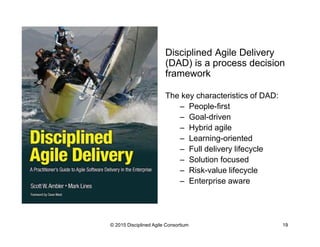
Disciplined Agile Delivery
(DAD) is a process decision
framework
The key characteristics of DAD:
–  People-first
–  Goal-driven
–  Hybrid agile
–  Learning-oriented
–  Full delivery lifecycle
–  Solution focused
–  Risk-value lifecycle
–  Enterprise aware
© 2015-2016 Disciplined Agile Consortium
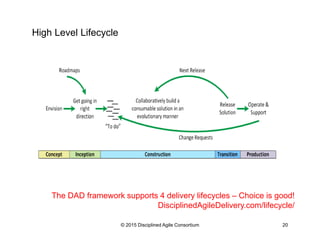
High Level Lifecycle
The DAD framework supports 4 delivery lifecycles – Choice is good!
DisciplinedAgileDelivery.com/lifecycle/
© 2015-2016 Disciplined Agile Consortium
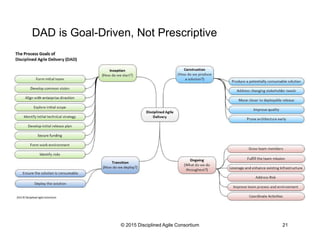
DAD is Goal-Driven, Not Prescriptive
© 2015-2016 Disciplined Agile Consortium
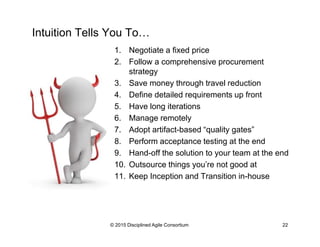
Intuition Tells You To…
1.  Negotiate a fixed price
2.  Follow a comprehensive procurement
strategy
3.  Save money through travel reduction
4.  Define detailed requirements up front
5.  Have long iterations
6.  Manage remotely
7.  Adopt artifact-based “quality gates”
8.  Perform acceptance testing at the end
9.  Hand-off the solution to your team at the end
10.  Outsource things you’re not good at
11.  Keep Inception and Transition in-house
© 2015-2016 Disciplined Agile Consortium
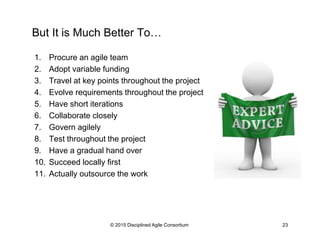
But It is Much Better To…
1.  Adopt variable funding
2.  Procure an agile team
3.  Travel at key points throughout the project
4.  Evolve requirements throughout the project
5.  Have short iterations
6.  Collaborate closely
7.  Govern agilely
8.  Test throughout the project
9.  Have a gradual hand over
10.  Succeed locally first
11.  Actually outsource the work
© 2015-2016 Disciplined Agile Consortium
Procure an Agile Team
The biggest single source of risk in agile IT outsourcing is the
customer’s procurement process
•  Our advice:
–  Involve people in the procurement effort with actual
experience in disciplined agile strategies
–  Make it very clear at the beginning that you are looking for
agile-experienced teams
–  Explicitly describe how your team and the service provider’s
team will work together
•  Resources:
–  AgileContracts.com
–  FlexibleContracts.com
© 2015-2016 Disciplined Agile Consortium
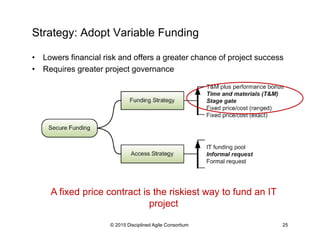
Strategy: Adopt Variable Funding
•  Lowers financial risk and offers a greater chance of project success
•  Requires greater project governance
© 2015-2016 Disciplined Agile Consortium
A fixed price contract is the riskiest way to fund an IT
project
Strategy: Travel
•  Get key people together physically:
–  During Inception for initial modeling and planning
–  Key project milestones, particularly project viability reviews
•  Throughout the project:
–  “Ambassadors” fly between sites to improve communication
–  Consider bringing key developers to the customer site to observe the
actual work environment and to interact with real stakeholders
–  Consider flying key stakeholders, or proxies, to the development site
•  Reduces communication risk on your project
–  BUT, travel costs are easy to measure therefore are first to be cut
The cheapest way to pay for travel is to actually pay for
travel
© 2015-2016 Disciplined Agile Consortium
Strategy: Evolutionary Requirements
•  The challenges with detailed requirements specifications:
–  Documentation is the least effective way communicating information
–  A “big requirements up front (BRUF)” approach has been found to lead
to the development of functionality that is unused (45% average) or
rarely used (19%) – Chaos Report 2003, Standish Group
–  You still have the CRUFT dilemma (see AgileModeling.com)
•  Disciplined agile teams will:
–  Produce a high-level definition of the scope
–  Explore detailed requirements on a just in time (JIT) basis throughout
the project
–  Allow the requirements to evolve as the stakeholders understanding
evolves
–  Acceptance test throughout the project
© 2015-2016 Disciplined Agile Consortium
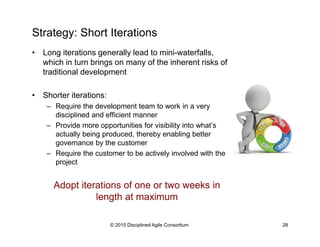
Strategy: Short Iterations
•  Long iterations generally lead to mini-waterfalls,
which in turn brings on many of the inherent risks of
traditional development
•  Shorter iterations:
–  Require the development team to work in a very
disciplined and efficient manner
–  Provide more opportunities for visibility into what’s
actually being produced, thereby enabling better
governance by the customer
–  Require the customer to be actively involved with the
project
Adopt iterations of one or two weeks in
length at maximum
© 2015-2016 Disciplined Agile Consortium
Strategy: Collaborate Closely
•  Observation:
–  It is critical for agile teams in general to have ready
access to stakeholders or stakeholder proxies (such as
Product Owners)
–  It is incredibly difficult for service providers to learn your
domain, your existing IT ecosystem, and your
organization structure
–  It is even harder to do so from the other side of the planet
•  Recommendations:
–  All types of stakeholders, on both the business and IT
side, need to be available on a daily basis at least
electronically
–  Consider embedding key stakeholders (or proxies) with
the development team
© 2015-2016 Disciplined Agile Consortium
Strategy: Govern Agilely
•  Observations:
–  The motivations of service providers are different from
those of customers
–  Customers really shouldn’t trust the service provider
•  Recommendation:
–  Trust but verify
–  Embed one or more of your people with the development
team
–  The service provider should adopt tools which support
development intelligence (DI)
–  The customer should have live access to DI project
dashboards
–  The service provider should include code analysis tools as
part of their continuous integration (CI) strategy
–  Progress should be judged on the basis of regular delivery
of a consumable solution
© 2015-2016 Disciplined Agile Consortium
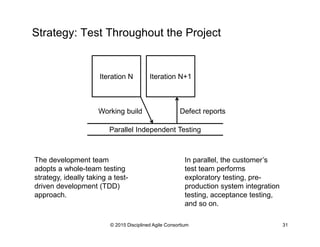
Strategy: Test Throughout the Project
© 2015-2016 Disciplined Agile Consortium
Iteration N Iteration N+1
Parallel Independent Testing
Working build Defect reports
The development team
adopts a whole-team testing
strategy, ideally taking a test-
driven development (TDD)
approach.
In parallel, the customer’s
test team performs
exploratory testing, pre-
production system integration
testing, acceptance testing,
and so on.
Strategy: Gradual Hand Over
•  Observations:
–  Hand-over of the solution, for operations and potentially continued
development, is very risky
–  Documentation is required to support this, but is a poor way to
communicate
•  Recommendations:
–  Co-locate key members of the sustainment team with the development
team later in the lifecycle
–  Have key members of the sustainment team be actively involved with
acceptance testing aspects of independent testing
© 2015-2016 Disciplined Agile Consortium
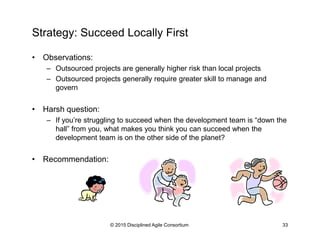
Strategy: Succeed Locally First
•  Observations:
–  Outsourced projects are generally higher risk than local projects
–  Outsourced projects generally require greater skill to manage and
govern
•  Harsh question:
–  If you’re struggling to succeed when the development team is “down the
hall” from you, what makes you think you can succeed when the
development team is on the other side of the planet?
•  Recommendation:
© 2015-2016 Disciplined Agile Consortium
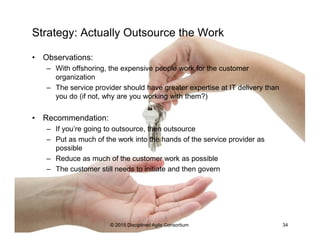
Strategy: Actually Outsource the Work
•  Observations:
–  With offshoring, the expensive people work for the customer
organization
–  The service provider should have greater expertise at IT delivery than
you do (if not, why are you working with them?)
•  Recommendation:
–  If you’re going to outsource, then outsource
–  Put as much of the work into the hands of the service provider as
possible
–  Reduce as much of the customer work as possible
–  The customer still needs to initiate and then govern
© 2015-2016 Disciplined Agile Consortium
Agile Development Practices for Outsourcing
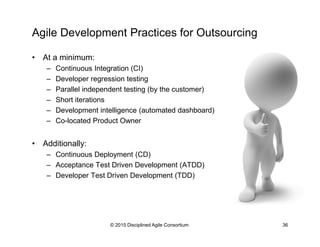
•  At a minimum:
–  Continuous Integration (CI)
–  Developer regression testing
–  Parallel independent testing (by the customer)
–  Short iterations
–  Development intelligence (automated dashboard)
–  Co-located Product Owner
•  Additionally:
–  Continuous Deployment (CD)
–  Acceptance Test Driven Development (ATDD)
–  Developer Test Driven Development (TDD)
© 2015-2016 Disciplined Agile Consortium
When Disciplined Agile Outsourcing Makes Sense
•  You are already successful at insourced agile
•  You understand and accept the risks
involved with outsourcing
•  You are prepared to address those risks
© 2015-2016 Disciplined Agile Consortium
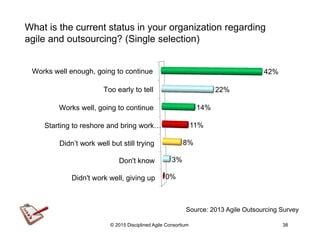
What is the current status in your organization regarding
agile and outsourcing? (Single selection)
Didn't work well, giving up
Don't know
Didn’t work well but still trying
Starting to reshore and bring work
Works well, going to continue
Too early to tell
Works well enough, going to continue
0%
3%
8%
11%
14%
22%
42%
© 2015-2016 Disciplined Agile Consortium
Source: 2013 Agile Outsourcing Survey
Thank you – Questions?
•  Scott Ambler + Associates
–  ScottAmbler.com
–  scott@scottambler.com
@scottwambler
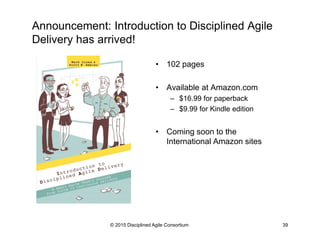
•  Disciplined Agile Delivery: A Practitioner’s Guide, by Scott Ambler &
Mark Lines
•  Introduction to Disciplined Agile Delivery: A Small Team’s Journey, by
Mark Lines and Scott Ambler
•  DisciplinedAgileDelivery.com
•  DisciplinedAgileConsortium.org
•  DAD LinkedIn Discussion Group:
–  linkedin.com/groups/Disciplined-Agile-Delivery-4685263
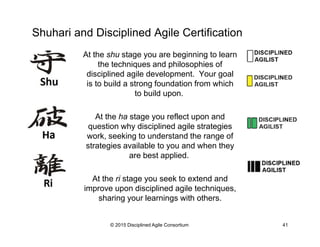
Shuhari and Disciplined Agile Certification
At the shu stage you are beginning to
learn the techniques and philosophies of
disciplined agile development. Your
goal is to build a strong foundation from
which to build upon.
At the ha stage you reflect upon and
question why disciplined agile strategies
work, seeking to understand the range
of strategies available to you and
when they are best applied.
At the ri stage you seek to extend and
improve upon disciplined agile
techniques, sharing your learnings with
others.
© Disciplined Agile Consortium 40
Disciplined Agile Delivery (DAD)
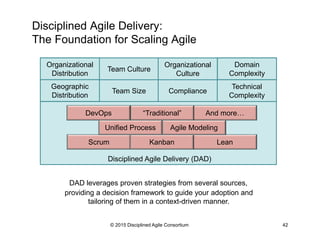
Disciplined Agile Delivery:
The Foundation for Scaling Agile
© 2015-2016 Disciplined Agile Consortium
Scrum LeanKanban
Unified Process Agile Modeling
And more…“Traditional”DevOps
Team Size
Geographic
Distribution
Compliance
Domain
Complexity
Technical
Complexity
Organizational
Distribution
Team Culture
Organizational
Culture
DAD leverages proven strategies from several sources,
providing a decision framework to guide your adoption and
tailoring of them in a context-driven manner.
Scott Ambler + Associates is the thought leader behind the Disciplined
Agile Delivery (DAD) framework and its application. We are a boutique
IT management consulting firm that advises organizations to be more
effective applying disciplined agile and lean processes within the
context of your business.
Our website is ScottAmbler.com
We can help
© 2015-2016 Disciplined Agile Consortium

Disciplined Agile Outsourcing: Making it work for both the customer and the service provider

  • 1.
    Disciplined Agile Outsourcing: Makingit Work for Both the Customer and the Service Provider Scott W. Ambler Senior Consulting Partner scott [at] scottambler.com @scottwambler
  • 2.
    © 2015-2016 DisciplinedAgile Consortium Agenda •  Some Housekeeping •  Agile and Outsourcing? Really? •  Disciplined Agile Delivery (DAD) •  Common Agile Outsourcing Pitfalls •  Intuition Fails You •  Disciplined Agile Outsourcing Strategies •  Parting Thoughts
  • 3.
    For the CertifiedDisciplined Agilists among us… This webinar counts as one hour towards your education time to maintain your certification See DisciplinedAgileConsortium.org/certification for details © 2015-2016 Disciplined Agile Consortium
  • 4.
    •  Everyone ison mute •  To ask a question, please submit it into the chat box •  At the end of the webinar I will answer as many questions as I can •  It is likely that I won’t get to all of your questions. In that case I will soon post a blog at DisciplinedAgileDelivery.com answering them © 2015-2016 Disciplined Agile Consortium
  • 5.
    The Survey ResultsShared in This Presentation •  All surveys were performed in an open manner •  The questions as they were asked, the source data, and a summary slide deck can be downloaded free of charge from Ambysoft.com/surveys/ © 2015-2016 Disciplined Agile Consortium
  • 6.
    Some Assumptions •  Forthe most part I’ll be speaking from the point of view of: –  A customer in North America or Europe –  A project being outsourced to an Indian service provider •  But, I will still cover: –  The service provider perspective –  Outsourcing in general, not just offshoring © 2015-2016 Disciplined Agile Consortium
  • 7.
    © 2015-2016 DisciplinedAgile Consortium Agile and Outsourcing? Really?
  • 8.
    Why Agile Outsourcing?Customer’s Viewpoint •  Augmenting their ability to deliver •  Better, faster, cheaper IT delivery •  Want similar or better quality than what their own IT people would deliver •  The solution must work in their environment © 2015-2016 Disciplined Agile Consortium
  • 9.
    Why Agile Outsourcing?Service Provider’s Viewpoint •  Increase business •  Deliver what was promised •  Reduce development costs •  Retain staff © 2015-2016 Disciplined Agile Consortium
  • 10.
    BUT…. © 2015-2016 DisciplinedAgile Consortium We’re not sure the service provider can work in an agile manner The customer’s procurement process forces us into a more traditional approach
  • 11.
    The IT OutsourcingMarket in General •  Computer Economics Inc. 2015 IT Outsourcing Statistics: –  Large organizations spend 7.8% of their IT budget on outsourcing –  Mid-size organizations spend 6.7% –  65% of organizations that are outsourcing application hosting intend to increase spending on that •  Deloitte’s 2014 Global Outsourcing Survey: –  53% of organizations are outsourcing some of their IT function –  26% of respondents who do not outsource today plan to –  79% of respondents DO NOT believe their service providers are too expensive –  49% of respondents say their service providers are reactive vs proactive –  Outsourcing activity is expected to increase © 2015-2016 Disciplined Agile Consortium
  • 12.
    Half of organizationswho are “doing agile” are also involving outsourcing in some way © 2015-2016 Disciplined Agile Consortium Source: 2013 Agile Outsourcing survey
  • 13.
    Why is yourorganization outsourcing? (Multiple selections allowed) 3% 6% 9% 9% 16% 19% 19% 34% 69% No IT department Business frustrated with quality Business frustrated with value delivered Experimenting with outsourcing Internal IT focuses on new technologies Business frustrated with schedules Lack of IT experience technologies Business frustrated with IT cost Short of IT staff © 2015-2016 Disciplined Agile Consortium Source: 2013 Agile Outsourcing Survey
  • 14.
    In general, howwell do the outsourcer(s) hit their targets? 0% 5% 10% 15% 20% 25% 30% 35% 40% 45% Produce High Quality Reduce Time to Delivery Improve ROI Improve Stakeholder Satisfaction Greatly Agree Agree Neutral Disagree Greatly Disagree © 2015-2016 Disciplined Agile Consortium Source: 2013 Agile Outsourcing Survey
  • 15.
    Common Outsourcing Pitfalls • Organizational culture differences •  Expectations mismatch between the customer and the service provider •  The customer underestimates difficulty of managing outsourced projects •  Total cost of the solution isn’t considered •  Total value of the solution isn’t considered •  Transition to the operations team is mismanaged •  Over-reliance on documentation •  Software licensing issues •  Learning curve for service provider underestimated •  The service provider is understaffed •  Some aspects, e.g. security, cannot be outsourced •  Intellectual property (IP) rights •  Technology connectivity •  Solution doesn’t fit into organizational ecosystem © 2015-2016 Disciplined Agile Consortium
  • 16.
    © 2015-2016 DisciplinedAgile Consortium Ad Hoc Traditional Agile Iterative 48% 55% 55% 59% 65% 69% 73% 74% 72% 73% 79% 80% 62% 66% 70% 71% Average Co-located Near Located Far Located Success Rates Fall as Geographic Distribution Rises Source: 2009 IT Project Success Survey
  • 17.
    Common Agile OutsourcingPitfalls •  The customer procures the “agile” project via traditional strategies •  The customer takes a Water-Scrum-Fall approach •  The customer governs the service provider via a traditional approach •  The customer really isn’t agile •  The service provider really isn’t agile •  Neither are agile •  Agile is based on trust, yet it behooves you to not trust the service provider © 2015-2016 Disciplined Agile Consortium
  • 18.
    Common Geographic DistributionPitfalls •  Communication challenges •  Time zone differences •  Cultural differences •  Customer unwilling to invest in travel © 2015-2016 Disciplined Agile Consortium
  • 19.
    Disciplined Agile Delivery (DAD)is a process decision framework The key characteristics of DAD: –  People-first –  Goal-driven –  Hybrid agile –  Learning-oriented –  Full delivery lifecycle –  Solution focused –  Risk-value lifecycle –  Enterprise aware © 2015-2016 Disciplined Agile Consortium
  • 20.
    High Level Lifecycle TheDAD framework supports 4 delivery lifecycles – Choice is good! DisciplinedAgileDelivery.com/lifecycle/ © 2015-2016 Disciplined Agile Consortium
  • 21.
    DAD is Goal-Driven,Not Prescriptive © 2015-2016 Disciplined Agile Consortium
  • 22.
    Intuition Tells YouTo… 1.  Negotiate a fixed price 2.  Follow a comprehensive procurement strategy 3.  Save money through travel reduction 4.  Define detailed requirements up front 5.  Have long iterations 6.  Manage remotely 7.  Adopt artifact-based “quality gates” 8.  Perform acceptance testing at the end 9.  Hand-off the solution to your team at the end 10.  Outsource things you’re not good at 11.  Keep Inception and Transition in-house © 2015-2016 Disciplined Agile Consortium
  • 23.
    But It isMuch Better To… 1.  Adopt variable funding 2.  Procure an agile team 3.  Travel at key points throughout the project 4.  Evolve requirements throughout the project 5.  Have short iterations 6.  Collaborate closely 7.  Govern agilely 8.  Test throughout the project 9.  Have a gradual hand over 10.  Succeed locally first 11.  Actually outsource the work © 2015-2016 Disciplined Agile Consortium
  • 24.
    Procure an AgileTeam The biggest single source of risk in agile IT outsourcing is the customer’s procurement process •  Our advice: –  Involve people in the procurement effort with actual experience in disciplined agile strategies –  Make it very clear at the beginning that you are looking for agile-experienced teams –  Explicitly describe how your team and the service provider’s team will work together •  Resources: –  AgileContracts.com –  FlexibleContracts.com © 2015-2016 Disciplined Agile Consortium
  • 25.
    Strategy: Adopt VariableFunding •  Lowers financial risk and offers a greater chance of project success •  Requires greater project governance © 2015-2016 Disciplined Agile Consortium A fixed price contract is the riskiest way to fund an IT project
  • 26.
    Strategy: Travel •  Getkey people together physically: –  During Inception for initial modeling and planning –  Key project milestones, particularly project viability reviews •  Throughout the project: –  “Ambassadors” fly between sites to improve communication –  Consider bringing key developers to the customer site to observe the actual work environment and to interact with real stakeholders –  Consider flying key stakeholders, or proxies, to the development site •  Reduces communication risk on your project –  BUT, travel costs are easy to measure therefore are first to be cut The cheapest way to pay for travel is to actually pay for travel © 2015-2016 Disciplined Agile Consortium
  • 27.
    Strategy: Evolutionary Requirements • The challenges with detailed requirements specifications: –  Documentation is the least effective way communicating information –  A “big requirements up front (BRUF)” approach has been found to lead to the development of functionality that is unused (45% average) or rarely used (19%) – Chaos Report 2003, Standish Group –  You still have the CRUFT dilemma (see AgileModeling.com) •  Disciplined agile teams will: –  Produce a high-level definition of the scope –  Explore detailed requirements on a just in time (JIT) basis throughout the project –  Allow the requirements to evolve as the stakeholders understanding evolves –  Acceptance test throughout the project © 2015-2016 Disciplined Agile Consortium
  • 28.
    Strategy: Short Iterations • Long iterations generally lead to mini-waterfalls, which in turn brings on many of the inherent risks of traditional development •  Shorter iterations: –  Require the development team to work in a very disciplined and efficient manner –  Provide more opportunities for visibility into what’s actually being produced, thereby enabling better governance by the customer –  Require the customer to be actively involved with the project Adopt iterations of one or two weeks in length at maximum © 2015-2016 Disciplined Agile Consortium
  • 29.
    Strategy: Collaborate Closely • Observation: –  It is critical for agile teams in general to have ready access to stakeholders or stakeholder proxies (such as Product Owners) –  It is incredibly difficult for service providers to learn your domain, your existing IT ecosystem, and your organization structure –  It is even harder to do so from the other side of the planet •  Recommendations: –  All types of stakeholders, on both the business and IT side, need to be available on a daily basis at least electronically –  Consider embedding key stakeholders (or proxies) with the development team © 2015-2016 Disciplined Agile Consortium
  • 30.
    Strategy: Govern Agilely • Observations: –  The motivations of service providers are different from those of customers –  Customers really shouldn’t trust the service provider •  Recommendation: –  Trust but verify –  Embed one or more of your people with the development team –  The service provider should adopt tools which support development intelligence (DI) –  The customer should have live access to DI project dashboards –  The service provider should include code analysis tools as part of their continuous integration (CI) strategy –  Progress should be judged on the basis of regular delivery of a consumable solution © 2015-2016 Disciplined Agile Consortium
  • 31.
    Strategy: Test Throughoutthe Project © 2015-2016 Disciplined Agile Consortium Iteration N Iteration N+1 Parallel Independent Testing Working build Defect reports The development team adopts a whole-team testing strategy, ideally taking a test- driven development (TDD) approach. In parallel, the customer’s test team performs exploratory testing, pre- production system integration testing, acceptance testing, and so on.
  • 32.
    Strategy: Gradual HandOver •  Observations: –  Hand-over of the solution, for operations and potentially continued development, is very risky –  Documentation is required to support this, but is a poor way to communicate •  Recommendations: –  Co-locate key members of the sustainment team with the development team later in the lifecycle –  Have key members of the sustainment team be actively involved with acceptance testing aspects of independent testing © 2015-2016 Disciplined Agile Consortium
  • 33.
    Strategy: Succeed LocallyFirst •  Observations: –  Outsourced projects are generally higher risk than local projects –  Outsourced projects generally require greater skill to manage and govern •  Harsh question: –  If you’re struggling to succeed when the development team is “down the hall” from you, what makes you think you can succeed when the development team is on the other side of the planet? •  Recommendation: © 2015-2016 Disciplined Agile Consortium
  • 34.
    Strategy: Actually Outsourcethe Work •  Observations: –  With offshoring, the expensive people work for the customer organization –  The service provider should have greater expertise at IT delivery than you do (if not, why are you working with them?) •  Recommendation: –  If you’re going to outsource, then outsource –  Put as much of the work into the hands of the service provider as possible –  Reduce as much of the customer work as possible –  The customer still needs to initiate and then govern © 2015-2016 Disciplined Agile Consortium
  • 35.
    © 2015-2016 DisciplinedAgile Consortium
  • 36.
    Agile Development Practicesfor Outsourcing •  At a minimum: –  Continuous Integration (CI) –  Developer regression testing –  Parallel independent testing (by the customer) –  Short iterations –  Development intelligence (automated dashboard) –  Co-located Product Owner •  Additionally: –  Continuous Deployment (CD) –  Acceptance Test Driven Development (ATDD) –  Developer Test Driven Development (TDD) © 2015-2016 Disciplined Agile Consortium
  • 37.
    When Disciplined AgileOutsourcing Makes Sense •  You are already successful at insourced agile •  You understand and accept the risks involved with outsourcing •  You are prepared to address those risks © 2015-2016 Disciplined Agile Consortium
  • 38.
    What is thecurrent status in your organization regarding agile and outsourcing? (Single selection) Didn't work well, giving up Don't know Didn’t work well but still trying Starting to reshore and bring work Works well, going to continue Too early to tell Works well enough, going to continue 0% 3% 8% 11% 14% 22% 42% © 2015-2016 Disciplined Agile Consortium Source: 2013 Agile Outsourcing Survey
  • 39.
    Thank you –Questions? •  Scott Ambler + Associates –  ScottAmbler.com –  scott@scottambler.com @scottwambler •  Disciplined Agile Delivery: A Practitioner’s Guide, by Scott Ambler & Mark Lines •  Introduction to Disciplined Agile Delivery: A Small Team’s Journey, by Mark Lines and Scott Ambler •  DisciplinedAgileDelivery.com •  DisciplinedAgileConsortium.org •  DAD LinkedIn Discussion Group: –  linkedin.com/groups/Disciplined-Agile-Delivery-4685263
  • 40.
    Shuhari and DisciplinedAgile Certification At the shu stage you are beginning to learn the techniques and philosophies of disciplined agile development. Your goal is to build a strong foundation from which to build upon. At the ha stage you reflect upon and question why disciplined agile strategies work, seeking to understand the range of strategies available to you and when they are best applied. At the ri stage you seek to extend and improve upon disciplined agile techniques, sharing your learnings with others. © Disciplined Agile Consortium 40
  • 41.
    Disciplined Agile Delivery(DAD) Disciplined Agile Delivery: The Foundation for Scaling Agile © 2015-2016 Disciplined Agile Consortium Scrum LeanKanban Unified Process Agile Modeling And more…“Traditional”DevOps Team Size Geographic Distribution Compliance Domain Complexity Technical Complexity Organizational Distribution Team Culture Organizational Culture DAD leverages proven strategies from several sources, providing a decision framework to guide your adoption and tailoring of them in a context-driven manner.
  • 42.
    Scott Ambler +Associates is the thought leader behind the Disciplined Agile Delivery (DAD) framework and its application. We are a boutique IT management consulting firm that advises organizations to be more effective applying disciplined agile and lean processes within the context of your business. Our website is ScottAmbler.com We can help © 2015-2016 Disciplined Agile Consortium