ECE 213
DIGITAL
ELECTRONICS
Course Instructor
Course details
[ LTP 3-0-0]
[ 3 lectures /week]
• Text Book
1. DIGITAL FUNDAMENTALS by THOMAS L. FLOYD , R. P JAIN, PEARSON
• Reference Book
1. DIGITAL LOGIC DESIGN by MORRIS MANO, PRENTICE HALL OF INDIA,
5th Edition, (2001)
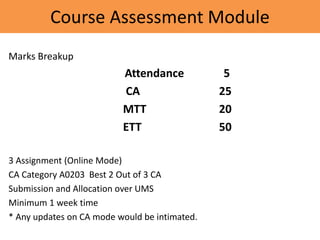
Course Assessment Module
Marks Breakup
Attendance 5
CA 25
MTT 20
ETT 50
3 Assignment (Online Mode)
CA Category A0203 Best 2 Out of 3 CA
Submission and Allocation over UMS
Minimum 1 week time
* Any updates on CA mode would be intimated.
What is Digital Electronics
• Electronics Vs Electrical Engg.
• Digital Electronics is that branch of
electronics which deals with the digital
signals to perform various tasks and meet
various requirements !
• It is based upon the digital design
methodologies and consists of digital
circuits, IC’s and logic gates.
• It uses only binary digits, ‘0’ or ‘1’
Why digital electronics needed
 Most analog systems were less accurate,
and were slow in computation and
performance.
 Digital system have the ability to work
faster than analog equivalents, and can
operate on very high frequencies too ! ! !
 It was much economical than analog
methodologies as the performance was
faster !
Digital Systems : The 21st Era
 Basically, the 21st era systems uses Silicon wafers, IC’s, CMOS etc. in the
VLSI technology to build up the large scale electronic devices & machines.
 The most commonly used devices are the Data servers, GPS systems,
Security systems, market products like Bar Code Readers etc. !
 All these devices are precise and reliable except the user makes his own
mistake, i.e. in these devices, system errors are least possible.
 The Cost : Performance ratio is high, hence these are economically
beneficial too !
Analog vs Digital
Analog signal are time varying
Analog devices accepts value across a continuous range
Digital signal is modeled as accepting only one of two discrete value. High ‘1’ or Low ‘0’
Digital devices preferred over Analog
 Reproducibility of result
 Ease of design
 Flexibility
 Programmability
 Processing speed
 Economy
 Steadily advanced technology
Most common digital devices are Logic gate, Flip Flop
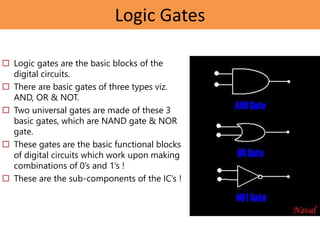
Logic Gates
 Logic gates are the basic blocks of the
digital circuits.
 There are basic gates of three types viz.
AND, OR & NOT.
 Two universal gates are made of these 3
basic gates, which are NAND gate & NOR
gate.
 These gates are the basic functional blocks
of digital circuits which work upon making
combinations of 0’s and 1’s !
 These are the sub-components of the IC’s !
Digital Systems over Analog Systems
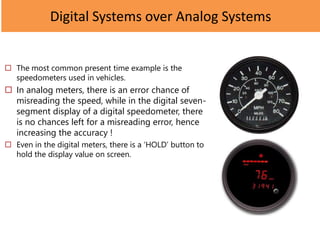
 The most common present time example is the
speedometers used in vehicles.
 In analog meters, there is an error chance of
misreading the speed, while in the digital seven-
segment display of a digital speedometer, there
is no chances left for a misreading error, hence
increasing the accuracy !
 Even in the digital meters, there is a ‘HOLD’ button to
hold the display value on screen.
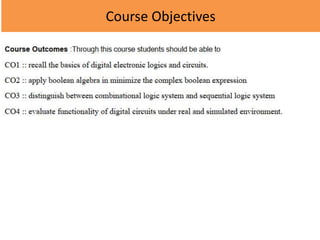
Course Objectives
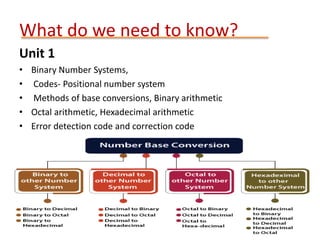
What do we need to know?
Unit 1
• Binary Number Systems,
• Codes- Positional number system
• Methods of base conversions, Binary arithmetic
• Octal arithmetic, Hexadecimal arithmetic
• Error detection code and correction code
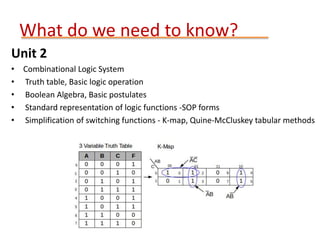
What do we need to know?
Unit 2
• Combinational Logic System
• Truth table, Basic logic operation
• Boolean Algebra, Basic postulates
• Standard representation of logic functions -SOP forms
• Simplification of switching functions - K-map, Quine-McCluskey tabular methods
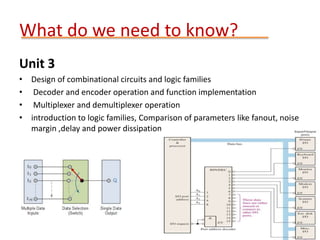
What do we need to know?
Unit 3
• Design of combinational circuits and logic families
• Decoder and encoder operation and function implementation
• Multiplexer and demultiplexer operation
• introduction to logic families, Comparison of parameters like fanout, noise
margin ,delay and power dissipation
What do we need to know?
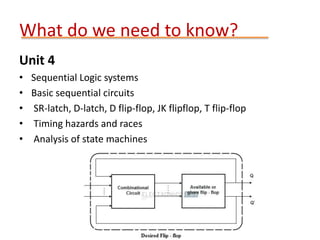
Unit 4
• Sequential Logic systems
• Basic sequential circuits
• SR-latch, D-latch, D flip-flop, JK flipflop, T flip-flop
• Timing hazards and races
• Analysis of state machines
What do we need to know?
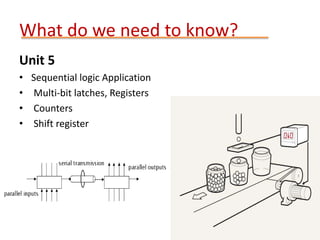
Unit 5
• Sequential logic Application
• Multi-bit latches, Registers
• Counters
• Shift register
What do we need to know?
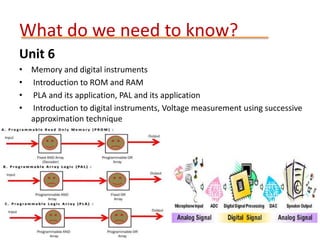
Unit 6
• Memory and digital instruments
• Introduction to ROM and RAM
• PLA and its application, PAL and its application
• Introduction to digital instruments, Voltage measurement using successive
approximation technique
Number System and Code
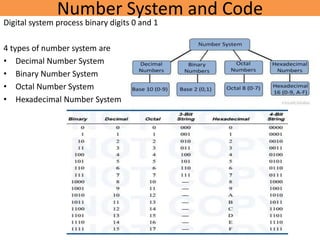
Digital system process binary digits 0 and 1
4 types of number system are
• Decimal Number System
• Binary Number System
• Octal Number System
• Hexadecimal Number System
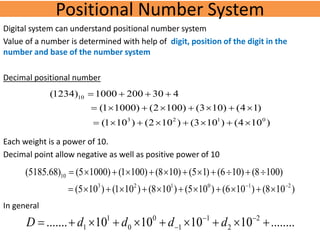
Positional Number System
Digital system can understand positional number system
Value of a number is determined with help of digit, position of the digit in the
number and base of the number system
Decimal positional number
Each weight is a power of 10.
Decimal point allow negative as well as positive power of 10
In general
10
3 2 1 0
(1234) 1000 200 30 4
(1 1000) (2 100) (3 10) (4 1)
(1 10 ) (2 10 ) (3 10 ) (4 10 )
   
       
       
10
3 2 1 0 1 2
(5185.68) (5 1000) (1 100) (8 10) (5 1) (6 10) (8 100)
(5 10 ) (1 10 ) (8 10 ) (5 10 ) (6 10 ) (8 10 )
 
           
           
1 0 1 2
1 0 1 2
....... 10 10 10 10 ........
D d d d d
 

         
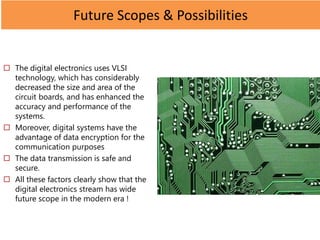
Future Scopes & Possibilities
 The digital electronics uses VLSI
technology, which has considerably
decreased the size and area of the
circuit boards, and has enhanced the
accuracy and performance of the
systems.
 Moreover, digital systems have the
advantage of data encryption for the
communication purposes
 The data transmission is safe and
secure.
 All these factors clearly show that the
digital electronics stream has wide
future scope in the modern era !
Get Set Go!!!
Gear up
Fasten your seat belts
Explore your hardware
designing abilities
Build futuristic solutions…

Introduction to Digital Electronics & What we will study.ppt

  • 1.
  • 2.
    Course details [ LTP3-0-0] [ 3 lectures /week] • Text Book 1. DIGITAL FUNDAMENTALS by THOMAS L. FLOYD , R. P JAIN, PEARSON • Reference Book 1. DIGITAL LOGIC DESIGN by MORRIS MANO, PRENTICE HALL OF INDIA, 5th Edition, (2001)
  • 3.
    Course Assessment Module MarksBreakup Attendance 5 CA 25 MTT 20 ETT 50 3 Assignment (Online Mode) CA Category A0203 Best 2 Out of 3 CA Submission and Allocation over UMS Minimum 1 week time * Any updates on CA mode would be intimated.
  • 4.
    What is DigitalElectronics • Electronics Vs Electrical Engg. • Digital Electronics is that branch of electronics which deals with the digital signals to perform various tasks and meet various requirements ! • It is based upon the digital design methodologies and consists of digital circuits, IC’s and logic gates. • It uses only binary digits, ‘0’ or ‘1’
  • 5.
    Why digital electronicsneeded  Most analog systems were less accurate, and were slow in computation and performance.  Digital system have the ability to work faster than analog equivalents, and can operate on very high frequencies too ! ! !  It was much economical than analog methodologies as the performance was faster !
  • 6.
    Digital Systems :The 21st Era  Basically, the 21st era systems uses Silicon wafers, IC’s, CMOS etc. in the VLSI technology to build up the large scale electronic devices & machines.  The most commonly used devices are the Data servers, GPS systems, Security systems, market products like Bar Code Readers etc. !  All these devices are precise and reliable except the user makes his own mistake, i.e. in these devices, system errors are least possible.  The Cost : Performance ratio is high, hence these are economically beneficial too !
  • 7.
    Analog vs Digital Analogsignal are time varying Analog devices accepts value across a continuous range Digital signal is modeled as accepting only one of two discrete value. High ‘1’ or Low ‘0’ Digital devices preferred over Analog  Reproducibility of result  Ease of design  Flexibility  Programmability  Processing speed  Economy  Steadily advanced technology Most common digital devices are Logic gate, Flip Flop
  • 8.
    Logic Gates  Logicgates are the basic blocks of the digital circuits.  There are basic gates of three types viz. AND, OR & NOT.  Two universal gates are made of these 3 basic gates, which are NAND gate & NOR gate.  These gates are the basic functional blocks of digital circuits which work upon making combinations of 0’s and 1’s !  These are the sub-components of the IC’s !
  • 9.
    Digital Systems overAnalog Systems  The most common present time example is the speedometers used in vehicles.  In analog meters, there is an error chance of misreading the speed, while in the digital seven- segment display of a digital speedometer, there is no chances left for a misreading error, hence increasing the accuracy !  Even in the digital meters, there is a ‘HOLD’ button to hold the display value on screen.
  • 10.
  • 11.
    What do weneed to know? Unit 1 • Binary Number Systems, • Codes- Positional number system • Methods of base conversions, Binary arithmetic • Octal arithmetic, Hexadecimal arithmetic • Error detection code and correction code
  • 12.
    What do weneed to know? Unit 2 • Combinational Logic System • Truth table, Basic logic operation • Boolean Algebra, Basic postulates • Standard representation of logic functions -SOP forms • Simplification of switching functions - K-map, Quine-McCluskey tabular methods
  • 13.
    What do weneed to know? Unit 3 • Design of combinational circuits and logic families • Decoder and encoder operation and function implementation • Multiplexer and demultiplexer operation • introduction to logic families, Comparison of parameters like fanout, noise margin ,delay and power dissipation
  • 14.
    What do weneed to know? Unit 4 • Sequential Logic systems • Basic sequential circuits • SR-latch, D-latch, D flip-flop, JK flipflop, T flip-flop • Timing hazards and races • Analysis of state machines
  • 15.
    What do weneed to know? Unit 5 • Sequential logic Application • Multi-bit latches, Registers • Counters • Shift register
  • 16.
    What do weneed to know? Unit 6 • Memory and digital instruments • Introduction to ROM and RAM • PLA and its application, PAL and its application • Introduction to digital instruments, Voltage measurement using successive approximation technique
  • 17.
    Number System andCode Digital system process binary digits 0 and 1 4 types of number system are • Decimal Number System • Binary Number System • Octal Number System • Hexadecimal Number System
  • 18.
    Positional Number System Digitalsystem can understand positional number system Value of a number is determined with help of digit, position of the digit in the number and base of the number system Decimal positional number Each weight is a power of 10. Decimal point allow negative as well as positive power of 10 In general 10 3 2 1 0 (1234) 1000 200 30 4 (1 1000) (2 100) (3 10) (4 1) (1 10 ) (2 10 ) (3 10 ) (4 10 )                     10 3 2 1 0 1 2 (5185.68) (5 1000) (1 100) (8 10) (5 1) (6 10) (8 100) (5 10 ) (1 10 ) (8 10 ) (5 10 ) (6 10 ) (8 10 )                           1 0 1 2 1 0 1 2 ....... 10 10 10 10 ........ D d d d d             
  • 19.
    Future Scopes &Possibilities  The digital electronics uses VLSI technology, which has considerably decreased the size and area of the circuit boards, and has enhanced the accuracy and performance of the systems.  Moreover, digital systems have the advantage of data encryption for the communication purposes  The data transmission is safe and secure.  All these factors clearly show that the digital electronics stream has wide future scope in the modern era !
  • 20.
    Get Set Go!!! Gearup Fasten your seat belts Explore your hardware designing abilities Build futuristic solutions…