Digital Electronics
Presentation on
Lecture1 : Introduction to Digital
Electronics
Presented By :
Parag Parandkar
1
Presentation on
Lecture1 : Introduction to
Digital Electronics
Presented By :
Parag Parandkar
Contents
 Analog vs. Digital
 Why Digital or Analog?
 Advantages of digital over analog
 How to get digital from analog
 How its made
 Where are they used
 How do they look
 What’s inside
 Levels of integration
 Digital design as Logic Circuits and its applications
 Number System and Interconversions
2
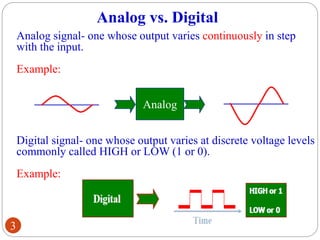
Analog vs. Digital
Analog signal- one whose output varies continuously in step
with the input.
Example:
Analog
Analog
Digital signal- one whose output varies at discrete voltage levels
commonly called HIGH or LOW (1 or 0).
Example:
3
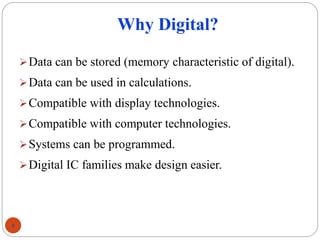
Why Digital?
Data can be stored (memory characteristic of digital).
Data can be used in calculations.
Compatible with display technologies.
Compatible with computer technologies.
Systems can be programmed.
Digital IC families make design easier.
4
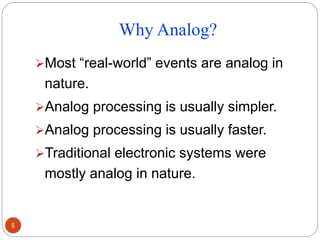
Why Analog?
Most “real-world” events are analog in
nature.
Analog processing is usually simpler.
Analog processing is usually faster.
Traditional electronic systems were
mostly analog in nature.
5
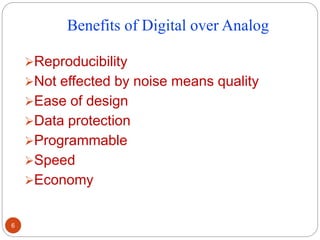
Benefits of Digital over Analog
Reproducibility
Not effected by noise means quality
Ease of design
Data protection
Programmable
Speed
Economy
6
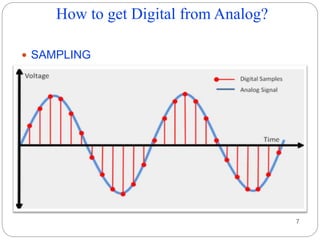
How to get Digital from Analog?
7
 SAMPLING
How its made?
8
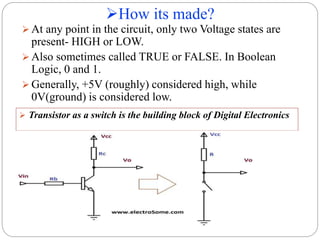
 At any point in the circuit, only two Voltage states are
present- HIGH or LOW.
 Also sometimes called TRUE or FALSE. In Boolean
Logic, 0 and 1.
 Generally, +5V (roughly) considered high, while
0V(ground) is considered low.
 Transistor as a switch is the building block of Digital Electronics
Where are they used?
9
 Think of any Real Life Application of Logic Gates!
• What are the
inputs?
• What’s the
output?
• Which logic gate
should be used?
How do they look?
10
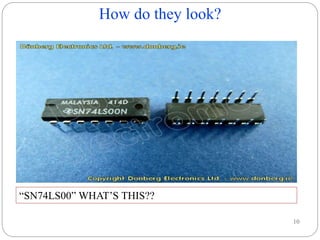
“SN74LS00” WHAT’S THIS??
What’s Inside?
11
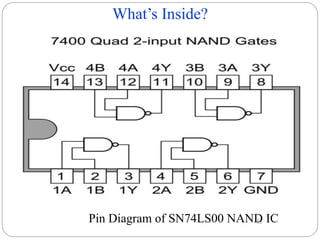
Pin Diagram of SN74LS00 NAND IC
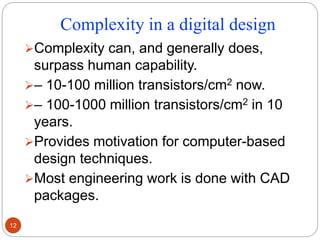
Complexity in a digital design
Complexity can, and generally does,
surpass human capability.
– 10-100 million transistors/cm2 now.
– 100-1000 million transistors/cm2 in 10
years.
Provides motivation for computer-based
design techniques.
Most engineering work is done with CAD
packages.
12
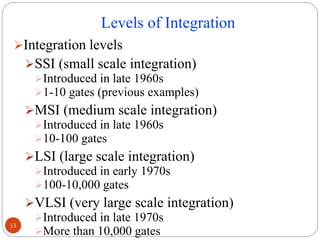
Levels of Integration
Integration levels
SSI (small scale integration)
Introduced in late 1960s
1-10 gates (previous examples)
MSI (medium scale integration)
Introduced in late 1960s
10-100 gates
LSI (large scale integration)
Introduced in early 1970s
100-10,000 gates
VLSI (very large scale integration)
Introduced in late 1970s
More than 10,000 gates
13
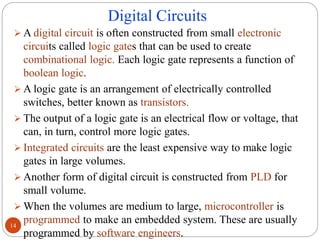
Digital Circuits
 A digital circuit is often constructed from small electronic
circuits called logic gates that can be used to create
combinational logic. Each logic gate represents a function of
boolean logic.
 A logic gate is an arrangement of electrically controlled
switches, better known as transistors.
 The output of a logic gate is an electrical flow or voltage, that
can, in turn, control more logic gates.
 Integrated circuits are the least expensive way to make logic
gates in large volumes.
 Another form of digital circuit is constructed from PLD for
small volume.
 When the volumes are medium to large, microcontroller is
programmed to make an embedded system. These are usually
programmed by software engineers.
14
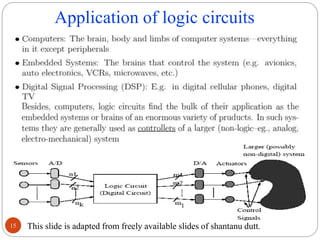
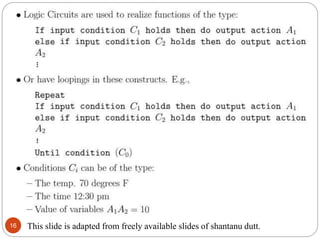
Application of logic circuits
This slide is adapted from freely available slides of shantanu dutt.
15
This slide is adapted from freely available slides of shantanu dutt.
16
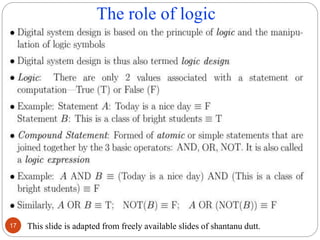
The role of logic
This slide is adapted from freely available slides of shantanu dutt.
17
This slide is adapted from freely available slides of shantanu dutt.
18
This slide is adapted from freely available slides of shantanu dutt.
19
This slide is adapted from freely available slides of shantanu dutt.
20
This slide is adapted from freely available slides of shantanu dutt.
21
This slide is adapted from freely available slides of shantanu dutt.
22

Presentation mpt68825 digital_electronics_introduction_1448281987_175

  • 1.
    Digital Electronics Presentation on Lecture1: Introduction to Digital Electronics Presented By : Parag Parandkar 1 Presentation on Lecture1 : Introduction to Digital Electronics Presented By : Parag Parandkar
  • 2.
    Contents  Analog vs.Digital  Why Digital or Analog?  Advantages of digital over analog  How to get digital from analog  How its made  Where are they used  How do they look  What’s inside  Levels of integration  Digital design as Logic Circuits and its applications  Number System and Interconversions 2
  • 3.
    Analog vs. Digital Analogsignal- one whose output varies continuously in step with the input. Example: Analog Analog Digital signal- one whose output varies at discrete voltage levels commonly called HIGH or LOW (1 or 0). Example: 3
  • 4.
    Why Digital? Data canbe stored (memory characteristic of digital). Data can be used in calculations. Compatible with display technologies. Compatible with computer technologies. Systems can be programmed. Digital IC families make design easier. 4
  • 5.
    Why Analog? Most “real-world”events are analog in nature. Analog processing is usually simpler. Analog processing is usually faster. Traditional electronic systems were mostly analog in nature. 5
  • 6.
    Benefits of Digitalover Analog Reproducibility Not effected by noise means quality Ease of design Data protection Programmable Speed Economy 6
  • 7.
    How to getDigital from Analog? 7  SAMPLING
  • 8.
    How its made? 8 At any point in the circuit, only two Voltage states are present- HIGH or LOW.  Also sometimes called TRUE or FALSE. In Boolean Logic, 0 and 1.  Generally, +5V (roughly) considered high, while 0V(ground) is considered low.  Transistor as a switch is the building block of Digital Electronics
  • 9.
    Where are theyused? 9  Think of any Real Life Application of Logic Gates! • What are the inputs? • What’s the output? • Which logic gate should be used?
  • 10.
    How do theylook? 10 “SN74LS00” WHAT’S THIS??
  • 11.
  • 12.
    Complexity in adigital design Complexity can, and generally does, surpass human capability. – 10-100 million transistors/cm2 now. – 100-1000 million transistors/cm2 in 10 years. Provides motivation for computer-based design techniques. Most engineering work is done with CAD packages. 12
  • 13.
    Levels of Integration Integrationlevels SSI (small scale integration) Introduced in late 1960s 1-10 gates (previous examples) MSI (medium scale integration) Introduced in late 1960s 10-100 gates LSI (large scale integration) Introduced in early 1970s 100-10,000 gates VLSI (very large scale integration) Introduced in late 1970s More than 10,000 gates 13
  • 14.
    Digital Circuits  Adigital circuit is often constructed from small electronic circuits called logic gates that can be used to create combinational logic. Each logic gate represents a function of boolean logic.  A logic gate is an arrangement of electrically controlled switches, better known as transistors.  The output of a logic gate is an electrical flow or voltage, that can, in turn, control more logic gates.  Integrated circuits are the least expensive way to make logic gates in large volumes.  Another form of digital circuit is constructed from PLD for small volume.  When the volumes are medium to large, microcontroller is programmed to make an embedded system. These are usually programmed by software engineers. 14
  • 15.
    Application of logiccircuits This slide is adapted from freely available slides of shantanu dutt. 15
  • 16.
    This slide isadapted from freely available slides of shantanu dutt. 16
  • 17.
    The role oflogic This slide is adapted from freely available slides of shantanu dutt. 17
  • 18.
    This slide isadapted from freely available slides of shantanu dutt. 18
  • 19.
    This slide isadapted from freely available slides of shantanu dutt. 19
  • 20.
    This slide isadapted from freely available slides of shantanu dutt. 20
  • 21.
    This slide isadapted from freely available slides of shantanu dutt. 21
  • 22.
    This slide isadapted from freely available slides of shantanu dutt. 22