DIGITAL ELECTRONICS
Ms.P.Sivalakshmi .M.E.,
Assistant Professor/ECE
.
R.M.K COLLEGE OF ENGINEERING & TECHNOLOGY
DEPARTMENT OF ELECTRONICS AND COMMUNICATION ENGINEERING
WHATDO YOULEARNIN THIS VIDEO?
What is Digital Electronics?
Importance of the subject.
Opportunities in this field.
Preparations for the job market.
What do you study in the entire course?
What is Digital Electronics ???
Digital electronics is a field
of electronics involving the
study of digital signals and the
engineering of devices that use
or produce them.
Digital ElectronicsQuickHistory
• Prior to digital technology, electronic transmission was limited
to analog technology, which transmitted and received data as
electronic signals by varying frequency or amplitude.
• In the 1930's the prototypes of the computer were constructed
using mechanical switches ( vacuum tubes ).
• During 1940's electronic diodes were used, while these were
better than earlier but they were not reliable.
• The next stage of development took in 1947 with the
transistors, which was much smaller, faster and cooler than
earlier technology. Also transistors were replaced by integrated
circuits (ICs) and that got smaller and smaller with the
enhancements in fabrication technology.
vacuumtubes
diode
transistors
IC(Chip)
What is an IC?
INTEGRATED
CIRCUIT
GATES
TRANSISTORS
DIODES
P TYPE & N TYPE
SEMICONDUCTOR
Classification of IC’S
Name Signification Year Transistors number Logic gatesnumber
SSI small-scale integration 1964 1 to 10 1 to 12
MSI medium-scale integration 1968 10 to 500 13 to 99
LSI large-scale integration 1971 500 to 20,000 100 to 9,999
VLSI very large-scale integration 1980 20,000 to 1,000,000 10,000 to 99,999
ULSI ultra-large-scale integration 1984 1,000,000 and more 100,000 and more
Moore’s Law
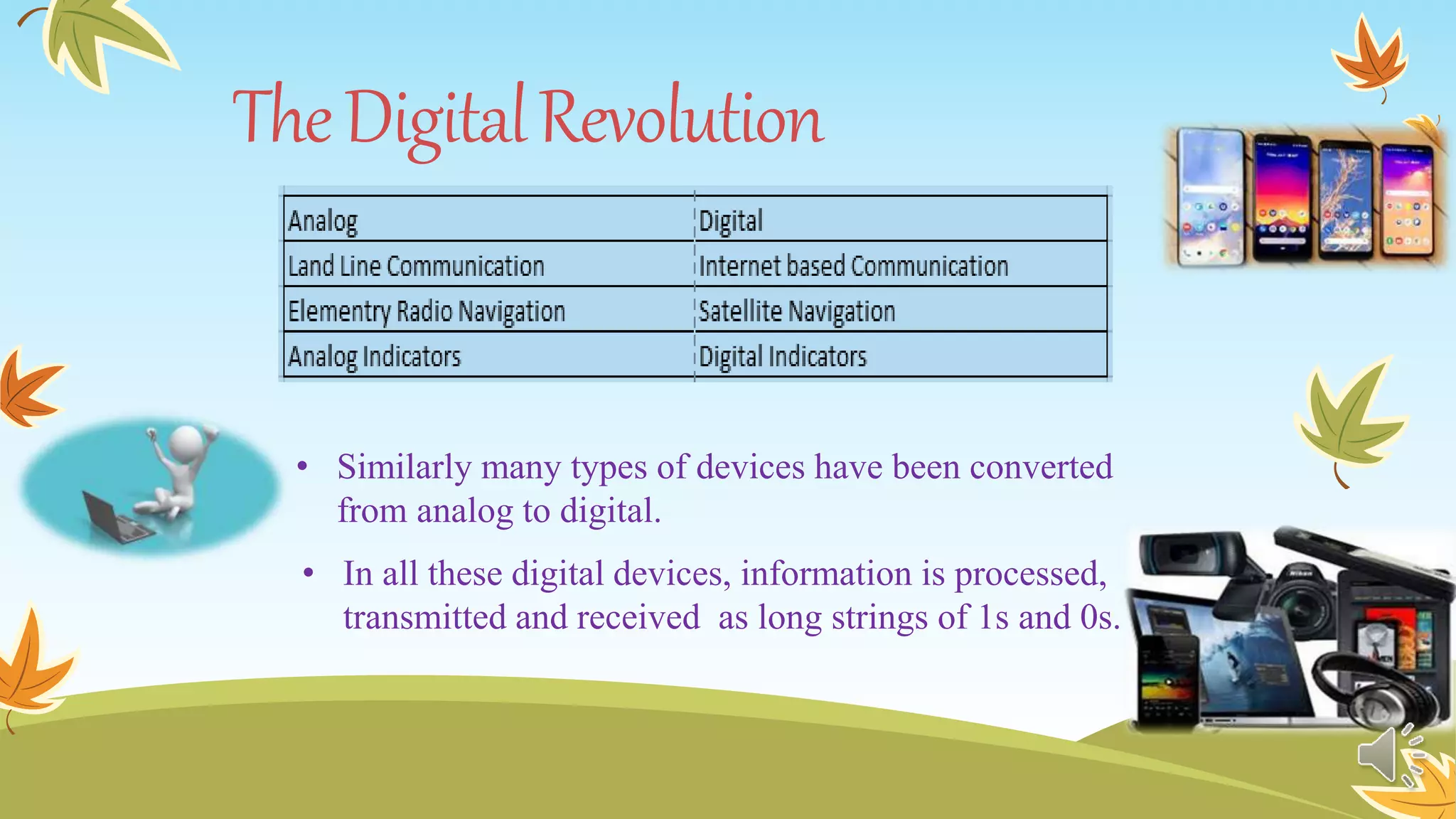
TheDigitalRevolution
• Similarly many types of devices have been converted
from analog to digital.
• In all these digital devices, information is processed,
transmitted and received as long strings of 1s and 0s.
Advantages of Digital Electronics
• Information storage is easier.
• Less affected by Noise.
• Easier to design and more precise representation of a signal can be
done.
• More digital circuitry can be fabricated on IC chips.
• Error management method can be inserted into the signal path to
detect and correct errors, if not at least ask for a new copy of the
data.
Disadvantages of Digital Electronics
1. Wherever ,Conversion to digital format and re-conversion to
analog format is needed, in a system it also includes the loss of
information.
2. In some cases, digital circuits use more energy than analog
circuits and produce more heat and need heat sinks.
3. Digital circuits are sometimes more expensive,
especially in small quantities.
FutureScopes OfDigitalElectronics
 The digital electronics uses VLSI technology, which has
considerably decreased the size and area of the circuit
boards, and has enhanced the accuracy and performance
of the systems.
 Moreover, digital systems have the advantage of data
encryption for the communication purposes !
 The data transmission is safe and secure.
 All these factors clearly show that the digital electronics
stream has wide future scope in this modern era !
ApplicationsofDigitalelectronics
RTL Engineer
FPGA Developer
IC Front End Engineer
ASIC/SoC Design Engineer
NoC L1 Design Engineer
Career Opportunities
To attain the Goal
 Also gain Subject knowledge of VLSI, Computer Networks&
Computer Architecture in your higher semesters of Bachelor Degree.
 Quantitative Aptitude
 Programming Language (HDL/VHDL/C/C++/Python)
 Tools (EDA, XILINX VIVADOOrCAD)
Digital
Fundamentals
• Number
System
• Boolean
Theorems
• Logic Gates
• SOP
• POS
• Minterms &
Maxterms
• K-Map
• Quine
McCluskey
Combinational
Circuits
• Half Adder
• Full Adder
• Half
Subtractors
• Full Stractors
• Priority
Encoder
• Carry Look
Ahead Adder
• Multiplexer
• Magnitude
Comparator
Synchronous
Sequential
Circuits
• FF-SR,JK,T,D
• Master Slave
FFA
• Analysis and
Design of
clocked
Sequential
circuit
• Moore/Mealey
• Counters
• Shift Registers
Asynchronous
Sequential
Circuits
• Cycles, Races
• Hazards
• Essential
Hazard
• Pulse Mode
Sequential
Circuit
• Design of
Hazard free
circuits
• State
Reduction
Memory
Devices and
Digital
integrated
Circuits
• ROM,RAM,PR
OM,EPROM,E
EPROM,EA
PROM
• PAL,PLA,FPG
A
• RTL,TTL,ETL
CMOS
ExpectedCourseOutcome
 To understand and examine the structure of various number systems and its application in digital design.
 Have a thorough understanding of the fundamental concepts and techniques used in digital electronics.
 The ability to understand, analyse and design various combinational circuits.
 The ability to identify and prevent various hazards and timing problems in a digital design.
 To develop skill to implement the combinational circuits using programmable logic devices.
 To know the use of logic families involved in the design of logic gates
THANK YOU

Digital electronics-overview

  • 1.
    DIGITAL ELECTRONICS Ms.P.Sivalakshmi .M.E., AssistantProfessor/ECE . R.M.K COLLEGE OF ENGINEERING & TECHNOLOGY DEPARTMENT OF ELECTRONICS AND COMMUNICATION ENGINEERING
  • 2.
    WHATDO YOULEARNIN THISVIDEO? What is Digital Electronics? Importance of the subject. Opportunities in this field. Preparations for the job market. What do you study in the entire course?
  • 3.
    What is DigitalElectronics ??? Digital electronics is a field of electronics involving the study of digital signals and the engineering of devices that use or produce them.
  • 4.
    Digital ElectronicsQuickHistory • Priorto digital technology, electronic transmission was limited to analog technology, which transmitted and received data as electronic signals by varying frequency or amplitude. • In the 1930's the prototypes of the computer were constructed using mechanical switches ( vacuum tubes ). • During 1940's electronic diodes were used, while these were better than earlier but they were not reliable. • The next stage of development took in 1947 with the transistors, which was much smaller, faster and cooler than earlier technology. Also transistors were replaced by integrated circuits (ICs) and that got smaller and smaller with the enhancements in fabrication technology. vacuumtubes diode transistors IC(Chip)
  • 5.
    What is anIC? INTEGRATED CIRCUIT GATES TRANSISTORS DIODES P TYPE & N TYPE SEMICONDUCTOR
  • 6.
    Classification of IC’S NameSignification Year Transistors number Logic gatesnumber SSI small-scale integration 1964 1 to 10 1 to 12 MSI medium-scale integration 1968 10 to 500 13 to 99 LSI large-scale integration 1971 500 to 20,000 100 to 9,999 VLSI very large-scale integration 1980 20,000 to 1,000,000 10,000 to 99,999 ULSI ultra-large-scale integration 1984 1,000,000 and more 100,000 and more
  • 7.
  • 8.
  • 9.
    TheDigitalRevolution • Similarly manytypes of devices have been converted from analog to digital. • In all these digital devices, information is processed, transmitted and received as long strings of 1s and 0s.
  • 10.
    Advantages of DigitalElectronics • Information storage is easier. • Less affected by Noise. • Easier to design and more precise representation of a signal can be done. • More digital circuitry can be fabricated on IC chips. • Error management method can be inserted into the signal path to detect and correct errors, if not at least ask for a new copy of the data.
  • 11.
    Disadvantages of DigitalElectronics 1. Wherever ,Conversion to digital format and re-conversion to analog format is needed, in a system it also includes the loss of information. 2. In some cases, digital circuits use more energy than analog circuits and produce more heat and need heat sinks. 3. Digital circuits are sometimes more expensive, especially in small quantities.
  • 12.
    FutureScopes OfDigitalElectronics  Thedigital electronics uses VLSI technology, which has considerably decreased the size and area of the circuit boards, and has enhanced the accuracy and performance of the systems.  Moreover, digital systems have the advantage of data encryption for the communication purposes !  The data transmission is safe and secure.  All these factors clearly show that the digital electronics stream has wide future scope in this modern era !
  • 13.
  • 14.
    RTL Engineer FPGA Developer ICFront End Engineer ASIC/SoC Design Engineer NoC L1 Design Engineer Career Opportunities
  • 15.
    To attain theGoal  Also gain Subject knowledge of VLSI, Computer Networks& Computer Architecture in your higher semesters of Bachelor Degree.  Quantitative Aptitude  Programming Language (HDL/VHDL/C/C++/Python)  Tools (EDA, XILINX VIVADOOrCAD)
  • 16.
    Digital Fundamentals • Number System • Boolean Theorems •Logic Gates • SOP • POS • Minterms & Maxterms • K-Map • Quine McCluskey Combinational Circuits • Half Adder • Full Adder • Half Subtractors • Full Stractors • Priority Encoder • Carry Look Ahead Adder • Multiplexer • Magnitude Comparator Synchronous Sequential Circuits • FF-SR,JK,T,D • Master Slave FFA • Analysis and Design of clocked Sequential circuit • Moore/Mealey • Counters • Shift Registers Asynchronous Sequential Circuits • Cycles, Races • Hazards • Essential Hazard • Pulse Mode Sequential Circuit • Design of Hazard free circuits • State Reduction Memory Devices and Digital integrated Circuits • ROM,RAM,PR OM,EPROM,E EPROM,EA PROM • PAL,PLA,FPG A • RTL,TTL,ETL CMOS
  • 17.
    ExpectedCourseOutcome  To understandand examine the structure of various number systems and its application in digital design.  Have a thorough understanding of the fundamental concepts and techniques used in digital electronics.  The ability to understand, analyse and design various combinational circuits.  The ability to identify and prevent various hazards and timing problems in a digital design.  To develop skill to implement the combinational circuits using programmable logic devices.  To know the use of logic families involved in the design of logic gates
  • 18.