CS3352 -Foundations of Data
Science
Introduction to Data Science
Dr.V.Anusuya
Associate Professor/IT
Ramco Institute of Technology
Rajapalayam
Introduction
• Data Science is the area of study which involves extracting
insights from vast amounts of data using various scientific
methods, algorithms and processes.
• Data Science is useful to discover hidden patterns from the
voluminous raw data.
• Data Science is because of the evolution of mathematical
statistics, data analysis, and big data.
Contd.,
• Ingredients = Data
• When a chef is starting out with a new dish.
• After the chef has determined what type of dish he would like to
make, he goes to the fridge to gather ingredients. If he doesn’t
have the necessary ingredients, he takes a trip to the store to
collect them.
• As data scientists, our data points are our ingredients. We may
have some on hand, but we still might have to collect more
through web scraping, SQL queries, etc.
Big Data
• Data Science focuses on processing the huge
volume of heterogeneous data known as big
data.
• Big data refers to the data sets that are large
and complex in nature and difficult to process
using traditional data processing application
software.
Contd.,
• The characteristics of big data are often referred
to as the three Vs:
• Volume—How much data is there?
• Variety—How diverse are different types of
data?
• Velocity—At what speed is new data generated?
• Veracity-How accurate is the data?.
• These four properties make big data different
from the data found in traditional data
management tools.
Contd.,
• The four V’s of data make the data
capturing,cleaning,preprocessing,storing,search
ing,sharing,transferring and visualization
processes a complex task.
• Specialization techniques are required to extract
the insights from this huge volume of data.
• The main things that set a data scientist apart
from a statistician are the ability to work with
big data and experience in machine learning,
computing, and algorithm building.
Big data
• Tools- Hadoop, Pig, Spark, R, Python, and Java.
• Python is a great language for data science
because it has many data science libraries
available, and it’s widely supported by
specialized software.
Contd.,
• Data Science is an interdisciplinary field that
allows to extract knowledge from structured
or unstructured data.
• Translate business problem and Research
project into practical solution.
Benefits and uses of data science
• Data science and big data are used almost everywhere
in both commercial and noncommercial Settings.
• Commercial companies in almost every industry use
data science and big data to gain insights into their
customers, processes, staff, completion, and products.
• Many companies use data science to offer customers a
better user experience, as well as to cross-sell, up-sell,
and personalize their offerings.
Benefits and uses of data science
• Governmental organizations are also aware of data’s value. Many
governmental organizations not only rely on internal data scientists to
discover valuable information, but also share their data with the
public.
• Nongovernmental organizations (NGOs) use it to raise money and
defend their causes.
• Universities use data science in their research but also to enhance the
study experience of their students. The rise of massive open online
courses (MOOC) produces a lot of data, which allows universities to
study how this type of learning can complement traditional classes.
Facets of data
• In data science and big data we’ll come across
many different types of data, and each of them
tends to require different tools and techniques. The
main categories of data are these:
• Structured
• Unstructured
• Natural language
• Machine-generated
• Graph-based
• Audio, video, and images
• Streaming
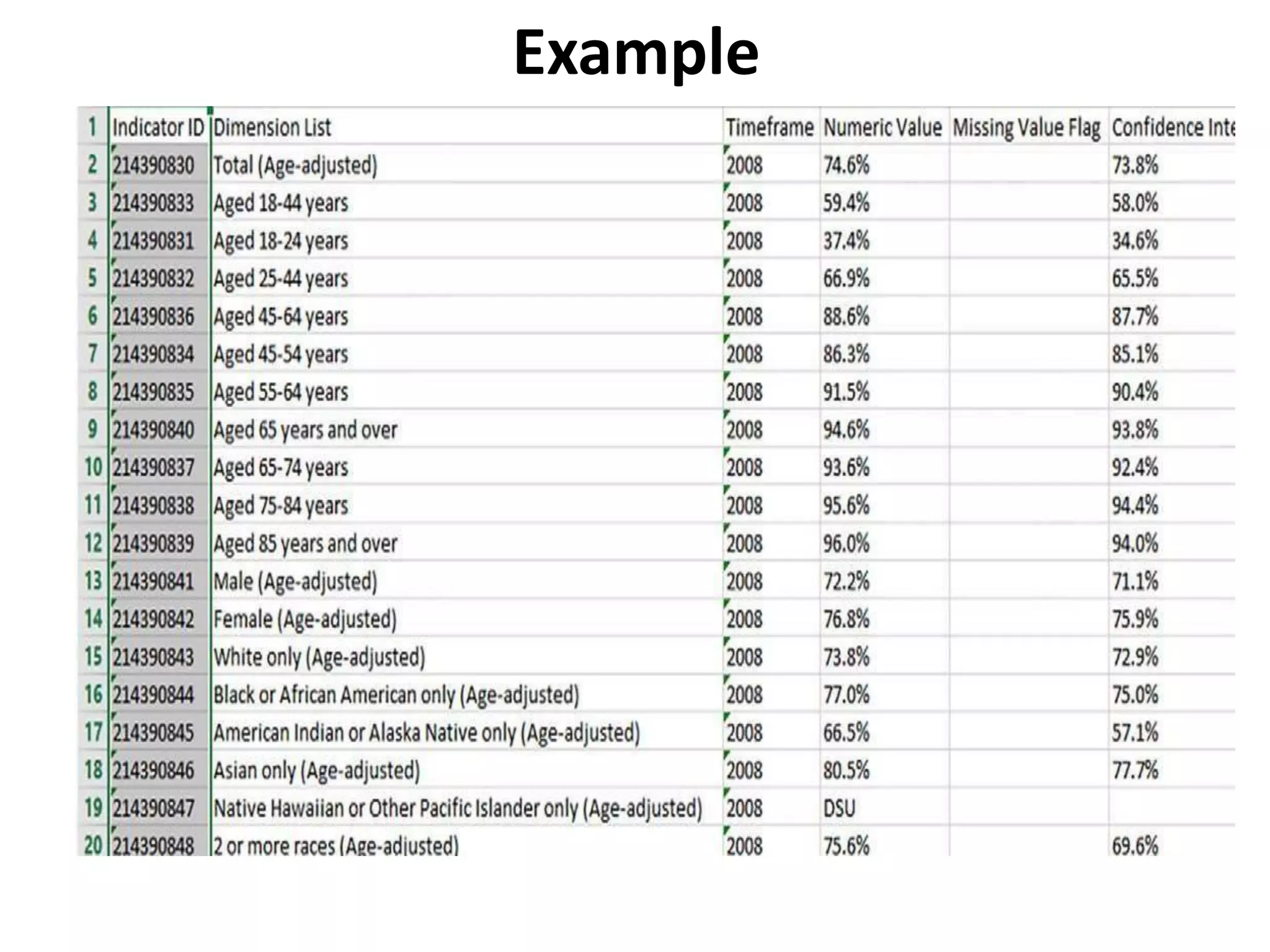
Structured Data
•Structured data is data that depends on a
data model and resides in a fixed field within
a record.
•To store structured data in tables within
databases or Excel files.
•SQL, or Structured Query Language, is the
preferred way to manage and query data
that resides in databases.
•Hierarchical data such as a family tree.
Example
Unstructured Data
• Unstructured data is data that isn’t easy to fit
into a data model because the content is
context-specific or varying.
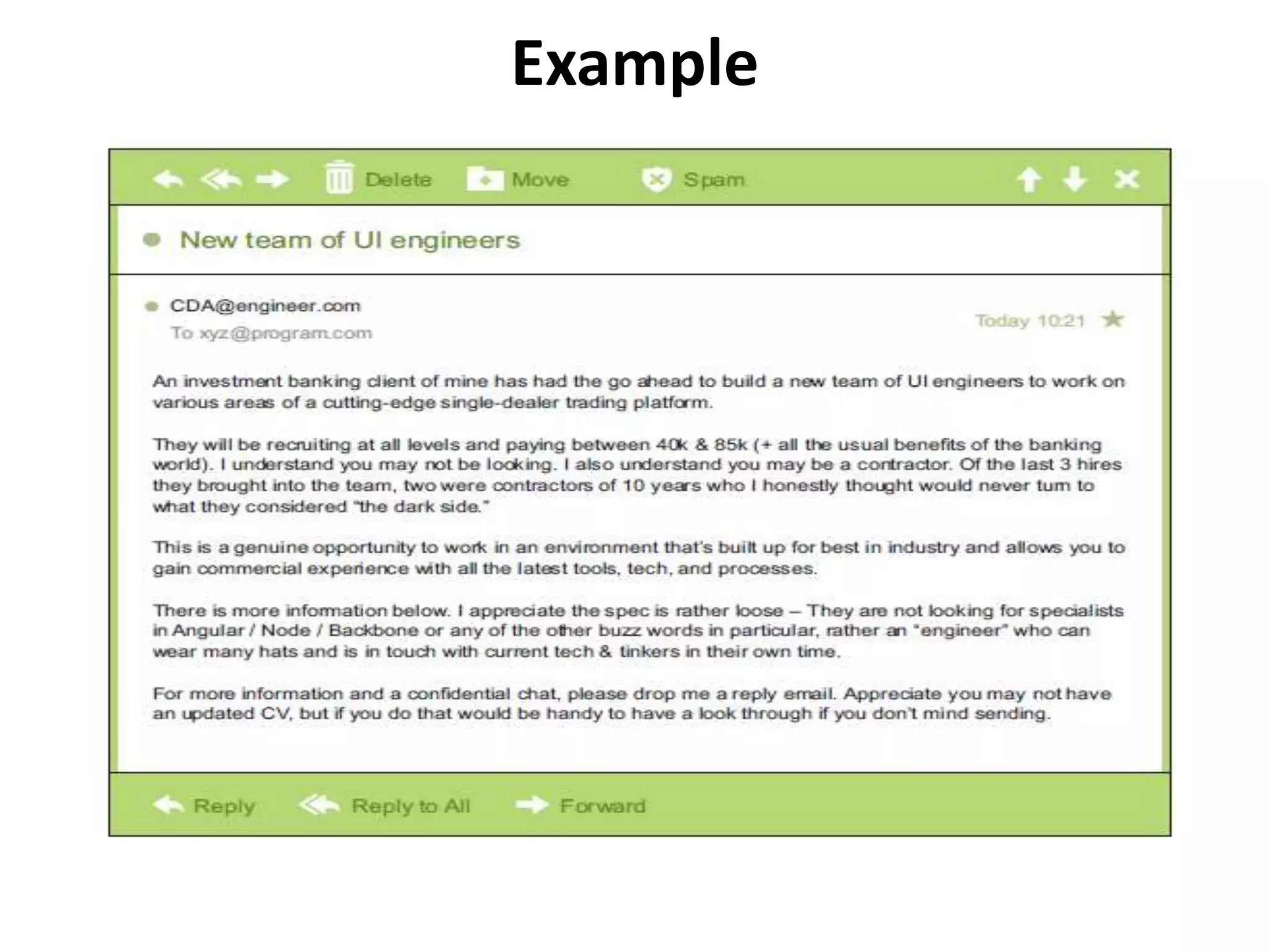
• Example of unstructured data is your regular
email.
• Although email contains structured elements
such as the sender, title, and body text.
• The thousands of different languages and
dialects out there further complicate this.
Example
Natural language
• Natural language is a special type of unstructured data; it’s challenging to
process because it requires knowledge of specific data science techniques
and linguistics.
• The natural language processing community has had success in entity
recognition, Speech recognition, summarization, text completion, and
sentiment analysis, but models trained in one domain don’t generalize well to
other domains.
• Even state-of-the-art techniques aren’t able to decipher the meaning of every
piece of text.
• Example: personal voice Assistant, siri, Alexa recognize patterns in speech,
provide a useful response.
• Example: Email Filters- Primary, Social ,Promotions
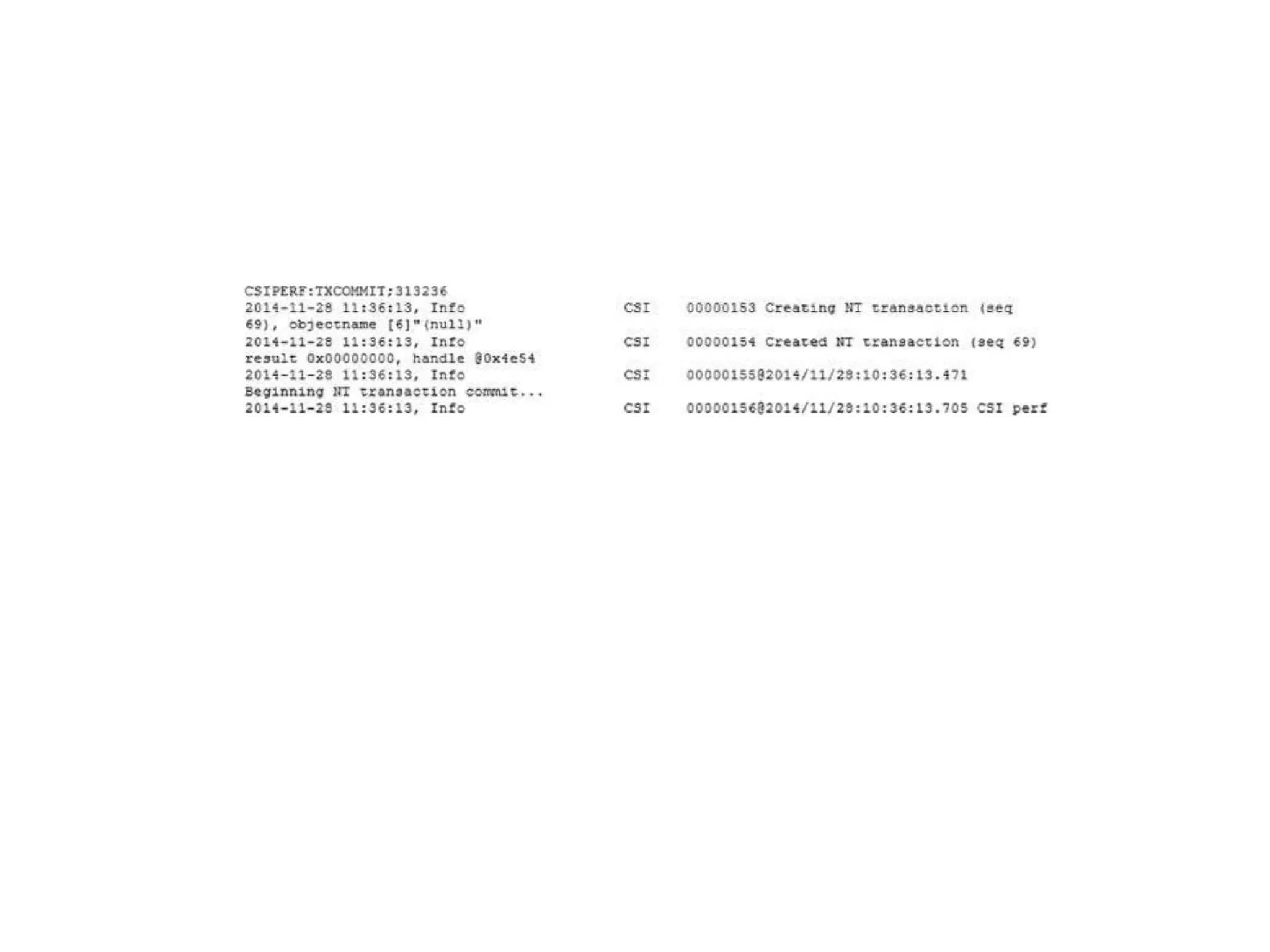
Machine-generated data
• Machine-generated data is information that’s
automatically created by a computer, process,
application, or other machine without human
intervention.
• Machine-generated data is becoming a major
data resource and will continue to do so.
• The analysis of machine data relies on highly
scalable tools, due to its high volume and
speed. Examples of machine data are web
server logs, call detail records, network event
logs, and telemetry.
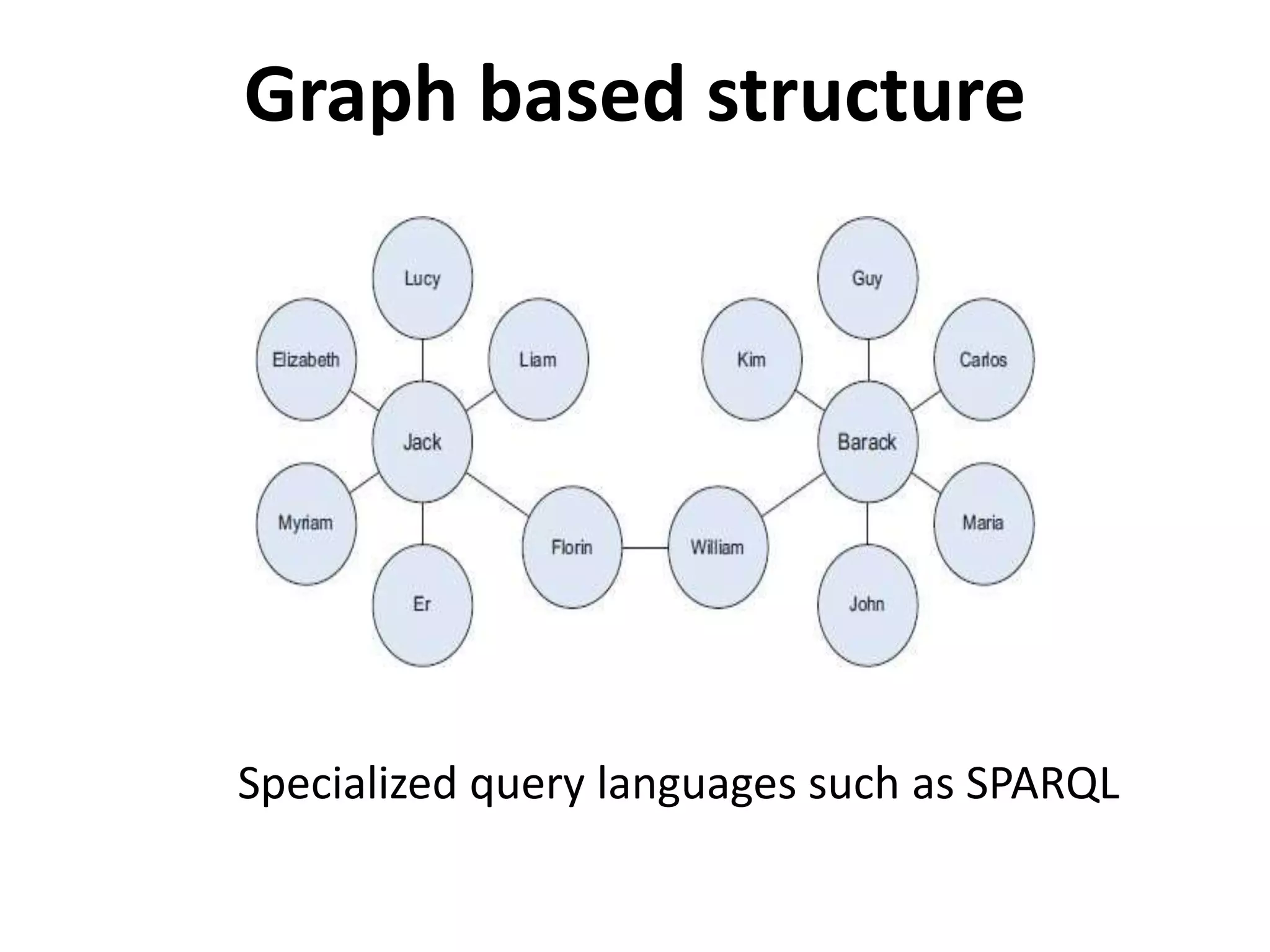
Graph-based or Networked Data
• A graph is a mathematical structure to model
pair-wise relationships between objects.
• Graph or network data is, in short, data that
focuses on the relationship or adjacency of
objects.
• The graph structures use nodes, edges, and
properties to represent and store graphical data.
Contd.,
• Graph-based data is a natural way to represent
social networks, and its structure allows you to
calculate specific metrics such as the influence
of a person and the shortest path between two
people.
• Example
• LinkedIn-business colleagues, Twitter-
follower list.
• Facebook-connecting edges here to show
friends.
Graph based structure
Specialized query languages such as SPARQL
Audio, image, and video
• Audio, image, and video are data types that
pose specific challenges to a data scientist.
• Tasks that are trivial for humans, such as
recognizing objects in pictures, to be challenging
for computers.
• MLBAM (Major League Baseball Advanced
Media) announced in 2014 that they’ll increase
video capture to approximately 7 TB per game
for the purpose of live, in-game analytics.
Contd.,
• Recently a company called DeepMind
succeeded at creating an algorithm that’s
capable of learning how to play video games.
• This algorithm takes the video screen as input
and learns to interpret everything via a
complex of deep learning.
Streaming Data
• The data flows into the system when an event
happens instead of being loaded into a data
store in a batch.
• Examples are the “What’s trending” on
Twitter, live sporting or music events, and the
stock market.

Introduction to Data Science.pptx

  • 1.
    CS3352 -Foundations ofData Science Introduction to Data Science Dr.V.Anusuya Associate Professor/IT Ramco Institute of Technology Rajapalayam
  • 2.
    Introduction • Data Scienceis the area of study which involves extracting insights from vast amounts of data using various scientific methods, algorithms and processes. • Data Science is useful to discover hidden patterns from the voluminous raw data. • Data Science is because of the evolution of mathematical statistics, data analysis, and big data.
  • 3.
    Contd., • Ingredients =Data • When a chef is starting out with a new dish. • After the chef has determined what type of dish he would like to make, he goes to the fridge to gather ingredients. If he doesn’t have the necessary ingredients, he takes a trip to the store to collect them. • As data scientists, our data points are our ingredients. We may have some on hand, but we still might have to collect more through web scraping, SQL queries, etc.
  • 4.
    Big Data • DataScience focuses on processing the huge volume of heterogeneous data known as big data. • Big data refers to the data sets that are large and complex in nature and difficult to process using traditional data processing application software.
  • 5.
    Contd., • The characteristicsof big data are often referred to as the three Vs: • Volume—How much data is there? • Variety—How diverse are different types of data? • Velocity—At what speed is new data generated? • Veracity-How accurate is the data?. • These four properties make big data different from the data found in traditional data management tools.
  • 6.
    Contd., • The fourV’s of data make the data capturing,cleaning,preprocessing,storing,search ing,sharing,transferring and visualization processes a complex task. • Specialization techniques are required to extract the insights from this huge volume of data. • The main things that set a data scientist apart from a statistician are the ability to work with big data and experience in machine learning, computing, and algorithm building.
  • 7.
    Big data • Tools-Hadoop, Pig, Spark, R, Python, and Java. • Python is a great language for data science because it has many data science libraries available, and it’s widely supported by specialized software.
  • 8.
    Contd., • Data Scienceis an interdisciplinary field that allows to extract knowledge from structured or unstructured data. • Translate business problem and Research project into practical solution.
  • 9.
    Benefits and usesof data science • Data science and big data are used almost everywhere in both commercial and noncommercial Settings. • Commercial companies in almost every industry use data science and big data to gain insights into their customers, processes, staff, completion, and products. • Many companies use data science to offer customers a better user experience, as well as to cross-sell, up-sell, and personalize their offerings.
  • 10.
    Benefits and usesof data science • Governmental organizations are also aware of data’s value. Many governmental organizations not only rely on internal data scientists to discover valuable information, but also share their data with the public. • Nongovernmental organizations (NGOs) use it to raise money and defend their causes. • Universities use data science in their research but also to enhance the study experience of their students. The rise of massive open online courses (MOOC) produces a lot of data, which allows universities to study how this type of learning can complement traditional classes.
  • 11.
    Facets of data •In data science and big data we’ll come across many different types of data, and each of them tends to require different tools and techniques. The main categories of data are these: • Structured • Unstructured • Natural language • Machine-generated • Graph-based • Audio, video, and images • Streaming
  • 12.
    Structured Data •Structured datais data that depends on a data model and resides in a fixed field within a record. •To store structured data in tables within databases or Excel files. •SQL, or Structured Query Language, is the preferred way to manage and query data that resides in databases. •Hierarchical data such as a family tree.
  • 13.
  • 14.
    Unstructured Data • Unstructureddata is data that isn’t easy to fit into a data model because the content is context-specific or varying. • Example of unstructured data is your regular email. • Although email contains structured elements such as the sender, title, and body text. • The thousands of different languages and dialects out there further complicate this.
  • 15.
  • 16.
    Natural language • Naturallanguage is a special type of unstructured data; it’s challenging to process because it requires knowledge of specific data science techniques and linguistics. • The natural language processing community has had success in entity recognition, Speech recognition, summarization, text completion, and sentiment analysis, but models trained in one domain don’t generalize well to other domains. • Even state-of-the-art techniques aren’t able to decipher the meaning of every piece of text. • Example: personal voice Assistant, siri, Alexa recognize patterns in speech, provide a useful response. • Example: Email Filters- Primary, Social ,Promotions
  • 17.
    Machine-generated data • Machine-generateddata is information that’s automatically created by a computer, process, application, or other machine without human intervention. • Machine-generated data is becoming a major data resource and will continue to do so. • The analysis of machine data relies on highly scalable tools, due to its high volume and speed. Examples of machine data are web server logs, call detail records, network event logs, and telemetry.
  • 19.
    Graph-based or NetworkedData • A graph is a mathematical structure to model pair-wise relationships between objects. • Graph or network data is, in short, data that focuses on the relationship or adjacency of objects. • The graph structures use nodes, edges, and properties to represent and store graphical data.
  • 20.
    Contd., • Graph-based datais a natural way to represent social networks, and its structure allows you to calculate specific metrics such as the influence of a person and the shortest path between two people. • Example • LinkedIn-business colleagues, Twitter- follower list. • Facebook-connecting edges here to show friends.
  • 21.
    Graph based structure Specializedquery languages such as SPARQL
  • 22.
    Audio, image, andvideo • Audio, image, and video are data types that pose specific challenges to a data scientist. • Tasks that are trivial for humans, such as recognizing objects in pictures, to be challenging for computers. • MLBAM (Major League Baseball Advanced Media) announced in 2014 that they’ll increase video capture to approximately 7 TB per game for the purpose of live, in-game analytics.
  • 23.
    Contd., • Recently acompany called DeepMind succeeded at creating an algorithm that’s capable of learning how to play video games. • This algorithm takes the video screen as input and learns to interpret everything via a complex of deep learning.
  • 24.
    Streaming Data • Thedata flows into the system when an event happens instead of being loaded into a data store in a batch. • Examples are the “What’s trending” on Twitter, live sporting or music events, and the stock market.