
Introduction to Cyber
Law
Intellectual Property Rights
Unit-6
Professor & Lawyer P. Guru Prasad
M.B.A., M.Com., M.Phil., PGDFTM., APSET.,
PhD at JNTUK
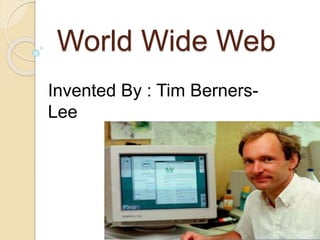
World Wide Web
Invented By : Tim Berners-
Lee
 Is a system of
interlinked hypertext documents
 Accessed via the Internet with
a web browser
 Web pages contain text,
images, videos, and
other multimedia.
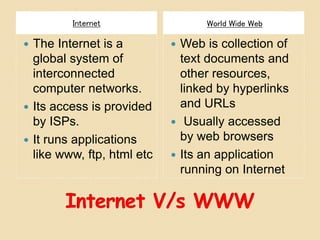
Internet
 The Internet is a
global system of
interconnected
computer networks.
 Its access is provided
by ISPs.
 It runs applications
like www, ftp, html etc
World Wide Web
 Web is collection of
text documents and
other resources,
linked by hyperlinks
and URLs
 Usually accessed
by web browsers
 Its an application
running on Internet
IT ACT PROVISIONS
 email would now be a valid and legal form
of communication in our country that can be
duly produced and approved in a court of
law.
 Companies shall now be able to carry out
electronic commerce using the legal
infrastructure provided by the Act.
 Digital signatures have been given legal
validity and sanction in the Act.
IT ACT PROVISIONS
 The Act now allows Government to
issue notification on the web thus
heralding e-governance
 statutory remedy in case if anyone
breaks into companies computer
systems or network and causes
damages or copies data
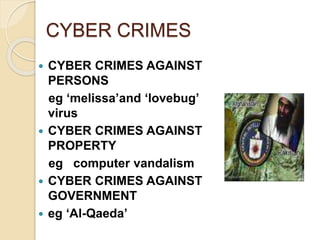
CYBER CRIMES
 CYBER CRIMES AGAINST
PERSONS
eg ‘melissa’and ‘lovebug’
virus
 CYBER CRIMES AGAINST
PROPERTY
eg computer vandalism
 CYBER CRIMES AGAINST
GOVERNMENT
 eg ‘Al-Qaeda’
Cyber Squatting
 Cyber squatting is a type of crime
where in the hackers register sells and
uses domain name of some company
with the aim of gaining profit from the
goodwill of its trademark.
 It is the practice of buying the Domain
Names of popular business names
with the intention of selling it to the
actual owner to earn profit.
The salient features of IT
Act,2000
 Sec 65- Tampering with computer source
document.
 Sec 66- Computer related offences
 Sec 67- Punishment for Publishing or transmitting
Obscene Material in Electronic form.
 Sec 71- Penalty for Misrepresentation
 Sec 72- Penalty for Breach of confidentiality and
Privacy
 Sec 73- Penalty for publishing Digital
signature Certificate False in certain particulars
 Sec 74- Publications for Fraudulent Purpose
Cyber crime and E-commerce
 A cyber crime can defined as a criminal
activity doing using computer. They make
use of computer technology in order to steal
the personal information of the user,
business secrets for the malicious purpose.
 Cyber space
 Cyber squatting
 Cyber punk
 Cyber warfare
 Cyber Terrorism
Various Cyber Crimes
 Cyber crime against Persons
 Cyber crime against Property
 Cyber crime against Organizations
 Cyber crime against Society
 Cyber crime against user group.
 Apart from this, they also perform other
criminal activities, like child pornography,
credit card frauds, cyber stalking,
defaming, ignoring copy right and
software licensing.
 Connectivity via the Internet has greatly
abridged geographical distances and made
communication even more rapid. While
activities in this limitless new universe are
increasing incessantly, the need for laws to be
formulated to govern all spheres of this new
revolution was felt.
 In order to keep pace with the changing
generation the Indian Parliament passed
Information Technology (IT) Act, 2000. The IT
Act has been conceptualized on the United
Nations Commission on International Trade
Law (UNCITRAL) Model Law
INFORMATION
TECHNOLOGY ACT,2000
 The Act aims at providing legal
recognition for transactions carried out
by means of electronic data interchange
and other means of electronic
communications commonly referred to
as "electronic commerce"
 which involve the use of alternative to
paper based methods of communication
and storage of information and aims at
facilitating electronic filing of documents
with the government agencies.
INFORMATION TECHNOLOGY
ACT,2000
Information Technology
Act,2000 in a capsule
 Called the Information Technology
Act, 2000.
 Came into force in June,2000
 Extends to whole of India and also
to people who contravene the
provisions of the act outside India.
 Shall come into force as per
notification by the Central govt.
 The Act applies to the whole of India.
It also applies to any offence
committed outside India by any
person.
 It does not apply to the following.
 a negotiable instrument as defined in
section 13 of the Negotiable
Instruments Act, 1881;
 a power-of-attorney as defined in
section 1A of the Power-of-attorney
Information Technology Act,2000 in a
capsule
DIGITAL SIGNATURES:
LEGITIMACY AND USE
 The Act has adopted the Public Key
Infrastructure (PKI) for securing
electronic transactions. A digital
signature means an authentication of
any electronic record by a subscriber
by means of an electronic method or
procedure in accordance with the
other provisions of the Act.
 Thus a subscriber can authenticate an
electronic record by affixing his digital
signature.
 A private key is used to create a digital
signature whereas a public key is used
to verify the digital signature and
electronic record.
 They both are unique for each
subscriber and together form a
functioning key pair.
DIGITAL SIGNATURES:
LEGITIMACY AND USE
 Further, the Act provides that when any
information or other matter needs to be
authenticated by the signature of a
person, the same can be authenticated
by means of the digital signature affixed
in a manner prescribed by the Central
Government.
 The Act also gives the Central
Government powers:
 a) to make rules prescribing the digital
signature
DIGITAL SIGNATURES:
LEGITIMACY AND USE
b) the manner in which it shall be
affixed
c) the procedure to identify the person
affixing the signature
d) the maintenance of integrity, security
and confidentiality of records or
e) payments and rules regarding any
other appropriate matters
DIGITAL SIGNATURES:
LEGITIMACY AND USE
 These signatures are to be
authenticated by Certifying Authorities
(CAs) appointed under the Act. These
authorities would inter alia, have the
license to issue Digital Signature
Certificates (DSCs).
 The applicant must have a private key
that can create a digital signature. This
private key and the public key listed on
the DSC must form the functioning key
DIGITAL SIGNATURES:
LEGITIMACY AND USE
 Once the subscriber has accepted
the DSC, he shall generate the key
pair by applying the security
procedure.
 Every subscriber is under an
obligation to exercise reasonable
care and caution to retain control of
the private key corresponding to the
public key listed in his DSC.
DIGITAL SIGNATURES:
LEGITIMACY AND USE
List of Organizations that control
Internet
 ISOC
 IETF
 IAB
 IANA
 IRTF
 IESG
 IEEE
 W3C
Introduction to cyber law.

Introduction to cyber law.

  • 1.
    Introduction to Cyber Law IntellectualProperty Rights Unit-6 Professor & Lawyer P. Guru Prasad M.B.A., M.Com., M.Phil., PGDFTM., APSET., PhD at JNTUK
  • 2.
    World Wide Web InventedBy : Tim Berners- Lee
  • 3.
     Is asystem of interlinked hypertext documents  Accessed via the Internet with a web browser  Web pages contain text, images, videos, and other multimedia.
  • 4.
    Internet  The Internetis a global system of interconnected computer networks.  Its access is provided by ISPs.  It runs applications like www, ftp, html etc World Wide Web  Web is collection of text documents and other resources, linked by hyperlinks and URLs  Usually accessed by web browsers  Its an application running on Internet
  • 5.
    IT ACT PROVISIONS email would now be a valid and legal form of communication in our country that can be duly produced and approved in a court of law.  Companies shall now be able to carry out electronic commerce using the legal infrastructure provided by the Act.  Digital signatures have been given legal validity and sanction in the Act.
  • 6.
    IT ACT PROVISIONS The Act now allows Government to issue notification on the web thus heralding e-governance  statutory remedy in case if anyone breaks into companies computer systems or network and causes damages or copies data
  • 7.
    CYBER CRIMES  CYBERCRIMES AGAINST PERSONS eg ‘melissa’and ‘lovebug’ virus  CYBER CRIMES AGAINST PROPERTY eg computer vandalism  CYBER CRIMES AGAINST GOVERNMENT  eg ‘Al-Qaeda’
  • 8.
    Cyber Squatting  Cybersquatting is a type of crime where in the hackers register sells and uses domain name of some company with the aim of gaining profit from the goodwill of its trademark.  It is the practice of buying the Domain Names of popular business names with the intention of selling it to the actual owner to earn profit.
  • 9.
    The salient featuresof IT Act,2000  Sec 65- Tampering with computer source document.  Sec 66- Computer related offences  Sec 67- Punishment for Publishing or transmitting Obscene Material in Electronic form.  Sec 71- Penalty for Misrepresentation  Sec 72- Penalty for Breach of confidentiality and Privacy  Sec 73- Penalty for publishing Digital signature Certificate False in certain particulars  Sec 74- Publications for Fraudulent Purpose
  • 10.
    Cyber crime andE-commerce  A cyber crime can defined as a criminal activity doing using computer. They make use of computer technology in order to steal the personal information of the user, business secrets for the malicious purpose.  Cyber space  Cyber squatting  Cyber punk  Cyber warfare  Cyber Terrorism
  • 11.
    Various Cyber Crimes Cyber crime against Persons  Cyber crime against Property  Cyber crime against Organizations  Cyber crime against Society  Cyber crime against user group.  Apart from this, they also perform other criminal activities, like child pornography, credit card frauds, cyber stalking, defaming, ignoring copy right and software licensing.
  • 12.
     Connectivity viathe Internet has greatly abridged geographical distances and made communication even more rapid. While activities in this limitless new universe are increasing incessantly, the need for laws to be formulated to govern all spheres of this new revolution was felt.  In order to keep pace with the changing generation the Indian Parliament passed Information Technology (IT) Act, 2000. The IT Act has been conceptualized on the United Nations Commission on International Trade Law (UNCITRAL) Model Law INFORMATION TECHNOLOGY ACT,2000
  • 13.
     The Actaims at providing legal recognition for transactions carried out by means of electronic data interchange and other means of electronic communications commonly referred to as "electronic commerce"  which involve the use of alternative to paper based methods of communication and storage of information and aims at facilitating electronic filing of documents with the government agencies. INFORMATION TECHNOLOGY ACT,2000
  • 14.
    Information Technology Act,2000 ina capsule  Called the Information Technology Act, 2000.  Came into force in June,2000  Extends to whole of India and also to people who contravene the provisions of the act outside India.  Shall come into force as per notification by the Central govt.
  • 15.
     The Actapplies to the whole of India. It also applies to any offence committed outside India by any person.  It does not apply to the following.  a negotiable instrument as defined in section 13 of the Negotiable Instruments Act, 1881;  a power-of-attorney as defined in section 1A of the Power-of-attorney Information Technology Act,2000 in a capsule
  • 16.
    DIGITAL SIGNATURES: LEGITIMACY ANDUSE  The Act has adopted the Public Key Infrastructure (PKI) for securing electronic transactions. A digital signature means an authentication of any electronic record by a subscriber by means of an electronic method or procedure in accordance with the other provisions of the Act.
  • 17.
     Thus asubscriber can authenticate an electronic record by affixing his digital signature.  A private key is used to create a digital signature whereas a public key is used to verify the digital signature and electronic record.  They both are unique for each subscriber and together form a functioning key pair. DIGITAL SIGNATURES: LEGITIMACY AND USE
  • 18.
     Further, theAct provides that when any information or other matter needs to be authenticated by the signature of a person, the same can be authenticated by means of the digital signature affixed in a manner prescribed by the Central Government.  The Act also gives the Central Government powers:  a) to make rules prescribing the digital signature DIGITAL SIGNATURES: LEGITIMACY AND USE
  • 19.
    b) the mannerin which it shall be affixed c) the procedure to identify the person affixing the signature d) the maintenance of integrity, security and confidentiality of records or e) payments and rules regarding any other appropriate matters DIGITAL SIGNATURES: LEGITIMACY AND USE
  • 20.
     These signaturesare to be authenticated by Certifying Authorities (CAs) appointed under the Act. These authorities would inter alia, have the license to issue Digital Signature Certificates (DSCs).  The applicant must have a private key that can create a digital signature. This private key and the public key listed on the DSC must form the functioning key DIGITAL SIGNATURES: LEGITIMACY AND USE
  • 21.
     Once thesubscriber has accepted the DSC, he shall generate the key pair by applying the security procedure.  Every subscriber is under an obligation to exercise reasonable care and caution to retain control of the private key corresponding to the public key listed in his DSC. DIGITAL SIGNATURES: LEGITIMACY AND USE
  • 22.
    List of Organizationsthat control Internet  ISOC  IETF  IAB  IANA  IRTF  IESG  IEEE  W3C