ASSIGNMENT
EDU 03
Cyber Law – IT Act 2000,
IT Act 2008
Submitted by,
ATHULYARAJ D S
Roll No : 30
Physical Science
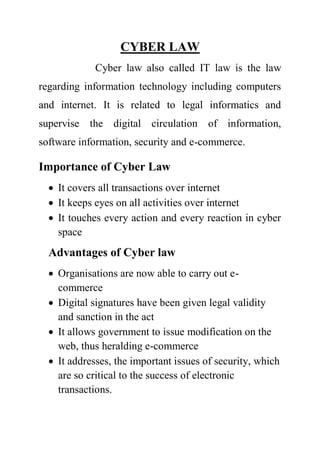
CYBER LAW
Cyber law also called IT law is the law
regarding information technology including computers
and internet. It is related to legal informatics and
supervise the digital circulation of information,
software information, security and e-commerce.
Importance of Cyber Law
 It covers all transactions over internet
 It keeps eyes on all activities over internet
 It touches every action and every reaction in cyber
space
Advantages of Cyber law
 Organisations are now able to carry out e-
commerce
 Digital signatures have been given legal validity
and sanction in the act
 It allows government to issue modification on the
web, thus heralding e-commerce
 It addresses, the important issues of security, which
are so critical to the success of electronic
transactions.
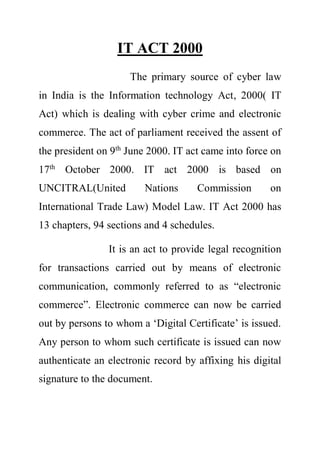
IT ACT 2000
The primary source of cyber law
in India is the Information technology Act, 2000( IT
Act) which is dealing with cyber crime and electronic
commerce. The act of parliament received the assent of
the president on 9th
June 2000. IT act came into force on
17th
October 2000. IT act 2000 is based on
UNCITRAL(United Nations Commission on
International Trade Law) Model Law. IT Act 2000 has
13 chapters, 94 sections and 4 schedules.
It is an act to provide legal recognition
for transactions carried out by means of electronic
communication, commonly referred to as “electronic
commerce”. Electronic commerce can now be carried
out by persons to whom a ‘Digital Certificate’ is issued.
Any person to whom such certificate is issued can now
authenticate an electronic record by affixing his digital
signature to the document.
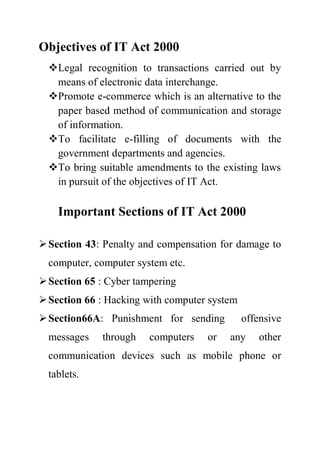
Objectives of IT Act 2000
Legal recognition to transactions carried out by
means of electronic data interchange.
Promote e-commerce which is an alternative to the
paper based method of communication and storage
of information.
To facilitate e-filling of documents with the
government departments and agencies.
To bring suitable amendments to the existing laws
in pursuit of the objectives of IT Act.
Important Sections of IT Act 2000
Section 43: Penalty and compensation for damage to
computer, computer system etc.
Section 65 : Cyber tampering
Section 66 : Hacking with computer system
Section66A: Punishment for sending offensive
messages through computers or any other
communication devices such as mobile phone or
tablets.
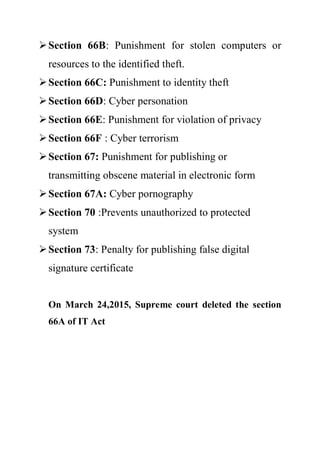
Section 66B: Punishment for stolen computers or
resources to the identified theft.
Section 66C: Punishment to identity theft
Section 66D: Cyber personation
Section 66E: Punishment for violation of privacy
Section 66F : Cyber terrorism
Section 67: Punishment for publishing or
transmitting obscene material in electronic form
Section 67A: Cyber pornography
Section 70 :Prevents unauthorized to protected
system
Section 73: Penalty for publishing false digital
signature certificate
On March 24,2015, Supreme court deleted the section
66A of IT Act
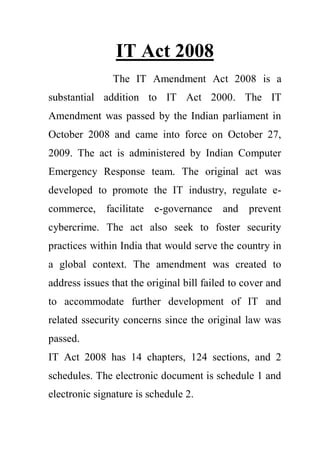
IT Act 2008
The IT Amendment Act 2008 is a
substantial addition to IT Act 2000. The IT
Amendment was passed by the Indian parliament in
October 2008 and came into force on October 27,
2009. The act is administered by Indian Computer
Emergency Response team. The original act was
developed to promote the IT industry, regulate e-
commerce, facilitate e-governance and prevent
cybercrime. The act also seek to foster security
practices within India that would serve the country in
a global context. The amendment was created to
address issues that the original bill failed to cover and
to accommodate further development of IT and
related ssecurity concerns since the original law was
passed.
IT Act 2008 has 14 chapters, 124 sections, and 2
schedules. The electronic document is schedule 1 and
electronic signature is schedule 2.
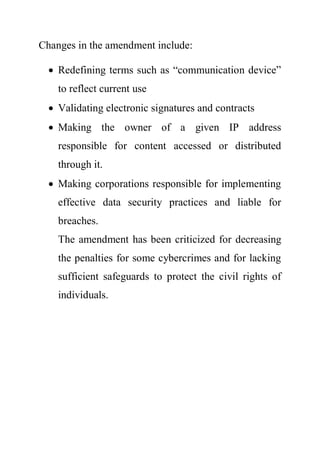
Changes in the amendment include:
 Redefining terms such as “communication device”
to reflect current use
 Validating electronic signatures and contracts
 Making the owner of a given IP address
responsible for content accessed or distributed
through it.
 Making corporations responsible for implementing
effective data security practices and liable for
breaches.
The amendment has been criticized for decreasing
the penalties for some cybercrimes and for lacking
sufficient safeguards to protect the civil rights of
individuals.

Assignment edu 03

  • 1.
    ASSIGNMENT EDU 03 Cyber Law– IT Act 2000, IT Act 2008 Submitted by, ATHULYARAJ D S Roll No : 30 Physical Science
  • 2.
    CYBER LAW Cyber lawalso called IT law is the law regarding information technology including computers and internet. It is related to legal informatics and supervise the digital circulation of information, software information, security and e-commerce. Importance of Cyber Law  It covers all transactions over internet  It keeps eyes on all activities over internet  It touches every action and every reaction in cyber space Advantages of Cyber law  Organisations are now able to carry out e- commerce  Digital signatures have been given legal validity and sanction in the act  It allows government to issue modification on the web, thus heralding e-commerce  It addresses, the important issues of security, which are so critical to the success of electronic transactions.
  • 3.
    IT ACT 2000 Theprimary source of cyber law in India is the Information technology Act, 2000( IT Act) which is dealing with cyber crime and electronic commerce. The act of parliament received the assent of the president on 9th June 2000. IT act came into force on 17th October 2000. IT act 2000 is based on UNCITRAL(United Nations Commission on International Trade Law) Model Law. IT Act 2000 has 13 chapters, 94 sections and 4 schedules. It is an act to provide legal recognition for transactions carried out by means of electronic communication, commonly referred to as “electronic commerce”. Electronic commerce can now be carried out by persons to whom a ‘Digital Certificate’ is issued. Any person to whom such certificate is issued can now authenticate an electronic record by affixing his digital signature to the document.
  • 4.
    Objectives of ITAct 2000 Legal recognition to transactions carried out by means of electronic data interchange. Promote e-commerce which is an alternative to the paper based method of communication and storage of information. To facilitate e-filling of documents with the government departments and agencies. To bring suitable amendments to the existing laws in pursuit of the objectives of IT Act. Important Sections of IT Act 2000 Section 43: Penalty and compensation for damage to computer, computer system etc. Section 65 : Cyber tampering Section 66 : Hacking with computer system Section66A: Punishment for sending offensive messages through computers or any other communication devices such as mobile phone or tablets.
  • 5.
    Section 66B: Punishmentfor stolen computers or resources to the identified theft. Section 66C: Punishment to identity theft Section 66D: Cyber personation Section 66E: Punishment for violation of privacy Section 66F : Cyber terrorism Section 67: Punishment for publishing or transmitting obscene material in electronic form Section 67A: Cyber pornography Section 70 :Prevents unauthorized to protected system Section 73: Penalty for publishing false digital signature certificate On March 24,2015, Supreme court deleted the section 66A of IT Act
  • 6.
    IT Act 2008 TheIT Amendment Act 2008 is a substantial addition to IT Act 2000. The IT Amendment was passed by the Indian parliament in October 2008 and came into force on October 27, 2009. The act is administered by Indian Computer Emergency Response team. The original act was developed to promote the IT industry, regulate e- commerce, facilitate e-governance and prevent cybercrime. The act also seek to foster security practices within India that would serve the country in a global context. The amendment was created to address issues that the original bill failed to cover and to accommodate further development of IT and related ssecurity concerns since the original law was passed. IT Act 2008 has 14 chapters, 124 sections, and 2 schedules. The electronic document is schedule 1 and electronic signature is schedule 2.
  • 7.
    Changes in theamendment include:  Redefining terms such as “communication device” to reflect current use  Validating electronic signatures and contracts  Making the owner of a given IP address responsible for content accessed or distributed through it.  Making corporations responsible for implementing effective data security practices and liable for breaches. The amendment has been criticized for decreasing the penalties for some cybercrimes and for lacking sufficient safeguards to protect the civil rights of individuals.