By :
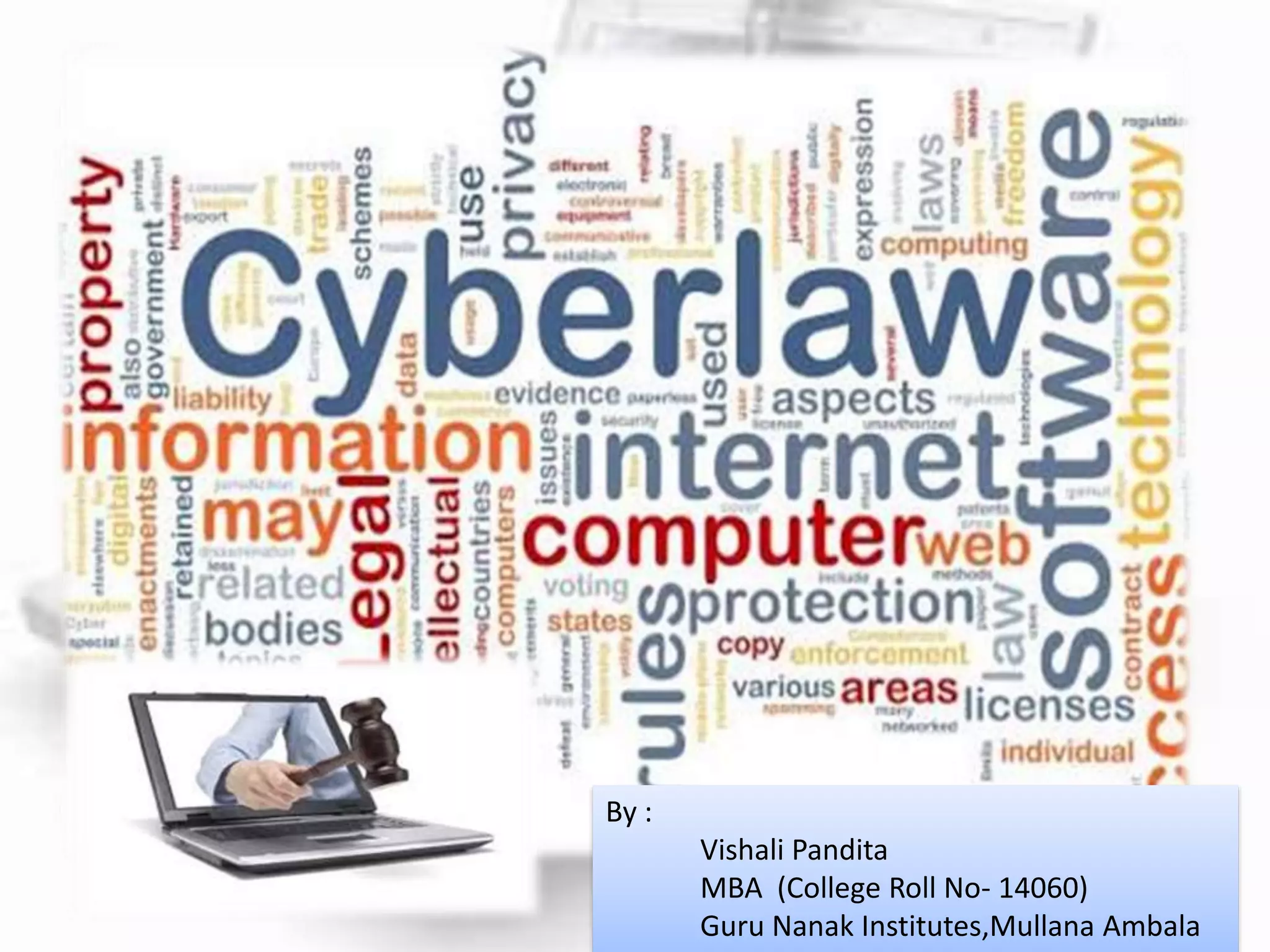
Vishali Pandita
MBA (College Roll No- 14060)
Guru Nanak Institutes,Mullana Ambala
CYBERLAW
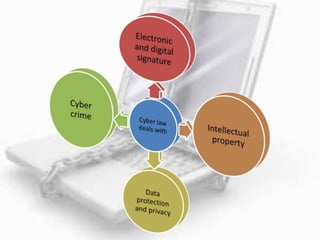
 Cyber law is a much newer phenomenon having emerged
much after the onset of internet . It is a generic term which
refers to all the legal and regulatory aspects of internet and the
www.
 So it is the part of the overall legal system that deals with the
internet,cyberspace and their respective legal issues.
 In other words you can say Cyber law is the law governing
cyber space
And cyber space includes computers/w, data storage
devices,internet websites,emails,and even electronic devices
such as cell phones, ATM machines etc.
Generally cyber law has been referred to “ law of
the internet”.
CYBERLAWSININDIA
• In May 2000,both the houses of the Indian
Parliament passed the Information
Technology Bill. The bill received the assent of
the president in August 2000 and came to be
known as the Information Technology
Act,2000.
• Cyber laws are contained in the IT ACT 2000.
ITACT2000
IT ACT 2000,has 13 chapters,94 sections and 4 schedules
• First 14 sections deals with some legal aspects
concerning digital signatures
• Further other sections deals with certifying authorities
who are licensed to issue digital signatures.
• Sections 43 to 47 provide for penalties and
compensation.
• Section 48 to 64 deals with Tribunals a appeal to high
court.
• Section 65 to 79 of the act deals with offences.
• Section 80 to 94 deals with miscellaneous of the act.
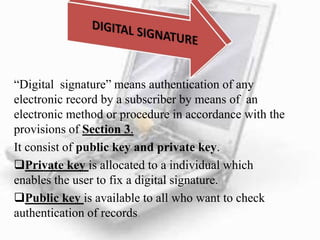
“Digital signature” means authentication of any
electronic record by a subscriber by means of an
electronic method or procedure in accordance with the
provisions of Section 3.
It consist of public key and private key.
Private key is allocated to a individual which
enables the user to fix a digital signature.
Public key is available to all who want to check
authentication of records.
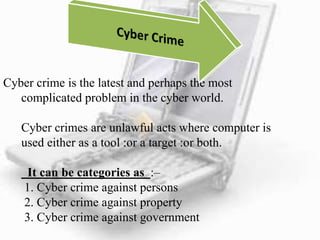
Cyber crime is the latest and perhaps the most
complicated problem in the cyber world.
Cyber crimes are unlawful acts where computer is
used either as a tool :or a target :or both.
It can be categories as :–
1. Cyber crime against persons
2. Cyber crime against property
3. Cyber crime against government
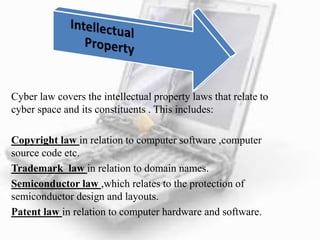
Cyber law covers the intellectual property laws that relate to
cyber space and its constituents . This includes:
Copyright law in relation to computer software ,computer
source code etc.
Trademark law in relation to domain names.
Semiconductor law ,which relates to the protection of
semiconductor design and layouts.
Patent law in relation to computer hardware and software.
Data protection and privacy laws aim to achieve a fair
balance between the privacy rights of the individual
and the interests of data controllers such as: banks,
hospitals , email service providers etc.
Many nations have enacted legislation relating to
data protection and privacy within their jurisdictions.
These laws would probably play a vital role, as the
dependence on insecure networks such as the internet
grows further.
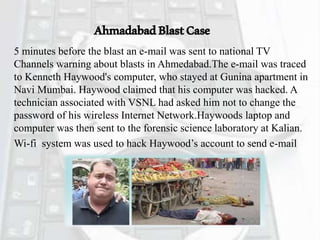
AhmadabadBlastCase
5 minutes before the blast an e-mail was sent to national TV
Channels warning about blasts in Ahmedabad.The e-mail was traced
to Kenneth Haywood's computer, who stayed at Gunina apartment in
Navi Mumbai. Haywood claimed that his computer was hacked. A
technician associated with VSNL had asked him not to change the
password of his wireless Internet Network.Haywoods laptop and
computer was then sent to the forensic science laboratory at Kalian.
Wi-fi system was used to hack Haywood’s account to send e-mail
Need For Cyber Laws
1. Laws are necessary in all segments of society, and
e-commerce is exception .
2. All internet users , including minors , need to be assured of
their privacy and the safety of their personal information
online .
3. In today’s highly digitalized world , almost everyone is affected
by cyber law.
4. Almost all companies extensively depend upon their
computer networks and keep their valuable data in
electronic form.
5. Government forms including income tax returns , company
law forms etc are now filled in electronic forms.
6. Consumers are increasingly using credit cards for shopping.
ADVNATAGESOFCYBERLAW
1. IT ACT 2000 attempts to change outdated laws and
provides ways to deal with cyber crime.
2. Companies shall now be able to carry out electronic
commerce using legal infrastructure provided by the
act
3. Digital signatures have been given legal validity and
sanction in the Act.
4. The act now allows government to issue notification
on the web thus handling e-goverence.
5. The law sets up the territorial jurisdictions of the
adjudicating officers for cyber crimes and the crime
regulations appellate tribunal.
DONOT SHARE IT
WITH ANYONE ELSE
AND CHANGE IT AFTER
EVERY 3 MONTHS

Cyber law

  • 1.
    By : Vishali Pandita MBA(College Roll No- 14060) Guru Nanak Institutes,Mullana Ambala
  • 2.
    CYBERLAW  Cyber lawis a much newer phenomenon having emerged much after the onset of internet . It is a generic term which refers to all the legal and regulatory aspects of internet and the www.  So it is the part of the overall legal system that deals with the internet,cyberspace and their respective legal issues.  In other words you can say Cyber law is the law governing cyber space And cyber space includes computers/w, data storage devices,internet websites,emails,and even electronic devices such as cell phones, ATM machines etc. Generally cyber law has been referred to “ law of the internet”.
  • 3.
    CYBERLAWSININDIA • In May2000,both the houses of the Indian Parliament passed the Information Technology Bill. The bill received the assent of the president in August 2000 and came to be known as the Information Technology Act,2000. • Cyber laws are contained in the IT ACT 2000.
  • 4.
    ITACT2000 IT ACT 2000,has13 chapters,94 sections and 4 schedules • First 14 sections deals with some legal aspects concerning digital signatures • Further other sections deals with certifying authorities who are licensed to issue digital signatures. • Sections 43 to 47 provide for penalties and compensation. • Section 48 to 64 deals with Tribunals a appeal to high court. • Section 65 to 79 of the act deals with offences. • Section 80 to 94 deals with miscellaneous of the act.
  • 6.
    “Digital signature” meansauthentication of any electronic record by a subscriber by means of an electronic method or procedure in accordance with the provisions of Section 3. It consist of public key and private key. Private key is allocated to a individual which enables the user to fix a digital signature. Public key is available to all who want to check authentication of records.
  • 7.
    Cyber crime isthe latest and perhaps the most complicated problem in the cyber world. Cyber crimes are unlawful acts where computer is used either as a tool :or a target :or both. It can be categories as :– 1. Cyber crime against persons 2. Cyber crime against property 3. Cyber crime against government
  • 8.
    Cyber law coversthe intellectual property laws that relate to cyber space and its constituents . This includes: Copyright law in relation to computer software ,computer source code etc. Trademark law in relation to domain names. Semiconductor law ,which relates to the protection of semiconductor design and layouts. Patent law in relation to computer hardware and software.
  • 9.
    Data protection andprivacy laws aim to achieve a fair balance between the privacy rights of the individual and the interests of data controllers such as: banks, hospitals , email service providers etc. Many nations have enacted legislation relating to data protection and privacy within their jurisdictions. These laws would probably play a vital role, as the dependence on insecure networks such as the internet grows further.
  • 10.
    AhmadabadBlastCase 5 minutes beforethe blast an e-mail was sent to national TV Channels warning about blasts in Ahmedabad.The e-mail was traced to Kenneth Haywood's computer, who stayed at Gunina apartment in Navi Mumbai. Haywood claimed that his computer was hacked. A technician associated with VSNL had asked him not to change the password of his wireless Internet Network.Haywoods laptop and computer was then sent to the forensic science laboratory at Kalian. Wi-fi system was used to hack Haywood’s account to send e-mail
  • 11.
    Need For CyberLaws 1. Laws are necessary in all segments of society, and e-commerce is exception . 2. All internet users , including minors , need to be assured of their privacy and the safety of their personal information online . 3. In today’s highly digitalized world , almost everyone is affected by cyber law. 4. Almost all companies extensively depend upon their computer networks and keep their valuable data in electronic form. 5. Government forms including income tax returns , company law forms etc are now filled in electronic forms. 6. Consumers are increasingly using credit cards for shopping.
  • 12.
    ADVNATAGESOFCYBERLAW 1. IT ACT2000 attempts to change outdated laws and provides ways to deal with cyber crime. 2. Companies shall now be able to carry out electronic commerce using legal infrastructure provided by the act 3. Digital signatures have been given legal validity and sanction in the Act. 4. The act now allows government to issue notification on the web thus handling e-goverence. 5. The law sets up the territorial jurisdictions of the adjudicating officers for cyber crimes and the crime regulations appellate tribunal.
  • 13.
    DONOT SHARE IT WITHANYONE ELSE AND CHANGE IT AFTER EVERY 3 MONTHS