CYBER CRIME & CYBER
        LAW


                Presented by:-
             himanshu munjal
                   Viii sem,cs
                    Roll no.26
STRUCTURE
•   Introduction
•   Cyber crime
•   Classification of cybercrime
•   Cyber Law & Need
•   Cyber law in US
•   Global efforts
WHAT DO YOU KNOW?
Crime & Cybercrime
• Crime
   – Engaging in conduct that has been outlawed by a particular
     society

• Cybercrime
   – Differ in the tool: guns are change for computers


   Harm to: Individuals, property, government and
    morality
CYBER CRIME

• Cybercrime is any illegal act committed using a computer network
  (especially the Internet).

• Criminal activities that take place in cyberspace (the Internet).

• Computer used to commit a crime
    – Child porn, threatening email, assuming someone’s identity, sexual
      harassment, defamation, spam, phishing

• Computer as a target of a crime
    – Viruses, worms, industrial espionage, software piracy, hacking
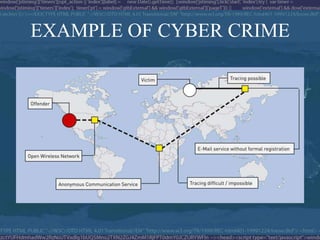
EXAMPLE OF CYBER CRIME
Classification OF CYBER CRIME
• Cybercrime includes a wide variety of crime

• Offences under cyber crime:

   – Offences against the confidentiality integrity and availability of
     computer data and systems

   – Content-related offences

   – Copyright-related offences
TYPES OF CYBER CRIME

  Viruses        Fraud
  Worms          Theft
  Trojans        Piracy
  Mail bombs     Break-ins
  Threats        Terrorism.
  Harassment
  DOS
CYBER LAW
• Law governing cyber space

• Cyber law encompasses laws relating to:

   – Cyber Crimes

   – Electronic and Digital Signatures

   – Intellectual Property

   – Data Protection and Privacy
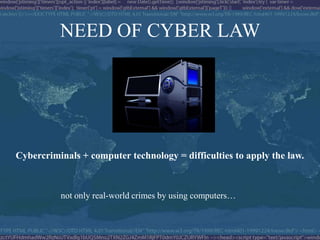
NEED OF CYBER LAW


Cybercriminals + computer technology = difficulties to apply the law.


          not only real-world crimes by using computers…
CYBER LAW IN USA
• Protect America Act of 2007

• Key component “Electronic Surveillance”

• USA Patriot ACT
   – Hacking, cracking, extortion, fraud and malware.
• Advertising Law

• E-Signatures

• Electronic Contracts

• Cryptography Laws

• Electronic Evidence

• Copyright Law

• Domain Names

• Confidentiality
National & International Efforts
• First Wave (privacy)
   – Sweden (1973) ; USA (1974); Federal Republic of German
      (1977); Austria, Denmark, France and Norway (1978), etc.
• Second Wave (property)
   – Italy (1978); UK (1981,1990); USA (1980s); Canada and
      Denmark (1985), etc.
• Third Wave (intellectual property)
• Convention on Cybercrime
   – Ensuring that countries adopt procedural laws.
   – Harmonizing national cybercrime law.
PROTECT YOUR SYSTEM
• Use anti-virus software and firewalls - keep them up to date

• Keep your operating system up to date with critical security updates
  and patches

• Don't open emails or attachments from unknown sources

• Use hard-to-guess passwords. Don’t use words found in a dictionary.
  Remember that password cracking tools exist

• Back-up your computer data on disks or CDs often
• Don't share access to your computers with strangers

• If you have a wi-fi network, password protect it

• Disconnect from the Internet when not in use

• Reevaluate your security on a regular basis

• Make sure your employees and family members know this info too!
• Treat your password like you treat your
    toothbrush. Never give it to anyone
    else to use, and change it every few
                  months.


                THANKS
                  ????

cyber crime & cyber law

  • 1.
    CYBER CRIME &CYBER LAW Presented by:- himanshu munjal Viii sem,cs Roll no.26
  • 2.
    STRUCTURE • Introduction • Cyber crime • Classification of cybercrime • Cyber Law & Need • Cyber law in US • Global efforts
  • 3.
  • 4.
    Crime & Cybercrime •Crime – Engaging in conduct that has been outlawed by a particular society • Cybercrime – Differ in the tool: guns are change for computers Harm to: Individuals, property, government and morality
  • 5.
    CYBER CRIME • Cybercrimeis any illegal act committed using a computer network (especially the Internet). • Criminal activities that take place in cyberspace (the Internet). • Computer used to commit a crime – Child porn, threatening email, assuming someone’s identity, sexual harassment, defamation, spam, phishing • Computer as a target of a crime – Viruses, worms, industrial espionage, software piracy, hacking
  • 6.
  • 7.
    Classification OF CYBERCRIME • Cybercrime includes a wide variety of crime • Offences under cyber crime: – Offences against the confidentiality integrity and availability of computer data and systems – Content-related offences – Copyright-related offences
  • 8.
    TYPES OF CYBERCRIME Viruses  Fraud Worms  Theft Trojans  Piracy Mail bombs  Break-ins Threats  Terrorism. Harassment DOS
  • 9.
    CYBER LAW • Lawgoverning cyber space • Cyber law encompasses laws relating to: – Cyber Crimes – Electronic and Digital Signatures – Intellectual Property – Data Protection and Privacy
  • 10.
    NEED OF CYBERLAW Cybercriminals + computer technology = difficulties to apply the law. not only real-world crimes by using computers…
  • 11.
    CYBER LAW INUSA • Protect America Act of 2007 • Key component “Electronic Surveillance” • USA Patriot ACT – Hacking, cracking, extortion, fraud and malware.
  • 12.
    • Advertising Law •E-Signatures • Electronic Contracts • Cryptography Laws • Electronic Evidence • Copyright Law • Domain Names • Confidentiality
  • 13.
    National & InternationalEfforts • First Wave (privacy) – Sweden (1973) ; USA (1974); Federal Republic of German (1977); Austria, Denmark, France and Norway (1978), etc. • Second Wave (property) – Italy (1978); UK (1981,1990); USA (1980s); Canada and Denmark (1985), etc. • Third Wave (intellectual property) • Convention on Cybercrime – Ensuring that countries adopt procedural laws. – Harmonizing national cybercrime law.
  • 14.
    PROTECT YOUR SYSTEM •Use anti-virus software and firewalls - keep them up to date • Keep your operating system up to date with critical security updates and patches • Don't open emails or attachments from unknown sources • Use hard-to-guess passwords. Don’t use words found in a dictionary. Remember that password cracking tools exist • Back-up your computer data on disks or CDs often
  • 15.
    • Don't shareaccess to your computers with strangers • If you have a wi-fi network, password protect it • Disconnect from the Internet when not in use • Reevaluate your security on a regular basis • Make sure your employees and family members know this info too!
  • 16.
    • Treat yourpassword like you treat your toothbrush. Never give it to anyone else to use, and change it every few months. THANKS ????