 A computer is a device that accepts information (in the form
of digitalized data) and manipulates it for some result based
on a program or sequence of instructions on how the data is
to be processed.
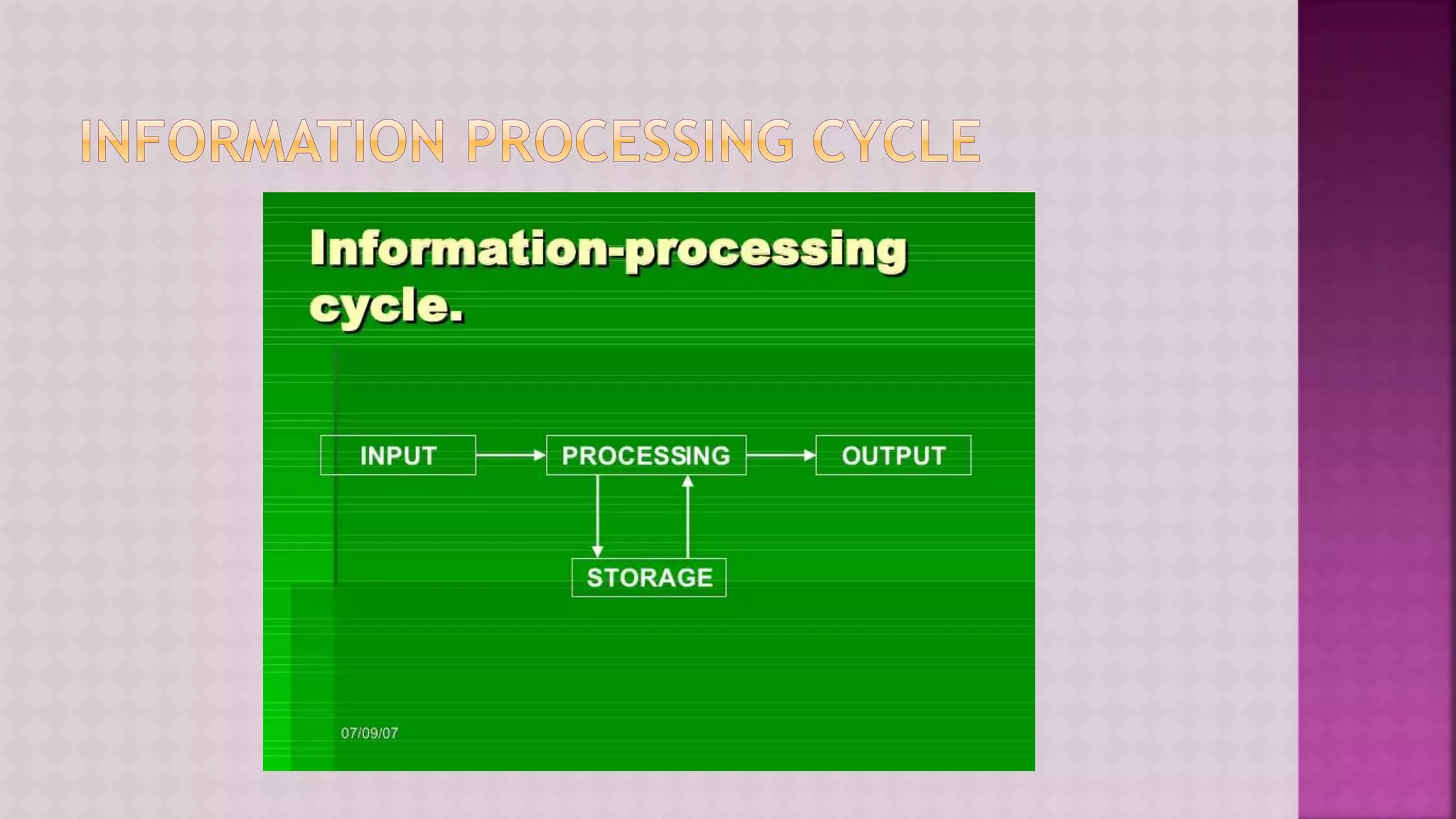
A computer is a machine that performs four basic operations
 input
 processing
 output
 storage
These four operations are called the information processing
cycle
Devices that enable you to enter data into computer for
processing
examples
 mouse
 keyboard
 computers transform data into information
 information is data that have been simplified and organized
in a way that people can use
Example
 cpu
 computer provides the results of the processing operations in
a way that people understand
 save the results of processing to be used again later. storage
devices hold all of the programs and data that the computer
system uses
Examples
 floppy disk
 hard disk
 Hardware
 software
 hardware means the physical structure of a computer
 the parts that can be touched by us
 all the components attached to the computer like keyboard
mouse monitor printers are hardware
 hardware is just a box with electronic parts in it
 it cannot do any work by itself
 it needs certain programs to do some work
 software is a general term used to describe a collection of
computer programs , procedure and documentation that
performs some tasks on a computer system.
 software includes websites , programs , video games etc
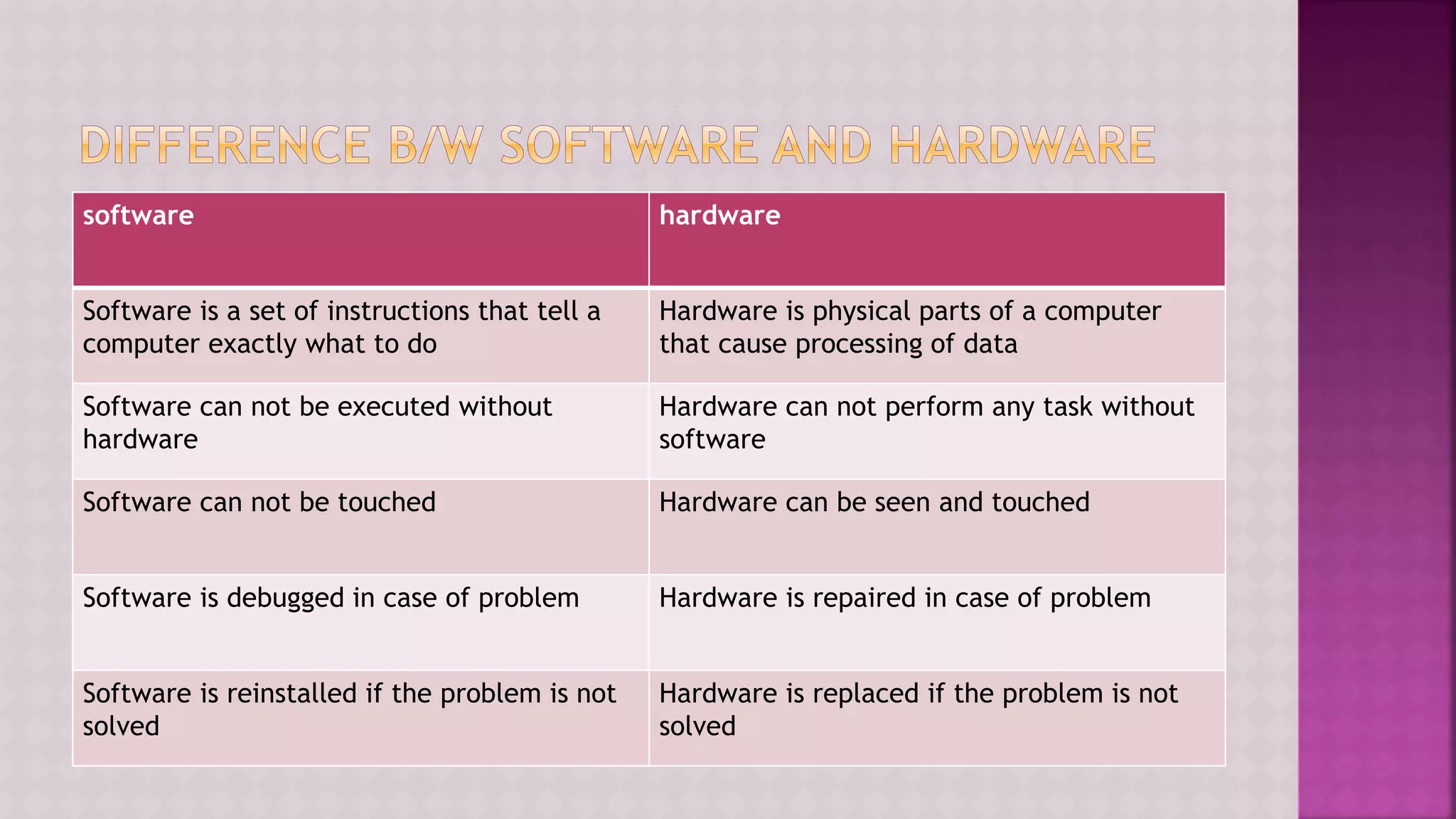
software hardware
Software is a set of instructions that tell a
computer exactly what to do
Hardware is physical parts of a computer
that cause processing of data
Software can not be executed without
hardware
Hardware can not perform any task without
software
Software can not be touched Hardware can be seen and touched
Software is debugged in case of problem Hardware is repaired in case of problem
Software is reinstalled if the problem is not
solved
Hardware is replaced if the problem is not
solved
 Information technology is the technology that uses computing
with the high speed communication links to spread the
information from one place to another place.
 The interconnection of computer enable the user/people to
send and receive information. The communication links are
also used to communicate with different people in the world.
 The world has become the global village due to IT. It means
that people living in the world know one another as if they
are living in a village. It has become possible due to fast
communication links.
 Information can be transferred from one place to another
easily and quickly
 Artificial intelligence
It is used to develop machines with human like qualities.
 Web based Applications
It is a type of s/w applications that is available on the web
 E-commerce
It is a process of performing business over the internet.
 Mobile commerce
It is a process of performing business over the internet using
mobile phones.
 Computer animation
it is a process of create moving images using computers.
 input devices
 CPU
 output devices
 storage devices
 input devices are used to put data and instructions into a
computer
 most common input devices are keyboard and mouse
 CPU stands for central processing unit
 it is a small chip inside the computer
 it does all decisions , calculations.
 it also controls other parts of computer
 CPU consist of several section
 1-control unit
 2-Arithmetic and logic unit
 3-Main memory
 Control Unit controls operations of other parts of CPU as well
as all parts of computer by sending control signal
 Arithmetic and logic unit .
 It is mainly responsible for
1. calculation
2. logical comparison
 The main memory holds the program instructions and data
 It contains two types of memory chip called ROM and RAM
 Output devices are used to get the result of the processing
done by computer
 Most common output devices include monitor and printer
 Secondary storage is used to store programs and data when
they are not being used to store permanently.
 Secondary storage is non-volatile
 So data that is stored on these devices remains there safely
 A hard drive a CD ROM a floppy disk and a USB memory stick
are all examples of secondary storage devices
 Application software
 System software
 A system software package is a collection of programs
designed to operate control and extend processing
capabilities of computer
 Operating system is one of the system software
 application software is a set of programs that allow computer
to perform a specific data processing job for the user
 Special purpose software
 General purpose software
 Utility Software is special purpose software that improves the
operations of system software by providing additional and
specialized functionality to it. it helps to keep your system in
shape by eliminating errors.
 keyboard
 mouse
 Trackball
 joystick
 image scanners
 Touch pads
 Touch screen
 Pointing stick
 voice system
 This is the most common input device available on almost
every computers
 It has a series of keys similar to typewriter
 Each key has a letter , number, symbol or word on it
 The user presses the key desired causing special code to adds
to the keyboard buffer.
 A mouse is a hand held device that is moved on surface on
the desk or on a mouse pad.
 It has a ball underneath and usually two or more buttons on
the top
 When the mouse is moved this causes the ball to moved.
 a joystick consist of a base and a stick. the stick can be
moved in any direction to move an object around the
computer screen. a joystick can perform a similar function to
a mouse. but it is often consider less comfortable and
efficient.
 This is a device that is used to scan images and text into the
computer.
 Data scanning devices are input devices used for direct data
entry into a computer system from source documents.
 This is a device that functions in much the same way as the
microphones you see used on stage.
 It is designed so that the user does not have to hold it while
he/she is speaking.
 Touch screen is the display screen that receives input from
the touch of the finger.
 The screen is covered with a plastic layer
 There are invisible beams of infrared light behind the screen
 The user enter data by touching icons or menus on the
screens
 Most touch screen computers use sensors to detect touch of a
finger.
 Used in ATM,s , departmental stores and super markets.
 A trackball can be used as alternative of a mouse
 This device has buttons similar to those on mouse
 It has a large rotating ball on the top
 the body of the trackball is not moved
 The ball is rolled with finger
 Monitor
 Monitor can display graphics, text and video. The size of a
 monitor is measured in inches diagonally across the screen;
 15, 17, 19 and 21 inch monitors are the most common
 sizes. A color monitor can display from 16 to over 1 million
 different colors.
 Size
 Monitors are available in different sizes. The size of monitor
for personal computers is from 14 to 21 inches. The size of
monitor is measured diagonally.
 Color
 The display screen can be either monochrome or color. The
color display screens display output in multiple colors. The
RGB display screen can create 256 colors and thousands of
variations of these colors. RGB stand for Red Green Blue.
 Resolution
 Number of pixels on screen is called resolution.
 A printer is an output device that produces a print-out or
hard copy of the output from a computer. There are many
types of printer available.
 The speed of printers can be measured in characters per
second (CPS) or pages per minute (PPM), the higher the
values are, the faster the printer can produce output.
 Impact Printers: An impact printer forms characters and
graphics on a piece of paper by striking a mechanism against
an ink ribbon that physically contacts the paper.
 Non-Impact Printers: A non-impact printer forms characters
and graphics on a piece of paper without actually striking the
paper.
 A plotter is a large printer that generates high-quality
documents by moving ink pens over the surface of a page.
Plotters are particularly useful to engineers and architects,
as they produce high-quality blueprints, maps, and floor
plans.
 Modem
 The word modem comes from modulator and demodulator
 Modulation - digital information to analog signals
 Demodulation- analog signals back into the useful digital
information.
 Router
 Routers are highly intelligent devices that connect multiple
network types and determine the best path for sending data
 Routers are normally used to connect one LAN to another
 Thy transfer data in less time.
 Bridge is a device that connects two network segments.
 It is used to connect similar types of network.
 Gateway is a device that connects two or more networks with
different types of protocols
 Two different types of networks require a gateway to
communicate with each other
 It receives data from one network and converts it according
to the protocol of other network
 Home budget-you can calculate home budget easily in a
spread sheet program to compute savings by entering income
in one column and expenses in other column.
 computer games
 Entertainment
 Chatting
 online education
 online examination
 marketing
 banks
 departmental store
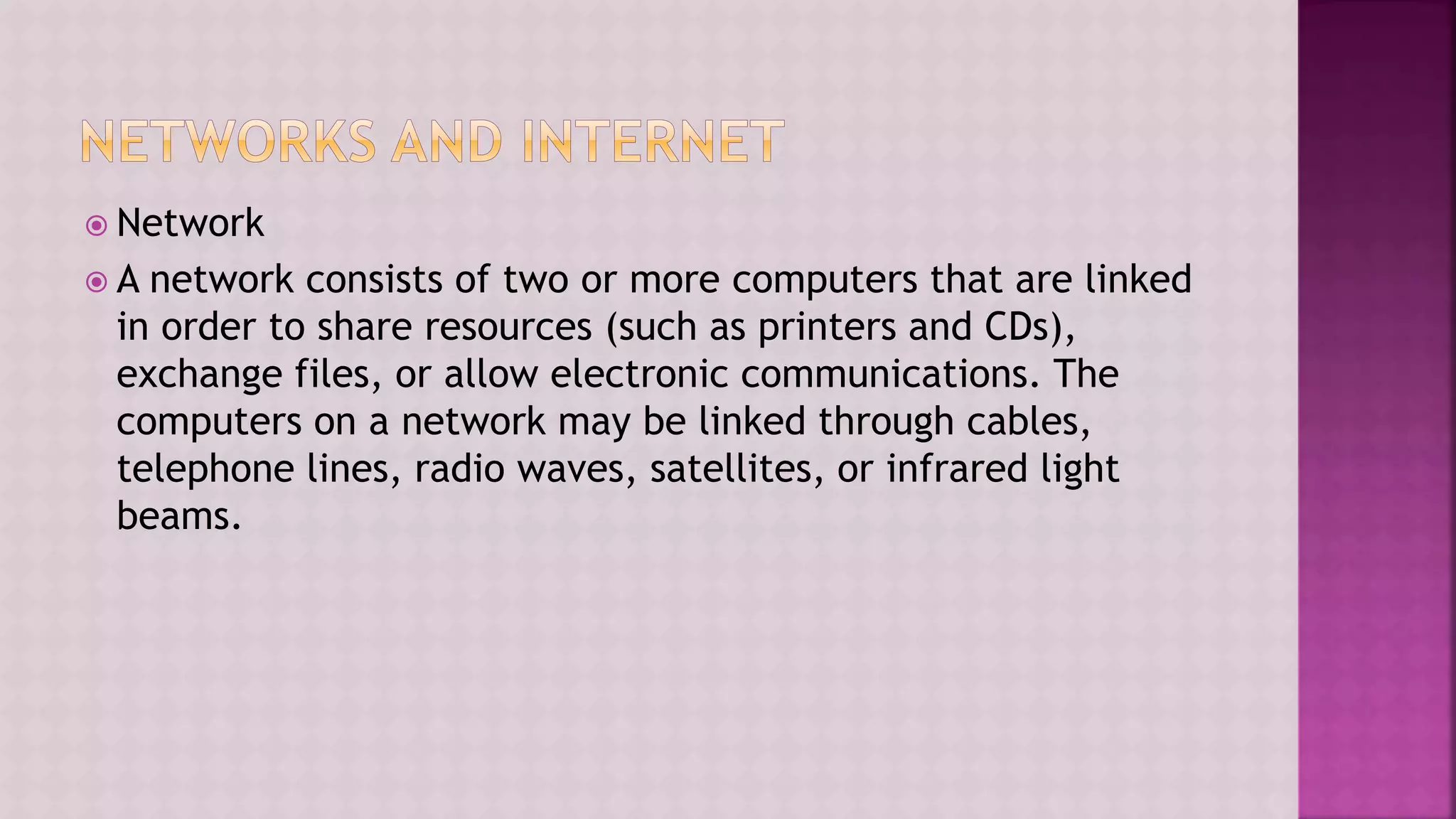
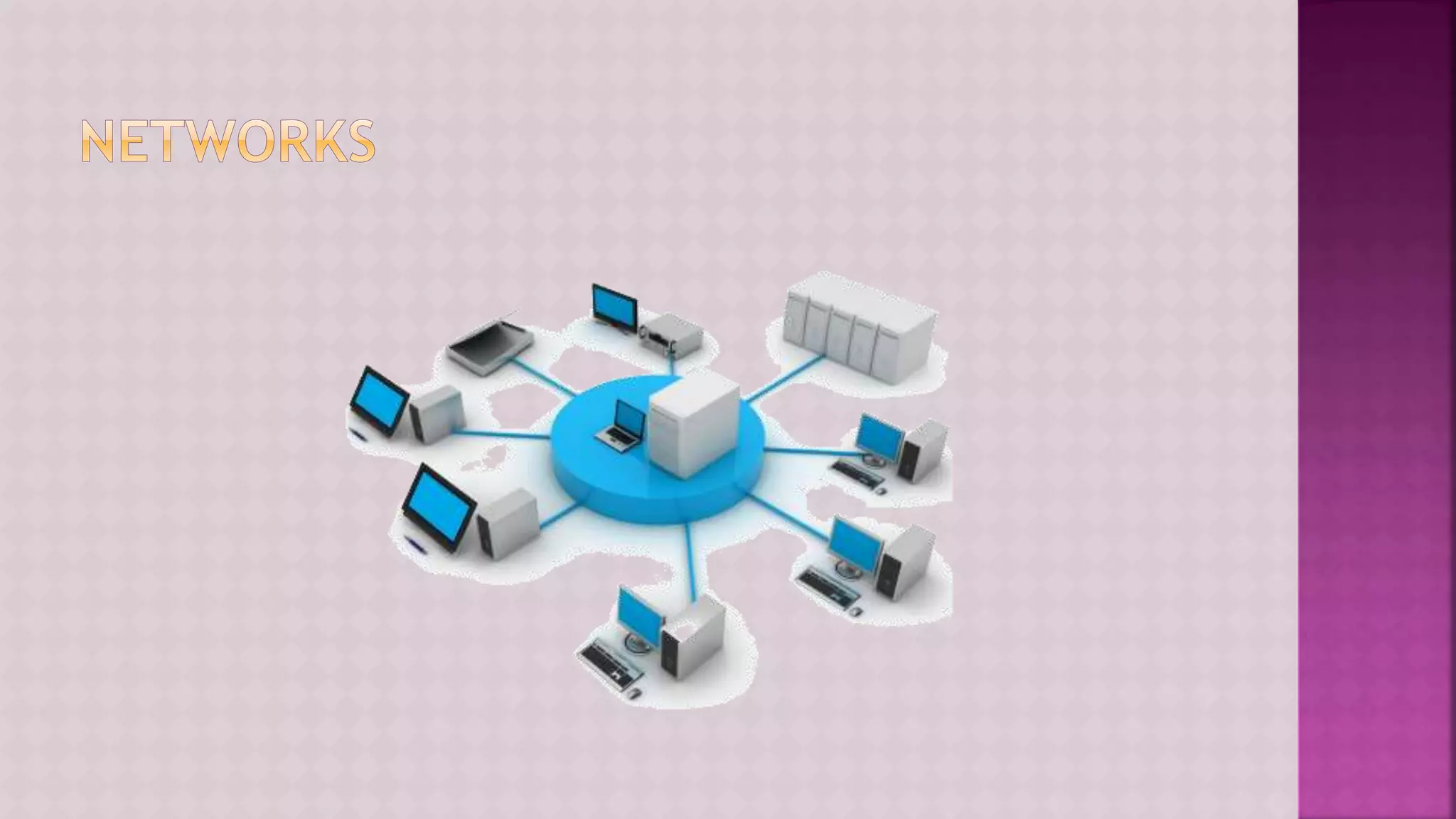
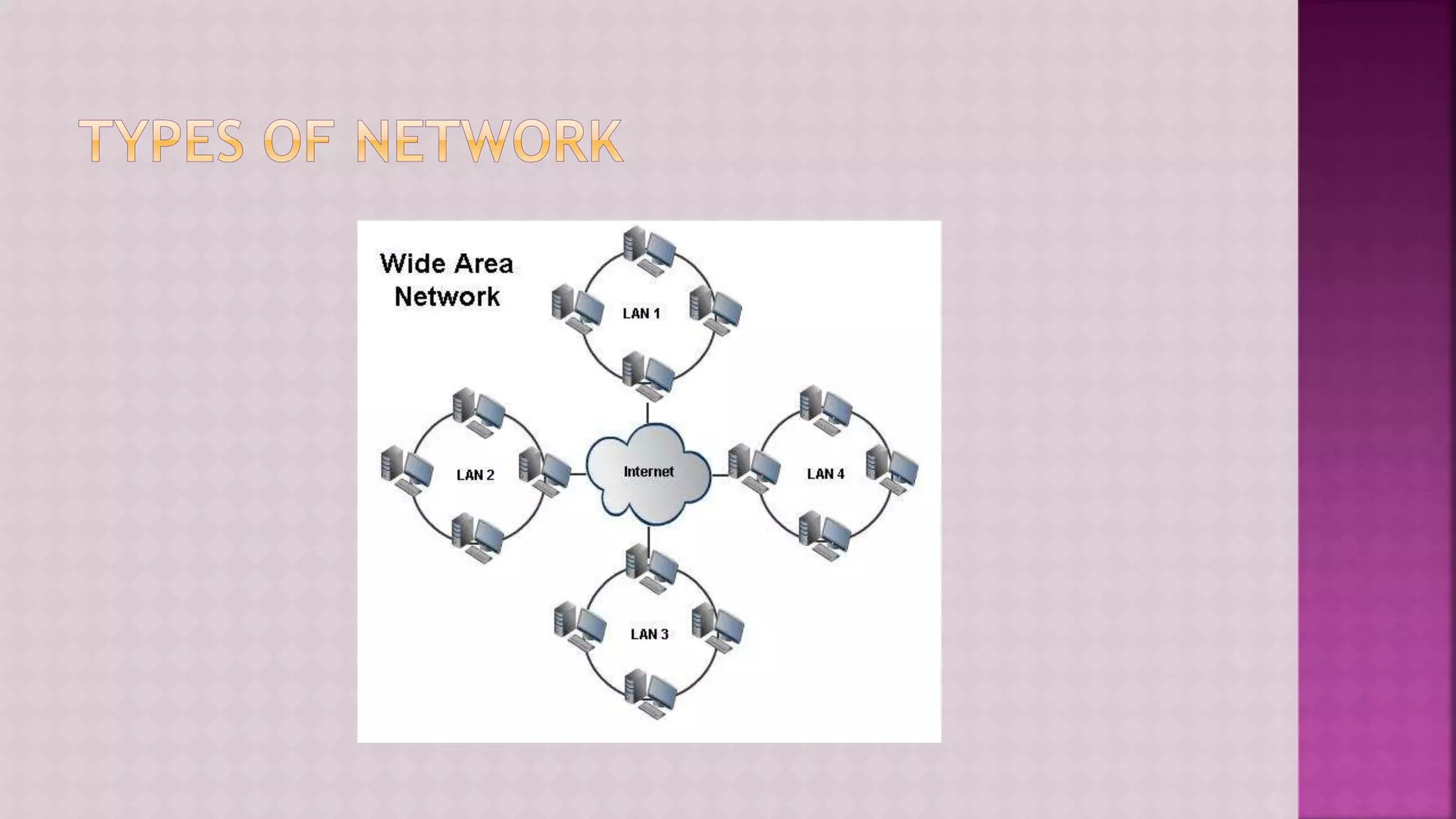
 Network
 A network consists of two or more computers that are linked
in order to share resources (such as printers and CDs),
exchange files, or allow electronic communications. The
computers on a network may be linked through cables,
telephone lines, radio waves, satellites, or infrared light
beams.
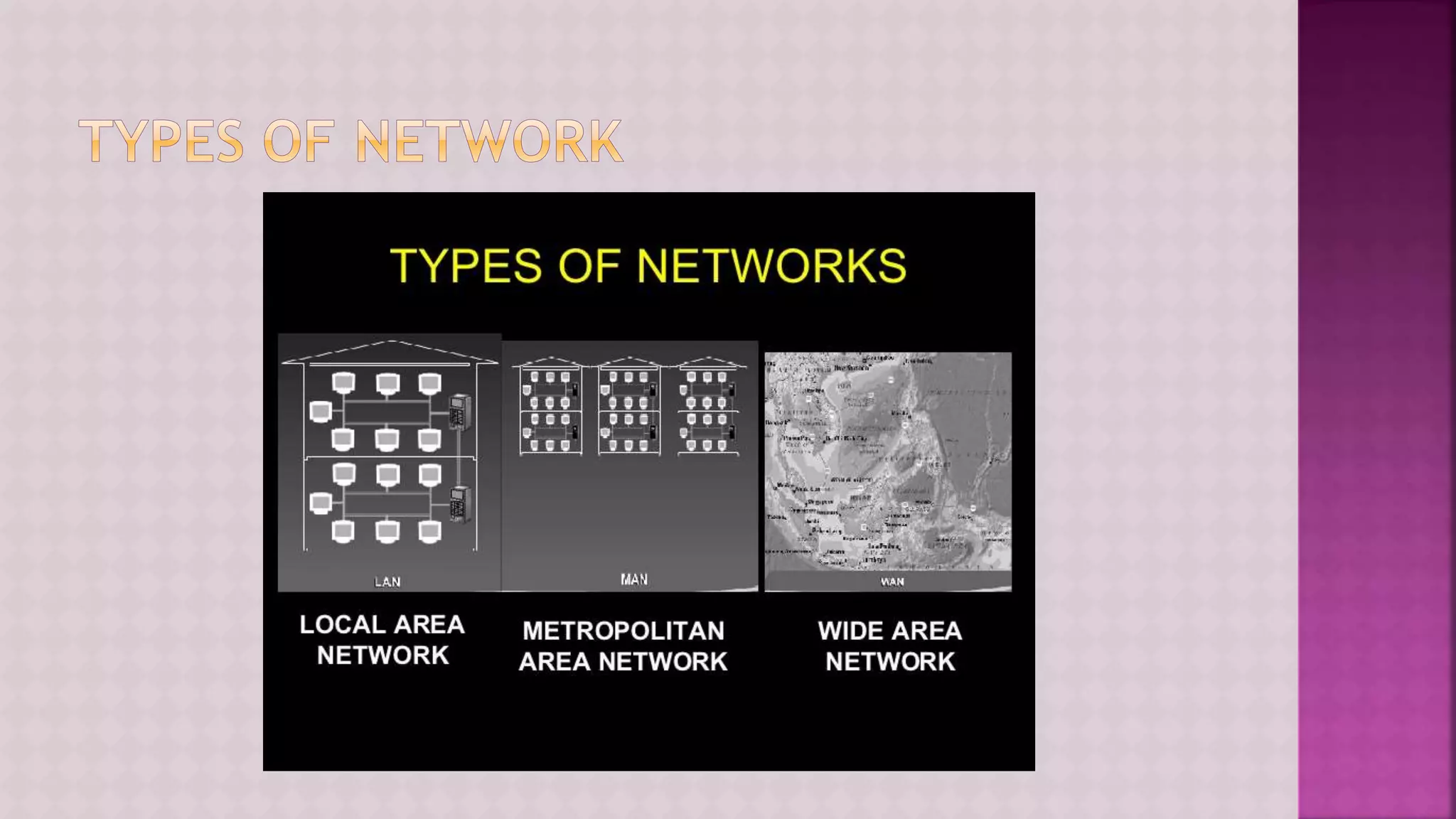
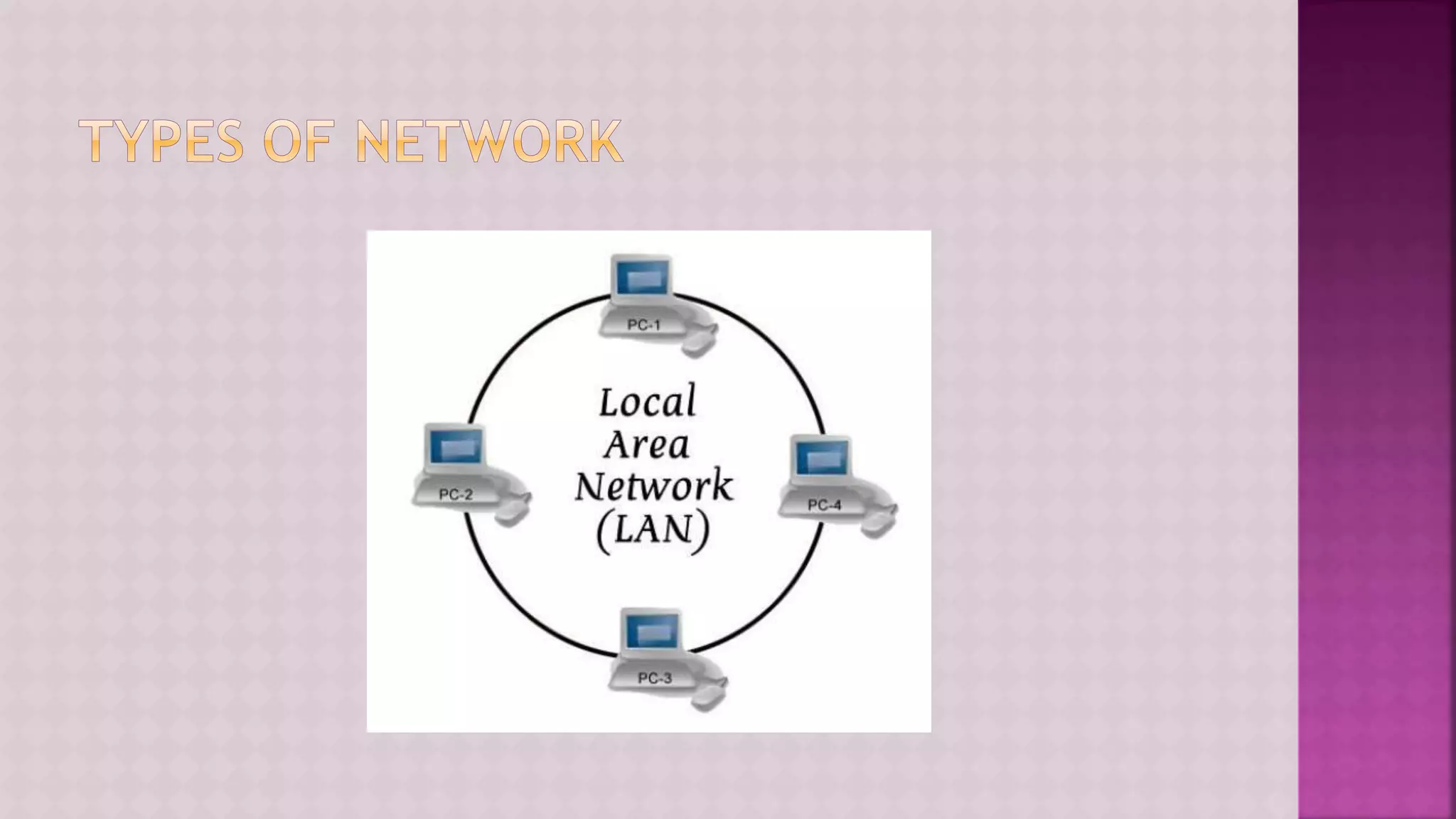
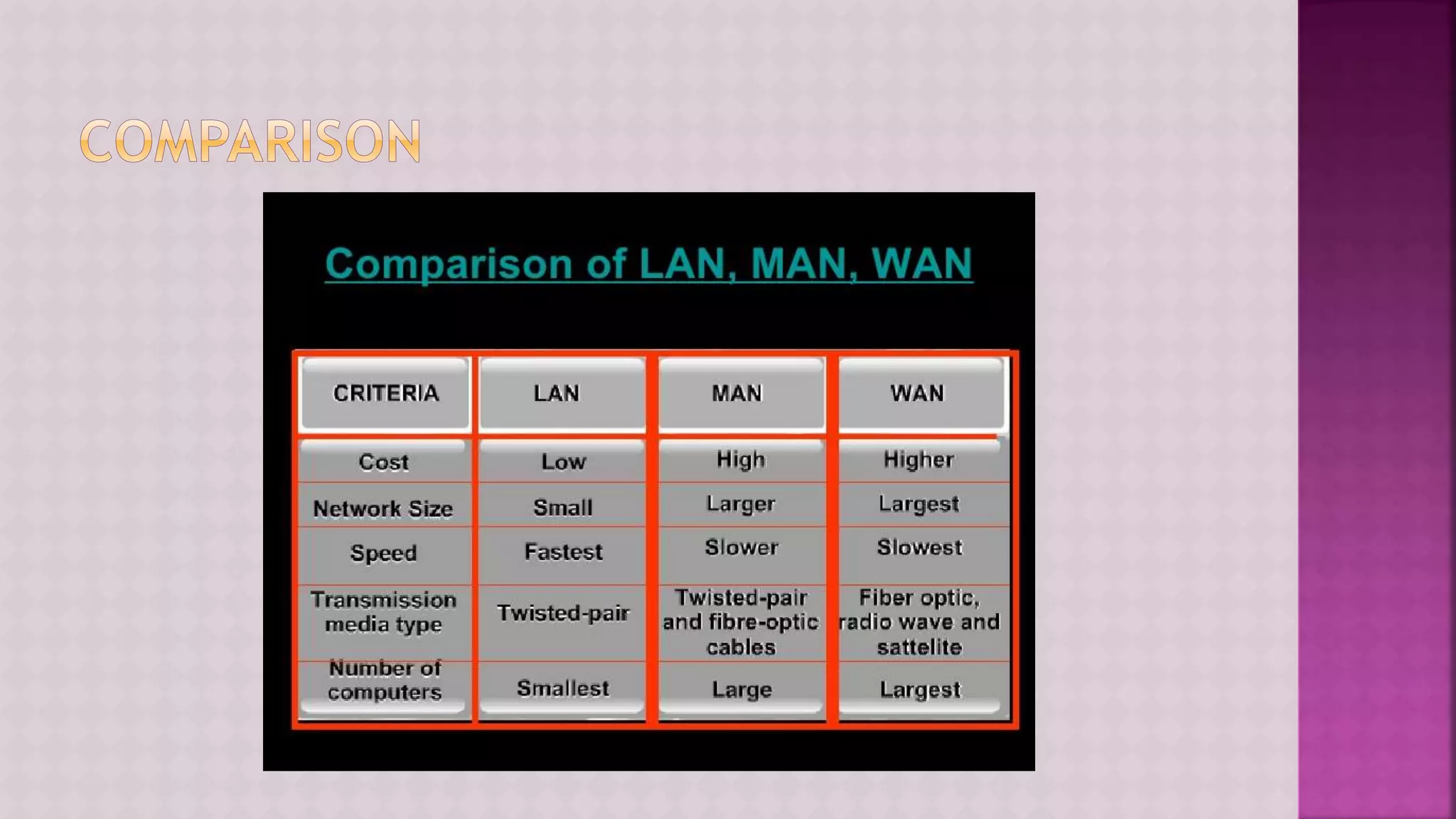
 LAN
 smallest network compared to the other two networks
 the simplest form of LAN is to connect two computer
together
 LAN is operated within a limited physical area such as at
home school a single building or several buildings
 A network which consist of less than 500 interconnected
devices across several buildings is still recognized as a LAN.
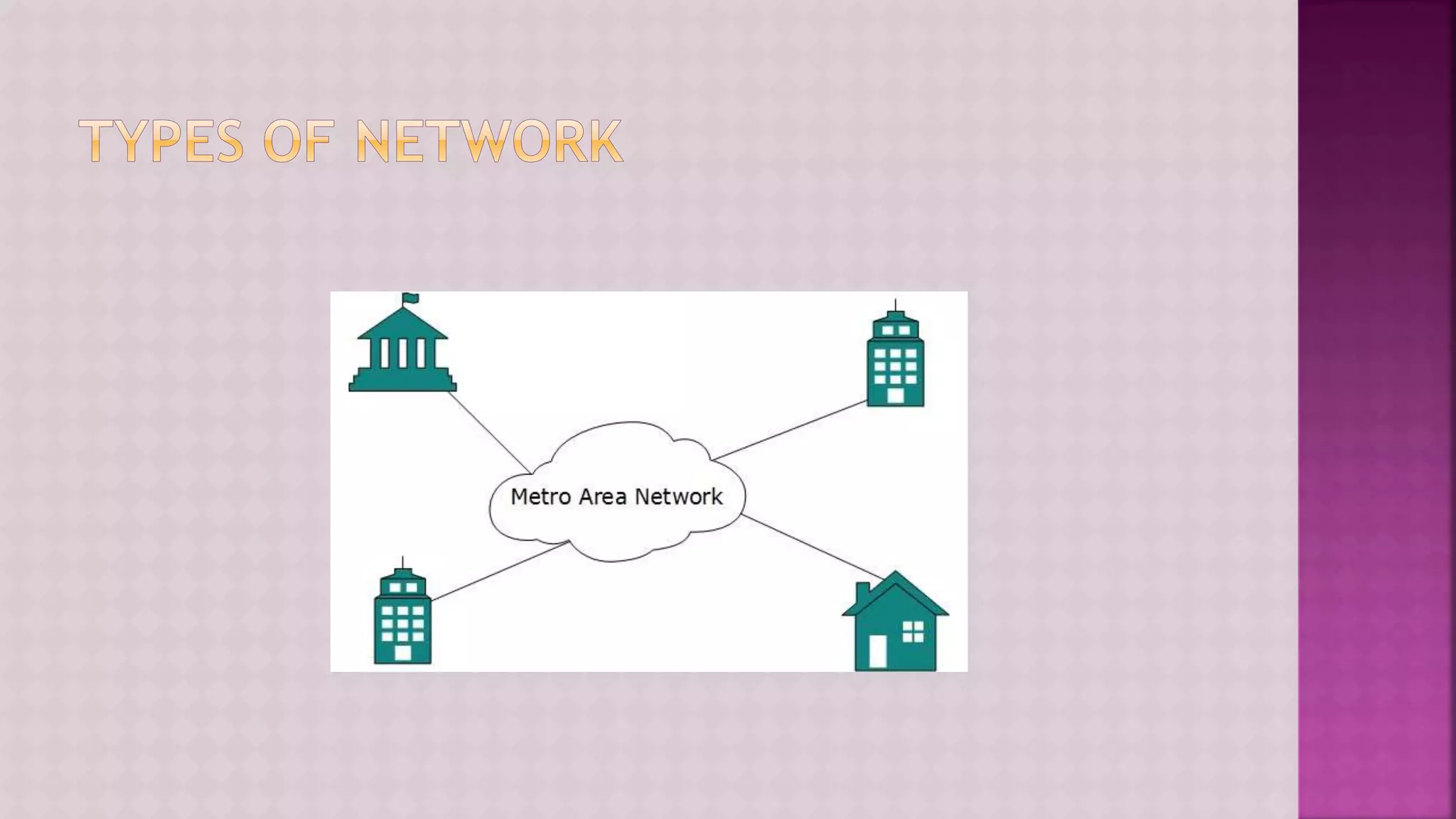
 MAN
 Metropolitan describes important cities like lahore karachi
multan okara sahiwal etc
 Companies that have several branches within the lahore city
such as banks use a man
 Can be collection of several LANs within the same city
 MAN can be defined as a group of computers and network
devices connected together within a large physical area.
WAN
 The largest network of all network types
 Internet is the largest wan in the world
 WAN generally covers large distances such as states
countries.
 WAN is a group of mans or LANs or the mixture of both
networks.
 Overall design of a computer network that describes how a
computer network is configured and what strategies are
being used
 Also known as network model or network design.
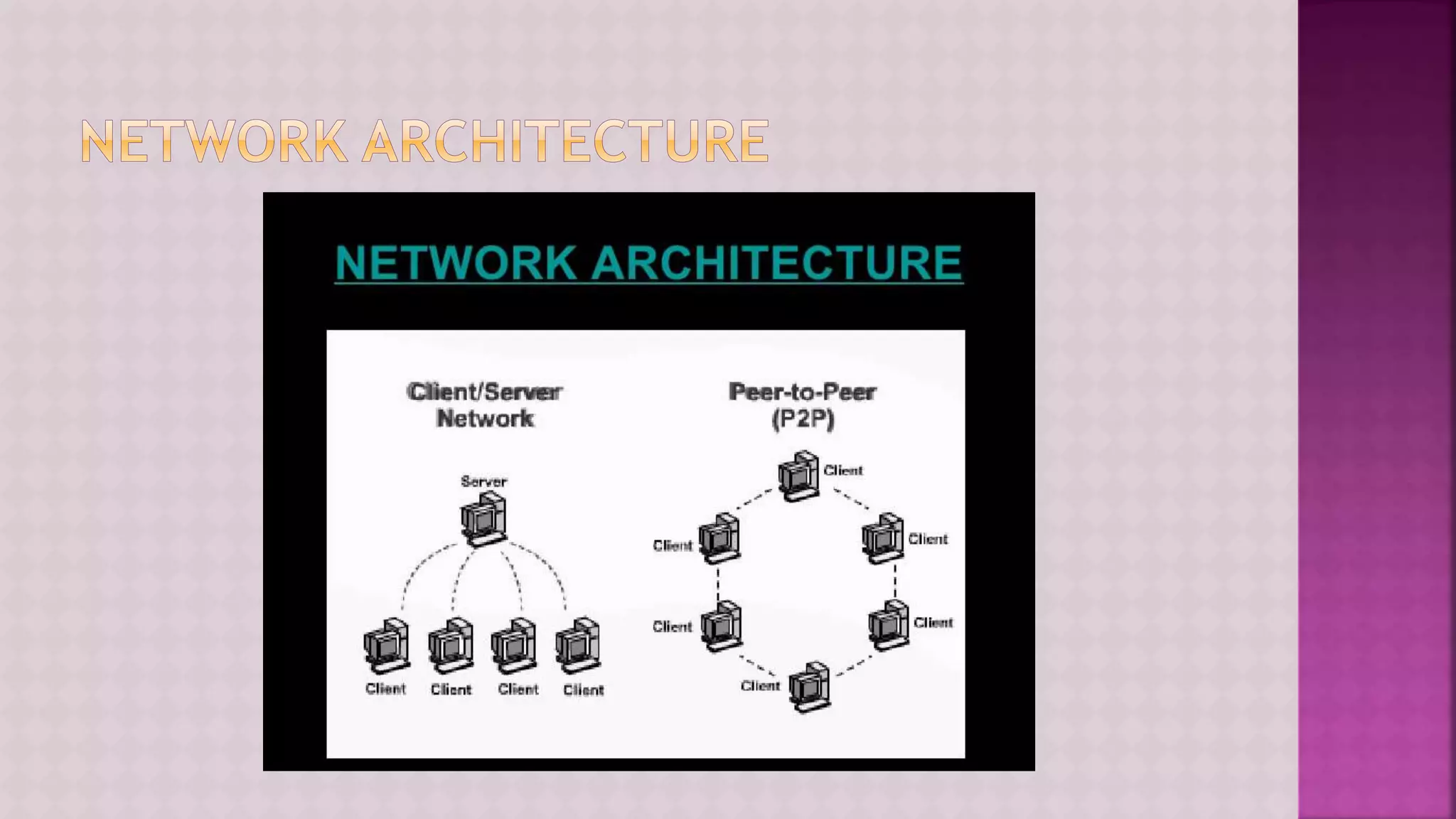
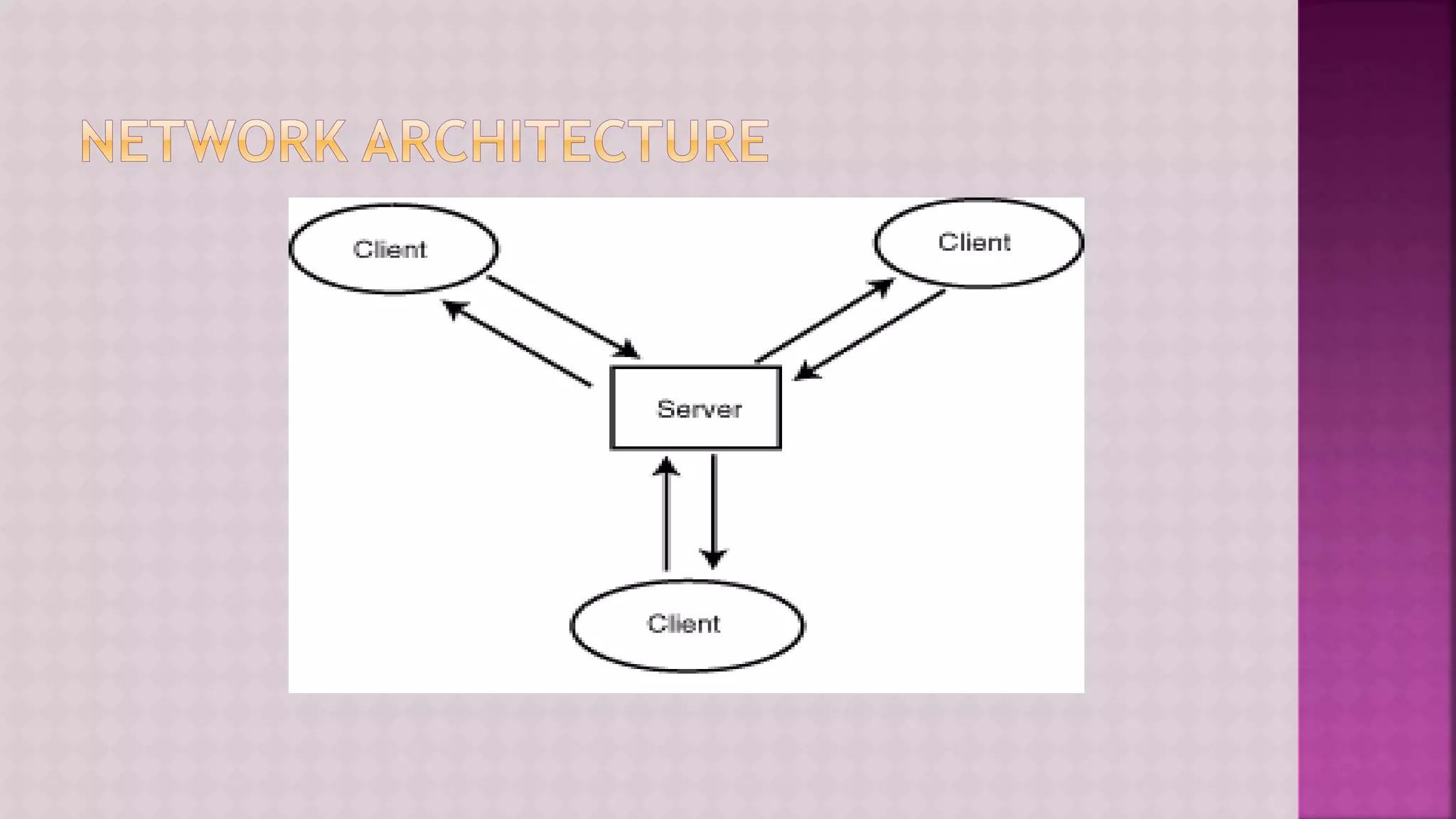
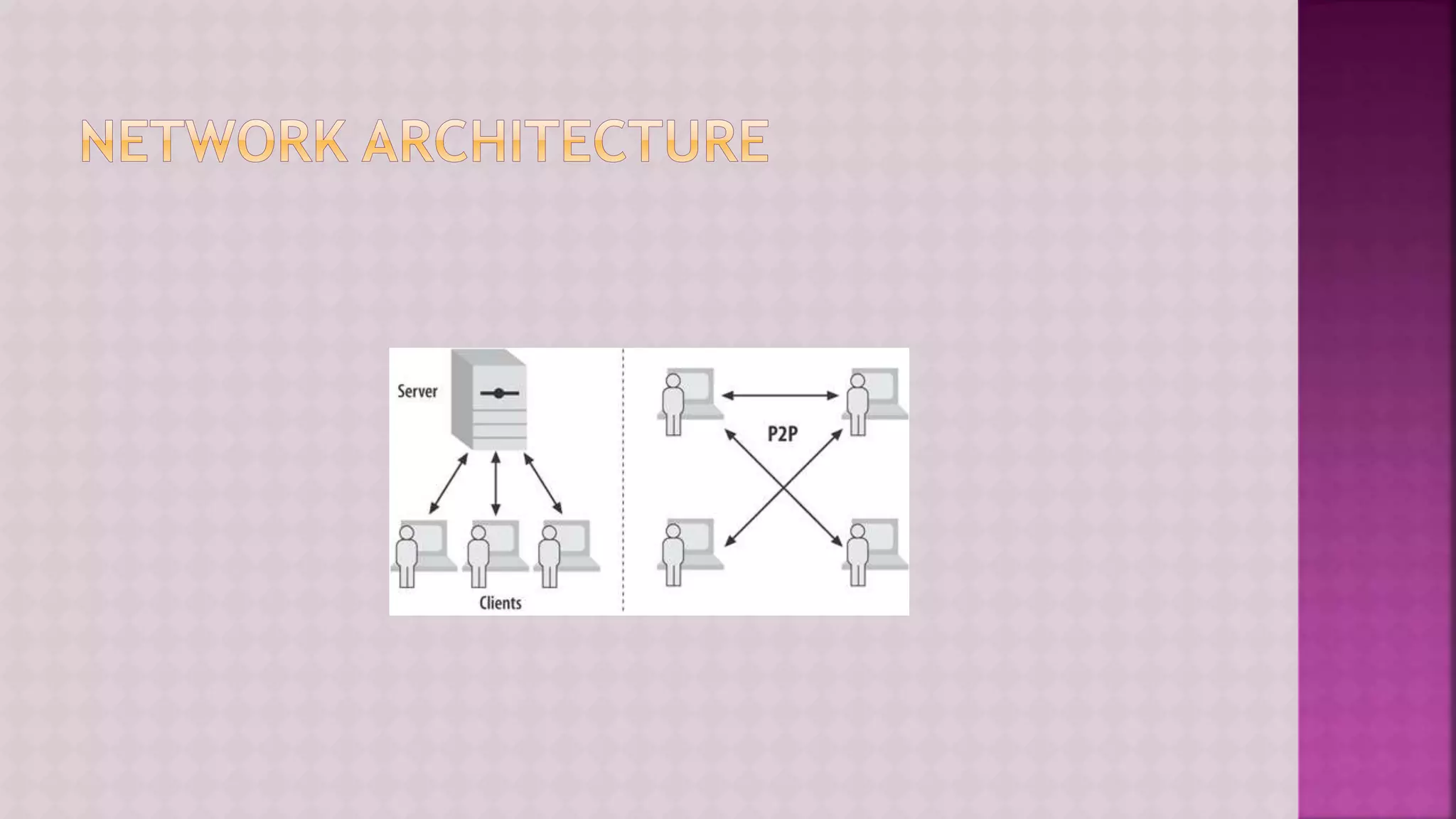
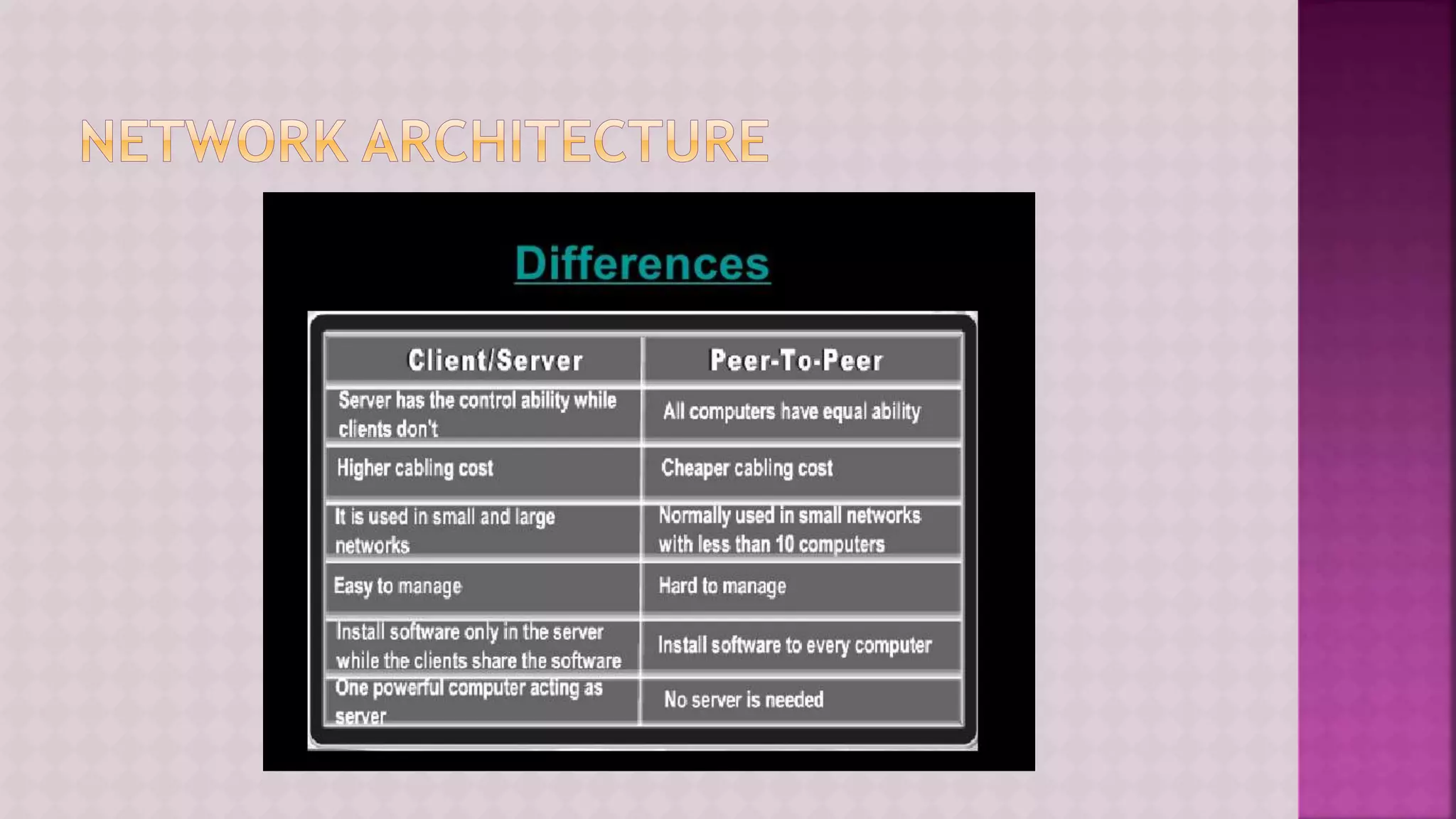
 client server network
 a client server network is a network in which the shared files
and application are stored in the server but network users
can still store files on their individual pcs.
 a server is a computer that shares information and resources
with other computers on a network
 a client is a computer which requests services or files from a
server.
 It is a network with all the nodes acting as both servers and
clients.
 All computers in the peer to peer network has equal
responsibilities and capabilities to use the resources available
on the network.
 With peer to peer network no server is needed. each
computer in the network is called peer.
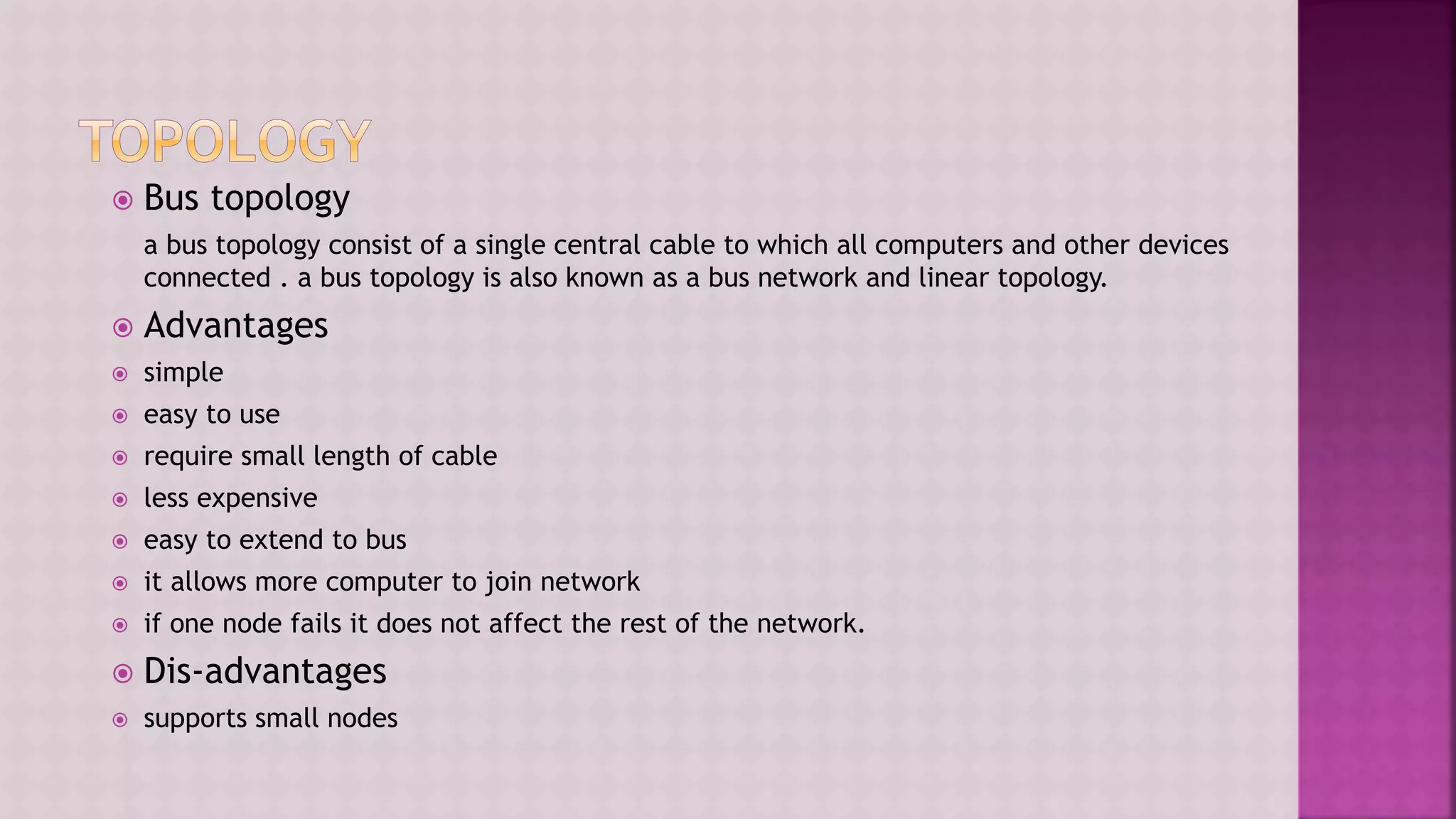
 Bus topology
a bus topology consist of a single central cable to which all computers and other devices
connected . a bus topology is also known as a bus network and linear topology.
 Advantages
 simple
 easy to use
 require small length of cable
 less expensive
 easy to extend to bus
 it allows more computer to join network
 if one node fails it does not affect the rest of the network.
 Dis-advantages
 supports small nodes
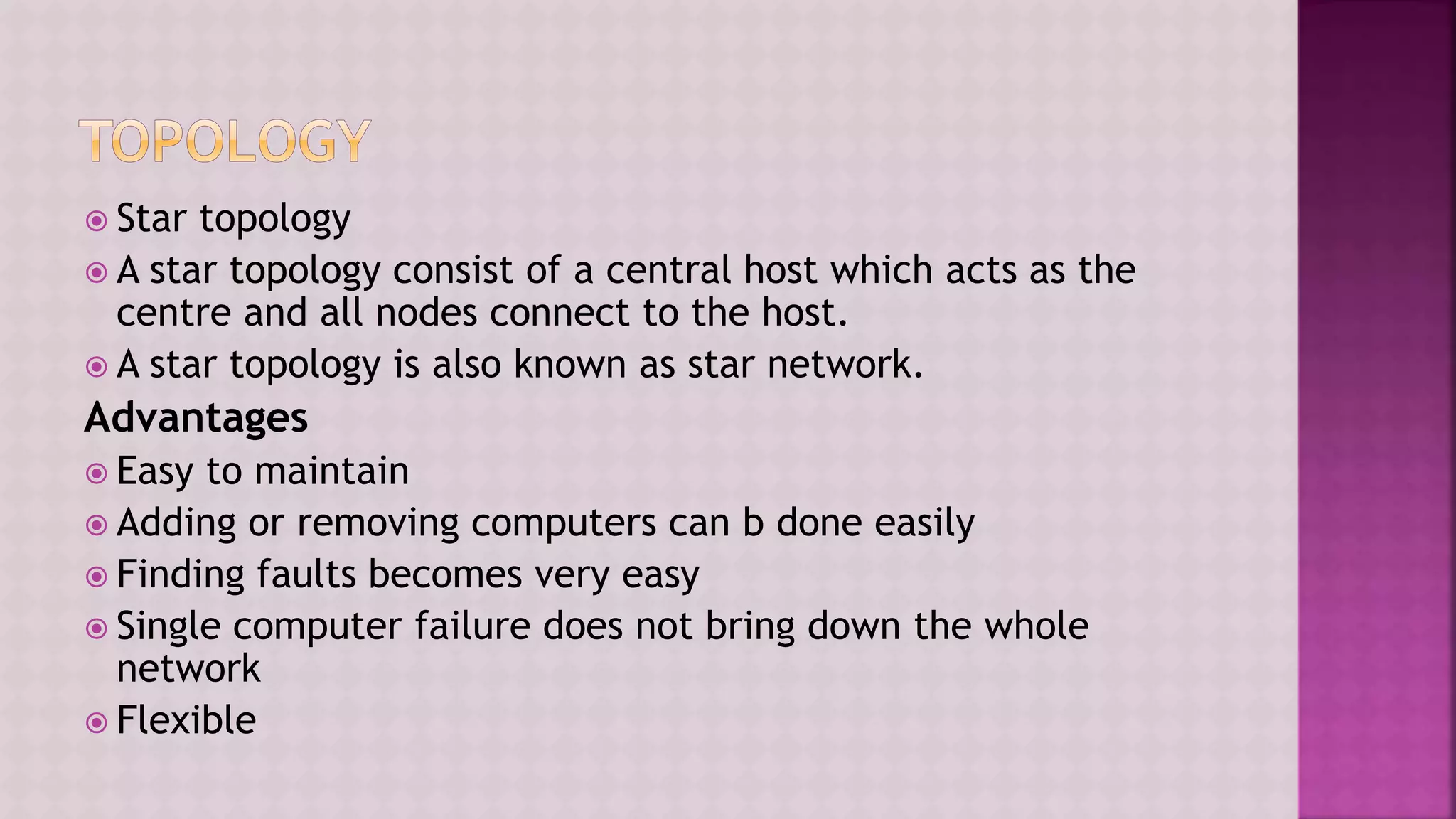
 Star topology
 A star topology consist of a central host which acts as the
centre and all nodes connect to the host.
 A star topology is also known as star network.
Advantages
 Easy to maintain
 Adding or removing computers can b done easily
 Finding faults becomes very easy
 Single computer failure does not bring down the whole
network
 Flexible
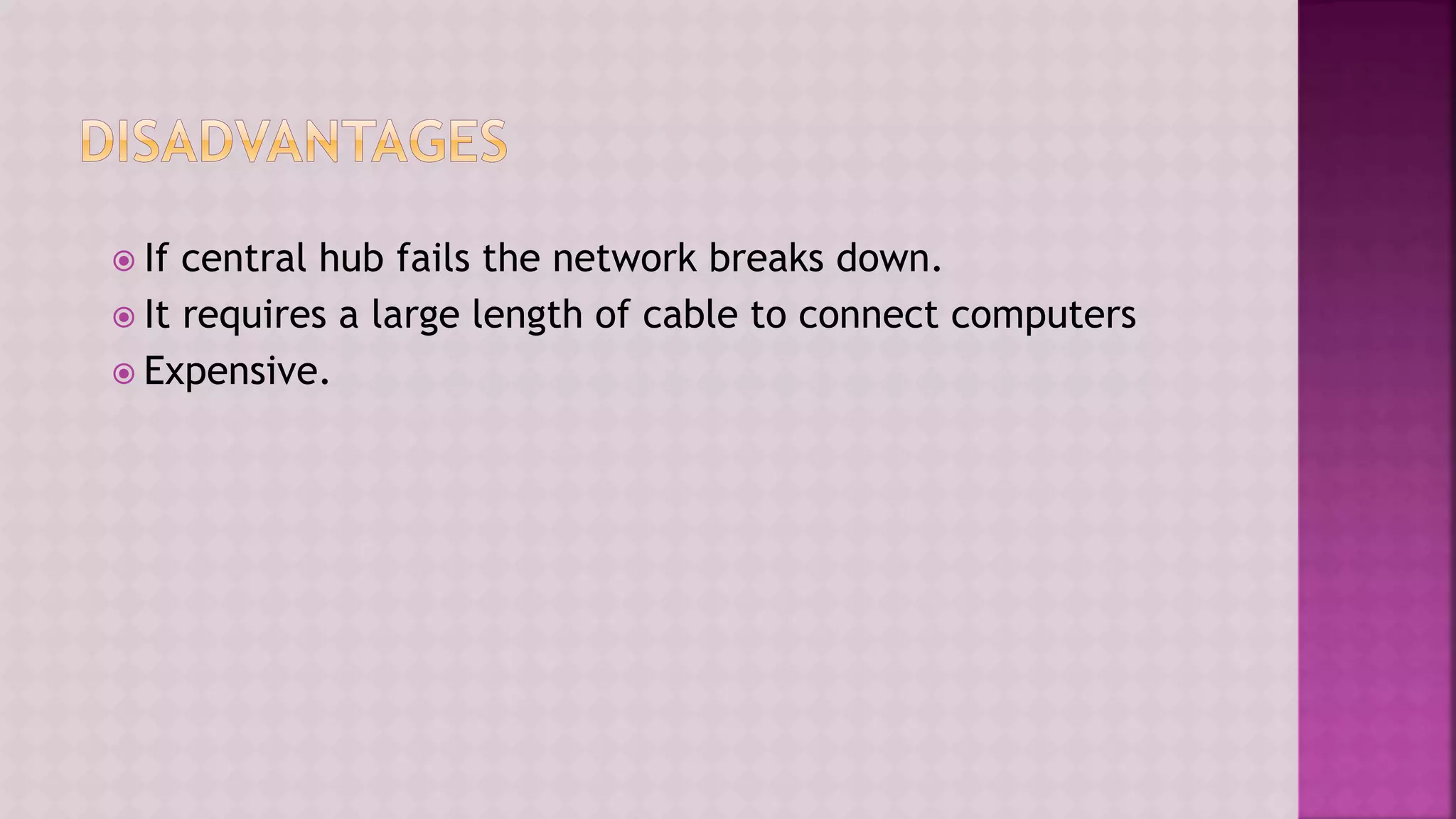
 If central hub fails the network breaks down.
 It requires a large length of cable to connect computers
 Expensive.
 A ring topology consist of all computers and other devices
that are connected in a loop.
 Ring topology is also known as a ring network.
 Less expensive
 Equal access
 Difficult to troubleshoot
 Failure of one computer in the ring can affect the whole
network
 Adding or removing computers affect the network.
 Tree topology is the combination of the bus and the star
topology.
 The tree like structure allows you to have many servers on
the network and you can branch out the network on many
ways.
 Also known as hierarchical network.
 It provides point to point wiring for individual segments.
 It is supported by the several hardware and software
vendors.
 Difficult to configure
 Backbone line fails then network fails
 Length of the segment is limited.
 Mesh topology is a network where all the nodes are
connected to each other and is a complete network
 In a mesh topology every node is connected to other nodes
on the network through hops.
 Easy to troubleshoot
 If one link becomes unusable it does not harm the entire
system
 A full mesh network can be very expensive
 It is difficult to install and reconfigure.
 The internet is a network of computers which links many
different types of computer all over the world...
 E-mail
 FTP
 www
 Gopher
 Telnet
 Chat groups
 Intranet
 Extranet
 A set of instructions given to the computer to solved problem
is called software
 A software is also called the program
 Different software's are used to solve the different programs.
 System software
 Application software
 System software is a set of programs to control and manage
the operations of a computer hardware.
 It controls the basic operations as follows.
 Saving data on disk
 Making computer to work for us
 Printing the document.
 Operating system
 Utility programs
 Device drivers.
 Application software is used to perform the various
applications on the computer.
 It is also known as application package
 Customized software
 Package software
 Customized software is a type of application software that is
designed for a particular customer or organization.
 Example
 A software developed for a particular university is an
example of customized software.
 Package software is a type of software of application
software that is developed for the sale to the general public.
 Examples
 Word processor such as MS Word
 CorelDraw
 Oracle

Introduction To Computing

  • 2.
     A computeris a device that accepts information (in the form of digitalized data) and manipulates it for some result based on a program or sequence of instructions on how the data is to be processed.
  • 3.
    A computer isa machine that performs four basic operations  input  processing  output  storage These four operations are called the information processing cycle
  • 5.
    Devices that enableyou to enter data into computer for processing examples  mouse  keyboard
  • 6.
     computers transformdata into information  information is data that have been simplified and organized in a way that people can use Example  cpu
  • 7.
     computer providesthe results of the processing operations in a way that people understand
  • 8.
     save theresults of processing to be used again later. storage devices hold all of the programs and data that the computer system uses Examples  floppy disk  hard disk
  • 9.
  • 10.
     hardware meansthe physical structure of a computer  the parts that can be touched by us  all the components attached to the computer like keyboard mouse monitor printers are hardware
  • 11.
     hardware isjust a box with electronic parts in it  it cannot do any work by itself  it needs certain programs to do some work  software is a general term used to describe a collection of computer programs , procedure and documentation that performs some tasks on a computer system.  software includes websites , programs , video games etc
  • 12.
    software hardware Software isa set of instructions that tell a computer exactly what to do Hardware is physical parts of a computer that cause processing of data Software can not be executed without hardware Hardware can not perform any task without software Software can not be touched Hardware can be seen and touched Software is debugged in case of problem Hardware is repaired in case of problem Software is reinstalled if the problem is not solved Hardware is replaced if the problem is not solved
  • 13.
     Information technologyis the technology that uses computing with the high speed communication links to spread the information from one place to another place.  The interconnection of computer enable the user/people to send and receive information. The communication links are also used to communicate with different people in the world.  The world has become the global village due to IT. It means that people living in the world know one another as if they are living in a village. It has become possible due to fast communication links.  Information can be transferred from one place to another easily and quickly
  • 14.
     Artificial intelligence Itis used to develop machines with human like qualities.  Web based Applications It is a type of s/w applications that is available on the web  E-commerce It is a process of performing business over the internet.  Mobile commerce It is a process of performing business over the internet using mobile phones.  Computer animation it is a process of create moving images using computers.
  • 15.
     input devices CPU  output devices  storage devices
  • 16.
     input devicesare used to put data and instructions into a computer  most common input devices are keyboard and mouse
  • 17.
     CPU standsfor central processing unit  it is a small chip inside the computer  it does all decisions , calculations.  it also controls other parts of computer  CPU consist of several section  1-control unit  2-Arithmetic and logic unit  3-Main memory
  • 18.
     Control Unitcontrols operations of other parts of CPU as well as all parts of computer by sending control signal
  • 19.
     Arithmetic andlogic unit .  It is mainly responsible for 1. calculation 2. logical comparison
  • 20.
     The mainmemory holds the program instructions and data  It contains two types of memory chip called ROM and RAM
  • 21.
     Output devicesare used to get the result of the processing done by computer  Most common output devices include monitor and printer
  • 22.
     Secondary storageis used to store programs and data when they are not being used to store permanently.  Secondary storage is non-volatile  So data that is stored on these devices remains there safely  A hard drive a CD ROM a floppy disk and a USB memory stick are all examples of secondary storage devices
  • 23.
  • 24.
     A systemsoftware package is a collection of programs designed to operate control and extend processing capabilities of computer  Operating system is one of the system software
  • 25.
     application softwareis a set of programs that allow computer to perform a specific data processing job for the user  Special purpose software  General purpose software
  • 26.
     Utility Softwareis special purpose software that improves the operations of system software by providing additional and specialized functionality to it. it helps to keep your system in shape by eliminating errors.
  • 27.
     keyboard  mouse Trackball  joystick  image scanners  Touch pads  Touch screen  Pointing stick  voice system
  • 28.
     This isthe most common input device available on almost every computers  It has a series of keys similar to typewriter  Each key has a letter , number, symbol or word on it  The user presses the key desired causing special code to adds to the keyboard buffer.
  • 29.
     A mouseis a hand held device that is moved on surface on the desk or on a mouse pad.  It has a ball underneath and usually two or more buttons on the top  When the mouse is moved this causes the ball to moved.
  • 30.
     a joystickconsist of a base and a stick. the stick can be moved in any direction to move an object around the computer screen. a joystick can perform a similar function to a mouse. but it is often consider less comfortable and efficient.
  • 31.
     This isa device that is used to scan images and text into the computer.  Data scanning devices are input devices used for direct data entry into a computer system from source documents.
  • 32.
     This isa device that functions in much the same way as the microphones you see used on stage.  It is designed so that the user does not have to hold it while he/she is speaking.
  • 33.
     Touch screenis the display screen that receives input from the touch of the finger.  The screen is covered with a plastic layer  There are invisible beams of infrared light behind the screen  The user enter data by touching icons or menus on the screens  Most touch screen computers use sensors to detect touch of a finger.  Used in ATM,s , departmental stores and super markets.
  • 34.
     A trackballcan be used as alternative of a mouse  This device has buttons similar to those on mouse  It has a large rotating ball on the top  the body of the trackball is not moved  The ball is rolled with finger
  • 35.
     Monitor  Monitorcan display graphics, text and video. The size of a  monitor is measured in inches diagonally across the screen;  15, 17, 19 and 21 inch monitors are the most common  sizes. A color monitor can display from 16 to over 1 million  different colors.
  • 36.
     Size  Monitorsare available in different sizes. The size of monitor for personal computers is from 14 to 21 inches. The size of monitor is measured diagonally.  Color  The display screen can be either monochrome or color. The color display screens display output in multiple colors. The RGB display screen can create 256 colors and thousands of variations of these colors. RGB stand for Red Green Blue.  Resolution  Number of pixels on screen is called resolution.
  • 37.
     A printeris an output device that produces a print-out or hard copy of the output from a computer. There are many types of printer available.  The speed of printers can be measured in characters per second (CPS) or pages per minute (PPM), the higher the values are, the faster the printer can produce output.
  • 38.
     Impact Printers:An impact printer forms characters and graphics on a piece of paper by striking a mechanism against an ink ribbon that physically contacts the paper.  Non-Impact Printers: A non-impact printer forms characters and graphics on a piece of paper without actually striking the paper.
  • 39.
     A plotteris a large printer that generates high-quality documents by moving ink pens over the surface of a page. Plotters are particularly useful to engineers and architects, as they produce high-quality blueprints, maps, and floor plans.
  • 40.
     Modem  Theword modem comes from modulator and demodulator  Modulation - digital information to analog signals  Demodulation- analog signals back into the useful digital information.
  • 41.
     Router  Routersare highly intelligent devices that connect multiple network types and determine the best path for sending data  Routers are normally used to connect one LAN to another  Thy transfer data in less time.
  • 42.
     Bridge isa device that connects two network segments.  It is used to connect similar types of network.
  • 43.
     Gateway isa device that connects two or more networks with different types of protocols  Two different types of networks require a gateway to communicate with each other  It receives data from one network and converts it according to the protocol of other network
  • 44.
     Home budget-youcan calculate home budget easily in a spread sheet program to compute savings by entering income in one column and expenses in other column.  computer games  Entertainment  Chatting
  • 45.
     online education online examination  marketing  banks  departmental store
  • 46.
     Network  Anetwork consists of two or more computers that are linked in order to share resources (such as printers and CDs), exchange files, or allow electronic communications. The computers on a network may be linked through cables, telephone lines, radio waves, satellites, or infrared light beams.
  • 49.
     LAN  smallestnetwork compared to the other two networks  the simplest form of LAN is to connect two computer together  LAN is operated within a limited physical area such as at home school a single building or several buildings  A network which consist of less than 500 interconnected devices across several buildings is still recognized as a LAN.
  • 51.
     MAN  Metropolitandescribes important cities like lahore karachi multan okara sahiwal etc  Companies that have several branches within the lahore city such as banks use a man  Can be collection of several LANs within the same city  MAN can be defined as a group of computers and network devices connected together within a large physical area.
  • 53.
    WAN  The largestnetwork of all network types  Internet is the largest wan in the world  WAN generally covers large distances such as states countries.  WAN is a group of mans or LANs or the mixture of both networks.
  • 56.
     Overall designof a computer network that describes how a computer network is configured and what strategies are being used  Also known as network model or network design.
  • 58.
     client servernetwork  a client server network is a network in which the shared files and application are stored in the server but network users can still store files on their individual pcs.  a server is a computer that shares information and resources with other computers on a network  a client is a computer which requests services or files from a server.
  • 60.
     It isa network with all the nodes acting as both servers and clients.  All computers in the peer to peer network has equal responsibilities and capabilities to use the resources available on the network.  With peer to peer network no server is needed. each computer in the network is called peer.
  • 63.
     Bus topology abus topology consist of a single central cable to which all computers and other devices connected . a bus topology is also known as a bus network and linear topology.  Advantages  simple  easy to use  require small length of cable  less expensive  easy to extend to bus  it allows more computer to join network  if one node fails it does not affect the rest of the network.  Dis-advantages  supports small nodes
  • 64.
     Star topology A star topology consist of a central host which acts as the centre and all nodes connect to the host.  A star topology is also known as star network. Advantages  Easy to maintain  Adding or removing computers can b done easily  Finding faults becomes very easy  Single computer failure does not bring down the whole network  Flexible
  • 65.
     If centralhub fails the network breaks down.  It requires a large length of cable to connect computers  Expensive.
  • 66.
     A ringtopology consist of all computers and other devices that are connected in a loop.  Ring topology is also known as a ring network.
  • 67.
  • 68.
     Difficult totroubleshoot  Failure of one computer in the ring can affect the whole network  Adding or removing computers affect the network.
  • 69.
     Tree topologyis the combination of the bus and the star topology.  The tree like structure allows you to have many servers on the network and you can branch out the network on many ways.  Also known as hierarchical network.
  • 70.
     It providespoint to point wiring for individual segments.  It is supported by the several hardware and software vendors.
  • 71.
     Difficult toconfigure  Backbone line fails then network fails  Length of the segment is limited.
  • 72.
     Mesh topologyis a network where all the nodes are connected to each other and is a complete network  In a mesh topology every node is connected to other nodes on the network through hops.
  • 73.
     Easy totroubleshoot  If one link becomes unusable it does not harm the entire system
  • 74.
     A fullmesh network can be very expensive  It is difficult to install and reconfigure.
  • 76.
     The internetis a network of computers which links many different types of computer all over the world...
  • 77.
     E-mail  FTP www  Gopher  Telnet  Chat groups  Intranet  Extranet
  • 78.
     A setof instructions given to the computer to solved problem is called software  A software is also called the program  Different software's are used to solve the different programs.
  • 79.
     System software Application software
  • 80.
     System softwareis a set of programs to control and manage the operations of a computer hardware.  It controls the basic operations as follows.  Saving data on disk  Making computer to work for us  Printing the document.
  • 81.
     Operating system Utility programs  Device drivers.
  • 82.
     Application softwareis used to perform the various applications on the computer.  It is also known as application package
  • 83.
  • 84.
     Customized softwareis a type of application software that is designed for a particular customer or organization.  Example  A software developed for a particular university is an example of customized software.
  • 85.
     Package softwareis a type of software of application software that is developed for the sale to the general public.  Examples  Word processor such as MS Word  CorelDraw  Oracle