INTRODUCTION TO COMPUTERS
 an electronic machine that performs a wide variety of
activities reliably, accurately and quickly
 a programmable machine designed to sequentially and
automatically carry out a sequence of arithmetic or
logical operations
 works under the control of a set of instructions called
Program
 accepts data, processes it by doing some mathematical
and logical operations and gives the desired output or
result
INTRODUCTION TO COMPUTERS
EDP: Electronic Data Processing (EDP) was the first
sceintific term, used in the field of computers. The
data processed electronically stored in storage media
like hard disk
Data: Data are facts/informational raw materials,
represented either as numbers or text or a
combination of both
INTRODUCTION TO COMPUTERS
Processing : It refers to the techniques and procedures of
sorting, relating, interpreting, updating and computing
items of data to impart the meaning and usefulness to
it
Information : It consits of data in an organised form or the
result after processing by the computer
Characteristics of a computer
Speed : Moden computer systems can process the data in a
fraction of a second to provide the desired results.
Speed of different computer systems is measures in
terms of MIPS (Million Instructions Per Seconds).
Speed of microprocessor is measures in this unit.
Reliability : These mechines are capable of operating under
adverse conditions for any time period producing
consistent results
Accuarcy : Computers can process the data accurately. The
computing principle known as Garbage In, Garbage
Out (GIGO), refres to the accuracy of computers
where output depends upon the accuaracy of the
user’s input
Characteristics of a computer
Storage : Modern computer systems have big storage media.
Using any of the available storage devices, the data
can be transferred quickly from the storage into the
memory, processed and then stored again back into
the storage unit for future use.
Communication : Computers can communicate with each
other and share information.
This is possible through communication mediums
such as modems, telephone lines, satellites etc. which
are used to connect each other. This connection of
computers is known as networking
Application of a computer
1. Home
2. Entertainment
3. Small business
4. Large business
5. Power users
6. Shops
7. Hotels
8. Railways
9. Air reservation
10. Banks
11. Education
12. Hospitals
13. Defence
14. Telecommunications
Overview of a Computer System
Data : Data are facts/informational raw materials,
represented either as numbers or text or a
combination of both.
All the data and informations are strored in files
Files are stored in Directories
Directories - a named area of the disk
Overview of a Computer System
Software : Instructions to the computer that specify which
functions the CPU has to perform
A list of sequenced intructions – Programme
Preparing sequenced programme - Programming
Hardware : Collection of electronic circuit and other
devices that make up the computer system
The physical equipments and components which can
see touch and feel
ANATOMY OF COMPUTERS
1. Input Unit
2. Processing Unit
3. Output Unit
ANATOMY OF COMPUTERS
Input Unit
Keyboard: The keyboard has a whole lot of keys on it. These
keys are also called buttons. The keyboard allows to
enter information into the computer. It is similar to a
typewriter but has some different keys that perform
special functions
Mouse: A pointing device - allows to select and manipulate
objects see on the monitor. It has two or more buttons
on it. By moving the body of the mouse in the desired
direction, we can move the cursor (pointer) on the
screen
ANATOMY OF COMPUTERS
Input Unit
Joystick: It has a base and a vertical stem. The control
buttons are mounted on them. We can move the
vertical stem in any direction to control cursor on the
screen. It is used to palygames on a computer
Game Pad: It is a hand held input device. It is used to play
games. Buttons on the game pad allow a player to
control direction, speed and other screen actions
Scanner: It helps to copy an image from the paper. It reads
photos or other images into the computer and converts
them into graphics files. To read pages of text and
produce text files Optical Character Recognition (OCR)
software is used.
ANATOMY OF COMPUTERS
Input Unit
Digital camera: It is a video input device. It captures and
stores photos as computer data instead of on
photographic film
Digitizer and graphic tablets: Graphic tablets or graphic
pad has a magnetic surface. It converts drawings and
photos into digital signals. The digital signal goes into
the computer. The computer converts them into
drawings or photos that appear on monitor
Sound input: A microphone captures sound from the air. This
captured sound can input into the computer with the
help of microphone. Electronic musical instruments can
also be connected directly to the computer .
ANATOMY OF COMPUTERS
Processing Unit
Main function of processing unit is to process input
and convert it into output
 Central Processing Unit (CPU) chip
 Power supply (SMPS)
 One or more Disk Drives
 Mother board
 Fan and Speaker
ANATOMY OF COMPUTERS
Processing Unit
A CPU has got three components
 Control Unit: It controls everything that happens
inside the computer. It also controls the operation of
all other parts of the computer
 Arithmetic and Logic Unit (ALU): ALU performs all
the arithmetic calculations like addition,
substraction, multiplication, division etc
 Memory: A computer can remember everything that
feed into it. It also remembers the instructions that
were stored into it.
ANATOMY OF COMPUTERS
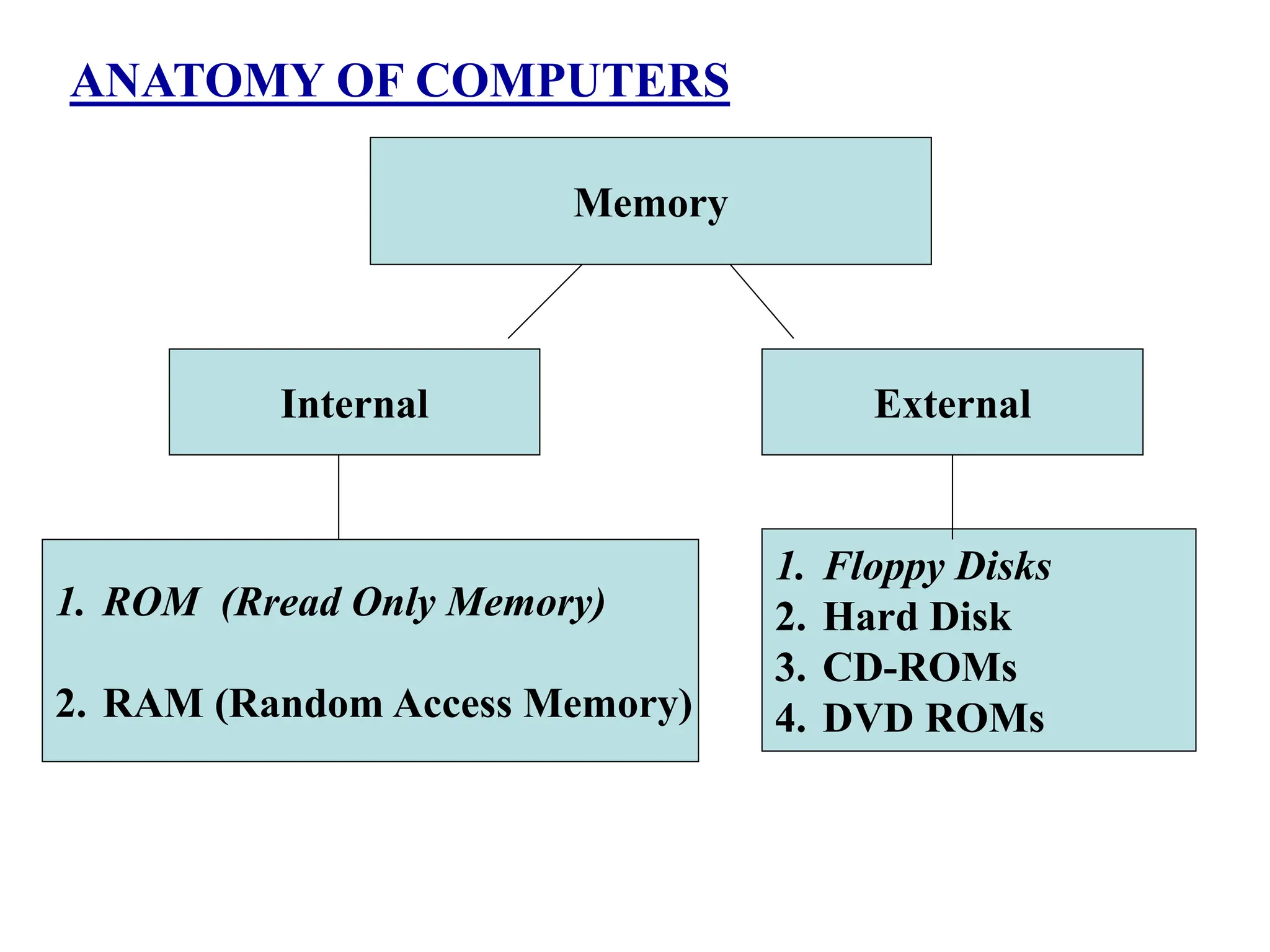
Memory
Internal External
1. ROM (Rread Only Memory)
2. RAM (Random Access Memory)
1. Floppy Disks
2. Hard Disk
3. CD-ROMs
4. DVD ROMs
ANATOMY OF COMPUTERS
RAM: The main memory – The place where the computer
temporarily stores its operating system, application
programms and current data so that processor can
reach them quickly and easily. This memory is lost
when computer is switched off.
ROM: Instructions to perform such operations which are
critical to the operation of a computer are stored in
this memory
PROM: Programmable read Only memory – same as ROM
and the user determines what data and instructions
are recorded on them
ANATOMY OF COMPUTERS
EPROM: Erasable Programmable read Only memory –
same as PROM with the help of a special device that
uses ultraviolet light. Data or instructions on
EPROM can be erasable and new data can be
recorded on them
EEPROM: Electronically Erasable Programmable read
Only memory – Changes can be made electronically
Register: A register is a special temporary storage location
within the CPU
ANATOMY OF COMPUTERS
MOTHER BOARD: The main circuit board of a computer.
This is where you plug in microprocessor (CPU),
RAM, ROM etc. The mother board is also knows as
system board
The parts of CPU are usually connected by an electronic
component referred to as a bus which acts as an electronic
highway between them
The term bus refers to an electronic pathway through which
bits are transmitted between the various components.
ANATOMY OF COMPUTERS
Output Unit
The most common means of output are the computer
screen and the printer
Monitor: The computer screen is also called Visual Display
Unit(VDU). It is commonly known as monitor. It is
an output unit capable of showing still or moving
images generated by a computer
ANATOMY OF COMPUTERS
Output Unit
In terms of color capabilities, monitors can be classified into
three classes
Monochrome monitors which displays the images,
text and pictures on the screen in black and
white
Gray-scale Monitor: A gray-scale monitor is a special
type of monochrome monitor capable of displaying
different shades of gray.
Colour Monitor which displays the images, text and pictures
on the screen in different colours
ANATOMY OF COMPUTERS
Output Unit
Another types of classification of monitors are the CRT
(Cathode Ray Tube) monitor, the LCD Flat Panel monitor,
and the TFT-LCD monitor
CRT monitors This is the most inexpensive
monitor in the market today. It is bigger in size
and require more space
LCD Flat panel Monitor: Liquid Crystal Display (LCD)
monitors also known as flat screen monitors. This is
expensive than CRT. Require less space. Due to its
technology, the display is also far superior than the
CRT monitor’s
ANATOMY OF COMPUTERS
Output Unit
TFT-LCD Monitor: A Thin Film Transistor (TFT) – LCD
monitor is more widely used with LCD monitors, because
of its high level of resolution and sharpness.
The only difference is a thin film transistor that is applied to
the screen, which results in better control of pixels.
This type of monitor is recommended for those who play
animated, colourful, and high-resolution games, as well as
graphic artists who may need to check out different fonts
on the computer screen
ANATOMY OF COMPUTERS
Output Unit
A printer is a device that takes the images, text and pictures
created on the computer and puts them onto the paper
Printer
Dot-Matrix printer: uses small dots to form characters on
the paper
Ink-Jet Printer: It prints text and graphics on the page by
shooting ink onto the paper
Laser printer: It prints graphics and text on the page using
a laser beam. The laser bearns ink onto the page
INPUT
Memory
Control Unit
ALU
OUTPUT
BLOCK DIAGRAM OF
A COMPUTER
CPU
Conversion of Data into Information
Computer is a device that computes at a high speed
To compute means to play with numbers, letter and sympols
It also plays with sounds, picures and other machines
It converts every data into binary digits i.e. zero and ones
A system having two numbers - a binary number system
Conversion of Data into Information
The numbers are represented by electronic pulses,
It breaks all data into electronic pulses
Computer counts these pulses and does the processing of
work
A processed data is converted to information
Units of Memory
The data in a computer is organised in the form of bits.
Bit means any one of the Binary digits Zeros and ones.
It is the basic unit of Data writing.
One bit means one electronic pulse.
A group of four bits is known as Nibble
A group of eight bits is known as Byte.
A character is normally represented by a byte.
Byte is a unit for counting memory size.
Units of Memory
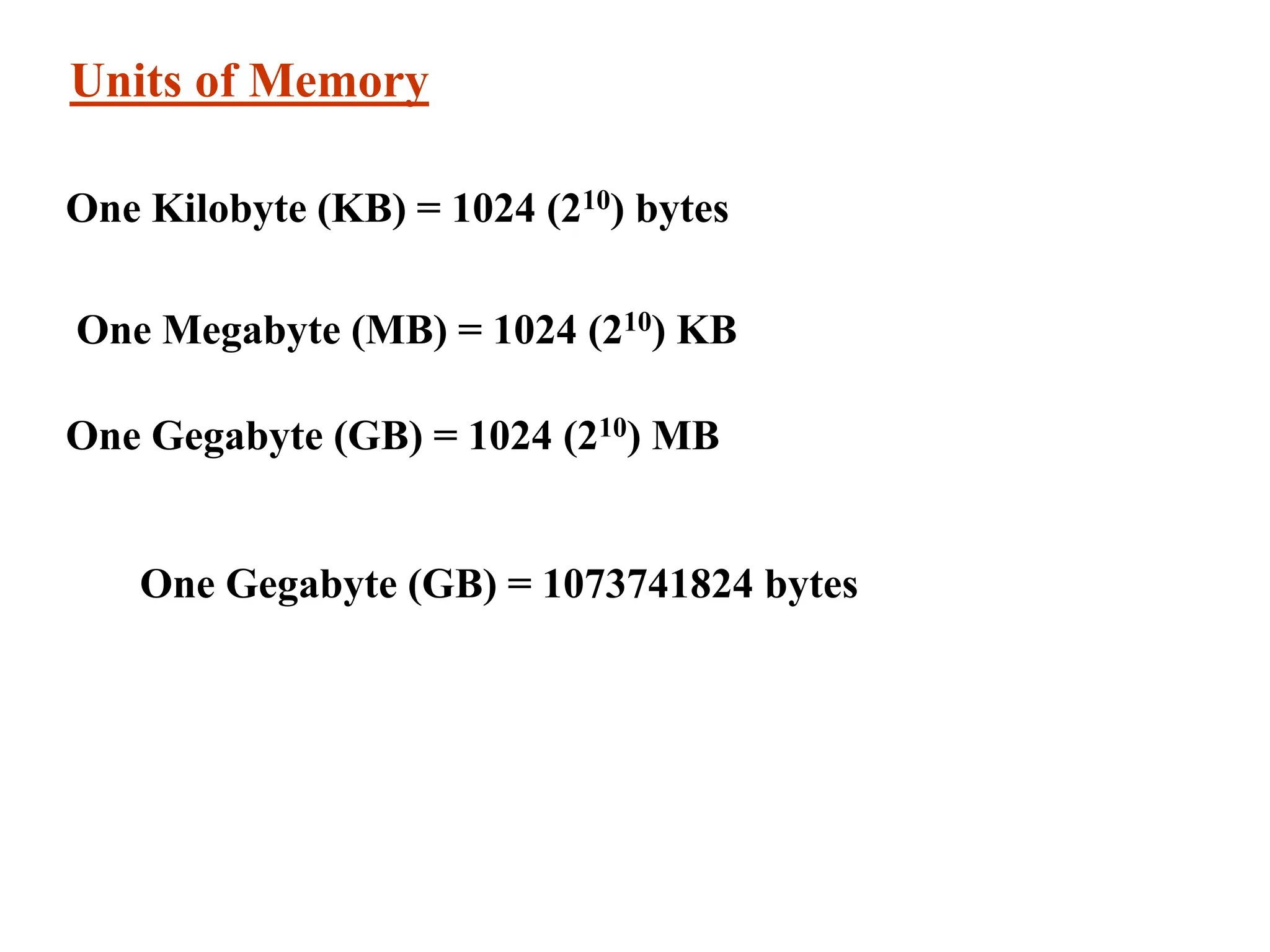
One Kilobyte (KB) = 1024 (210) bytes
One Megabyte (MB) = 1024 (210) KB
One Gegabyte (GB) = 1024 (210) MB
One Gegabyte (GB) = 1073741824 bytes
Number System
The set of values used to represent quantity.
Common system is the existing system of numbers
based on ten
Two types
Non-posistional Number system
Positional Number system
Non-posistional Number system
Counting using fingers, stones, sticks etc.
It had no sympol for Zero
It is very difficult to perform the additon and other
arithemetic operations
No logicval and positional techniques
Number System
Posistional Number system
The value of each digit in a number is defined not only
by the sympol but also by the sympol’s position
It have a base or radix.
First poisitonal number system – By the babylonians
(base 60 system)
Present system – Decimal number system
Other systems are binary number system, Octal
number system, Hexadecimal number system
Conversion systems
BCD – Binary Coded Decimal approach
ASCII – American Standard codes for Information
Interchange
EBCDIC – Extended Binary Coded Decimal
Intechange Code

Computer, introduction, features, anatomy,

  • 1.
    INTRODUCTION TO COMPUTERS an electronic machine that performs a wide variety of activities reliably, accurately and quickly  a programmable machine designed to sequentially and automatically carry out a sequence of arithmetic or logical operations  works under the control of a set of instructions called Program  accepts data, processes it by doing some mathematical and logical operations and gives the desired output or result
  • 2.
    INTRODUCTION TO COMPUTERS EDP:Electronic Data Processing (EDP) was the first sceintific term, used in the field of computers. The data processed electronically stored in storage media like hard disk Data: Data are facts/informational raw materials, represented either as numbers or text or a combination of both
  • 3.
    INTRODUCTION TO COMPUTERS Processing: It refers to the techniques and procedures of sorting, relating, interpreting, updating and computing items of data to impart the meaning and usefulness to it Information : It consits of data in an organised form or the result after processing by the computer
  • 4.
    Characteristics of acomputer Speed : Moden computer systems can process the data in a fraction of a second to provide the desired results. Speed of different computer systems is measures in terms of MIPS (Million Instructions Per Seconds). Speed of microprocessor is measures in this unit. Reliability : These mechines are capable of operating under adverse conditions for any time period producing consistent results Accuarcy : Computers can process the data accurately. The computing principle known as Garbage In, Garbage Out (GIGO), refres to the accuracy of computers where output depends upon the accuaracy of the user’s input
  • 5.
    Characteristics of acomputer Storage : Modern computer systems have big storage media. Using any of the available storage devices, the data can be transferred quickly from the storage into the memory, processed and then stored again back into the storage unit for future use. Communication : Computers can communicate with each other and share information. This is possible through communication mediums such as modems, telephone lines, satellites etc. which are used to connect each other. This connection of computers is known as networking
  • 6.
    Application of acomputer 1. Home 2. Entertainment 3. Small business 4. Large business 5. Power users 6. Shops 7. Hotels 8. Railways 9. Air reservation 10. Banks 11. Education 12. Hospitals 13. Defence 14. Telecommunications
  • 7.
    Overview of aComputer System Data : Data are facts/informational raw materials, represented either as numbers or text or a combination of both. All the data and informations are strored in files Files are stored in Directories Directories - a named area of the disk
  • 8.
    Overview of aComputer System Software : Instructions to the computer that specify which functions the CPU has to perform A list of sequenced intructions – Programme Preparing sequenced programme - Programming Hardware : Collection of electronic circuit and other devices that make up the computer system The physical equipments and components which can see touch and feel
  • 9.
    ANATOMY OF COMPUTERS 1.Input Unit 2. Processing Unit 3. Output Unit
  • 10.
    ANATOMY OF COMPUTERS InputUnit Keyboard: The keyboard has a whole lot of keys on it. These keys are also called buttons. The keyboard allows to enter information into the computer. It is similar to a typewriter but has some different keys that perform special functions Mouse: A pointing device - allows to select and manipulate objects see on the monitor. It has two or more buttons on it. By moving the body of the mouse in the desired direction, we can move the cursor (pointer) on the screen
  • 11.
    ANATOMY OF COMPUTERS InputUnit Joystick: It has a base and a vertical stem. The control buttons are mounted on them. We can move the vertical stem in any direction to control cursor on the screen. It is used to palygames on a computer Game Pad: It is a hand held input device. It is used to play games. Buttons on the game pad allow a player to control direction, speed and other screen actions Scanner: It helps to copy an image from the paper. It reads photos or other images into the computer and converts them into graphics files. To read pages of text and produce text files Optical Character Recognition (OCR) software is used.
  • 12.
    ANATOMY OF COMPUTERS InputUnit Digital camera: It is a video input device. It captures and stores photos as computer data instead of on photographic film Digitizer and graphic tablets: Graphic tablets or graphic pad has a magnetic surface. It converts drawings and photos into digital signals. The digital signal goes into the computer. The computer converts them into drawings or photos that appear on monitor Sound input: A microphone captures sound from the air. This captured sound can input into the computer with the help of microphone. Electronic musical instruments can also be connected directly to the computer .
  • 13.
    ANATOMY OF COMPUTERS ProcessingUnit Main function of processing unit is to process input and convert it into output  Central Processing Unit (CPU) chip  Power supply (SMPS)  One or more Disk Drives  Mother board  Fan and Speaker
  • 14.
    ANATOMY OF COMPUTERS ProcessingUnit A CPU has got three components  Control Unit: It controls everything that happens inside the computer. It also controls the operation of all other parts of the computer  Arithmetic and Logic Unit (ALU): ALU performs all the arithmetic calculations like addition, substraction, multiplication, division etc  Memory: A computer can remember everything that feed into it. It also remembers the instructions that were stored into it.
  • 15.
    ANATOMY OF COMPUTERS Memory InternalExternal 1. ROM (Rread Only Memory) 2. RAM (Random Access Memory) 1. Floppy Disks 2. Hard Disk 3. CD-ROMs 4. DVD ROMs
  • 16.
    ANATOMY OF COMPUTERS RAM:The main memory – The place where the computer temporarily stores its operating system, application programms and current data so that processor can reach them quickly and easily. This memory is lost when computer is switched off. ROM: Instructions to perform such operations which are critical to the operation of a computer are stored in this memory PROM: Programmable read Only memory – same as ROM and the user determines what data and instructions are recorded on them
  • 17.
    ANATOMY OF COMPUTERS EPROM:Erasable Programmable read Only memory – same as PROM with the help of a special device that uses ultraviolet light. Data or instructions on EPROM can be erasable and new data can be recorded on them EEPROM: Electronically Erasable Programmable read Only memory – Changes can be made electronically Register: A register is a special temporary storage location within the CPU
  • 18.
    ANATOMY OF COMPUTERS MOTHERBOARD: The main circuit board of a computer. This is where you plug in microprocessor (CPU), RAM, ROM etc. The mother board is also knows as system board The parts of CPU are usually connected by an electronic component referred to as a bus which acts as an electronic highway between them The term bus refers to an electronic pathway through which bits are transmitted between the various components.
  • 19.
    ANATOMY OF COMPUTERS OutputUnit The most common means of output are the computer screen and the printer Monitor: The computer screen is also called Visual Display Unit(VDU). It is commonly known as monitor. It is an output unit capable of showing still or moving images generated by a computer
  • 20.
    ANATOMY OF COMPUTERS OutputUnit In terms of color capabilities, monitors can be classified into three classes Monochrome monitors which displays the images, text and pictures on the screen in black and white Gray-scale Monitor: A gray-scale monitor is a special type of monochrome monitor capable of displaying different shades of gray. Colour Monitor which displays the images, text and pictures on the screen in different colours
  • 21.
    ANATOMY OF COMPUTERS OutputUnit Another types of classification of monitors are the CRT (Cathode Ray Tube) monitor, the LCD Flat Panel monitor, and the TFT-LCD monitor CRT monitors This is the most inexpensive monitor in the market today. It is bigger in size and require more space LCD Flat panel Monitor: Liquid Crystal Display (LCD) monitors also known as flat screen monitors. This is expensive than CRT. Require less space. Due to its technology, the display is also far superior than the CRT monitor’s
  • 22.
    ANATOMY OF COMPUTERS OutputUnit TFT-LCD Monitor: A Thin Film Transistor (TFT) – LCD monitor is more widely used with LCD monitors, because of its high level of resolution and sharpness. The only difference is a thin film transistor that is applied to the screen, which results in better control of pixels. This type of monitor is recommended for those who play animated, colourful, and high-resolution games, as well as graphic artists who may need to check out different fonts on the computer screen
  • 23.
    ANATOMY OF COMPUTERS OutputUnit A printer is a device that takes the images, text and pictures created on the computer and puts them onto the paper Printer Dot-Matrix printer: uses small dots to form characters on the paper Ink-Jet Printer: It prints text and graphics on the page by shooting ink onto the paper Laser printer: It prints graphics and text on the page using a laser beam. The laser bearns ink onto the page
  • 24.
  • 25.
    Conversion of Datainto Information Computer is a device that computes at a high speed To compute means to play with numbers, letter and sympols It also plays with sounds, picures and other machines It converts every data into binary digits i.e. zero and ones A system having two numbers - a binary number system
  • 26.
    Conversion of Datainto Information The numbers are represented by electronic pulses, It breaks all data into electronic pulses Computer counts these pulses and does the processing of work A processed data is converted to information
  • 27.
    Units of Memory Thedata in a computer is organised in the form of bits. Bit means any one of the Binary digits Zeros and ones. It is the basic unit of Data writing. One bit means one electronic pulse. A group of four bits is known as Nibble A group of eight bits is known as Byte. A character is normally represented by a byte. Byte is a unit for counting memory size.
  • 28.
    Units of Memory OneKilobyte (KB) = 1024 (210) bytes One Megabyte (MB) = 1024 (210) KB One Gegabyte (GB) = 1024 (210) MB One Gegabyte (GB) = 1073741824 bytes
  • 29.
    Number System The setof values used to represent quantity. Common system is the existing system of numbers based on ten Two types Non-posistional Number system Positional Number system Non-posistional Number system Counting using fingers, stones, sticks etc. It had no sympol for Zero It is very difficult to perform the additon and other arithemetic operations No logicval and positional techniques
  • 30.
    Number System Posistional Numbersystem The value of each digit in a number is defined not only by the sympol but also by the sympol’s position It have a base or radix. First poisitonal number system – By the babylonians (base 60 system) Present system – Decimal number system Other systems are binary number system, Octal number system, Hexadecimal number system
  • 31.
    Conversion systems BCD –Binary Coded Decimal approach ASCII – American Standard codes for Information Interchange EBCDIC – Extended Binary Coded Decimal Intechange Code