A Brief History ofA Brief History of
ComputersComputers
Pre-Mechanical Computing:
Before humans invented “machines”
to help them count or do math, they
used whatever was available…
It’s possible the human facility in math
is the most significant difference
between us and other species.
Mechanical
computers
FromFrom
The Abacus - 4000 BCThe Abacus - 4000 BC
toto
Charles BabbageCharles Babbage
and his Difference Engine (1812)and his Difference Engine (1812)
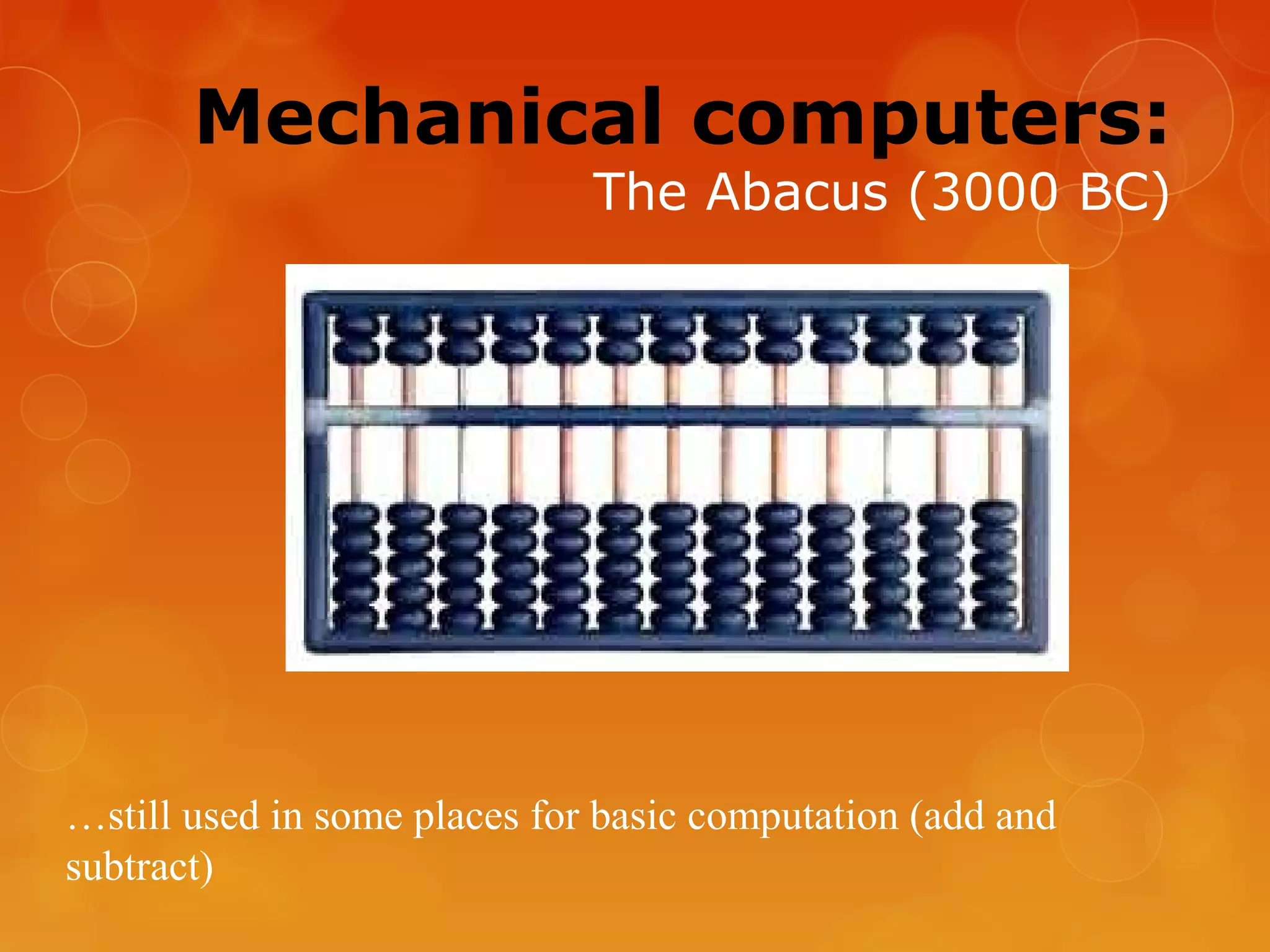
Mechanical computers:
The Abacus (3000 BC)
…still used in some places for basic computation (add and
subtract)
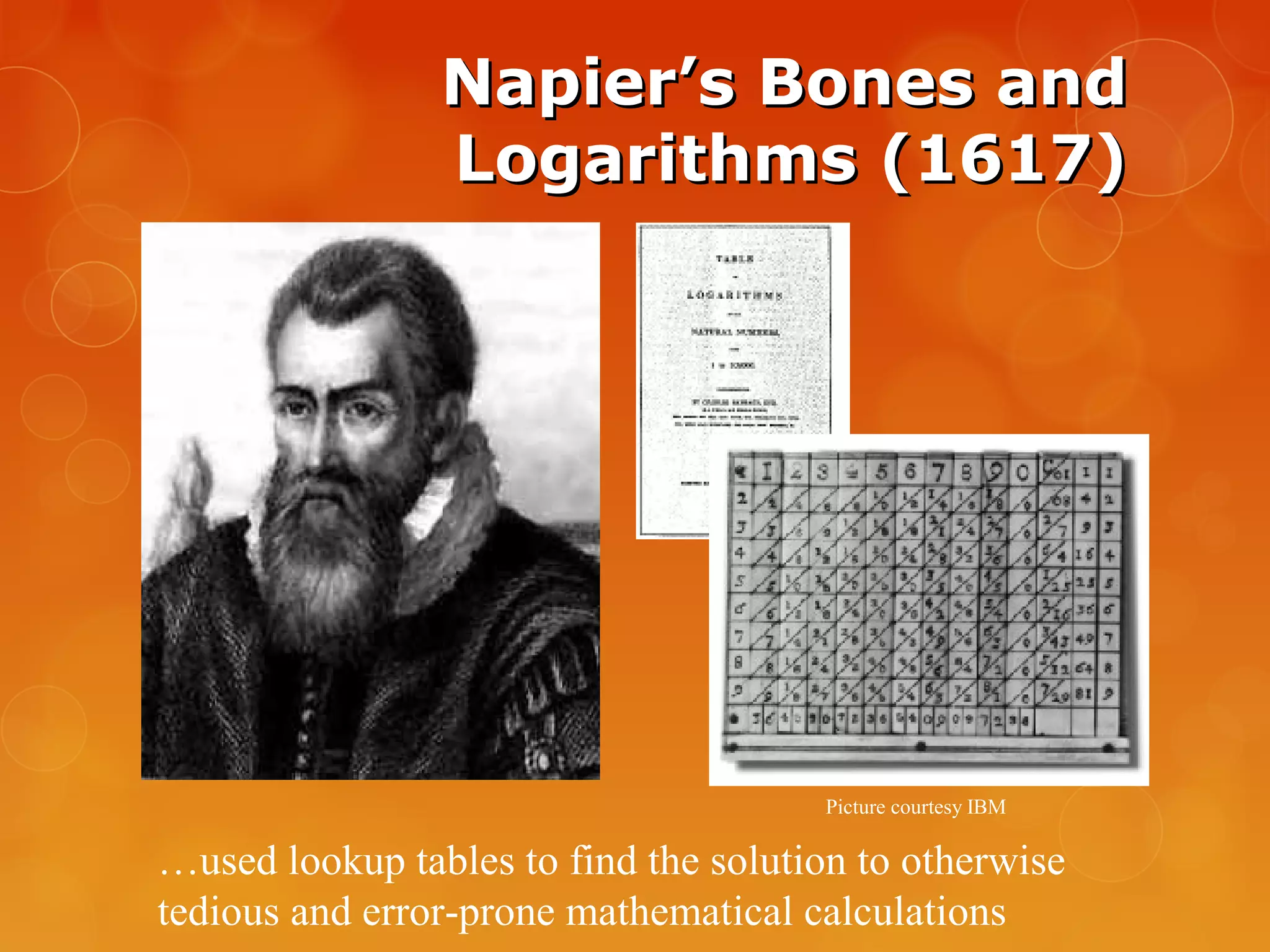
Napier’s Bones andNapier’s Bones and
Logarithms (1617)Logarithms (1617)
Picture courtesy IBM
…used lookup tables to find the solution to otherwise
tedious and error-prone mathematical calculations
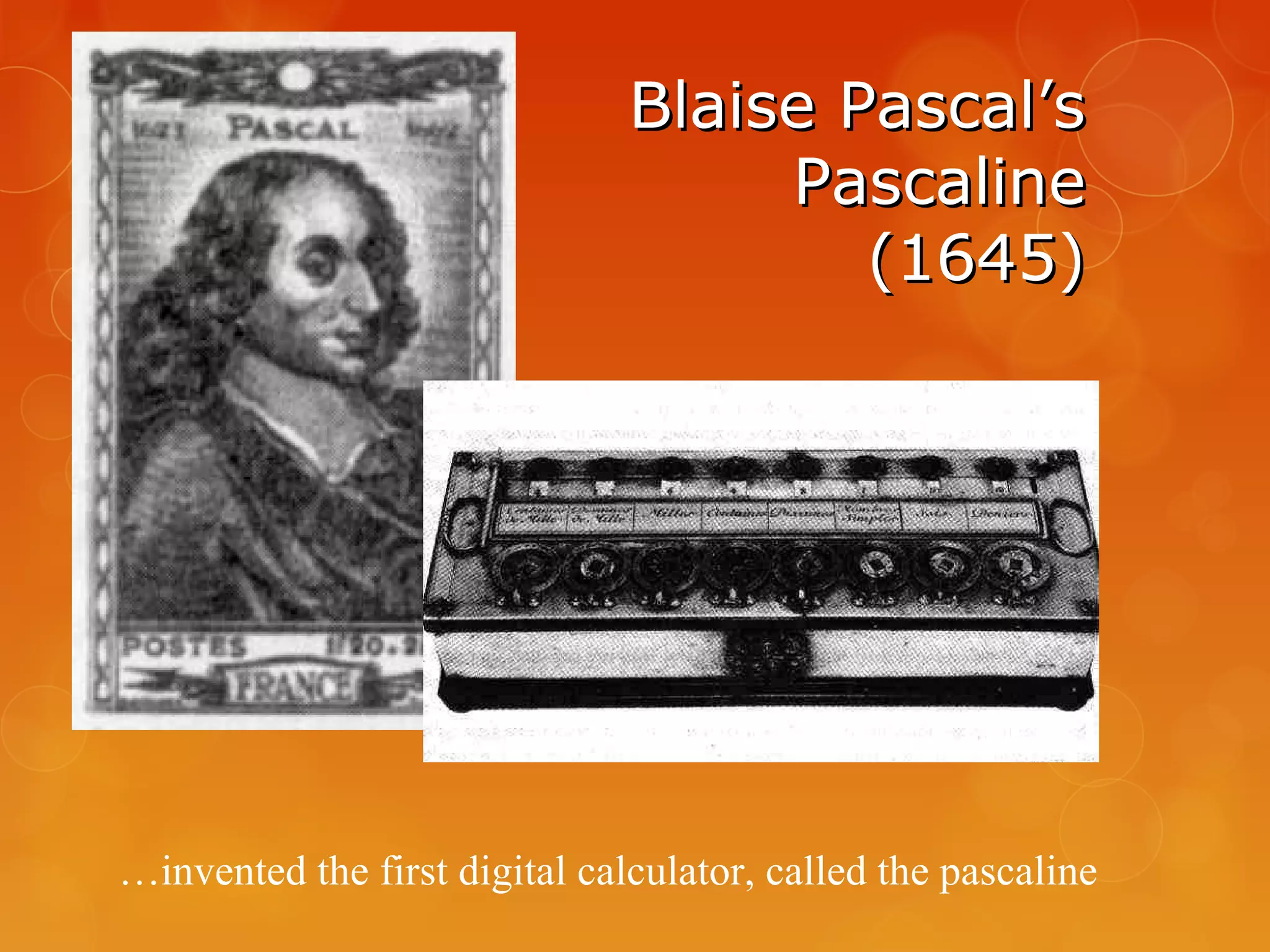
Blaise Pascal’sBlaise Pascal’s
PascalinePascaline
(1645)(1645)
…invented the first digital calculator, called the pascaline
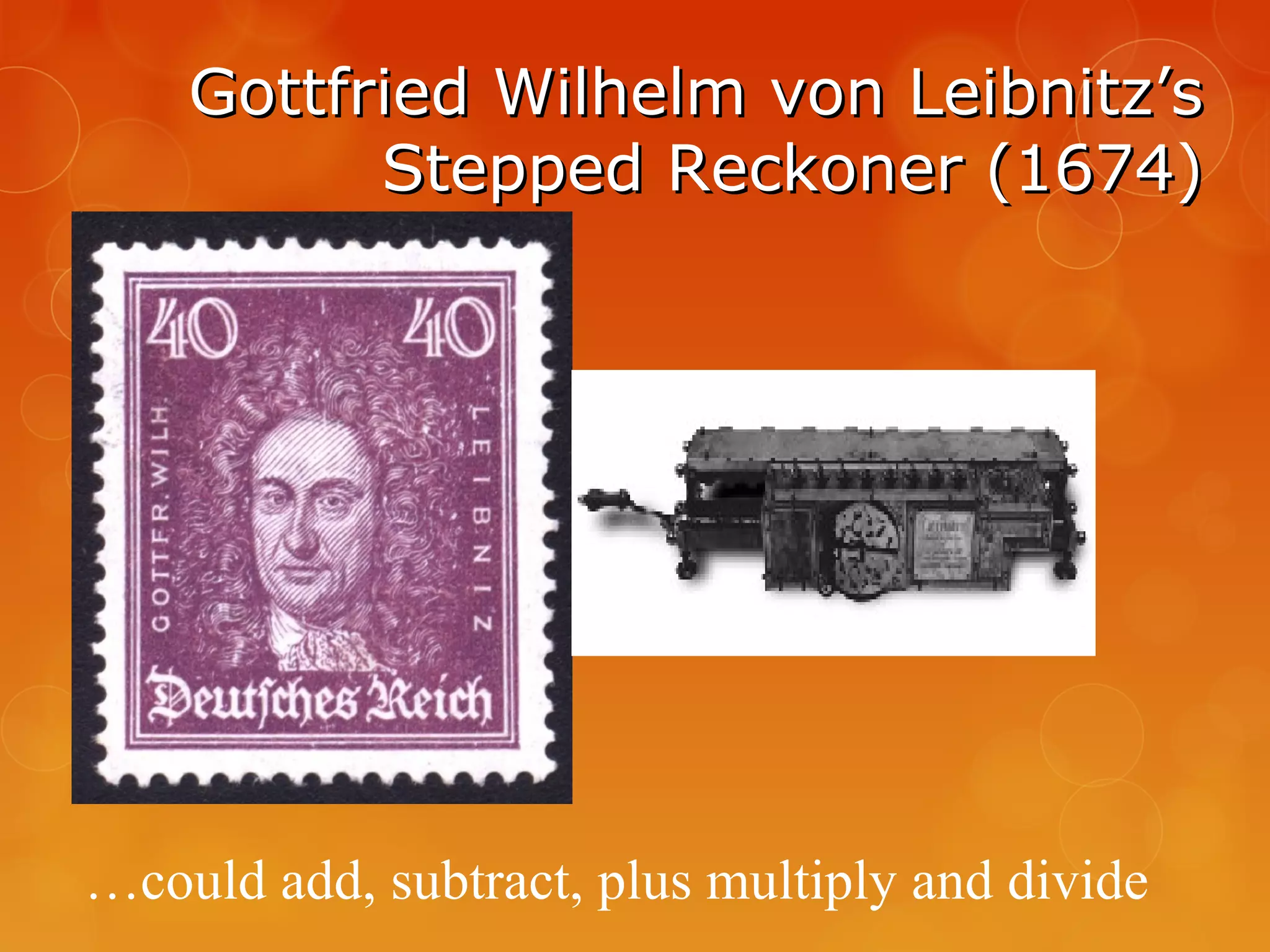
Gottfried Wilhelm von Leibnitz’sGottfried Wilhelm von Leibnitz’s
Stepped Reckoner (1674)Stepped Reckoner (1674)
…could add, subtract, plus multiply and divide
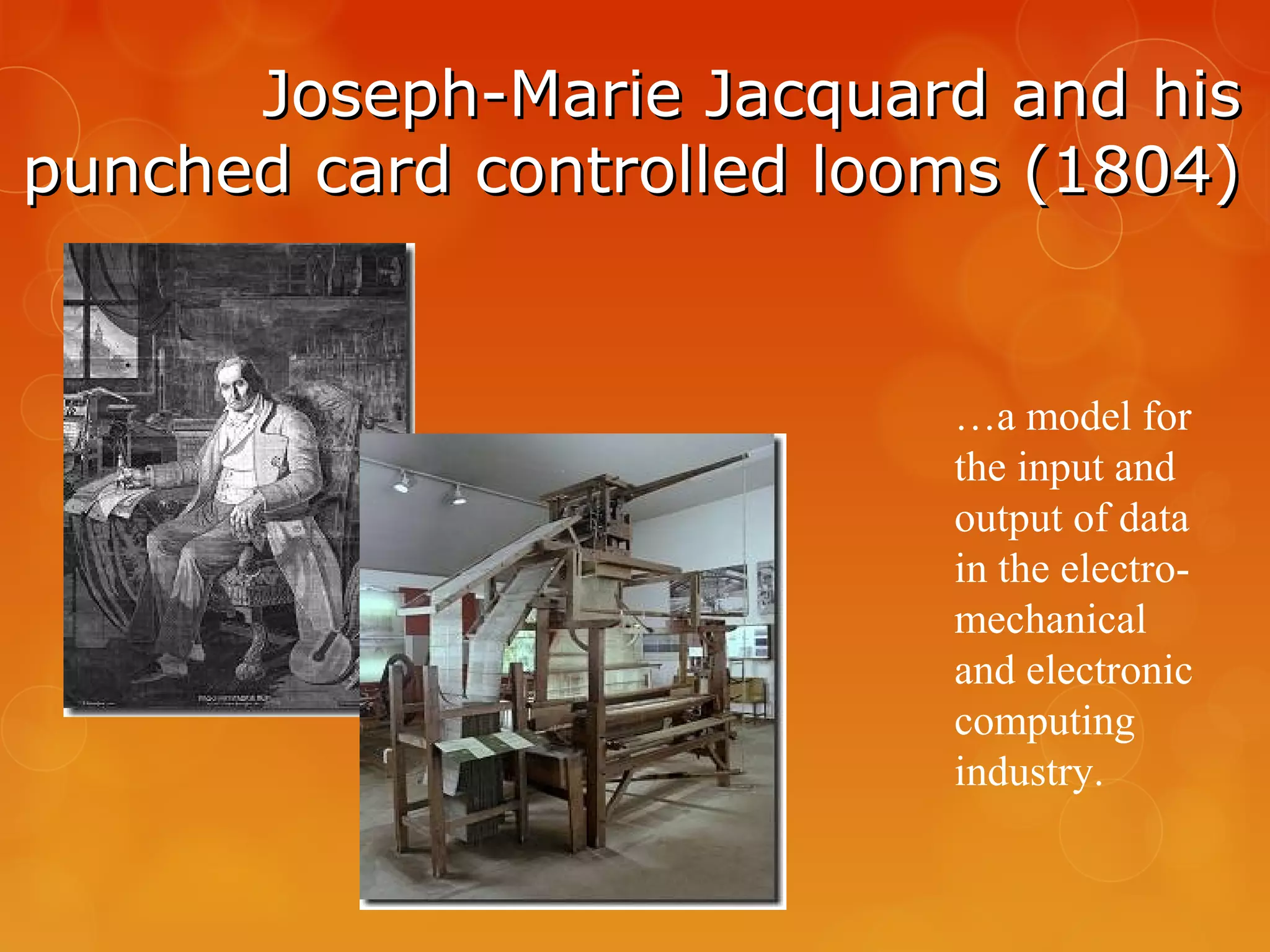
Joseph-Marie Jacquard and hisJoseph-Marie Jacquard and his
punched card controlled looms (1804)punched card controlled looms (1804)
…a model for
the input and
output of data
in the electro-
mechanical
and electronic
computing
industry.
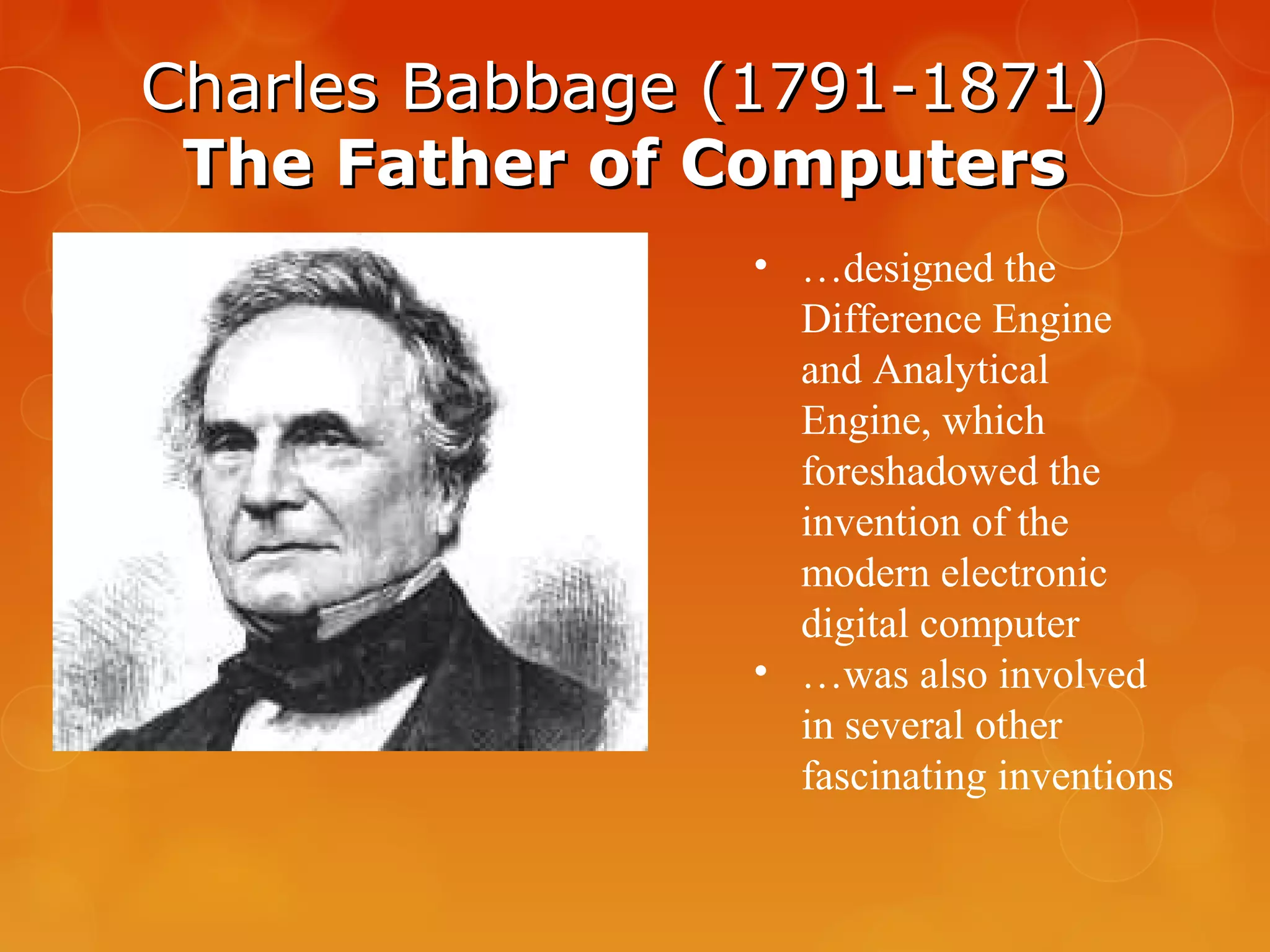
Charles Babbage (1791-1871)Charles Babbage (1791-1871)
The Father of ComputersThe Father of Computers
• …designed the
Difference Engine
and Analytical
Engine, which
foreshadowed the
invention of the
modern electronic
digital computer
• …was also involved
in several other
fascinating inventions
Charles Babbage’s DifferenceCharles Babbage’s Difference
Engine [1822-1842]Engine [1822-1842]
…born of the advances in technology that accompanied
the Industrial Revolution
The Difference Engine [1989-1991]
See http://en.wikipedia.org/wiki/Difference_engine
Charles Babbage’s Analytical EngineCharles Babbage’s Analytical Engine
[1837-1871—never completed][1837-1871—never completed]
Babbage was
never able to
complete
construction
of any of his
machines
due to
conflicts with
his chief
engineer and
inadequate
funding.
Lady Augusta AdaCountess of LovelaceLady Augusta AdaCountess of Lovelace
(1815-1852](1815-1852]
• … a brilliant
mathematician who
helped Babbage in his
work by documenting
his work
• … also wrote
programs to be run on
Babbage’s machines
(First Programmer)
Electro-mechanical
computers
FromFrom
Herman Hollerith’sHerman Hollerith’s
18901890
Census Counting MachineCensus Counting Machine
toto
Howard AikenHoward Aiken
and the Harvard Mark I (1944)and the Harvard Mark I (1944)
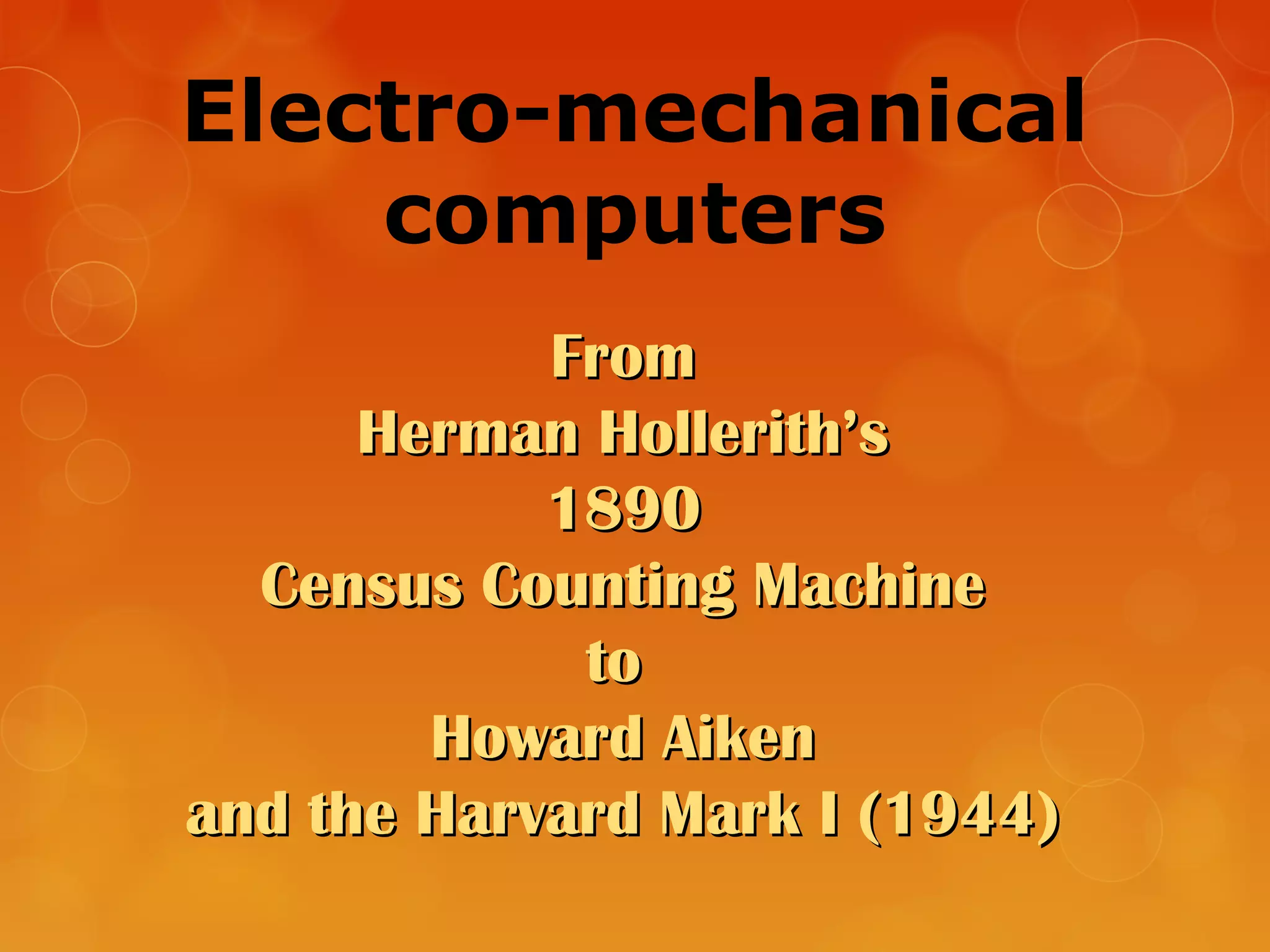
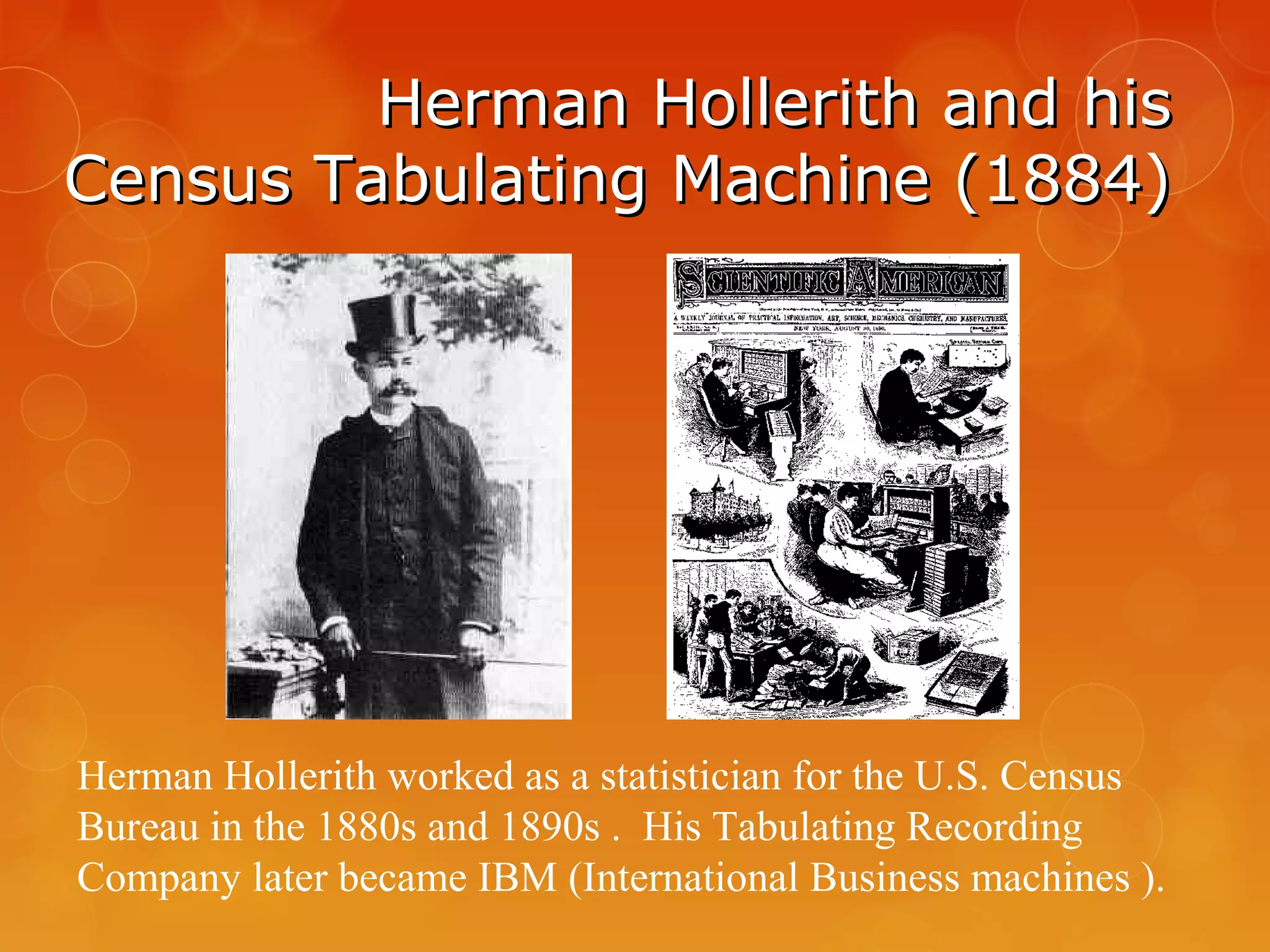
Herman Hollerith and hisHerman Hollerith and his
Census Tabulating Machine (1884)Census Tabulating Machine (1884)
Herman Hollerith worked as a statistician for the U.S. Census
Bureau in the 1880s and 1890s . His Tabulating Recording
Company later became IBM (International Business machines ).
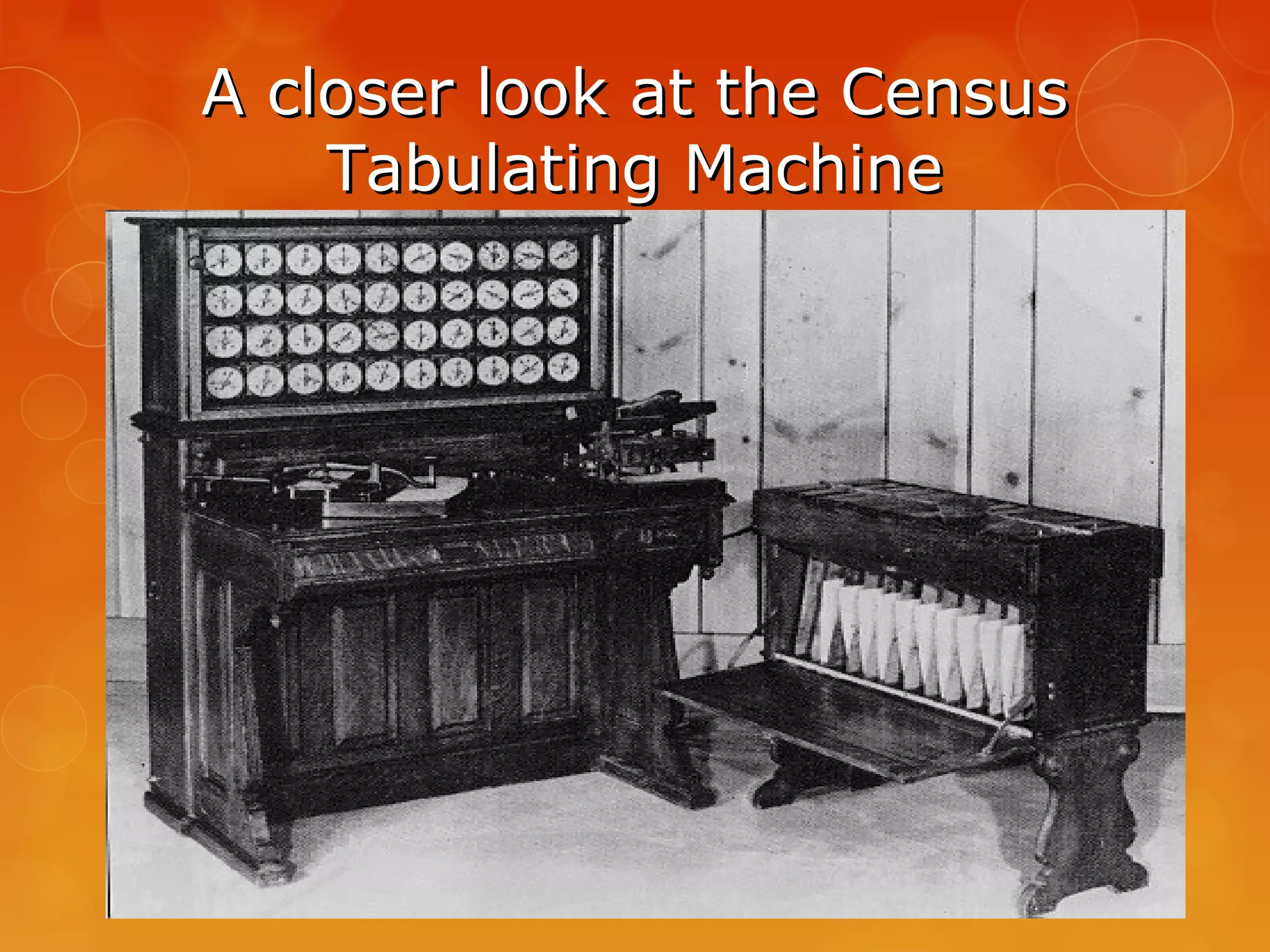
A closer look at the CensusA closer look at the Census
Tabulating MachineTabulating Machine
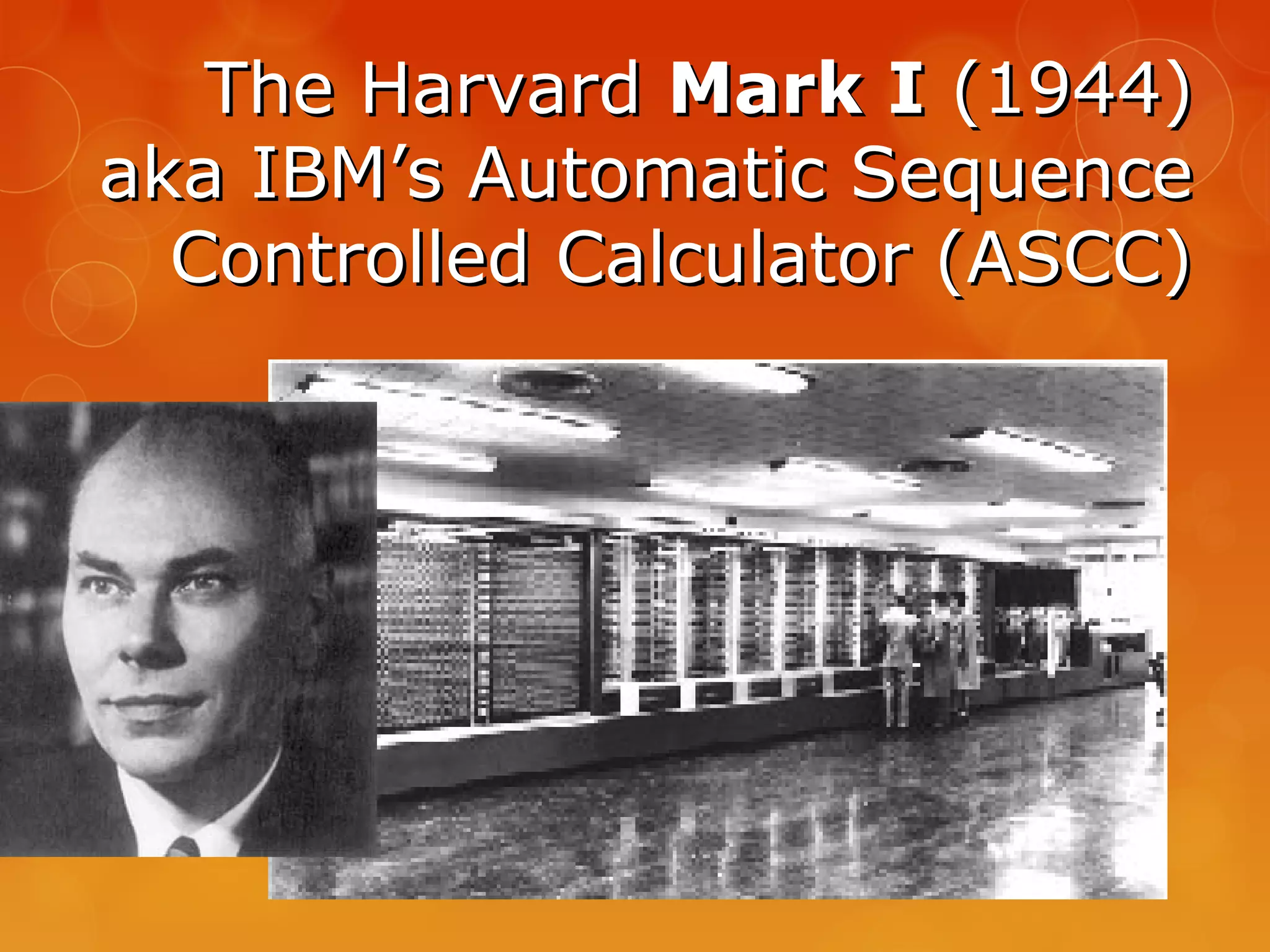
The HarvardThe Harvard Mark IMark I (1944)(1944)
aka IBM’s Automatic Sequenceaka IBM’s Automatic Sequence
Controlled Calculator (ASCC)Controlled Calculator (ASCC)
Electronic digital
computers
FromFrom
John Vincent Atanasoff’sJohn Vincent Atanasoff’s
19391939
Atanasoff-Berry Computer (ABC)Atanasoff-Berry Computer (ABC)
toto
the present daythe present day
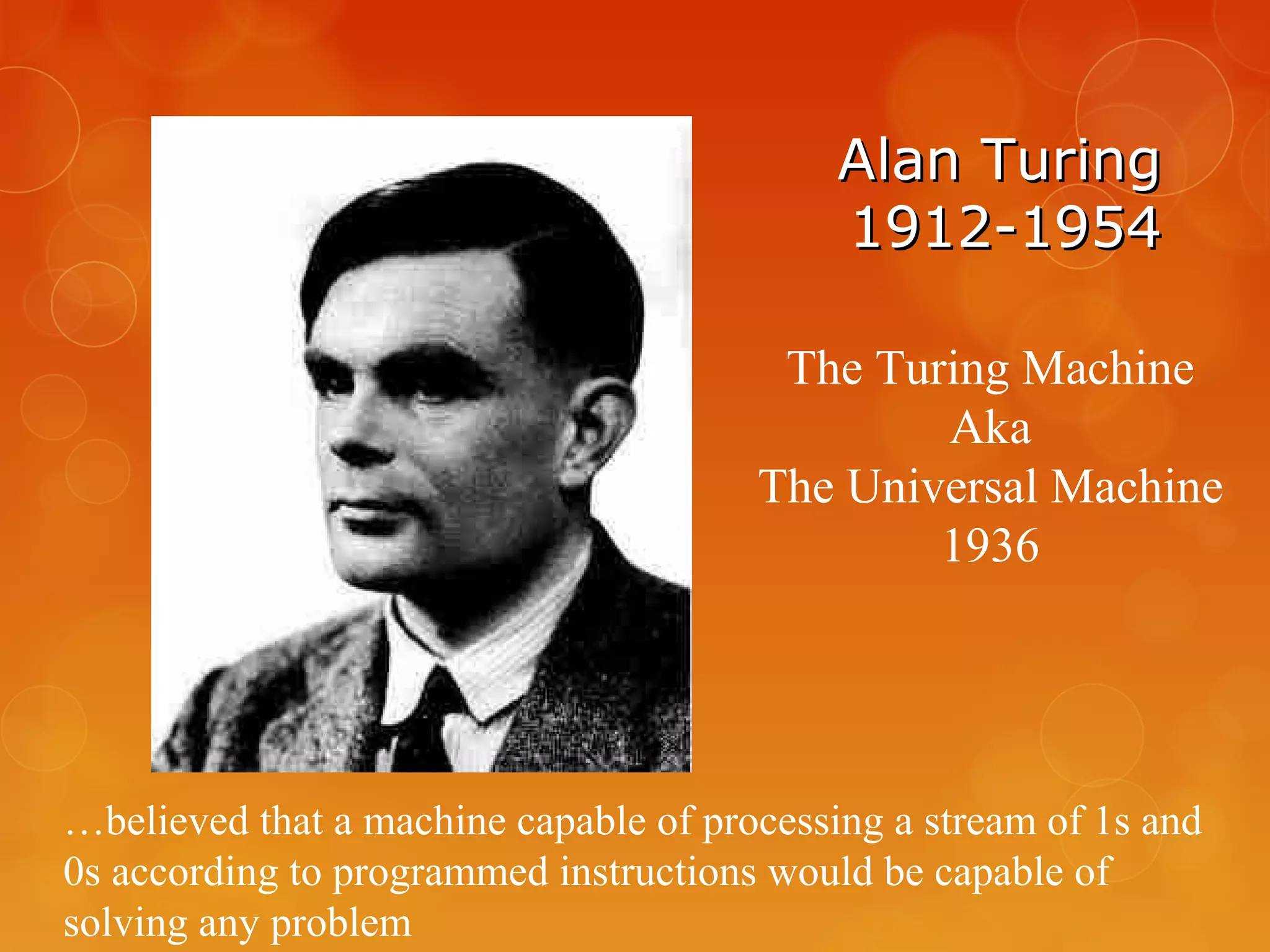
Alan TuringAlan Turing
1912-19541912-1954
The Turing Machine
Aka
The Universal Machine
1936
…believed that a machine capable of processing a stream of 1s and
0s according to programmed instructions would be capable of
solving any problem
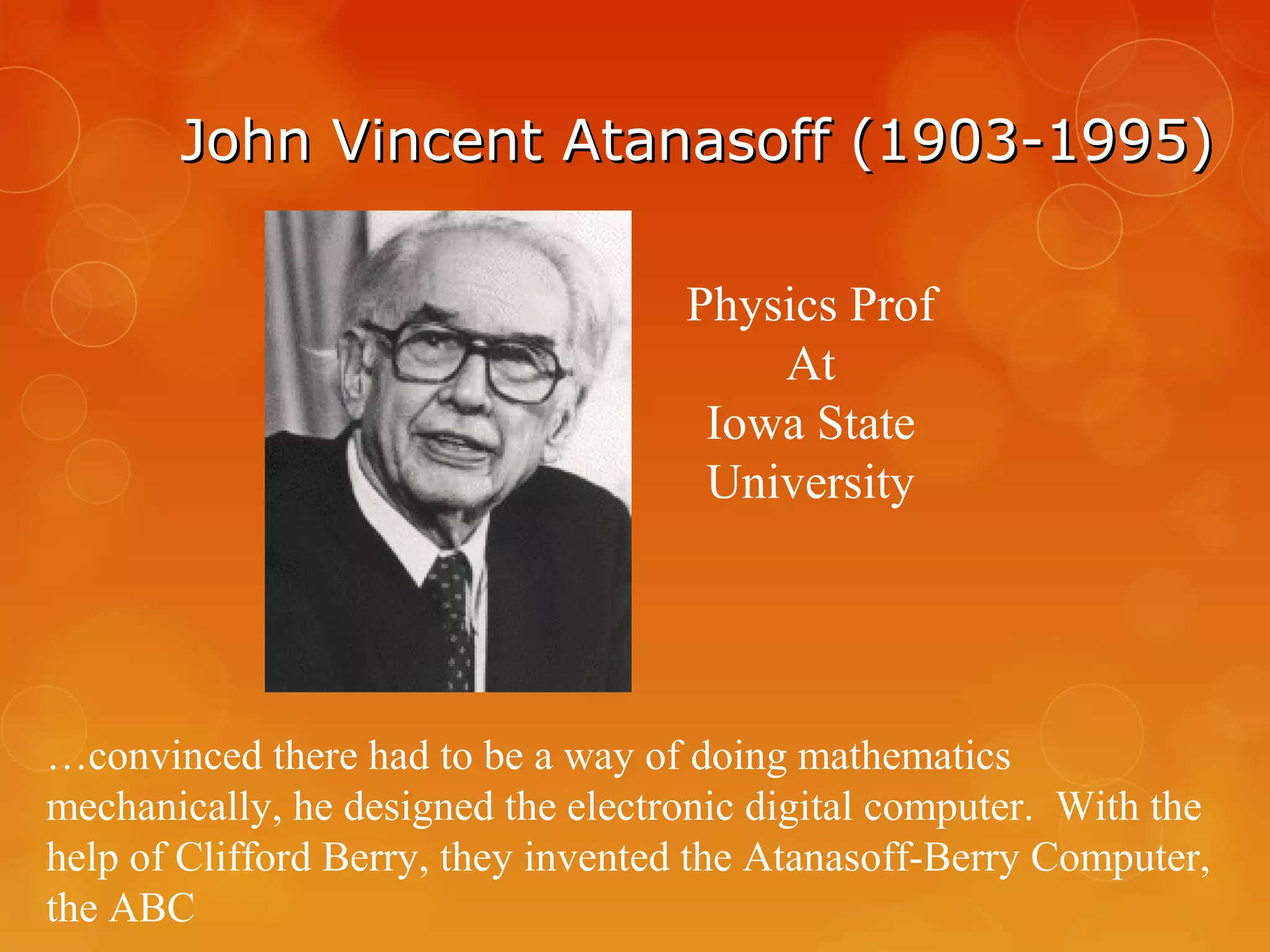
John Vincent Atanasoff (1903-1995)John Vincent Atanasoff (1903-1995)
Physics Prof
At
Iowa State
University
…convinced there had to be a way of doing mathematics
mechanically, he designed the electronic digital computer. With the
help of Clifford Berry, they invented the Atanasoff-Berry Computer,
the ABC
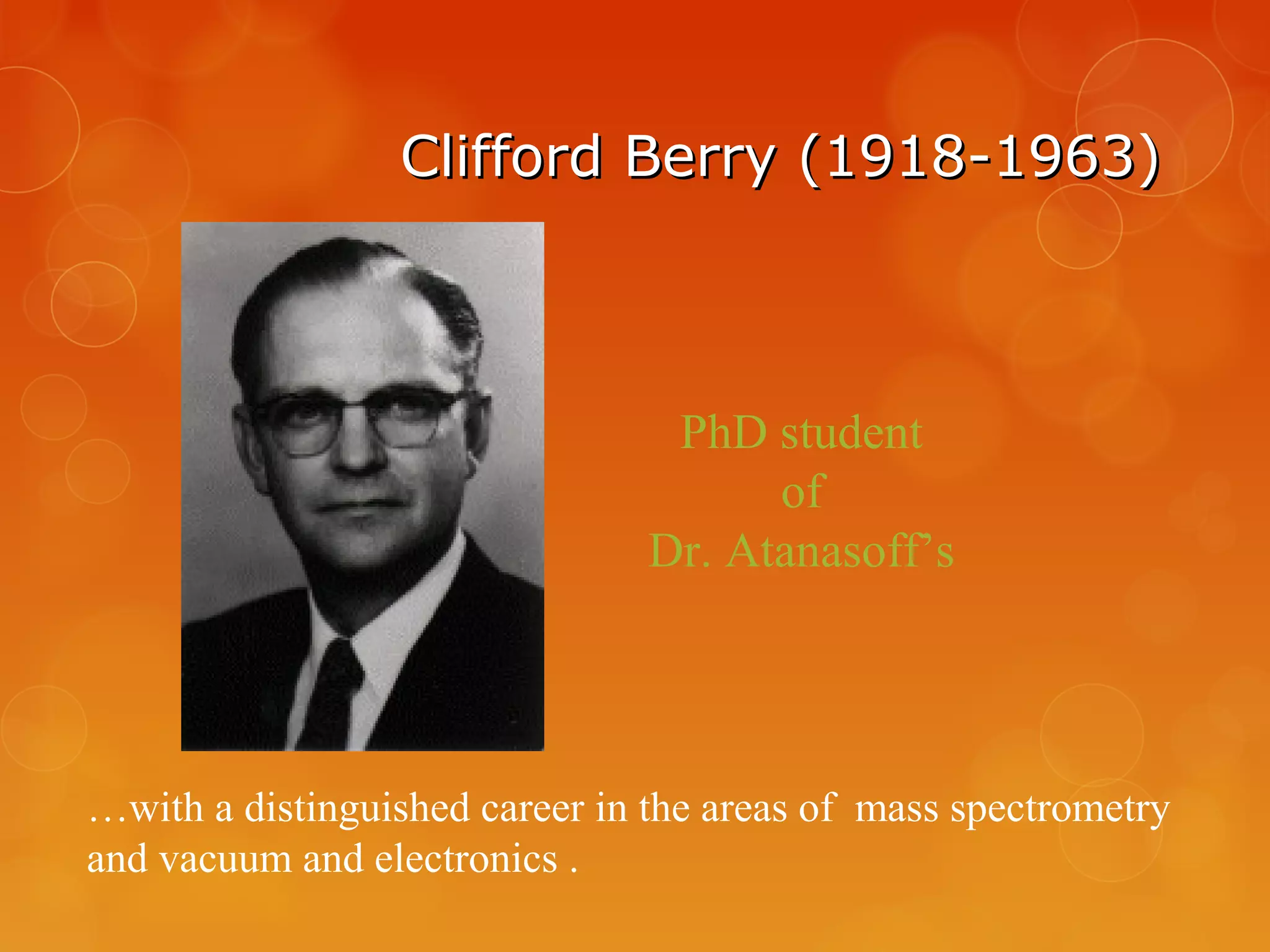
Clifford Berry (1918-1963)Clifford Berry (1918-1963)
PhD student
of
Dr. Atanasoff’s
…with a distinguished career in the areas of mass spectrometry
and vacuum and electronics .
19391939
The Atanasoff-Berry ComputerThe Atanasoff-Berry Computer
(ABC)(ABC)
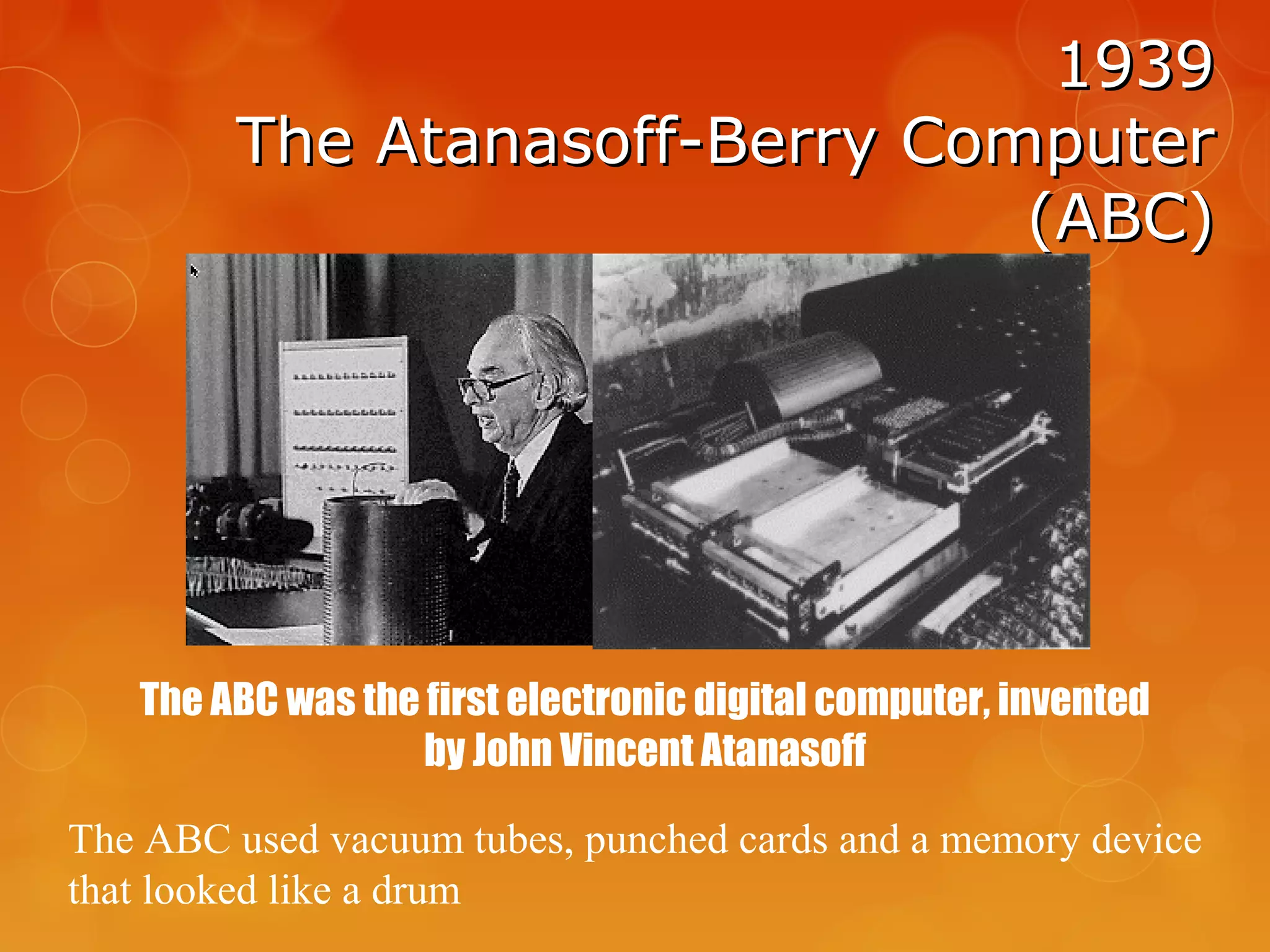
The ABC was the first electronic digital computer, invented
by John Vincent Atanasoff
The ABC used vacuum tubes, punched cards and a memory device
that looked like a drum
19431943
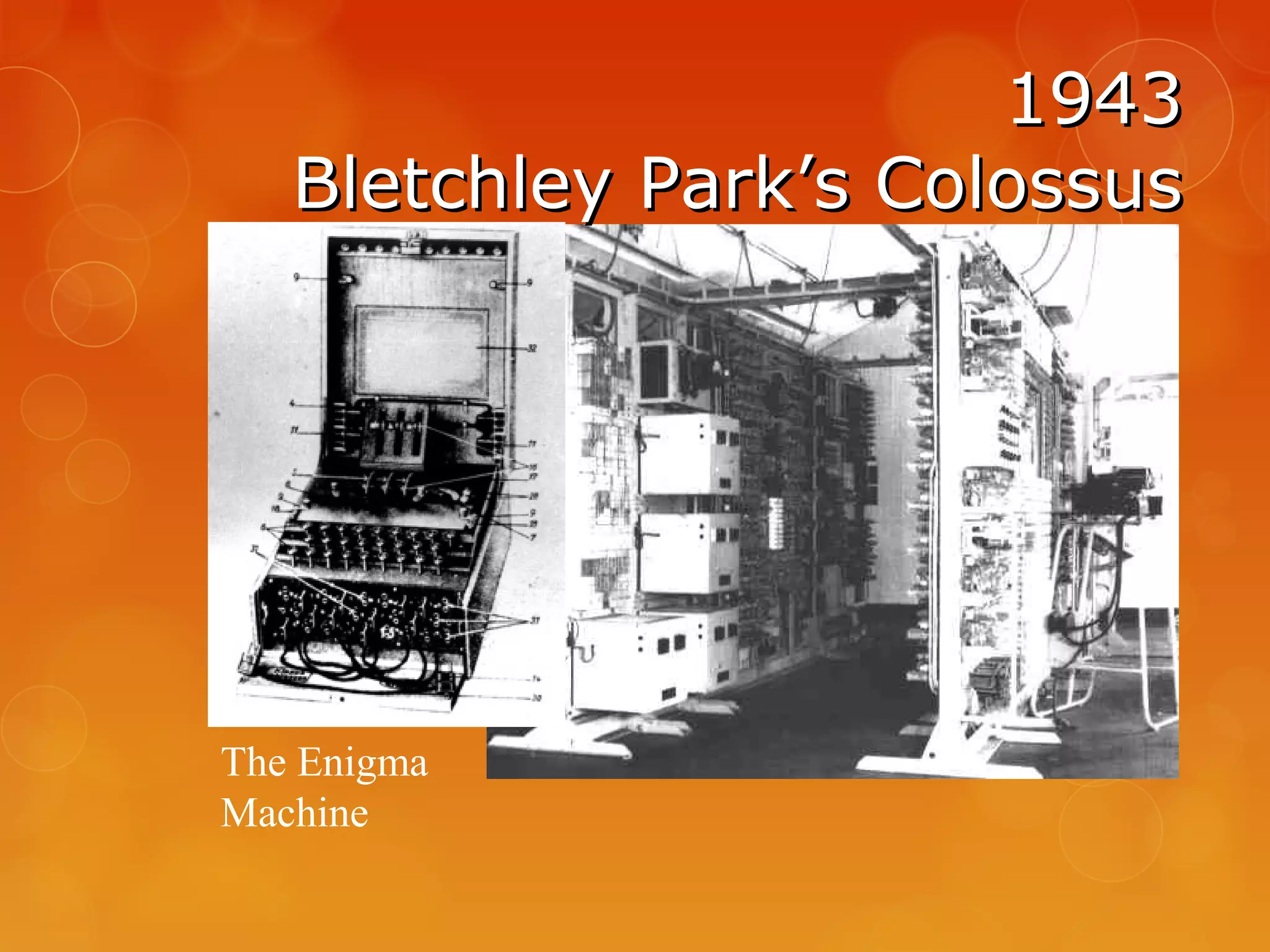
Bletchley Park’s ColossusBletchley Park’s Colossus
The Enigma
Machine
19461946
The ENIACThe ENIAC
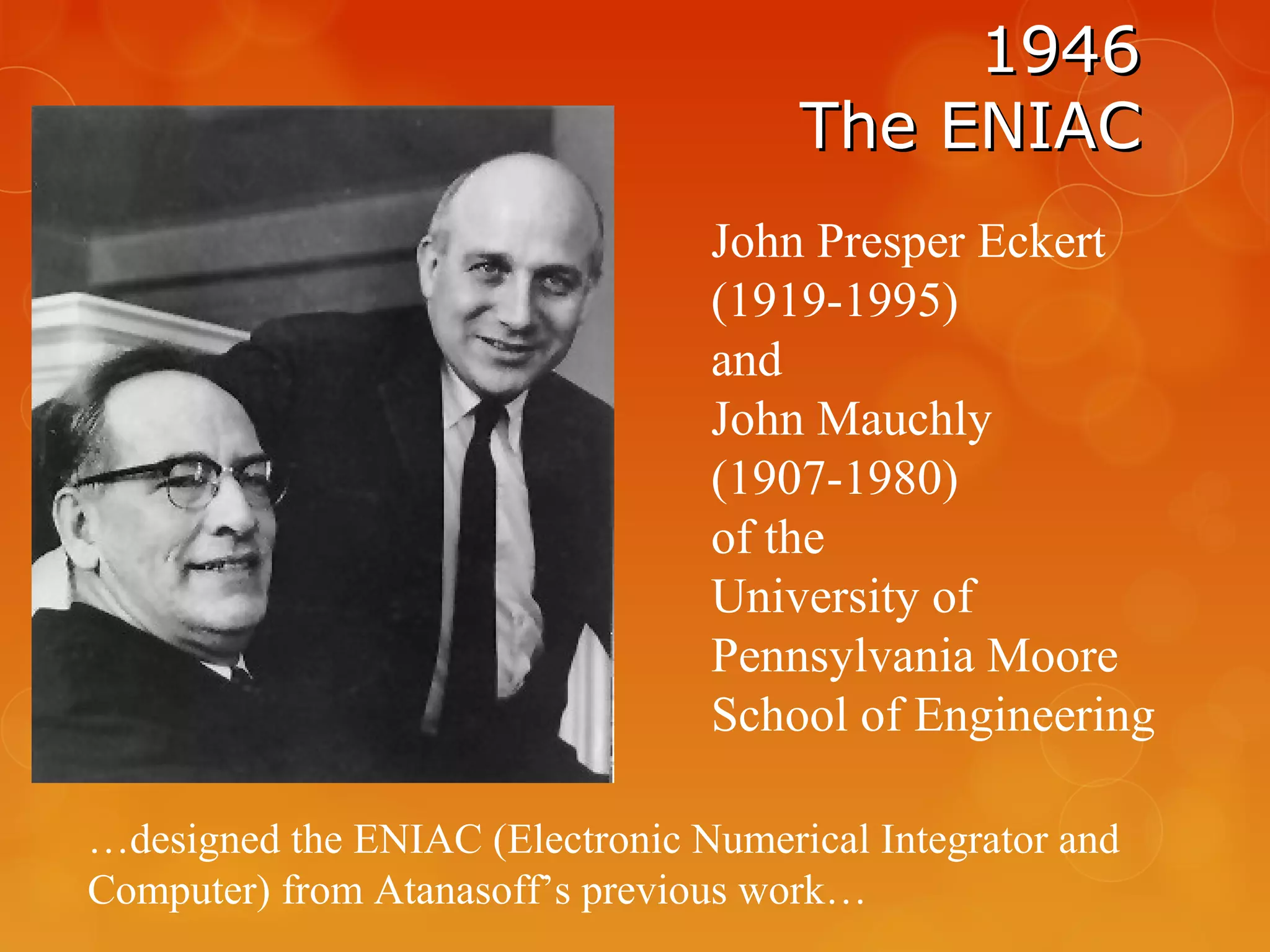
John Presper Eckert
(1919-1995)
and
John Mauchly
(1907-1980)
of the
University of
Pennsylvania Moore
School of Engineering
…designed the ENIAC (Electronic Numerical Integrator and
Computer) from Atanasoff’s previous work…
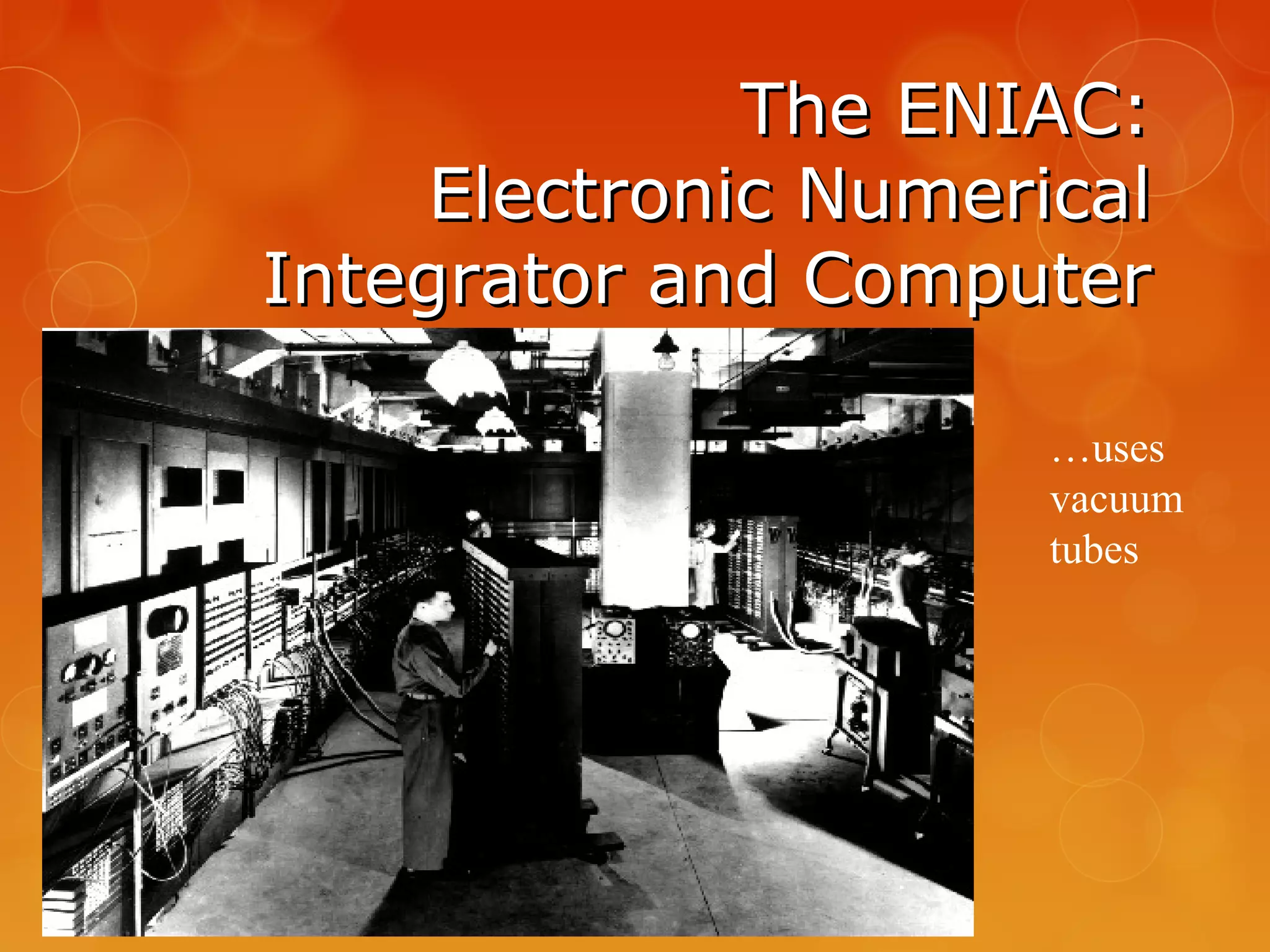
The ENIAC:The ENIAC:
Electronic NumericalElectronic Numerical
Integrator and ComputerIntegrator and Computer
…uses
vacuum
tubes
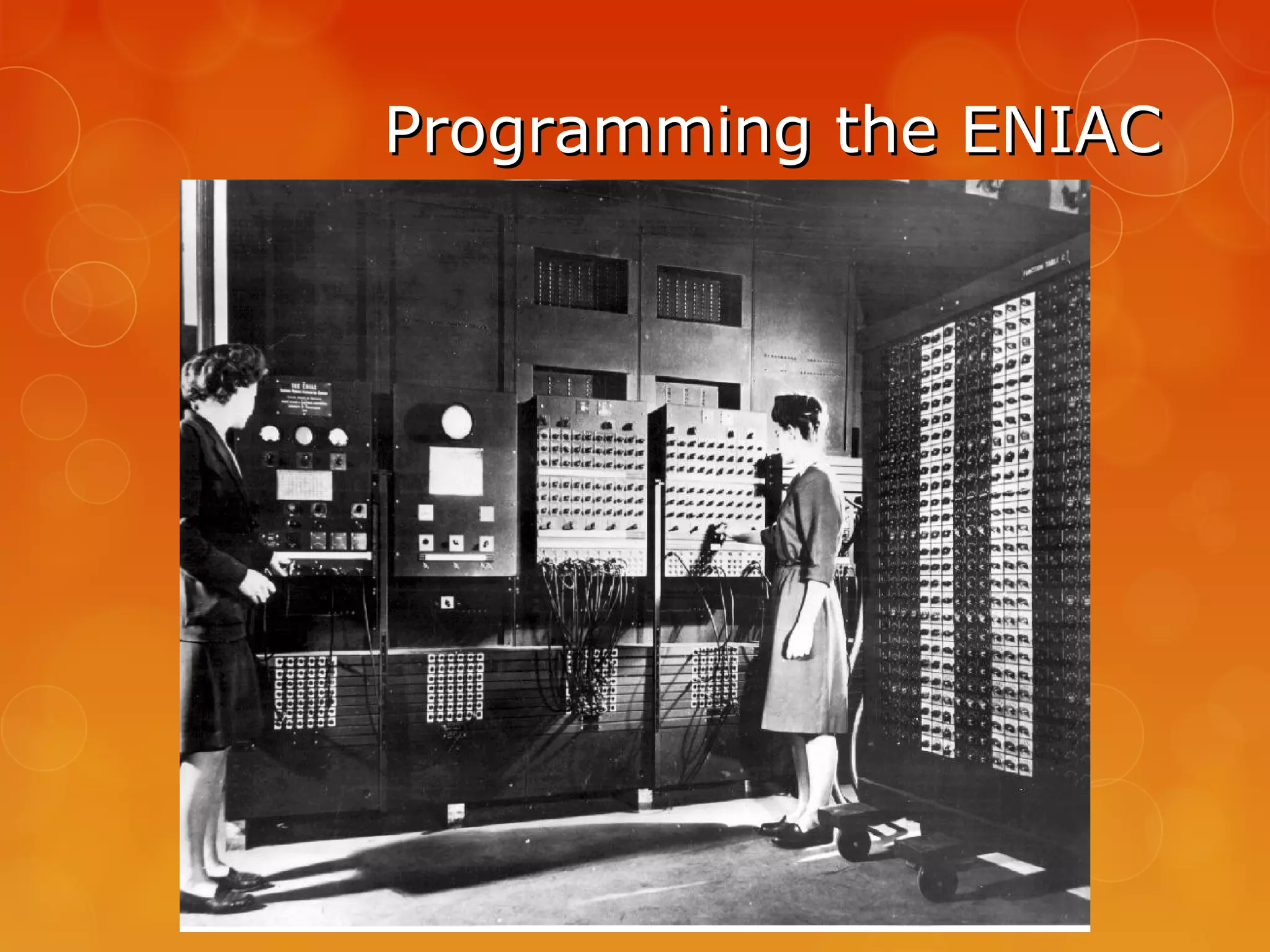
Programming the ENIACProgramming the ENIAC
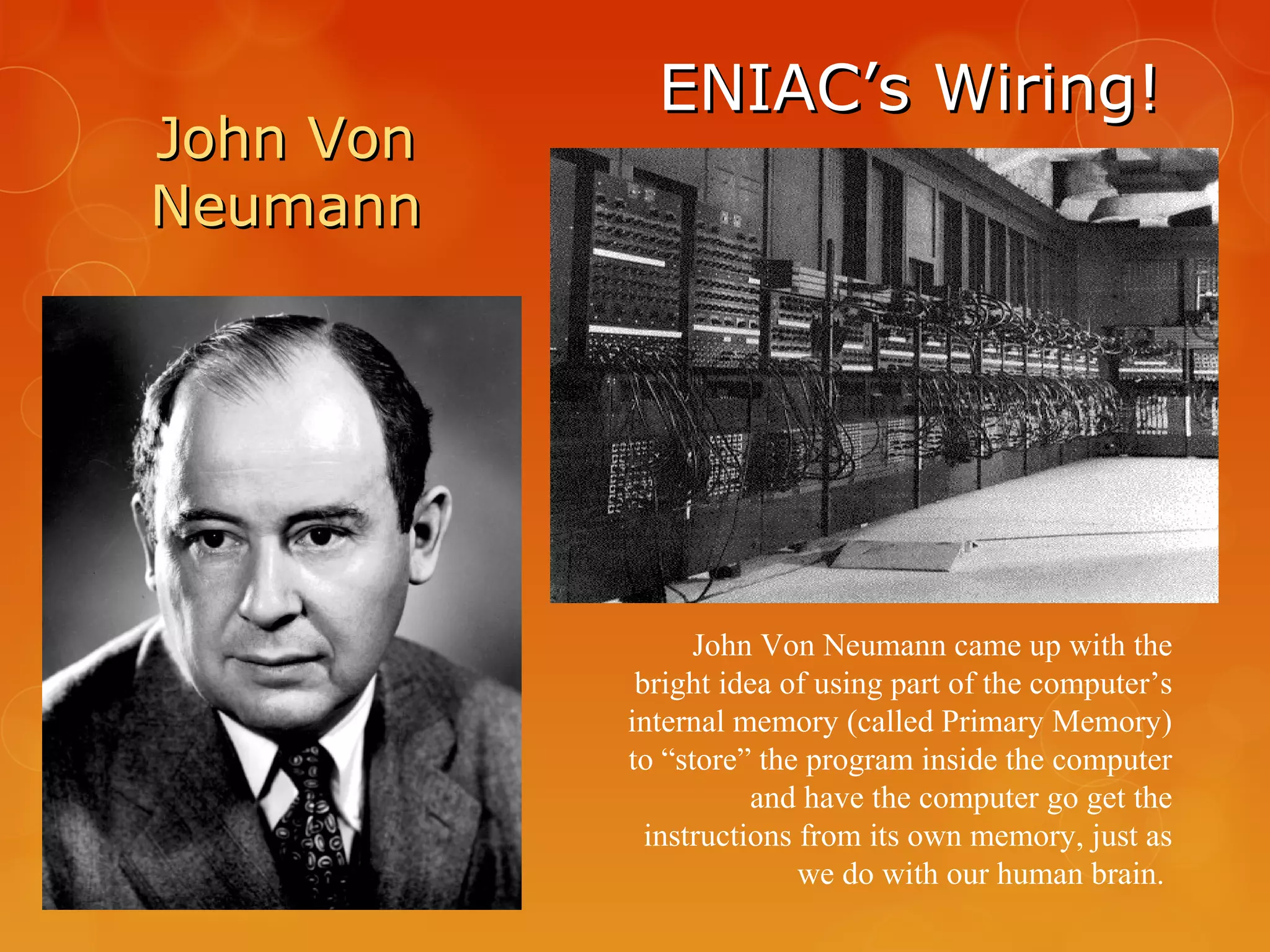
ENIAC’s Wiring!ENIAC’s Wiring!
John Von Neumann came up with the
bright idea of using part of the computer’s
internal memory (called Primary Memory)
to “store” the program inside the computer
and have the computer go get the
instructions from its own memory, just as
we do with our human brain.
John VonJohn Von
NeumannNeumann
Summing it all up!
First telegraph message sent by Samuel Morse, 1844Samuel Morse, 1844
Electronic and computing technology quickly progressed—
at an ever-accelerating pace—
from vacuum tubes (Lee de Forrest, the audion, 1907Lee de Forrest, the audion, 1907)
to transistors (William Shockley et al. 1947)William Shockley et al. 1947)
to semiconductors (Jack Kilby & Robert Noyce, 1958Jack Kilby & Robert Noyce, 1958)
to microprocessors (M.E. “Ted” Hoff, 1971M.E. “Ted” Hoff, 1971)
to personal computers [Atari, Apple, IBM, et al., 1975- ]
to networking and the Internet (Vinton Cerf & Robert Kahn,Vinton Cerf & Robert Kahn,
19821982]
to the World Wide Web (Tim Berners-Lee, 1991Tim Berners-Lee, 1991)
to mobile/cell phones, tablet PCs
and beyond…
Whatever next?…
Reference
• Most of the information for this powerpoint was
obtained from the following web page:
http://www.computersciencelab.com/ComputerHistory/
History.htm

Lesson Four

  • 1.
    A Brief HistoryofA Brief History of ComputersComputers
  • 2.
    Pre-Mechanical Computing: Before humansinvented “machines” to help them count or do math, they used whatever was available… It’s possible the human facility in math is the most significant difference between us and other species.
  • 3.
    Mechanical computers FromFrom The Abacus -4000 BCThe Abacus - 4000 BC toto Charles BabbageCharles Babbage and his Difference Engine (1812)and his Difference Engine (1812)
  • 4.
    Mechanical computers: The Abacus(3000 BC) …still used in some places for basic computation (add and subtract)
  • 5.
    Napier’s Bones andNapier’sBones and Logarithms (1617)Logarithms (1617) Picture courtesy IBM …used lookup tables to find the solution to otherwise tedious and error-prone mathematical calculations
  • 6.
  • 7.
    Gottfried Wilhelm vonLeibnitz’sGottfried Wilhelm von Leibnitz’s Stepped Reckoner (1674)Stepped Reckoner (1674) …could add, subtract, plus multiply and divide
  • 8.
    Joseph-Marie Jacquard andhisJoseph-Marie Jacquard and his punched card controlled looms (1804)punched card controlled looms (1804) …a model for the input and output of data in the electro- mechanical and electronic computing industry.
  • 9.
    Charles Babbage (1791-1871)CharlesBabbage (1791-1871) The Father of ComputersThe Father of Computers • …designed the Difference Engine and Analytical Engine, which foreshadowed the invention of the modern electronic digital computer • …was also involved in several other fascinating inventions
  • 10.
    Charles Babbage’s DifferenceCharlesBabbage’s Difference Engine [1822-1842]Engine [1822-1842] …born of the advances in technology that accompanied the Industrial Revolution
  • 11.
    The Difference Engine[1989-1991] See http://en.wikipedia.org/wiki/Difference_engine
  • 12.
    Charles Babbage’s AnalyticalEngineCharles Babbage’s Analytical Engine [1837-1871—never completed][1837-1871—never completed] Babbage was never able to complete construction of any of his machines due to conflicts with his chief engineer and inadequate funding.
  • 13.
    Lady Augusta AdaCountessof LovelaceLady Augusta AdaCountess of Lovelace (1815-1852](1815-1852] • … a brilliant mathematician who helped Babbage in his work by documenting his work • … also wrote programs to be run on Babbage’s machines (First Programmer)
  • 14.
    Electro-mechanical computers FromFrom Herman Hollerith’sHerman Hollerith’s 18901890 CensusCounting MachineCensus Counting Machine toto Howard AikenHoward Aiken and the Harvard Mark I (1944)and the Harvard Mark I (1944)
  • 15.
    Herman Hollerith andhisHerman Hollerith and his Census Tabulating Machine (1884)Census Tabulating Machine (1884) Herman Hollerith worked as a statistician for the U.S. Census Bureau in the 1880s and 1890s . His Tabulating Recording Company later became IBM (International Business machines ).
  • 16.
    A closer lookat the CensusA closer look at the Census Tabulating MachineTabulating Machine
  • 17.
    The HarvardThe HarvardMark IMark I (1944)(1944) aka IBM’s Automatic Sequenceaka IBM’s Automatic Sequence Controlled Calculator (ASCC)Controlled Calculator (ASCC)
  • 18.
    Electronic digital computers FromFrom John VincentAtanasoff’sJohn Vincent Atanasoff’s 19391939 Atanasoff-Berry Computer (ABC)Atanasoff-Berry Computer (ABC) toto the present daythe present day
  • 19.
    Alan TuringAlan Turing 1912-19541912-1954 TheTuring Machine Aka The Universal Machine 1936 …believed that a machine capable of processing a stream of 1s and 0s according to programmed instructions would be capable of solving any problem
  • 20.
    John Vincent Atanasoff(1903-1995)John Vincent Atanasoff (1903-1995) Physics Prof At Iowa State University …convinced there had to be a way of doing mathematics mechanically, he designed the electronic digital computer. With the help of Clifford Berry, they invented the Atanasoff-Berry Computer, the ABC
  • 21.
    Clifford Berry (1918-1963)CliffordBerry (1918-1963) PhD student of Dr. Atanasoff’s …with a distinguished career in the areas of mass spectrometry and vacuum and electronics .
  • 22.
    19391939 The Atanasoff-Berry ComputerTheAtanasoff-Berry Computer (ABC)(ABC) The ABC was the first electronic digital computer, invented by John Vincent Atanasoff The ABC used vacuum tubes, punched cards and a memory device that looked like a drum
  • 23.
    19431943 Bletchley Park’s ColossusBletchleyPark’s Colossus The Enigma Machine
  • 24.
    19461946 The ENIACThe ENIAC JohnPresper Eckert (1919-1995) and John Mauchly (1907-1980) of the University of Pennsylvania Moore School of Engineering …designed the ENIAC (Electronic Numerical Integrator and Computer) from Atanasoff’s previous work…
  • 25.
    The ENIAC:The ENIAC: ElectronicNumericalElectronic Numerical Integrator and ComputerIntegrator and Computer …uses vacuum tubes
  • 26.
  • 27.
    ENIAC’s Wiring!ENIAC’s Wiring! JohnVon Neumann came up with the bright idea of using part of the computer’s internal memory (called Primary Memory) to “store” the program inside the computer and have the computer go get the instructions from its own memory, just as we do with our human brain. John VonJohn Von NeumannNeumann
  • 28.
    Summing it allup! First telegraph message sent by Samuel Morse, 1844Samuel Morse, 1844 Electronic and computing technology quickly progressed— at an ever-accelerating pace— from vacuum tubes (Lee de Forrest, the audion, 1907Lee de Forrest, the audion, 1907) to transistors (William Shockley et al. 1947)William Shockley et al. 1947) to semiconductors (Jack Kilby & Robert Noyce, 1958Jack Kilby & Robert Noyce, 1958) to microprocessors (M.E. “Ted” Hoff, 1971M.E. “Ted” Hoff, 1971) to personal computers [Atari, Apple, IBM, et al., 1975- ] to networking and the Internet (Vinton Cerf & Robert Kahn,Vinton Cerf & Robert Kahn, 19821982] to the World Wide Web (Tim Berners-Lee, 1991Tim Berners-Lee, 1991) to mobile/cell phones, tablet PCs and beyond… Whatever next?…
  • 29.
    Reference • Most ofthe information for this powerpoint was obtained from the following web page: http://www.computersciencelab.com/ComputerHistory/ History.htm

Editor's Notes

  • #15 Electricity was discovered long before it was actually named as such. One Sir Thomas Browne is supposed to have come up with the term “electricity”. It was a while before electricity was used to power computing machines. This section tells that story.
  • #19 John Vincent Atanasoff’s contribution to the history of computers is little known, thanks to the preoccupations of his university and the shenanigans of two rival inventors of electronic digital machines. Read on to find out more…
  • #20 The story of modern electronic digital computing should start with Alan Turing who published a paper in 1936 On Computable Numbers, with an application to the Entscheidungsproblem. The paper proved that a machine capable of processing a stream of 1s and 0s according to programmed instructions would be capable of solving any problem that would count as a 'definite method.' As it happens, the set of problems included in this definition is the universe of mechanically solvable problems. Hence, the Turing Machine is also known as the Universal Machine, the theoretical precursor to the electronic digital computer which Dr. John Vincent Atanasoff was soon to invent.
  • #22 Dr. Clifford Berry had a distinguished career of his own outside of contribution in the invention of the electronic digital computer. He was issued 19 patents in the area of mass spectrometry, 11 patents in various areas of vacuum and electronics and, at the time of his death, had 13 patents pending. He died suddenly on October 30, 1963.
  • #25 J. Presper Eckert (at right in the picture on this slide) and John Mauchly were professors in the Moore School of Engineering at the University of Pennsylvania. Mauchly invited himself to Atanasoff’s home for a long weekend in order to check our the ABC. Atanasoff made him welcome, showed him his machine, and gave him a copy of the paper describing the workings of the machine that already had been filed with the Iowa State College’s patent lawyer. Mauchly returned to Pennsylvania and, together with Eckert, designed and built the ENIAC (Electronic Numerical Integrator and Computer) which was commissioned by the U.S. Department of Defense and delivered in 1946. Eckert and Mauchly successfully filed for the patent as inventors of the electronic digital computer, ignoring Atanasoff’s work. Some thirty years later, in 1972, this injustice was rectified when Honeywell (for Atanasoff) successfully challenged Sperry Rand (the company that acquired Eckert and Mauchly’s patent), and Atanasoff and Berry were duly credited as being the inventors of the electronic digital computer. Mauchly died in 1980. Eckert died in 1995, one week before the nonogenarian Atanasoff. You might say that Atanasoff had the last laugh.
  • #26 The ENIAC: 30 tons, 18,000 vacuum tubes, with the computing power of little more than the modern calculator…..