Communication
planning
What is communication
for you?
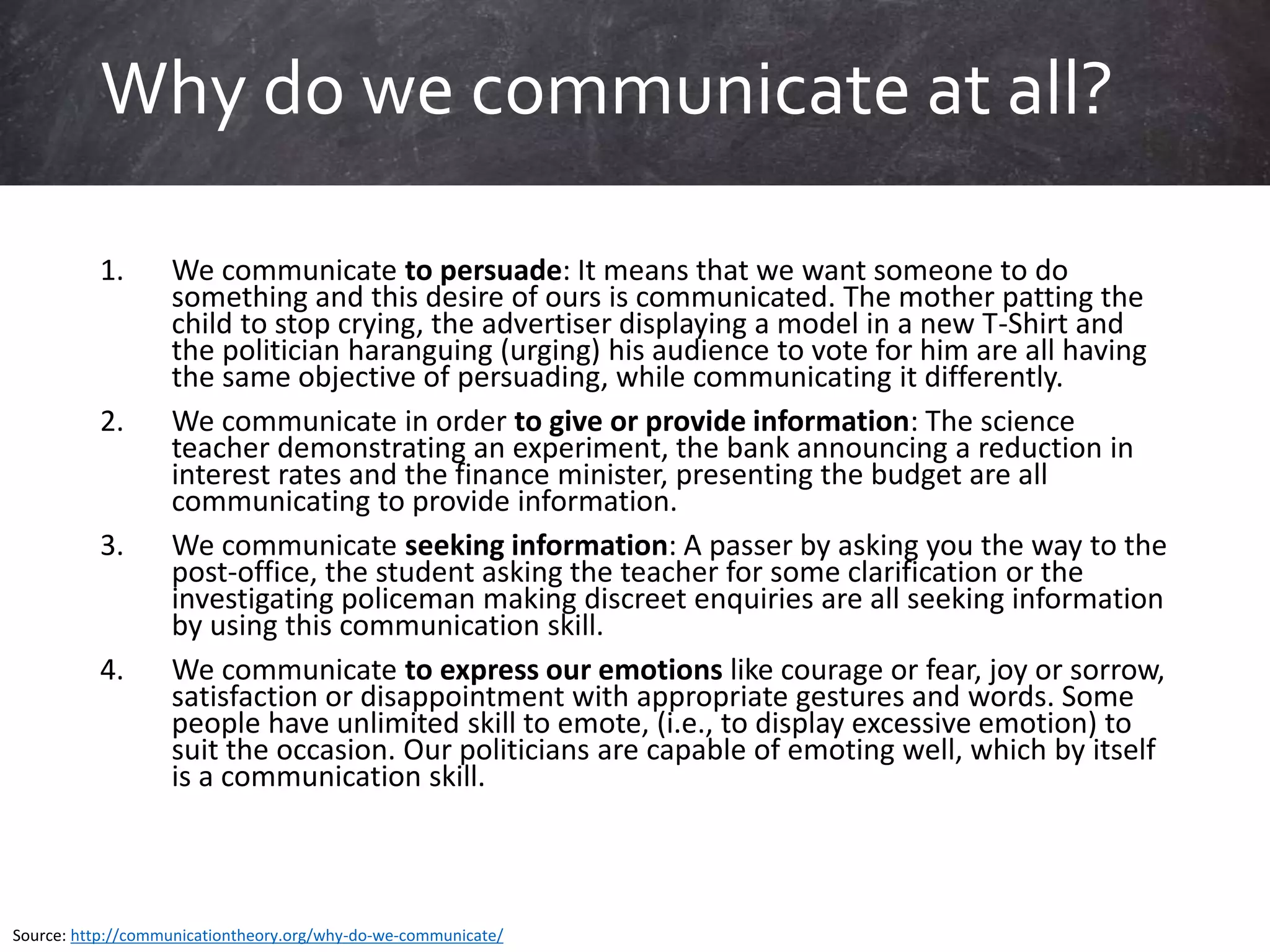
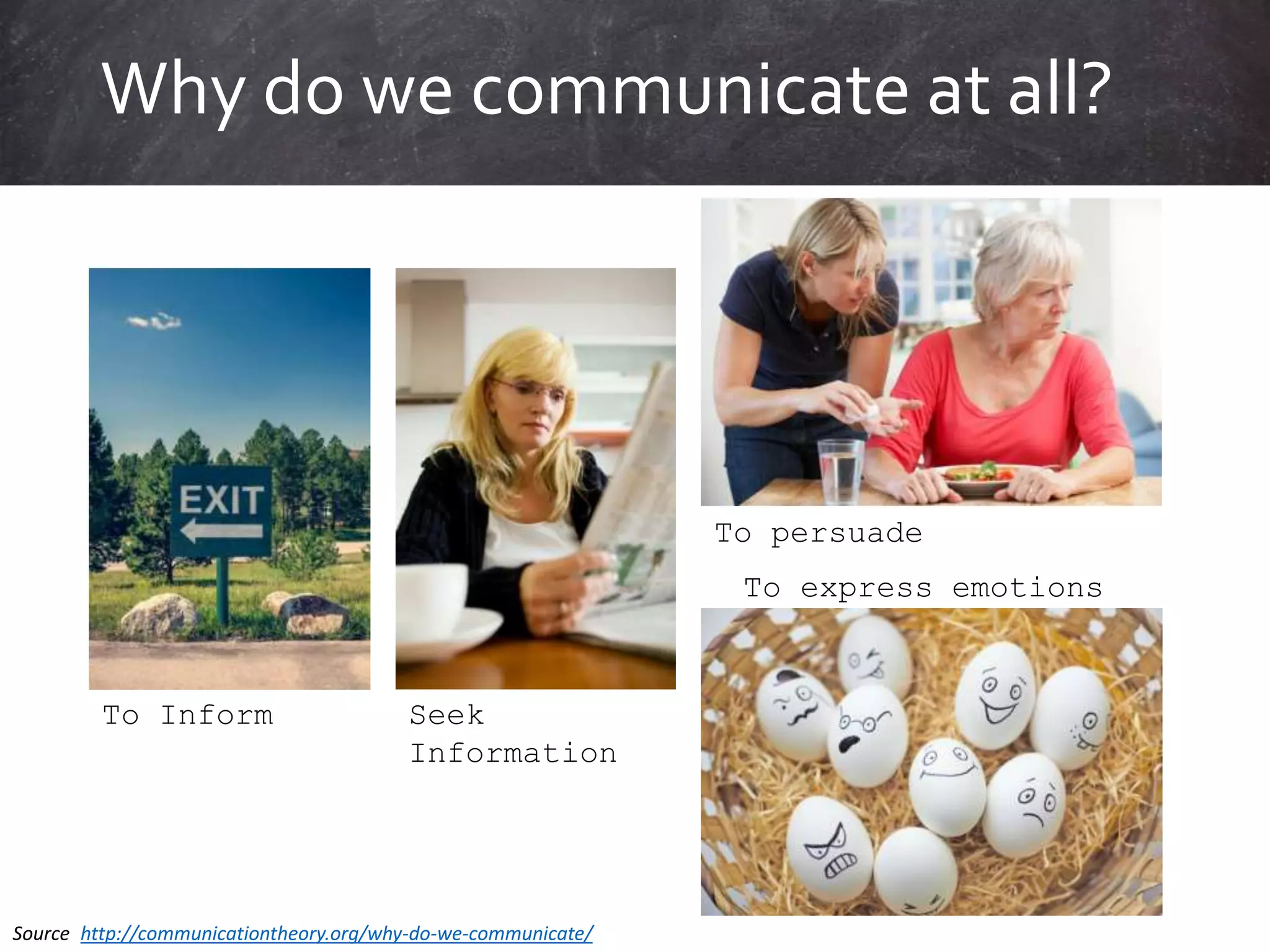
1. We communicate to persuade: It means that we want someone to do
something and this desire of ours is communicated. The mother patting the
child to stop crying, the advertiser displaying a model in a new T-Shirt and
the politician haranguing (urging) his audience to vote for him are all having
the same objective of persuading, while communicating it differently.
2. We communicate in order to give or provide information: The science
teacher demonstrating an experiment, the bank announcing a reduction in
interest rates and the finance minister, presenting the budget are all
communicating to provide information.
3. We communicate seeking information: A passer by asking you the way to the
post-office, the student asking the teacher for some clarification or the
investigating policeman making discreet enquiries are all seeking information
by using this communication skill.
4. We communicate to express our emotions like courage or fear, joy or sorrow,
satisfaction or disappointment with appropriate gestures and words. Some
people have unlimited skill to emote, (i.e., to display excessive emotion) to
suit the occasion. Our politicians are capable of emoting well, which by itself
is a communication skill.
Why do we communicate at all?
Source: http://communicationtheory.org/why-do-we-communicate/
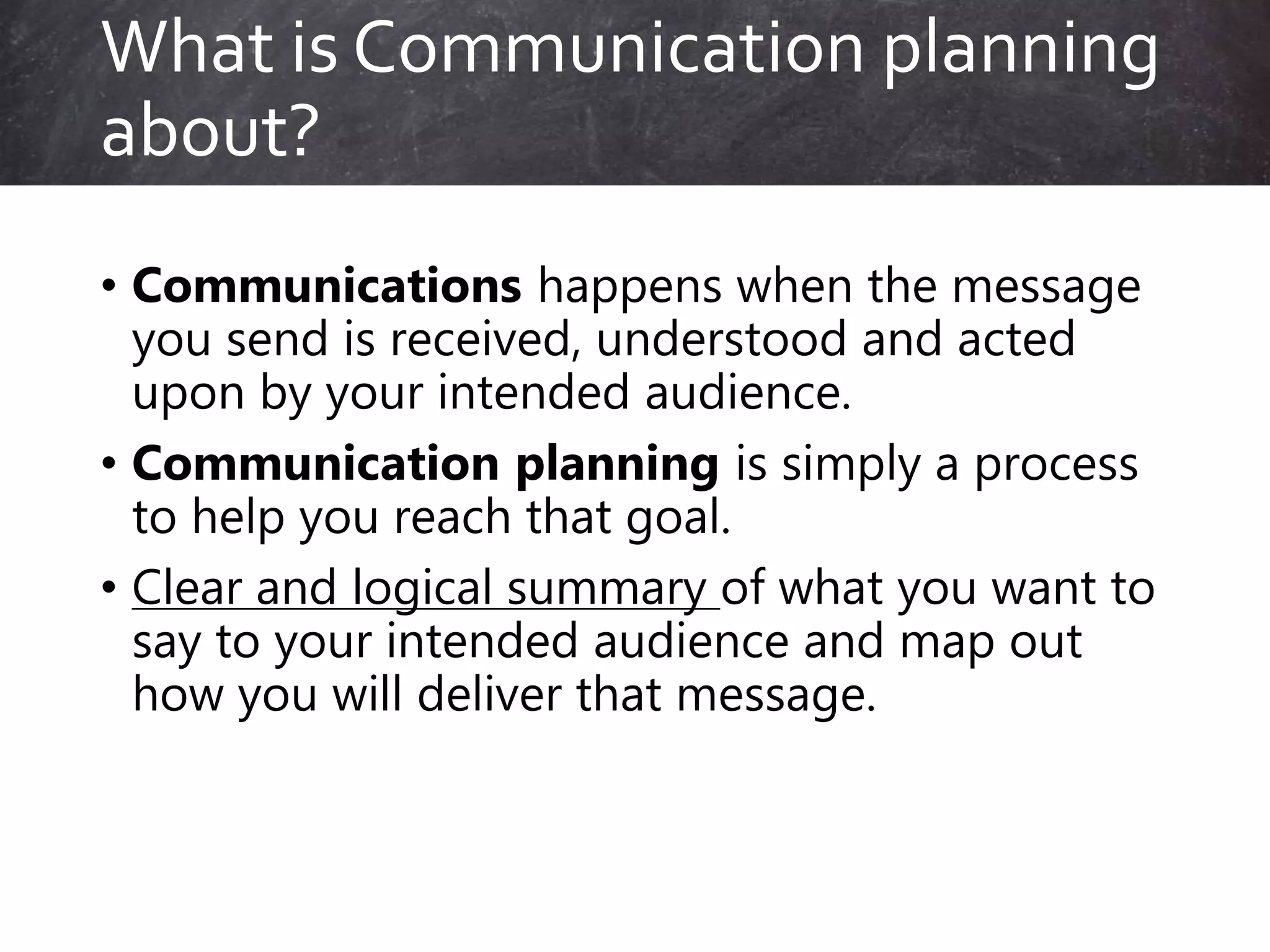
• Communications happens when the message
you send is received, understood and acted
upon by your intended audience.
• Communication planning is simply a process
to help you reach that goal.
• Clear and logical summary of what you want to
say to your intended audience and map out
how you will deliver that message.
What is Communication planning
about?
Why do we communicate at all?
To Inform Seek
Information
To persuade
To express emotions
Source: http://communicationtheory.org/why-do-we-communicate/
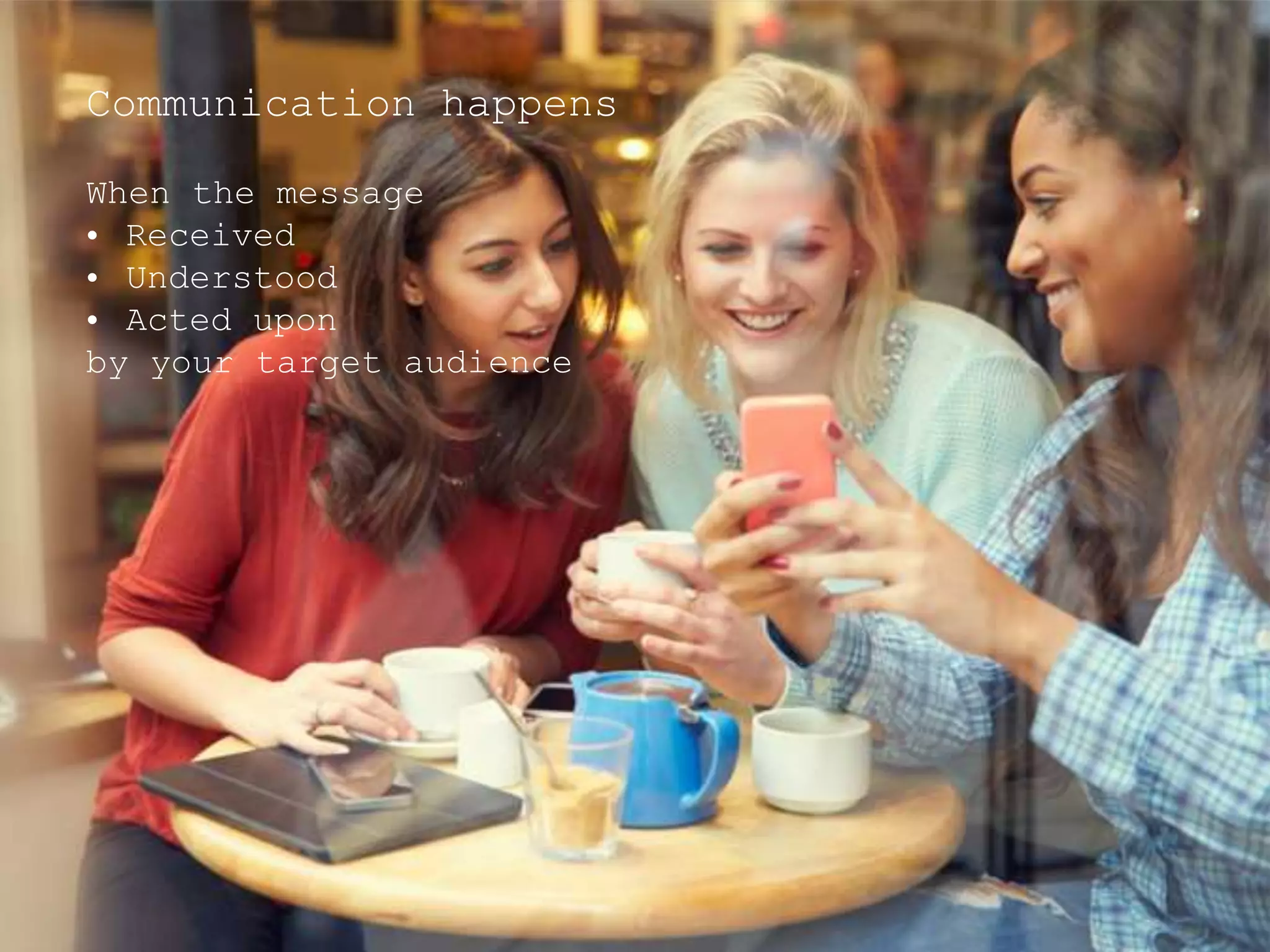
Communication happens
When the message
• Received
• Understood
• Acted upon
by your target audience
Communication planning is
simply a process
to reach that goal
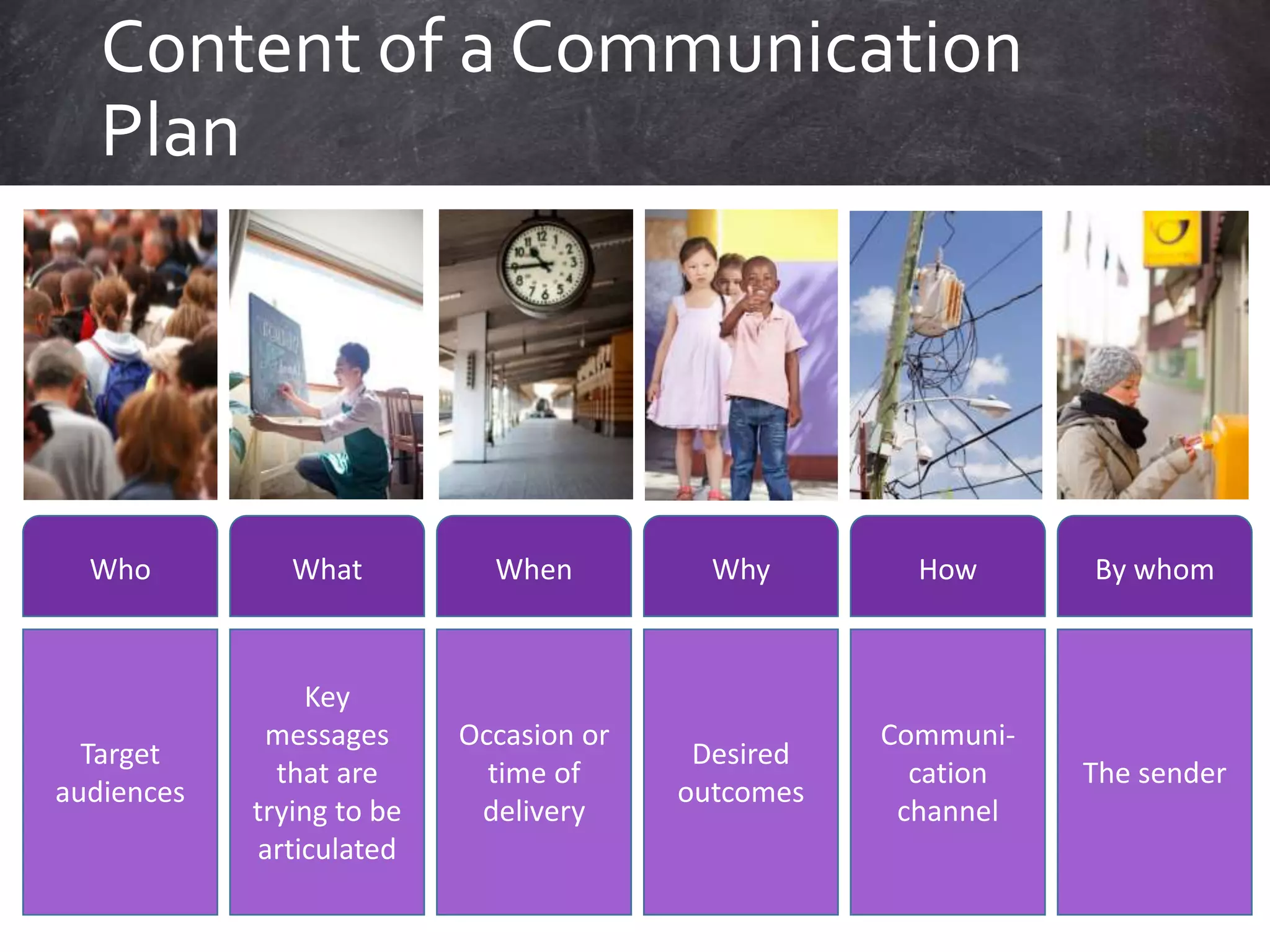
Content of a Communication
Plan
Target
audiences
Who
Key
messages
that are
trying to be
articulated
What
Occasion or
time of
delivery
When
Desired
outcomes
Why
Communi-
cation
channel
How
The sender
By whom
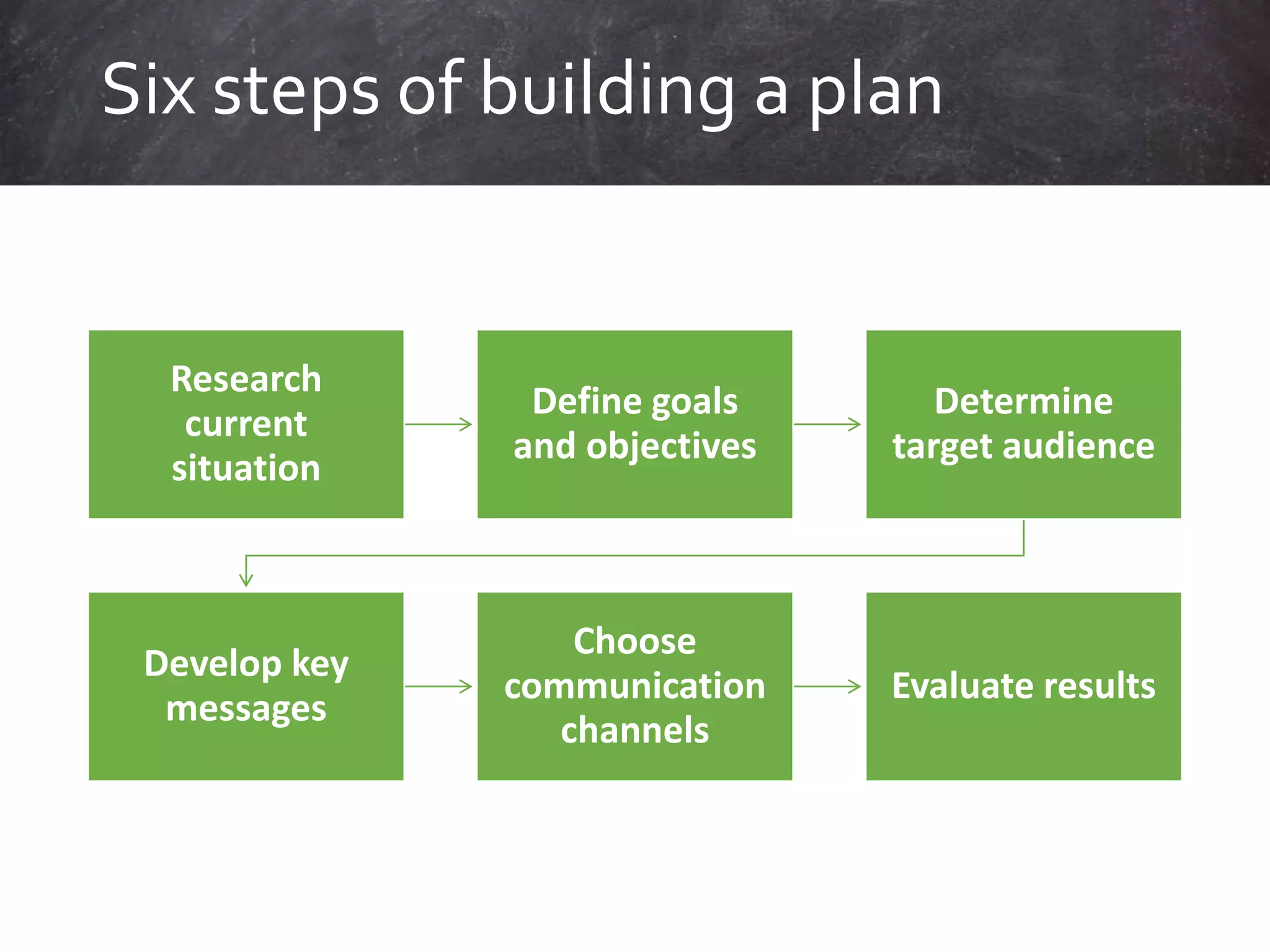
Research
current
situation
Define goals
and objectives
Determine
target audience
Develop key
messages
Choose
communication
channels
Evaluate results
Six steps of building a plan
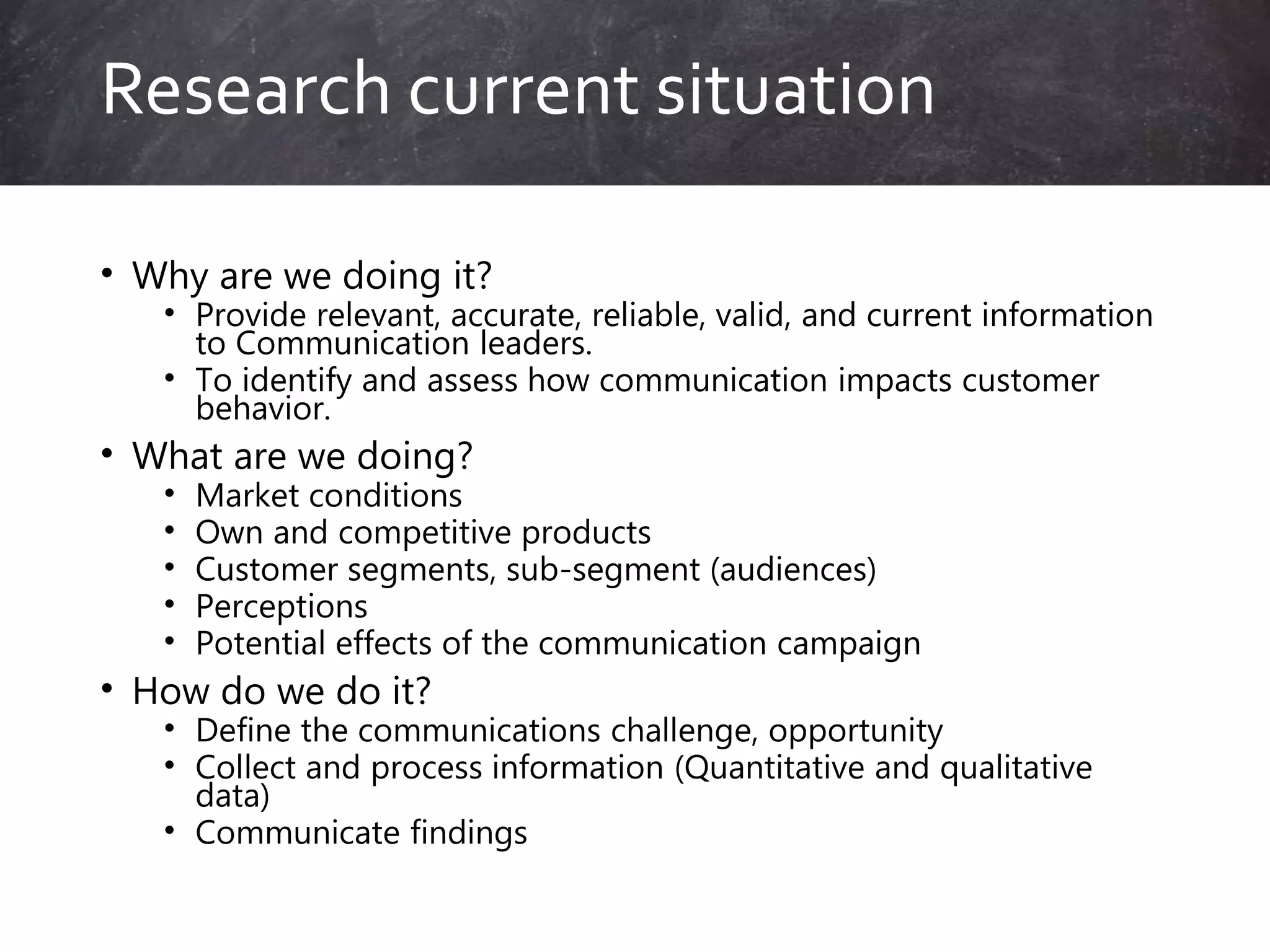
• Why are we doing it?
• Provide relevant, accurate, reliable, valid, and current information
to Communication leaders.
• To identify and assess how communication impacts customer
behavior.
• What are we doing?
• Market conditions
• Own and competitive products
• Customer segments, sub-segment (audiences)
• Perceptions
• Potential effects of the communication campaign
• How do we do it?
• Define the communications challenge, opportunity
• Collect and process information (Quantitative and qualitative
data)
• Communicate findings
Research current situation
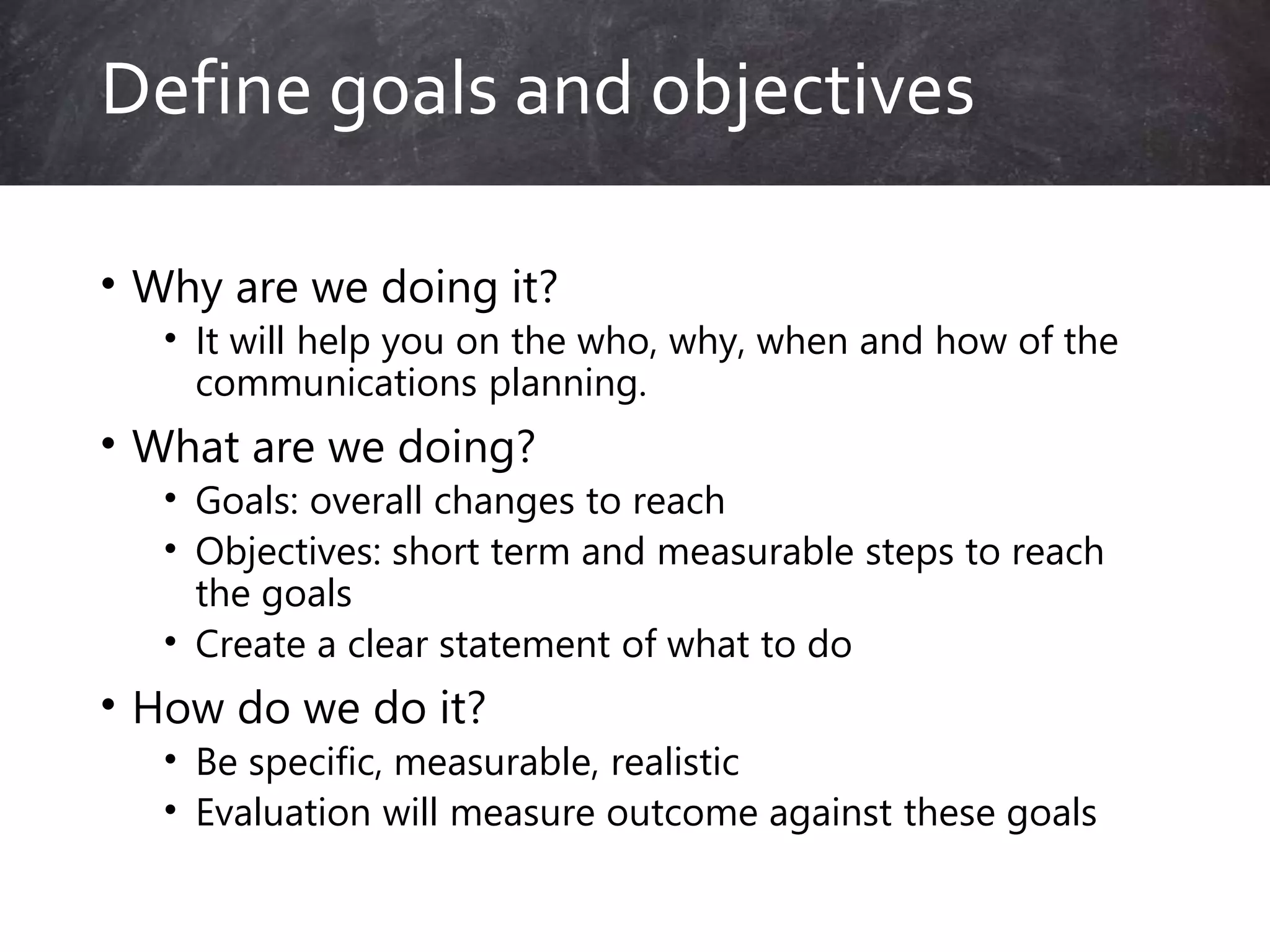
• Why are we doing it?
• It will help you on the who, why, when and how of the
communications planning.
• What are we doing?
• Goals: overall changes to reach
• Objectives: short term and measurable steps to reach
the goals
• Create a clear statement of what to do
• How do we do it?
• Be specific, measurable, realistic
• Evaluation will measure outcome against these goals
Define goals and objectives
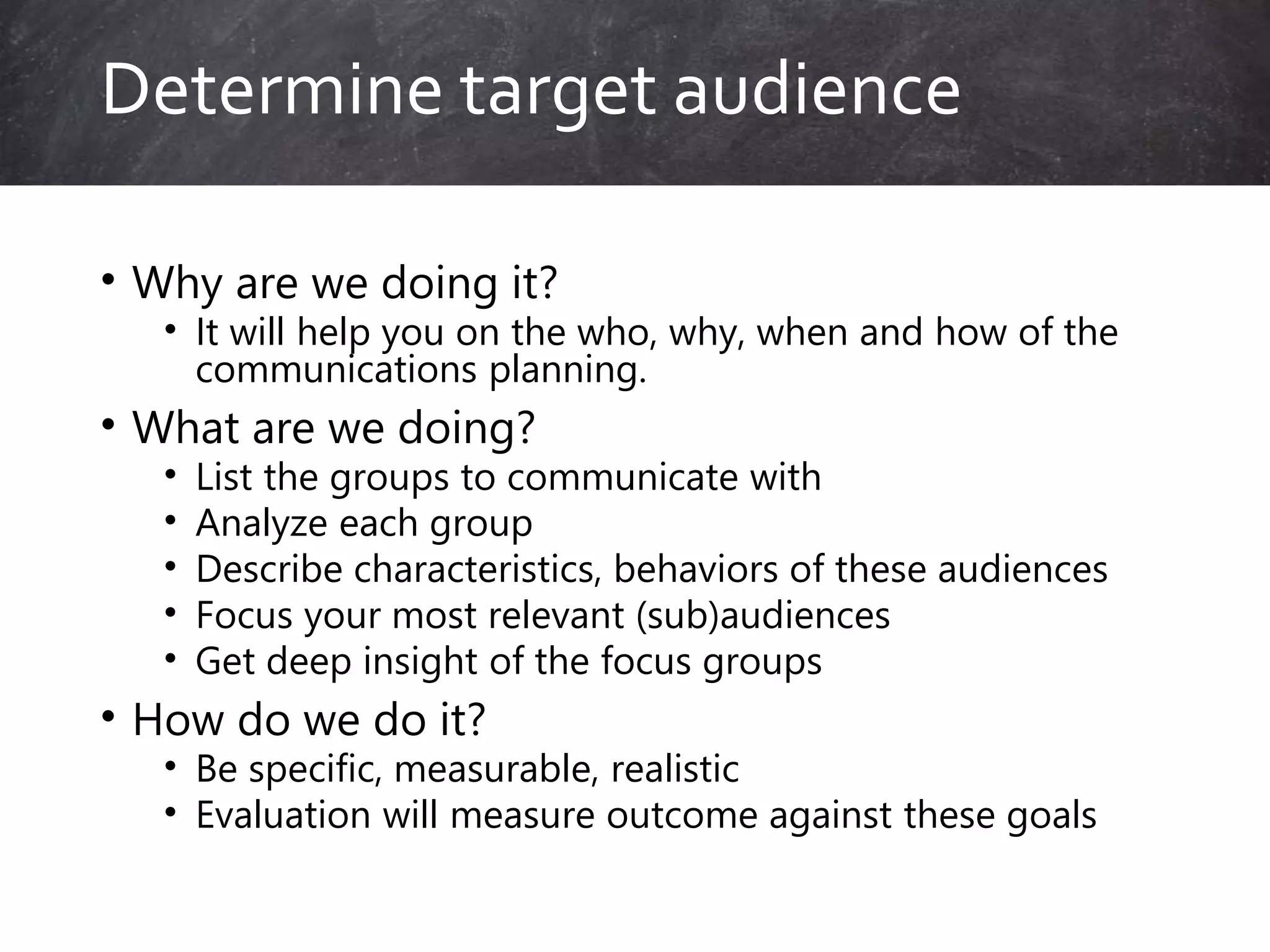
• Why are we doing it?
• It will help you on the who, why, when and how of the
communications planning.
• What are we doing?
• List the groups to communicate with
• Analyze each group
• Describe characteristics, behaviors of these audiences
• Focus your most relevant (sub)audiences
• Get deep insight of the focus groups
• How do we do it?
• Be specific, measurable, realistic
• Evaluation will measure outcome against these goals
Determine target audience
• Why are we doing it?
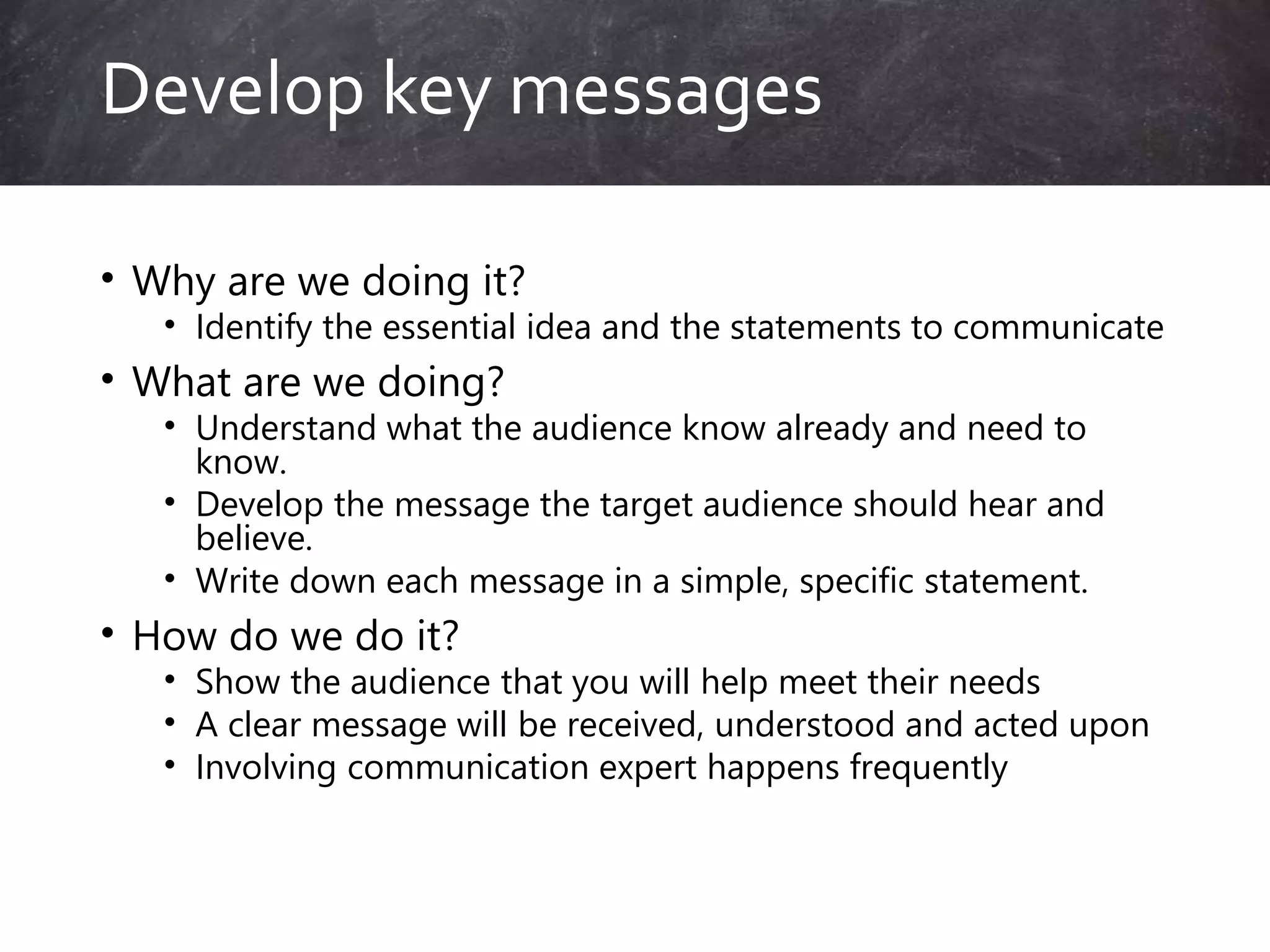
• Identify the essential idea and the statements to communicate
• What are we doing?
• Understand what the audience know already and need to
know.
• Develop the message the target audience should hear and
believe.
• Write down each message in a simple, specific statement.
• How do we do it?
• Show the audience that you will help meet their needs
• A clear message will be received, understood and acted upon
• Involving communication expert happens frequently
Develop key messages
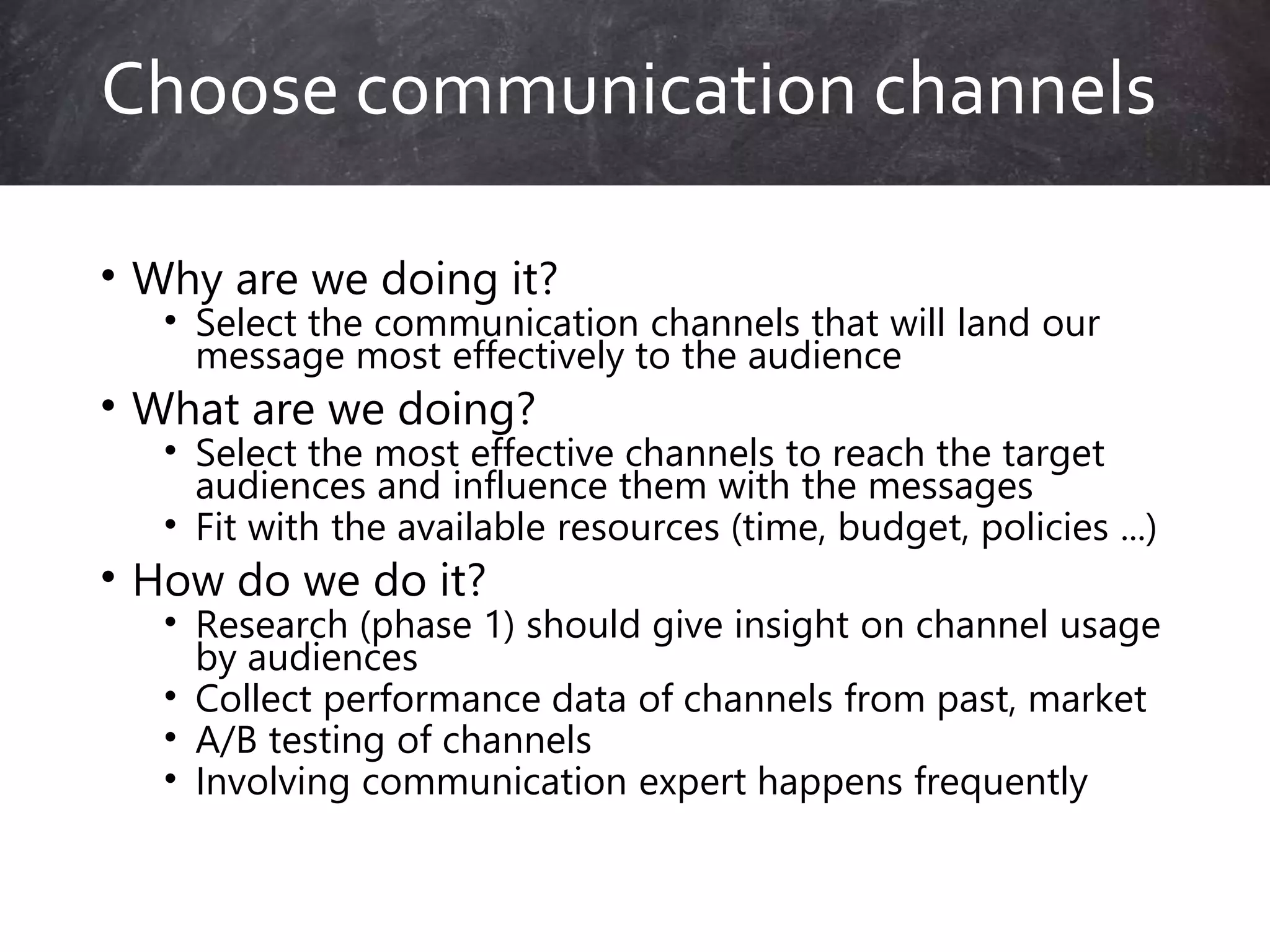
• Why are we doing it?
• Select the communication channels that will land our
message most effectively to the audience
• What are we doing?
• Select the most effective channels to reach the target
audiences and influence them with the messages
• Fit with the available resources (time, budget, policies ...)
• How do we do it?
• Research (phase 1) should give insight on channel usage
by audiences
• Collect performance data of channels from past, market
• A/B testing of channels
• Involving communication expert happens frequently
Choose communication channels
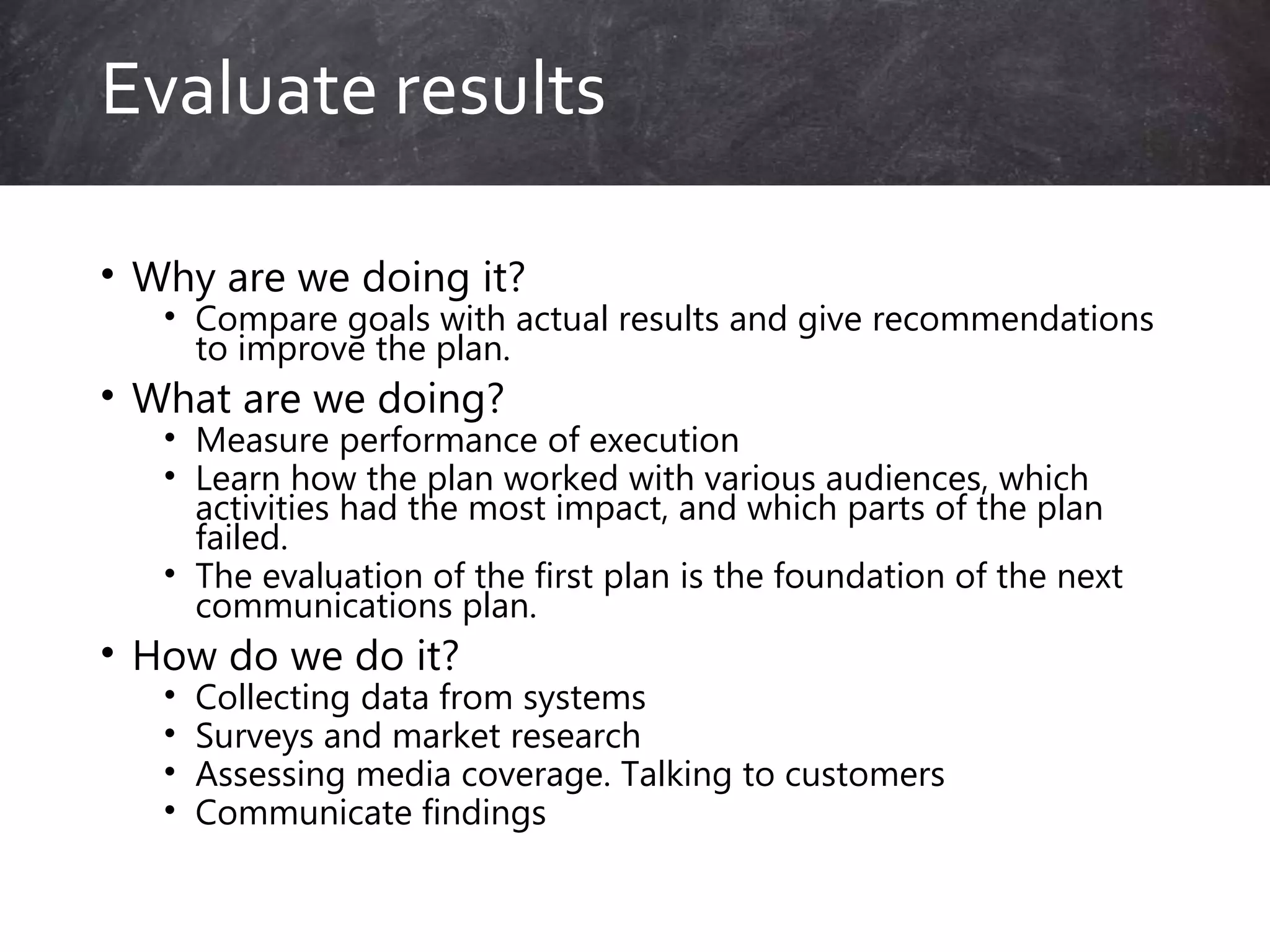
• Why are we doing it?
• Compare goals with actual results and give recommendations
to improve the plan.
• What are we doing?
• Measure performance of execution
• Learn how the plan worked with various audiences, which
activities had the most impact, and which parts of the plan
failed.
• The evaluation of the first plan is the foundation of the next
communications plan.
• How do we do it?
• Collecting data from systems
• Surveys and market research
• Assessing media coverage. Talking to customers
• Communicate findings
Evaluate results
Communication
planning

Introduction to communication planning

  • 1.
  • 2.
  • 3.
    1. We communicateto persuade: It means that we want someone to do something and this desire of ours is communicated. The mother patting the child to stop crying, the advertiser displaying a model in a new T-Shirt and the politician haranguing (urging) his audience to vote for him are all having the same objective of persuading, while communicating it differently. 2. We communicate in order to give or provide information: The science teacher demonstrating an experiment, the bank announcing a reduction in interest rates and the finance minister, presenting the budget are all communicating to provide information. 3. We communicate seeking information: A passer by asking you the way to the post-office, the student asking the teacher for some clarification or the investigating policeman making discreet enquiries are all seeking information by using this communication skill. 4. We communicate to express our emotions like courage or fear, joy or sorrow, satisfaction or disappointment with appropriate gestures and words. Some people have unlimited skill to emote, (i.e., to display excessive emotion) to suit the occasion. Our politicians are capable of emoting well, which by itself is a communication skill. Why do we communicate at all? Source: http://communicationtheory.org/why-do-we-communicate/
  • 4.
    • Communications happenswhen the message you send is received, understood and acted upon by your intended audience. • Communication planning is simply a process to help you reach that goal. • Clear and logical summary of what you want to say to your intended audience and map out how you will deliver that message. What is Communication planning about?
  • 5.
    Why do wecommunicate at all? To Inform Seek Information To persuade To express emotions Source: http://communicationtheory.org/why-do-we-communicate/
  • 6.
    Communication happens When themessage • Received • Understood • Acted upon by your target audience
  • 7.
    Communication planning is simplya process to reach that goal
  • 8.
    Content of aCommunication Plan Target audiences Who Key messages that are trying to be articulated What Occasion or time of delivery When Desired outcomes Why Communi- cation channel How The sender By whom
  • 9.
    Research current situation Define goals and objectives Determine targetaudience Develop key messages Choose communication channels Evaluate results Six steps of building a plan
  • 10.
    • Why arewe doing it? • Provide relevant, accurate, reliable, valid, and current information to Communication leaders. • To identify and assess how communication impacts customer behavior. • What are we doing? • Market conditions • Own and competitive products • Customer segments, sub-segment (audiences) • Perceptions • Potential effects of the communication campaign • How do we do it? • Define the communications challenge, opportunity • Collect and process information (Quantitative and qualitative data) • Communicate findings Research current situation
  • 11.
    • Why arewe doing it? • It will help you on the who, why, when and how of the communications planning. • What are we doing? • Goals: overall changes to reach • Objectives: short term and measurable steps to reach the goals • Create a clear statement of what to do • How do we do it? • Be specific, measurable, realistic • Evaluation will measure outcome against these goals Define goals and objectives
  • 12.
    • Why arewe doing it? • It will help you on the who, why, when and how of the communications planning. • What are we doing? • List the groups to communicate with • Analyze each group • Describe characteristics, behaviors of these audiences • Focus your most relevant (sub)audiences • Get deep insight of the focus groups • How do we do it? • Be specific, measurable, realistic • Evaluation will measure outcome against these goals Determine target audience
  • 13.
    • Why arewe doing it? • Identify the essential idea and the statements to communicate • What are we doing? • Understand what the audience know already and need to know. • Develop the message the target audience should hear and believe. • Write down each message in a simple, specific statement. • How do we do it? • Show the audience that you will help meet their needs • A clear message will be received, understood and acted upon • Involving communication expert happens frequently Develop key messages
  • 14.
    • Why arewe doing it? • Select the communication channels that will land our message most effectively to the audience • What are we doing? • Select the most effective channels to reach the target audiences and influence them with the messages • Fit with the available resources (time, budget, policies ...) • How do we do it? • Research (phase 1) should give insight on channel usage by audiences • Collect performance data of channels from past, market • A/B testing of channels • Involving communication expert happens frequently Choose communication channels
  • 15.
    • Why arewe doing it? • Compare goals with actual results and give recommendations to improve the plan. • What are we doing? • Measure performance of execution • Learn how the plan worked with various audiences, which activities had the most impact, and which parts of the plan failed. • The evaluation of the first plan is the foundation of the next communications plan. • How do we do it? • Collecting data from systems • Surveys and market research • Assessing media coverage. Talking to customers • Communicate findings Evaluate results
  • 16.

Editor's Notes

  • #6 “Who” - the target audiences “What” – the key messages that are trying to be articulated “When” – timing, it will specify the appropriate time of delivery for each message “Why” – the desired outcomes “How” - the communication vehicle (how the message will be delivered) “By whom” - the sender (determining who will deliver the information and how he or she is chosen)
  • #9 “Who” - the target audiences “What” – the key messages that are trying to be articulated “When” – timing, it will specify the appropriate time of delivery for each message “Why” – the desired outcomes “How” - the communication vehicle (how the message will be delivered) “By whom” - the sender (determining who will deliver the information and how he or she is chosen)