COMMUNICATION STRATEGYMCD2044| ORGANIZATIONAL COMMUNICATION - week three -
Communication StrategyWhat is Communication Strategy?Plans or methods that can be used or taught to facilitate communication proficiencyCommunication does not "just happen." Effective communication requires effective strategy - a coherent plan of action. To be effective, strategy must take three factors into account simultaneously
Communication StrategyWhat is Communication Strategy?As you formulate communication strategy, you should also consider:-	Your communication objectives.  What do you want 	from this interaction?-	Your communication style.  How will you approach 	your subject and your audience?-	Your credibility.  What does your audience think of 	you, and how will that affect their response?
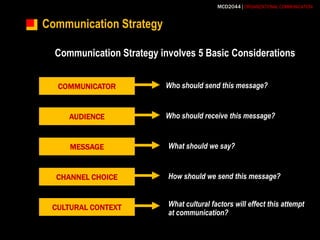
Communication StrategyCommunication Strategy involves 5 Basic ConsiderationsCOMMUNICATORWho should send this message?AUDIENCEWho should receive this message?MESSAGEWhat should we say?CHANNEL CHOICEHow should we send this message?CULTURAL CONTEXTWhat cultural factors will effect this attempt  at communication?
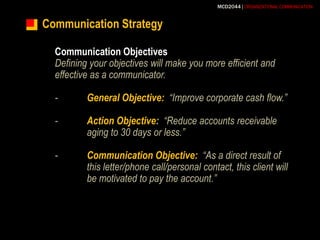
Communication StrategyCommunication ObjectivesDefining your objectives will make you more efficient and effective as a communicator.-	General Objective:  โ€œImprove corporate cash flow.โ€-	Action Objective:  โ€œReduce accounts receivable 	aging to 30 days or less.โ€-	Communication Objective:  โ€œAs a direct result of 	this letter/phone call/personal contact, this client will 	be motivated to pay the account.โ€
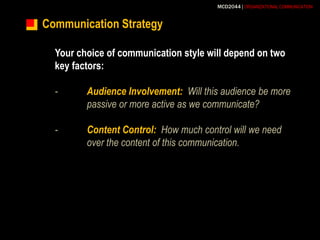
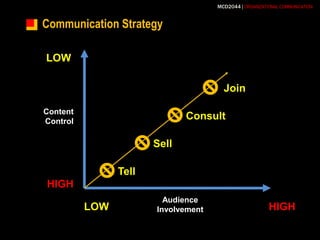
Communication StrategyYour choice of communication style will depend on two key factors:-	Audience Involvement:  Will this audience be more 	passive or more active as we communicate?-	Content Control:  How much control will we need 	over the content of this communication.
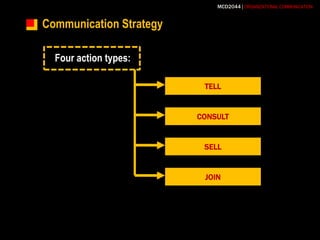
Communication StrategyFour action types:TELLCONSULTSELLJOIN
Communication StrategyLOWJoinContentControlConsultSellTellHIGHAudienceInvolvementHIGHLOW
Communication StrategyThe Tell/Sell StyleFeature lower audience involvement and higher content control.Use the tell style to inform and the sellstyle to persuade.In these situations:-	you have already sufficient information,-	you donโ€™t need to hear otherโ€™s opinions or ideas,-	you need or want to control message content yourself
Communication StrategyThe Consult/Join StyleFeature higher audience involvement and lower content controlUse the consult style to gather information or learn from the audience.  Use the join style to collaborate with members of the audience.In these situations:-	you do not have sufficient information,-	you need to hear otherโ€™s opinions, ideas, or input,-	you want to involve your audience in content.
Communication StrategyCommunication CredibilityFive factors will generally affect your credibility:-	Rank-	Goodwill-	Expertise-	Image-	Shared ValuesBegin by emphasizing your initial credibility and work to increase your acquired credibility with the audience.
Communication StrategyAudience StrategyInvolves answering four sets of questions:	-	Who are they?	-	What do they know?	-	What do they feel?	-	How can you motivate them?
Communication StrategyWho are they?Primary Audience:who will receive your written or spoken message directly?Secondary Audience:consider any hidden audiences who will receive your message indirectly.Gatekeepers:Is there someone you need to route your message through who might filter or block it?Opinion Leaders:Who has significant influence over members of the audience?Key Decision-Makers:Who has power to influence the outcome of the communication?
Communication StrategyHow do they know?How much background information do they need?How much new information do they need?What are their expectations and preferences?-	Style Preferences(formal or informal, direct or 	indirect)?-	Channel Preferences(paper, e-mail, face-to-face, 	group or individual)?-	Length and Format Preferences(how should this -	message appear to your audience)?
Communication StrategyHow do they feel?Whatโ€™s their level of interest in your message?Whatโ€™s their probable bias:  positive, negative, or neutral?How difficult is your desired outcome for them?  Will this be relatively easy for them to buy into, or somewhat difficult?
Communication StrategyHow can you motivate them?Shared Values and Common Ground:Begin with views and values you hold in common, then move to areas where disagreement is more likely.Goodwill and Reciprocity:  This is a form of bargaining. Rank and Reward/Punishment:Though inappropriate for most audiences, the removal of privileges or threats to do so may motivate the response you want.Message Structure:Arrangement of your message may help through inoculation techniques, segmented actions (โ€œfoot in the doorโ€), or two-sided arguments.
Message StrategyConsider Emphasis and OrganizationUsing the direct approach.โ€œThe committee recommends this policy for three reasons:  it will be cheaper, faster, and longer lasting.โ€Using the indirect approach.โ€œBecause it will be cheaper, faster, and longer lasting, the committee recommends this policy.โ€
Message StrategyThe DIRECT ApproachAdvantages of the direct approach:-	Improves comprehension.-	Itโ€™s audience-centered.-	It saves time.Why donโ€™t more people use the direct approach?-	Habit-	Suspense-	Academic Training-	Effort Involved
Message StrategyThe DIRECT ApproachWhen should you consider using a direct communication approach to your audience?-	All non-sensitive messages with no emotional 	overtones.-	Sensitive messages if the audienceโ€™s bias is positive.-	Sensitive messages if the audience is results-	oriented.-	Sensitive messages if your credibility is particularly 	high.
Message StrategyThe IN-DIRECT ApproachWhen should you consider using an indirect communication approach to your audience?Because this approach takes longer and does not take advantage of an audienceโ€™s initial attentiveness at the beginning of a message, use it only when:-	Sensitive message with emotional overtones and-	Your audienceโ€™s bias is negative and-	Your audience is analysis-oriented and-	Your credibility is low.
Channel Choice StrategyWriting or Speaking?Writingproducts a permanent record, can be used to convey great detail, is often much more precise, and can be used for careful wording.Speaking produces a richer context, including non-verbal cues, less rigidity, less permanence, no permanent record, and may be quicker.
Channel Choice StrategyFormal of Informal?Formalchannels may be needed for legal negotiations, tend to be precise, controlled, logical, focused, organized, conclusive, decisive, and action-oriented.Informalchannels may be better when you need to gather new ideas; tend to be fast, interactive, uninhibited, innovative, creative, open, candid, communal, and flexible.
Channel Choice StrategyIndividual of Group?Individual channels help build individual relationships, gain individual responses, may be more secure or private.  Example:  telephone, voice mail, personal memos, letters, fax, or e-mail.Group channels help build group relationships or identity, gain group responses (including consensus), avoid excluding people, make sure all audience members receive the message at the same time.  Example:  group meetings, electronic bulletin boards, news groups, videoconferences, conference calls, memos, fax, or e-mail.
Cultural StrategyNot all cultures react to senders, messages, or channels in the same way.  Itโ€™s best to consider your audienceโ€™s probable reaction from a cultural point of view.-	Time-	Power Distance-	Communication Style-	Non-verbal Mannerisms-	Language
Thank You & Have a Nice Day!

week 2- chapter 1

  • 1.
  • 2.
    Communication StrategyWhat isCommunication Strategy?Plans or methods that can be used or taught to facilitate communication proficiencyCommunication does not "just happen." Effective communication requires effective strategy - a coherent plan of action. To be effective, strategy must take three factors into account simultaneously
  • 3.
    Communication StrategyWhat isCommunication Strategy?As you formulate communication strategy, you should also consider:- Your communication objectives. What do you want from this interaction?- Your communication style. How will you approach your subject and your audience?- Your credibility. What does your audience think of you, and how will that affect their response?
  • 4.
    Communication StrategyCommunication Strategyinvolves 5 Basic ConsiderationsCOMMUNICATORWho should send this message?AUDIENCEWho should receive this message?MESSAGEWhat should we say?CHANNEL CHOICEHow should we send this message?CULTURAL CONTEXTWhat cultural factors will effect this attempt at communication?
  • 5.
    Communication StrategyCommunication ObjectivesDefiningyour objectives will make you more efficient and effective as a communicator.- General Objective: โ€œImprove corporate cash flow.โ€- Action Objective: โ€œReduce accounts receivable aging to 30 days or less.โ€- Communication Objective: โ€œAs a direct result of this letter/phone call/personal contact, this client will be motivated to pay the account.โ€
  • 6.
    Communication StrategyYour choiceof communication style will depend on two key factors:- Audience Involvement: Will this audience be more passive or more active as we communicate?- Content Control: How much control will we need over the content of this communication.
  • 7.
    Communication StrategyFour actiontypes:TELLCONSULTSELLJOIN
  • 8.
  • 9.
    Communication StrategyThe Tell/SellStyleFeature lower audience involvement and higher content control.Use the tell style to inform and the sellstyle to persuade.In these situations:- you have already sufficient information,- you donโ€™t need to hear otherโ€™s opinions or ideas,- you need or want to control message content yourself
  • 10.
    Communication StrategyThe Consult/JoinStyleFeature higher audience involvement and lower content controlUse the consult style to gather information or learn from the audience. Use the join style to collaborate with members of the audience.In these situations:- you do not have sufficient information,- you need to hear otherโ€™s opinions, ideas, or input,- you want to involve your audience in content.
  • 11.
    Communication StrategyCommunication CredibilityFivefactors will generally affect your credibility:- Rank- Goodwill- Expertise- Image- Shared ValuesBegin by emphasizing your initial credibility and work to increase your acquired credibility with the audience.
  • 12.
    Communication StrategyAudience StrategyInvolvesanswering four sets of questions: - Who are they? - What do they know? - What do they feel? - How can you motivate them?
  • 13.
    Communication StrategyWho arethey?Primary Audience:who will receive your written or spoken message directly?Secondary Audience:consider any hidden audiences who will receive your message indirectly.Gatekeepers:Is there someone you need to route your message through who might filter or block it?Opinion Leaders:Who has significant influence over members of the audience?Key Decision-Makers:Who has power to influence the outcome of the communication?
  • 14.
    Communication StrategyHow dothey know?How much background information do they need?How much new information do they need?What are their expectations and preferences?- Style Preferences(formal or informal, direct or indirect)?- Channel Preferences(paper, e-mail, face-to-face, group or individual)?- Length and Format Preferences(how should this - message appear to your audience)?
  • 15.
    Communication StrategyHow dothey feel?Whatโ€™s their level of interest in your message?Whatโ€™s their probable bias: positive, negative, or neutral?How difficult is your desired outcome for them? Will this be relatively easy for them to buy into, or somewhat difficult?
  • 16.
    Communication StrategyHow canyou motivate them?Shared Values and Common Ground:Begin with views and values you hold in common, then move to areas where disagreement is more likely.Goodwill and Reciprocity: This is a form of bargaining. Rank and Reward/Punishment:Though inappropriate for most audiences, the removal of privileges or threats to do so may motivate the response you want.Message Structure:Arrangement of your message may help through inoculation techniques, segmented actions (โ€œfoot in the doorโ€), or two-sided arguments.
  • 17.
    Message StrategyConsider Emphasisand OrganizationUsing the direct approach.โ€œThe committee recommends this policy for three reasons: it will be cheaper, faster, and longer lasting.โ€Using the indirect approach.โ€œBecause it will be cheaper, faster, and longer lasting, the committee recommends this policy.โ€
  • 18.
    Message StrategyThe DIRECTApproachAdvantages of the direct approach:- Improves comprehension.- Itโ€™s audience-centered.- It saves time.Why donโ€™t more people use the direct approach?- Habit- Suspense- Academic Training- Effort Involved
  • 19.
    Message StrategyThe DIRECTApproachWhen should you consider using a direct communication approach to your audience?- All non-sensitive messages with no emotional overtones.- Sensitive messages if the audienceโ€™s bias is positive.- Sensitive messages if the audience is results- oriented.- Sensitive messages if your credibility is particularly high.
  • 20.
    Message StrategyThe IN-DIRECTApproachWhen should you consider using an indirect communication approach to your audience?Because this approach takes longer and does not take advantage of an audienceโ€™s initial attentiveness at the beginning of a message, use it only when:- Sensitive message with emotional overtones and- Your audienceโ€™s bias is negative and- Your audience is analysis-oriented and- Your credibility is low.
  • 21.
    Channel Choice StrategyWritingor Speaking?Writingproducts a permanent record, can be used to convey great detail, is often much more precise, and can be used for careful wording.Speaking produces a richer context, including non-verbal cues, less rigidity, less permanence, no permanent record, and may be quicker.
  • 22.
    Channel Choice StrategyFormalof Informal?Formalchannels may be needed for legal negotiations, tend to be precise, controlled, logical, focused, organized, conclusive, decisive, and action-oriented.Informalchannels may be better when you need to gather new ideas; tend to be fast, interactive, uninhibited, innovative, creative, open, candid, communal, and flexible.
  • 23.
    Channel Choice StrategyIndividualof Group?Individual channels help build individual relationships, gain individual responses, may be more secure or private. Example: telephone, voice mail, personal memos, letters, fax, or e-mail.Group channels help build group relationships or identity, gain group responses (including consensus), avoid excluding people, make sure all audience members receive the message at the same time. Example: group meetings, electronic bulletin boards, news groups, videoconferences, conference calls, memos, fax, or e-mail.
  • 24.
    Cultural StrategyNot allcultures react to senders, messages, or channels in the same way. Itโ€™s best to consider your audienceโ€™s probable reaction from a cultural point of view.- Time- Power Distance- Communication Style- Non-verbal Mannerisms- Language
  • 25.
    Thank You &Have a Nice Day!