Uncertainty Management
Theory
Katelyn Osborne
COMM 6120
Uncertainty Management Theory
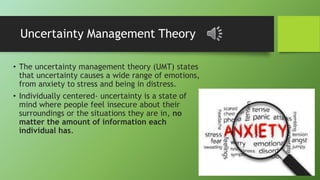
• The uncertainty management theory (UMT) states
that uncertainty causes a wide range of emotions,
from anxiety to stress and being in distress.
• Individually centered- uncertainty is a state of
mind where people feel insecure about their
surroundings or the situations they are in, no
matter the amount of information each
individual has.
UMT
• UMT not only helps understand the role of information‐seeking but
also information‐avoiding in different interpersonal
communication contexts.
• Understand how individuals use communication to cope with
various questions.
• Interpersonal relationships: friendships, romantic and marital
relationships, familial, professional, and health care centered
relationships
Different Levels of Uncertainty & Their Effects
• Uncertainty theories (uncertainty reduction theory, uncertainty
management theory, & action assembly theory) are tools to explain how
individuals assess, manage, and cope with difficult and complex
situations. People appraise uncertainty differently.
• Negative uncertainty- causing anxiety & stress
• Positive uncertainty- interaction is an opportunity, viewed with optimism
• Neutral uncertainty- seen as a “fact of life” & accepted for what it is
• Researchers study the impact that appraisal has on communication
strategies.
• Are humans are invariably motivated to reduce uncertainty?
• Are there situations where a person desires to maintain or even increase
uncertainty?
Health Care Provider-Patient Interaction:
Information Seeking & Avoiding
• Maintaining health can become more or less prioritized and this will determine their level of
information seeking.
• Do patients feel qualified to understand medical information and terminology? If not, information
seeking is not a goal.
• Acquiring the information will help in managing their health.
• Ask questions reduce the uncertainty increase medical awareness and preserve hope
• Providers and patients should keep open communication and
continually reevaluate the goals of patients.
• Uncertainty management theory has been applied to healthcare communication for many different
health fields- from end of life care and oncology to breast self-examinations.
• UMT has been used extensively to focus on patient involvement and information preferences of
individuals that have been diagnosed with HIV and AIDS.
• It has also been helpful as the application for those suffering from spinal cord injuries as patients
must adjust to life with a disability.
Other Real World UMT Applications
• Rapid changes lead to uncertainty.
• Perceptions of fairness
• Intercultural communication- avoidance or brief, tense interactions
• Anxiety and uncertainty need to be managed in order to have
effective and satisfying communication.
• Management
• Rehearsing different scenarios
• Researching potential topics of
discussion beforehand
4 minutes total so far
Other Ways Of Managing Uncertainty
• Cognitive behavioral therapy (CBT)
• Talking to someone you trust
• Taking prescribed antidepressants
• It is important to note that uncertainty does not always produce
anxiety.
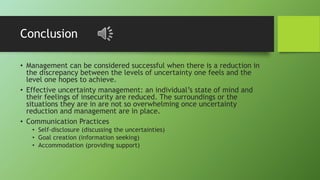
UMT Used in Different Industries
• Guidelines For Company To Follow to Reduce Uncertainty
• Analytic techniques used that do not require high accuracy allow for
stability and success during times of uncertainty
• Simple statistical models offer more reliability than complex ones.
• Prepare for multiple outcomes.
• Identify high influencing individuals and popular
products and services.
• Focus on evaluation of initiatives on inputs.
• Move and respond quickly in communication efforts.
• Cultivate a reputation for extreme trust.
Conclusion
• Management can be considered successful when there is a reduction in
the discrepancy between the levels of uncertainty one feels and the
level one hopes to achieve.
• Effective uncertainty management: an individual’s state of mind and
their feelings of insecurity are reduced. The surroundings or the
situations they are in are not so overwhelming once uncertainty
reduction and management are in place.
• Communication Practices
• Self-disclosure (discussing the uncertainties)
• Goal creation (information seeking)
• Accommodation (providing support)
References
• Bos, K. & Lind, A. E. (2002). Uncertainty management by means of fairness judgements. Advances
in Experimental Social Psychology. Vol. 34. 1-60. Retrieved from https://doi.org/10.1016/S0065-
2601(02)80003-X
• Brashers, D.E. (2006). Communication and Uncertainty Management. Journal of Communication.
DOI:10.1111/j.1460-2466.2001.tb0292.x
• Bylund, C.L., Peterson, E., & Cameron, K. (2012). A practitioner’s guide to interpersonal
communication theory: An overview and exploration of selected theories. Patient Education and
Counseling. 87 (2012), 261-267. Retrieved from https://bit.ly/2rXmNk7
• Collingwood, J. (2016). Tackling the Fears of the Worried Well. Psych Central. Retrieved from
https://psychcentral.com/lib/tackling-the-fears-of-the-worried-well/
• Greeven, A. (2007). Cognitive behavior therapy and paroxetine in the treatment of hypochondriasis:
a randomized controlled trial. The American Journal of Psychiatry. Vol. 164. 91-99.
• Gudykunst, W.D. (1995). Anxiety/uncertainty management (AUM) theory: Current status.
International and Intercultural Communication Annual. Vol. 19. Retrieved from
http://psycnet.apa.org/record/1995-97866-001
• Hines, S.C., Babrow, A.S., & Moss, A.H. (1997). Communication and Problematic Integration in End-
of-Life Decisions: Dialysis Decisions among the Elderly. Health Commun. 9 (3), 199-217.
References Continued
• Peppers, D. (2012). 6 Strategies For Dealing With Uncertainty In Business. Fast Company. Retrieved
from https://bit.ly/2rsOKzq
• Rains, S.A. & Tukachinsky, R. (2015) Information Seeking in Uncertainty Management Theory:
Exposure to Information about Medical Uncertainty and Information- Processing Orientation as
Predictors of Uncertainty Management Success. J Health Commun. 20 (11), 1275-1286. DOI:
10.1080/10810730.2015.1018641. Retrieved from https://www.ncbi.nlm.nih.gov/pubmed/26132807
• Roloff, M.E. (2015). Theorizing Interpersonal Communication: Progress and Problematic Practices.
Communication Theory, 25 (4), 420-425. DOI: 10.1111/comt.12081.
• Samochowiec, J. & Florack, A. (2010). Intercultural Contact under Uncertainty: The Impact of
Predictability and Anxiety on the Willingness to Interact with a Member from an Unknown Cultural
Group. International Journal of Intercultural Relations. Retrieved from https://bit.ly/2KHXevd
• Stephan, W.G., Stephan, C.W., & Gudykunst, W.B. (1999). Anxiety in intergroup relations: A
comparison of anxiety/uncertainty management theory and integrated threat theory. International
Journal of Intercultural Relations. 23 (4), 613-628. Retrieved from https://doi.org/10.1016/S0147-
1767(99)00012-7
• Stone, A.M. (2015). Uncertainty Management Theory. Wiley Online Library.
DOI:10.1002/9781118540190.wbeic120. Retrieved from https://bit.ly/2x50Aqf

Uncertainty Management Theory

  • 1.
  • 2.
    Uncertainty Management Theory •The uncertainty management theory (UMT) states that uncertainty causes a wide range of emotions, from anxiety to stress and being in distress. • Individually centered- uncertainty is a state of mind where people feel insecure about their surroundings or the situations they are in, no matter the amount of information each individual has.
  • 3.
    UMT • UMT notonly helps understand the role of information‐seeking but also information‐avoiding in different interpersonal communication contexts. • Understand how individuals use communication to cope with various questions. • Interpersonal relationships: friendships, romantic and marital relationships, familial, professional, and health care centered relationships
  • 4.
    Different Levels ofUncertainty & Their Effects • Uncertainty theories (uncertainty reduction theory, uncertainty management theory, & action assembly theory) are tools to explain how individuals assess, manage, and cope with difficult and complex situations. People appraise uncertainty differently. • Negative uncertainty- causing anxiety & stress • Positive uncertainty- interaction is an opportunity, viewed with optimism • Neutral uncertainty- seen as a “fact of life” & accepted for what it is • Researchers study the impact that appraisal has on communication strategies. • Are humans are invariably motivated to reduce uncertainty? • Are there situations where a person desires to maintain or even increase uncertainty?
  • 5.
    Health Care Provider-PatientInteraction: Information Seeking & Avoiding • Maintaining health can become more or less prioritized and this will determine their level of information seeking. • Do patients feel qualified to understand medical information and terminology? If not, information seeking is not a goal. • Acquiring the information will help in managing their health. • Ask questions reduce the uncertainty increase medical awareness and preserve hope • Providers and patients should keep open communication and continually reevaluate the goals of patients. • Uncertainty management theory has been applied to healthcare communication for many different health fields- from end of life care and oncology to breast self-examinations. • UMT has been used extensively to focus on patient involvement and information preferences of individuals that have been diagnosed with HIV and AIDS. • It has also been helpful as the application for those suffering from spinal cord injuries as patients must adjust to life with a disability.
  • 6.
    Other Real WorldUMT Applications • Rapid changes lead to uncertainty. • Perceptions of fairness • Intercultural communication- avoidance or brief, tense interactions • Anxiety and uncertainty need to be managed in order to have effective and satisfying communication. • Management • Rehearsing different scenarios • Researching potential topics of discussion beforehand 4 minutes total so far
  • 7.
    Other Ways OfManaging Uncertainty • Cognitive behavioral therapy (CBT) • Talking to someone you trust • Taking prescribed antidepressants • It is important to note that uncertainty does not always produce anxiety.
  • 8.
    UMT Used inDifferent Industries • Guidelines For Company To Follow to Reduce Uncertainty • Analytic techniques used that do not require high accuracy allow for stability and success during times of uncertainty • Simple statistical models offer more reliability than complex ones. • Prepare for multiple outcomes. • Identify high influencing individuals and popular products and services. • Focus on evaluation of initiatives on inputs. • Move and respond quickly in communication efforts. • Cultivate a reputation for extreme trust.
  • 9.
    Conclusion • Management canbe considered successful when there is a reduction in the discrepancy between the levels of uncertainty one feels and the level one hopes to achieve. • Effective uncertainty management: an individual’s state of mind and their feelings of insecurity are reduced. The surroundings or the situations they are in are not so overwhelming once uncertainty reduction and management are in place. • Communication Practices • Self-disclosure (discussing the uncertainties) • Goal creation (information seeking) • Accommodation (providing support)
  • 10.
    References • Bos, K.& Lind, A. E. (2002). Uncertainty management by means of fairness judgements. Advances in Experimental Social Psychology. Vol. 34. 1-60. Retrieved from https://doi.org/10.1016/S0065- 2601(02)80003-X • Brashers, D.E. (2006). Communication and Uncertainty Management. Journal of Communication. DOI:10.1111/j.1460-2466.2001.tb0292.x • Bylund, C.L., Peterson, E., & Cameron, K. (2012). A practitioner’s guide to interpersonal communication theory: An overview and exploration of selected theories. Patient Education and Counseling. 87 (2012), 261-267. Retrieved from https://bit.ly/2rXmNk7 • Collingwood, J. (2016). Tackling the Fears of the Worried Well. Psych Central. Retrieved from https://psychcentral.com/lib/tackling-the-fears-of-the-worried-well/ • Greeven, A. (2007). Cognitive behavior therapy and paroxetine in the treatment of hypochondriasis: a randomized controlled trial. The American Journal of Psychiatry. Vol. 164. 91-99. • Gudykunst, W.D. (1995). Anxiety/uncertainty management (AUM) theory: Current status. International and Intercultural Communication Annual. Vol. 19. Retrieved from http://psycnet.apa.org/record/1995-97866-001 • Hines, S.C., Babrow, A.S., & Moss, A.H. (1997). Communication and Problematic Integration in End- of-Life Decisions: Dialysis Decisions among the Elderly. Health Commun. 9 (3), 199-217.
  • 11.
    References Continued • Peppers,D. (2012). 6 Strategies For Dealing With Uncertainty In Business. Fast Company. Retrieved from https://bit.ly/2rsOKzq • Rains, S.A. & Tukachinsky, R. (2015) Information Seeking in Uncertainty Management Theory: Exposure to Information about Medical Uncertainty and Information- Processing Orientation as Predictors of Uncertainty Management Success. J Health Commun. 20 (11), 1275-1286. DOI: 10.1080/10810730.2015.1018641. Retrieved from https://www.ncbi.nlm.nih.gov/pubmed/26132807 • Roloff, M.E. (2015). Theorizing Interpersonal Communication: Progress and Problematic Practices. Communication Theory, 25 (4), 420-425. DOI: 10.1111/comt.12081. • Samochowiec, J. & Florack, A. (2010). Intercultural Contact under Uncertainty: The Impact of Predictability and Anxiety on the Willingness to Interact with a Member from an Unknown Cultural Group. International Journal of Intercultural Relations. Retrieved from https://bit.ly/2KHXevd • Stephan, W.G., Stephan, C.W., & Gudykunst, W.B. (1999). Anxiety in intergroup relations: A comparison of anxiety/uncertainty management theory and integrated threat theory. International Journal of Intercultural Relations. 23 (4), 613-628. Retrieved from https://doi.org/10.1016/S0147- 1767(99)00012-7 • Stone, A.M. (2015). Uncertainty Management Theory. Wiley Online Library. DOI:10.1002/9781118540190.wbeic120. Retrieved from https://bit.ly/2x50Aqf