Introduction to
Communication
DEVC 205
Ernesto D. Doloso Jr., LPT, MA
PhD in Development Studies
University of the Philippines – Los Banos
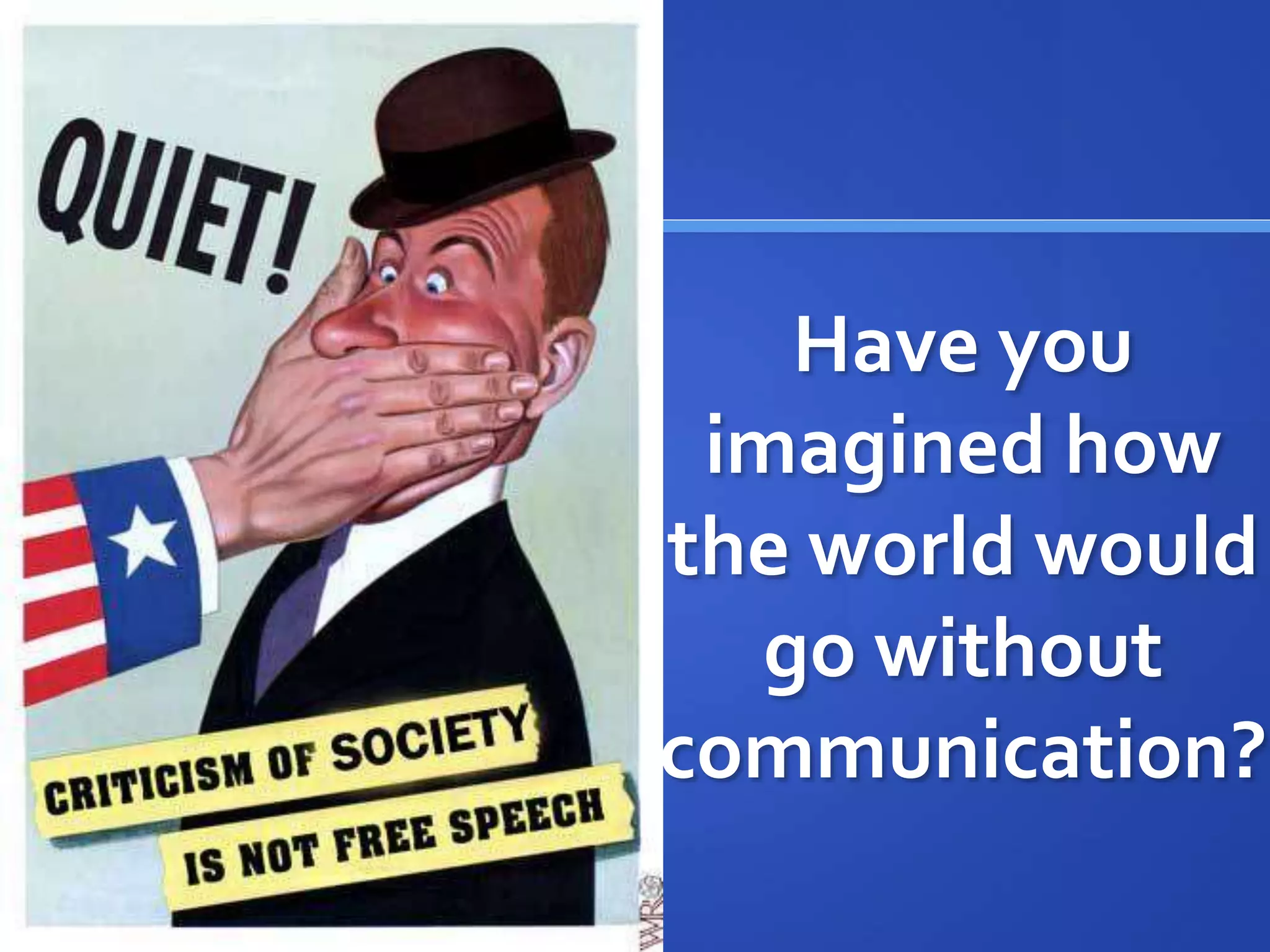
Have you
imagined how
the world would
go without
communication?
Are you
aware that
you are
spending
most of your
waking hours
talking?
Definitions of
Communication
Communication
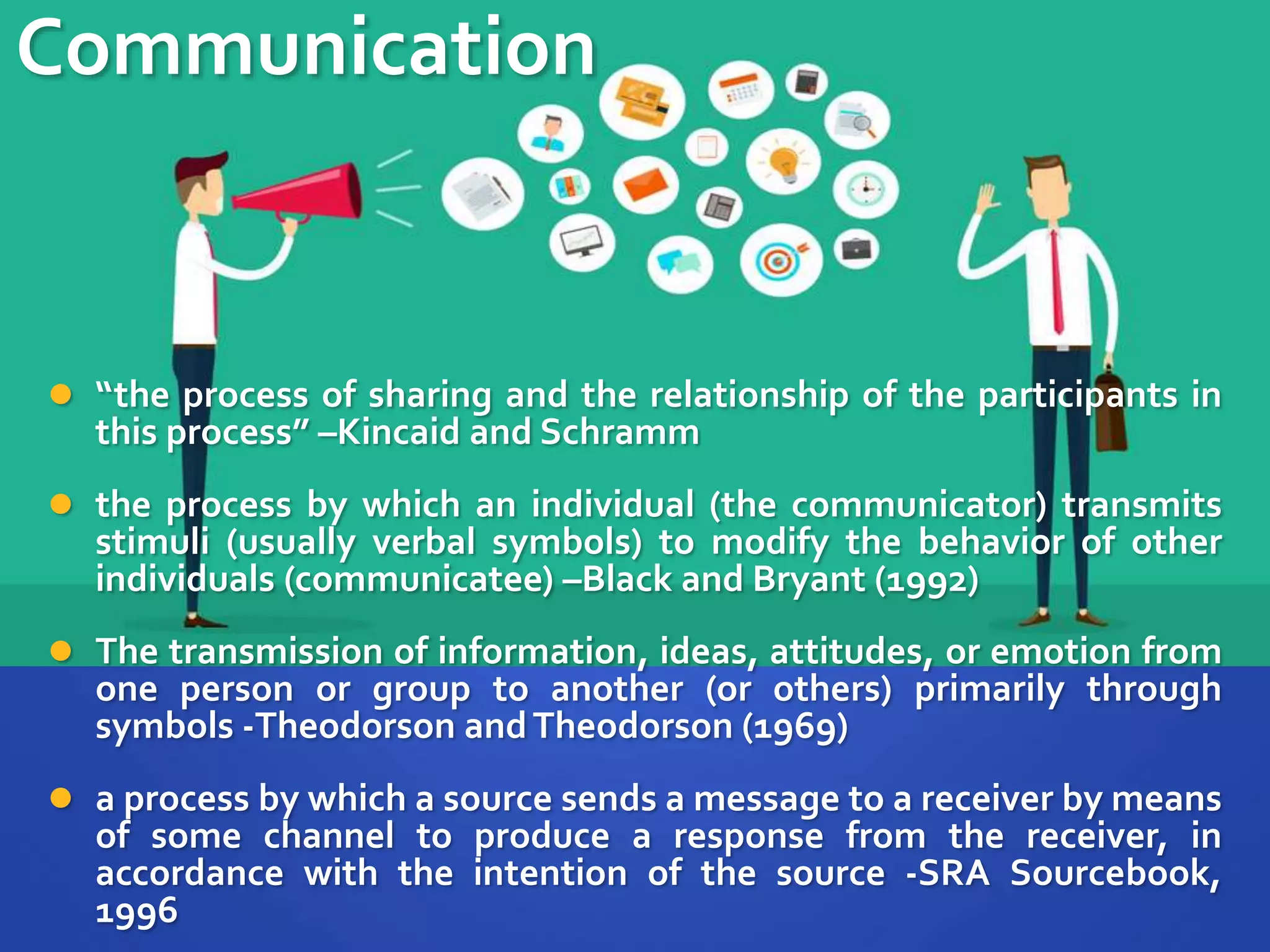
 “the process of sharing and the relationship of the participants in
this process” –Kincaid and Schramm
 the process by which an individual (the communicator) transmits
stimuli (usually verbal symbols) to modify the behavior of other
individuals (communicatee) –Black and Bryant (1992)
 The transmission of information, ideas, attitudes, or emotion from
one person or group to another (or others) primarily through
symbols -Theodorson andTheodorson (1969)
 a process by which a source sends a message to a receiver by means
of some channel to produce a response from the receiver, in
accordance with the intention of the source -SRA Sourcebook,
1996
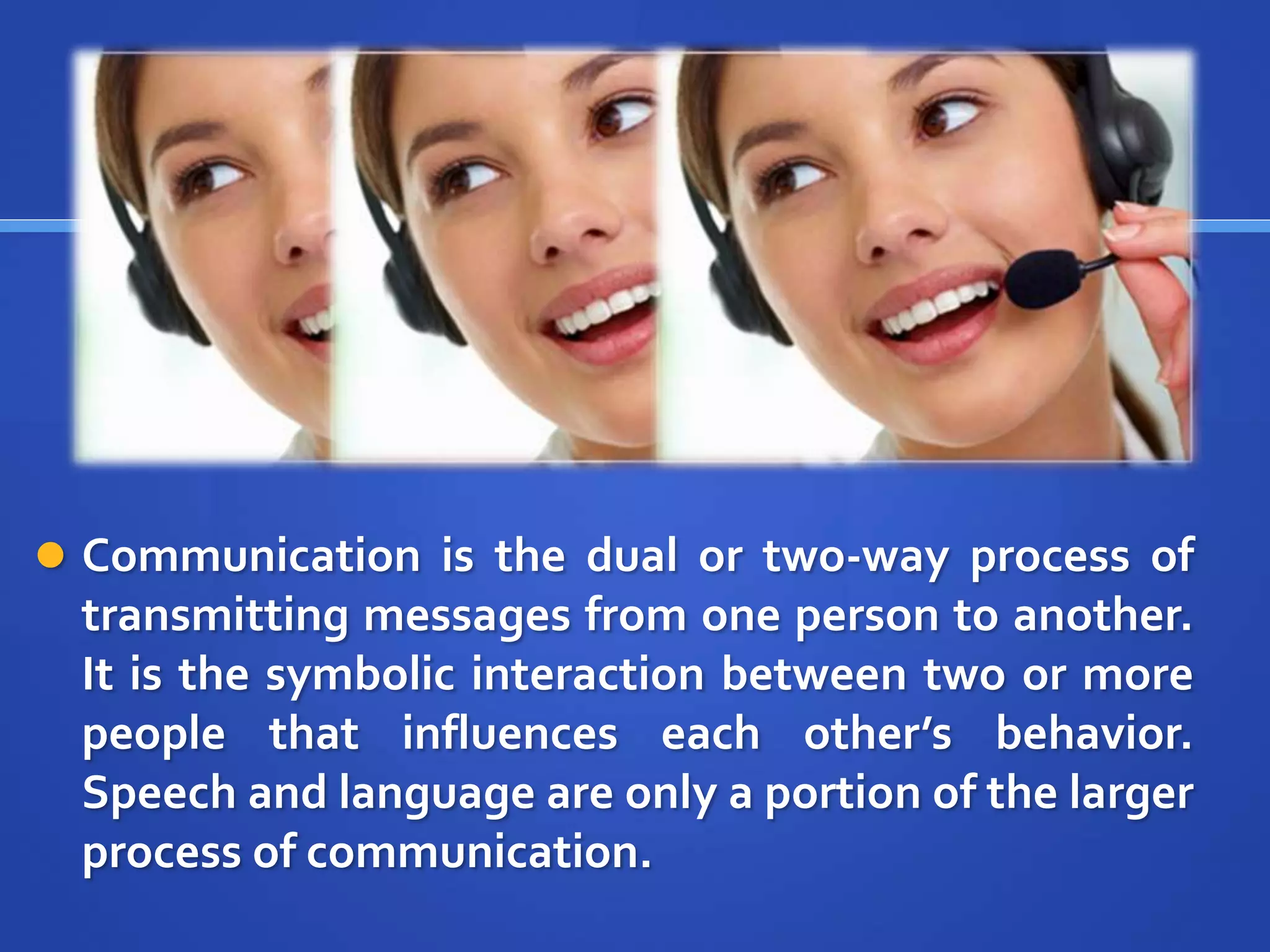
 Communication is the dual or two-way process of
transmitting messages from one person to another.
It is the symbolic interaction between two or more
people that influences each other’s behavior.
Speech and language are only a portion of the larger
process of communication.
 Language is the medium or vehicle through which
messages are sent and received while speech is
one of its modes. It is the verbal means of
communicating or conveying meaning.
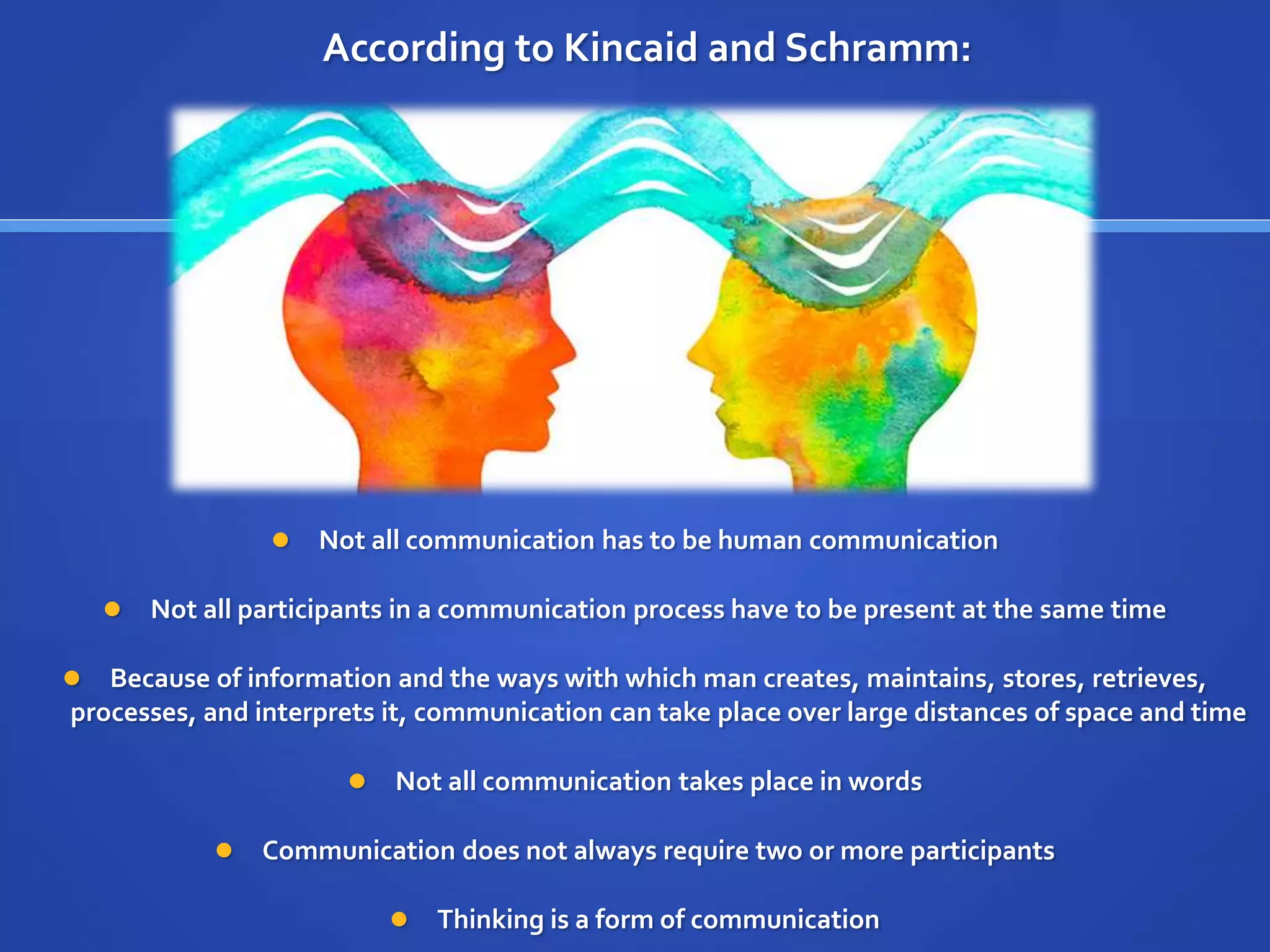
According to Kincaid and Schramm:
 Not all communication has to be human communication
 Not all participants in a communication process have to be present at the same time
 Because of information and the ways with which man creates, maintains, stores, retrieves,
processes, and interprets it, communication can take place over large distances of space and time
 Not all communication takes place in words
 Communication does not always require two or more participants
 Thinking is a form of communication
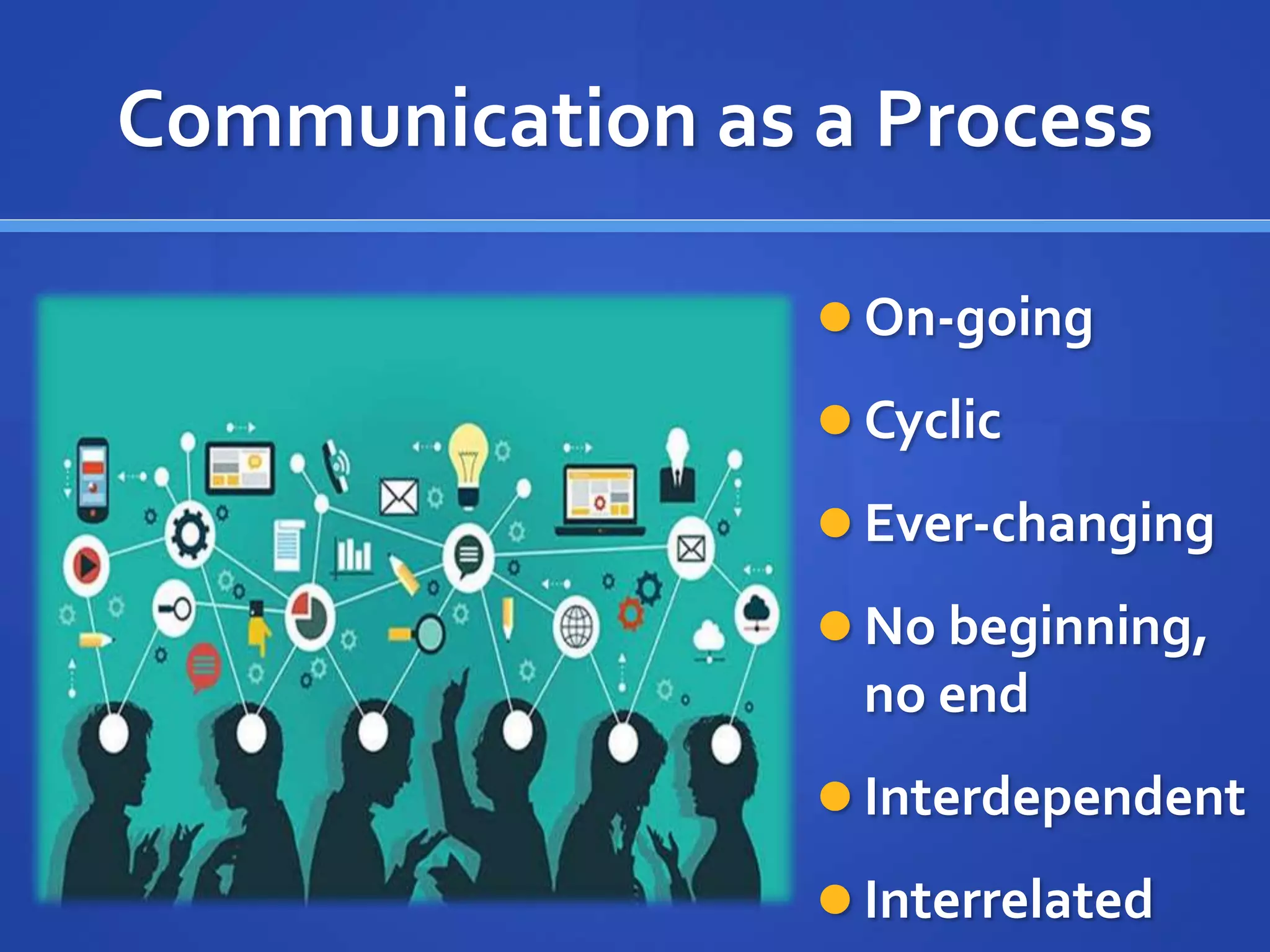
Communication as a Process
 On-going
 Cyclic
 Ever-changing
 No beginning,
no end
 Interdependent
 Interrelated
As a process, it has at least four
attributes (SRA Sourcebook)
 Dynamic
 Systematic
 Symbolic Interaction
 Meaning is personally
constructed
Elements of the Process
(Berlo’s Model of Communication, 1961)
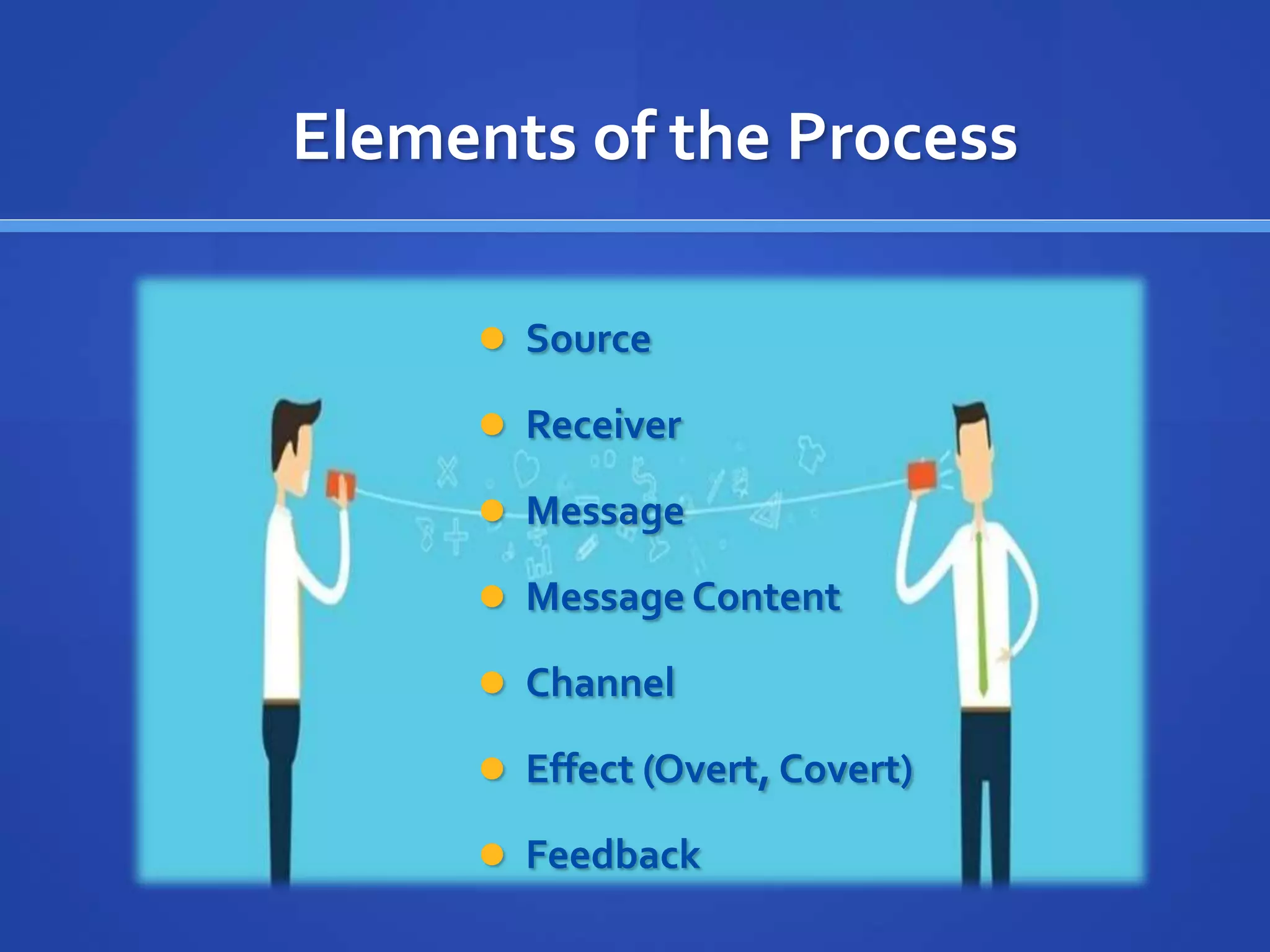
 Source
 Receiver
 Message
 Message Content
 Channel
 Effect (Overt, Covert)
 Feedback
Elements of the Process
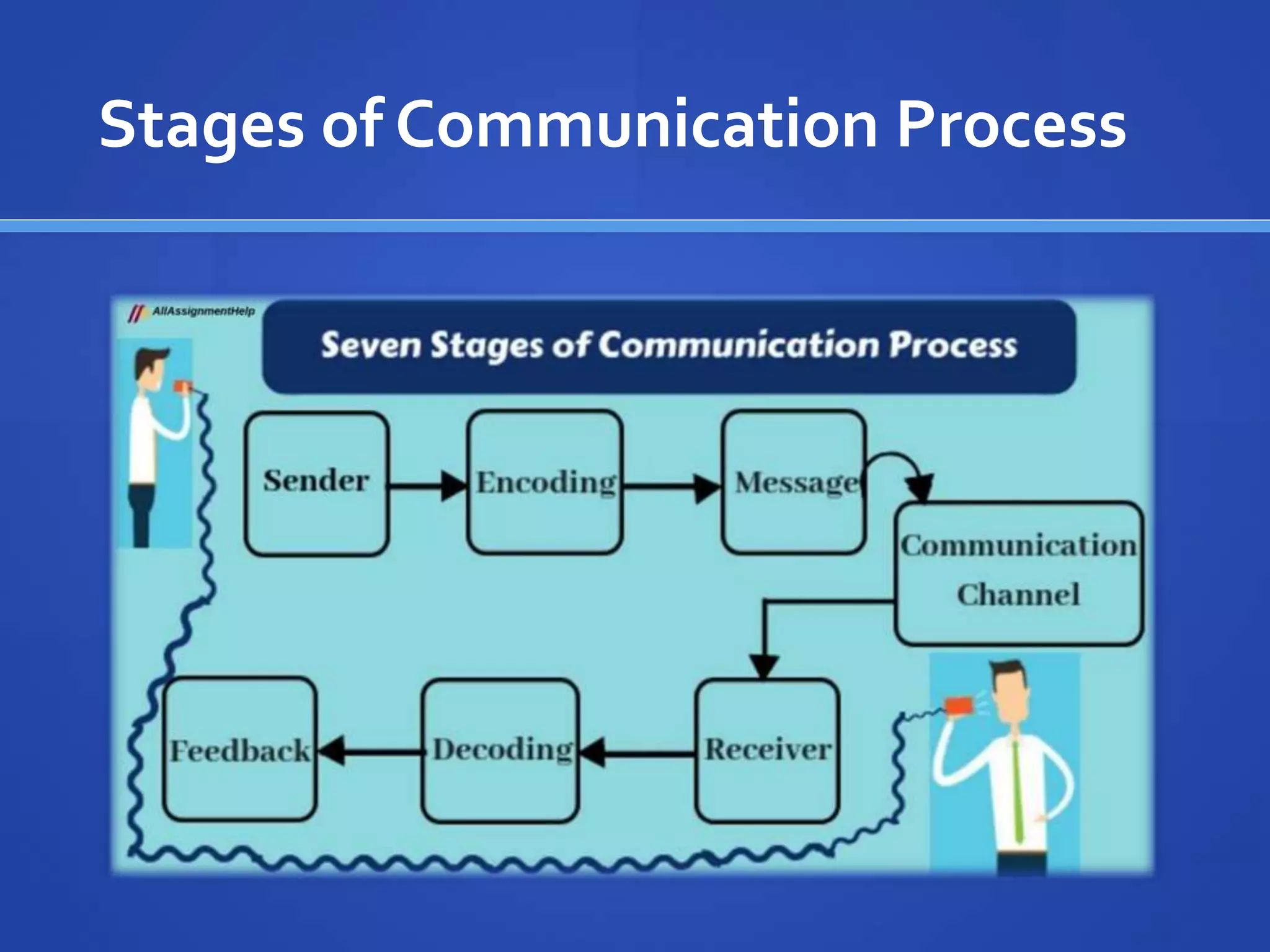
Stages of Communication Process
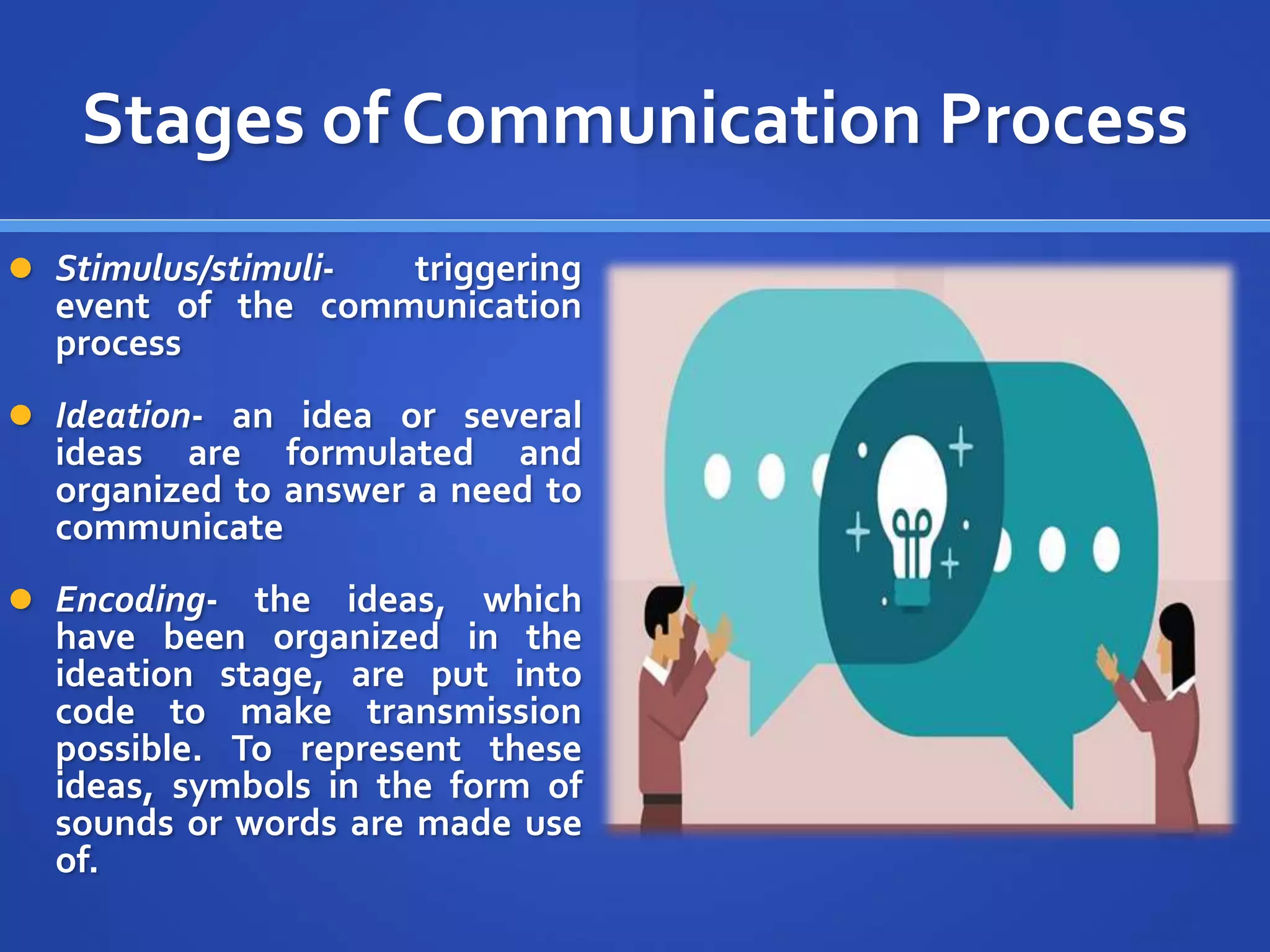
 Stimulus/stimuli- triggering
event of the communication
process
 Ideation- an idea or several
ideas are formulated and
organized to answer a need to
communicate
 Encoding- the ideas, which
have been organized in the
ideation stage, are put into
code to make transmission
possible. To represent these
ideas, symbols in the form of
sounds or words are made use
of.
Stages of Communication Process
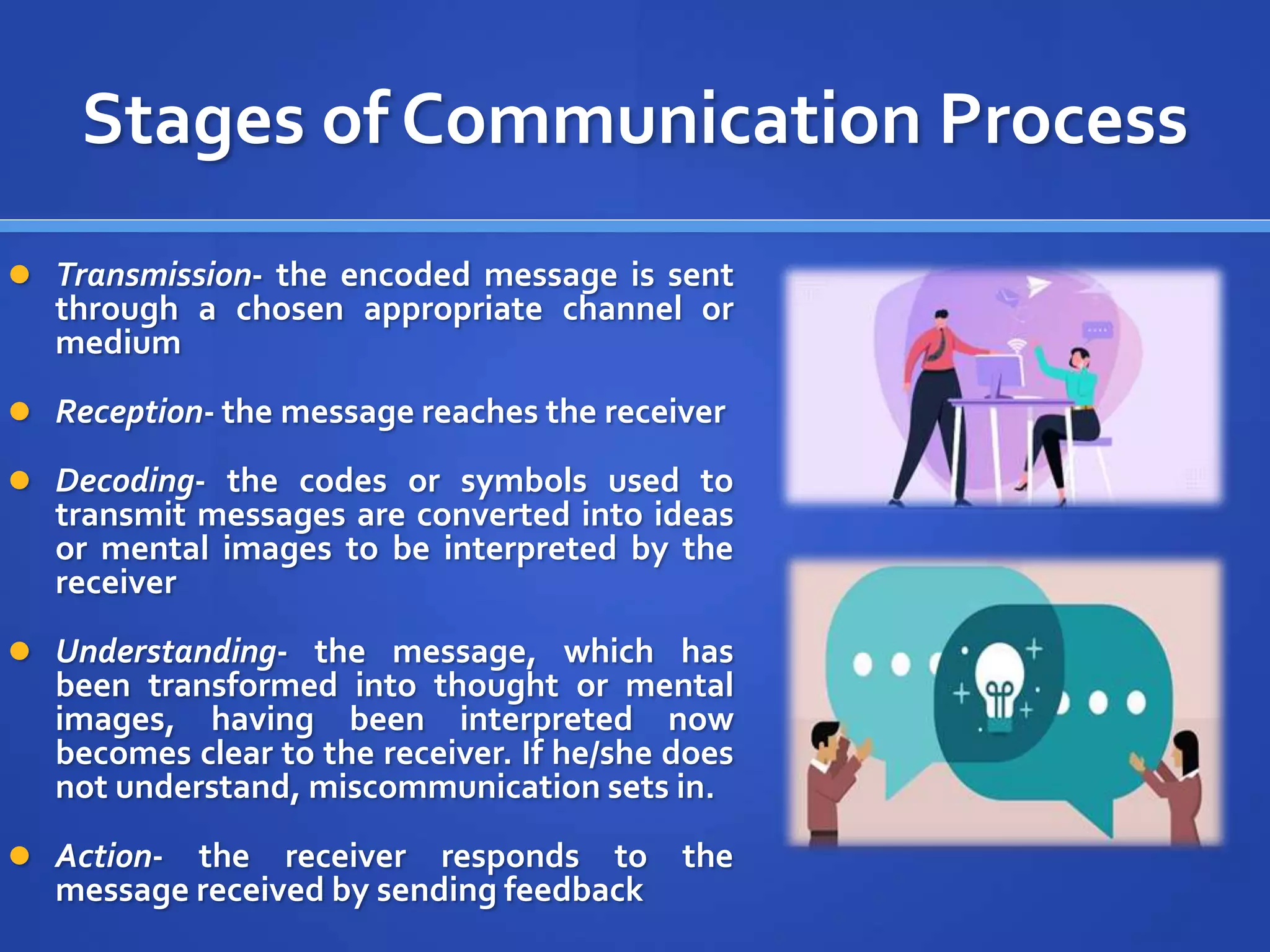
 Transmission- the encoded message is sent
through a chosen appropriate channel or
medium
 Reception- the message reaches the receiver
 Decoding- the codes or symbols used to
transmit messages are converted into ideas
or mental images to be interpreted by the
receiver
 Understanding- the message, which has
been transformed into thought or mental
images, having been interpreted now
becomes clear to the receiver. If he/she does
not understand, miscommunication sets in.
 Action- the receiver responds to the
message received by sending feedback
Stages of Communication Process
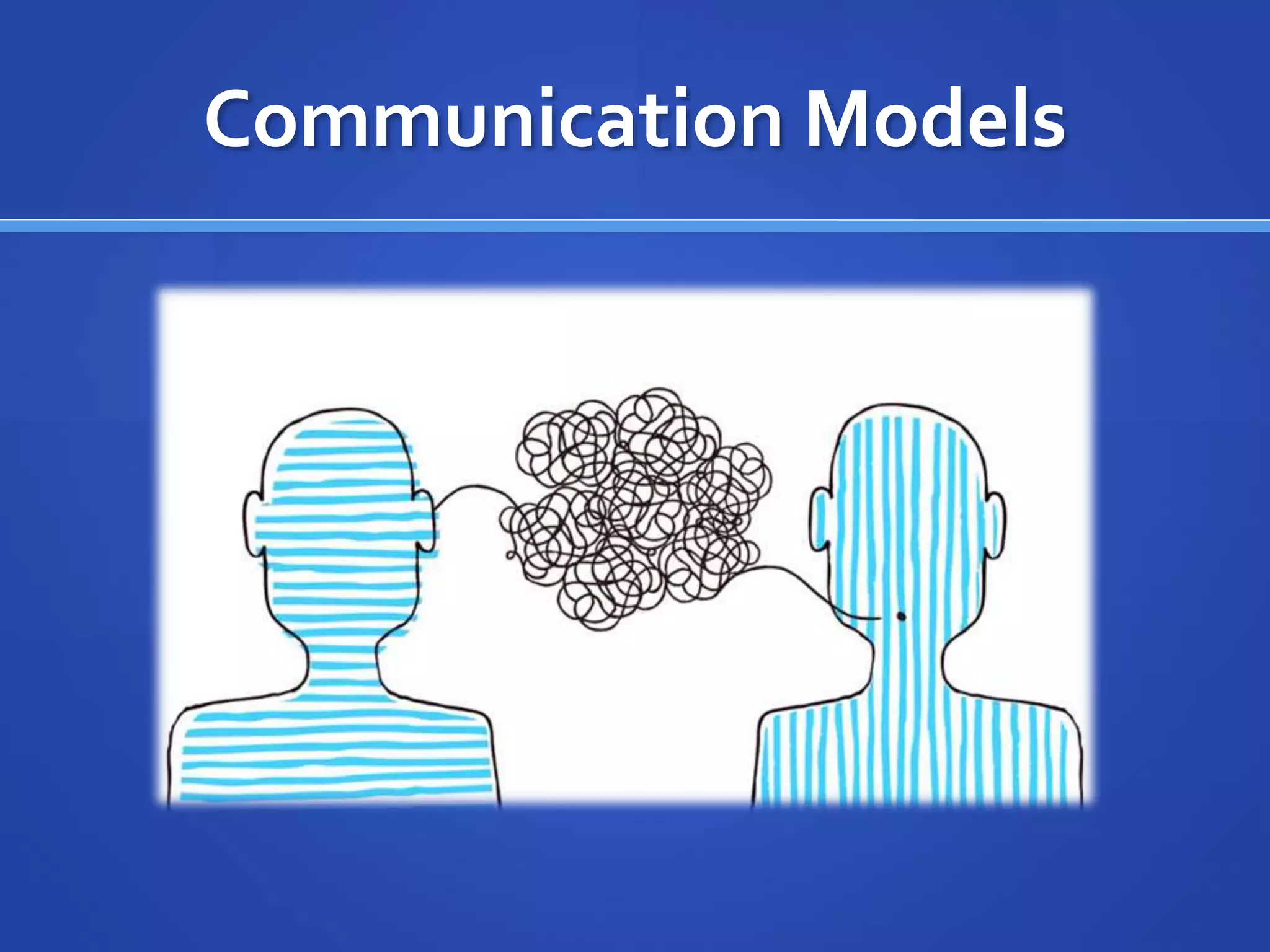
Communication Models
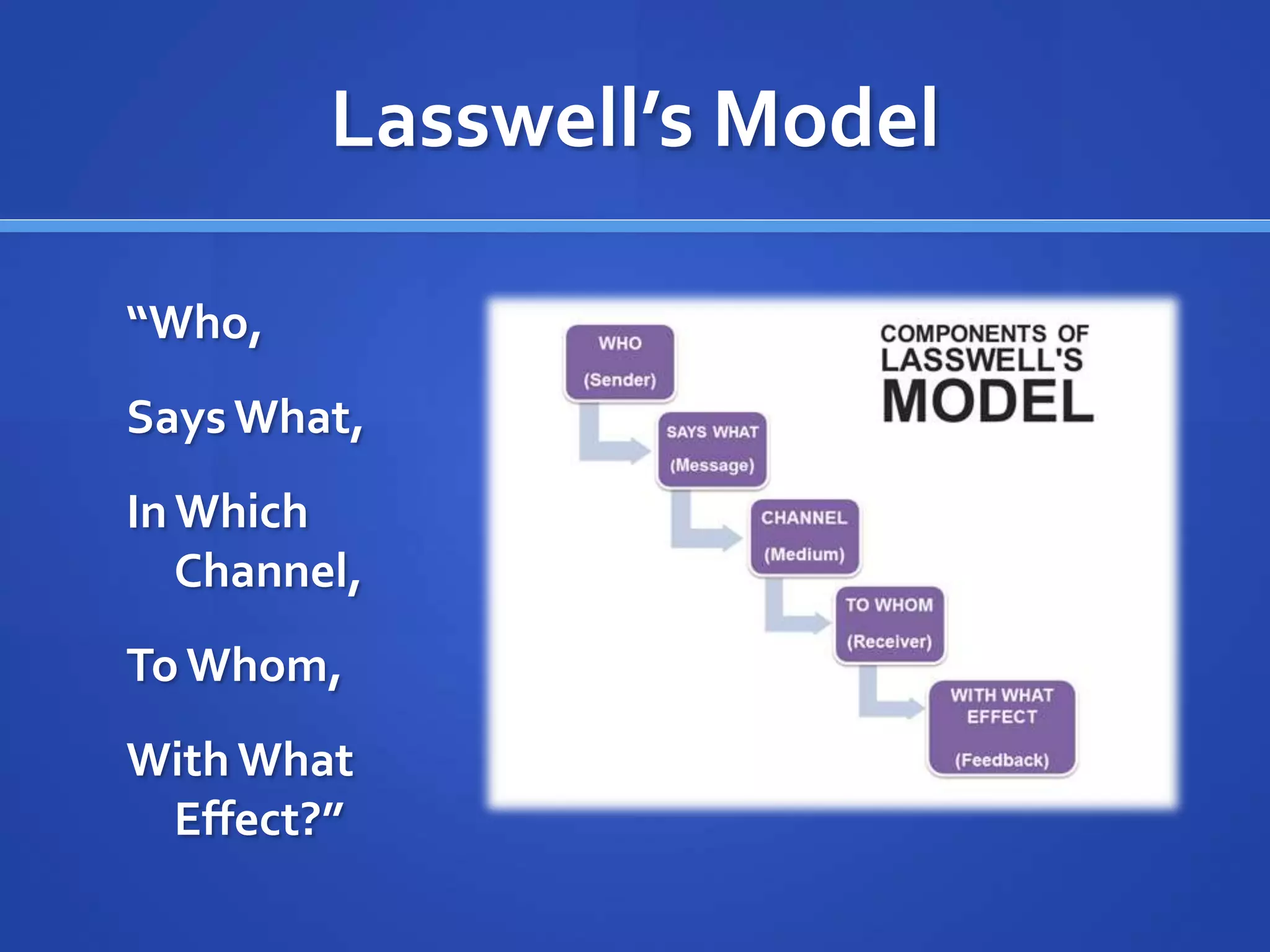
Lasswell’s Model
“Who,
SaysWhat,
In Which
Channel,
To Whom,
With What
Effect?”
Criticism to Lasswell’s
Communication Model
The model took for granted that
communication is mainly a persuasive
process, that the communicator
always has some in- tent to influence
the receiver.
It omits the elements of feedback.
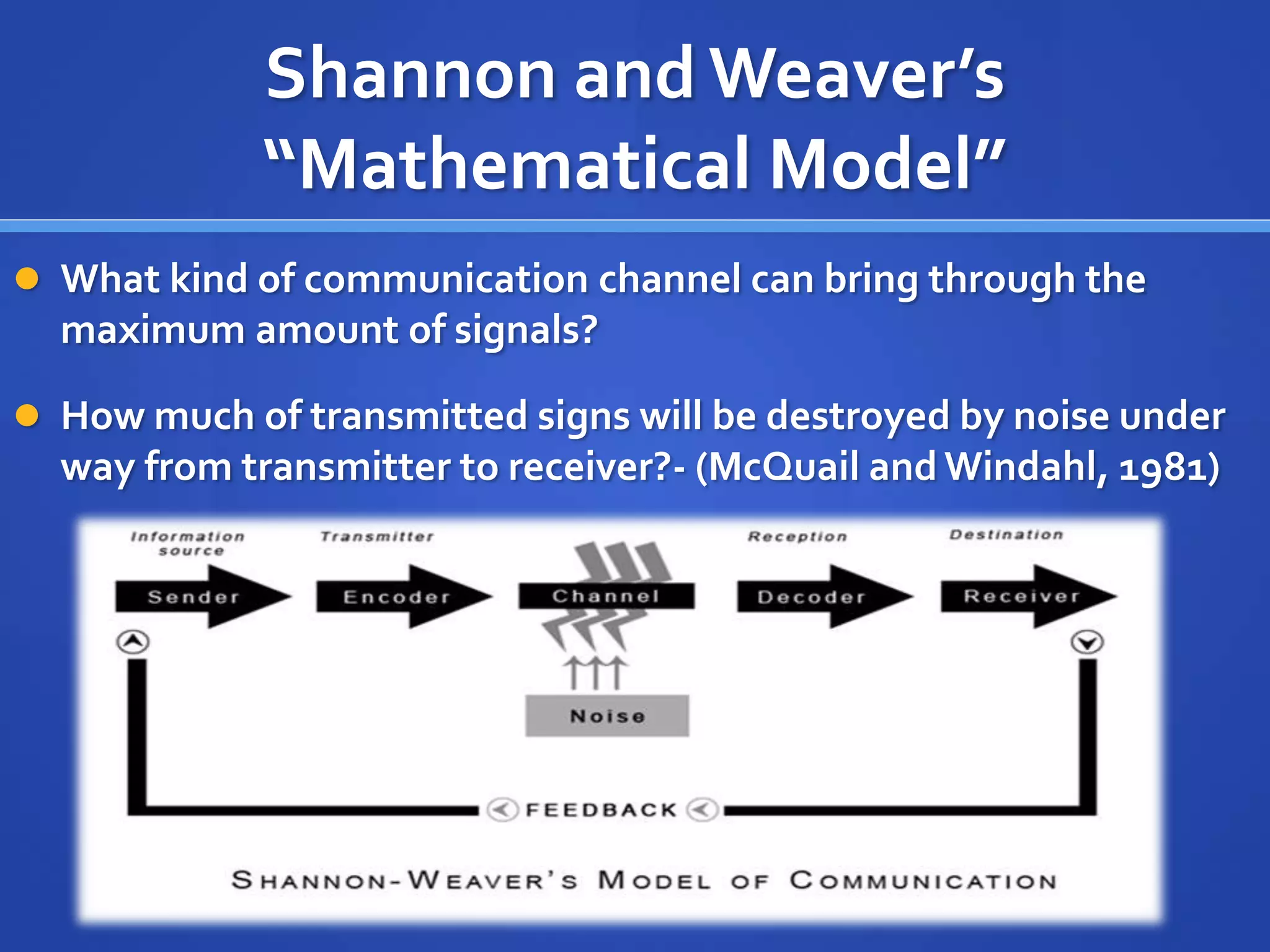
Shannon and Weaver’s
“Mathematical Model”
 What kind of communication channel can bring through the
maximum amount of signals?
 How much of transmitted signs will be destroyed by noise under
way from transmitter to receiver?- (McQuail and Windahl, 1981)
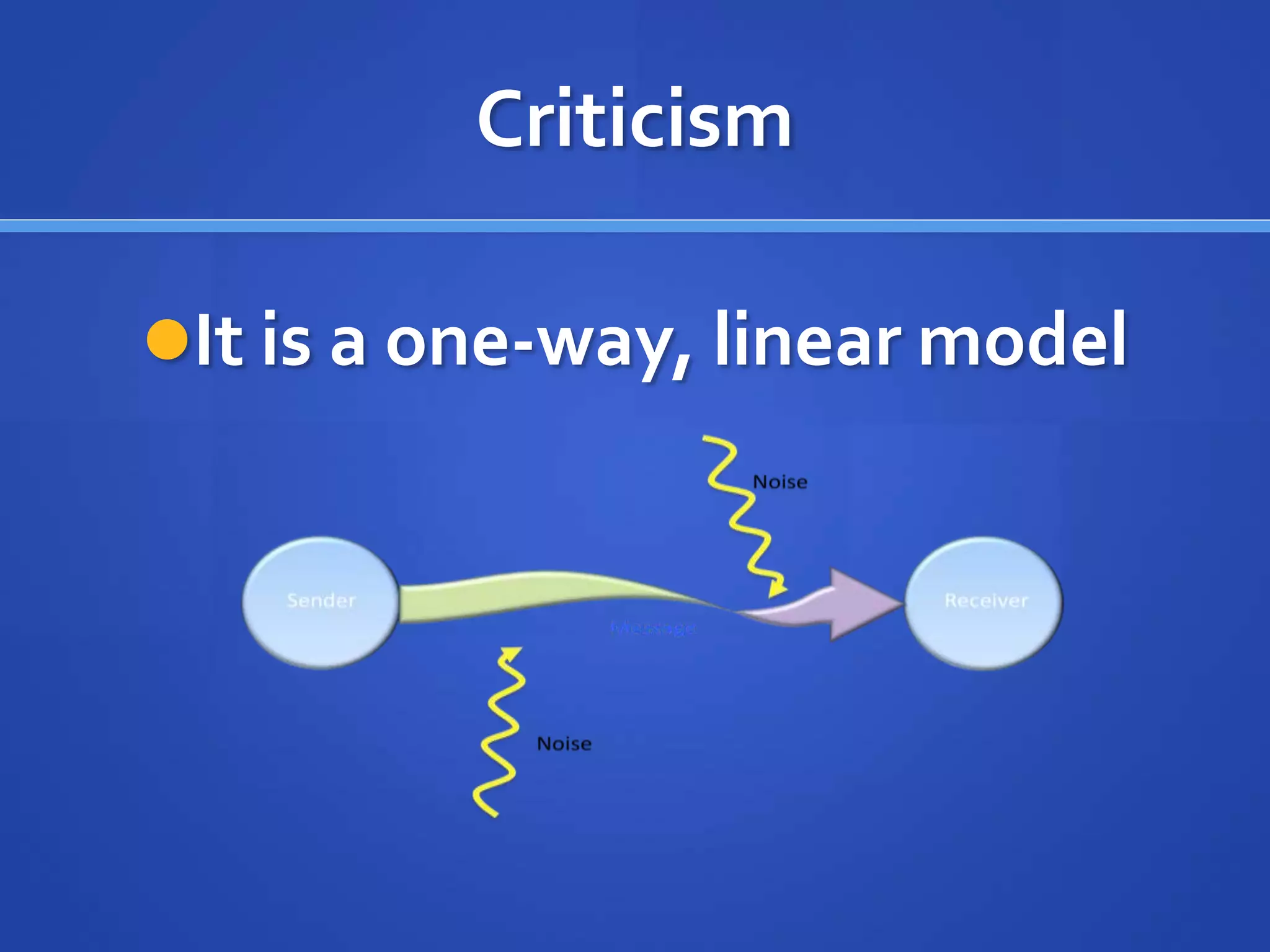
Criticism
It is a one-way, linear model
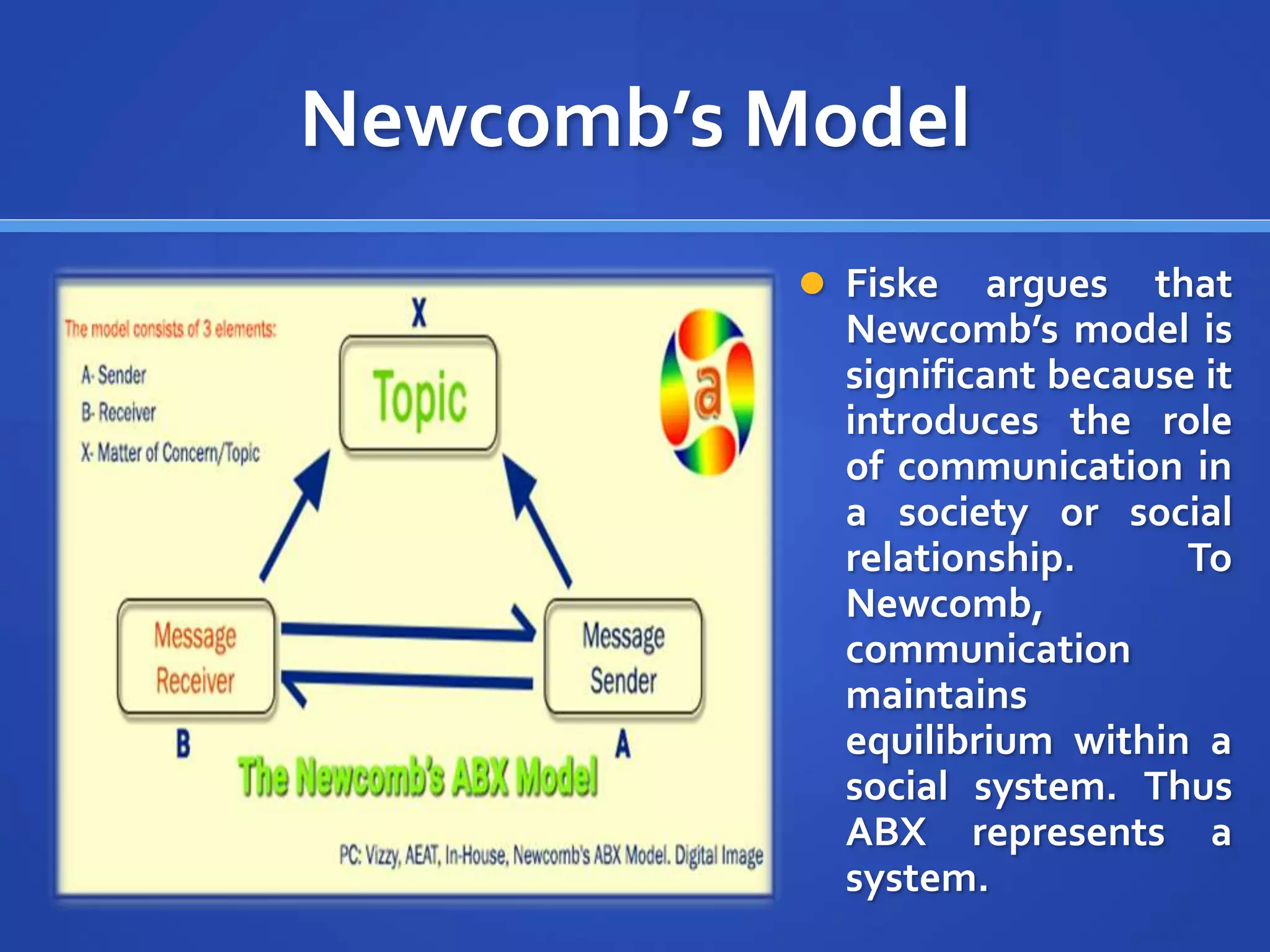
Newcomb’s Model
 Fiske argues that
Newcomb’s model is
significant because it
introduces the role
of communication in
a society or social
relationship. To
Newcomb,
communication
maintains
equilibrium within a
social system. Thus
ABX represents a
system.
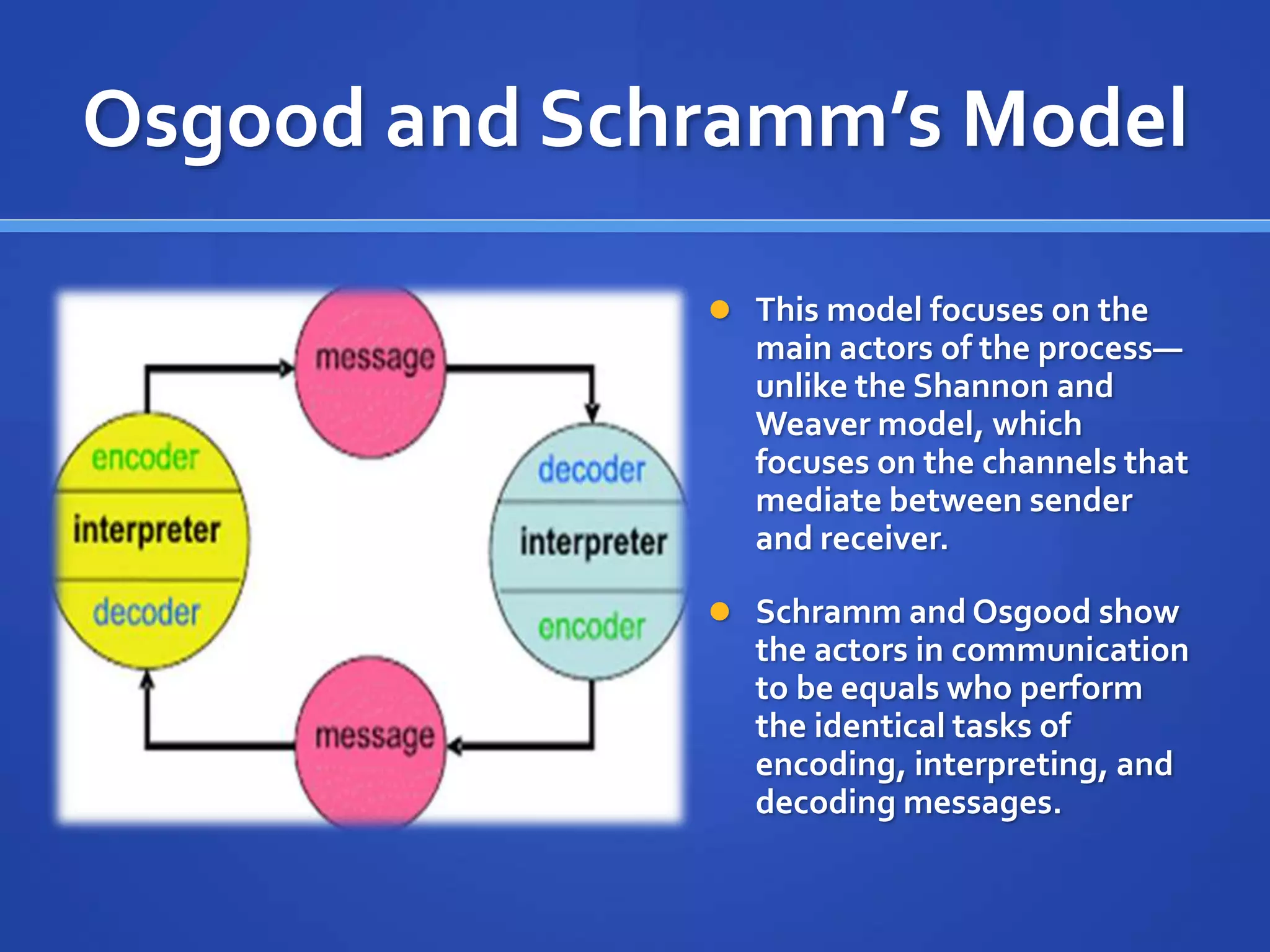
Osgood and Schramm’s Model
 This model focuses on the
main actors of the process—
unlike the Shannon and
Weaver model, which
focuses on the channels that
mediate between sender
and receiver.
 Schramm and Osgood show
the actors in communication
to be equals who perform
the identical tasks of
encoding, interpreting, and
decoding messages.
Criticism
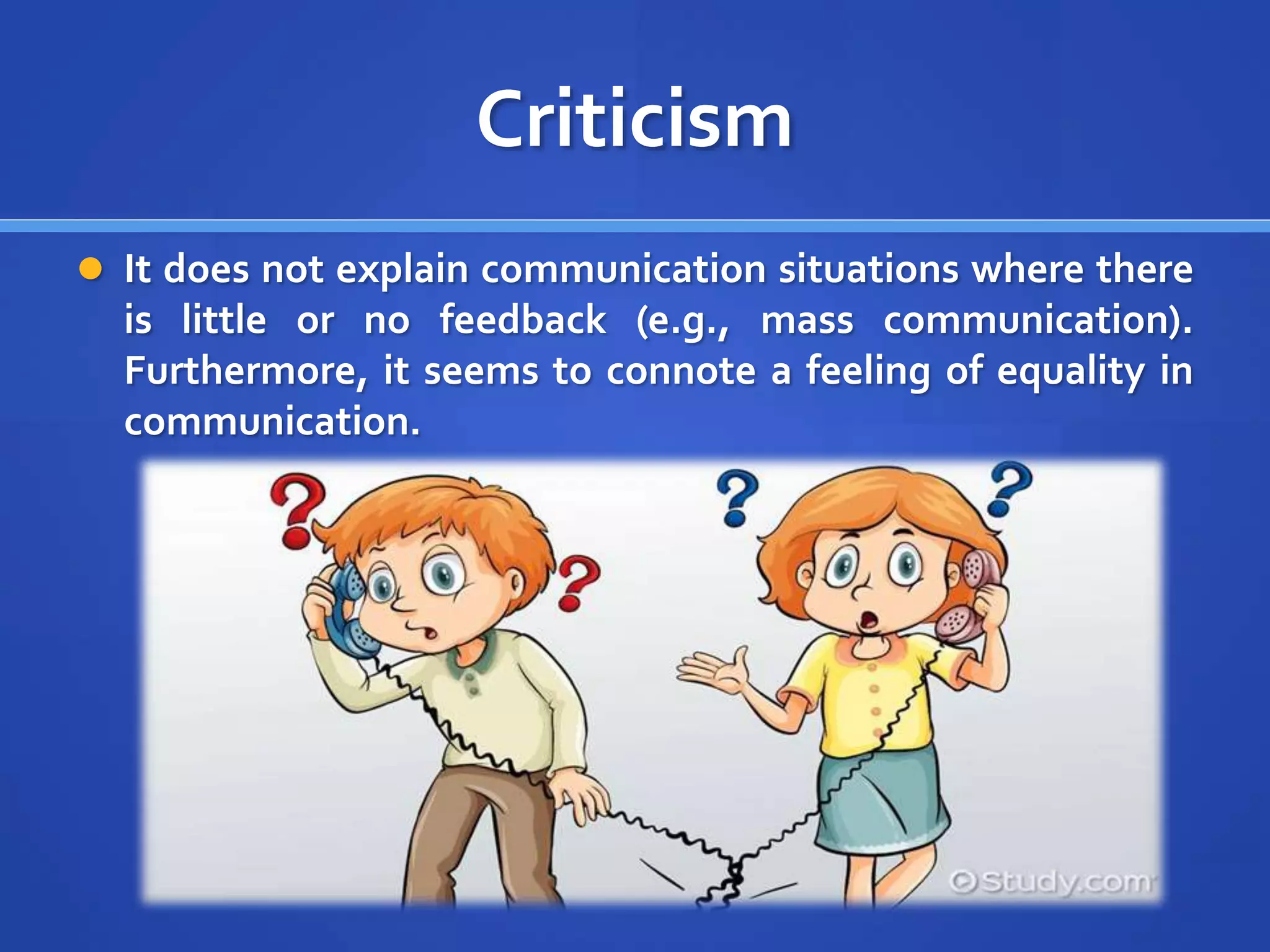
 It does not explain communication situations where there
is little or no feedback (e.g., mass communication).
Furthermore, it seems to connote a feeling of equality in
communication.
Gerbner’s Model
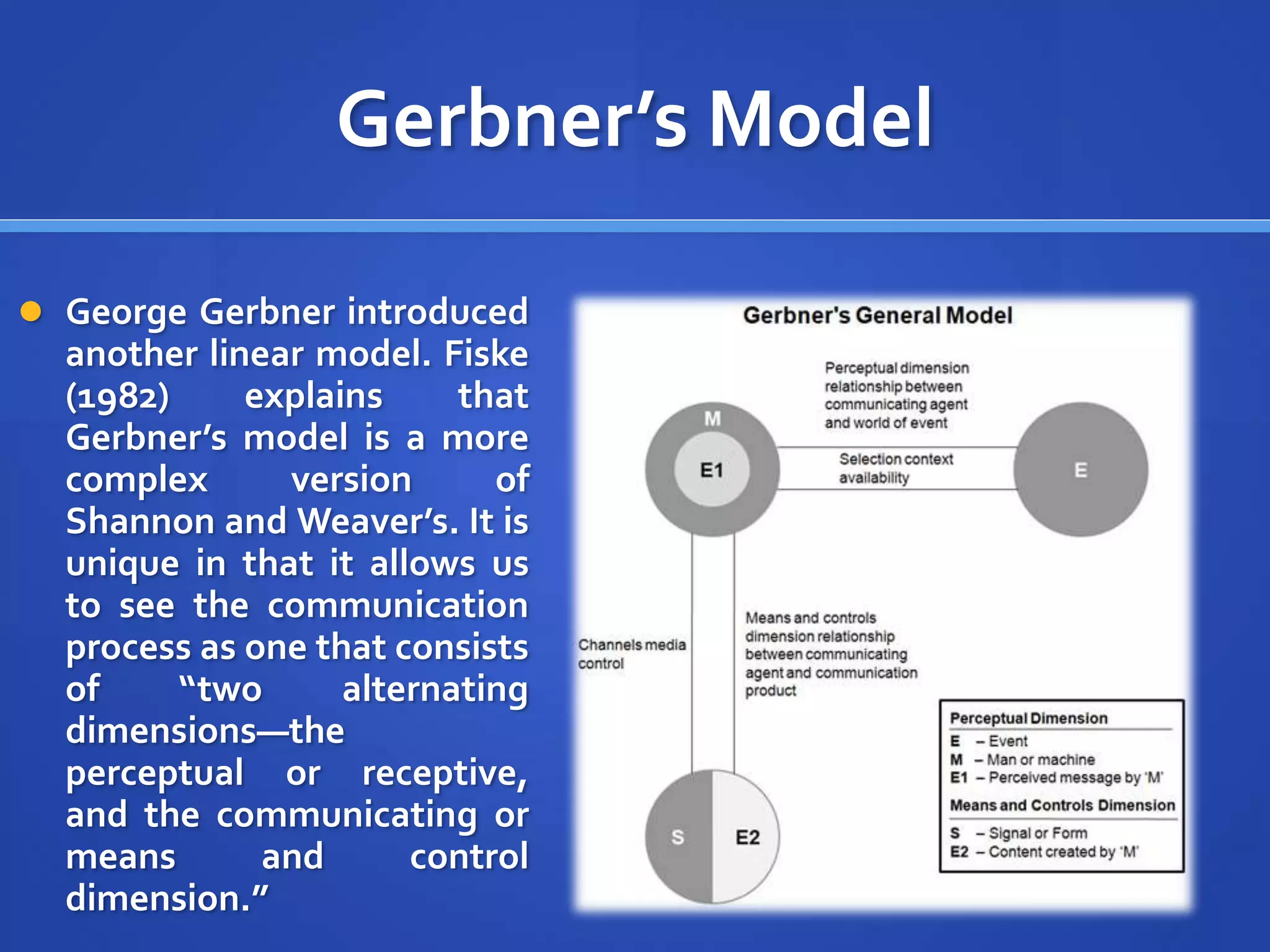
 George Gerbner introduced
another linear model. Fiske
(1982) explains that
Gerbner’s model is a more
complex version of
Shannon and Weaver’s. It is
unique in that it allows us
to see the communication
process as one that consists
of “two alternating
dimensions—the
perceptual or receptive,
and the communicating or
means and control
dimension.”
Westley and MacLeans’s Model
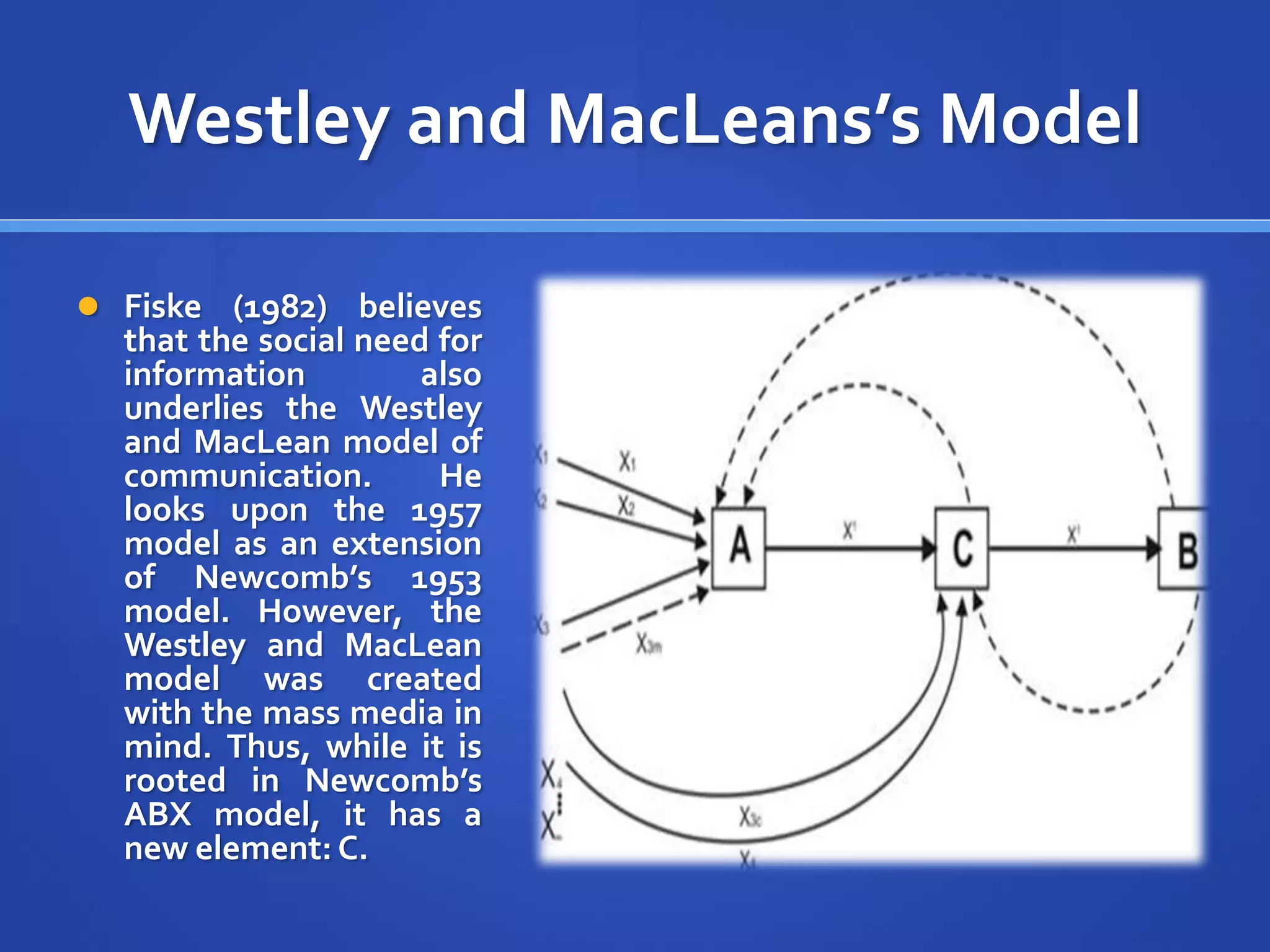
 Fiske (1982) believes
that the social need for
information also
underlies the Westley
and MacLean model of
communication. He
looks upon the 1957
model as an extension
of Newcomb’s 1953
model. However, the
Westley and MacLean
model was created
with the mass media in
mind. Thus, while it is
rooted in Newcomb’s
ABX model, it has a
new element: C.
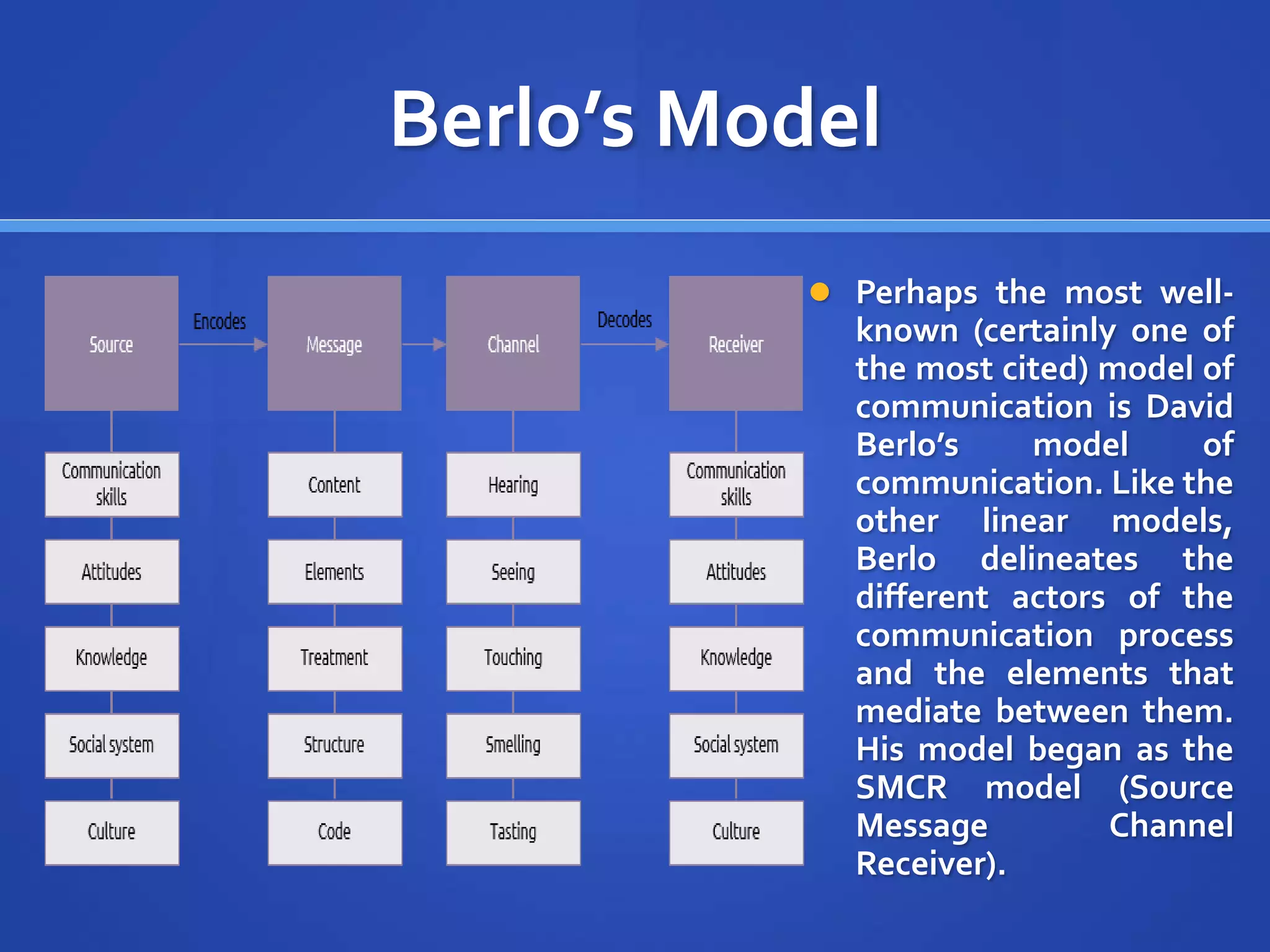
Berlo’s Model
 Perhaps the most well-
known (certainly one of
the most cited) model of
communication is David
Berlo’s model of
communication. Like the
other linear models,
Berlo delineates the
different actors of the
communication process
and the elements that
mediate between them.
His model began as the
SMCR model (Source
Message Channel
Receiver).
Dance Helical Model
 The circular model of
communication (e.g., Osgood
and Schramm’s model)
suggest that communication
is circular, that it goes full
circle to the same point from
which it started. The helical
model, however, portrays the
communication process more
accurately—in that it shows
the communication process
as moving.
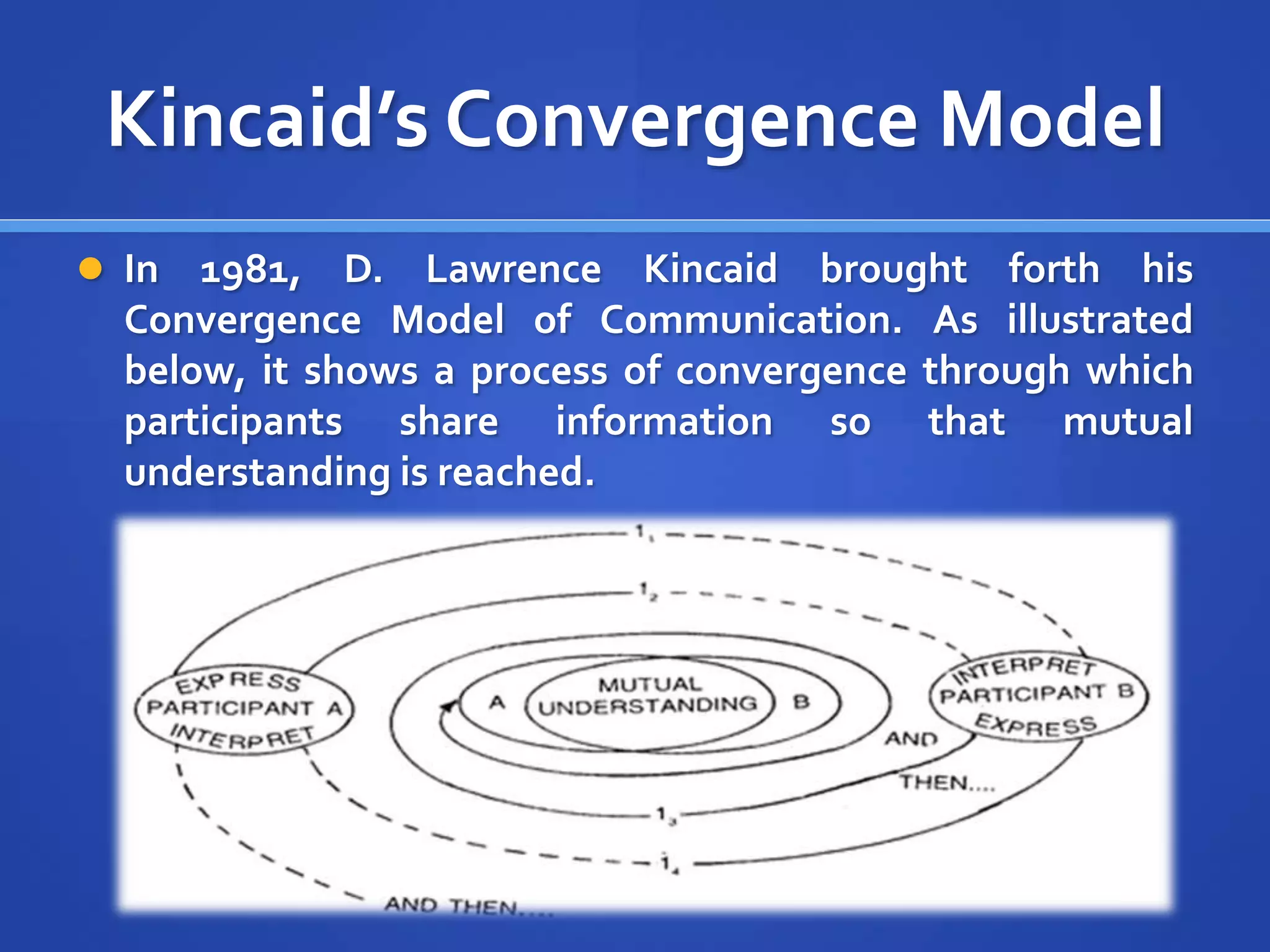
Kincaid’s Convergence Model
 In 1981, D. Lawrence Kincaid brought forth his
Convergence Model of Communication. As illustrated
below, it shows a process of convergence through which
participants share information so that mutual
understanding is reached.
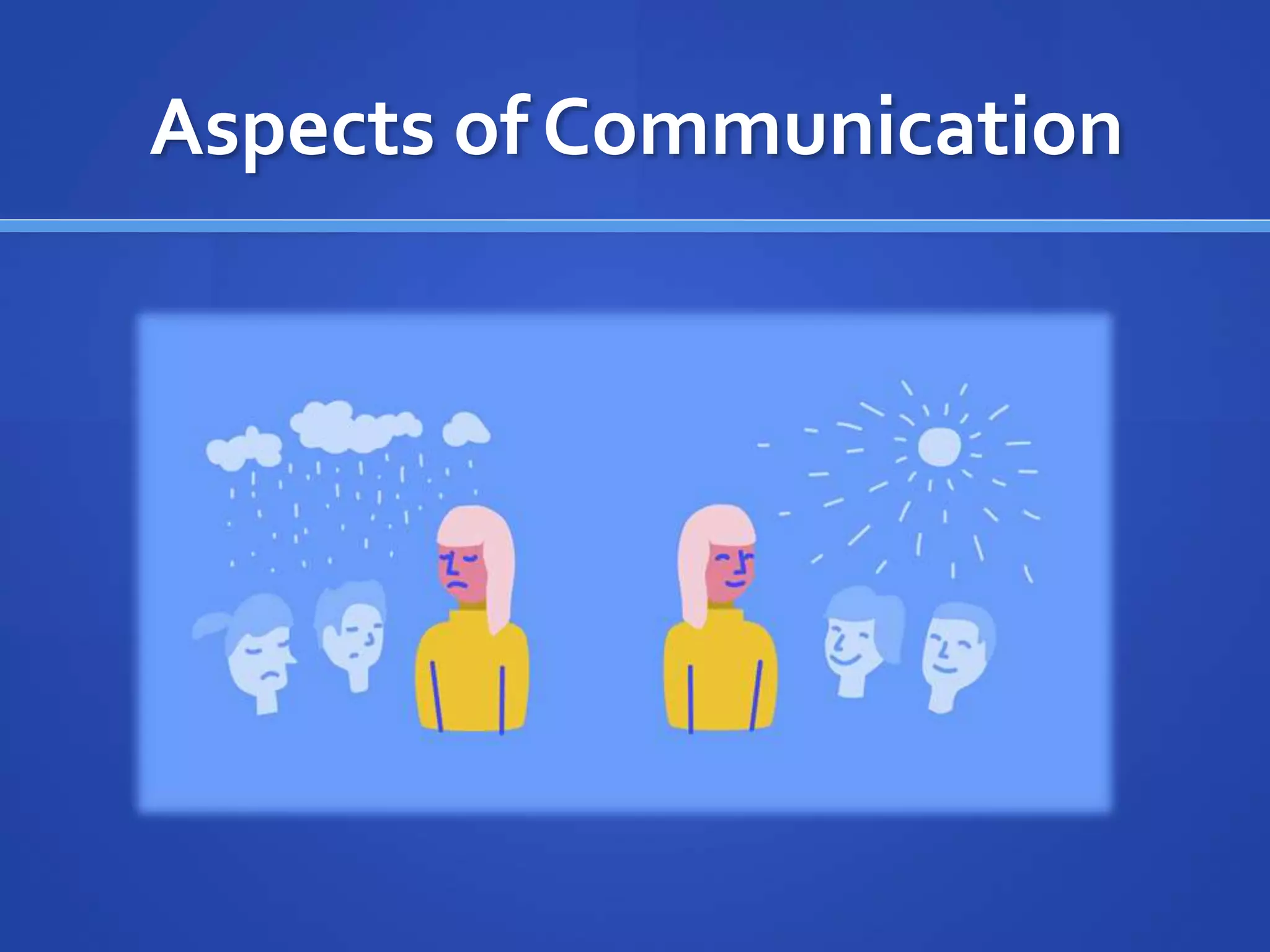
Aspects of Communication
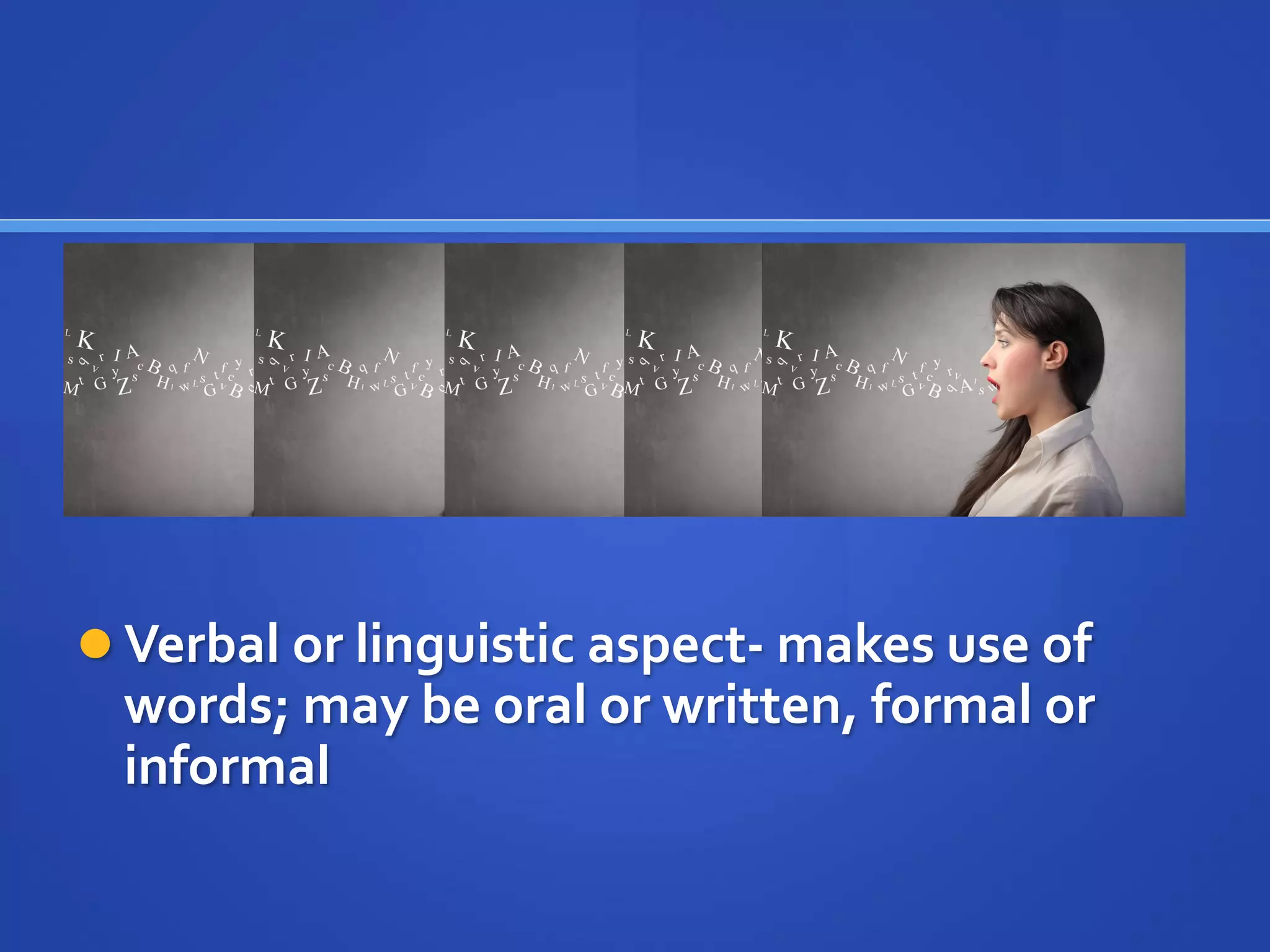
 Verbal or linguistic aspect- makes use of
words; may be oral or written, formal or
informal
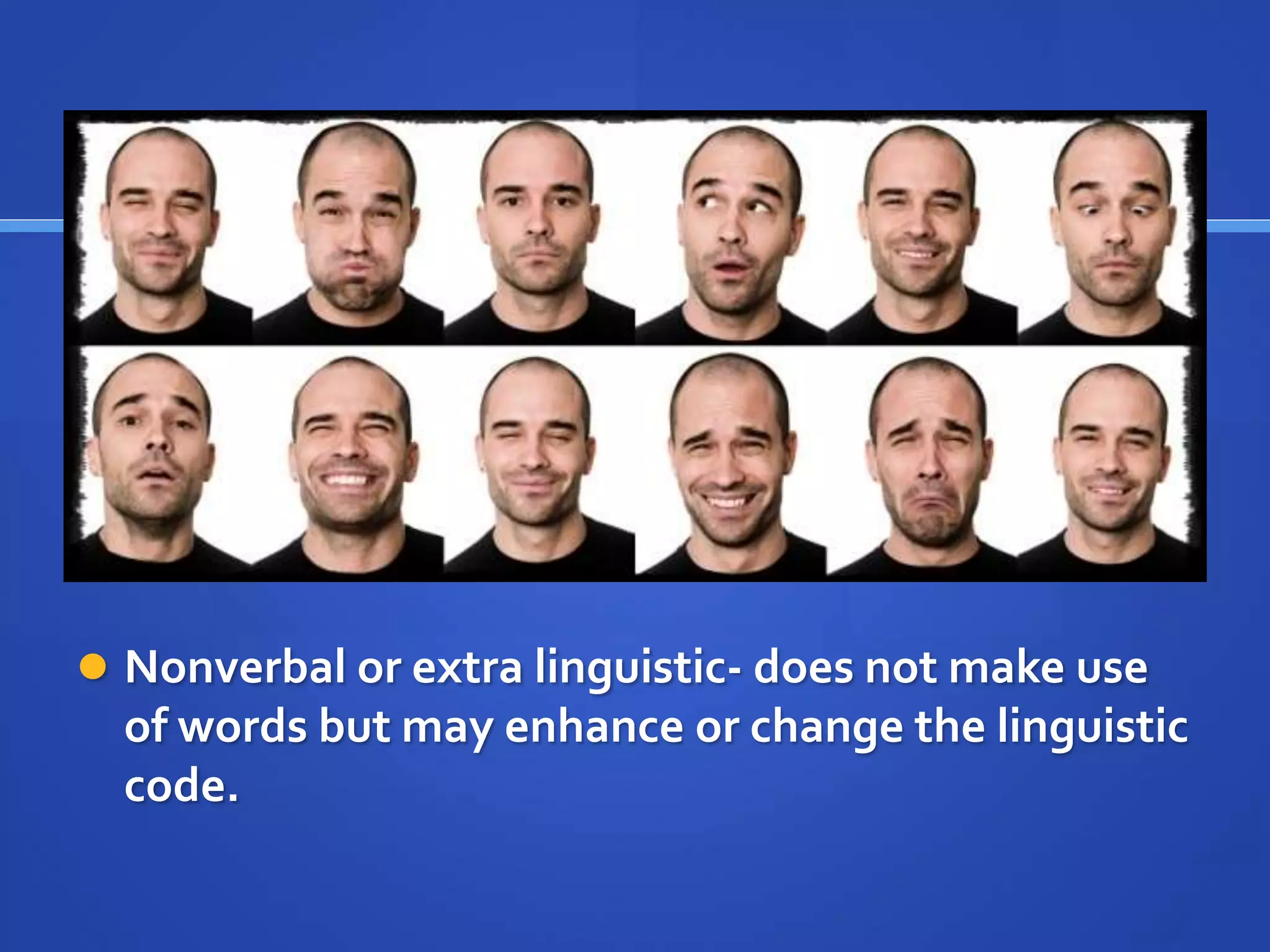
 Nonverbal or extra linguistic- does not make use
of words but may enhance or change the linguistic
code.
Elements of Nonverbal
Communication
 Nonlinguistic elements- devices used in conveying
messages without entirely relying on speech or language.
 Paralinguistic elements- include the following attributes of
voice that accompany the words we say: vocal quality,
pitch, tempo, volume, and juncture. Our voice is capable
of various dimensions making it possible to identify one
person from another.
 Metalinguistic element-takes place in the mind of
communicators – their awareness of the component units
of language like sound, words, phrases and sentences.
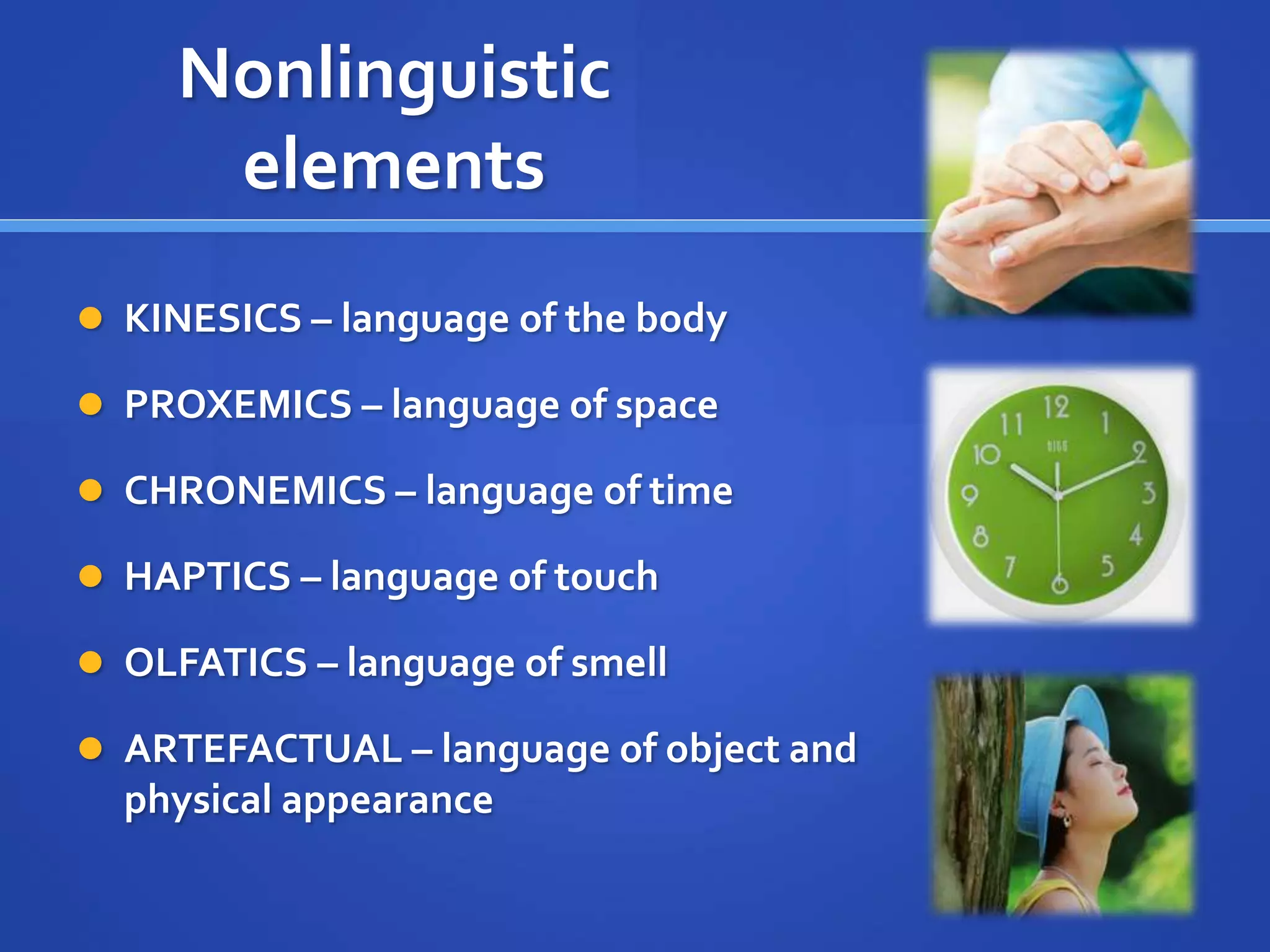
Nonlinguistic
elements
 KINESICS – language of the body
 PROXEMICS – language of space
 CHRONEMICS – language of time
 HAPTICS – language of touch
 OLFATICS – language of smell
 ARTEFACTUAL – language of object and
physical appearance
Types and Levels of
Communication
 Intrapersonal- communication with oneself. It
involves thinking, remembering and feeling
interpersonal
 Interpersonal- communication among a relatively small
number of people. Much of our communication takes place
at this level.
Dyadic Communication – communication
between two individuals
Triadic
Communication –
communication
participated in by
three individuals
Small Group Communication –
communication of more than three
individuals
mass comm and
other media
 Mass communication- this covers other forms of public
communication. These are printed form, radio, television,
and movies. The tools/materials used are called mass
media.
Radio
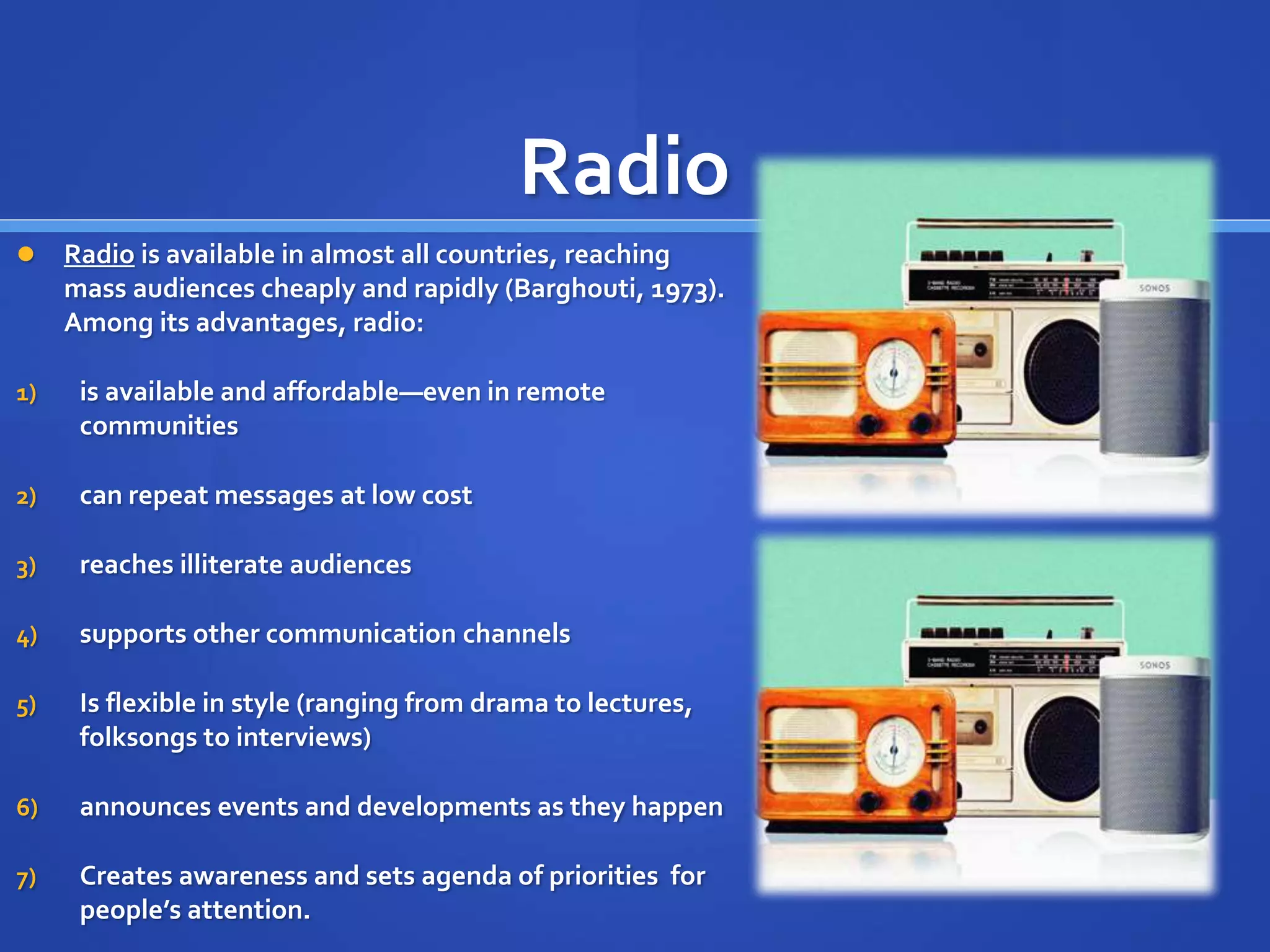
 Radio is available in almost all countries, reaching
mass audiences cheaply and rapidly (Barghouti, 1973).
Among its advantages, radio:
1) is available and affordable—even in remote
communities
2) can repeat messages at low cost
3) reaches illiterate audiences
4) supports other communication channels
5) Is flexible in style (ranging from drama to lectures,
folksongs to interviews)
6) announces events and developments as they happen
7) Creates awareness and sets agenda of priorities for
people’s attention.
Can you think of radio’s
disadvantages?
Cannot…
 illustrate complicated technical concepts
 gauge immediate audience reaction, participation, or
interest in messages broadcast
 Provide or respond to immediate feedback
 repeat messages upon demand
 Pace itself according to audience needs
 overcome some geographical barriers (such as high
mountain ranges) to reach the remotest communities.
Television
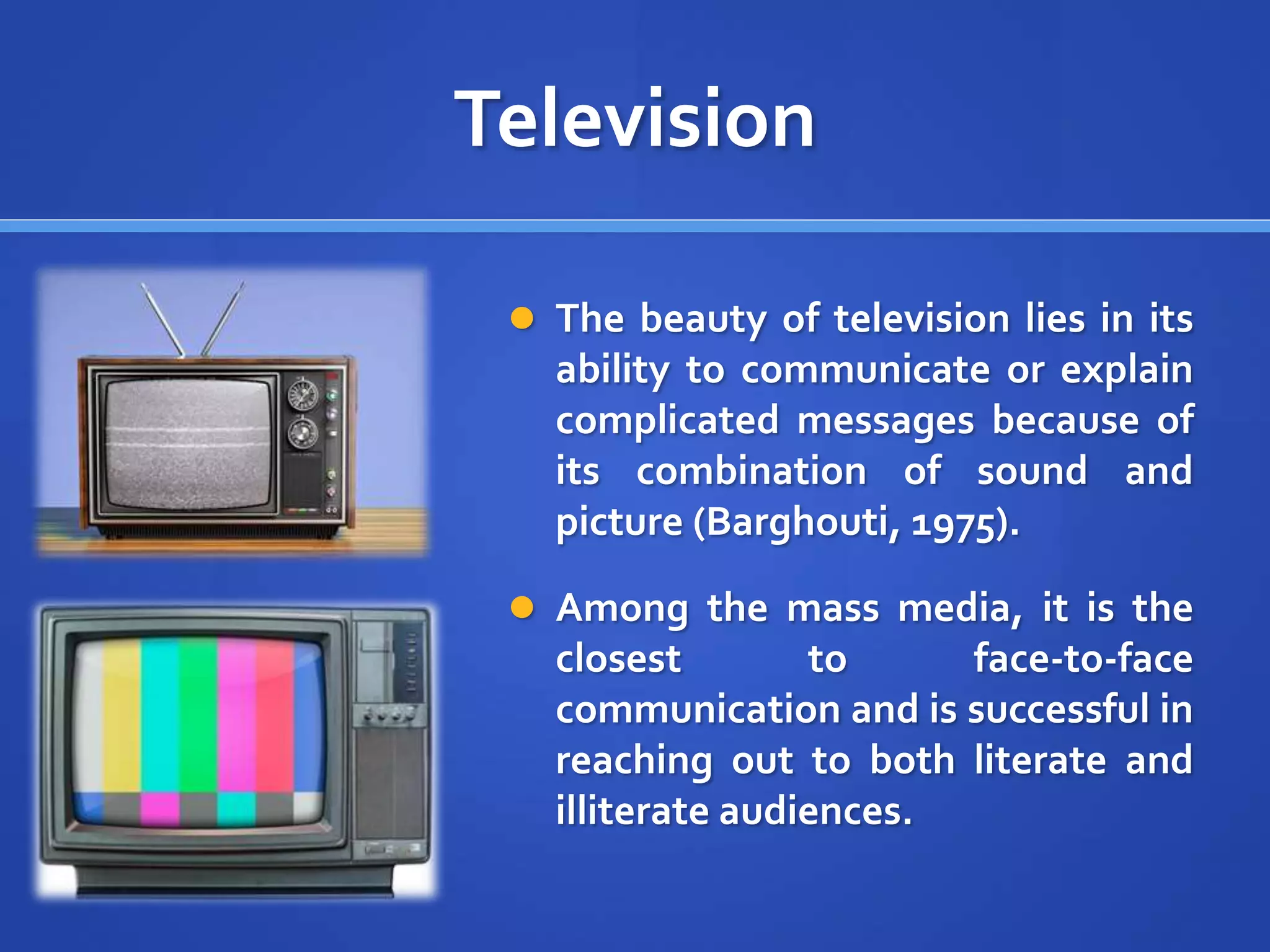
 The beauty of television lies in its
ability to communicate or explain
complicated messages because of
its combination of sound and
picture (Barghouti, 1975).
 Among the mass media, it is the
closest to face-to-face
communication and is successful in
reaching out to both literate and
illiterate audiences.
Disadvantages (Barghouti, 1975)
 accessibility and
availability
 Educational/development
shows face severe
competition from
entertainment programs
 Preparation of
development
communication programs
forTV requires much
planning, preparation,
technical, creative, and
communication skills than
for other media
 It costs plenty of money to
produce and airTV
programs.
Newspapers
 Philippine Information Agency data
show that fewer Filipinos read the
newspapers than listen to the radio
or watchTV.
 Nevertheless, development
communication uses newspapers
because, according to Barghouti
(1973), they can present technical
data in clearly de- signed text and
provide detailed information.
 Furthermore, he feels that
important topics can be covered in a
series of articles. News- papers are
still influential in creating awareness
and mobilizing public opinion. And,
like other print media, articles can
be shared or kept as reference
materials.
Disadvantages
 Audience is limited to
those who can read.
 Price is expensive
especially on a daily
basis.
 One-way
communication
 Small communities or
businesses have
difficulties in
publishing
news/feature articles
for publication
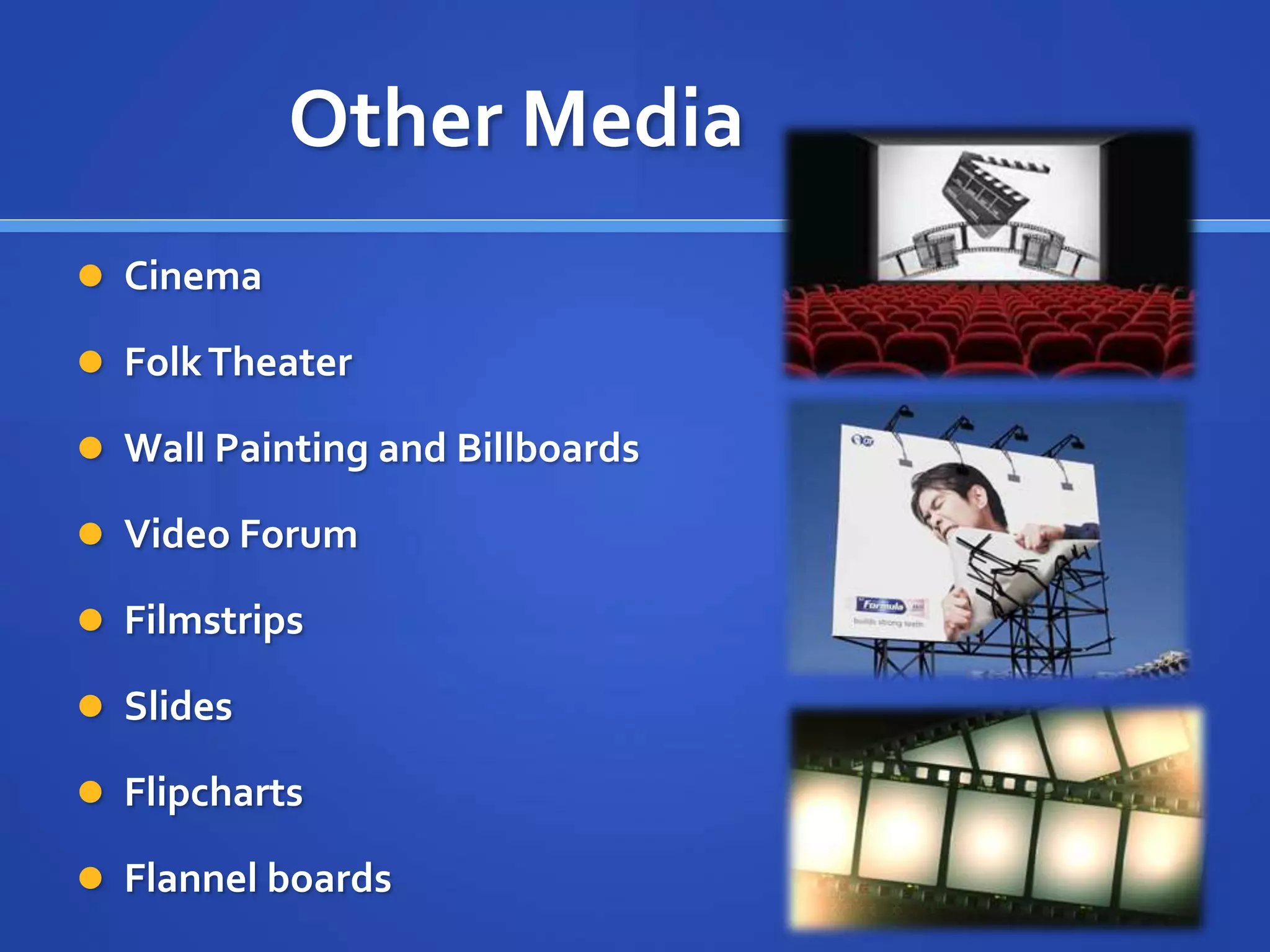
Other Media
 Cinema
 FolkTheater
 Wall Painting and Billboards
 Video Forum
 Filmstrips
 Slides
 Flipcharts
 Flannel boards
Barriers in Communication
 Noise - is any interference with the message traveling along the
channel...which may lead to the signal received being different
from that sent -(Chandler, n.d.)
Shannon and Weaver argued that there were three levels of
problems of communication:
1. Technical problems — how accurately the message can be
transmitted
2. Semantic problems — how precisely the meaning is conveyed
3. Effectiveness problems—how effectively does the received
message affect behavior
Other classifications of
communication barrier
 Physical barrier (environmental factors, channel noise)
 Psychological-cultural barriers (semantic noise)
 Social barriers (socio-psychological barriers)
 Ethnocentrism
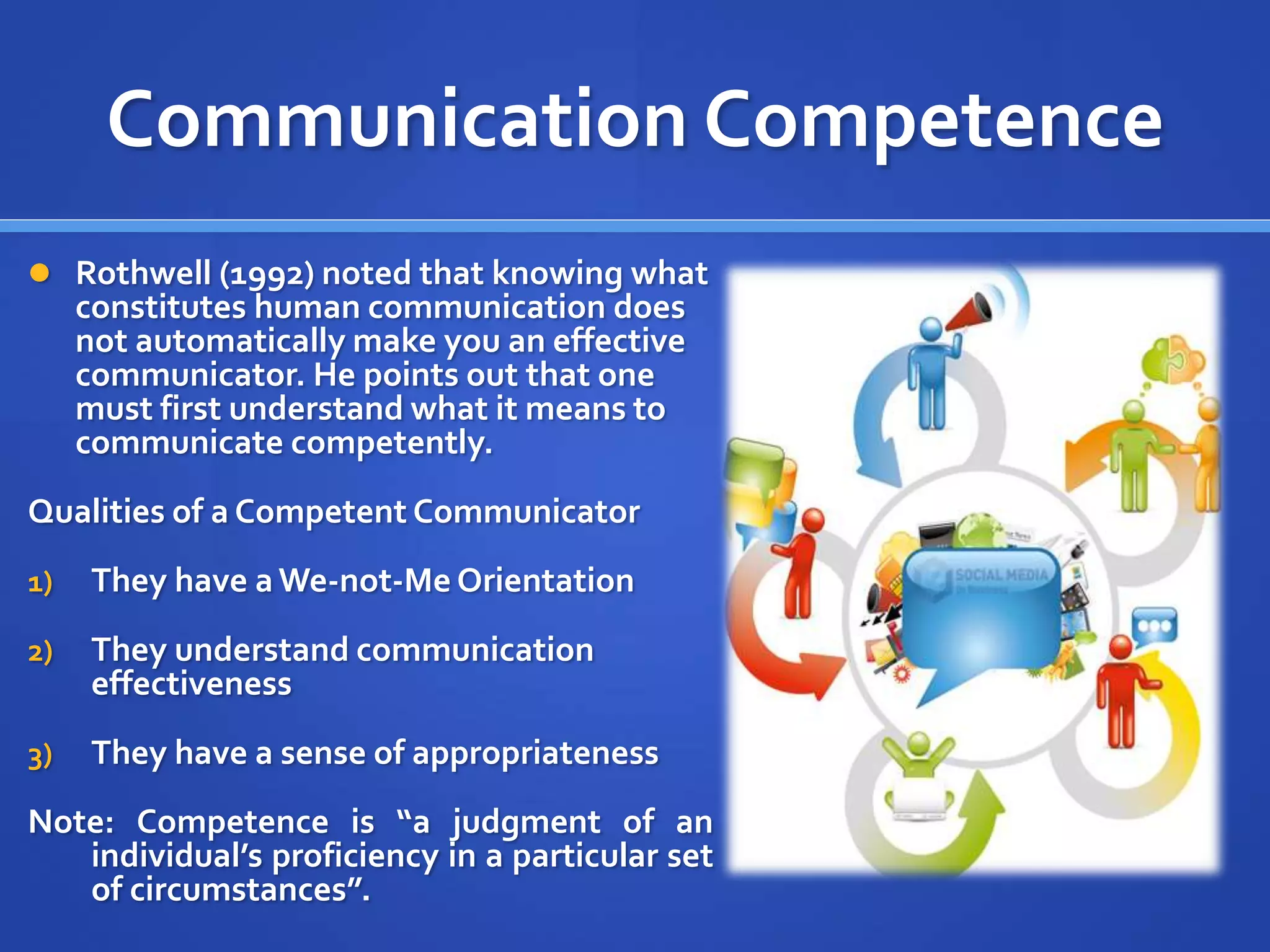
Communication Competence
 Rothwell (1992) noted that knowing what
constitutes human communication does
not automatically make you an effective
communicator. He points out that one
must first understand what it means to
communicate competently.
Qualities of a Competent Communicator
1) They have aWe-not-Me Orientation
2) They understand communication
effectiveness
3) They have a sense of appropriateness
Note: Competence is “a judgment of an
individual’s proficiency in a particular set
of circumstances”.
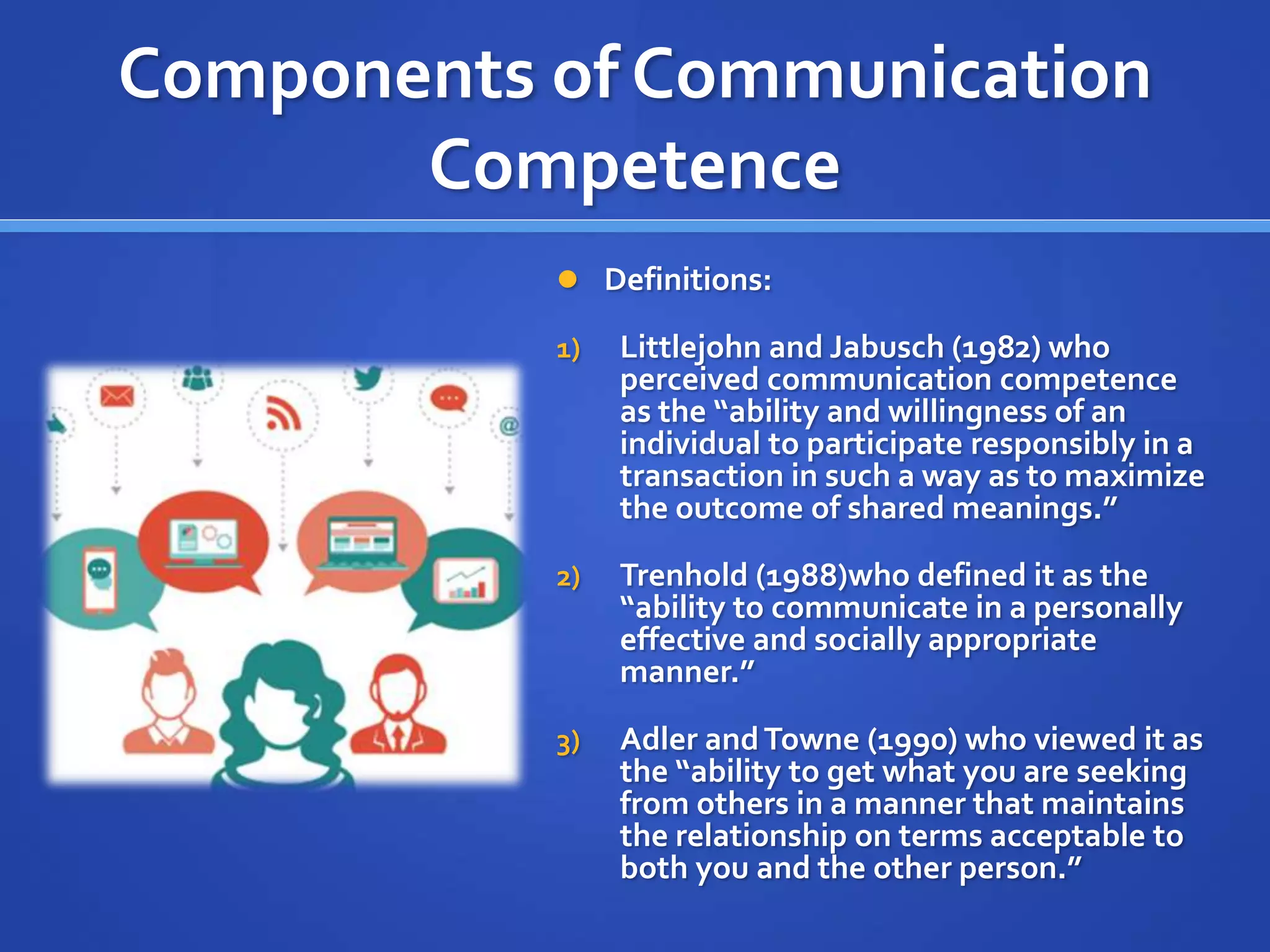
Components of Communication
Competence
 Definitions:
1) Littlejohn and Jabusch (1982) who
perceived communication competence
as the “ability and willingness of an
individual to participate responsibly in a
transaction in such a way as to maximize
the outcome of shared meanings.”
2) Trenhold (1988)who defined it as the
“ability to communicate in a personally
effective and socially appropriate
manner.”
3) Adler andTowne (1990) who viewed it as
the “ability to get what you are seeking
from others in a manner that maintains
the relationship on terms acceptable to
both you and the other person.”
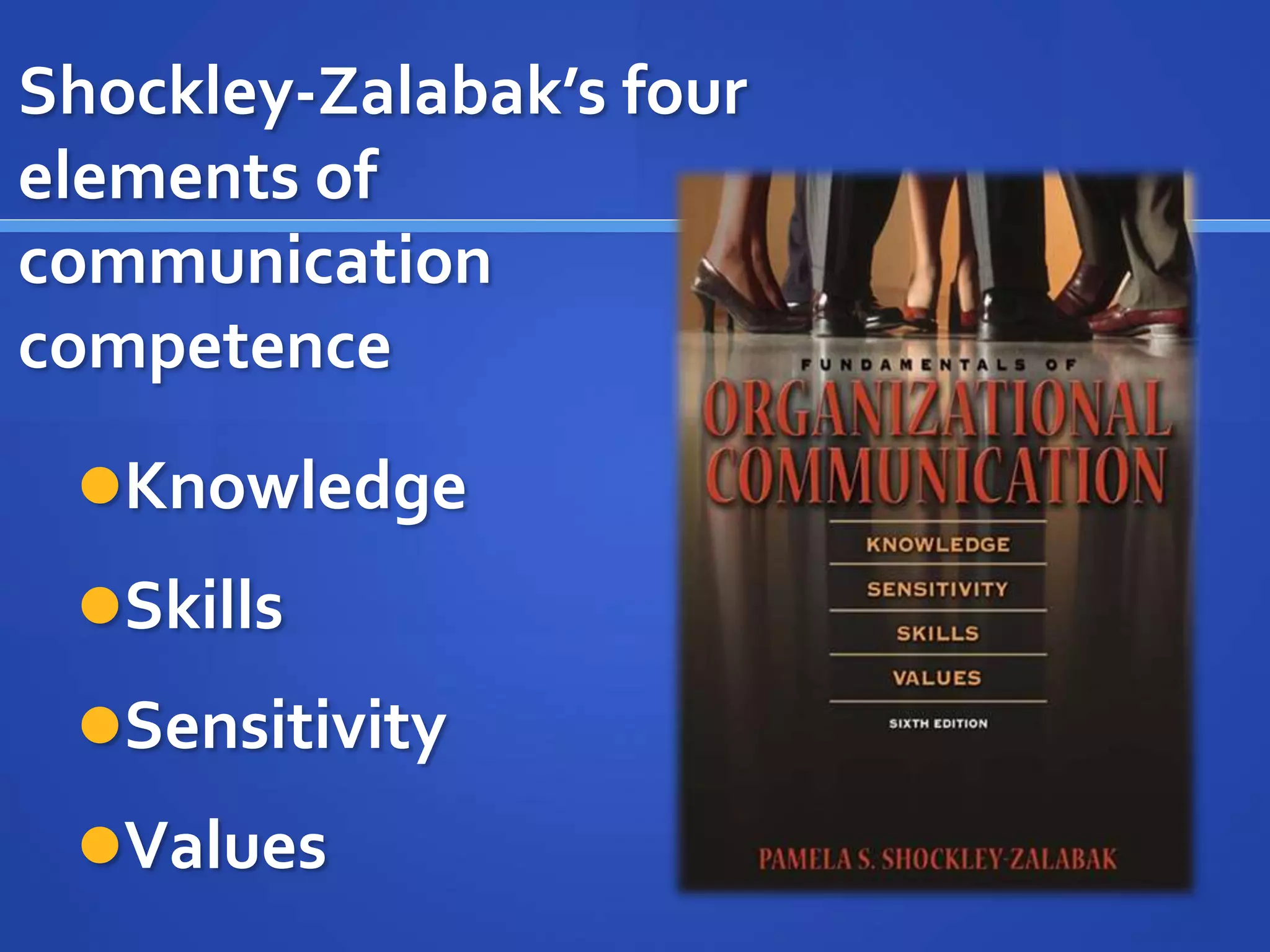
Shockley-Zalabak’s four
elements of
communication
competence
Knowledge
Skills
Sensitivity
Values
public communication
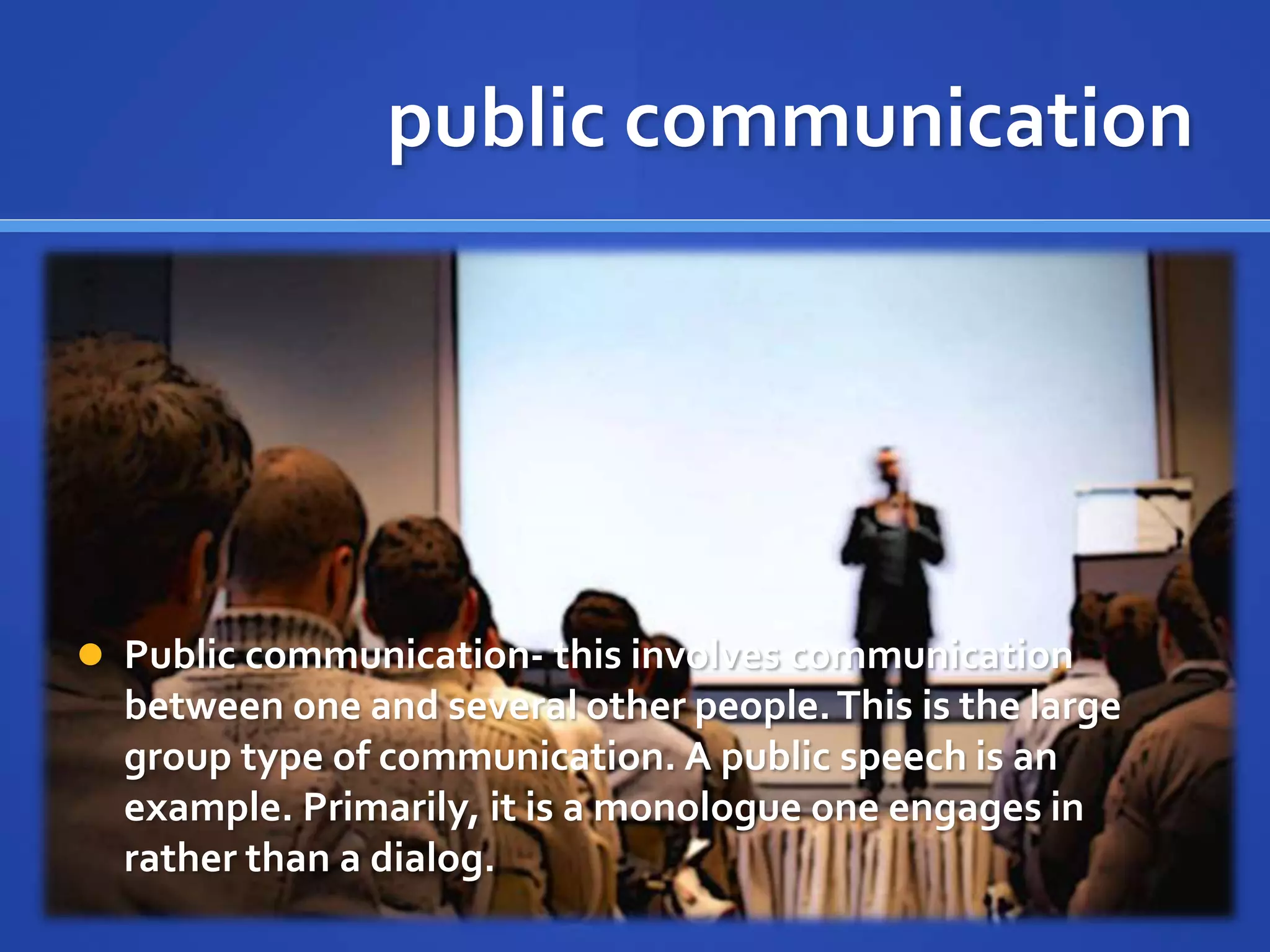
 Public communication- this involves communication
between one and several other people.This is the large
group type of communication. A public speech is an
example. Primarily, it is a monologue one engages in
rather than a dialog.
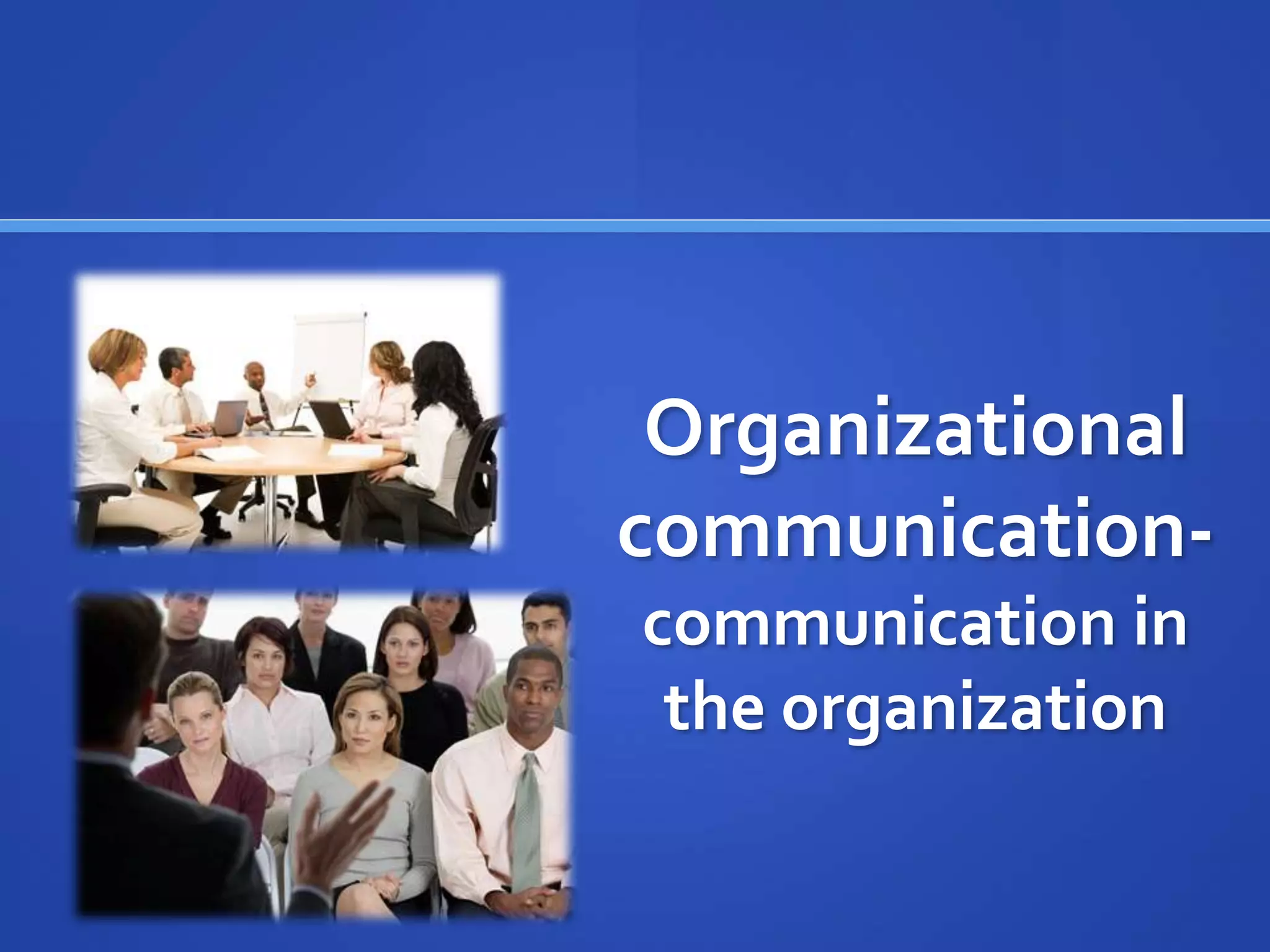
Organizational
communication-
communication in
the organization
Questions will be
entertained after
the reporting 
Thank You!
Maraming Salamat!
Dios Mabalos!
References
Flor, A. (2006). Introduction to Development
Communication. ResearchGate
Mafelopulos, P. (2008). Development Communication
Sourcebook. Washington, DC.World Bank.
Littlejohn, S. and Foss, K. (2009). Encyclopedia of
CommunicationTheories. Sage Publication. New Mexico

Introduction to Communication

  • 1.
    Introduction to Communication DEVC 205 ErnestoD. Doloso Jr., LPT, MA PhD in Development Studies University of the Philippines – Los Banos
  • 2.
    Have you imagined how theworld would go without communication?
  • 3.
    Are you aware that youare spending most of your waking hours talking?
  • 4.
  • 5.
    Communication  “the processof sharing and the relationship of the participants in this process” –Kincaid and Schramm  the process by which an individual (the communicator) transmits stimuli (usually verbal symbols) to modify the behavior of other individuals (communicatee) –Black and Bryant (1992)  The transmission of information, ideas, attitudes, or emotion from one person or group to another (or others) primarily through symbols -Theodorson andTheodorson (1969)  a process by which a source sends a message to a receiver by means of some channel to produce a response from the receiver, in accordance with the intention of the source -SRA Sourcebook, 1996
  • 6.
     Communication isthe dual or two-way process of transmitting messages from one person to another. It is the symbolic interaction between two or more people that influences each other’s behavior. Speech and language are only a portion of the larger process of communication.
  • 7.
     Language isthe medium or vehicle through which messages are sent and received while speech is one of its modes. It is the verbal means of communicating or conveying meaning.
  • 8.
    According to Kincaidand Schramm:  Not all communication has to be human communication  Not all participants in a communication process have to be present at the same time  Because of information and the ways with which man creates, maintains, stores, retrieves, processes, and interprets it, communication can take place over large distances of space and time  Not all communication takes place in words  Communication does not always require two or more participants  Thinking is a form of communication
  • 9.
    Communication as aProcess  On-going  Cyclic  Ever-changing  No beginning, no end  Interdependent  Interrelated
  • 10.
    As a process,it has at least four attributes (SRA Sourcebook)  Dynamic  Systematic  Symbolic Interaction  Meaning is personally constructed
  • 11.
    Elements of theProcess (Berlo’s Model of Communication, 1961)
  • 12.
     Source  Receiver Message  Message Content  Channel  Effect (Overt, Covert)  Feedback Elements of the Process
  • 13.
    Stages of CommunicationProcess  Stimulus/stimuli- triggering event of the communication process  Ideation- an idea or several ideas are formulated and organized to answer a need to communicate  Encoding- the ideas, which have been organized in the ideation stage, are put into code to make transmission possible. To represent these ideas, symbols in the form of sounds or words are made use of.
  • 14.
    Stages of CommunicationProcess  Transmission- the encoded message is sent through a chosen appropriate channel or medium  Reception- the message reaches the receiver  Decoding- the codes or symbols used to transmit messages are converted into ideas or mental images to be interpreted by the receiver  Understanding- the message, which has been transformed into thought or mental images, having been interpreted now becomes clear to the receiver. If he/she does not understand, miscommunication sets in.  Action- the receiver responds to the message received by sending feedback
  • 15.
  • 16.
  • 17.
  • 18.
    Criticism to Lasswell’s CommunicationModel The model took for granted that communication is mainly a persuasive process, that the communicator always has some in- tent to influence the receiver. It omits the elements of feedback.
  • 19.
    Shannon and Weaver’s “MathematicalModel”  What kind of communication channel can bring through the maximum amount of signals?  How much of transmitted signs will be destroyed by noise under way from transmitter to receiver?- (McQuail and Windahl, 1981)
  • 20.
    Criticism It is aone-way, linear model
  • 21.
    Newcomb’s Model  Fiskeargues that Newcomb’s model is significant because it introduces the role of communication in a society or social relationship. To Newcomb, communication maintains equilibrium within a social system. Thus ABX represents a system.
  • 22.
    Osgood and Schramm’sModel  This model focuses on the main actors of the process— unlike the Shannon and Weaver model, which focuses on the channels that mediate between sender and receiver.  Schramm and Osgood show the actors in communication to be equals who perform the identical tasks of encoding, interpreting, and decoding messages.
  • 23.
    Criticism  It doesnot explain communication situations where there is little or no feedback (e.g., mass communication). Furthermore, it seems to connote a feeling of equality in communication.
  • 24.
    Gerbner’s Model  GeorgeGerbner introduced another linear model. Fiske (1982) explains that Gerbner’s model is a more complex version of Shannon and Weaver’s. It is unique in that it allows us to see the communication process as one that consists of “two alternating dimensions—the perceptual or receptive, and the communicating or means and control dimension.”
  • 25.
    Westley and MacLeans’sModel  Fiske (1982) believes that the social need for information also underlies the Westley and MacLean model of communication. He looks upon the 1957 model as an extension of Newcomb’s 1953 model. However, the Westley and MacLean model was created with the mass media in mind. Thus, while it is rooted in Newcomb’s ABX model, it has a new element: C.
  • 26.
    Berlo’s Model  Perhapsthe most well- known (certainly one of the most cited) model of communication is David Berlo’s model of communication. Like the other linear models, Berlo delineates the different actors of the communication process and the elements that mediate between them. His model began as the SMCR model (Source Message Channel Receiver).
  • 27.
    Dance Helical Model The circular model of communication (e.g., Osgood and Schramm’s model) suggest that communication is circular, that it goes full circle to the same point from which it started. The helical model, however, portrays the communication process more accurately—in that it shows the communication process as moving.
  • 28.
    Kincaid’s Convergence Model In 1981, D. Lawrence Kincaid brought forth his Convergence Model of Communication. As illustrated below, it shows a process of convergence through which participants share information so that mutual understanding is reached.
  • 29.
  • 30.
     Verbal orlinguistic aspect- makes use of words; may be oral or written, formal or informal
  • 31.
     Nonverbal orextra linguistic- does not make use of words but may enhance or change the linguistic code.
  • 32.
    Elements of Nonverbal Communication Nonlinguistic elements- devices used in conveying messages without entirely relying on speech or language.  Paralinguistic elements- include the following attributes of voice that accompany the words we say: vocal quality, pitch, tempo, volume, and juncture. Our voice is capable of various dimensions making it possible to identify one person from another.  Metalinguistic element-takes place in the mind of communicators – their awareness of the component units of language like sound, words, phrases and sentences.
  • 33.
    Nonlinguistic elements  KINESICS –language of the body  PROXEMICS – language of space  CHRONEMICS – language of time  HAPTICS – language of touch  OLFATICS – language of smell  ARTEFACTUAL – language of object and physical appearance
  • 34.
    Types and Levelsof Communication  Intrapersonal- communication with oneself. It involves thinking, remembering and feeling
  • 35.
    interpersonal  Interpersonal- communicationamong a relatively small number of people. Much of our communication takes place at this level. Dyadic Communication – communication between two individuals Triadic Communication – communication participated in by three individuals Small Group Communication – communication of more than three individuals
  • 36.
    mass comm and othermedia  Mass communication- this covers other forms of public communication. These are printed form, radio, television, and movies. The tools/materials used are called mass media.
  • 37.
    Radio  Radio isavailable in almost all countries, reaching mass audiences cheaply and rapidly (Barghouti, 1973). Among its advantages, radio: 1) is available and affordable—even in remote communities 2) can repeat messages at low cost 3) reaches illiterate audiences 4) supports other communication channels 5) Is flexible in style (ranging from drama to lectures, folksongs to interviews) 6) announces events and developments as they happen 7) Creates awareness and sets agenda of priorities for people’s attention.
  • 38.
    Can you thinkof radio’s disadvantages?
  • 39.
    Cannot…  illustrate complicatedtechnical concepts  gauge immediate audience reaction, participation, or interest in messages broadcast  Provide or respond to immediate feedback  repeat messages upon demand  Pace itself according to audience needs  overcome some geographical barriers (such as high mountain ranges) to reach the remotest communities.
  • 40.
    Television  The beautyof television lies in its ability to communicate or explain complicated messages because of its combination of sound and picture (Barghouti, 1975).  Among the mass media, it is the closest to face-to-face communication and is successful in reaching out to both literate and illiterate audiences.
  • 41.
    Disadvantages (Barghouti, 1975) accessibility and availability  Educational/development shows face severe competition from entertainment programs  Preparation of development communication programs forTV requires much planning, preparation, technical, creative, and communication skills than for other media  It costs plenty of money to produce and airTV programs.
  • 42.
    Newspapers  Philippine InformationAgency data show that fewer Filipinos read the newspapers than listen to the radio or watchTV.  Nevertheless, development communication uses newspapers because, according to Barghouti (1973), they can present technical data in clearly de- signed text and provide detailed information.  Furthermore, he feels that important topics can be covered in a series of articles. News- papers are still influential in creating awareness and mobilizing public opinion. And, like other print media, articles can be shared or kept as reference materials.
  • 43.
    Disadvantages  Audience islimited to those who can read.  Price is expensive especially on a daily basis.  One-way communication  Small communities or businesses have difficulties in publishing news/feature articles for publication
  • 44.
    Other Media  Cinema FolkTheater  Wall Painting and Billboards  Video Forum  Filmstrips  Slides  Flipcharts  Flannel boards
  • 45.
    Barriers in Communication Noise - is any interference with the message traveling along the channel...which may lead to the signal received being different from that sent -(Chandler, n.d.) Shannon and Weaver argued that there were three levels of problems of communication: 1. Technical problems — how accurately the message can be transmitted 2. Semantic problems — how precisely the meaning is conveyed 3. Effectiveness problems—how effectively does the received message affect behavior
  • 46.
    Other classifications of communicationbarrier  Physical barrier (environmental factors, channel noise)  Psychological-cultural barriers (semantic noise)  Social barriers (socio-psychological barriers)  Ethnocentrism
  • 47.
    Communication Competence  Rothwell(1992) noted that knowing what constitutes human communication does not automatically make you an effective communicator. He points out that one must first understand what it means to communicate competently. Qualities of a Competent Communicator 1) They have aWe-not-Me Orientation 2) They understand communication effectiveness 3) They have a sense of appropriateness Note: Competence is “a judgment of an individual’s proficiency in a particular set of circumstances”.
  • 48.
    Components of Communication Competence Definitions: 1) Littlejohn and Jabusch (1982) who perceived communication competence as the “ability and willingness of an individual to participate responsibly in a transaction in such a way as to maximize the outcome of shared meanings.” 2) Trenhold (1988)who defined it as the “ability to communicate in a personally effective and socially appropriate manner.” 3) Adler andTowne (1990) who viewed it as the “ability to get what you are seeking from others in a manner that maintains the relationship on terms acceptable to both you and the other person.”
  • 49.
  • 50.
    public communication  Publiccommunication- this involves communication between one and several other people.This is the large group type of communication. A public speech is an example. Primarily, it is a monologue one engages in rather than a dialog.
  • 51.
  • 52.
    Questions will be entertainedafter the reporting 
  • 53.
  • 54.
    References Flor, A. (2006).Introduction to Development Communication. ResearchGate Mafelopulos, P. (2008). Development Communication Sourcebook. Washington, DC.World Bank. Littlejohn, S. and Foss, K. (2009). Encyclopedia of CommunicationTheories. Sage Publication. New Mexico