Nandha Engineering College
(Autonomous)
Department of ECE
By
JC
Circuit Theory
• Circuit - A complete electrical network with a closed
loop giving a return path for current
• Circuit analysis - The process of finding all the
currents and voltages in a network of connected
components
Classification of Circuit Elements
• Active and passive element
• Lumped and Distributed parameters
• Bilateral and Unilateral elements
• Linear and non-Linear elements
Active and passive element
• A passive element is an electrical component that does not generate
power, but instead dissipates, stores, and/or releases it
• The active elements generate energy. Active electronic components are
those that can control the flow of electricity. Active Components are
electronic components that require a Source of Energy to perform their
intended functions
Lumped and Distributed parameters
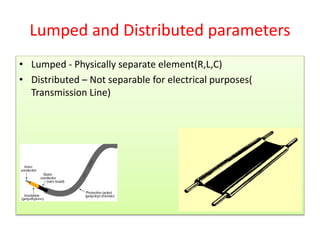
• Lumped - Physically separate element(R,L,C)
• Distributed – Not separable for electrical purposes(
Transmission Line)
Bilateral and Unilateral elements
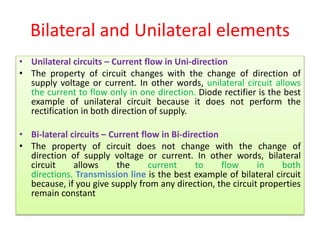
• Unilateral circuits – Current flow in Uni-direction
• The property of circuit changes with the change of direction of
supply voltage or current. In other words, unilateral circuit allows
the current to flow only in one direction. Diode rectifier is the best
example of unilateral circuit because it does not perform the
rectification in both direction of supply.
• Bi-lateral circuits – Current flow in Bi-direction
• The property of circuit does not change with the change of
direction of supply voltage or current. In other words, bilateral
circuit allows the current to flow in both
directions. Transmission line is the best example of bilateral circuit
because, if you give supply from any direction, the circuit properties
remain constant
Linear and non-Linear elements
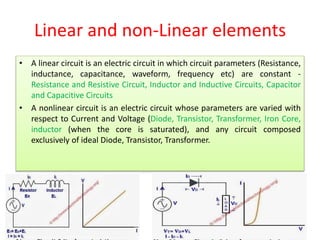
• A linear circuit is an electric circuit in which circuit parameters (Resistance,
inductance, capacitance, waveform, frequency etc) are constant -
Resistance and Resistive Circuit, Inductor and Inductive Circuits, Capacitor
and Capacitive Circuits
• A nonlinear circuit is an electric circuit whose parameters are varied with
respect to Current and Voltage (Diode, Transistor, Transformer, Iron Core,
inductor (when the core is saturated), and any circuit composed
exclusively of ideal Diode, Transistor, Transformer.
Sources
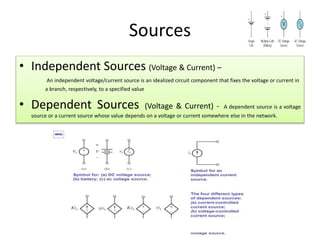
• Independent Sources (Voltage & Current) –
An independent voltage/current source is an idealized circuit component that fixes the voltage or current in
a branch, respectively, to a specified value
• Dependent Sources (Voltage & Current) - A dependent source is a voltage
source or a current source whose value depends on a voltage or current somewhere else in the network.
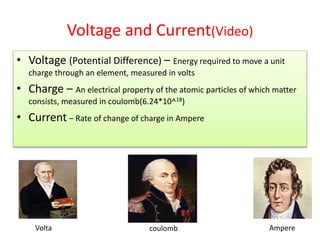
Voltage and Current(Video)
• Voltage (Potential Difference) – Energy required to move a unit
charge through an element, measured in volts
• Charge – An electrical property of the atomic particles of which matter
consists, measured in coulomb(6.24*10^18)
• Current – Rate of change of charge in Ampere
Volta coulomb Ampere
• Thank u

Introduction to circuit theory

  • 1.
  • 2.
    Circuit Theory • Circuit- A complete electrical network with a closed loop giving a return path for current • Circuit analysis - The process of finding all the currents and voltages in a network of connected components
  • 3.
    Classification of CircuitElements • Active and passive element • Lumped and Distributed parameters • Bilateral and Unilateral elements • Linear and non-Linear elements
  • 4.
    Active and passiveelement • A passive element is an electrical component that does not generate power, but instead dissipates, stores, and/or releases it • The active elements generate energy. Active electronic components are those that can control the flow of electricity. Active Components are electronic components that require a Source of Energy to perform their intended functions
  • 5.
    Lumped and Distributedparameters • Lumped - Physically separate element(R,L,C) • Distributed – Not separable for electrical purposes( Transmission Line)
  • 6.
    Bilateral and Unilateralelements • Unilateral circuits – Current flow in Uni-direction • The property of circuit changes with the change of direction of supply voltage or current. In other words, unilateral circuit allows the current to flow only in one direction. Diode rectifier is the best example of unilateral circuit because it does not perform the rectification in both direction of supply. • Bi-lateral circuits – Current flow in Bi-direction • The property of circuit does not change with the change of direction of supply voltage or current. In other words, bilateral circuit allows the current to flow in both directions. Transmission line is the best example of bilateral circuit because, if you give supply from any direction, the circuit properties remain constant
  • 7.
    Linear and non-Linearelements • A linear circuit is an electric circuit in which circuit parameters (Resistance, inductance, capacitance, waveform, frequency etc) are constant - Resistance and Resistive Circuit, Inductor and Inductive Circuits, Capacitor and Capacitive Circuits • A nonlinear circuit is an electric circuit whose parameters are varied with respect to Current and Voltage (Diode, Transistor, Transformer, Iron Core, inductor (when the core is saturated), and any circuit composed exclusively of ideal Diode, Transistor, Transformer.
  • 8.
    Sources • Independent Sources(Voltage & Current) – An independent voltage/current source is an idealized circuit component that fixes the voltage or current in a branch, respectively, to a specified value • Dependent Sources (Voltage & Current) - A dependent source is a voltage source or a current source whose value depends on a voltage or current somewhere else in the network.
  • 9.
    Voltage and Current(Video) •Voltage (Potential Difference) – Energy required to move a unit charge through an element, measured in volts • Charge – An electrical property of the atomic particles of which matter consists, measured in coulomb(6.24*10^18) • Current – Rate of change of charge in Ampere Volta coulomb Ampere
  • 10.