DEBASMITA CHAKRA
SENIOR TEACHER EDUCATOR
DIET MAYURBHANJ
POWER TO EMPOWER
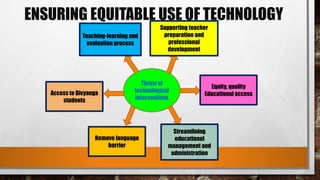
ENSURING EQUITABLE USE OF TECHNOLOGY
Thrust of
technological
interventions
Equity, quality
Educational access
Streamlining
educational
management and
administration
Remove language
barrier
Access to Divyanga
students
Teaching-learning and
evaluation process
Supporting teacher
preparation and
professional
development
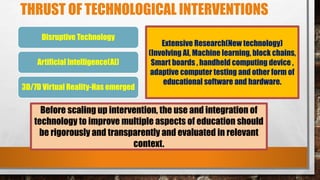
THRUST OF TECHNOLOGICAL INTERVENTIONS
Disruptive Technology
Artificial Intelligence(AI)
3D/7D Virtual Reality-Has emerged
Extensive Research(New technology)
(Involving AI, Machine learning, block chains,
Smart boards , handheld computing device ,
adaptive computer testing and other form of
educational software and hardware.
Before scaling up intervention, the use and integration of
technology to improve multiple aspects of education should
be rigorously and transparently and evaluated in relevant
context.
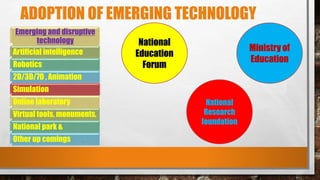
ADOPTION OF EMERGING TECHNOLOGY
Emerging and disruptive
technology
Artificial intelligence
Robotics
2D/3D/7D , Animation
Simulation
Online laboratory
Virtual tools, monuments,
National park &
Other up comings
National
Education
Forum
Ministry of
Education
National
Research
foundation
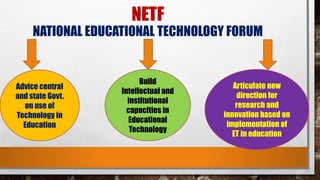
NETF
NATIONAL EDUCATIONAL TECHNOLOGY FORUM
Advice central
and state Govt.
on use of
Technology in
Education
Build
Intellectual and
institutional
capacities in
Educational
Technology
Articulate new
direction for
research and
innovation based on
implementation of
ET in education
NATIONAL RESEARCH FOUNDATION
Advancing
core AI research
Advancing research
efforts to
teaching-learning-
assessment
Developing and
deploying
application based
research
Healthcare Agriculture Climate Change
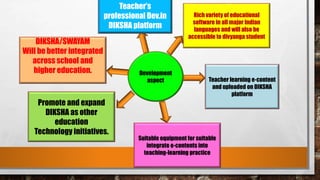
Development
aspect Teacher learning e-content
and uploaded on DIKSHA
platform
Suitable equipment for suitable
integrate e-contents into
teaching-learning practice
Promote and expand
DIKSHA as other
education
Technology initiatives.
DIKSHA/SWAYAM
Will be better integrated
across school and
higher education.
Teacher’s
professional Dev.in
DIKSHA platform
Rich variety of educational
software in all major Indian
languages and will also be
accessible to divyanga student
ROLE OF HIGHER EDUCATION INSTITUTIONS
Play an active role in
conducting research
on disruptional
versions of
instructional material
courses including
online course and
assessing their impact
on specific areas.
HEIs will conduct
targeted training for
job readiness and
address skilling ,
deskilling and
scaling keeping in
view the disruptive
technology.
Universities will aim to
offer PH.D and Masters
programme in core
areas such as machine
learning as well as
multidisciplinary fields
and professional areas
like health, agricultural
and law.
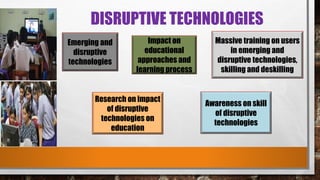
DISRUPTIVE TECHNOLOGIES
Emerging and
disruptive
technologies
Impact on
educational
approaches and
learning process
Massive training on users
in emerging and
disruptive technologies,
skilling and deskilling
Research on impact
of disruptive
technologies on
education
Awareness on skill
of disruptive
technologies
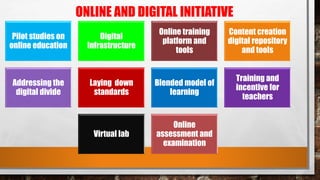
ONLINE AND DIGITAL INITIATIVE
Pilot studies on
online education
Digital
Infrastructure
Online training
platform and
tools
Content creation
digital repository
and tools
Addressing the
digital divide
Laying down
standards
Blended model of
learning
Training and
incentive for
teachers
Virtual lab
Online
assessment and
examination
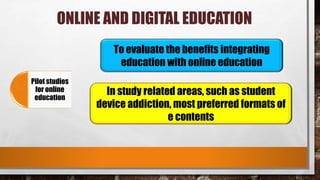
ONLINE AND DIGITAL EDUCATION
Pilot studies
for online
education
To evaluate the benefits integrating
education with online education
In study related areas, such as student
device addiction, most preferred formats of
e contents
ONLINE AND DIGITAL EDUCATION
Digital
infrastructure
Digital
infrastructure
Public
domain
ONLINE AND DIGITAL EDUCATION
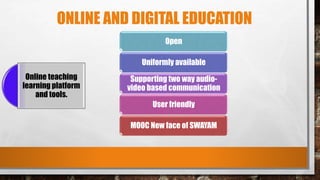
Online teaching
learning platform
and tools.
Open
Uniformly available
Supporting two way audio-
video based communication
User friendly
MOOC New face of SWAYAM
ONLINE AND DIGITAL EDUCATION
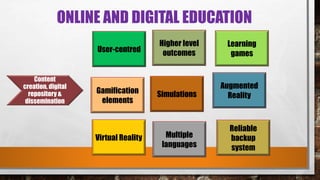
Content
creation, digital
repository &
dissemination
User-centred
Higher level
outcomes
Learning
games
Gamification
elements
Simulations
Augmented
Reality
Virtual Reality Multiple
languages
Reliable
backup
system
ONLINE AND DIGITAL EDUCATION
Addressing the
Digital divide
Television Radio
Community
radio
Smart
phone
24×7
Focus on
regional media
of instruction
ONLINE AND DIGITAL EDUCATION
E-learning platforms such as DIKSHA, SWAYAM,SWAYAMPRAVA be
leveraged.
Hands on experiments-based on learning experience
Adequate access to SEDG students and teachers
Suitable digital devices such as tablets with pre-loaded content
ONLINE AND DIGITAL EDUCATION
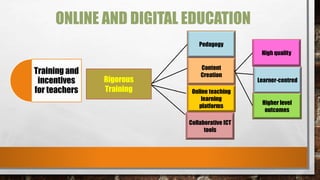
Training and
incentives
for teachers
Rigorous
Training
Pedagogy
Content
Creation
Online teaching
learning
platforms
Collaborative ICT
tools
High quality
Learner-centred
Higher level
outcomes
ONLINE AND DIGITAL EDUCATION
Online
assessment
and
examinatio
ns
Design
Competency
Portfolio
Rubrics
Standardised
assessments
Assessment
analytics
ONLINE AND DIGITAL EDUCATION
Significance of Face-to-Face
interactions recognised
Models of Blended learning
ONLINE AND DIGITAL EDUCATION
Laying
down
standards
Content Technology Pedagogy
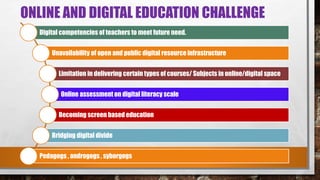
ONLINE AND DIGITAL EDUCATION CHALLENGE
Digital competencies of teachers to meet future need.
Unavailability of open and public digital resource infrastructure
Limitation in delivering certain types of courses/ Subjects in online/digital space
Online assessment on digital literacy scale
Becoming screen based education
Bridging digital divide
Pedagogs , androgogs , syborgogs
ONLINE AND DIGITAL EDUCATION WAY FORWARD
Optimise
and
expand
exiting
platform
and ICT
based
institution.
Provide
assistive
tools for
monitoring
of diverse
group to
learning
Sustainable
teacher
training to
prepare
teacher as
effective
and online
teachers.
Online
assessme
nt in
different
approach
Changing
the
pedagogy
for online
digital
Education
Blended
approach
with online
and
experimenta
l learning.
Educational
programme
to made
available
24×7 in
different
language
Provide
two many
audio and
videos
interface
for
holding
online
classes.
IMPLEMENTATION
Elevate DIKSHA
and swayam
portal
MOOCS in all
areas in all
language
Dissemination of
e-content
through apps,
portals, through
telecast and
broadcast to
reach the
ground.
Collaboration,
Cooperation in
between
organisations need
to happen for
convergence of
service in real sense
at national level,
local level in real
time in real manner.
ROLE OF TEACHER FOR IMPLEMENTATION
Positive attitude towards meaningful integration of technology.
Readiness to acquire skills of adapting to new technologies.
Creativity to integrate technology in multiple ways to achieve quality education.
Urge to strive for access to all.
Confidence and competence to cope up with the disruptive technologies
Ready to work in teams and in collaboration.
Nep 2020 ict

Nep 2020 ict

  • 1.
    DEBASMITA CHAKRA SENIOR TEACHEREDUCATOR DIET MAYURBHANJ POWER TO EMPOWER
  • 2.
    ENSURING EQUITABLE USEOF TECHNOLOGY Thrust of technological interventions Equity, quality Educational access Streamlining educational management and administration Remove language barrier Access to Divyanga students Teaching-learning and evaluation process Supporting teacher preparation and professional development
  • 3.
    THRUST OF TECHNOLOGICALINTERVENTIONS Disruptive Technology Artificial Intelligence(AI) 3D/7D Virtual Reality-Has emerged Extensive Research(New technology) (Involving AI, Machine learning, block chains, Smart boards , handheld computing device , adaptive computer testing and other form of educational software and hardware. Before scaling up intervention, the use and integration of technology to improve multiple aspects of education should be rigorously and transparently and evaluated in relevant context.
  • 4.
    ADOPTION OF EMERGINGTECHNOLOGY Emerging and disruptive technology Artificial intelligence Robotics 2D/3D/7D , Animation Simulation Online laboratory Virtual tools, monuments, National park & Other up comings National Education Forum Ministry of Education National Research foundation
  • 5.
    NETF NATIONAL EDUCATIONAL TECHNOLOGYFORUM Advice central and state Govt. on use of Technology in Education Build Intellectual and institutional capacities in Educational Technology Articulate new direction for research and innovation based on implementation of ET in education
  • 6.
    NATIONAL RESEARCH FOUNDATION Advancing coreAI research Advancing research efforts to teaching-learning- assessment Developing and deploying application based research Healthcare Agriculture Climate Change
  • 7.
    Development aspect Teacher learninge-content and uploaded on DIKSHA platform Suitable equipment for suitable integrate e-contents into teaching-learning practice Promote and expand DIKSHA as other education Technology initiatives. DIKSHA/SWAYAM Will be better integrated across school and higher education. Teacher’s professional Dev.in DIKSHA platform Rich variety of educational software in all major Indian languages and will also be accessible to divyanga student
  • 8.
    ROLE OF HIGHEREDUCATION INSTITUTIONS Play an active role in conducting research on disruptional versions of instructional material courses including online course and assessing their impact on specific areas. HEIs will conduct targeted training for job readiness and address skilling , deskilling and scaling keeping in view the disruptive technology. Universities will aim to offer PH.D and Masters programme in core areas such as machine learning as well as multidisciplinary fields and professional areas like health, agricultural and law.
  • 9.
    DISRUPTIVE TECHNOLOGIES Emerging and disruptive technologies Impacton educational approaches and learning process Massive training on users in emerging and disruptive technologies, skilling and deskilling Research on impact of disruptive technologies on education Awareness on skill of disruptive technologies
  • 10.
    ONLINE AND DIGITALINITIATIVE Pilot studies on online education Digital Infrastructure Online training platform and tools Content creation digital repository and tools Addressing the digital divide Laying down standards Blended model of learning Training and incentive for teachers Virtual lab Online assessment and examination
  • 11.
    ONLINE AND DIGITALEDUCATION Pilot studies for online education To evaluate the benefits integrating education with online education In study related areas, such as student device addiction, most preferred formats of e contents
  • 12.
    ONLINE AND DIGITALEDUCATION Digital infrastructure Digital infrastructure Public domain
  • 13.
    ONLINE AND DIGITALEDUCATION Online teaching learning platform and tools. Open Uniformly available Supporting two way audio- video based communication User friendly MOOC New face of SWAYAM
  • 14.
    ONLINE AND DIGITALEDUCATION Content creation, digital repository & dissemination User-centred Higher level outcomes Learning games Gamification elements Simulations Augmented Reality Virtual Reality Multiple languages Reliable backup system
  • 15.
    ONLINE AND DIGITALEDUCATION Addressing the Digital divide Television Radio Community radio Smart phone 24×7 Focus on regional media of instruction
  • 16.
    ONLINE AND DIGITALEDUCATION E-learning platforms such as DIKSHA, SWAYAM,SWAYAMPRAVA be leveraged. Hands on experiments-based on learning experience Adequate access to SEDG students and teachers Suitable digital devices such as tablets with pre-loaded content
  • 17.
    ONLINE AND DIGITALEDUCATION Training and incentives for teachers Rigorous Training Pedagogy Content Creation Online teaching learning platforms Collaborative ICT tools High quality Learner-centred Higher level outcomes
  • 18.
    ONLINE AND DIGITALEDUCATION Online assessment and examinatio ns Design Competency Portfolio Rubrics Standardised assessments Assessment analytics
  • 19.
    ONLINE AND DIGITALEDUCATION Significance of Face-to-Face interactions recognised Models of Blended learning
  • 20.
    ONLINE AND DIGITALEDUCATION Laying down standards Content Technology Pedagogy
  • 21.
    ONLINE AND DIGITALEDUCATION CHALLENGE Digital competencies of teachers to meet future need. Unavailability of open and public digital resource infrastructure Limitation in delivering certain types of courses/ Subjects in online/digital space Online assessment on digital literacy scale Becoming screen based education Bridging digital divide Pedagogs , androgogs , syborgogs
  • 22.
    ONLINE AND DIGITALEDUCATION WAY FORWARD Optimise and expand exiting platform and ICT based institution. Provide assistive tools for monitoring of diverse group to learning Sustainable teacher training to prepare teacher as effective and online teachers. Online assessme nt in different approach Changing the pedagogy for online digital Education Blended approach with online and experimenta l learning. Educational programme to made available 24×7 in different language Provide two many audio and videos interface for holding online classes.
  • 23.
    IMPLEMENTATION Elevate DIKSHA and swayam portal MOOCSin all areas in all language Dissemination of e-content through apps, portals, through telecast and broadcast to reach the ground. Collaboration, Cooperation in between organisations need to happen for convergence of service in real sense at national level, local level in real time in real manner.
  • 24.
    ROLE OF TEACHERFOR IMPLEMENTATION Positive attitude towards meaningful integration of technology. Readiness to acquire skills of adapting to new technologies. Creativity to integrate technology in multiple ways to achieve quality education. Urge to strive for access to all. Confidence and competence to cope up with the disruptive technologies Ready to work in teams and in collaboration.