BIOAVAILABILITY
INTRODUCTION
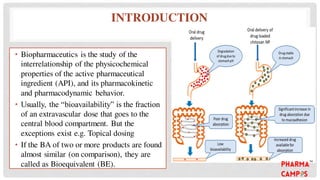
• Biopharmaceutics is the study of the
interrelationship of the physicochemical
properties of the active pharmaceutical
ingredient (API), and its pharmacokinetic
and pharmacodynamic behavior.
• Usually, the “bioavailability” is the fraction
of an extravascular dose that goes to the
central blood compartment. But the
exceptions exist e.g. Topical dosing
• If the BA of two or more products are found
almost similar (on comparison), they are
called as Bioequivalent (BE).
IMPORTANCE OF STUDYING BIOAVAILABILITY
• The drug becomes available to the systemic circulation for exerting the effect after
dissolution , absorption and surviving metabolism.
• The drug may show very low bioavailability due to one (or more) of the following
reasons:
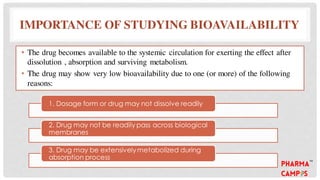
1. Dosage form or drug may not dissolve readily
2. Drug may not be readily pass across biological
membranes
3. Drug may be extensivelymetabolized during
absorption process
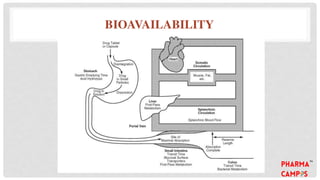
CONCEPT OF BIOAVAILABILITY
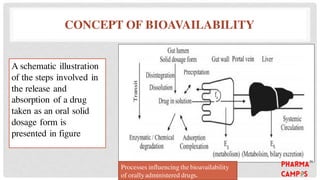
A schematic illustration
of the steps involved in
the release and
absorption of a drug
taken as an oral solid
dosage form is
presented in figure
Processes influencing the bioavailability
of orallyadministered drugs.
BIOPHARMACEUTICALCLASSIFICATION
SYSTEM (BCS)
• The Biopharmaceutical Classification
System (BCS), which was proposed by
Amidon et al. in 1995, classifies drugs
into four different groups depending on
their solubility and permeability.
• BCS is a drug development tool that
allows estimation of the contribution of
three fundamental factors including
dissolution, solubility and intestinal
permeability.
• The BCS can be employed as a tool to
develop a strategy for improving the
bioavailability of new chemical entities.
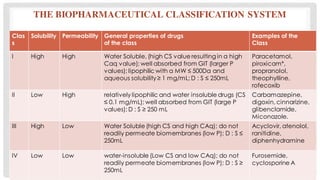
THE BIOPHARMACEUTICAL CLASSIFICATION SYSTEM
Clas
s
Solubility Permeability General properties of drugs
of the class
Examples of the
Class
I High High Water Soluble, (high CS value resulting in a high
Caq value); well absorbed from GIT (larger P
values); lipophilic with a MW ≤ 500Da and
aqueous solubility ≥ 1 mg/mL; D : S ≤ 250mL
Paracetamol,
piroxicam*,
propranolol,
theophylline,
rofecoxib
II Low High relatively lipophilic and water insoluble drugs (CS
≤ 0.1 mg/mL); well absorbed from GIT (large P
values); D : S ≥ 250 mL
Carbamazepine,
digoxin, cinnarizine,
glibenclamide,
Miconazole.
III High Low Water Soluble (high CS and high CAq); do not
readily permeate biomembranes (low P); D : S ≤
250mL
Acyclovir, atenolol,
ranitidine,
diphenhydramine
IV Low Low water-insoluble (Low CS and low CAq); do not
readily permeate biomembranes (low P); D : S ≥
250mL
Furosemide,
cyclosporine A
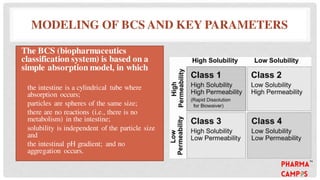
MODELING OF BCS AND KEY PARAMETERS
The BCS (biopharmaceutics
classification system) is based on a
simple absorption model, in which
• the intestine is a cylindrical tube where
absorption occurs;
• particles are spheres of the same size;
• there are no reactions (i.e., there is no
metabolism) in the intestine;
• solubility is independent of the particle size
and
• the intestinal pH gradient; and no
aggregation occurs.
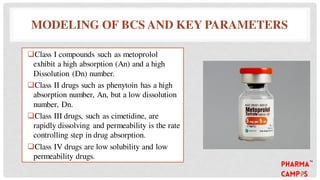
MODELING OF BCS AND KEY PARAMETERS
Class I compounds such as metoprolol
exhibit a high absorption (An) and a high
Dissolution (Dn) number.
Class II drugs such as phenytoin has a high
absorption number, An, but a low dissolution
number, Dn.
Class III drugs, such as cimetidine, are
rapidly dissolving and permeability is the rate
controlling step in drug absorption.
Class IV drugs are low solubility and low
permeability drugs.
TYPES OF BIOAVAILABILITY
Bioavailability Dose: Dose available to the patient to give therapeutic effect is called
as bioavailable dose, which is always less than the administered dose.
Systemic bioavailability: The amount of drug that reaches the systemic circulation
is known as ‘Systemic bioavailability’.
Bioavailable fraction: It refers to the fraction of administered dose.
Absolute bioavailability: Comparison between systemic availability of orally
administered drug with IV administered one. (Denoted by F).
Relative bioavailability: Comparison between systematic availability of orally
administered drug with an oral standard of same drug. Denoted by Fr.
BIOAVAILABILITY
OBJECTIVES OF BIOAVAILABILITY STUDIES
• Bioavailability studies are done in clinical, academic,
and regulatory interest.
• The latter includes agencies that approve the sale of
products in their nation(s), as well as regulatory
agencies.
• Objective of BA studies can be summarized as followed.
1. Development of new drug entity.
2. Determination of influence of Excipients.
3. Patient related factors.
4. To control the quality of drug.
5. To determine the Processing factors.
6. Storage

Introduction to Bio-availability study

  • 1.
  • 2.
    INTRODUCTION • Biopharmaceutics isthe study of the interrelationship of the physicochemical properties of the active pharmaceutical ingredient (API), and its pharmacokinetic and pharmacodynamic behavior. • Usually, the “bioavailability” is the fraction of an extravascular dose that goes to the central blood compartment. But the exceptions exist e.g. Topical dosing • If the BA of two or more products are found almost similar (on comparison), they are called as Bioequivalent (BE).
  • 3.
    IMPORTANCE OF STUDYINGBIOAVAILABILITY • The drug becomes available to the systemic circulation for exerting the effect after dissolution , absorption and surviving metabolism. • The drug may show very low bioavailability due to one (or more) of the following reasons: 1. Dosage form or drug may not dissolve readily 2. Drug may not be readily pass across biological membranes 3. Drug may be extensivelymetabolized during absorption process
  • 4.
    CONCEPT OF BIOAVAILABILITY Aschematic illustration of the steps involved in the release and absorption of a drug taken as an oral solid dosage form is presented in figure Processes influencing the bioavailability of orallyadministered drugs.
  • 5.
    BIOPHARMACEUTICALCLASSIFICATION SYSTEM (BCS) • TheBiopharmaceutical Classification System (BCS), which was proposed by Amidon et al. in 1995, classifies drugs into four different groups depending on their solubility and permeability. • BCS is a drug development tool that allows estimation of the contribution of three fundamental factors including dissolution, solubility and intestinal permeability. • The BCS can be employed as a tool to develop a strategy for improving the bioavailability of new chemical entities.
  • 6.
    THE BIOPHARMACEUTICAL CLASSIFICATIONSYSTEM Clas s Solubility Permeability General properties of drugs of the class Examples of the Class I High High Water Soluble, (high CS value resulting in a high Caq value); well absorbed from GIT (larger P values); lipophilic with a MW ≤ 500Da and aqueous solubility ≥ 1 mg/mL; D : S ≤ 250mL Paracetamol, piroxicam*, propranolol, theophylline, rofecoxib II Low High relatively lipophilic and water insoluble drugs (CS ≤ 0.1 mg/mL); well absorbed from GIT (large P values); D : S ≥ 250 mL Carbamazepine, digoxin, cinnarizine, glibenclamide, Miconazole. III High Low Water Soluble (high CS and high CAq); do not readily permeate biomembranes (low P); D : S ≤ 250mL Acyclovir, atenolol, ranitidine, diphenhydramine IV Low Low water-insoluble (Low CS and low CAq); do not readily permeate biomembranes (low P); D : S ≥ 250mL Furosemide, cyclosporine A
  • 7.
    MODELING OF BCSAND KEY PARAMETERS The BCS (biopharmaceutics classification system) is based on a simple absorption model, in which • the intestine is a cylindrical tube where absorption occurs; • particles are spheres of the same size; • there are no reactions (i.e., there is no metabolism) in the intestine; • solubility is independent of the particle size and • the intestinal pH gradient; and no aggregation occurs.
  • 8.
    MODELING OF BCSAND KEY PARAMETERS Class I compounds such as metoprolol exhibit a high absorption (An) and a high Dissolution (Dn) number. Class II drugs such as phenytoin has a high absorption number, An, but a low dissolution number, Dn. Class III drugs, such as cimetidine, are rapidly dissolving and permeability is the rate controlling step in drug absorption. Class IV drugs are low solubility and low permeability drugs.
  • 9.
    TYPES OF BIOAVAILABILITY BioavailabilityDose: Dose available to the patient to give therapeutic effect is called as bioavailable dose, which is always less than the administered dose. Systemic bioavailability: The amount of drug that reaches the systemic circulation is known as ‘Systemic bioavailability’. Bioavailable fraction: It refers to the fraction of administered dose. Absolute bioavailability: Comparison between systemic availability of orally administered drug with IV administered one. (Denoted by F). Relative bioavailability: Comparison between systematic availability of orally administered drug with an oral standard of same drug. Denoted by Fr.
  • 10.
  • 11.
    OBJECTIVES OF BIOAVAILABILITYSTUDIES • Bioavailability studies are done in clinical, academic, and regulatory interest. • The latter includes agencies that approve the sale of products in their nation(s), as well as regulatory agencies. • Objective of BA studies can be summarized as followed. 1. Development of new drug entity. 2. Determination of influence of Excipients. 3. Patient related factors. 4. To control the quality of drug. 5. To determine the Processing factors. 6. Storage