Indian Pharma Industry:
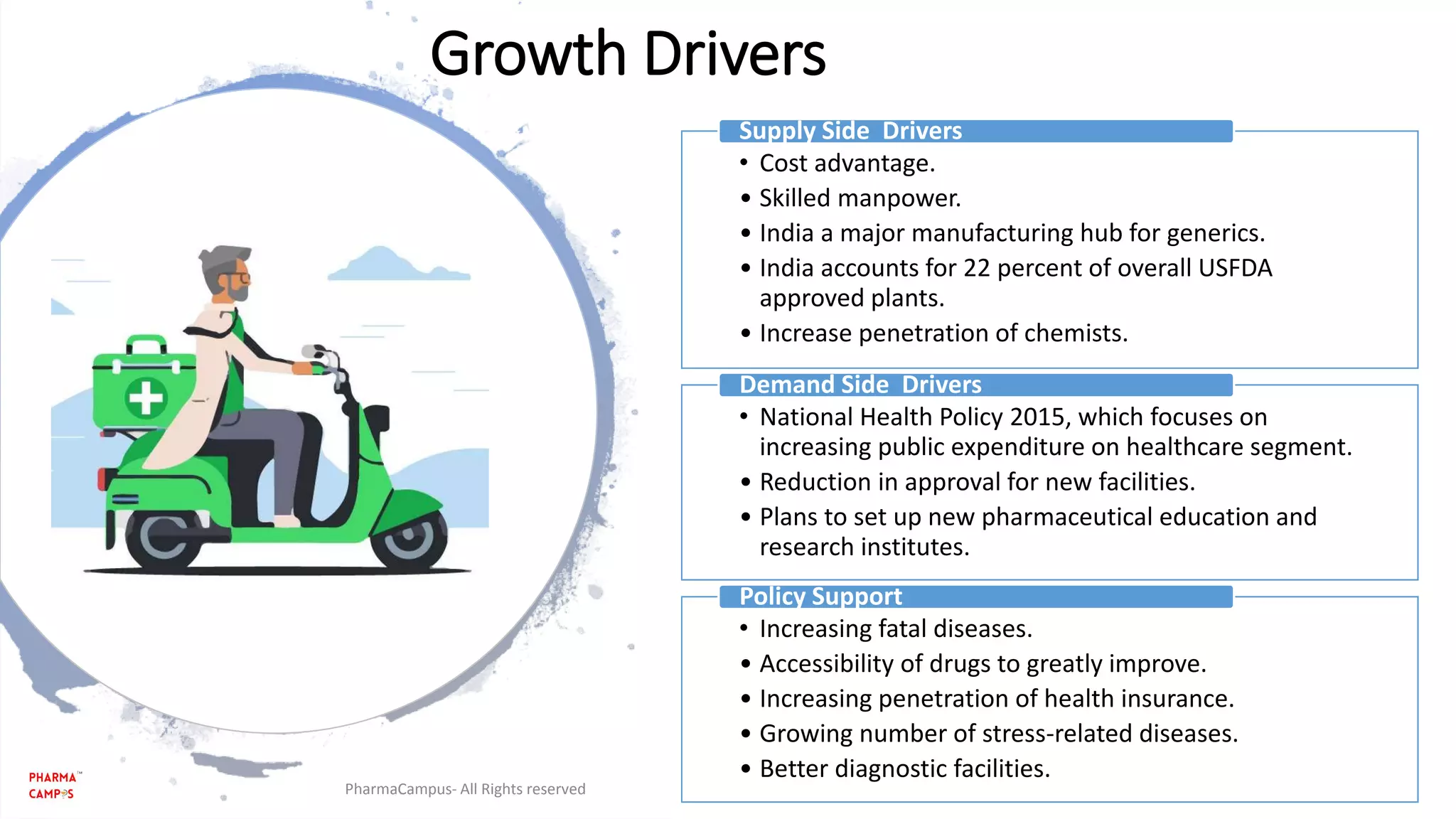
Growth Drivers
PharmaCampus- All Rights reserved
Growth drivers-
Supply Side Drivers
PharmaCampus- All Rights reserved
• Cost advantage.
• Skilled manpower.
• India a major manufacturing hub for
generics.
• India accounts for 22 percent of overall
USFDA approved plants.
• Increase penetration of chemists.
Growth drivers-
Demand Side Drivers
• Increasing fatal diseases.
• Accessibility of drugs to greatly improve.
• Increasing penetration of health insurance.
• Growing number of stress-related diseases.
• Better diagnostic facilities.
PharmaCampus- All Rights reserved
Growth drivers-
Policy Support
PharmaCampus-
All
Rights
reserved
• National Health Policy
2015, which focuses on
increasing public
expenditure on
healthcare segment.
• Reduction in approval
for new facilities.
• Plans to set up new
pharmaceutical
education and research
institutes.
Growth Drivers
PharmaCampus- All Rights reserved
• Cost advantage.
• Skilled manpower.
• India a major manufacturing hub for generics.
• India accounts for 22 percent of overall USFDA
approved plants.
• Increase penetration of chemists.
Supply Side Drivers
• National Health Policy 2015, which focuses on
increasing public expenditure on healthcare segment.
• Reduction in approval for new facilities.
• Plans to set up new pharmaceutical education and
research institutes.
Demand Side Drivers
• Increasing fatal diseases.
• Accessibility of drugs to greatly improve.
• Increasing penetration of health insurance.
• Growing number of stress-related diseases.
• Better diagnostic facilities.
Policy Support
1. Launch of
Patented Drugs
PharmaCampus- All Rights reserved
Launch of Patented
Drugs
• Following the introduction of product
patents, several multinational companies are
expected to launch patented drugs in India-
• Growth in the number of lifestyle diseases
in India could boost the sale of drugs in this
segment.
• High Court allowing to export patent drugs,
to foreign players in the Indian market.
PharmaCampus- All Rights reserved
2.Medical
Infrastructure
PharmaCampus- All Rights reserved
• Pharma companies have increased
spending to tap rural markets and develop
better medical infrastructure.
• Hospitals’ market size is expected to
increase by US$ 200 billion by 2024.
• Medical devices industry in India has
been growing 17 per cent annually.
PharmaCampus- All Rights reserved
Medical
Infrastructure
3. Scope in
Generics
Market
PharmaCampus- All Rights reserved
Scope in Generics
Market
• India’s generic drugs account for 20
per cent of global exports in terms of
volume, making it the largest provider
of generic medicines globally.
• The generics drug market accounts
for around 70 per cent of the India
pharmaceutical industry and it is
expected to reach US$ 27.9 billion by
2020
PharmaCampus- All Rights reserved
4. Over-The-
Counter (OTC)
Drugs
PharmaCampus- All Rights reserved
Over-The-Counter
(OTC) Drugs
• India’s OTC drugs market is
estimated to have grown at a
CAGR of 16.3 per cent to US$
6.6 billion over.
• 2008–16 and is further expected
to grow on the account of
increased penetration of
chemists, especially in rural
regions.
• Indian OTC market is expected
to grow at a CAGR of 9 per cent
from 2016-26 to cross Rs 44,115
crore (US$ 6.81 billion).
PharmaCampus- All Rights reserved
5. Patent Expiry
PharmaCampus- All Rights reserved
Patent Expiry
• About 120 drugs are expected to go
off-patent over the next 10 years.
• The estimated worldwide revenue of
patent expiry is US$ 80 to 250 billion
PharmaCampus- All Rights reserved
Demand
Drivers
Accessibility
• Over US$ 200 billion to be spent on medical next
decade.
• New business models expected to penetrate
tier-2 and 3 boosting the OTC market.
• Over 160,000 hospital beds expected to be
added each year in the next decade.
Acceptability
• Rising levels of education to increase
acceptability of infrastructure in the
pharmaceuticals.
• Patients to show greater propensity to self-
medicate, cities.
• Acceptance of biologics and preventive
medicines to rise.
Affordability Epidemiological factors
• Rising income could drive 73 million households
to the increase over 20 per cent in middle class
over the next 10 years.
• Over 650 million people expected to be covered
by changes to boost demand health insurance
by 2020.
• Patient pool expected to the next 10 years,
mainly due to rise in population.
• New diseases and lifestyle.
• Increasing prevalence of lifestyle diseases
PharmaCampus- All Rights reserved
Demand drivers-
accessibility
• Over US$ 200 billion to be spent on
medical next decade.
• New business models expected to
penetrate tier-2 and 3 boosting the
OTC market.
• Over 160,000 hospital beds expected
to be added each year in the next
decade.
PharmaCampus- All Rights reserved
Demand drivers-
acceptability
• Rising levels of education to
increase acceptability of
infrastructure in the
pharmaceuticals.
• Patients to show greater
propensity to self-medicate,
cities.
• Acceptance of biologics and
preventive medicines to rise.
PharmaCampus- All Rights reserved
Demand drivers-
Epidemiological factors
• Patient pool expected to the next 10
years, mainly due to rise in population.
• New diseases and lifestyle.
• Increasing prevalence of lifestyle
diseases
PharmaCampus- All Rights reserved
Demand drivers-
Affordability
• Rising income could drive 73
million households to the
increase over 20 per cent in
middle class over the next 10
years.
• Over 650 million people
expected to be covered by
changes to boost demand health
insurance by 2020.
PharmaCampus- All Rights reserved
9.28
11.05
12.03
13.14
14.95
19.89
23.38
11.66
0
5
10
15
20
25
FY 12 FY 13 FY 14 FY 15 FY 16 FY 17 FY 18 FY 19
Gross Directs Premium of Non-Life insurers (US$
billion)
Health
Others
Break-up of non-life insurance market in India
(FY18)
 Increasing penetration of non-life insurance- will drive the expansion of healthcare services and
pharmaceutical market.
 Gross direct premium from health insurance- reached Rs 378.97 billion (US$ 5.88 billion) in FY18 and
contributed 25.2 per cent to the gross direct premiums of non-life insurance companies in India.
 In FY19 (up to November 2018), health insurance- premiums have increased 19.3 per cent year-on-year to
Rs 278.96 billion (US$ 3.87 billion).
PharmaCampus- All Rights reserved

Growth drivers in Indian Pharma Industry

  • 1.
    Indian Pharma Industry: GrowthDrivers PharmaCampus- All Rights reserved
  • 2.
    Growth drivers- Supply SideDrivers PharmaCampus- All Rights reserved • Cost advantage. • Skilled manpower. • India a major manufacturing hub for generics. • India accounts for 22 percent of overall USFDA approved plants. • Increase penetration of chemists.
  • 3.
    Growth drivers- Demand SideDrivers • Increasing fatal diseases. • Accessibility of drugs to greatly improve. • Increasing penetration of health insurance. • Growing number of stress-related diseases. • Better diagnostic facilities. PharmaCampus- All Rights reserved
  • 4.
    Growth drivers- Policy Support PharmaCampus- All Rights reserved •National Health Policy 2015, which focuses on increasing public expenditure on healthcare segment. • Reduction in approval for new facilities. • Plans to set up new pharmaceutical education and research institutes.
  • 5.
    Growth Drivers PharmaCampus- AllRights reserved • Cost advantage. • Skilled manpower. • India a major manufacturing hub for generics. • India accounts for 22 percent of overall USFDA approved plants. • Increase penetration of chemists. Supply Side Drivers • National Health Policy 2015, which focuses on increasing public expenditure on healthcare segment. • Reduction in approval for new facilities. • Plans to set up new pharmaceutical education and research institutes. Demand Side Drivers • Increasing fatal diseases. • Accessibility of drugs to greatly improve. • Increasing penetration of health insurance. • Growing number of stress-related diseases. • Better diagnostic facilities. Policy Support
  • 6.
    1. Launch of PatentedDrugs PharmaCampus- All Rights reserved
  • 7.
    Launch of Patented Drugs •Following the introduction of product patents, several multinational companies are expected to launch patented drugs in India- • Growth in the number of lifestyle diseases in India could boost the sale of drugs in this segment. • High Court allowing to export patent drugs, to foreign players in the Indian market. PharmaCampus- All Rights reserved
  • 8.
  • 9.
    • Pharma companieshave increased spending to tap rural markets and develop better medical infrastructure. • Hospitals’ market size is expected to increase by US$ 200 billion by 2024. • Medical devices industry in India has been growing 17 per cent annually. PharmaCampus- All Rights reserved Medical Infrastructure
  • 10.
  • 11.
    Scope in Generics Market •India’s generic drugs account for 20 per cent of global exports in terms of volume, making it the largest provider of generic medicines globally. • The generics drug market accounts for around 70 per cent of the India pharmaceutical industry and it is expected to reach US$ 27.9 billion by 2020 PharmaCampus- All Rights reserved
  • 12.
  • 13.
    Over-The-Counter (OTC) Drugs • India’sOTC drugs market is estimated to have grown at a CAGR of 16.3 per cent to US$ 6.6 billion over. • 2008–16 and is further expected to grow on the account of increased penetration of chemists, especially in rural regions. • Indian OTC market is expected to grow at a CAGR of 9 per cent from 2016-26 to cross Rs 44,115 crore (US$ 6.81 billion). PharmaCampus- All Rights reserved
  • 14.
    5. Patent Expiry PharmaCampus-All Rights reserved
  • 15.
    Patent Expiry • About120 drugs are expected to go off-patent over the next 10 years. • The estimated worldwide revenue of patent expiry is US$ 80 to 250 billion PharmaCampus- All Rights reserved
  • 16.
    Demand Drivers Accessibility • Over US$200 billion to be spent on medical next decade. • New business models expected to penetrate tier-2 and 3 boosting the OTC market. • Over 160,000 hospital beds expected to be added each year in the next decade. Acceptability • Rising levels of education to increase acceptability of infrastructure in the pharmaceuticals. • Patients to show greater propensity to self- medicate, cities. • Acceptance of biologics and preventive medicines to rise. Affordability Epidemiological factors • Rising income could drive 73 million households to the increase over 20 per cent in middle class over the next 10 years. • Over 650 million people expected to be covered by changes to boost demand health insurance by 2020. • Patient pool expected to the next 10 years, mainly due to rise in population. • New diseases and lifestyle. • Increasing prevalence of lifestyle diseases PharmaCampus- All Rights reserved
  • 17.
    Demand drivers- accessibility • OverUS$ 200 billion to be spent on medical next decade. • New business models expected to penetrate tier-2 and 3 boosting the OTC market. • Over 160,000 hospital beds expected to be added each year in the next decade. PharmaCampus- All Rights reserved
  • 18.
    Demand drivers- acceptability • Risinglevels of education to increase acceptability of infrastructure in the pharmaceuticals. • Patients to show greater propensity to self-medicate, cities. • Acceptance of biologics and preventive medicines to rise. PharmaCampus- All Rights reserved
  • 19.
    Demand drivers- Epidemiological factors •Patient pool expected to the next 10 years, mainly due to rise in population. • New diseases and lifestyle. • Increasing prevalence of lifestyle diseases PharmaCampus- All Rights reserved
  • 20.
    Demand drivers- Affordability • Risingincome could drive 73 million households to the increase over 20 per cent in middle class over the next 10 years. • Over 650 million people expected to be covered by changes to boost demand health insurance by 2020. PharmaCampus- All Rights reserved
  • 21.
    9.28 11.05 12.03 13.14 14.95 19.89 23.38 11.66 0 5 10 15 20 25 FY 12 FY13 FY 14 FY 15 FY 16 FY 17 FY 18 FY 19 Gross Directs Premium of Non-Life insurers (US$ billion) Health Others Break-up of non-life insurance market in India (FY18)  Increasing penetration of non-life insurance- will drive the expansion of healthcare services and pharmaceutical market.  Gross direct premium from health insurance- reached Rs 378.97 billion (US$ 5.88 billion) in FY18 and contributed 25.2 per cent to the gross direct premiums of non-life insurance companies in India.  In FY19 (up to November 2018), health insurance- premiums have increased 19.3 per cent year-on-year to Rs 278.96 billion (US$ 3.87 billion). PharmaCampus- All Rights reserved
  • 22.