ENTERPRISE AND ENTERPRISE
APPLICATION
1
ENTERPRISE
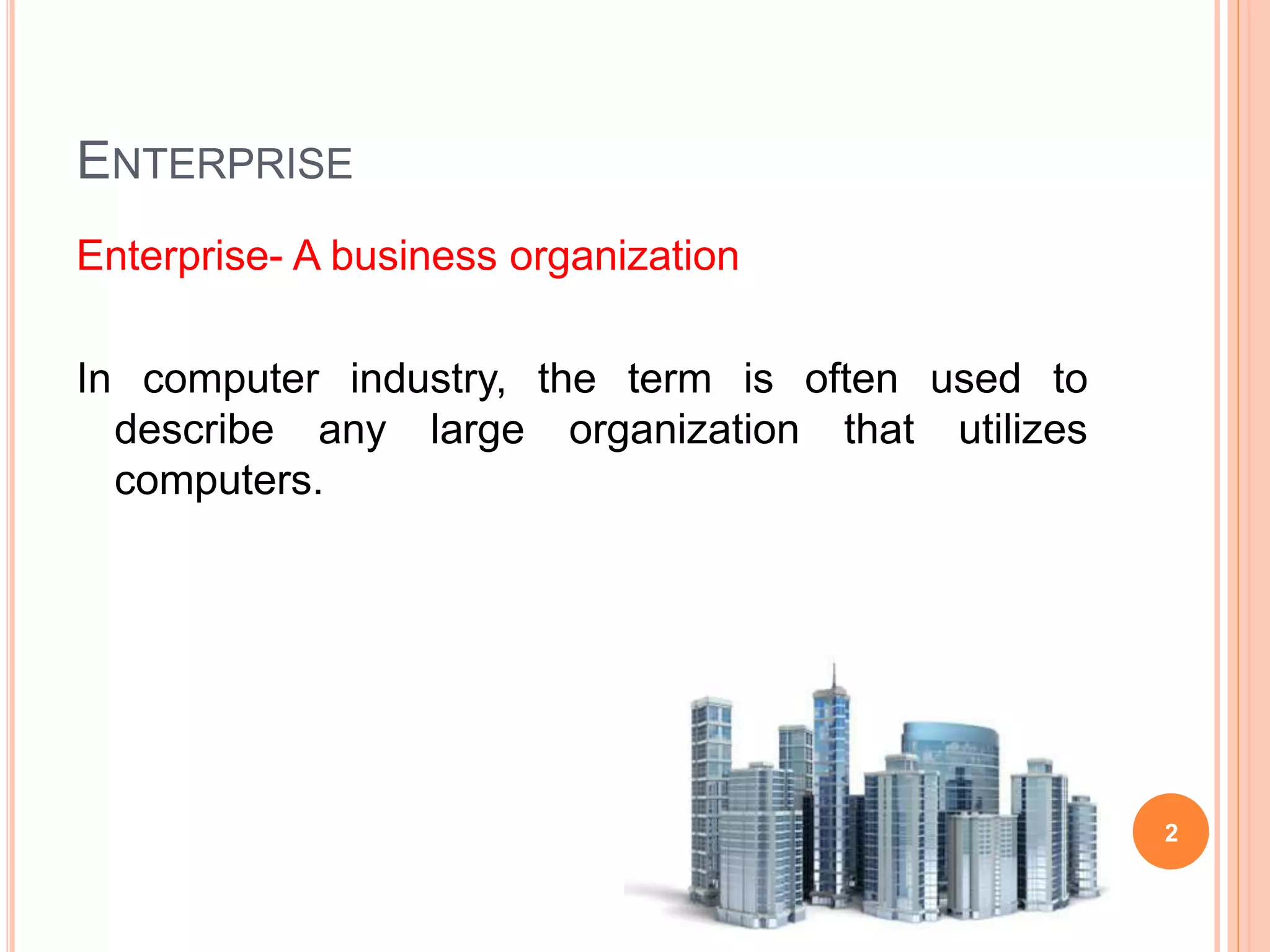
Enterprise- A business organization
In computer industry, the term is often used to
describe any large organization that utilizes
computers.
2
ENTERPRISE APPLICATION
 An application which satisfies the business
functionalities (functional requirements) of an
organization and also take care of factors such as
efficiency, scalability, security etc. (non functional
requirements) is termed as Enterprise Application.
 An enterprise application is the phrase used to
describe applications (or software) that a business
would use to assist the organization in solving
enterprise problems.
3
EXAMPLES OF ENTERPRISE APPLICATIONS
 automated billing systems
 payment processing
 email marketing systems
 content management
 call center and customer support
 Customer Relationship Management (CRM)
 Enterprise Resource Planning (ERP)
 Business Intelligence
 Business Continuity Planning (BCP)
 HR Management
 Enterprise Application Integration (EAI)
 enterprise search
 messaging and collaboration systems. 4
CHARACTERISTICS OF ENTERPRISE
APPLICATIONS
 Enhance Efficiency & Productivity
 Ensure Business Continuity
 High Performance
 Fortify Security
 Handle large volume data
 Easily Maintainable & Extendable
 High availability
 High integrity
5
CHARACTERISTICS OF ENTERPRISE
APPLICATIONS (CONTD...)
 High mean time between failure
 Confidential
 Does not lose information under failure conditions
 Does not corrupt information under failure
conditions
 Defines a clear recovery path under failure
conditions
6
CATEGORIES OF ENTERPRISE APPLICATION
1) From visibility to Customers
1.1 Upstream or Customer facing enterprise
applications
1.2 Downstream or Back end enterprise applications
1.3 Business Enabler enterprise applications
7
1.1 UPSTREAM ENTERPRISE APPLICATION
 The applications which are front end systems of an
organization known as upstream enterprise
applications.
 Also known as Customer facing enterprise
application.
 For Example
“order capture” application that captures online orders
of customers is an upstream enterprise application.
8
1.2 DOWNSTREAM ENTERPRISE APPLICATION
 Applications that work behind of the scenes in an
organization to fulfill the customers or end users
needs are known as downstream enterprise
applications.
 For Example
“order provisioning” which helps in fulfill and
provisioning the online orders captured through
“order capture” upstream enterprise application.
9
1.3 BUSINESS ENABLER ENTERPRISE
APPLICATION
 The applications that fulfill the general organization
needs are known as Business enabler enterprise
applications.
 For Example
Payroll System
Human Resource Management
10
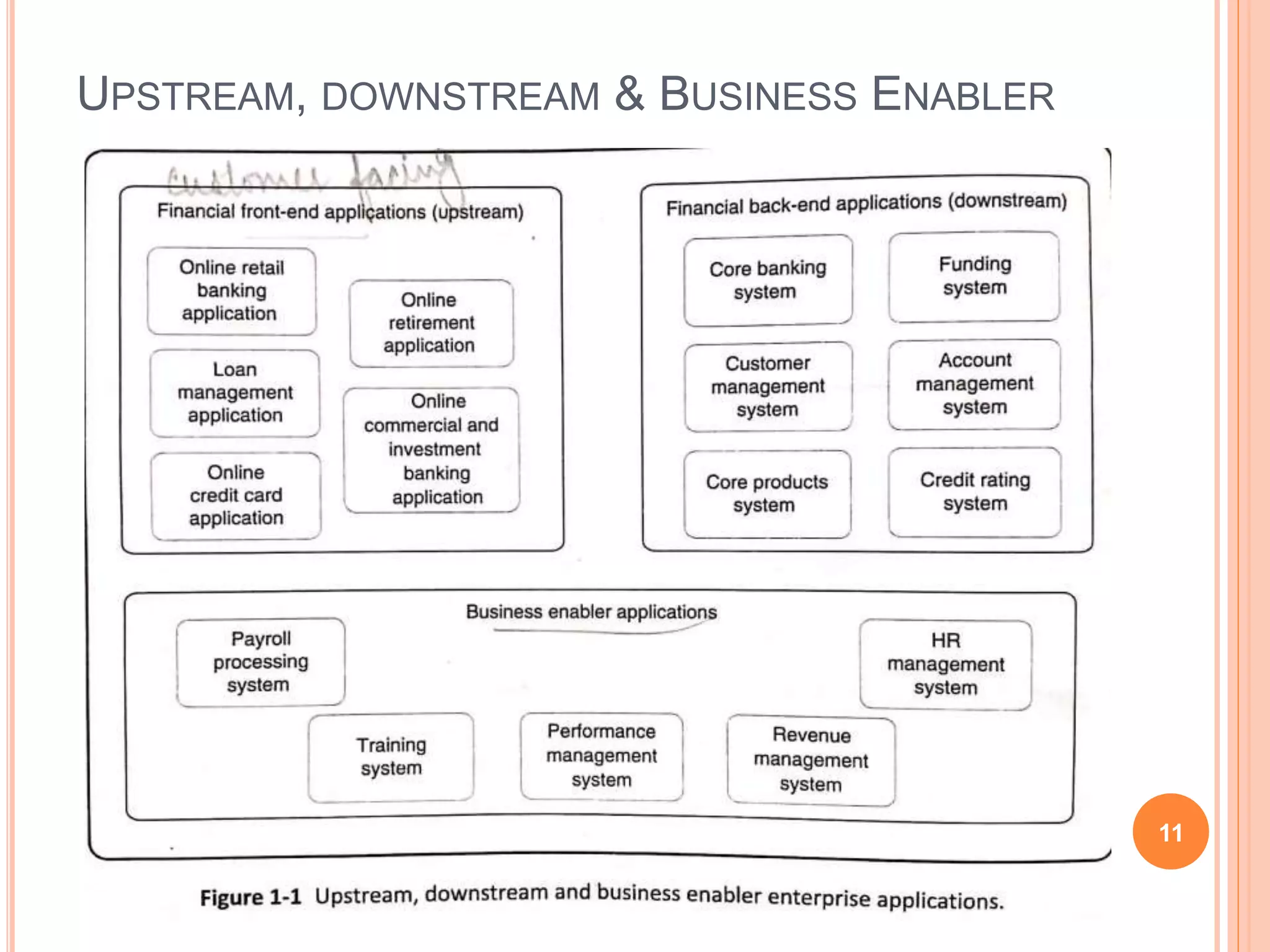
UPSTREAM, DOWNSTREAM & BUSINESS ENABLER
11
CATEGORIES OF ENTERPRISE APPLICATION
(CONTD…)
2) Industry they cater to
Example Billing System for telecom is different from
billing system in retail industry
3) Enterprise business functions they fulfill
For example, order management or order fulfillment
application
4) Nature of processing
For example, batch processing, online analytical
processing (OLAP), online transaction
processing(OLTP) or Decision Support System (DSS)
5)Customers built or readymade commercial off the shelf
packages
6) Host centric or Distributed Application 12
OLTP
 OLTP (On-line Transaction Processing) deals with
operational data, which is data involved in the operation
of a particular system and it is characterized by a large
number of short on-line transactions (INSERT, UPDATE,
and DELETE).
 The main emphasis for OLTP systems is put on very fast
query processing, maintaining data integrity in multi-
access environments and an effectiveness measured by
number of transactions per second.
 Example: In a banking System, you withdraw amount
through an ATM. Then account Number, ATM PIN
Number, Amount you are withdrawing and Balance
amount in account are operational data elements. 13
OLAP
 An OLAP (On-line Analytical Processing) deal
with Historical Data or Archival Data, and it is
characterized by relatively low volume of
transactions. In addition, the Queries needed for
these systems are often very complex and involve
aggregations as for OLAP systems the response
time is an effectiveness measure.
 Example: If we collect last 10 years data about flight
reservation, the data can give us much meaningful
information such as the trends in reservation.
14
CHALLENGES FACED BY ENTERPRISE
APPLICATIONS
 Business Process Automation
-Automating business process
 Data Harmonization
-Unification and standardization of data
 Application Integration
-Integrating individual application
 Application Security
-Fortify the security perimeter
 Internationalization
-Handling Globalization in localized manner 15
CHALLENGES FACED BY ENTERPRISE
APPLICATIONS (CONTD…)
 Transaction Management
-Managing transactions from customers,
vendor partners, suppliers and stakeholder.
 Rich User Experience
-Users become more demanding and
experienced.
 Quality of Service (QoS)
-Functional and non-functional (ilities) quality
attributes. Ilities like scalability, reliability, security,
maintainability, availability etc.
16
CHALLENGES FACED BY ENTERPRISE
APPLICATIONS (CONTD…)
 Technology Selection
- choosing right technology
 Governance and Team Productivity
-Managing diverse teams with string governance
17
SUMMARY
 Enterprise
 Enterprise Application
 Types:
1) From Customer’s visibility
Upstream, downstream, business enabler
2) Industry they cater to
3) Enterprise business functions they fulfill
4) Nature of processing
5)Customers built or readymade commercial off the
shelf packages
6) Host centric or Distributed Application
18
SUMMARY (CONTD…)
 Characteristics
 Challenges
19

Enterprise and Enterprise Application

  • 1.
  • 2.
    ENTERPRISE Enterprise- A businessorganization In computer industry, the term is often used to describe any large organization that utilizes computers. 2
  • 3.
    ENTERPRISE APPLICATION  Anapplication which satisfies the business functionalities (functional requirements) of an organization and also take care of factors such as efficiency, scalability, security etc. (non functional requirements) is termed as Enterprise Application.  An enterprise application is the phrase used to describe applications (or software) that a business would use to assist the organization in solving enterprise problems. 3
  • 4.
    EXAMPLES OF ENTERPRISEAPPLICATIONS  automated billing systems  payment processing  email marketing systems  content management  call center and customer support  Customer Relationship Management (CRM)  Enterprise Resource Planning (ERP)  Business Intelligence  Business Continuity Planning (BCP)  HR Management  Enterprise Application Integration (EAI)  enterprise search  messaging and collaboration systems. 4
  • 5.
    CHARACTERISTICS OF ENTERPRISE APPLICATIONS Enhance Efficiency & Productivity  Ensure Business Continuity  High Performance  Fortify Security  Handle large volume data  Easily Maintainable & Extendable  High availability  High integrity 5
  • 6.
    CHARACTERISTICS OF ENTERPRISE APPLICATIONS(CONTD...)  High mean time between failure  Confidential  Does not lose information under failure conditions  Does not corrupt information under failure conditions  Defines a clear recovery path under failure conditions 6
  • 7.
    CATEGORIES OF ENTERPRISEAPPLICATION 1) From visibility to Customers 1.1 Upstream or Customer facing enterprise applications 1.2 Downstream or Back end enterprise applications 1.3 Business Enabler enterprise applications 7
  • 8.
    1.1 UPSTREAM ENTERPRISEAPPLICATION  The applications which are front end systems of an organization known as upstream enterprise applications.  Also known as Customer facing enterprise application.  For Example “order capture” application that captures online orders of customers is an upstream enterprise application. 8
  • 9.
    1.2 DOWNSTREAM ENTERPRISEAPPLICATION  Applications that work behind of the scenes in an organization to fulfill the customers or end users needs are known as downstream enterprise applications.  For Example “order provisioning” which helps in fulfill and provisioning the online orders captured through “order capture” upstream enterprise application. 9
  • 10.
    1.3 BUSINESS ENABLERENTERPRISE APPLICATION  The applications that fulfill the general organization needs are known as Business enabler enterprise applications.  For Example Payroll System Human Resource Management 10
  • 11.
    UPSTREAM, DOWNSTREAM &BUSINESS ENABLER 11
  • 12.
    CATEGORIES OF ENTERPRISEAPPLICATION (CONTD…) 2) Industry they cater to Example Billing System for telecom is different from billing system in retail industry 3) Enterprise business functions they fulfill For example, order management or order fulfillment application 4) Nature of processing For example, batch processing, online analytical processing (OLAP), online transaction processing(OLTP) or Decision Support System (DSS) 5)Customers built or readymade commercial off the shelf packages 6) Host centric or Distributed Application 12
  • 13.
    OLTP  OLTP (On-lineTransaction Processing) deals with operational data, which is data involved in the operation of a particular system and it is characterized by a large number of short on-line transactions (INSERT, UPDATE, and DELETE).  The main emphasis for OLTP systems is put on very fast query processing, maintaining data integrity in multi- access environments and an effectiveness measured by number of transactions per second.  Example: In a banking System, you withdraw amount through an ATM. Then account Number, ATM PIN Number, Amount you are withdrawing and Balance amount in account are operational data elements. 13
  • 14.
    OLAP  An OLAP(On-line Analytical Processing) deal with Historical Data or Archival Data, and it is characterized by relatively low volume of transactions. In addition, the Queries needed for these systems are often very complex and involve aggregations as for OLAP systems the response time is an effectiveness measure.  Example: If we collect last 10 years data about flight reservation, the data can give us much meaningful information such as the trends in reservation. 14
  • 15.
    CHALLENGES FACED BYENTERPRISE APPLICATIONS  Business Process Automation -Automating business process  Data Harmonization -Unification and standardization of data  Application Integration -Integrating individual application  Application Security -Fortify the security perimeter  Internationalization -Handling Globalization in localized manner 15
  • 16.
    CHALLENGES FACED BYENTERPRISE APPLICATIONS (CONTD…)  Transaction Management -Managing transactions from customers, vendor partners, suppliers and stakeholder.  Rich User Experience -Users become more demanding and experienced.  Quality of Service (QoS) -Functional and non-functional (ilities) quality attributes. Ilities like scalability, reliability, security, maintainability, availability etc. 16
  • 17.
    CHALLENGES FACED BYENTERPRISE APPLICATIONS (CONTD…)  Technology Selection - choosing right technology  Governance and Team Productivity -Managing diverse teams with string governance 17
  • 18.
    SUMMARY  Enterprise  EnterpriseApplication  Types: 1) From Customer’s visibility Upstream, downstream, business enabler 2) Industry they cater to 3) Enterprise business functions they fulfill 4) Nature of processing 5)Customers built or readymade commercial off the shelf packages 6) Host centric or Distributed Application 18
  • 19.