Artificial Neural Networks
•Computational models inspired by the human brain:
– Algorithms that try to mimic the brain.
– Massively parallel, distributed system, made up of simple processing
units (neurons)
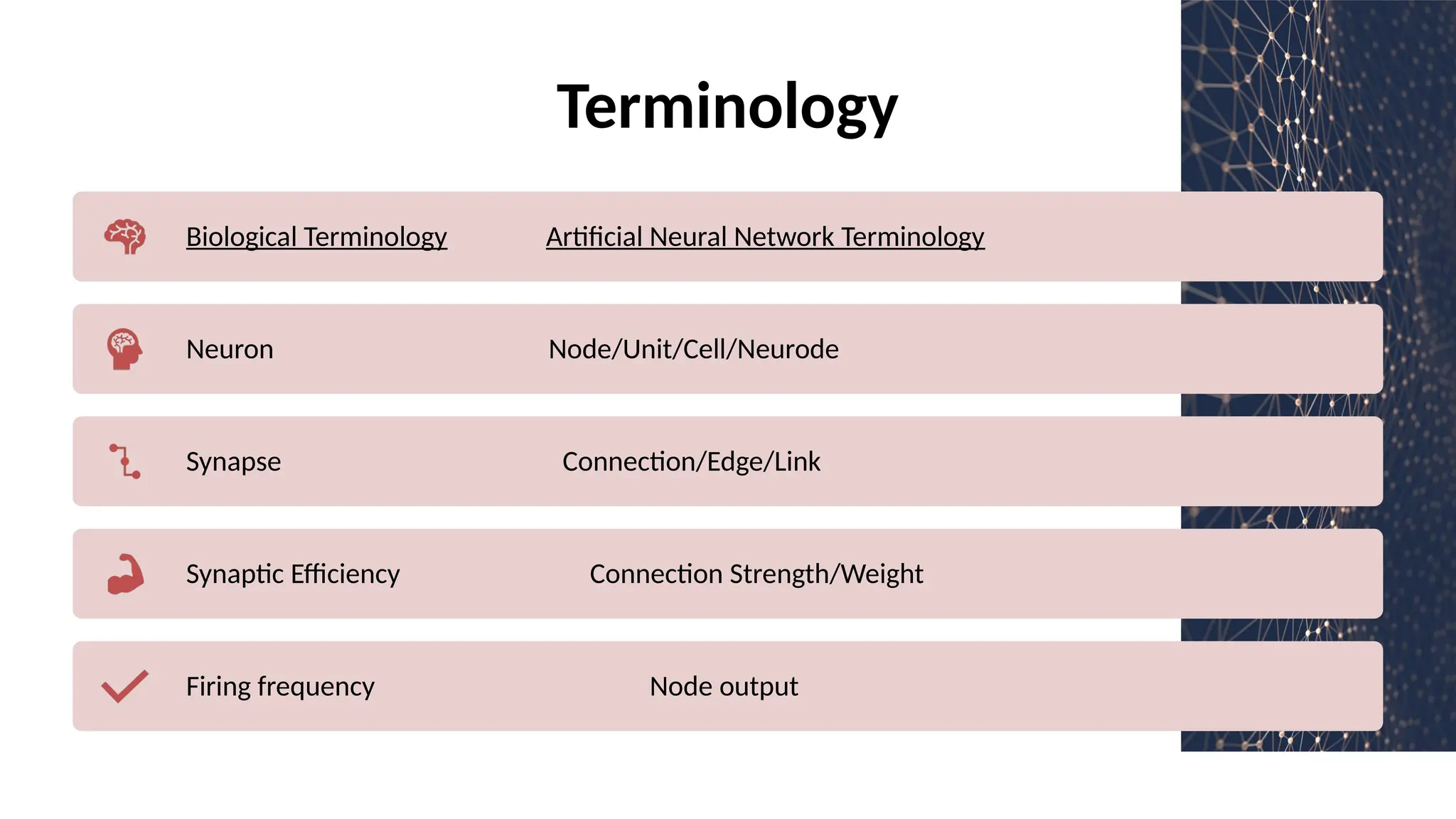
– Synaptic connection strengths among neurons are used to store the
acquired knowledge.
– Knowledge is acquired by the network from its environment through a
learning process
3.
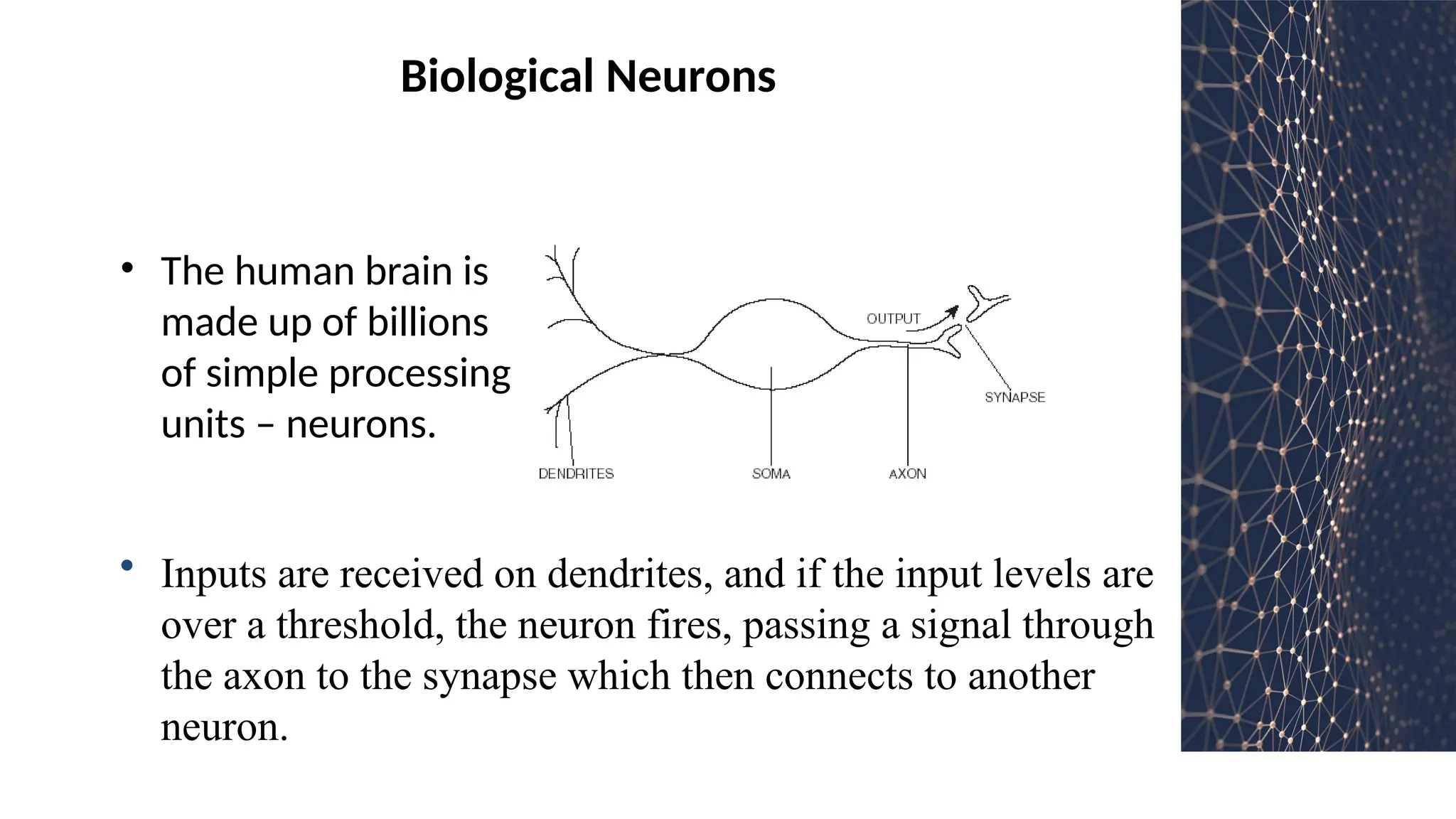
Biological Neurons
• Thehuman brain is
made up of billions
of simple processing
units – neurons.
• Inputs are received on dendrites, and if the input levels are
over a threshold, the neuron fires, passing a signal through
the axon to the synapse which then connects to another
neuron.
Introduction
• real-valued functions
•discrete-valued functions
• vector-valued functions
Artificial neural networks (ANNs) provide a practical method for learning
Robust to errors in training data
• interpreting visual scenes
• speech recognition
• learning robot control strategies
Successfully applied to such problems as
6.
Neural Network Representation
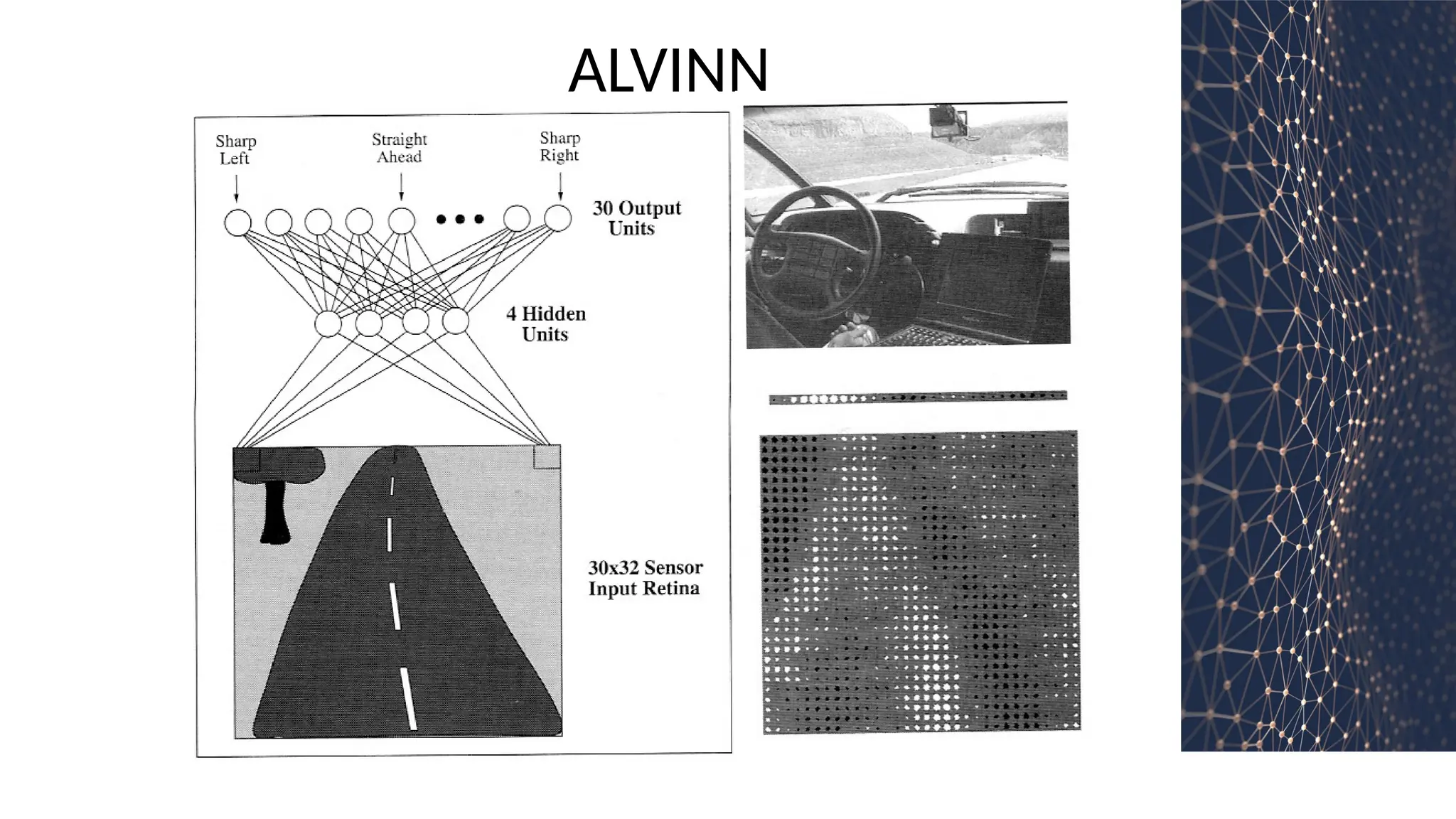
•ALVINN uses a learned ANN to steer an autonomous
vehicle driving at normal speeds on public highways
– Input to network: 30x32 grid of pixel intensities obtained
from a forward-pointed camera mounted on the vehicle
– Output: direction in which the vehicle is steered
– Trained to mimic observed steering commands of a human
driving the vehicle for approximately 5 minutes
Appropriate problems
ANN learningwell-suit to problems which the training data corresponds
to noisy, complex data (inputs from cameras or microphones)
Can also be used for problems with symbolic representations
Most appropriate for problems where
• Instances have many attribute-value pairs
• Target function output may be discrete-valued, real-valued, or a vector of several real-
or discrete-valued attributes
• Training examples may contain errors
• Long training times are acceptable
• Fast evaluation of the learned target function may be required
• The ability for humans to understand the learned target function is not important
9.
Artificial Neural Network
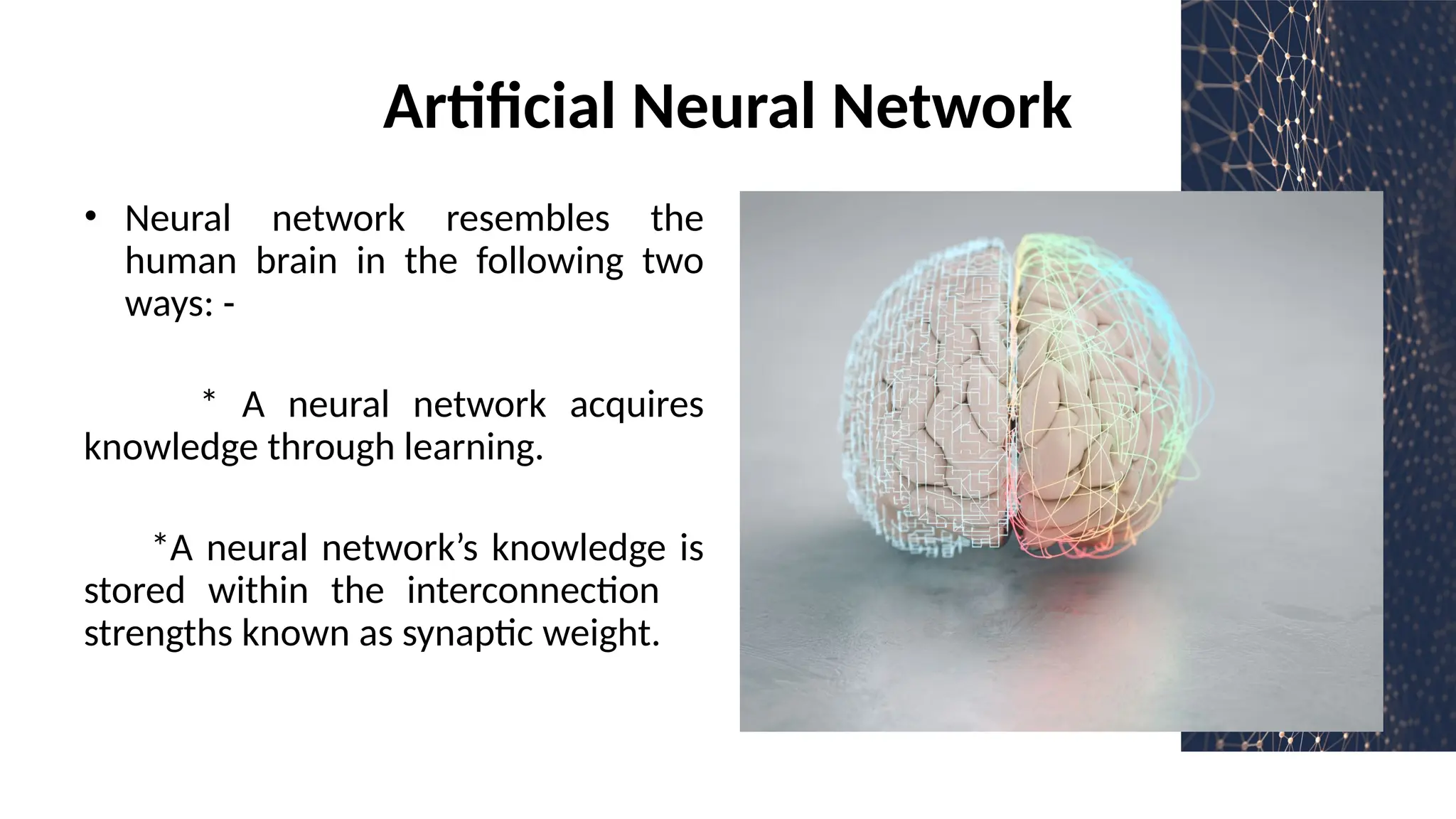
•Neural network resembles the
human brain in the following two
ways: -
* A neural network acquires
knowledge through learning.
*A neural network’s knowledge is
stored within the interconnection
strengths known as synaptic weight.
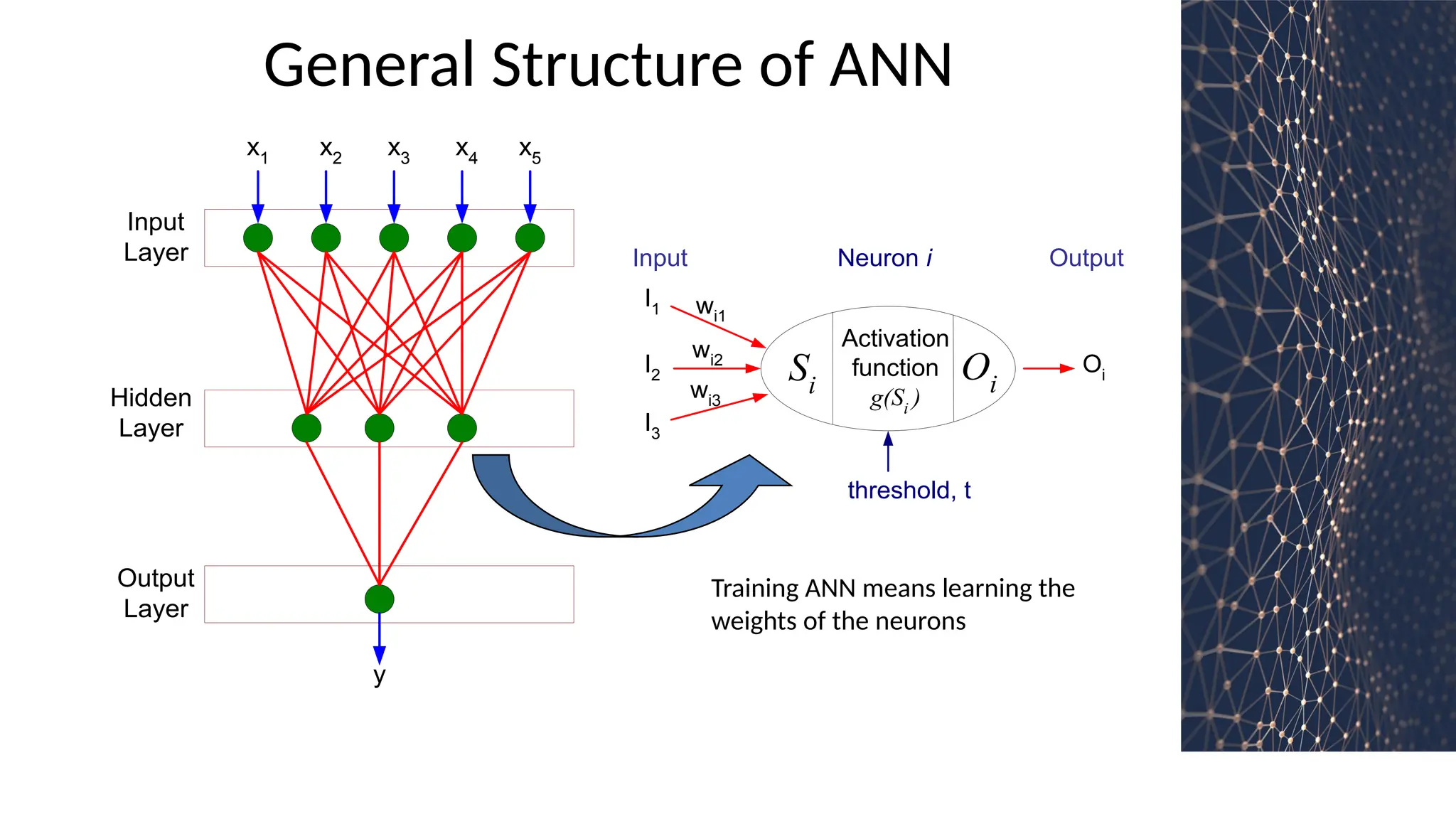
General Structure ofANN
Activation
function
g(Si
)
Si
Oi
I1
I2
I3
wi1
wi2
wi3
Oi
Neuron i
Input Output
threshold, t
Input
Layer
Hidden
Layer
Output
Layer
x1
x2
x3
x4
x5
y
Training ANN means learning the
weights of the neurons
12.
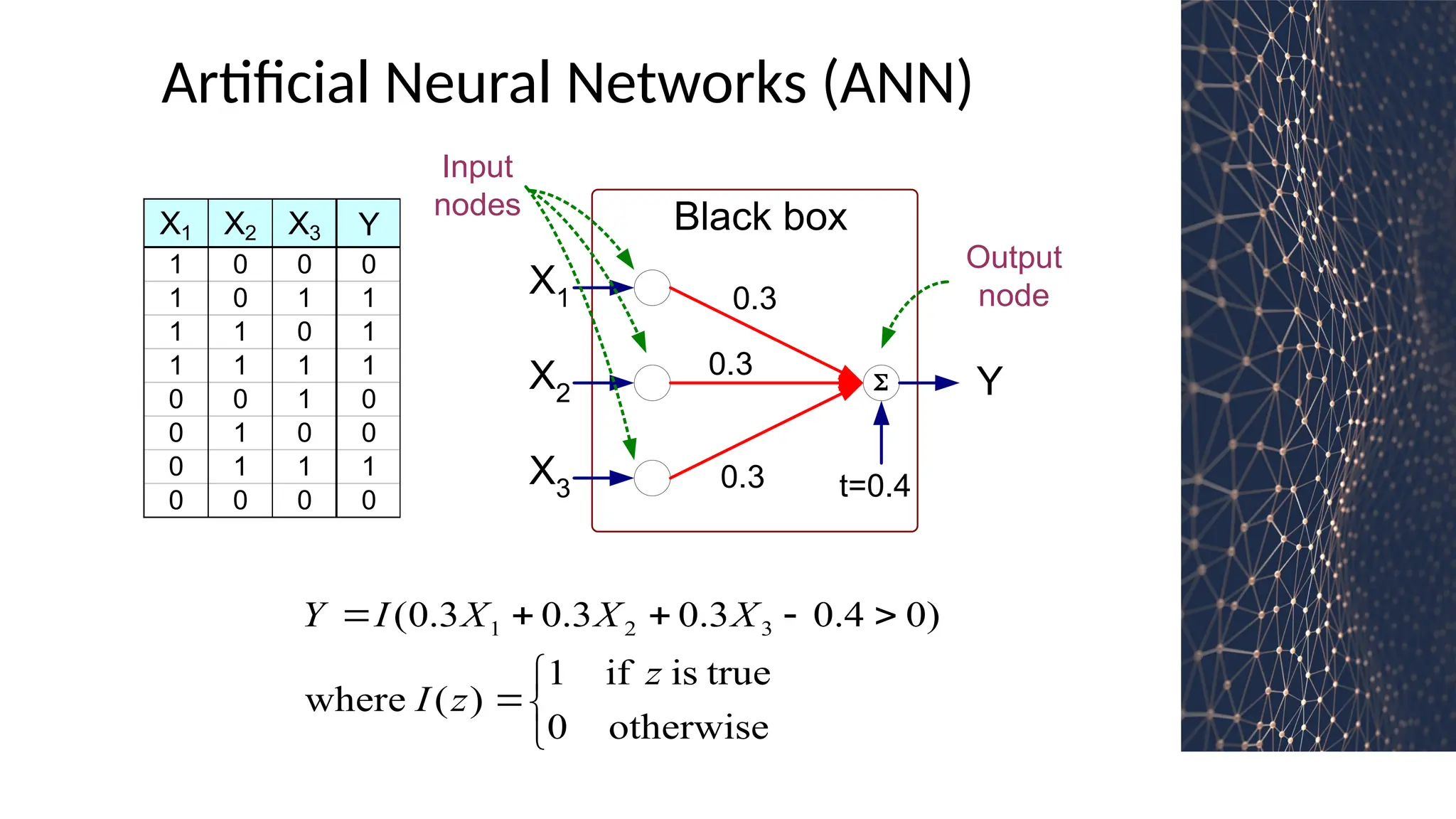
Artificial Neural Networks(ANN)
X1 X2 X3 Y
1 0 0 0
1 0 1 1
1 1 0 1
1 1 1 1
0 0 1 0
0 1 0 0
0 1 1 1
0 0 0 0
X1
X2
X3
Y
Black box
0.3
0.3
0.3 t=0.4
Output
node
Input
nodes
otherwise
0
true
is
if
1
)
(
where
)
0
4
.
0
3
.
0
3
.
0
3
.
0
( 3
2
1
z
z
I
X
X
X
I
Y
13.
Advantages of ArtificialNeural Networks
• It involves human
like thinking.
• They handle noisy
or missing data.
• They can work
with large number
of variables or
parameters.
• They provide
general solutions
with good
predictive accuracy.
• System has got
property of
continuous
learning.
• They deal with
the non-linearity in
the world in which
we live.
14.
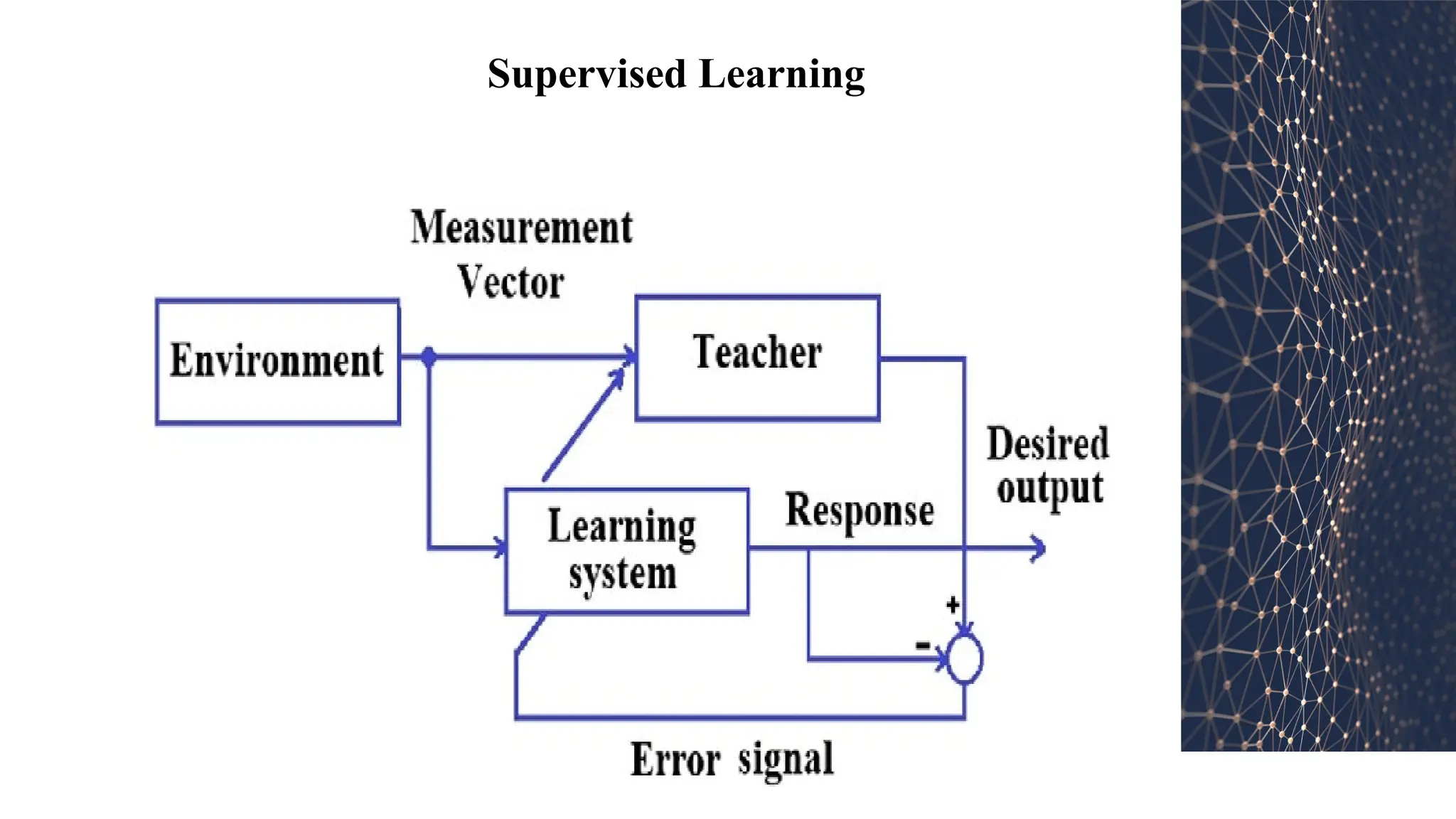
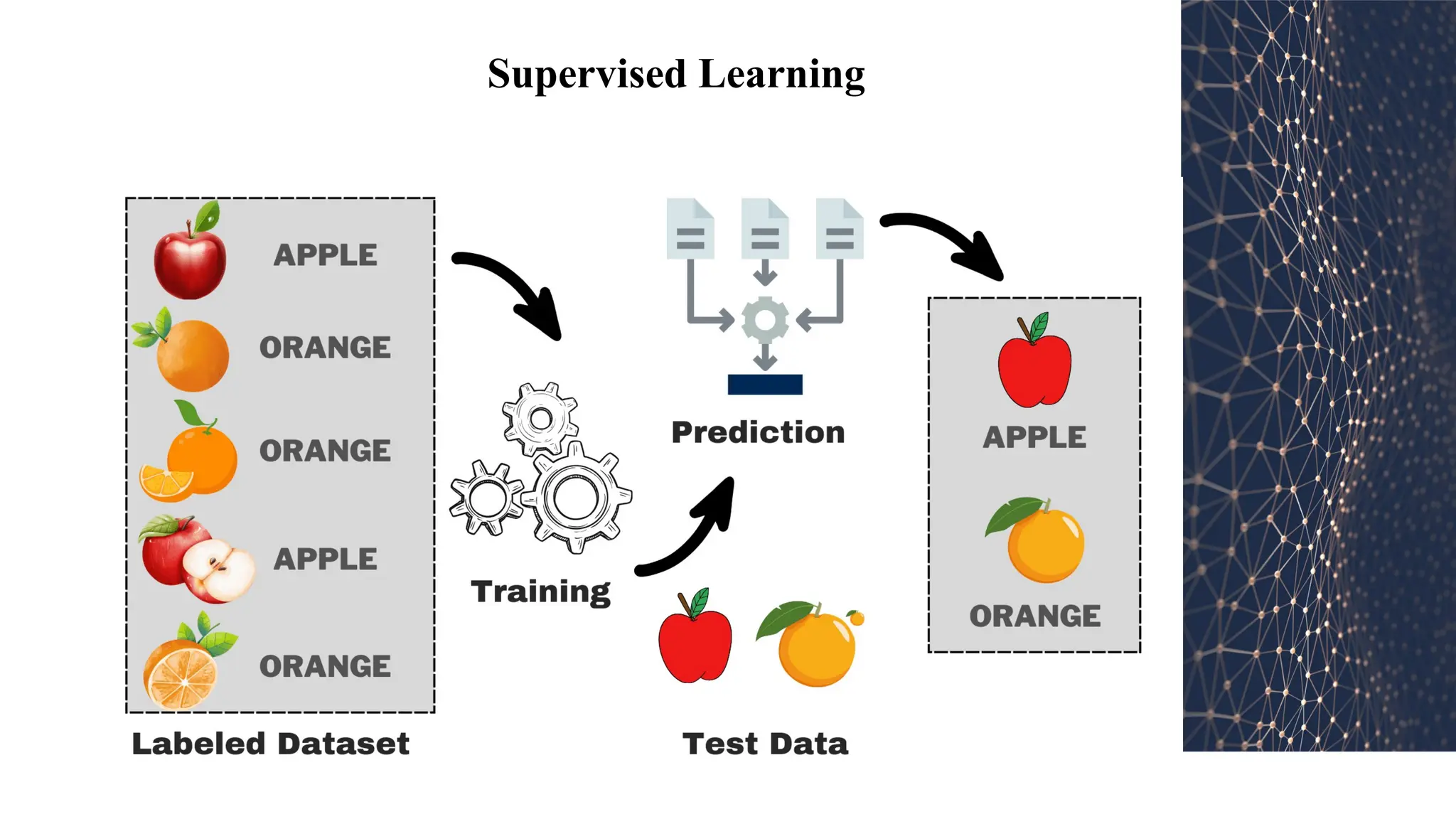
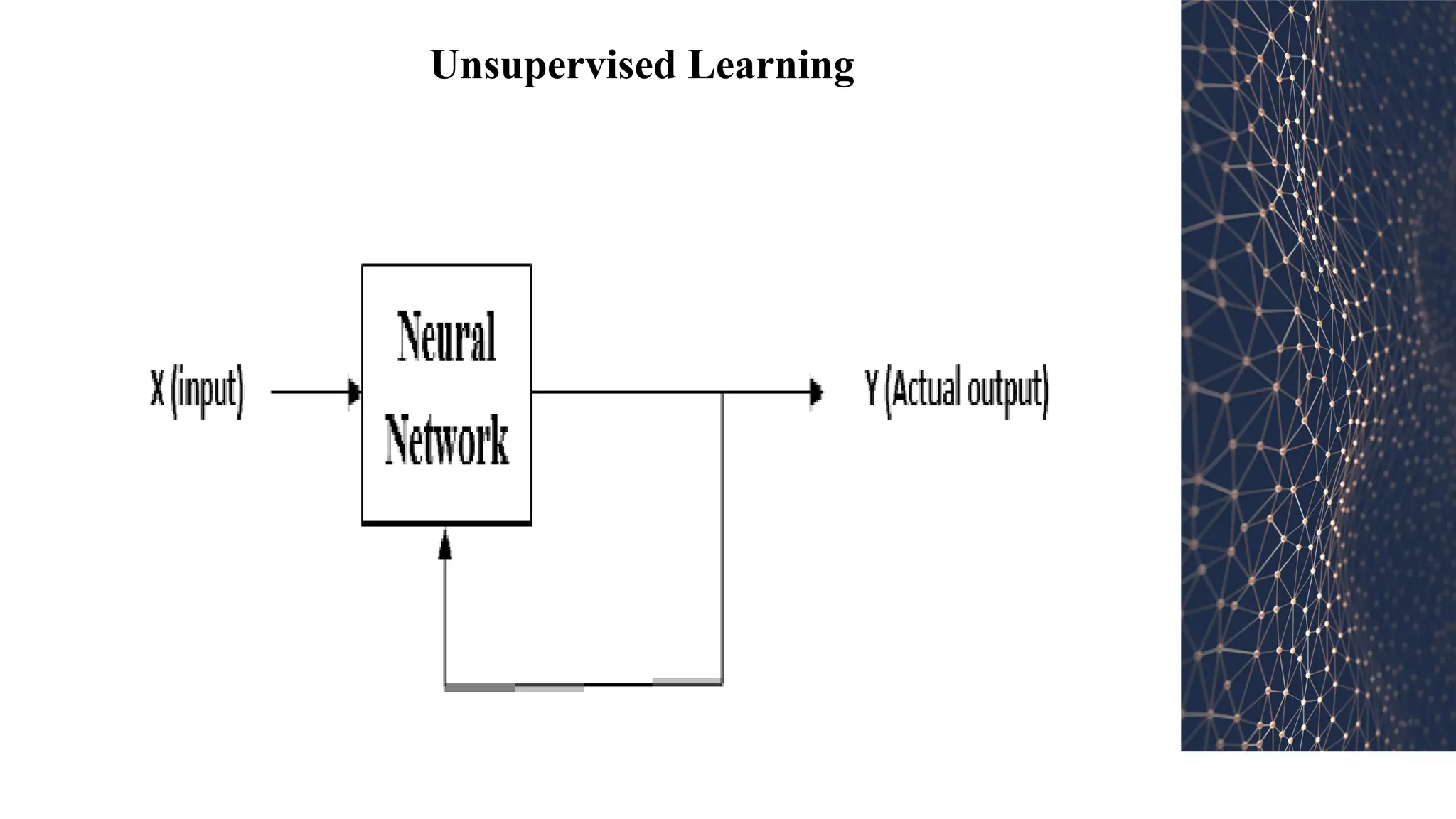
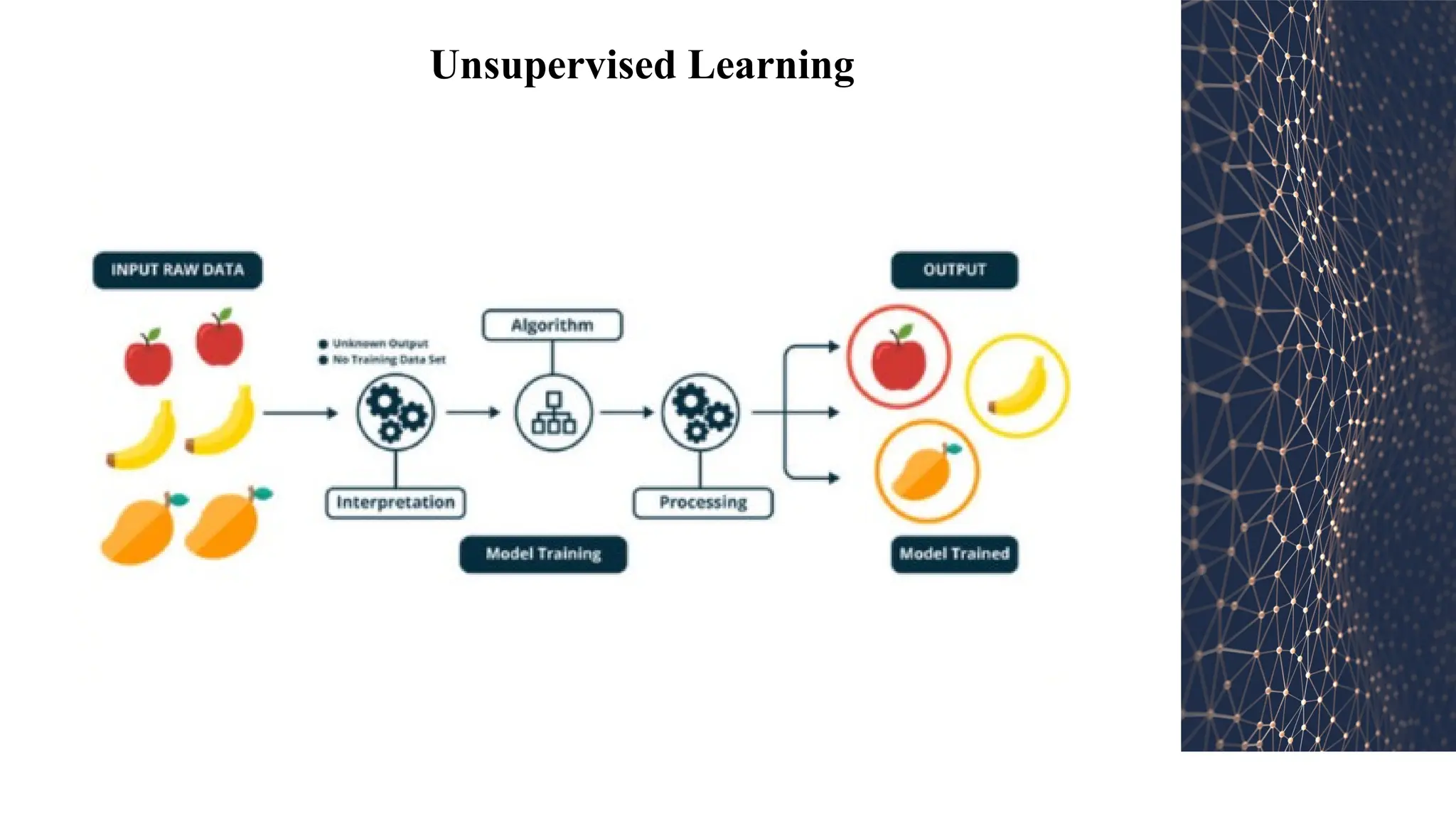
Learning Process
• Definitionof learning adapted from Mendel and McClaren:
“Learning is a process by which the free parameters of a neural network are
adapted through a process of stimulation by the environment in which the
network is embedded. The type of learning is determined by the parameter
in which the changes take place.”
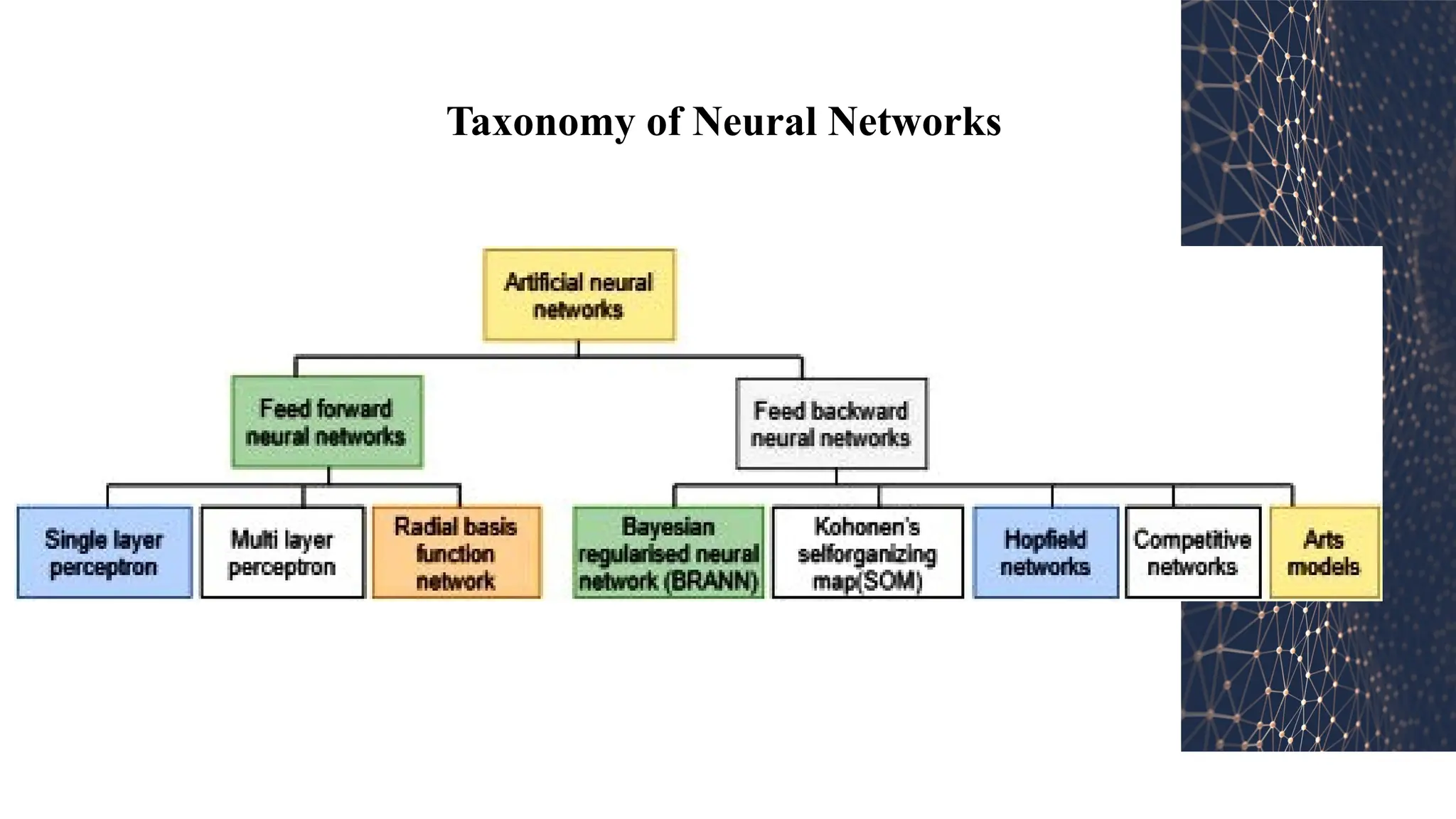
Taxonomy of NeuralNetworks (Cont…)
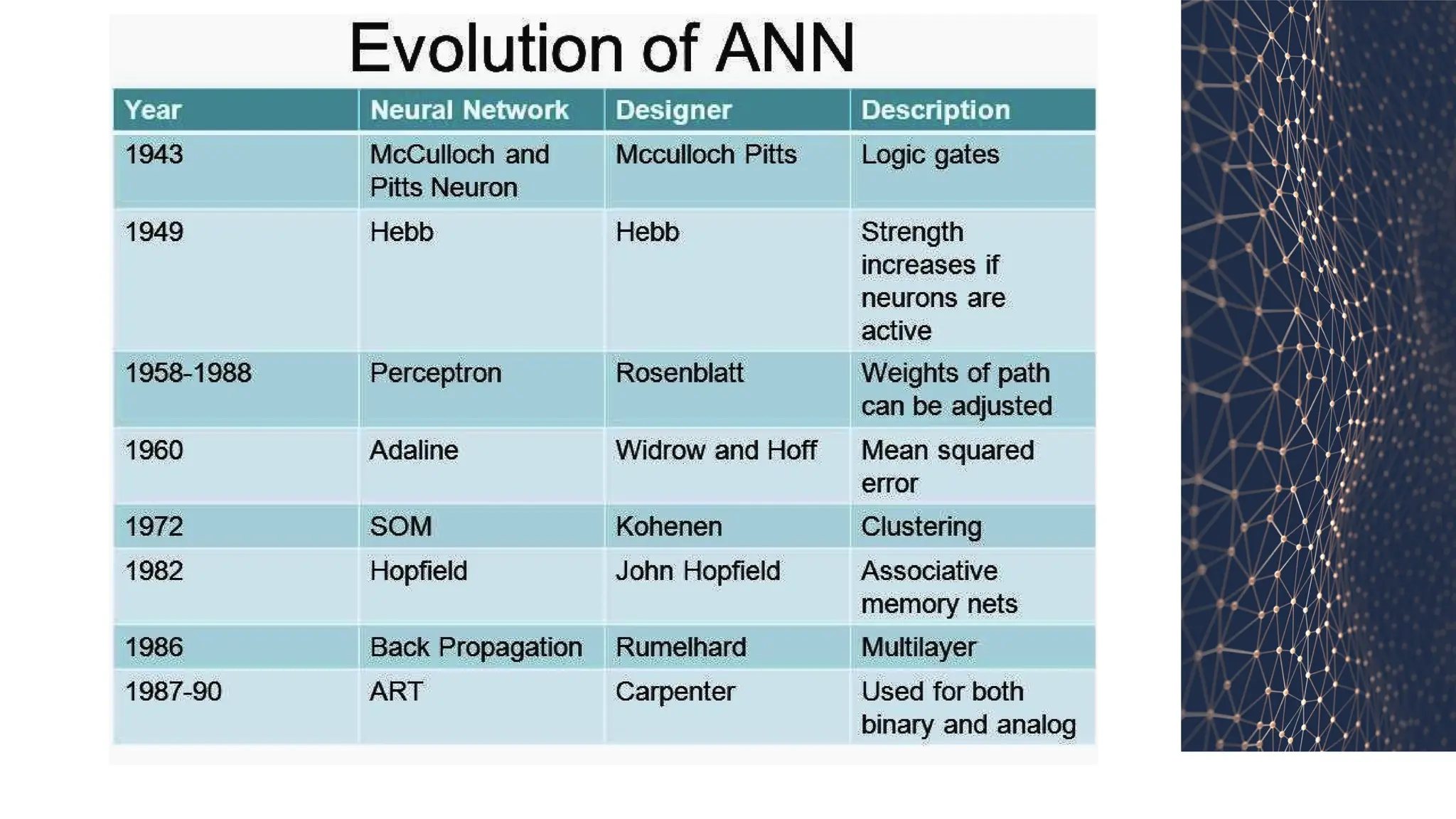
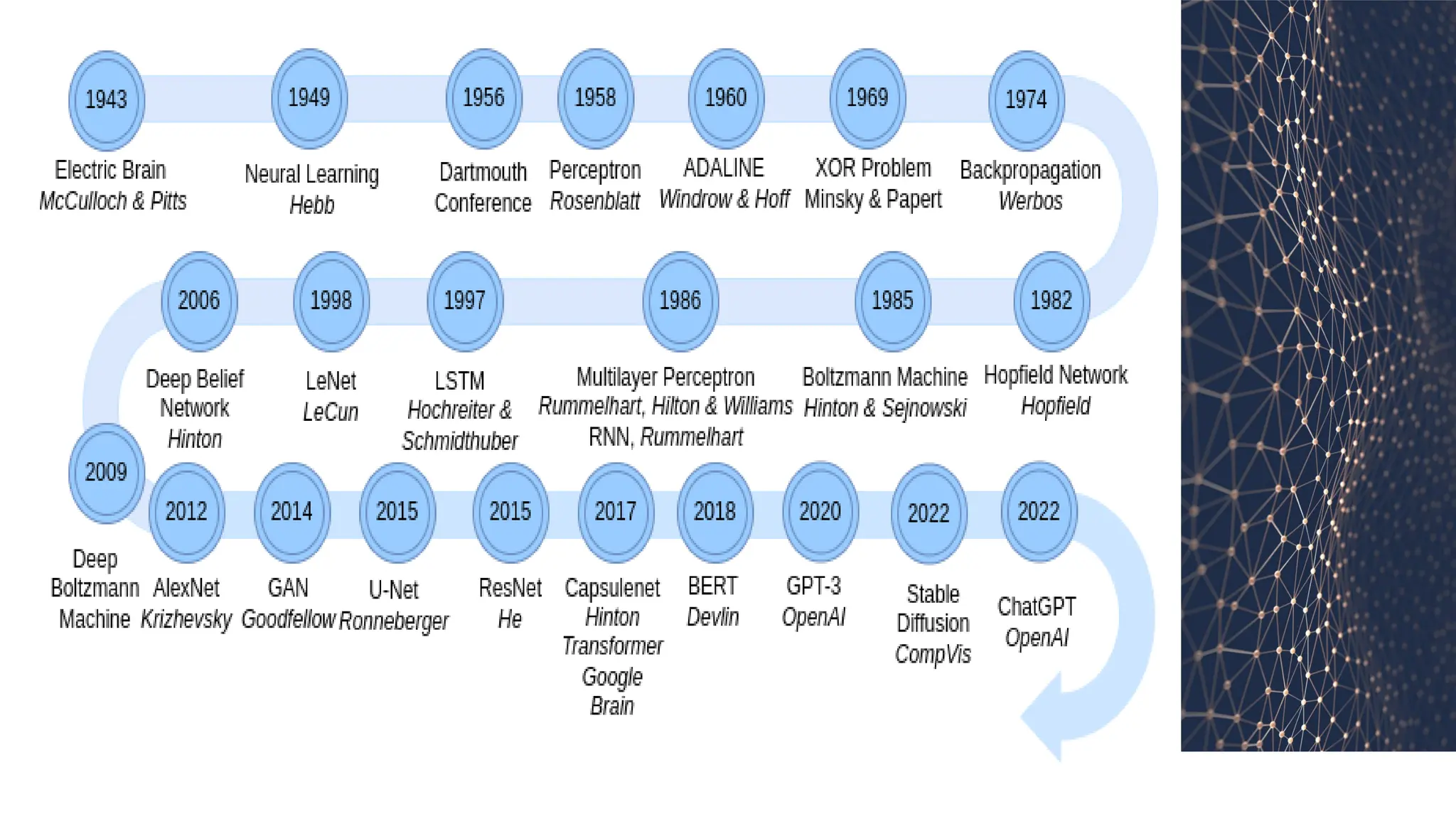
• Adaptive Linear Element (ADALINE)
• Multiple ADALINEs (MADALINE)
• Perceptron
• Radial Basis Function Network
• Feed-forward
• Recurrent Neural Networks (RNNs)
32.
Neural Networks –In the Past
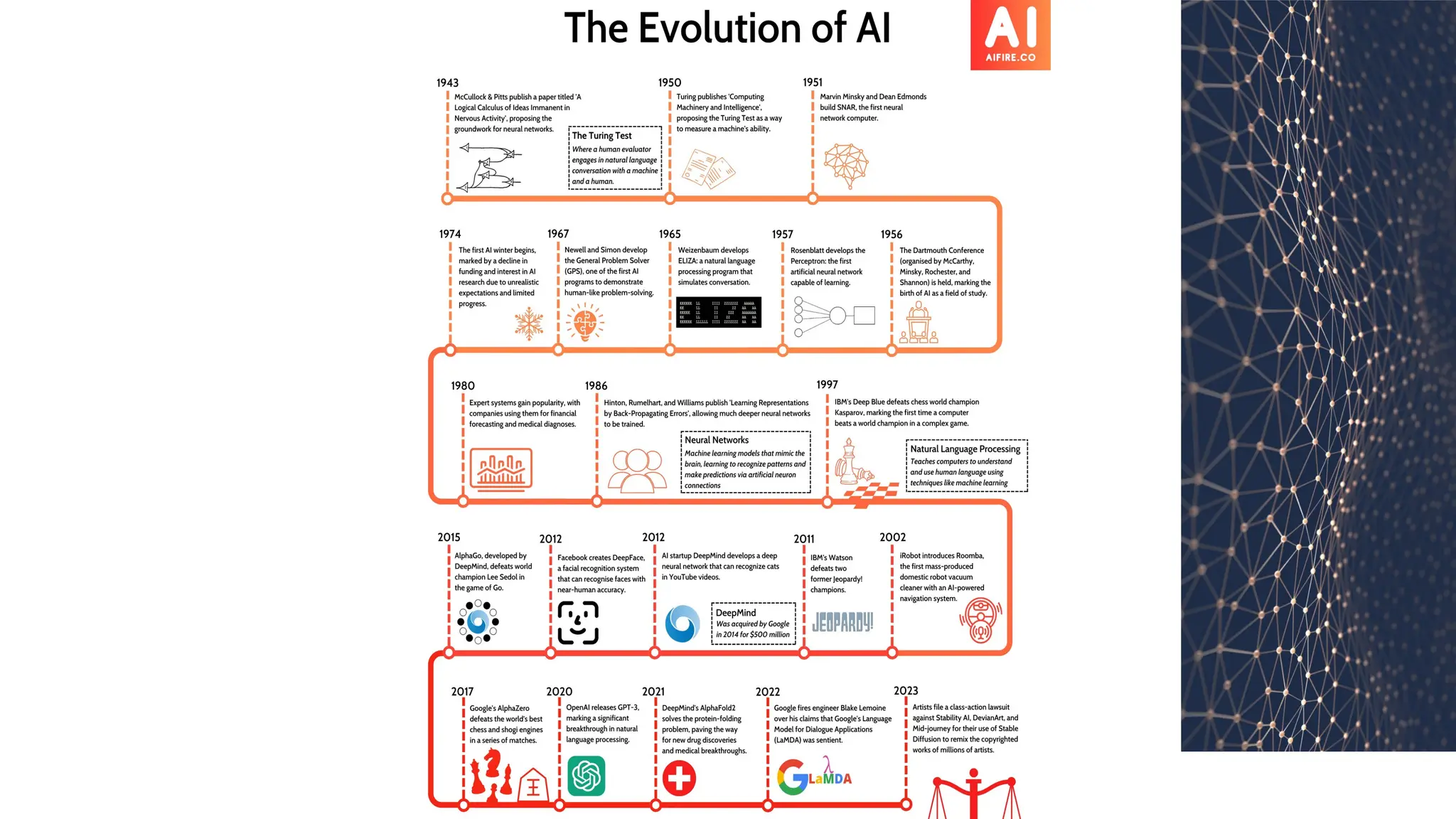
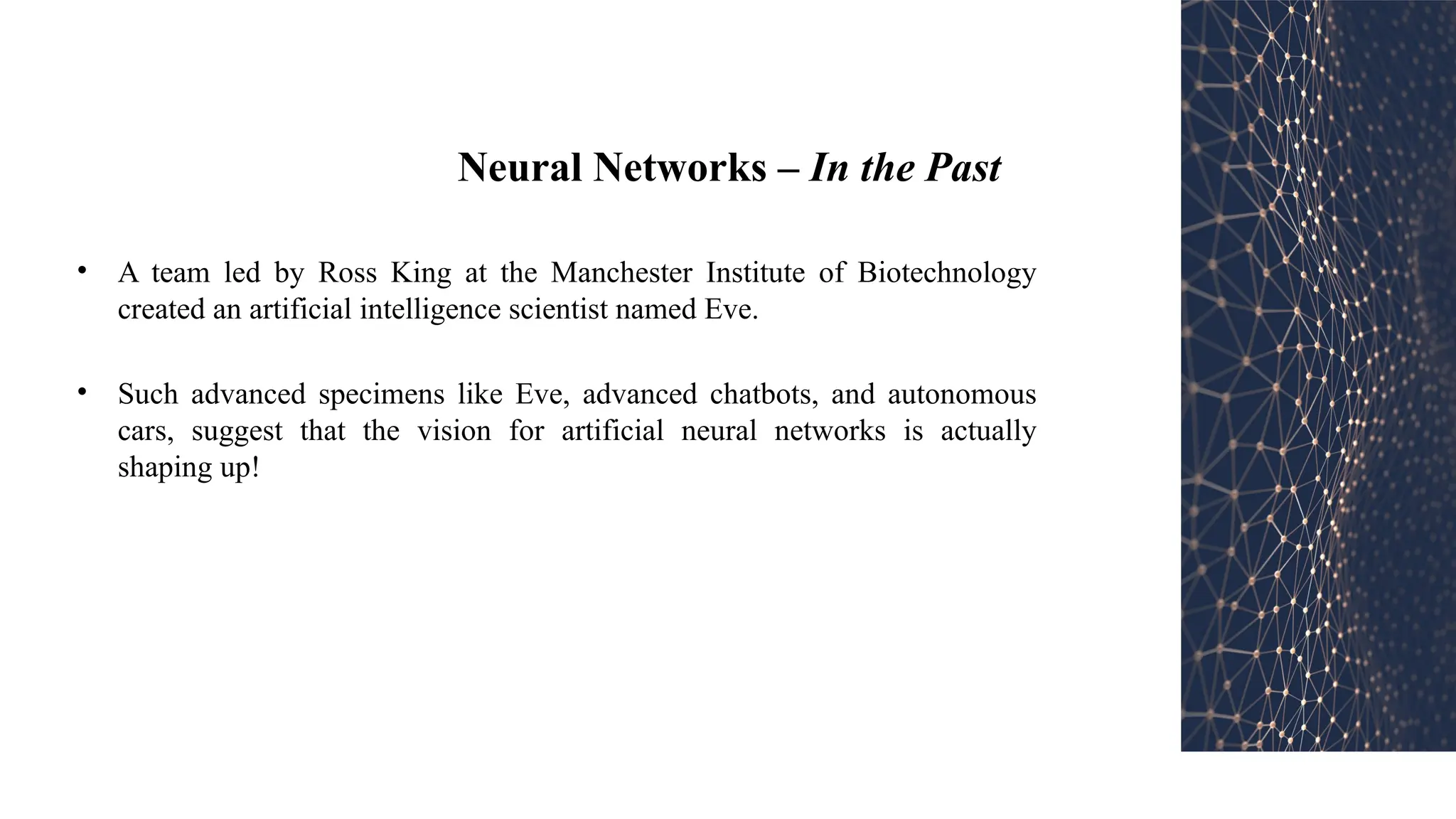
• A team led by Ross King at the Manchester Institute of Biotechnology
created an artificial intelligence scientist named Eve.
• Such advanced specimens like Eve, advanced chatbots, and autonomous
cars, suggest that the vision for artificial neural networks is actually
shaping up!
33.
Neural Networks –In the Present
• One of the applications of artificial neural networks is chatbots.
• Some of the novel applications of neural networks include earthquake
prediction based on the existing seismograms and creating artworks based
on existing iconic paintings by Van Gogh, Picasso, and many more.
34.
Neural Networks –In the Future
• Governments and private organizations have realized the true potential of
the future of artificial neural networks.
• The future of artificial neural networks is going to unlock multiple
possibilities in various business sectors.
Editor's Notes
#3 biological learning systems are built out of very complex webs of interconnected neurons
Human brain contains approx 10^11 neurons each connects to approx. 10^4 others
Neuron activity is typically excited or inhibited through connections to other neurons
fastest neuron switching time 10^-3 (computer switching 10^-10)
Recognize mom: 10^-1
brains highly parallel
More complexity in biological systems than is modeled by ANNs and many features of ANNs are known to be inconsistent with biological systems
Ex: ANNs whose individual units output a single constant value, whereas biological neurons output a complex time series of spikes
Today we are interested in obtaining highly effective machine learning algorithms, independent of whether these algorithms mirror biological processes
#6 ALVINN successfully drive at speeds up to 70 miles per hour for 90 miles (driving in the left lane of a divided public highway, with other vehicles present)
#7 Each node (circle) corresponds to the output of a single network unit and the lines entering the node from below are its inputs
4 nodes receive inputs from all of the 30X32 pixels
called hidden units because their output is available only within the network and not as part of the global network output
Each computes a single real-valued output based on a weighted combination of its 960 inputs
Hidden outputs used as inputs to a second layer of 30 "output" units.
Each output unit corresponds to a particular steering direction, output values determine which steering direction is recommended most strongly
Right corresponds to weights associated with one of the hidden nodes. Large matrix for picture. White indicated positive weights, black negative
Smaller rectangle weights for the hidden unit to each of 30 outputs
ALVINN is typical of many ANNs (directed-acyclic graph)
ANNs can be graphs of many structures (acyclic or cyclic, directed or undirected) We focus on directed graphs (possibly with cycles)
learning corresponds to choosing a weight value for each edge in the graph
#8 Problems where decision trees are used
instances described by a vector of predefined features (pixels in ALVINN). Input may be highly correlated or independent. Input value can be real values (floating point)
ALVINN – vector of 30 attributes, recommending a steering direction. Real number between 0 and 1 corresponding to the confidence in predicting the corresponding steering direction
Single network could output both the steering command and suggested acceleration – concatenate the vectors that encode the two outputs
Takes longer to training than a decision tree (few seconds to many hours) Depends on factors such as number of weights in the network, the number of training examples considered, and the settings of various learning algorithm parameters
Once trained, evaluating the network on a particular instance is typically very fast. ALVINN applies its neural network several times pre second to continually update its steering command as the vehicle drives forward
Learned neural networks less easily communicated to humans than learned rules