MARKETING MANAGEMENT 1
SESSION 1 AND 2
What do you think?
What do people think of marketing?
The Value of Marketing
• Financial success often depends on marketing ability
• Successful marketing builds demand for products and services, which, in turn,
creates jobs
• Marketing builds strong brands and a loyal customer base, intangible assets that
contribute heavily to the value of a firm
The Scope of Marketing
• Marketing is about identifying and meeting human and social needs
• AMA’s formal definition: Marketing is the activity, set of institutions, and
processes for creating, communicating, delivering, and exchanging offerings
that have value for customers, clients, partners, and society at large.
“…..marketing is both a philosophy centered on serving customers and a set of
activities and skills to solve economic and social problems. Almost everyone is
involved in marketing something to someone, whether it is a young man
courting a young woman, a CEO trying to get a contract or a junior worker
trying to get a promotion.” ( Excerpt from “ Philip Kotler : Some of my
adventures in marketing”)
Marketing Management
• The art and science of choosing target markets and getting, keeping, and growing
customers through creating, delivering, and communicating superior customer
value
What is Marketed?
• Goods
• Services
• Events
• Experiences
• Persons
• Places
• Properties
• Organizations
• Information
• Ideas
Who Markets?
• A marketer is someone who seeks a response—attention, a purchase, a vote, a
donation—from another party, called the prospect
Demand creation or demand stimulation??
8 Demand States
• Negative
• Nonexistent
• Latent
• Declining
• Irregular
• Unwholesome
• Full
• Overfull
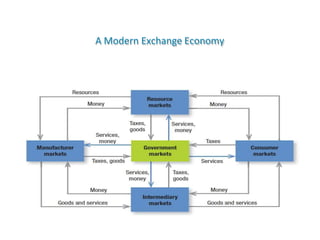
A Modern Exchange Economy
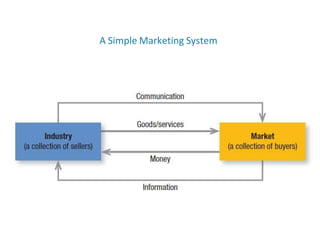
A Simple Marketing System
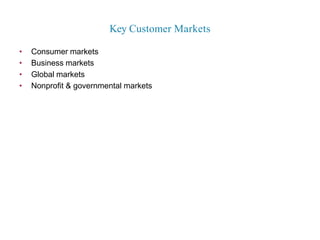
Key Customer Markets
• Consumer markets
• Business markets
• Global markets
• Nonprofit & governmental markets
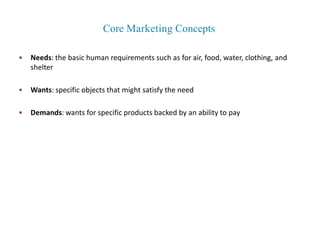
Core Marketing Concepts
• Needs: the basic human requirements such as for air, food, water, clothing, and
shelter
• Wants: specific objects that might satisfy the need
• Demands: wants for specific products backed by an ability to pay
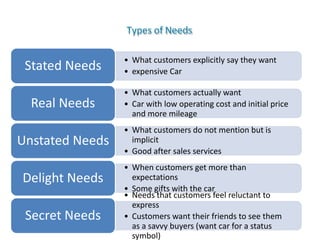
Types of Needs
• What customers explicitly say they want
• expensive Car
Stated Needs
• What customers actually want
• Car with low operating cost and initial price
and more mileage
Real Needs
• What customers do not mention but is
implicit
• Good after sales services
Unstated Needs
• When customers get more than
expectations
• Some gifts with the car
Delight Needs
• Needs that customers feel reluctant to
express
• Customers want their friends to see them
as a savvy buyers (want car for a status
symbol)
Secret Needs
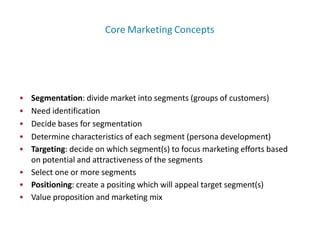
• Segmentation: divide market into segments (groups of customers)
• Need identification
• Decide bases for segmentation
• Determine characteristics of each segment (persona development)
• Targeting: decide on which segment(s) to focus marketing efforts based
on potential and attractiveness of the segments
• Select one or more segments
• Positioning: create a positing which will appeal target segment(s)
• Value proposition and marketing mix
Core Marketing Concepts
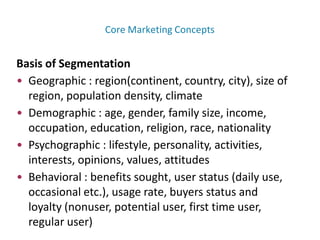
Basis of Segmentation
• Geographic : region(continent, country, city), size of
region, population density, climate
• Demographic : age, gender, family size, income,
occupation, education, religion, race, nationality
• Psychographic : lifestyle, personality, activities,
interests, opinions, values, attitudes
• Behavioral : benefits sought, user status (daily use,
occasional etc.), usage rate, buyers status and
loyalty (nonuser, potential user, first time user,
regular user)
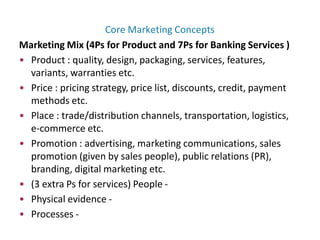
Core Marketing Concepts
Marketing Mix (4Ps for Product and 7Ps for Banking Services )
• Product : quality, design, packaging, services, features,
variants, warranties etc.
• Price : pricing strategy, price list, discounts, credit, payment
methods etc.
• Place : trade/distribution channels, transportation, logistics,
e-commerce etc.
• Promotion : advertising, marketing communications, sales
promotion (given by sales people), public relations (PR),
branding, digital marketing etc.
• (3 extra Ps for services) People -
• Physical evidence -
• Processes -
Core Marketing Concepts
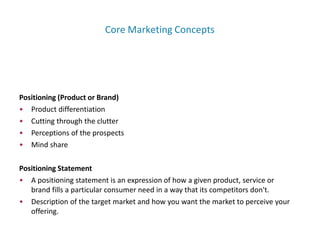
Positioning (Product or Brand)
• Product differentiation
• Cutting through the clutter
• Perceptions of the prospects
• Mind share
Positioning Statement
• A positioning statement is an expression of how a given product, service or
brand fills a particular consumer need in a way that its competitors don't.
• Description of the target market and how you want the market to perceive your
offering.
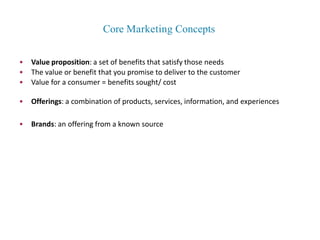
Core Marketing Concepts
• Value proposition: a set of benefits that satisfy those needs
• The value or benefit that you promise to deliver to the customer
• Value for a consumer = benefits sought/ cost
• Offerings: a combination of products, services, information, and experiences
• Brands: an offering from a known source
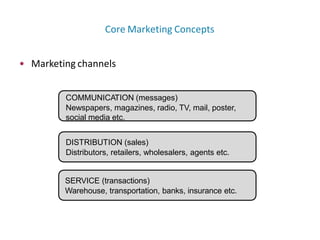
Core Marketing Concepts
• Marketing channels
COMMUNICATION (messages)
Newspapers, magazines, radio, TV, mail, poster,
social media etc.
DISTRIBUTION (sales)
Distributors, retailers, wholesalers, agents etc.
SERVICE (transactions)
Warehouse, transportation, banks, insurance etc.
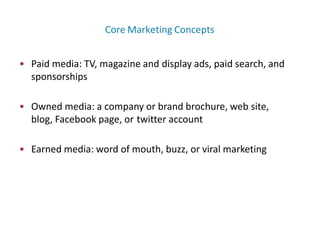
Core Marketing Concepts
• Paid media: TV, magazine and display ads, paid search, and
sponsorships
• Owned media: a company or brand brochure, web site,
blog, Facebook page, or twitter account
• Earned media: word of mouth, buzz, or viral marketing
Core Marketing Concepts
• Impressions: occur when consumers view a
communication
• Engagement: the extent of a customer’s
attention and active involvement with a
communication
Core Marketing Concepts
• Value: a combination of quality, service, and price (qsp: the
customer value triad)
• Satisfaction: a person’s judgment of a product’s perceived
performance in relationship to expectations
Core Marketing Concepts
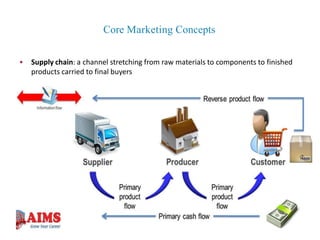
• Supply chain: a channel stretching from raw materials to components to finished
products carried to final buyers
RM , WIP, FG (consumed)
Core Marketing Concepts
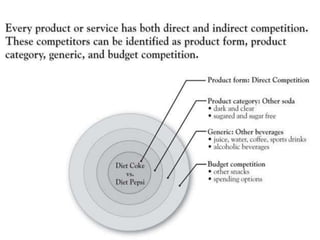
• Competition: all the actual and potential rival offerings and substitutes a buyer
might consider
Core Marketing Concepts
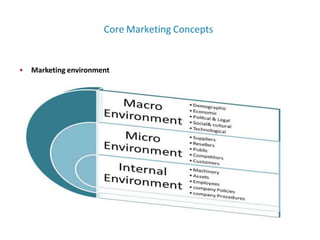
• Marketing environment
Core Marketing Concepts
The New Marketing Realities
• Technology
• Globalization
• Social responsibility
New consumer capabilities
New company capabilities
Impact on marketing
BUILDING CUSTOMER VALUE, SATISFACTION AND LOYALTY
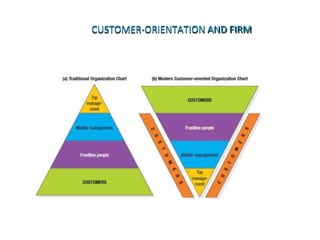
CUSTOMER-ORIENTATION AND FIRM
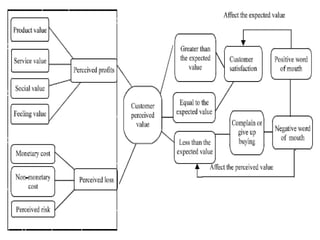
CUSTOMER PERCEIVED VALUE
Customer perceived value is the difference between the prospective
customer’s evaluation of all the benefits and all the costs of an offering
when compared with alternatives.
How customers view a product?
What value it assigns to it?
Value = Benefits – Costs
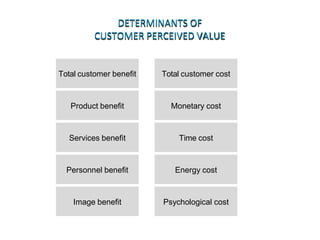
DETERMINANTS OF
CUSTOMER PERCEIVED VALUE
Total customer benefit
Product benefit
Services benefit
Personnel benefit
Image benefit
Total customer cost
Monetary cost
Time cost
Energy cost
Psychological cost
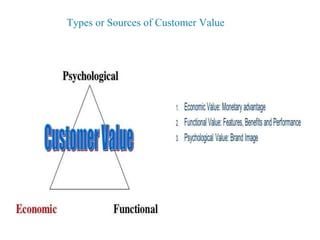
Types or Sources of Customer Value
APPLYING VALUE CONCEPTS
A firm can improve its offers in three ways:
1. By improving the economic, functional, and psychological benefits of its
product, services, people, and/or image.
2. By reducing the buyer’s nonmonetary costs by lesser time, energy,
and psychological investment.
3. By reducing the product’s monetary cost to the buyer.
STEPS IN A
CUSTOMER VALUE ANALYSIS
• IDENTIFY MAJOR ATTRIBUTES AND BENEFITS THAT CUSTOMERS VALUE
• ASSESS THE QUALITATIVE IMPORTANCE OF DIFFERENT ATTRIBUTES AND
BENEFITS
• ASSESS THE COMPANY’S AND COMPETITOR’S PERFORMANCES ON THE
DIFFERENT CUSTOMER VALUES AGAINST RATED IMPORTANCE
• EXAMINE RATINGS OF SPECIFIC SEGMENTS
• MONITOR CUSTOMER VALUES OVER TIME
HIGH CUSTOMER VALUE
• The Value Proposition - Promise to customer on expected experience
• Value Delivery System – Ensures that promise is kept
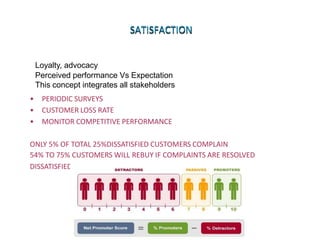
SATISFACTION
Loyalty, advocacy
Perceived performance Vs Expectation
This concept integrates all stakeholders
• PERIODIC SURVEYS
• CUSTOMER LOSS RATE
• MONITOR COMPETITIVE PERFORMANCE
ONLY 5% OF TOTAL 25%DISSATISFIED CUSTOMERS COMPLAIN
54% TO 75% CUSTOMERS WILL REBUY IF COMPLAINTS ARE RESOLVED
DISSATISFIED CUSTOMERS GRIPES TO 11 PEOPLE.
CUSTOMERS AND VALUE TO FIRMS
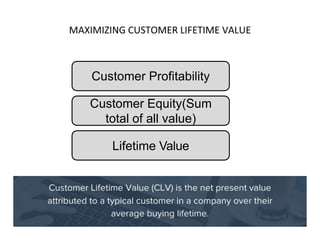
Customer Profitability
Customer Equity(Sum
total of all value)
Lifetime Value
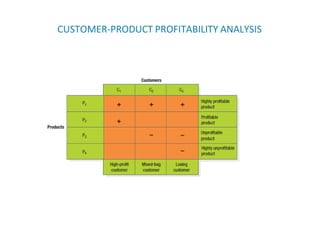
CUSTOMER-PRODUCT PROFITABILITY ANALYSIS
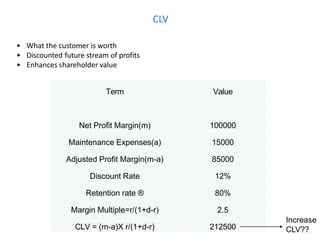
CLV
• What the customer is worth
• Discounted future stream of profits
• Enhances shareholder value
Term Value
Net Profit Margin(m) 100000
Maintenance Expenses(a) 15000
Adjusted Profit Margin(m-a) 85000
Discount Rate 12%
Retention rate ® 80%
Margin Multiple=r/(1+d-r) 2.5
CLV = (m-a)X r/(1+d-r) 212500
Increase
CLV??
WHAT IS
CUSTOMER RELATIONSHIP MANAGEMENT?
CRM IS THE PROCESS OF CAREFULLY MANAGING DETAILED INFORMATION
ABOUT INDIVIDUAL CUSTOMERS AND ALL CUSTOMER TOUCH POINTS
TO MAXIMIZE CUSTOMER LOYALTY.
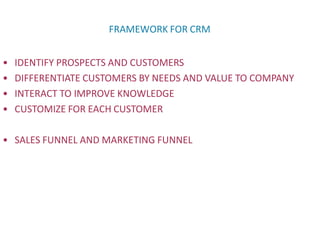
FRAMEWORK FOR CRM
• IDENTIFY PROSPECTS AND CUSTOMERS
• DIFFERENTIATE CUSTOMERS BY NEEDS AND VALUE TO COMPANY
• INTERACT TO IMPROVE KNOWLEDGE
• CUSTOMIZE FOR EACH CUSTOMER
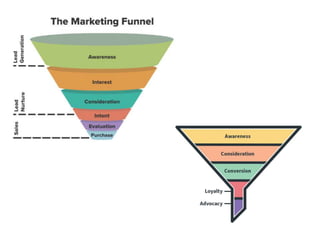
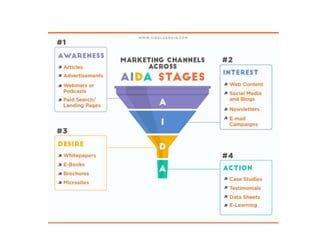
• SALES FUNNEL AND MARKETING FUNNEL
ATTRACTING AND
RETAINING CUSTOMERS
• REDUCE THE RATE OF DEFECTION
• INCREASE LONGEVITY
• ENHANCE SHARE OF WALLET
• TERMINATE LOW-PROFIT CUSTOMERS
• FOCUS MORE EFFORT ON HIGH-PROFIT CUSTOMERS
FRAMEWORK FOR CRM
• IDENTIFY PROSPECTS AND CUSTOMERS
• DIFFERENTIATE CUSTOMERS BY NEEDS AND VALUE TO COMPANY
• INTERACT TO IMPROVE KNOWLEDGE
• CUSTOMIZE FOR EACH CUSTOMER
• Sales funnel – prospect to customer to loyalist to advocacy
ATTRACTING AND
RETAINING CUSTOMERS
• REDUCE THE RATE OF DEFECTION
• INCREASE LONGEVITY
• ENHANCE SHARE OF WALLET
• TERMINATE LOW-PROFIT CUSTOMERS
• FOCUS MORE EFFORT ON HIGH-PROFIT CUSTOMERS
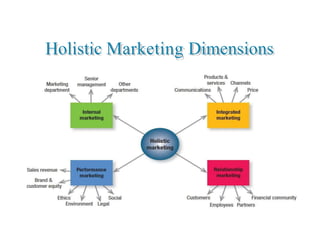
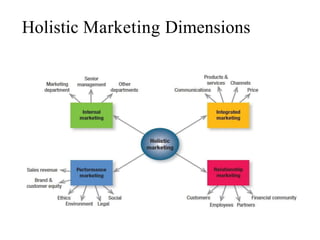
Holistic Marketing Dimensions
INNOVATION
https://www.youtube.com/watch?v=tV6gygNPetU
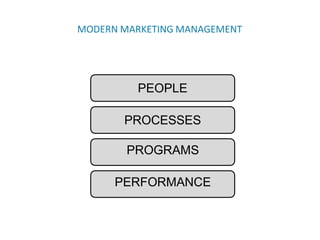
MODERN MARKETING MANAGEMENT
PEOPLE
PROCESSES
PROGRAMS
PERFORMANCE
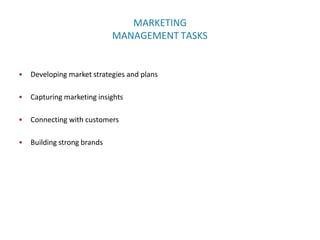
MARKETING
MANAGEMENT TASKS
• Developing market strategies and plans
• Capturing marketing insights
• Connecting with customers
• Building strong brands
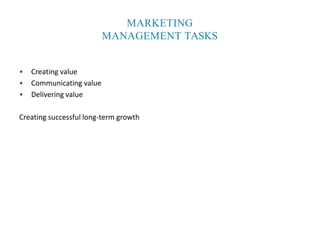
MARKETING
MANAGEMENT TASKS
• Creating value
• Communicating value
• Delivering value
Creating successful long-term growth
Session 3
Customer Relationship
Management
CRM is the process of carefully managing detailed
information about individual customers and all customer
touch points to maximize customer loyalty.
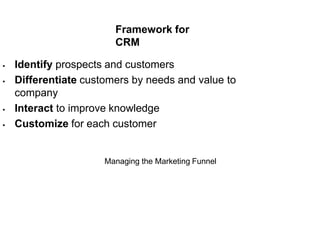
Framework for
CRM
 Identify prospects and customers
 Differentiate customers by needs and value to
company
 Interact to improve knowledge
 Customize for each customer
Managing the Marketing Funnel
Attracting and
Retaining
Customers
 Reduce the rate of defection
 Increase longevity
 Enhance share of wallet
 Terminate low-profit customers
 Focus more effort on high-profit
customers
HOLISTIC
MARKETING
 Holistic marketing refers to a marketing
strategy that considers the whole of a
business and all the different marketing
channels as a system. Under this strategy,
a business with different departments
comes together in synergy in pursuit of a
conscious mission, great customer
experience, and a positive brand image.
Holistic Marketing Dimensions
MARKETING
MANAGEMENT
TASKS
 Developing market strategies and
plans
 Capturing marketing insights
 Connecting with customers
 Building strong brands
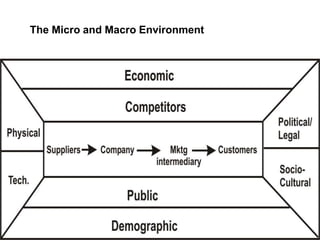
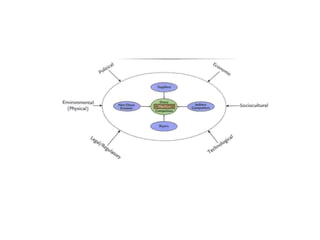
The Micro and Macro Environment
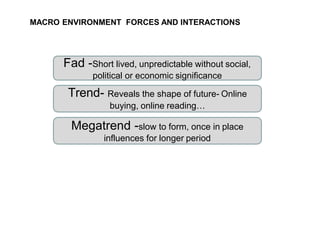
MACRO ENVIRONMENT FORCES AND INTERACTIONS
Fad -Short lived, unpredictable without social,
political or economic significance
Trend- Reveals the shape of future- Online
buying, online reading…
Megatrend -slow to form, once in place
influences for longer period
Political Environment
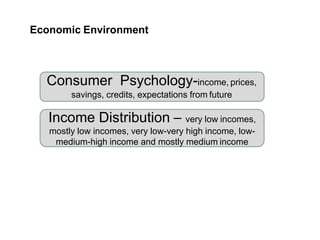
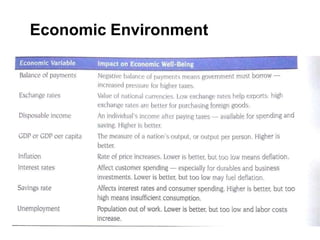
Economic Environment
Consumer Psychology-income, prices,
savings, credits, expectations from future
Income Distribution – very low incomes,
mostly low incomes, very low-very high income, low-
medium-high income and mostly medium income
Economic Environment
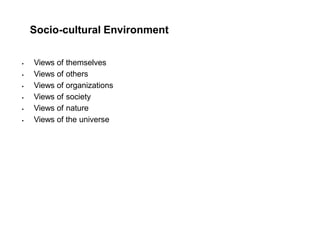
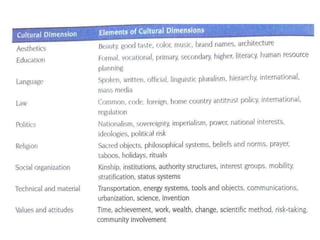
Socio-cultural Environment
 Views of themselves
 Views of others
 Views of organizations
 Views of society
 Views of nature
 Views of the universe
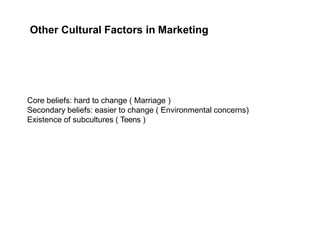
Other Cultural Factors in Marketing
Core beliefs: hard to change ( Marriage )
Secondary beliefs: easier to change ( Environmental concerns)
Existence of subcultures ( Teens )
Technological Environment

•
Can lead to new product development
• Multiple channels to serve customers
Higher efficiency & effectiveness-Lower costs
 Accelerating change : Can render old products obsolete-
walkmanmp3ipod
 Impact of e-commerce
 Impact of Social media
 Innovation ( Sustainable solutions )
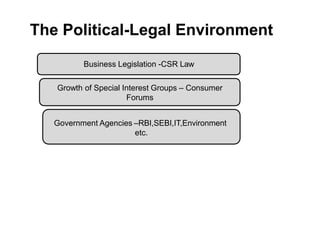
The Political-Legal Environment
Business Legislation -CSR Law
Growth of Special Interest Groups – Consumer
Forums
Government Agencies –RBI,SEBI,IT,Environment
etc.
Session 4
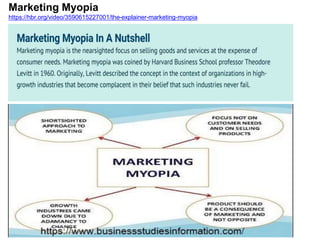
Marketing Myopia
https://hbr.org/video/3590615227001/the-explainer-marketing-myopia
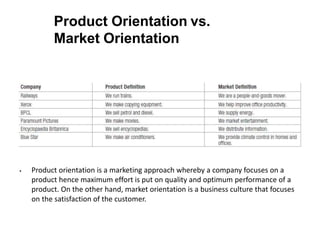
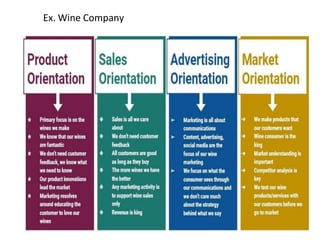
Product Orientation vs.
Market Orientation
 Product orientation is a marketing approach whereby a company focuses on a
product hence maximum effort is put on quality and optimum performance of a
product. On the other hand, market orientation is a business culture that focuses
on the satisfaction of the customer.
Ex. Wine Company
Strategic planning and Marketing Plan
 Strategic planning - Strategic planning is an organization's
process of defining its strategy, or direction, and making decisions
on allocating its resources to pursue this strategy. It may also
extend to control mechanisms for guiding the implementation of
the strategy.
 A strategic plan is a document used to communicate with the
organization the organizations goals, the actions needed to
achieve those goals
Strategic planning and Marketing Plan
 A marketing plan is the advertising strategy that a business will
implement to sell its product or service.
 A marketing plan is a report that outlines your marketing
strategy for the coming year, quarter or month.
 A marketing plan is a document that lays out the marketing
efforts of a business in an upcoming period, which is usually a
year.
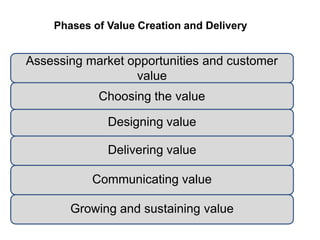
Phases of Value Creation and Delivery
Assessing market opportunities and customer
value
Choosing the value
Designing value
Delivering value
Communicating value
Growing and sustaining value
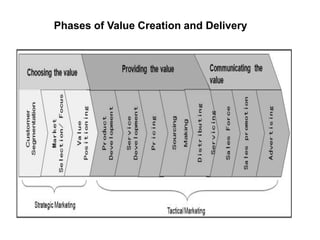
Phases of Value Creation and Delivery
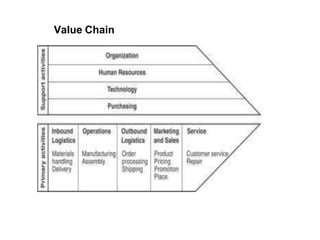
Value Chain
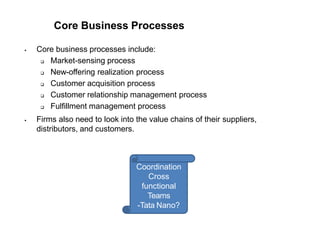
Core Business Processes
 Core business processes include:
 Market-sensing process
 New-offering realization process
 Customer acquisition process
 Customer relationship management process
 Fulfillment management process
 Firms also need to look into the value chains of their suppliers,
distributors, and customers.
Coordination
Cross
functional
Teams
-Tata Nano?
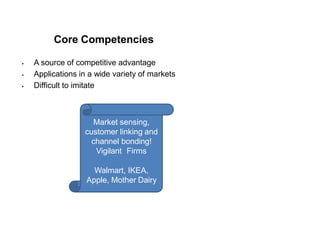
Core Competencies
 A source of competitive advantage
 Applications in a wide variety of markets
 Difficult to imitate
Market sensing,
customer linking and
channel bonding!
Vigilant Firms
Walmart, IKEA,
Apple, Mother Dairy
Maximizing Core Competencies
 (Re)define the business concept
 (Re)shaping the business scope
 (Re)positioning the company’s brand identity
(Titan, Tanisq)
Business of News
or Advertising or
Marketing
Solutions
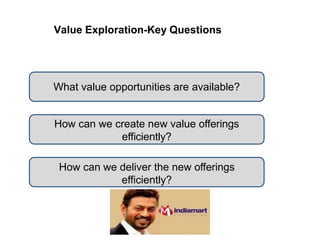
Value Exploration-Key Questions
What value opportunities are available?
How can we create new value offerings
efficiently?
How can we deliver the new offerings
efficiently?
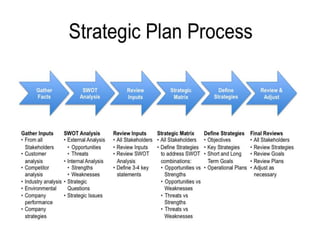
Strategic Planning
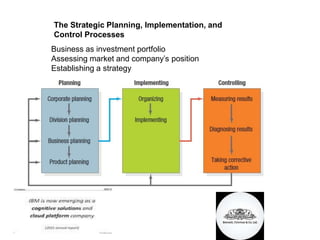
The Strategic Planning, Implementation, and
Control Processes
Business as investment portfolio
Assessing market and company’s position
Establishing a strategy
Master Marketers
Marketing Plan
A marketing plan is the
central instrument for
directing and coordinating
the marketing effort.
It operates at a strategic and tactical level.
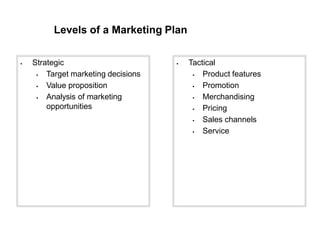
Levels of a Marketing Plan
 Strategic
 Target marketing decisions
 Value proposition
 Analysis of marketing
opportunities
 Tactical
 Product features
 Promotion
 Merchandising
 Pricing
 Sales channels
 Service
Corporate Headquarters’ Planning Activities
 Define the corporate mission
 Establish strategic business units (SBUs)
 Assign resources to each SBU
 Assess growth opportunities
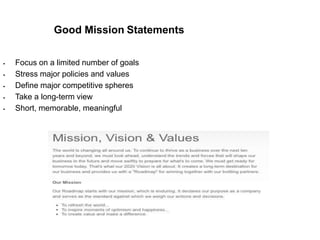
Good Mission Statements
 Focus on a limited number of goals
 Stress major policies and values
 Define major competitive spheres
 Take a long-term view
 Short, memorable, meaningful
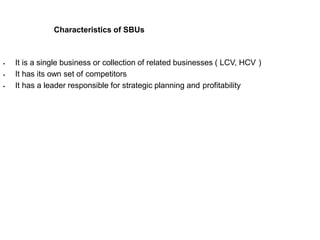
Characteristics of SBUs
 It is a single business or collection of related businesses ( LCV, HCV )
 It has its own set of competitors
 It has a leader responsible for strategic planning and profitability
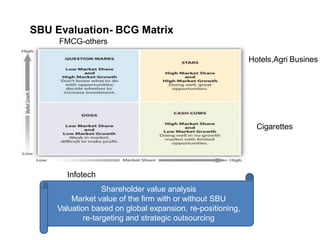
SBU Evaluation- BCG Matrix
FMCG-others
Infotech
Shareholder value analysis
Market value of the firm with or without SBU
Valuation based on global expansion, re-positioning,
re-targeting and strategic outsourcing
Hotels,Agri Busines
Cigarettes
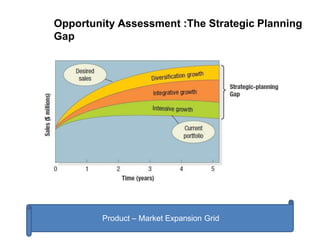
Opportunity Assessment :The Strategic Planning
Gap
Product – Market Expansion Grid
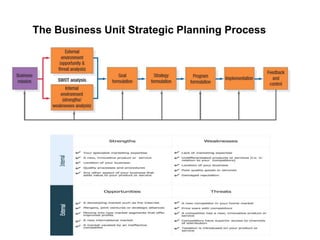
The Business Unit Strategic Planning Process
Market Opportunity Analysis (MOA)
 Can the benefits involved in the opportunity be articulated
convincingly to a defined target market?
 Can the target market be located and reached with cost-effective
media and trade channels?
 Does the company possess or have access to the critical capabilities
and resources needed to deliver the customer benefits?
 Can the company deliver the benefits better than any actual or
potential competitors?
 Will the financial rate of return meet or exceed the company’s
required threshold for investment?
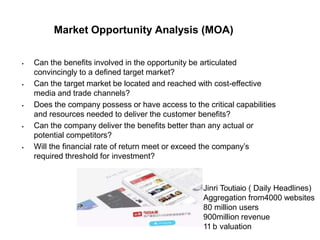
Jinri Toutiaio ( Daily Headlines)
Aggregation from4000 websites
80 million users
900million revenue
11 b valuation
Goal Formulation
 Unit’s objectives must be hierarchical
 Objectives should be quantitative
 Goals should be realistic
 Objectives must be consistent
Topline growth or bottom-line growth?
Market share or Reach?
Porter’s Generic Strategies
Overall cost leadership –
Price/Distribution
Differentiation – Superior
performance/Customer Benefit
Focus - Niche
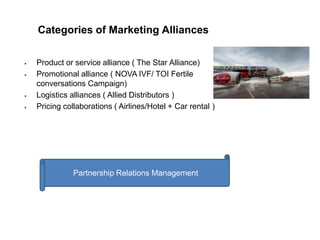
Categories of Marketing Alliances
 Product or service alliance ( The Star Alliance)
 Promotional alliance ( NOVA IVF/ TOI Fertile
conversations Campaign)
 Logistics alliances ( Allied Distributors )
 Pricing collaborations ( Airlines/Hotel + Car rental )
Partnership Relations Management
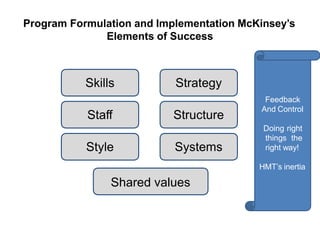
Program Formulation and Implementation McKinsey’s
Elements of Success
Strategy
Structure
Style Systems
Shared values
Staff
Skills
Feedback
And Control
Doing right
things the
right way!
HMT’s inertia
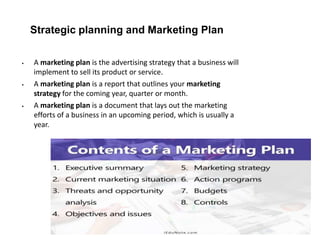
Marketing Plan Contents
 Executive summary
 Table of contents
 Situation analysis
 Marketing strategy
 Financial projections
 Implementation controls
Evaluating a Marketing Plan
 Is the plan simple?
 Is the plan specific?
 Is the plan realistic?
 Is the plan complete?
PRESENTATION 4 OF 24 / 104
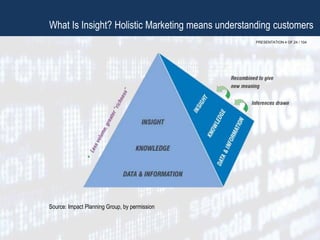
What Is Insight? Holistic Marketing means understanding customers
Source: Impact Planning Group, by permission
PRESENTATION 4 OF 24 / 105
Consumer Behavior
Consumer behavior is the study of how
individuals, groups, and organizations select,
buy, use, and dispose of goods, services,
ideas, or experiences to satisfy their needs
and wants.
PRESENTATION 4 OF 24 / 106
Customer Insight
Session Roadmap
• Who are the customers?
• What do customers need and want?
• How do customers buy?
• Influences on customer purchase decisions
PRESENTATION 4 OF 24 / 107
Who Are the Customers?
A customer is any person or organization, in the channel of distribution
or decision (excluding competitors), whose actions can affect the
purchase of the firm’s products and services.
PRESENTATION 4 OF 24 / 108
Who Are the Customers?
• Macro versus micro
• Direct versus indirect
• Roles in the purchase process
• Evolution: current versus future
PRESENTATION 4 OF 24 / 109
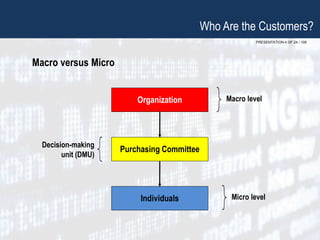
Who Are the Customers?
Macro versus Micro
Organization
Purchasing Committee
Individuals
Macro level
Micro level
Decision-making
unit (DMU)
PRESENTATION 4 OF 24 / 110
Who Are the Customers?
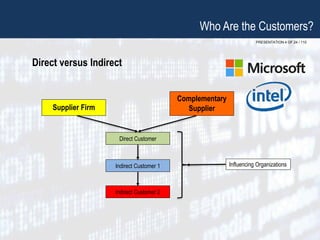
Direct versus Indirect
Direct Customer
Indirect Customer 1
Indirect Customer 2
Influencing Organizations
Supplier Firm
Complementary
Supplier
PRESENTATION 4 OF 24 / 111
Who Are the Customers?
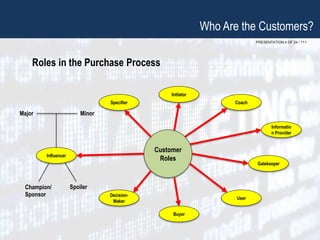
Roles in the Purchase Process
Customer
Roles
Specifier
Initiator
Coach
Informatio
n Provider
Gatekeeper
User
Buyer
Decision-
Maker
Influencer
Major Minor
Champion/
Sponsor
Spoiler
PRESENTATION 4 OF 24 / 112
Who Are the Customers?
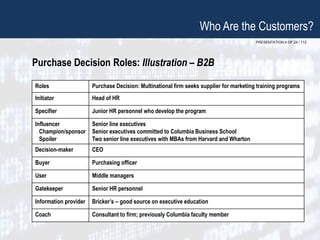
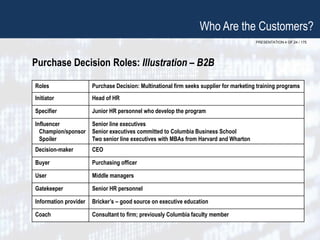
Purchase Decision Roles: Illustration – B2B
Roles Purchase Decision: Multinational firm seeks supplier for marketing training programs
Initiator Head of HR
Specifier Junior HR personnel who develop the program
Influencer
Champion/sponsor
Spoiler
Senior line executives
Senior executives committed to Columbia Business School
Two senior line executives with MBAs from Harvard and Wharton
Decision-maker CEO
Buyer Purchasing officer
User Middle managers
Gatekeeper Senior HR personnel
Information provider Bricker’s – good source on executive education
Coach Consultant to firm; previously Columbia faculty member
PRESENTATION 4 OF 24 / 113
Who Are the Customers?
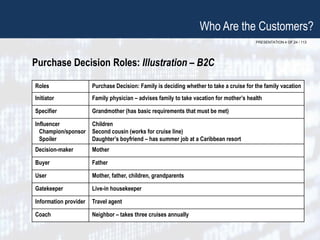
Purchase Decision Roles: Illustration – B2C
Roles Purchase Decision: Family is deciding whether to take a cruise for the family vacation
Initiator Family physician – advises family to take vacation for mother’s health
Specifier Grandmother (has basic requirements that must be met)
Influencer
Champion/sponsor
Spoiler
Children
Second cousin (works for cruise line)
Daughter’s boyfriend – has summer job at a Caribbean resort
Decision-maker Mother
Buyer Father
User Mother, father, children, grandparents
Gatekeeper Live-in housekeeper
Information provider Travel agent
Coach Neighbor – takes three cruises annually
PRESENTATION 4 OF 24 / 114
Customer Insight
Session Roadmap
• Who are the customers?
• What do customers need and want?
• How do customers buy?
• Influences on customer purchase decisions
PRESENTATION 4 OF 24 / 115
What Do Customers Need and Want?
• Recognized versus latent
• Hierarchy of needs
• Attributes and features, benefits, values ladder
• Types of value
• Customer value issues
• Customer experiences
PRESENTATION 4 OF 24 / 116
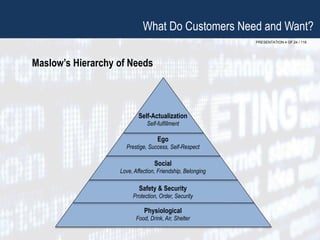
Maslow’s Hierarchy of Needs
What Do Customers Need and Want?
Self-Actualization
Self-fulfillment
Ego
Prestige, Success, Self-Respect
Social
Love, Affection, Friendship, Belonging
Safety & Security
Protection, Order, Security
Physiological
Food, Drink, Air, Shelter
PRESENTATION 4 OF 24 / 117
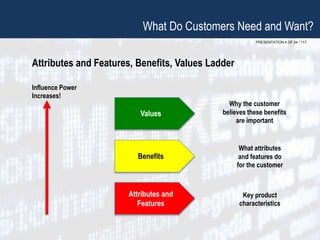
Attributes and Features, Benefits, Values Ladder
What Do Customers Need and Want?
Values
Benefits
Attributes and
Features
Why the customer
believes these benefits
are important
What attributes
and features do
for the customer
Key product
characteristics
Influence Power
Increases!
PRESENTATION 4 OF 24 / 118
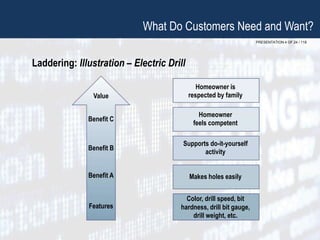
Laddering: Illustration – Electric Drill
What Do Customers Need and Want?
Value
Benefit C
Benefit B
Benefit A
Features
Homeowner is
respected by family
Homeowner
feels competent
Supports do-it-yourself
activity
Makes holes easily
Color, drill speed, bit
hardness, drill bit gauge,
drill weight, etc.
PRESENTATION 4 OF 24 / 119
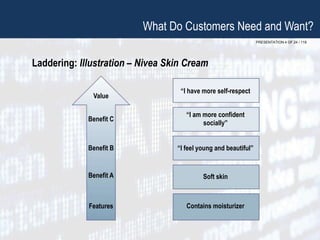
Laddering: Illustration – Nivea Skin Cream
What Do Customers Need and Want?
Value
Benefit C
Benefit B
Benefit A
Features
“I have more self-respect
“I am more confident
socially”
“I feel young and beautiful”
Soft skin
Contains moisturizer
PRESENTATION 4 OF 24 / 120
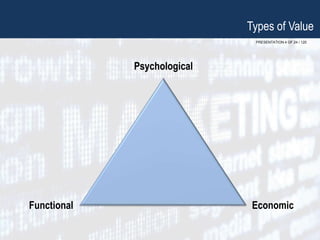
Psychological
Types of Value
Functional Economic
PRESENTATION 4 OF 24 / 121
Customer Insight
Session Roadmap
• Who are the customers?
• What do customers need and want?
• How do customers buy?
• Influences on customer purchase decisions
PRESENTATION 4 OF 24 / 122
How Do Customers Buy?
• Purchase decision process
• Purchase decision categories
PRESENTATION 4 OF 24 / 123
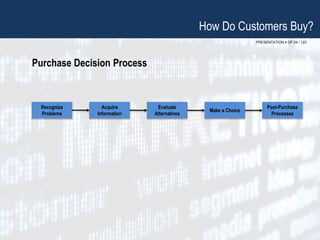
Purchase Decision Process
How Do Customers Buy?
Recognize
Problems
Acquire
Information
Evaluate
Alternatives
Make a Choice
Post-Purchase
Processes
PRESENTATION 4 OF 24 / 124
Recognize Problems
PRESENTATION 4 OF 24 / 125
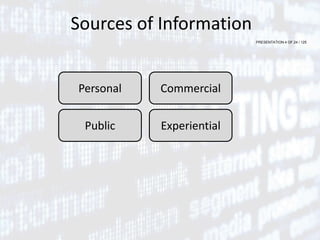
Sources of Information
Commercial
Personal
Public Experiential
PRESENTATION 4 OF 24 / 126
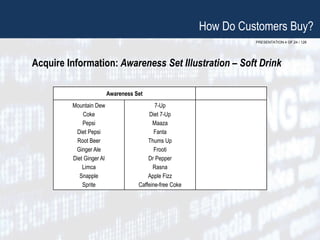
Acquire Information: Awareness Set Illustration – Soft Drink
How Do Customers Buy?
Awareness Set
Mountain Dew
Coke
Pepsi
Diet Pepsi
Root Beer
Ginger Ale
Diet Ginger Al
Limca
Snapple
Sprite
7-Up
Diet 7-Up
Maaza
Fanta
Thums Up
Frooti
Dr Pepper
Rasna
Apple Fizz
Caffeine-free Coke
PRESENTATION 4 OF 24 / 127
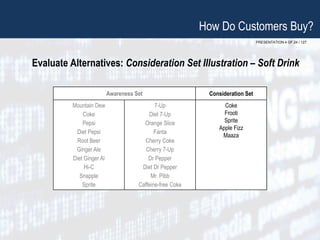
Evaluate Alternatives: Consideration Set Illustration – Soft Drink
How Do Customers Buy?
Consideration Set
Coke
Frooti
Sprite
Apple Fizz
Maaza
PRESENTATION 4 OF 24 / 128
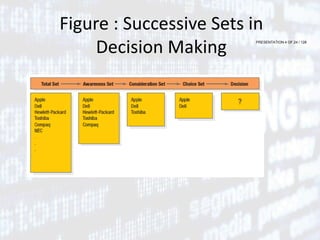
Figure : Successive Sets in
Decision Making
PRESENTATION 4 OF 24 / 129
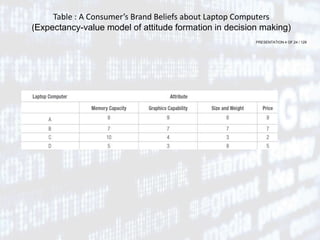
Table : A Consumer’s Brand Beliefs about Laptop Computers
(Expectancy-value model of attitude formation in decision making)
PRESENTATION 4 OF 24 / 130
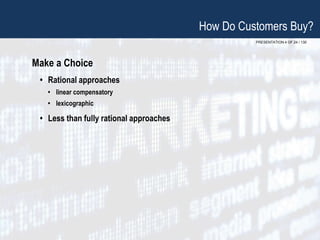
Make a Choice
• Rational approaches
• linear compensatory
• lexicographic
• Less than fully rational approaches
How Do Customers Buy?
PRESENTATION 4 OF 24 / 131
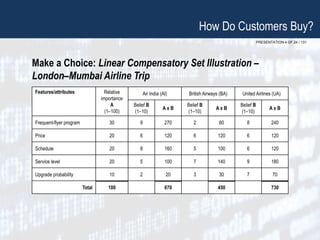
Make a Choice: Linear Compensatory Set Illustration –
London–Mumbai Airline Trip
How Do Customers Buy?
Features/attributes Relative
importance
A
(1–100)
Air India (AI) British Airways (BA) United Airlines (UA)
Belief B
(1–10)
A x B
Belief B
(1–10)
A x B
Belief B
(1–10)
A x B
Frequent-flyer program 30 9 270 2 60 8 240
Price 20 6 120 6 120 6 120
Schedule 20 8 160 5 100 6 120
Service level 20 5 100 7 140 9 180
Upgrade probability 10 2 20 3 30 7 70
Total 100 670 450 730
PRESENTATION 4 OF 24 / 132
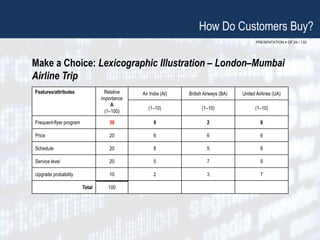
Make a Choice: Lexicographic Illustration – London–Mumbai
Airline Trip
How Do Customers Buy?
Features/attributes Relative
importance
A
(1–100)
Air India (AI) British Airways (BA) United Airlines (UA)
(1–10) (1–10) (1–10)
Frequent-flyer program 30 9 2 8
Price 20 6 6 6
Schedule 20 8 5 6
Service level 20 5 7 9
Upgrade probability 10 2 3 7
Total 100
PRESENTATION 4 OF 24 / 133
Conjunctive heuristic (minimum
acceptable cut-off for each
attribute)
PRESENTATION 4 OF 24 / 134
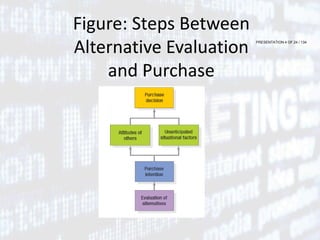
Figure: Steps Between
Alternative Evaluation
and Purchase
PRESENTATION 4 OF 24 / 135
Perceived Risk
• Functional
• Physical
• Financial
• Social
• Psychological
• Time
PRESENTATION 4 OF 24 / 136
Make a Choice: Illustration of Less Than Fully Rational Behavior
You are in a store about to buy a Rs 600 book. Your friend walks by and says you
can buy the same book two blocks away for Rs 450.
Question: Would you walk two blocks to save Rs 150?
You are in a store about to buy a home-entertainment system for Rs 8,000. Your
friend walks by and says you can buy the same system two blocks away for
Rs7,850.
Question: Would you walk two blocks to save Rs150?
How Do Customers Buy?
PRESENTATION 4 OF 24 / 137
How Do Customers Buy?
Make a Choice
You are about to buy a soft drink. You have 2 choices.
small – Rs 20
large – Rs 30
Which will you choose?
You are about to buy a soft drink. You have 3 choices.
small – Rs 20
large – Rs 30
very large – Rs 38
Which will you choose?
PRESENTATION 4 OF 24 / 138
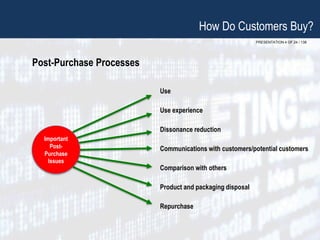
How Do Customers Buy?
Post-Purchase Processes
Use
Use experience
Dissonance reduction
Communications with customers/potential customers
Comparison with others
Product and packaging disposal
Repurchase
Important
Post-
Purchase
Issues
PRESENTATION 4 OF 24 / 139
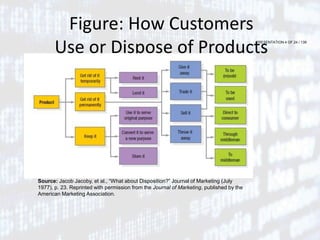
Figure: How Customers
Use or Dispose of Products
Source: Jacob Jacoby, et al., “What about Disposition?” Journal of Marketing (July
1977), p. 23. Reprinted with permission from the Journal of Marketing, published by the
American Marketing Association.
PRESENTATION 4 OF 24 / 140
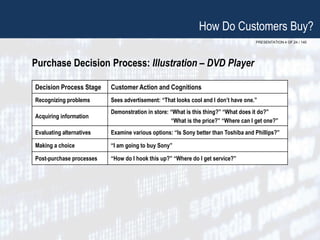
Purchase Decision Process: Illustration – DVD Player
How Do Customers Buy?
Decision Process Stage Customer Action and Cognitions
Recognizing problems Sees advertisement: “That looks cool and I don’t have one.”
Acquiring information
Demonstration in store: “What is this thing?” “What does it do?”
“What is the price?” “Where can I get one?”
Evaluating alternatives Examine various options: “Is Sony better than Toshiba and Phillips?”
Making a choice “I am going to buy Sony”
Post-purchase processes “How do I hook this up?” “Where do I get service?”
PRESENTATION 4 OF 24 / 141
How Do Customers Buy?
• Purchase decision process
• Purchase decision categories
PRESENTATION 4 OF 24 / 142
Purchase Decision Categories
• Routinized-response behavior – straight rebuy
• established alternatives and criteria, minimal uncertainty
• Limited problem solving – modified rebuy
• novel alternative(s), well-developed criteria, performance unknown
• Extended problem solving – new buy
• novel alternative(s), poorly developed criteria, great uncertainty
How Do Customers Buy?
PRESENTATION 4 OF 24 / 143
Purchase Decision Categories: Implications
• DMU varies by type of purchase
• Purchase categories depend on the customer, NOT on the product
• Potential suppliers should consider shifting decision-making from
simple to complex
How Do Customers Buy?
PRESENTATION 4 OF 24 / 144
Customer Insight
Session Roadmap
• Who are the customers?
• What do customers need and want?
• How do customers buy?
• Influences on customer purchase decisions
PRESENTATION 4 OF 24 / 145
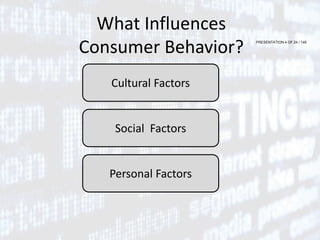
What Influences
Consumer Behavior?
Cultural Factors
Social Factors
Personal Factors
PRESENTATION 4 OF 24 / 146
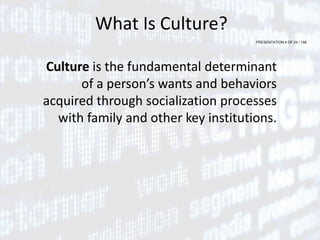
What Is Culture?
Culture is the fundamental determinant
of a person’s wants and behaviors
acquired through socialization processes
with family and other key institutions.
PRESENTATION 4 OF 24 / 147
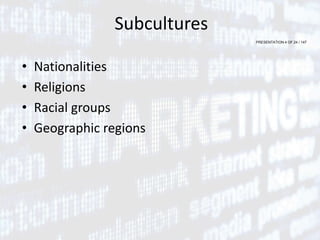
Subcultures
• Nationalities
• Religions
• Racial groups
• Geographic regions
PRESENTATION 4 OF 24 / 148
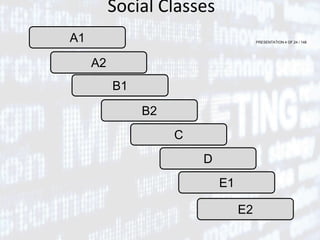
Social Classes
A1
A2
B1
B2
C
D
E1
E2
PRESENTATION 4 OF 24 / 149
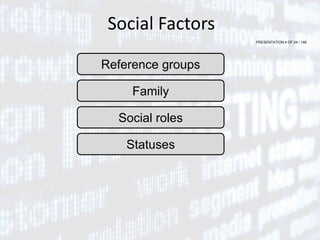
Social Factors
Reference groups
Family
Social roles
Statuses
PRESENTATION 4 OF 24 / 150
Reference Groups
• Membership groups
• Primary groups
• Secondary groups
• Aspirational groups
• Disassociative groups
PRESENTATION 4 OF 24 / 151
Family
 Family of orientation: parents and
siblings
 Family of procreation: spouse and
children
PRESENTATION 4 OF 24 / 152
Personal Factors
• Age
• Life cycle stage
• Occupation
• Wealth
• Personality
• Values
• Lifestyle
• Self-concept
PRESENTATION 4 OF 24 / 153
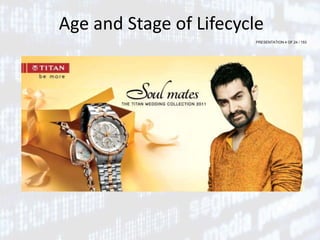
Age and Stage of Lifecycle
PRESENTATION 4 OF 24 / 154
Occupation and Economic
Circumstances
Marketers try to identify the occupational
groups that have above-average interest in
their products and services. Product and brand
choice are also affected by economic
circumstances—spendable income, savings
and assets, debts, borrowing power, and
attitudes toward spending and saving—to a
great extent.
PRESENTATION 4 OF 24 / 155
Personality
Personality refers to a set of distinguishing human
psychological traits that lead to relatively consistent
and enduring responses to environmental stimuli.
Personality can be a useful variable in analyzing
consumer brand choices.
PRESENTATION 4 OF 24 / 156
Brand Personality
• Sincerity
• Excitement
• Competence
• Sophistication
• Ruggedness
PRESENTATION 4 OF 24 / 157
Lifestyle and Values
PRESENTATION 4 OF 24 / 158
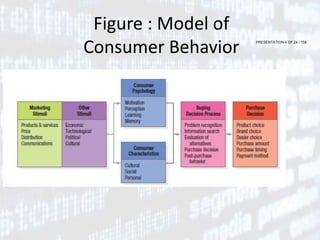
Figure : Model of
Consumer Behavior
PRESENTATION 4 OF 24 / 159
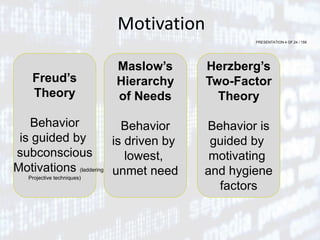
Motivation
Freud’s
Theory
Behavior
is guided by
subconscious
Motivations (laddering.
Projective techniques)
Maslow’s
Hierarchy
of Needs
Behavior
is driven by
lowest,
unmet need
Herzberg’s
Two-Factor
Theory
Behavior is
guided by
motivating
and hygiene
factors
PRESENTATION 4 OF 24 / 160
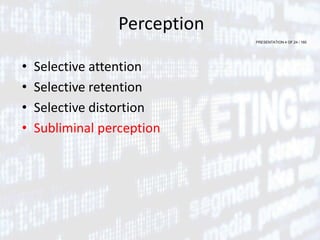
Perception
• Selective attention
• Selective retention
• Selective distortion
• Subliminal perception
PRESENTATION 4 OF 24 / 161
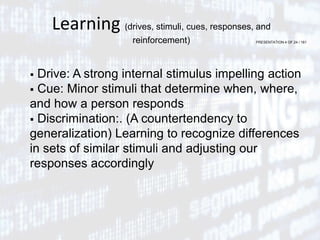
Learning (drives, stimuli, cues, responses, and
reinforcement)
 Drive: A strong internal stimulus impelling action
 Cue: Minor stimuli that determine when, where,
and how a person responds
 Discrimination:. (A countertendency to
generalization) Learning to recognize differences
in sets of similar stimuli and adjusting our
responses accordingly
PRESENTATION 4 OF 24 / 162
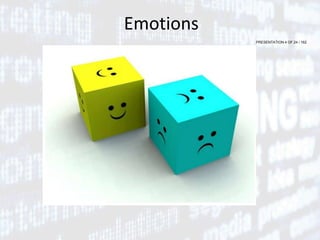
Emotions
PRESENTATION 4 OF 24 / 163
Memory
• Short term memory (limited repository of
information)
• Long term memory (a more permanent,
essentially unlimited repository)
Any type of information can be stored in the memory network,
including verbal, visual, abstract etc
Consumer brand knowledge looked as a node in memory with a
variety of linked associations.
PRESENTATION 4 OF 24 / 164
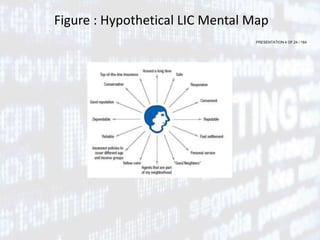
Figure : Hypothetical LIC Mental Map
PRESENTATION 4 OF 24 / 165
High/Low-Involvement Decision
Making
• Elaboration Likelihood Model
–Central Route
–Peripheral route
PRESENTATION 4 OF 24 / 166
Influences on Customer Purchase Decisions
Consumer Decisions – B2C
Organizational Decisions – B2B
PRESENTATION 4 OF 24 / 167
Questions
• What is the business market, and how
does it differ from the consumer market?
• What buying situations do organizational
buyers face?
• Who participates in the business-to-
business buying process?
PRESENTATION 4 OF 24 / 168
Questions
• How do business buyers make their
decisions?
• How can companies build strong
relationships with business customers?
• How do institutional buyers and
government agencies do their buying?
PRESENTATION 4 OF 24 / 169
What Is Organizational Buying?
Organizational buying refers to the
decision-making process by which formal
organizations establish the need for
purchased products and services, and
identify, evaluate, and choose among
alternative brands and suppliers.
PRESENTATION 4 OF 24 / 170
Top Marketing Challenges
• Understanding customer needs in new ways;
• Identifying new opportunities for growth;
• Improving value management techniques
• Calculating better marketing performance and
accountability metrics;
• Competing and growing in global markets
• Countering the threat of product and service
commoditization
PRESENTATION 4 OF 24 / 171
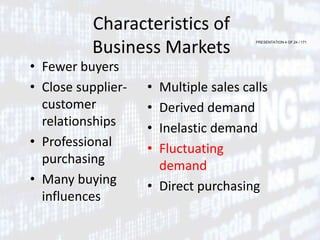
Characteristics of
Business Markets
• Fewer buyers
• Close supplier-
customer
relationships
• Professional
purchasing
• Many buying
influences
• Multiple sales calls
• Derived demand
• Inelastic demand
• Fluctuating
demand
• Direct purchasing
PRESENTATION 4 OF 24 / 172
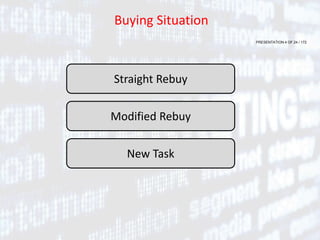
Buying Situation
Straight Rebuy
Modified Rebuy
New Task
PRESENTATION 4 OF 24 / 173
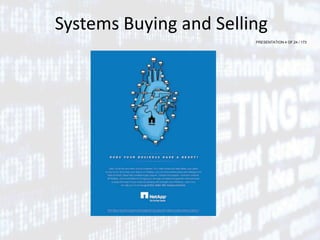
Systems Buying and Selling
PRESENTATION 4 OF 24 / 174
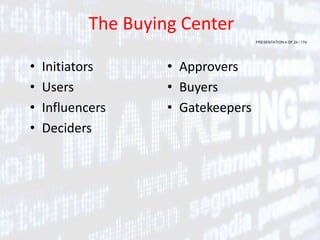
The Buying Center
• Initiators
• Users
• Influencers
• Deciders
• Approvers
• Buyers
• Gatekeepers
PRESENTATION 4 OF 24 / 175
Who Are the Customers?
Purchase Decision Roles: Illustration – B2B
Roles Purchase Decision: Multinational firm seeks supplier for marketing training programs
Initiator Head of HR
Specifier Junior HR personnel who develop the program
Influencer
Champion/sponsor
Spoiler
Senior line executives
Senior executives committed to Columbia Business School
Two senior line executives with MBAs from Harvard and Wharton
Decision-maker CEO
Buyer Purchasing officer
User Middle managers
Gatekeeper Senior HR personnel
Information provider Bricker’s – good source on executive education
Coach Consultant to firm; previously Columbia faculty member
PRESENTATION 4 OF 24 / 176
Of Concern to Marketers
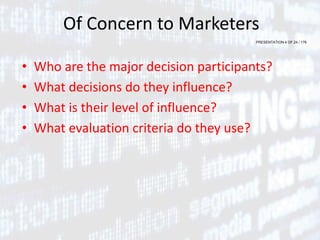
• Who are the major decision participants?
• What decisions do they influence?
• What is their level of influence?
• What evaluation criteria do they use?
PRESENTATION 4 OF 24 / 177
Stages in the Buying Process:
Buyphases
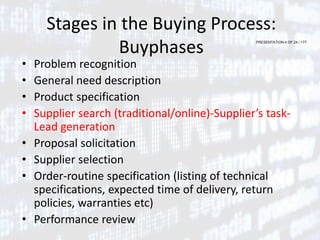
• Problem recognition
• General need description
• Product specification
• Supplier search (traditional/online)-Supplier’s task-
Lead generation
• Proposal solicitation
• Supplier selection
• Order-routine specification (listing of technical
specifications, expected time of delivery, return
policies, warranties etc)
• Performance review
PRESENTATION 4 OF 24 / 178
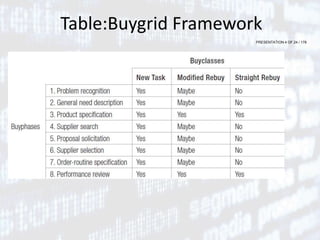
Table:Buygrid Framework
PRESENTATION 4 OF 24 / 179
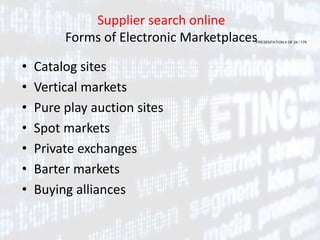
Supplier search online
Forms of Electronic Marketplaces
• Catalog sites
• Vertical markets
• Pure play auction sites
• Spot markets
• Private exchanges
• Barter markets
• Buying alliances
PRESENTATION 4 OF 24 / 180
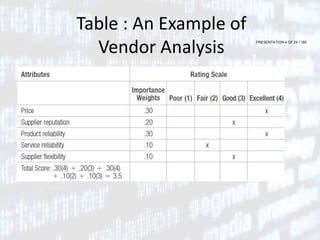
Table : An Example of
Vendor Analysis
PRESENTATION 4 OF 24 / 181
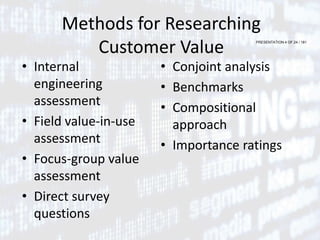
Methods for Researching
Customer Value
• Internal
engineering
assessment
• Field value-in-use
assessment
• Focus-group value
assessment
• Direct survey
questions
• Conjoint analysis
• Benchmarks
• Compositional
approach
• Importance ratings
PRESENTATION 4 OF 24 / 182
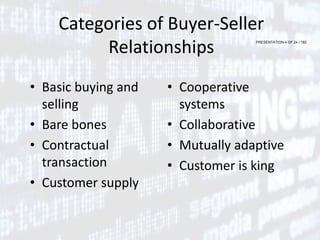
Categories of Buyer-Seller
Relationships
• Basic buying and
selling
• Bare bones
• Contractual
transaction
• Customer supply
• Cooperative
systems
• Collaborative
• Mutually adaptive
• Customer is king
PRESENTATION 4 OF 24 / 183
Institutional Markets
The institutional market consists of schools,
college and university hostels, hospitals and
nursing homes, and other institutions that
provide goods and services to people in their
care. Many of these organizations are
characterized by low budgets and captive
clienteles.
Session 8 and 9
Forecasting and Demand Measurement
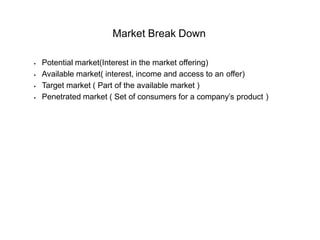
 Potential market(Interest in the market offering)
 Available market( interest, income and access to an offer)
 Target market ( Part of the available market )
 Penetrated market ( Set of consumers for a company’s product )
Market Break Down
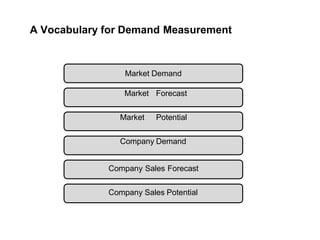
A Vocabulary for Demand Measurement
Market Demand
Market Forecast
Market Potential
Company Demand
Company Sales Forecast
Company Sales Potential
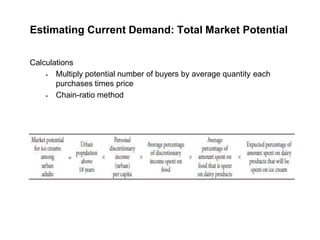
Estimating Current Demand: Total Market Potential
Calculations
 Multiply potential number of buyers by average quantity each
purchases times price
 Chain-ratio method
Estimating Future Demand
Forecasts : What people say, what people do, what people have done.
 Survey of Buyers’ Intentions – market research
 Composite of Sales Force Opinions
 Expert Opinion – delphi method
 Trend projection (past sales analysis)
 Statistical demand analysis/Econometric – impact of causal factors-
price, marketing expenditure, income levels (past sales analysis)
Marketing Research
Marketing Research
for Decision Making
Marketing research is the systematic design, collection, analysis, and
reporting of data and findings relevant to a specific marketing
situation facing the company.
The systematic collection and objective recording, classification, analysis
and presentation of data concerning the behavior, needs, attitudes,
opinions, motivation etc. for individuals and organizations within the
context of their economic, social, political and everyday activities.
Commissioning MarketingResearch
 In house activity
 Research Agencies – Cost effective
 Mix ( Only Field and Tab)
The Research Brief :
Background summary
Problem definition ( Business decision )
Research questions ( Information needed to take business decision)
Scope of research ( What to cover, deadlines)
Tendering Procedure ( How to pitch )
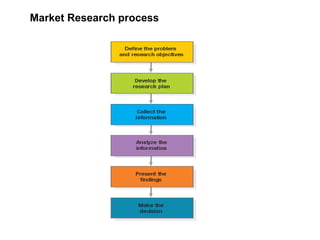
Market Research process
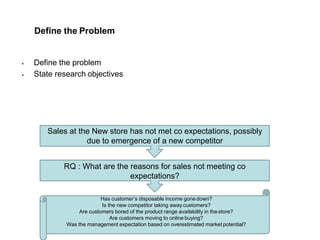
Define the Problem
 Define the problem
 State research objectives
Sales at the New store has not met co expectations, possibly
due to emergence of a new competitor
RQ : What are the reasons for sales not meeting co
expectations?
Has customer’s disposable income gone down?
Is the new competitor taking awaycustomers?
Are customers bored of the product range availability in the store?
Are customers moving to online buying?
Was the management expectation based on overestimated market potential?
Step 2: Develop the Research Plan
 Data sources – Primary data and secondary data ( Field vs Desk
research)
 Research approach ( Exploratory, Descriptive and Causal Research )
 Research instruments
 Sampling plan
 Contact methods
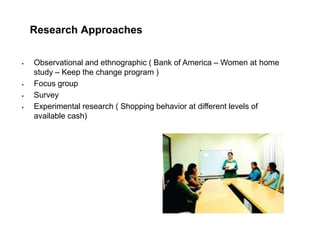
Research Approaches
 Observational and ethnographic ( Bank of America – Women at home
study – Keep the change program )
 Focus group
 Survey
 Experimental research ( Shopping behavior at different levels of
available cash)
Research Instruments
 Questionnaires (Dichotomous, Multiple choice, Likert scale, Rating scale,
Intention-to buy scale etc.)
 Qualitative Measures( Word associations, Projective techniques, open
ended questions, Brand personification etc)
 Technological Devices ( Galvanometers, Tachistoscope, Eye Cameras)
Sampling Plan
 Sampling unit: Who is to be surveyed?
 Sample size: How many people should be surveyed?
 Sampling procedure: How should the respondents be chosen?
Contact Methods
 Mail contacts
 Telephone contacts
 Personal contacts
 Online contacts
Ethical Issues in Marketing Research
 Participation – voluntary
 Confidentiality
 Objective and fair – Competition
 Data Collection Methods
 Adequacy of research scope
Session 10
Segmentation and Targeting
A market segment consists of a group of
customers who share a similar set of needs
and wants.
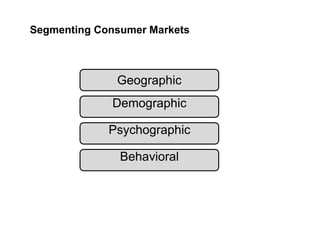
Segmenting Consumer Markets
Geographic
Demographic
Psychographic
Behavioral
Geographic Segmentation
Geographic segmentation divides the market into geographical units
such as nations, states, regions, counties, cities, or neighbourhoods.
The company can operate in one or a few areas, or it can operate in
all but pay attention to local variations.
Demographic Segmentation
 Age and life cycle
 Life stage
 Gender
 Income
 Generation
 Social-Economic classification
Psychographic Segmentation
• Study of psychology and demographics
• Different groups based on psychological/personality traits
• Consumers in the same demographic group can exhibit different
psychographic profiles
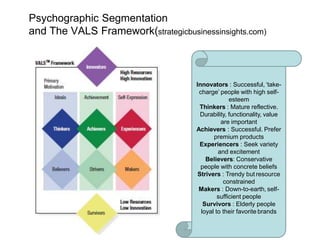
Psychographic Segmentation
and The VALS Framework(strategicbusinessinsights.com)
Innovators : Successful, ‘take-
charge’ people with high self-
esteem
Thinkers : Mature reflective.
Durability, functionality, value
are important
Achievers : Successful. Prefer
premium products
Experiencers : Seek variety
and excitement
Believers: Conservative
people with concrete beliefs
Strivers : Trendy but resource
constrained
Makers : Down-to-earth, self-
sufficient people
Survivors : Elderly people
loyal to their favorite brands
Behavioral Segmentation
Based on attitude towards products, use of products and response to
products
 Needs and Benefits
 Decision Roles
 User and Usage
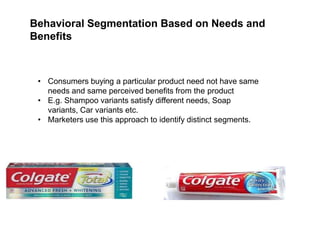
Behavioral Segmentation Based on Needs and
Benefits
• Consumers buying a particular product need not have same
needs and same perceived benefits from the product
• E.g. Shampoo variants satisfy different needs, Soap
variants, Car variants etc.
• Marketers use this approach to identify distinct segments.
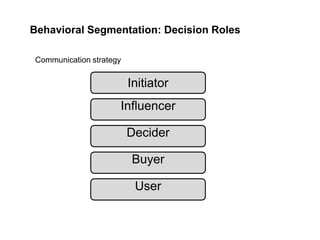
Behavioral Segmentation: Decision Roles
Initiator
Influencer
Decider
Buyer
User
Communication strategy
Behavioral Segmentation: User and Usage
 Occasions ( Festivals, Seasons such as marriage, Vacations etc)
 User Status ( Non users, Potential Users, ex users, existing users etc)
 Usage Rate ( Low, moderate, high : talktime, Internet usage,
restaurant/bars etc)
 Attitude – Enthusiastic, positive, indifferent, negative and hostile
 Buyer-Readiness
 Loyalty Status
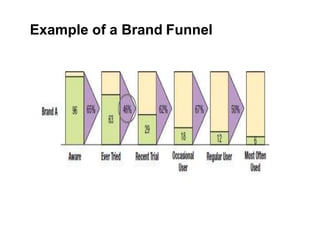
Example of a Brand Funnel
Loyalty Status
 Hard-core – insights on brand strengths
 Split loyals – competitors close to the brand
 Shifting loyals – weakness in the marketing program
 Switchers
Brand loyalty must be considered with other factors such as habit,
indifference, low price, high switching cost, unavailability of other brands.
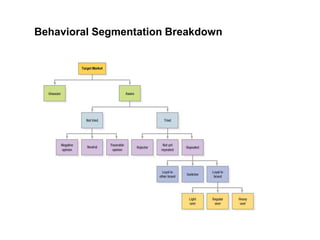
Behavioral Segmentation Breakdown
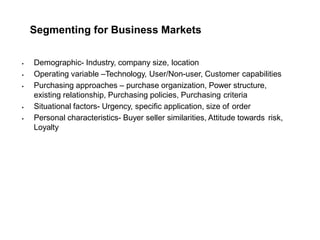
Segmenting for Business Markets
 Demographic- Industry, company size, location
 Operating variable –Technology, User/Non-user, Customer capabilities
 Purchasing approaches – purchase organization, Power structure,
existing relationship, Purchasing policies, Purchasing criteria
 Situational factors- Urgency, specific application, size of order
 Personal characteristics- Buyer seller similarities, Attitude towards risk,
Loyalty
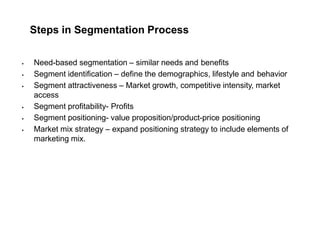
Steps in Segmentation Process
 Need-based segmentation – similar needs and benefits
 Segment identification – define the demographics, lifestyle and behavior
 Segment attractiveness – Market growth, competitive intensity, market
access
 Segment profitability- Profits
 Segment positioning- value proposition/product-price positioning
 Market mix strategy – expand positioning strategy to include elements of
marketing mix.
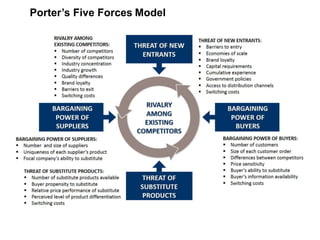
Porter’s Five Forces Model
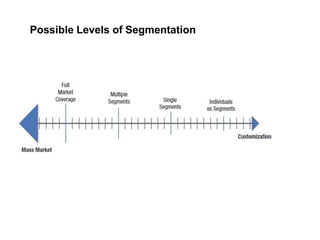
Possible Levels of Segmentation
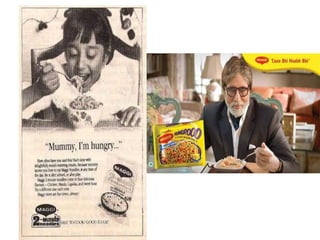
Brand Positioning
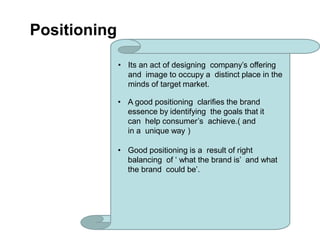
Positioning
• Its an act of designing company’s offering
and image to occupy a distinct place in the
minds of target market.
• A good positioning clarifies the brand
essence by identifying the goals that it
can help consumer’s achieve.( and
in a unique way )
• Good positioning is a result of right
balancing of ‘ what the brand is’ and what
the brand could be’.
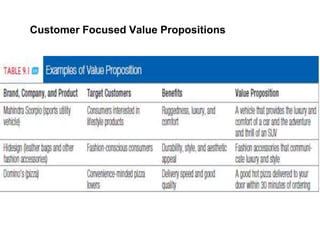
Customer Focused Value Propositions
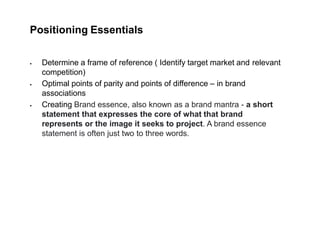
Positioning Essentials
 Determine a frame of reference ( Identify target market and relevant
competition)
 Optimal points of parity and points of difference – in brand
associations
 Creating Brand essence, also known as a brand mantra - a short
statement that expresses the core of what that brand
represents or the image it seeks to project. A brand essence
statement is often just two to three words.
Competitive Frame of Reference
Identifying Competitors
Analyzing Competitors ( SWOT )
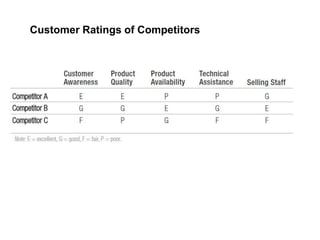
Customer Ratings of Competitors
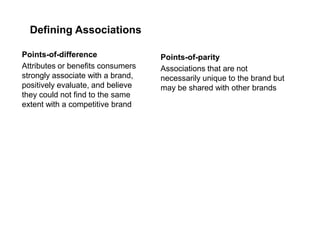
Defining Associations
Points-of-difference
Attributes or benefits consumers
strongly associate with a brand,
positively evaluate, and believe
they could not find to the same
extent with a competitive brand
Points-of-parity
Associations that are not
necessarily unique to the brand but
may be shared with other brands
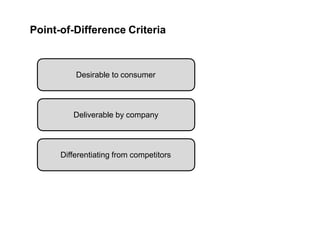
Point-of-Difference Criteria
Desirable to consumer
Deliverable by company
Differentiating from competitors
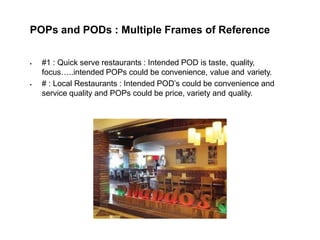
POPs and PODs : Multiple Frames of Reference
 #1 : Quick serve restaurants : Intended POD is taste, quality,
focus…..intended POPs could be convenience, value and variety.
 # : Local Restaurants : Intended POD’s could be convenience and
service quality and POPs could be price, variety and quality.
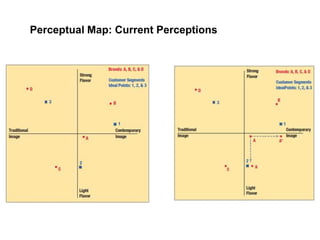
Choosing POPs and PODs : Perceptual Maps
Perceptual Map: Current Perceptions
Brand Mantras
• Articulation of heart and soul of the brand in 3-5 words phrases
• Powerful device : it states what the brand is and what it is not
Food Folks and Fun
Authentic Athletic Performance
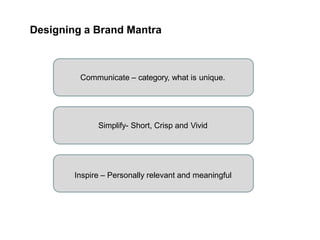
Designing a Brand Mantra
Communicate – category, what is unique.
Simplify- Short, Crisp and Vivid
Inspire – Personally relevant and meaningful
Establishing Brand Positioning
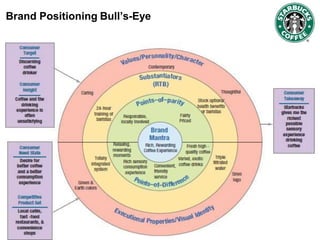
Brand Positioning Bull’s-Eye
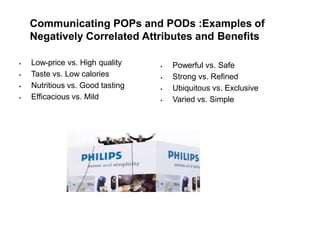
Communicating POPs and PODs :Examples of
Negatively Correlated Attributes and Benefits
 Low-price vs. High quality
 Taste vs. Low calories
 Nutritious vs. Good tasting
 Efficacious vs. Mild
 Powerful vs. Safe
 Strong vs. Refined
 Ubiquitous vs. Exclusive
 Varied vs. Simple
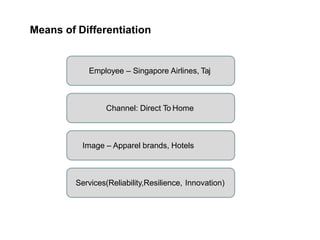
Means of Differentiation
Employee – Singapore Airlines, Taj
Channel: Direct To Home
Image – Apparel brands, Hotels
Services(Reliability,Resilience, Innovation)
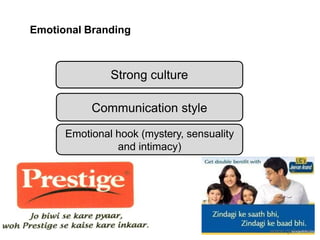
Emotional Branding
Strong culture
Communication style
Emotional hook (mystery, sensuality
and intimacy)
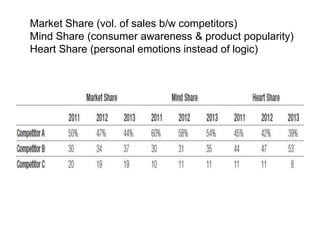
Market Share (vol. of sales b/w competitors)
Mind Share (consumer awareness & product popularity)
Heart Share (personal emotions instead of logic)

Session 1 and 2 (1) (1).pptx

  • 1.
  • 2.
    What do youthink? What do people think of marketing?
  • 3.
    The Value ofMarketing • Financial success often depends on marketing ability • Successful marketing builds demand for products and services, which, in turn, creates jobs • Marketing builds strong brands and a loyal customer base, intangible assets that contribute heavily to the value of a firm
  • 4.
    The Scope ofMarketing • Marketing is about identifying and meeting human and social needs • AMA’s formal definition: Marketing is the activity, set of institutions, and processes for creating, communicating, delivering, and exchanging offerings that have value for customers, clients, partners, and society at large. “…..marketing is both a philosophy centered on serving customers and a set of activities and skills to solve economic and social problems. Almost everyone is involved in marketing something to someone, whether it is a young man courting a young woman, a CEO trying to get a contract or a junior worker trying to get a promotion.” ( Excerpt from “ Philip Kotler : Some of my adventures in marketing”)
  • 5.
    Marketing Management • Theart and science of choosing target markets and getting, keeping, and growing customers through creating, delivering, and communicating superior customer value
  • 6.
    What is Marketed? •Goods • Services • Events • Experiences • Persons • Places • Properties • Organizations • Information • Ideas
  • 7.
    Who Markets? • Amarketer is someone who seeks a response—attention, a purchase, a vote, a donation—from another party, called the prospect Demand creation or demand stimulation??
  • 8.
    8 Demand States •Negative • Nonexistent • Latent • Declining • Irregular • Unwholesome • Full • Overfull
  • 9.
  • 10.
  • 11.
    Key Customer Markets •Consumer markets • Business markets • Global markets • Nonprofit & governmental markets
  • 12.
    Core Marketing Concepts •Needs: the basic human requirements such as for air, food, water, clothing, and shelter • Wants: specific objects that might satisfy the need • Demands: wants for specific products backed by an ability to pay
  • 13.
    Types of Needs •What customers explicitly say they want • expensive Car Stated Needs • What customers actually want • Car with low operating cost and initial price and more mileage Real Needs • What customers do not mention but is implicit • Good after sales services Unstated Needs • When customers get more than expectations • Some gifts with the car Delight Needs • Needs that customers feel reluctant to express • Customers want their friends to see them as a savvy buyers (want car for a status symbol) Secret Needs
  • 14.
    • Segmentation: dividemarket into segments (groups of customers) • Need identification • Decide bases for segmentation • Determine characteristics of each segment (persona development) • Targeting: decide on which segment(s) to focus marketing efforts based on potential and attractiveness of the segments • Select one or more segments • Positioning: create a positing which will appeal target segment(s) • Value proposition and marketing mix Core Marketing Concepts
  • 15.
    Basis of Segmentation •Geographic : region(continent, country, city), size of region, population density, climate • Demographic : age, gender, family size, income, occupation, education, religion, race, nationality • Psychographic : lifestyle, personality, activities, interests, opinions, values, attitudes • Behavioral : benefits sought, user status (daily use, occasional etc.), usage rate, buyers status and loyalty (nonuser, potential user, first time user, regular user) Core Marketing Concepts
  • 16.
    Marketing Mix (4Psfor Product and 7Ps for Banking Services ) • Product : quality, design, packaging, services, features, variants, warranties etc. • Price : pricing strategy, price list, discounts, credit, payment methods etc. • Place : trade/distribution channels, transportation, logistics, e-commerce etc. • Promotion : advertising, marketing communications, sales promotion (given by sales people), public relations (PR), branding, digital marketing etc. • (3 extra Ps for services) People - • Physical evidence - • Processes - Core Marketing Concepts
  • 17.
    Positioning (Product orBrand) • Product differentiation • Cutting through the clutter • Perceptions of the prospects • Mind share Positioning Statement • A positioning statement is an expression of how a given product, service or brand fills a particular consumer need in a way that its competitors don't. • Description of the target market and how you want the market to perceive your offering. Core Marketing Concepts
  • 18.
    • Value proposition:a set of benefits that satisfy those needs • The value or benefit that you promise to deliver to the customer • Value for a consumer = benefits sought/ cost • Offerings: a combination of products, services, information, and experiences • Brands: an offering from a known source Core Marketing Concepts
  • 19.
    • Marketing channels COMMUNICATION(messages) Newspapers, magazines, radio, TV, mail, poster, social media etc. DISTRIBUTION (sales) Distributors, retailers, wholesalers, agents etc. SERVICE (transactions) Warehouse, transportation, banks, insurance etc. Core Marketing Concepts
  • 20.
    • Paid media:TV, magazine and display ads, paid search, and sponsorships • Owned media: a company or brand brochure, web site, blog, Facebook page, or twitter account • Earned media: word of mouth, buzz, or viral marketing Core Marketing Concepts
  • 21.
    • Impressions: occurwhen consumers view a communication • Engagement: the extent of a customer’s attention and active involvement with a communication Core Marketing Concepts
  • 22.
    • Value: acombination of quality, service, and price (qsp: the customer value triad) • Satisfaction: a person’s judgment of a product’s perceived performance in relationship to expectations Core Marketing Concepts
  • 23.
    • Supply chain:a channel stretching from raw materials to components to finished products carried to final buyers RM , WIP, FG (consumed) Core Marketing Concepts
  • 24.
    • Competition: allthe actual and potential rival offerings and substitutes a buyer might consider Core Marketing Concepts
  • 25.
  • 26.
    The New MarketingRealities • Technology • Globalization • Social responsibility New consumer capabilities New company capabilities Impact on marketing
  • 27.
    BUILDING CUSTOMER VALUE,SATISFACTION AND LOYALTY
  • 28.
  • 29.
    CUSTOMER PERCEIVED VALUE Customerperceived value is the difference between the prospective customer’s evaluation of all the benefits and all the costs of an offering when compared with alternatives. How customers view a product? What value it assigns to it? Value = Benefits – Costs
  • 31.
    DETERMINANTS OF CUSTOMER PERCEIVEDVALUE Total customer benefit Product benefit Services benefit Personnel benefit Image benefit Total customer cost Monetary cost Time cost Energy cost Psychological cost
  • 32.
    Types or Sourcesof Customer Value
  • 33.
    APPLYING VALUE CONCEPTS Afirm can improve its offers in three ways: 1. By improving the economic, functional, and psychological benefits of its product, services, people, and/or image. 2. By reducing the buyer’s nonmonetary costs by lesser time, energy, and psychological investment. 3. By reducing the product’s monetary cost to the buyer.
  • 34.
    STEPS IN A CUSTOMERVALUE ANALYSIS • IDENTIFY MAJOR ATTRIBUTES AND BENEFITS THAT CUSTOMERS VALUE • ASSESS THE QUALITATIVE IMPORTANCE OF DIFFERENT ATTRIBUTES AND BENEFITS • ASSESS THE COMPANY’S AND COMPETITOR’S PERFORMANCES ON THE DIFFERENT CUSTOMER VALUES AGAINST RATED IMPORTANCE • EXAMINE RATINGS OF SPECIFIC SEGMENTS • MONITOR CUSTOMER VALUES OVER TIME
  • 35.
    HIGH CUSTOMER VALUE •The Value Proposition - Promise to customer on expected experience • Value Delivery System – Ensures that promise is kept
  • 36.
    SATISFACTION Loyalty, advocacy Perceived performanceVs Expectation This concept integrates all stakeholders • PERIODIC SURVEYS • CUSTOMER LOSS RATE • MONITOR COMPETITIVE PERFORMANCE ONLY 5% OF TOTAL 25%DISSATISFIED CUSTOMERS COMPLAIN 54% TO 75% CUSTOMERS WILL REBUY IF COMPLAINTS ARE RESOLVED DISSATISFIED CUSTOMERS GRIPES TO 11 PEOPLE.
  • 37.
  • 38.
  • 39.
  • 40.
    CLV • What thecustomer is worth • Discounted future stream of profits • Enhances shareholder value Term Value Net Profit Margin(m) 100000 Maintenance Expenses(a) 15000 Adjusted Profit Margin(m-a) 85000 Discount Rate 12% Retention rate ® 80% Margin Multiple=r/(1+d-r) 2.5 CLV = (m-a)X r/(1+d-r) 212500 Increase CLV??
  • 41.
    WHAT IS CUSTOMER RELATIONSHIPMANAGEMENT? CRM IS THE PROCESS OF CAREFULLY MANAGING DETAILED INFORMATION ABOUT INDIVIDUAL CUSTOMERS AND ALL CUSTOMER TOUCH POINTS TO MAXIMIZE CUSTOMER LOYALTY.
  • 42.
    FRAMEWORK FOR CRM •IDENTIFY PROSPECTS AND CUSTOMERS • DIFFERENTIATE CUSTOMERS BY NEEDS AND VALUE TO COMPANY • INTERACT TO IMPROVE KNOWLEDGE • CUSTOMIZE FOR EACH CUSTOMER • SALES FUNNEL AND MARKETING FUNNEL
  • 43.
    ATTRACTING AND RETAINING CUSTOMERS •REDUCE THE RATE OF DEFECTION • INCREASE LONGEVITY • ENHANCE SHARE OF WALLET • TERMINATE LOW-PROFIT CUSTOMERS • FOCUS MORE EFFORT ON HIGH-PROFIT CUSTOMERS
  • 44.
    FRAMEWORK FOR CRM •IDENTIFY PROSPECTS AND CUSTOMERS • DIFFERENTIATE CUSTOMERS BY NEEDS AND VALUE TO COMPANY • INTERACT TO IMPROVE KNOWLEDGE • CUSTOMIZE FOR EACH CUSTOMER • Sales funnel – prospect to customer to loyalist to advocacy
  • 45.
    ATTRACTING AND RETAINING CUSTOMERS •REDUCE THE RATE OF DEFECTION • INCREASE LONGEVITY • ENHANCE SHARE OF WALLET • TERMINATE LOW-PROFIT CUSTOMERS • FOCUS MORE EFFORT ON HIGH-PROFIT CUSTOMERS
  • 46.
  • 47.
  • 48.
  • 49.
    MARKETING MANAGEMENT TASKS • Developingmarket strategies and plans • Capturing marketing insights • Connecting with customers • Building strong brands
  • 50.
    MARKETING MANAGEMENT TASKS • Creatingvalue • Communicating value • Delivering value Creating successful long-term growth
  • 51.
  • 52.
    Customer Relationship Management CRM isthe process of carefully managing detailed information about individual customers and all customer touch points to maximize customer loyalty.
  • 53.
    Framework for CRM  Identifyprospects and customers  Differentiate customers by needs and value to company  Interact to improve knowledge  Customize for each customer Managing the Marketing Funnel
  • 56.
    Attracting and Retaining Customers  Reducethe rate of defection  Increase longevity  Enhance share of wallet  Terminate low-profit customers  Focus more effort on high-profit customers
  • 57.
    HOLISTIC MARKETING  Holistic marketingrefers to a marketing strategy that considers the whole of a business and all the different marketing channels as a system. Under this strategy, a business with different departments comes together in synergy in pursuit of a conscious mission, great customer experience, and a positive brand image.
  • 58.
  • 59.
    MARKETING MANAGEMENT TASKS  Developing marketstrategies and plans  Capturing marketing insights  Connecting with customers  Building strong brands
  • 60.
    The Micro andMacro Environment
  • 62.
    MACRO ENVIRONMENT FORCESAND INTERACTIONS Fad -Short lived, unpredictable without social, political or economic significance Trend- Reveals the shape of future- Online buying, online reading… Megatrend -slow to form, once in place influences for longer period
  • 63.
  • 64.
    Economic Environment Consumer Psychology-income,prices, savings, credits, expectations from future Income Distribution – very low incomes, mostly low incomes, very low-very high income, low- medium-high income and mostly medium income
  • 65.
  • 66.
    Socio-cultural Environment  Viewsof themselves  Views of others  Views of organizations  Views of society  Views of nature  Views of the universe
  • 68.
    Other Cultural Factorsin Marketing Core beliefs: hard to change ( Marriage ) Secondary beliefs: easier to change ( Environmental concerns) Existence of subcultures ( Teens )
  • 69.
    Technological Environment  • Can leadto new product development • Multiple channels to serve customers Higher efficiency & effectiveness-Lower costs  Accelerating change : Can render old products obsolete- walkmanmp3ipod  Impact of e-commerce  Impact of Social media  Innovation ( Sustainable solutions )
  • 70.
    The Political-Legal Environment BusinessLegislation -CSR Law Growth of Special Interest Groups – Consumer Forums Government Agencies –RBI,SEBI,IT,Environment etc.
  • 71.
  • 72.
  • 73.
    Product Orientation vs. MarketOrientation  Product orientation is a marketing approach whereby a company focuses on a product hence maximum effort is put on quality and optimum performance of a product. On the other hand, market orientation is a business culture that focuses on the satisfaction of the customer.
  • 74.
  • 75.
    Strategic planning andMarketing Plan  Strategic planning - Strategic planning is an organization's process of defining its strategy, or direction, and making decisions on allocating its resources to pursue this strategy. It may also extend to control mechanisms for guiding the implementation of the strategy.  A strategic plan is a document used to communicate with the organization the organizations goals, the actions needed to achieve those goals
  • 77.
    Strategic planning andMarketing Plan  A marketing plan is the advertising strategy that a business will implement to sell its product or service.  A marketing plan is a report that outlines your marketing strategy for the coming year, quarter or month.  A marketing plan is a document that lays out the marketing efforts of a business in an upcoming period, which is usually a year.
  • 78.
    Phases of ValueCreation and Delivery Assessing market opportunities and customer value Choosing the value Designing value Delivering value Communicating value Growing and sustaining value
  • 79.
    Phases of ValueCreation and Delivery
  • 80.
  • 81.
    Core Business Processes Core business processes include:  Market-sensing process  New-offering realization process  Customer acquisition process  Customer relationship management process  Fulfillment management process  Firms also need to look into the value chains of their suppliers, distributors, and customers. Coordination Cross functional Teams -Tata Nano?
  • 82.
    Core Competencies  Asource of competitive advantage  Applications in a wide variety of markets  Difficult to imitate Market sensing, customer linking and channel bonding! Vigilant Firms Walmart, IKEA, Apple, Mother Dairy
  • 83.
    Maximizing Core Competencies (Re)define the business concept  (Re)shaping the business scope  (Re)positioning the company’s brand identity (Titan, Tanisq) Business of News or Advertising or Marketing Solutions
  • 84.
    Value Exploration-Key Questions Whatvalue opportunities are available? How can we create new value offerings efficiently? How can we deliver the new offerings efficiently?
  • 85.
  • 86.
    The Strategic Planning,Implementation, and Control Processes Business as investment portfolio Assessing market and company’s position Establishing a strategy
  • 87.
  • 88.
    Marketing Plan A marketingplan is the central instrument for directing and coordinating the marketing effort. It operates at a strategic and tactical level.
  • 89.
    Levels of aMarketing Plan  Strategic  Target marketing decisions  Value proposition  Analysis of marketing opportunities  Tactical  Product features  Promotion  Merchandising  Pricing  Sales channels  Service
  • 90.
    Corporate Headquarters’ PlanningActivities  Define the corporate mission  Establish strategic business units (SBUs)  Assign resources to each SBU  Assess growth opportunities
  • 91.
    Good Mission Statements Focus on a limited number of goals  Stress major policies and values  Define major competitive spheres  Take a long-term view  Short, memorable, meaningful
  • 92.
    Characteristics of SBUs It is a single business or collection of related businesses ( LCV, HCV )  It has its own set of competitors  It has a leader responsible for strategic planning and profitability
  • 93.
    SBU Evaluation- BCGMatrix FMCG-others Infotech Shareholder value analysis Market value of the firm with or without SBU Valuation based on global expansion, re-positioning, re-targeting and strategic outsourcing Hotels,Agri Busines Cigarettes
  • 94.
    Opportunity Assessment :TheStrategic Planning Gap Product – Market Expansion Grid
  • 95.
    The Business UnitStrategic Planning Process
  • 96.
    Market Opportunity Analysis(MOA)  Can the benefits involved in the opportunity be articulated convincingly to a defined target market?  Can the target market be located and reached with cost-effective media and trade channels?  Does the company possess or have access to the critical capabilities and resources needed to deliver the customer benefits?  Can the company deliver the benefits better than any actual or potential competitors?  Will the financial rate of return meet or exceed the company’s required threshold for investment? Jinri Toutiaio ( Daily Headlines) Aggregation from4000 websites 80 million users 900million revenue 11 b valuation
  • 98.
    Goal Formulation  Unit’sobjectives must be hierarchical  Objectives should be quantitative  Goals should be realistic  Objectives must be consistent Topline growth or bottom-line growth? Market share or Reach?
  • 99.
    Porter’s Generic Strategies Overallcost leadership – Price/Distribution Differentiation – Superior performance/Customer Benefit Focus - Niche
  • 100.
    Categories of MarketingAlliances  Product or service alliance ( The Star Alliance)  Promotional alliance ( NOVA IVF/ TOI Fertile conversations Campaign)  Logistics alliances ( Allied Distributors )  Pricing collaborations ( Airlines/Hotel + Car rental ) Partnership Relations Management
  • 101.
    Program Formulation andImplementation McKinsey’s Elements of Success Strategy Structure Style Systems Shared values Staff Skills Feedback And Control Doing right things the right way! HMT’s inertia
  • 102.
    Marketing Plan Contents Executive summary  Table of contents  Situation analysis  Marketing strategy  Financial projections  Implementation controls
  • 103.
    Evaluating a MarketingPlan  Is the plan simple?  Is the plan specific?  Is the plan realistic?  Is the plan complete?
  • 104.
    PRESENTATION 4 OF24 / 104 What Is Insight? Holistic Marketing means understanding customers Source: Impact Planning Group, by permission
  • 105.
    PRESENTATION 4 OF24 / 105 Consumer Behavior Consumer behavior is the study of how individuals, groups, and organizations select, buy, use, and dispose of goods, services, ideas, or experiences to satisfy their needs and wants.
  • 106.
    PRESENTATION 4 OF24 / 106 Customer Insight Session Roadmap • Who are the customers? • What do customers need and want? • How do customers buy? • Influences on customer purchase decisions
  • 107.
    PRESENTATION 4 OF24 / 107 Who Are the Customers? A customer is any person or organization, in the channel of distribution or decision (excluding competitors), whose actions can affect the purchase of the firm’s products and services.
  • 108.
    PRESENTATION 4 OF24 / 108 Who Are the Customers? • Macro versus micro • Direct versus indirect • Roles in the purchase process • Evolution: current versus future
  • 109.
    PRESENTATION 4 OF24 / 109 Who Are the Customers? Macro versus Micro Organization Purchasing Committee Individuals Macro level Micro level Decision-making unit (DMU)
  • 110.
    PRESENTATION 4 OF24 / 110 Who Are the Customers? Direct versus Indirect Direct Customer Indirect Customer 1 Indirect Customer 2 Influencing Organizations Supplier Firm Complementary Supplier
  • 111.
    PRESENTATION 4 OF24 / 111 Who Are the Customers? Roles in the Purchase Process Customer Roles Specifier Initiator Coach Informatio n Provider Gatekeeper User Buyer Decision- Maker Influencer Major Minor Champion/ Sponsor Spoiler
  • 112.
    PRESENTATION 4 OF24 / 112 Who Are the Customers? Purchase Decision Roles: Illustration – B2B Roles Purchase Decision: Multinational firm seeks supplier for marketing training programs Initiator Head of HR Specifier Junior HR personnel who develop the program Influencer Champion/sponsor Spoiler Senior line executives Senior executives committed to Columbia Business School Two senior line executives with MBAs from Harvard and Wharton Decision-maker CEO Buyer Purchasing officer User Middle managers Gatekeeper Senior HR personnel Information provider Bricker’s – good source on executive education Coach Consultant to firm; previously Columbia faculty member
  • 113.
    PRESENTATION 4 OF24 / 113 Who Are the Customers? Purchase Decision Roles: Illustration – B2C Roles Purchase Decision: Family is deciding whether to take a cruise for the family vacation Initiator Family physician – advises family to take vacation for mother’s health Specifier Grandmother (has basic requirements that must be met) Influencer Champion/sponsor Spoiler Children Second cousin (works for cruise line) Daughter’s boyfriend – has summer job at a Caribbean resort Decision-maker Mother Buyer Father User Mother, father, children, grandparents Gatekeeper Live-in housekeeper Information provider Travel agent Coach Neighbor – takes three cruises annually
  • 114.
    PRESENTATION 4 OF24 / 114 Customer Insight Session Roadmap • Who are the customers? • What do customers need and want? • How do customers buy? • Influences on customer purchase decisions
  • 115.
    PRESENTATION 4 OF24 / 115 What Do Customers Need and Want? • Recognized versus latent • Hierarchy of needs • Attributes and features, benefits, values ladder • Types of value • Customer value issues • Customer experiences
  • 116.
    PRESENTATION 4 OF24 / 116 Maslow’s Hierarchy of Needs What Do Customers Need and Want? Self-Actualization Self-fulfillment Ego Prestige, Success, Self-Respect Social Love, Affection, Friendship, Belonging Safety & Security Protection, Order, Security Physiological Food, Drink, Air, Shelter
  • 117.
    PRESENTATION 4 OF24 / 117 Attributes and Features, Benefits, Values Ladder What Do Customers Need and Want? Values Benefits Attributes and Features Why the customer believes these benefits are important What attributes and features do for the customer Key product characteristics Influence Power Increases!
  • 118.
    PRESENTATION 4 OF24 / 118 Laddering: Illustration – Electric Drill What Do Customers Need and Want? Value Benefit C Benefit B Benefit A Features Homeowner is respected by family Homeowner feels competent Supports do-it-yourself activity Makes holes easily Color, drill speed, bit hardness, drill bit gauge, drill weight, etc.
  • 119.
    PRESENTATION 4 OF24 / 119 Laddering: Illustration – Nivea Skin Cream What Do Customers Need and Want? Value Benefit C Benefit B Benefit A Features “I have more self-respect “I am more confident socially” “I feel young and beautiful” Soft skin Contains moisturizer
  • 120.
    PRESENTATION 4 OF24 / 120 Psychological Types of Value Functional Economic
  • 121.
    PRESENTATION 4 OF24 / 121 Customer Insight Session Roadmap • Who are the customers? • What do customers need and want? • How do customers buy? • Influences on customer purchase decisions
  • 122.
    PRESENTATION 4 OF24 / 122 How Do Customers Buy? • Purchase decision process • Purchase decision categories
  • 123.
    PRESENTATION 4 OF24 / 123 Purchase Decision Process How Do Customers Buy? Recognize Problems Acquire Information Evaluate Alternatives Make a Choice Post-Purchase Processes
  • 124.
    PRESENTATION 4 OF24 / 124 Recognize Problems
  • 125.
    PRESENTATION 4 OF24 / 125 Sources of Information Commercial Personal Public Experiential
  • 126.
    PRESENTATION 4 OF24 / 126 Acquire Information: Awareness Set Illustration – Soft Drink How Do Customers Buy? Awareness Set Mountain Dew Coke Pepsi Diet Pepsi Root Beer Ginger Ale Diet Ginger Al Limca Snapple Sprite 7-Up Diet 7-Up Maaza Fanta Thums Up Frooti Dr Pepper Rasna Apple Fizz Caffeine-free Coke
  • 127.
    PRESENTATION 4 OF24 / 127 Evaluate Alternatives: Consideration Set Illustration – Soft Drink How Do Customers Buy? Consideration Set Coke Frooti Sprite Apple Fizz Maaza
  • 128.
    PRESENTATION 4 OF24 / 128 Figure : Successive Sets in Decision Making
  • 129.
    PRESENTATION 4 OF24 / 129 Table : A Consumer’s Brand Beliefs about Laptop Computers (Expectancy-value model of attitude formation in decision making)
  • 130.
    PRESENTATION 4 OF24 / 130 Make a Choice • Rational approaches • linear compensatory • lexicographic • Less than fully rational approaches How Do Customers Buy?
  • 131.
    PRESENTATION 4 OF24 / 131 Make a Choice: Linear Compensatory Set Illustration – London–Mumbai Airline Trip How Do Customers Buy? Features/attributes Relative importance A (1–100) Air India (AI) British Airways (BA) United Airlines (UA) Belief B (1–10) A x B Belief B (1–10) A x B Belief B (1–10) A x B Frequent-flyer program 30 9 270 2 60 8 240 Price 20 6 120 6 120 6 120 Schedule 20 8 160 5 100 6 120 Service level 20 5 100 7 140 9 180 Upgrade probability 10 2 20 3 30 7 70 Total 100 670 450 730
  • 132.
    PRESENTATION 4 OF24 / 132 Make a Choice: Lexicographic Illustration – London–Mumbai Airline Trip How Do Customers Buy? Features/attributes Relative importance A (1–100) Air India (AI) British Airways (BA) United Airlines (UA) (1–10) (1–10) (1–10) Frequent-flyer program 30 9 2 8 Price 20 6 6 6 Schedule 20 8 5 6 Service level 20 5 7 9 Upgrade probability 10 2 3 7 Total 100
  • 133.
    PRESENTATION 4 OF24 / 133 Conjunctive heuristic (minimum acceptable cut-off for each attribute)
  • 134.
    PRESENTATION 4 OF24 / 134 Figure: Steps Between Alternative Evaluation and Purchase
  • 135.
    PRESENTATION 4 OF24 / 135 Perceived Risk • Functional • Physical • Financial • Social • Psychological • Time
  • 136.
    PRESENTATION 4 OF24 / 136 Make a Choice: Illustration of Less Than Fully Rational Behavior You are in a store about to buy a Rs 600 book. Your friend walks by and says you can buy the same book two blocks away for Rs 450. Question: Would you walk two blocks to save Rs 150? You are in a store about to buy a home-entertainment system for Rs 8,000. Your friend walks by and says you can buy the same system two blocks away for Rs7,850. Question: Would you walk two blocks to save Rs150? How Do Customers Buy?
  • 137.
    PRESENTATION 4 OF24 / 137 How Do Customers Buy? Make a Choice You are about to buy a soft drink. You have 2 choices. small – Rs 20 large – Rs 30 Which will you choose? You are about to buy a soft drink. You have 3 choices. small – Rs 20 large – Rs 30 very large – Rs 38 Which will you choose?
  • 138.
    PRESENTATION 4 OF24 / 138 How Do Customers Buy? Post-Purchase Processes Use Use experience Dissonance reduction Communications with customers/potential customers Comparison with others Product and packaging disposal Repurchase Important Post- Purchase Issues
  • 139.
    PRESENTATION 4 OF24 / 139 Figure: How Customers Use or Dispose of Products Source: Jacob Jacoby, et al., “What about Disposition?” Journal of Marketing (July 1977), p. 23. Reprinted with permission from the Journal of Marketing, published by the American Marketing Association.
  • 140.
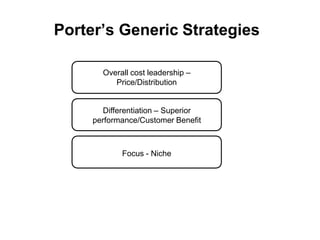
    PRESENTATION 4 OF24 / 140 Purchase Decision Process: Illustration – DVD Player How Do Customers Buy? Decision Process Stage Customer Action and Cognitions Recognizing problems Sees advertisement: “That looks cool and I don’t have one.” Acquiring information Demonstration in store: “What is this thing?” “What does it do?” “What is the price?” “Where can I get one?” Evaluating alternatives Examine various options: “Is Sony better than Toshiba and Phillips?” Making a choice “I am going to buy Sony” Post-purchase processes “How do I hook this up?” “Where do I get service?”
  • 141.
    PRESENTATION 4 OF24 / 141 How Do Customers Buy? • Purchase decision process • Purchase decision categories
  • 142.
    PRESENTATION 4 OF24 / 142 Purchase Decision Categories • Routinized-response behavior – straight rebuy • established alternatives and criteria, minimal uncertainty • Limited problem solving – modified rebuy • novel alternative(s), well-developed criteria, performance unknown • Extended problem solving – new buy • novel alternative(s), poorly developed criteria, great uncertainty How Do Customers Buy?
  • 143.
    PRESENTATION 4 OF24 / 143 Purchase Decision Categories: Implications • DMU varies by type of purchase • Purchase categories depend on the customer, NOT on the product • Potential suppliers should consider shifting decision-making from simple to complex How Do Customers Buy?
  • 144.
    PRESENTATION 4 OF24 / 144 Customer Insight Session Roadmap • Who are the customers? • What do customers need and want? • How do customers buy? • Influences on customer purchase decisions
  • 145.
    PRESENTATION 4 OF24 / 145 What Influences Consumer Behavior? Cultural Factors Social Factors Personal Factors
  • 146.
    PRESENTATION 4 OF24 / 146 What Is Culture? Culture is the fundamental determinant of a person’s wants and behaviors acquired through socialization processes with family and other key institutions.
  • 147.
    PRESENTATION 4 OF24 / 147 Subcultures • Nationalities • Religions • Racial groups • Geographic regions
  • 148.
    PRESENTATION 4 OF24 / 148 Social Classes A1 A2 B1 B2 C D E1 E2
  • 149.
    PRESENTATION 4 OF24 / 149 Social Factors Reference groups Family Social roles Statuses
  • 150.
    PRESENTATION 4 OF24 / 150 Reference Groups • Membership groups • Primary groups • Secondary groups • Aspirational groups • Disassociative groups
  • 151.
    PRESENTATION 4 OF24 / 151 Family  Family of orientation: parents and siblings  Family of procreation: spouse and children
  • 152.
    PRESENTATION 4 OF24 / 152 Personal Factors • Age • Life cycle stage • Occupation • Wealth • Personality • Values • Lifestyle • Self-concept
  • 153.
    PRESENTATION 4 OF24 / 153 Age and Stage of Lifecycle
  • 154.
    PRESENTATION 4 OF24 / 154 Occupation and Economic Circumstances Marketers try to identify the occupational groups that have above-average interest in their products and services. Product and brand choice are also affected by economic circumstances—spendable income, savings and assets, debts, borrowing power, and attitudes toward spending and saving—to a great extent.
  • 155.
    PRESENTATION 4 OF24 / 155 Personality Personality refers to a set of distinguishing human psychological traits that lead to relatively consistent and enduring responses to environmental stimuli. Personality can be a useful variable in analyzing consumer brand choices.
  • 156.
    PRESENTATION 4 OF24 / 156 Brand Personality • Sincerity • Excitement • Competence • Sophistication • Ruggedness
  • 157.
    PRESENTATION 4 OF24 / 157 Lifestyle and Values
  • 158.
    PRESENTATION 4 OF24 / 158 Figure : Model of Consumer Behavior
  • 159.
    PRESENTATION 4 OF24 / 159 Motivation Freud’s Theory Behavior is guided by subconscious Motivations (laddering. Projective techniques) Maslow’s Hierarchy of Needs Behavior is driven by lowest, unmet need Herzberg’s Two-Factor Theory Behavior is guided by motivating and hygiene factors
  • 160.
    PRESENTATION 4 OF24 / 160 Perception • Selective attention • Selective retention • Selective distortion • Subliminal perception
  • 161.
    PRESENTATION 4 OF24 / 161 Learning (drives, stimuli, cues, responses, and reinforcement)  Drive: A strong internal stimulus impelling action  Cue: Minor stimuli that determine when, where, and how a person responds  Discrimination:. (A countertendency to generalization) Learning to recognize differences in sets of similar stimuli and adjusting our responses accordingly
  • 162.
    PRESENTATION 4 OF24 / 162 Emotions
  • 163.
    PRESENTATION 4 OF24 / 163 Memory • Short term memory (limited repository of information) • Long term memory (a more permanent, essentially unlimited repository) Any type of information can be stored in the memory network, including verbal, visual, abstract etc Consumer brand knowledge looked as a node in memory with a variety of linked associations.
  • 164.
    PRESENTATION 4 OF24 / 164 Figure : Hypothetical LIC Mental Map
  • 165.
    PRESENTATION 4 OF24 / 165 High/Low-Involvement Decision Making • Elaboration Likelihood Model –Central Route –Peripheral route
  • 166.
    PRESENTATION 4 OF24 / 166 Influences on Customer Purchase Decisions Consumer Decisions – B2C Organizational Decisions – B2B
  • 167.
    PRESENTATION 4 OF24 / 167 Questions • What is the business market, and how does it differ from the consumer market? • What buying situations do organizational buyers face? • Who participates in the business-to- business buying process?
  • 168.
    PRESENTATION 4 OF24 / 168 Questions • How do business buyers make their decisions? • How can companies build strong relationships with business customers? • How do institutional buyers and government agencies do their buying?
  • 169.
    PRESENTATION 4 OF24 / 169 What Is Organizational Buying? Organizational buying refers to the decision-making process by which formal organizations establish the need for purchased products and services, and identify, evaluate, and choose among alternative brands and suppliers.
  • 170.
    PRESENTATION 4 OF24 / 170 Top Marketing Challenges • Understanding customer needs in new ways; • Identifying new opportunities for growth; • Improving value management techniques • Calculating better marketing performance and accountability metrics; • Competing and growing in global markets • Countering the threat of product and service commoditization
  • 171.
    PRESENTATION 4 OF24 / 171 Characteristics of Business Markets • Fewer buyers • Close supplier- customer relationships • Professional purchasing • Many buying influences • Multiple sales calls • Derived demand • Inelastic demand • Fluctuating demand • Direct purchasing
  • 172.
    PRESENTATION 4 OF24 / 172 Buying Situation Straight Rebuy Modified Rebuy New Task
  • 173.
    PRESENTATION 4 OF24 / 173 Systems Buying and Selling
  • 174.
    PRESENTATION 4 OF24 / 174 The Buying Center • Initiators • Users • Influencers • Deciders • Approvers • Buyers • Gatekeepers
  • 175.
    PRESENTATION 4 OF24 / 175 Who Are the Customers? Purchase Decision Roles: Illustration – B2B Roles Purchase Decision: Multinational firm seeks supplier for marketing training programs Initiator Head of HR Specifier Junior HR personnel who develop the program Influencer Champion/sponsor Spoiler Senior line executives Senior executives committed to Columbia Business School Two senior line executives with MBAs from Harvard and Wharton Decision-maker CEO Buyer Purchasing officer User Middle managers Gatekeeper Senior HR personnel Information provider Bricker’s – good source on executive education Coach Consultant to firm; previously Columbia faculty member
  • 176.
    PRESENTATION 4 OF24 / 176 Of Concern to Marketers • Who are the major decision participants? • What decisions do they influence? • What is their level of influence? • What evaluation criteria do they use?
  • 177.
    PRESENTATION 4 OF24 / 177 Stages in the Buying Process: Buyphases • Problem recognition • General need description • Product specification • Supplier search (traditional/online)-Supplier’s task- Lead generation • Proposal solicitation • Supplier selection • Order-routine specification (listing of technical specifications, expected time of delivery, return policies, warranties etc) • Performance review
  • 178.
    PRESENTATION 4 OF24 / 178 Table:Buygrid Framework
  • 179.
    PRESENTATION 4 OF24 / 179 Supplier search online Forms of Electronic Marketplaces • Catalog sites • Vertical markets • Pure play auction sites • Spot markets • Private exchanges • Barter markets • Buying alliances
  • 180.
    PRESENTATION 4 OF24 / 180 Table : An Example of Vendor Analysis
  • 181.
    PRESENTATION 4 OF24 / 181 Methods for Researching Customer Value • Internal engineering assessment • Field value-in-use assessment • Focus-group value assessment • Direct survey questions • Conjoint analysis • Benchmarks • Compositional approach • Importance ratings
  • 182.
    PRESENTATION 4 OF24 / 182 Categories of Buyer-Seller Relationships • Basic buying and selling • Bare bones • Contractual transaction • Customer supply • Cooperative systems • Collaborative • Mutually adaptive • Customer is king
  • 183.
    PRESENTATION 4 OF24 / 183 Institutional Markets The institutional market consists of schools, college and university hostels, hospitals and nursing homes, and other institutions that provide goods and services to people in their care. Many of these organizations are characterized by low budgets and captive clienteles.
  • 184.
  • 185.
  • 186.
     Potential market(Interestin the market offering)  Available market( interest, income and access to an offer)  Target market ( Part of the available market )  Penetrated market ( Set of consumers for a company’s product ) Market Break Down
  • 187.
    A Vocabulary forDemand Measurement Market Demand Market Forecast Market Potential Company Demand Company Sales Forecast Company Sales Potential
  • 188.
    Estimating Current Demand:Total Market Potential Calculations  Multiply potential number of buyers by average quantity each purchases times price  Chain-ratio method
  • 189.
    Estimating Future Demand Forecasts: What people say, what people do, what people have done.  Survey of Buyers’ Intentions – market research  Composite of Sales Force Opinions  Expert Opinion – delphi method  Trend projection (past sales analysis)  Statistical demand analysis/Econometric – impact of causal factors- price, marketing expenditure, income levels (past sales analysis)
  • 190.
  • 191.
    Marketing Research for DecisionMaking Marketing research is the systematic design, collection, analysis, and reporting of data and findings relevant to a specific marketing situation facing the company. The systematic collection and objective recording, classification, analysis and presentation of data concerning the behavior, needs, attitudes, opinions, motivation etc. for individuals and organizations within the context of their economic, social, political and everyday activities.
  • 192.
    Commissioning MarketingResearch  Inhouse activity  Research Agencies – Cost effective  Mix ( Only Field and Tab) The Research Brief : Background summary Problem definition ( Business decision ) Research questions ( Information needed to take business decision) Scope of research ( What to cover, deadlines) Tendering Procedure ( How to pitch )
  • 193.
  • 194.
    Define the Problem Define the problem  State research objectives Sales at the New store has not met co expectations, possibly due to emergence of a new competitor RQ : What are the reasons for sales not meeting co expectations? Has customer’s disposable income gone down? Is the new competitor taking awaycustomers? Are customers bored of the product range availability in the store? Are customers moving to online buying? Was the management expectation based on overestimated market potential?
  • 195.
    Step 2: Developthe Research Plan  Data sources – Primary data and secondary data ( Field vs Desk research)  Research approach ( Exploratory, Descriptive and Causal Research )  Research instruments  Sampling plan  Contact methods
  • 196.
    Research Approaches  Observationaland ethnographic ( Bank of America – Women at home study – Keep the change program )  Focus group  Survey  Experimental research ( Shopping behavior at different levels of available cash)
  • 197.
    Research Instruments  Questionnaires(Dichotomous, Multiple choice, Likert scale, Rating scale, Intention-to buy scale etc.)  Qualitative Measures( Word associations, Projective techniques, open ended questions, Brand personification etc)  Technological Devices ( Galvanometers, Tachistoscope, Eye Cameras)
  • 198.
    Sampling Plan  Samplingunit: Who is to be surveyed?  Sample size: How many people should be surveyed?  Sampling procedure: How should the respondents be chosen?
  • 199.
    Contact Methods  Mailcontacts  Telephone contacts  Personal contacts  Online contacts
  • 200.
    Ethical Issues inMarketing Research  Participation – voluntary  Confidentiality  Objective and fair – Competition  Data Collection Methods  Adequacy of research scope
  • 201.
  • 202.
    A market segmentconsists of a group of customers who share a similar set of needs and wants.
  • 203.
  • 204.
    Geographic Segmentation Geographic segmentationdivides the market into geographical units such as nations, states, regions, counties, cities, or neighbourhoods. The company can operate in one or a few areas, or it can operate in all but pay attention to local variations.
  • 205.
    Demographic Segmentation  Ageand life cycle  Life stage  Gender  Income  Generation  Social-Economic classification
  • 206.
    Psychographic Segmentation • Studyof psychology and demographics • Different groups based on psychological/personality traits • Consumers in the same demographic group can exhibit different psychographic profiles
  • 207.
    Psychographic Segmentation and TheVALS Framework(strategicbusinessinsights.com) Innovators : Successful, ‘take- charge’ people with high self- esteem Thinkers : Mature reflective. Durability, functionality, value are important Achievers : Successful. Prefer premium products Experiencers : Seek variety and excitement Believers: Conservative people with concrete beliefs Strivers : Trendy but resource constrained Makers : Down-to-earth, self- sufficient people Survivors : Elderly people loyal to their favorite brands
  • 209.
    Behavioral Segmentation Based onattitude towards products, use of products and response to products  Needs and Benefits  Decision Roles  User and Usage
  • 210.
    Behavioral Segmentation Basedon Needs and Benefits • Consumers buying a particular product need not have same needs and same perceived benefits from the product • E.g. Shampoo variants satisfy different needs, Soap variants, Car variants etc. • Marketers use this approach to identify distinct segments.
  • 211.
    Behavioral Segmentation: DecisionRoles Initiator Influencer Decider Buyer User Communication strategy
  • 212.
    Behavioral Segmentation: Userand Usage  Occasions ( Festivals, Seasons such as marriage, Vacations etc)  User Status ( Non users, Potential Users, ex users, existing users etc)  Usage Rate ( Low, moderate, high : talktime, Internet usage, restaurant/bars etc)  Attitude – Enthusiastic, positive, indifferent, negative and hostile  Buyer-Readiness  Loyalty Status
  • 213.
    Example of aBrand Funnel
  • 214.
    Loyalty Status  Hard-core– insights on brand strengths  Split loyals – competitors close to the brand  Shifting loyals – weakness in the marketing program  Switchers Brand loyalty must be considered with other factors such as habit, indifference, low price, high switching cost, unavailability of other brands.
  • 215.
  • 216.
    Segmenting for BusinessMarkets  Demographic- Industry, company size, location  Operating variable –Technology, User/Non-user, Customer capabilities  Purchasing approaches – purchase organization, Power structure, existing relationship, Purchasing policies, Purchasing criteria  Situational factors- Urgency, specific application, size of order  Personal characteristics- Buyer seller similarities, Attitude towards risk, Loyalty
  • 217.
    Steps in SegmentationProcess  Need-based segmentation – similar needs and benefits  Segment identification – define the demographics, lifestyle and behavior  Segment attractiveness – Market growth, competitive intensity, market access  Segment profitability- Profits  Segment positioning- value proposition/product-price positioning  Market mix strategy – expand positioning strategy to include elements of marketing mix.
  • 218.
  • 219.
    Possible Levels ofSegmentation
  • 220.
  • 223.
    Positioning • Its anact of designing company’s offering and image to occupy a distinct place in the minds of target market. • A good positioning clarifies the brand essence by identifying the goals that it can help consumer’s achieve.( and in a unique way ) • Good positioning is a result of right balancing of ‘ what the brand is’ and what the brand could be’.
  • 224.
  • 225.
    Positioning Essentials  Determinea frame of reference ( Identify target market and relevant competition)  Optimal points of parity and points of difference – in brand associations  Creating Brand essence, also known as a brand mantra - a short statement that expresses the core of what that brand represents or the image it seeks to project. A brand essence statement is often just two to three words.
  • 226.
    Competitive Frame ofReference Identifying Competitors Analyzing Competitors ( SWOT )
  • 227.
  • 228.
    Defining Associations Points-of-difference Attributes orbenefits consumers strongly associate with a brand, positively evaluate, and believe they could not find to the same extent with a competitive brand Points-of-parity Associations that are not necessarily unique to the brand but may be shared with other brands
  • 229.
    Point-of-Difference Criteria Desirable toconsumer Deliverable by company Differentiating from competitors
  • 230.
    POPs and PODs: Multiple Frames of Reference  #1 : Quick serve restaurants : Intended POD is taste, quality, focus…..intended POPs could be convenience, value and variety.  # : Local Restaurants : Intended POD’s could be convenience and service quality and POPs could be price, variety and quality.
  • 231.
    Choosing POPs andPODs : Perceptual Maps
  • 232.
  • 233.
    Brand Mantras • Articulationof heart and soul of the brand in 3-5 words phrases • Powerful device : it states what the brand is and what it is not Food Folks and Fun Authentic Athletic Performance
  • 234.
    Designing a BrandMantra Communicate – category, what is unique. Simplify- Short, Crisp and Vivid Inspire – Personally relevant and meaningful
  • 235.
  • 236.
  • 237.
    Communicating POPs andPODs :Examples of Negatively Correlated Attributes and Benefits  Low-price vs. High quality  Taste vs. Low calories  Nutritious vs. Good tasting  Efficacious vs. Mild  Powerful vs. Safe  Strong vs. Refined  Ubiquitous vs. Exclusive  Varied vs. Simple
  • 238.
    Means of Differentiation Employee– Singapore Airlines, Taj Channel: Direct To Home Image – Apparel brands, Hotels Services(Reliability,Resilience, Innovation)
  • 239.
    Emotional Branding Strong culture Communicationstyle Emotional hook (mystery, sensuality and intimacy)
  • 240.
    Market Share (vol.of sales b/w competitors) Mind Share (consumer awareness & product popularity) Heart Share (personal emotions instead of logic)