





Relationships
& Impacts of
Service quality,
perceived value,
customer satisfaction,
and image
An Empirical Study
Presenter: Sharon Chang Instructor: Dr. Pi-Ying Hsu Date: May 20, 20131
Citation
Hu, H.-H., Kandampully, J., Juwaheer, T. D. (2009).
Relationships and impacts of service quality,
perceived value, customer satisfaction, and image:
An empirical study. The Service Industries Journal,
29(2), 111-125.
2
Introduction
Literature Review
Methodology
Result & Conclusion
Reflection
3
Introduction
4
Introduction
Background
Given the global nature of the
market, competing firms are constantly
seeking to project their firms’ superior
quality of service, customer-perceived
value, and image in order to gain customer
loyalty.
5
Introduction
Purpose
This empirical study seeks to understand
the relationships that exist between
service quality and perceived value and
how they impact customer
satisfaction, corporate image, and
behavioural intentions.
6
Literature
Review
7
H1: Perceived quality has positive impacts on
behavioural intentions.
Literature Review
The positive relationships between service quality and
repurchase intentions and willingness to recommend.
(Boulding & Karla & Staelin & Zeithaml, 1993)
8
Literature Review
Service quality is an important driver of perceived
customer value.
(Cronin et al., 2000; Parasuraman & Grewal, 2000)
H2: Service quality has positive impacts on
perceived value.
9
Literature Review
Perceived value contributes directly to customer
satisfaction which, in turn, leads to future intentions.
(McDougall & Levesque, 2000)
H3: Perceived value has positive impacts on
behavioural intentions.
10
Customer satisfaction is a post-consumption experience
which compares perceived quality with expected
quality, whereas service quality refers to a global
evaluation of a firm’s service delivery system.
(Anderson & Fornell, 1994)
H4: Service quality has positive impacts on
customer satisfaction.
Literature Review
11
Literature Review
Service quality and satisfaction are distinct constructs,
and there is a causal relationship between the two,
and that perceptions of service quality affect feelings
of satisfaction which, in turn, influence future
purchase behaviour.
(Hurley & Estelami, 1998)
H5: Perceived value has positive impacts on
customer satisfaction.
12
Literature Review
Corporate image is built mainly by technical quality
what the customer receives from the service experience,
and functional quality: the manner in which the service
is delivered.
(CrÖnroos, 1984)
H6: Service quality has positive impacts on
corporate image.
13
Literature Review
A company will have a strong image if customers believe
that they are getting high value when they buy from it.
(Barich and Lotler, 1991)
H7: Perceived value has positive impacts on
corporate image.
14
Literature Review
H8: Customer satisfaction has positive impacts
on corporate image.
Satisfaction levels derived from each service encounter
are viewed as having an effect on image assessments.
(Nguyen &
LeBlanc, 1998)
15
Literature Review
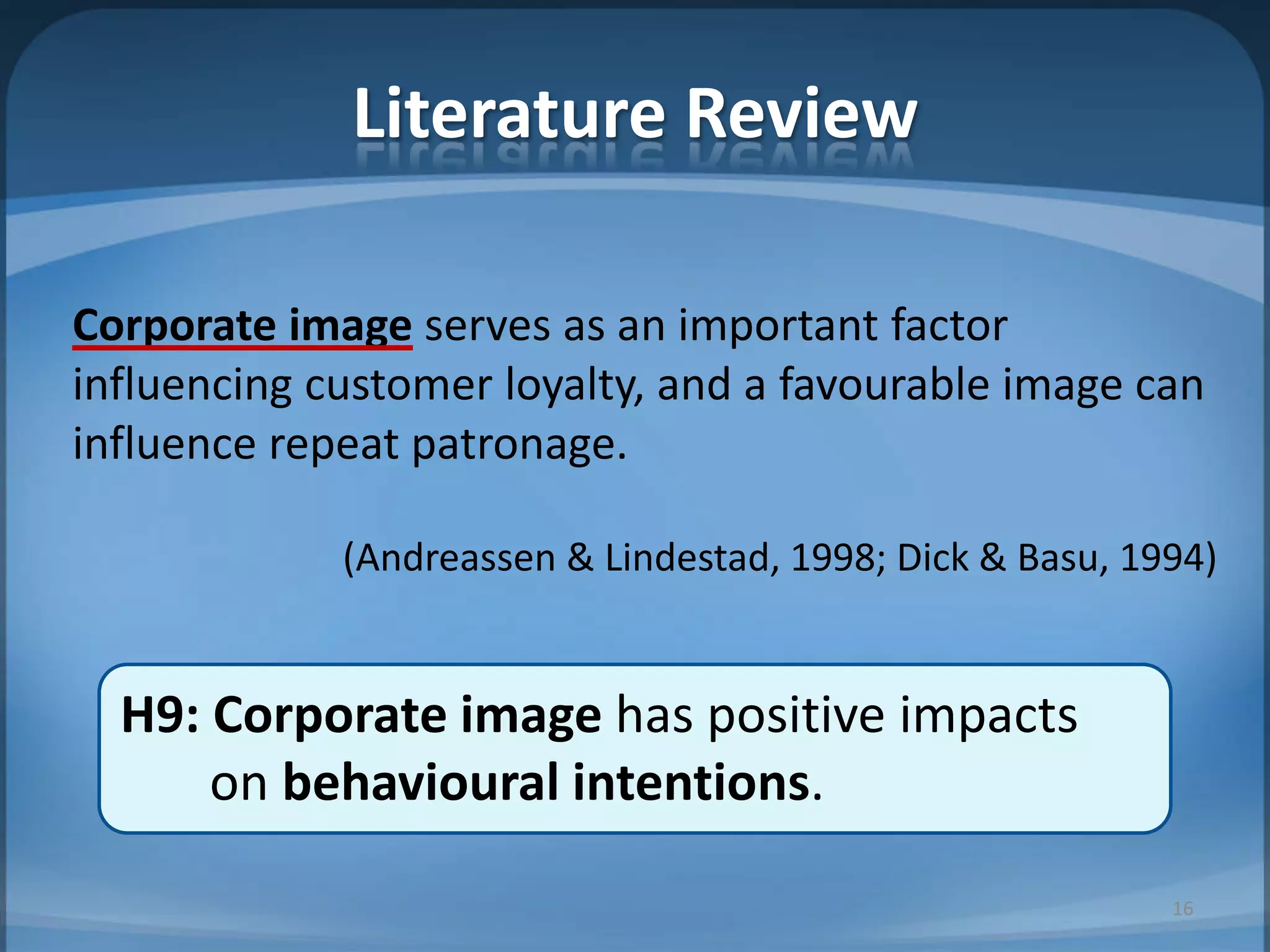
Corporate image serves as an important factor
influencing customer loyalty, and a favourable image can
influence repeat patronage.
(Andreassen & Lindestad, 1998; Dick & Basu, 1994)
H9: Corporate image has positive impacts
on behavioural intentions.
16
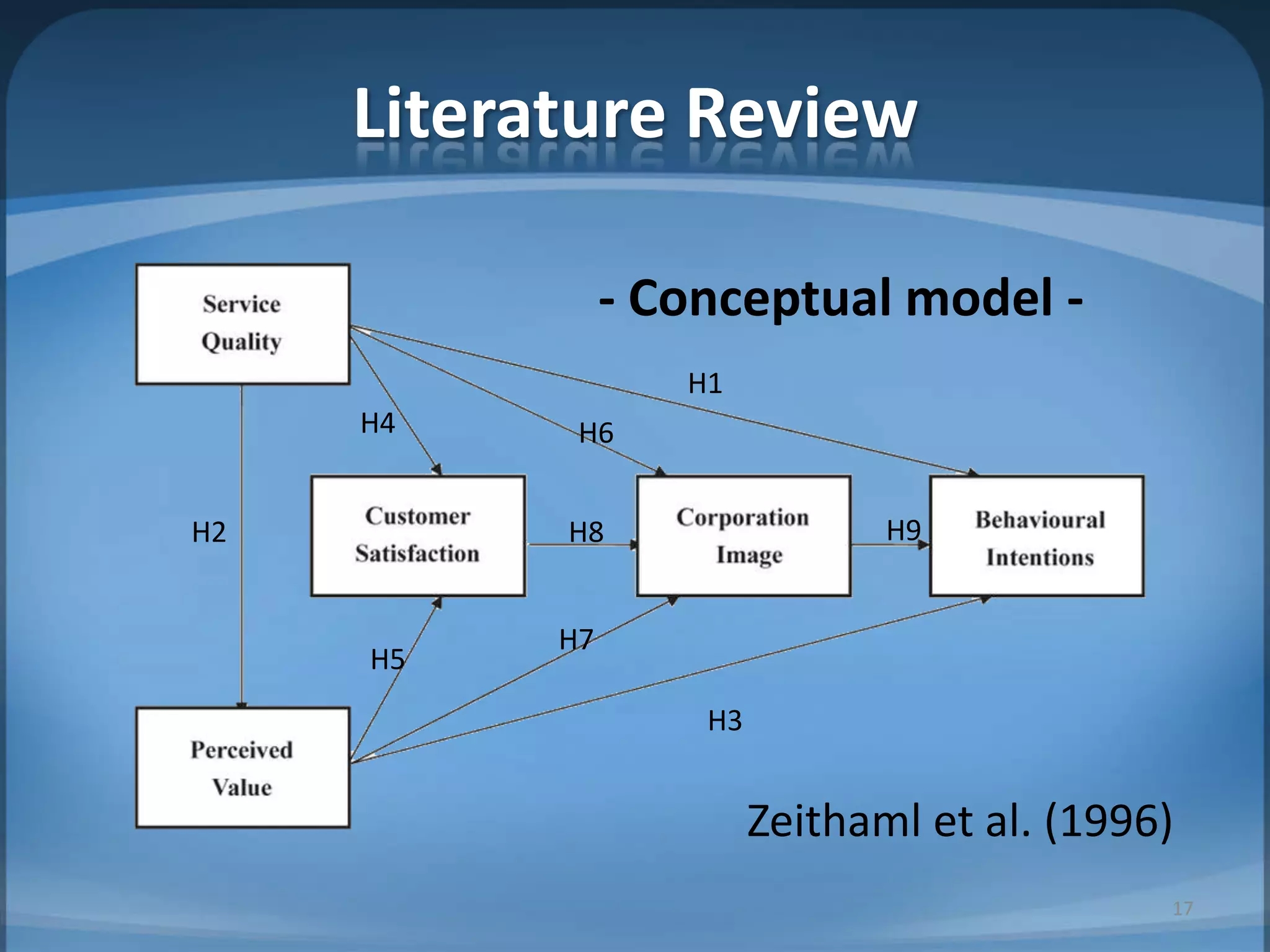
Literature Review
Zeithaml et al. (1996)
H1
H2
H3
H4
H5
H6
H7
H8 H9
- Conceptual model -
17
Methodology
18
Methodology
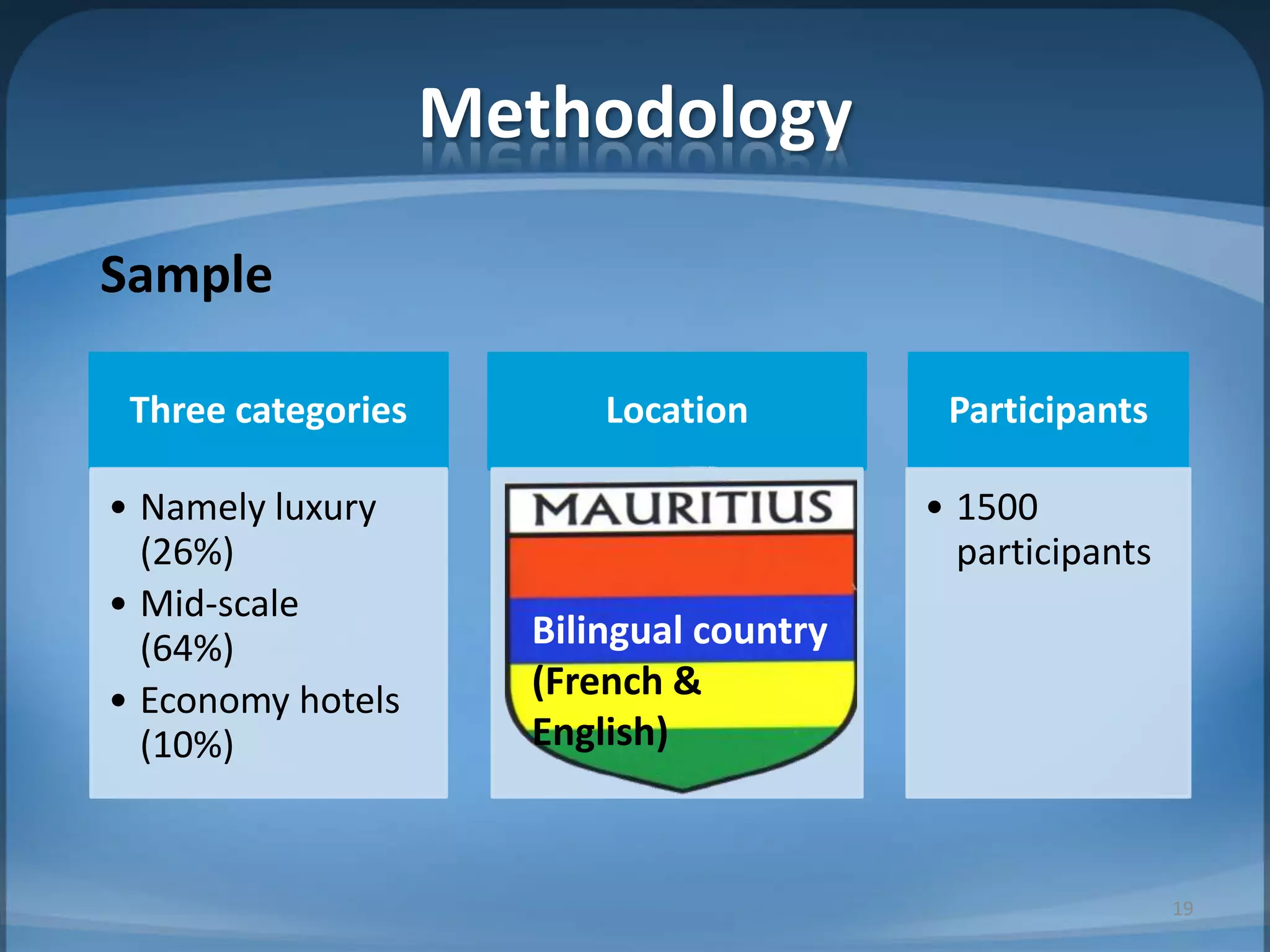
Sample
Three categories
• Namely luxury
(26%)
• Mid-scale
(64%)
• Economy hotels
(10%)
Location
•
Participants
• 1500
participants
Bilingual country
(French &
English)
19
Methodology
1 2 3 4 5 6 7
Completely
disagree
Disagree
Disagree
somewhat
Undecided
Agree
somewhat
Agree
Completely
agree
- Instrument -
Service quality –
Multiple-item scale of SERVQUAL from Parasuraman et al.
(1988)
20
Methodology
Perceived value –
Three items were adapted from Cronin et al. (2000)
1 2 3 4 5 6 7
Strongly
disagree
Disagree
Disagree
somewhat
Undecided
Agree
somewhat
Agree
Strongly
agree
21
Methodology
Customer satisfaction -
1 2 3 4 5 6 7
Very
dissatisfied
Dissatisfied
Dissatisfied
somewhat
Undecided
Satisfied
somewhat
Satisfied
Very
satisfied
Corporate image -
Two dimensions: image attributes and image holistic
1 2 3 4 5 6 7
Strongly
disagree
Disagree
Disagree
somewhat
Undecided
Agree
somewhat
Agree
Strongly
agree
22
Methodology
1 2 3 4 5 6 7
Not all
likely
Not
likely
Not likely
somewhat
Undecided
likely
somewhat
likely
Extremely
likely
Behavioural intentions –
Three categories: repurchase intentions,
willingness to recommend, and price sensitivity.
23
Methodology
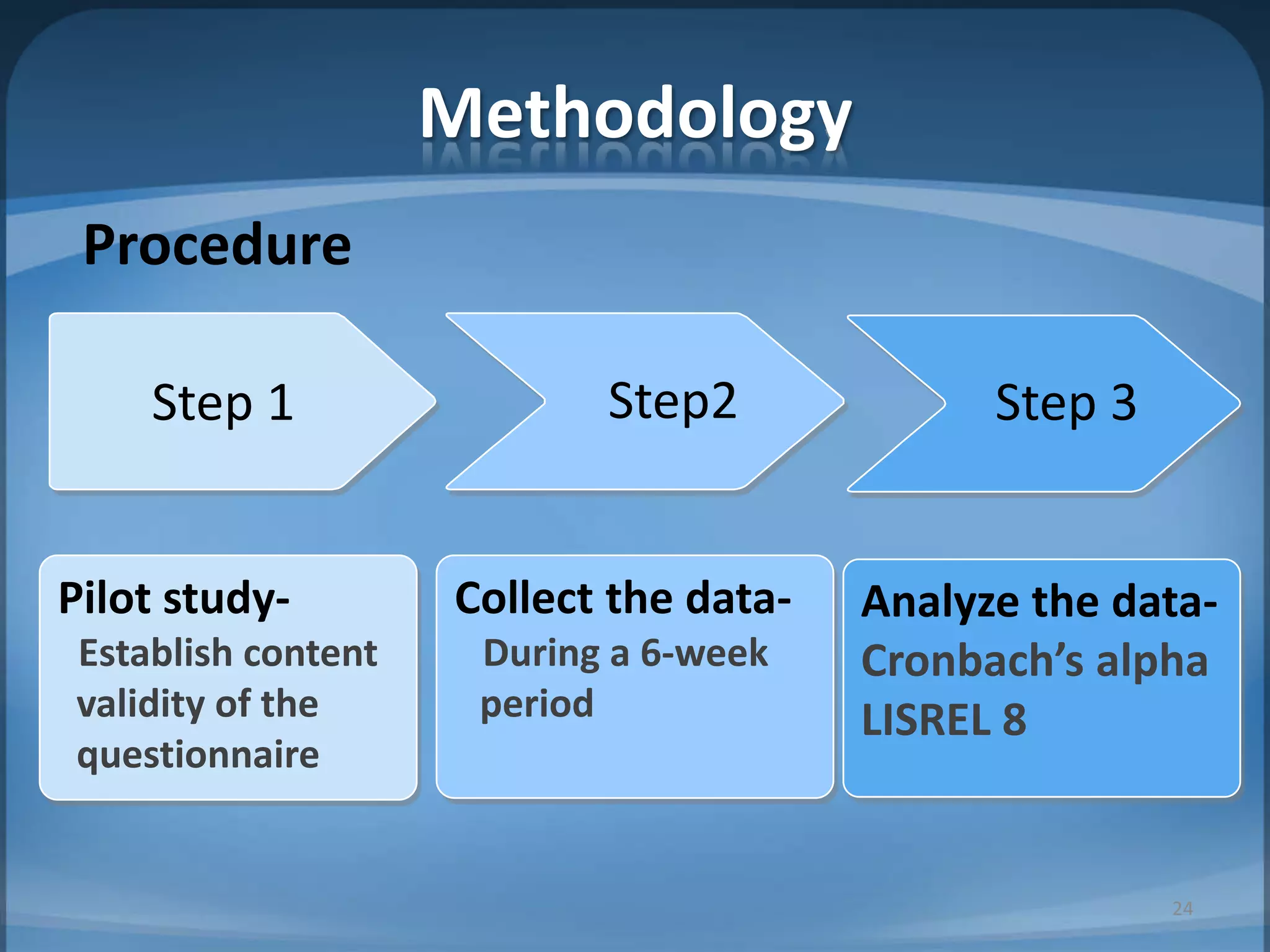
Pilot study-
Establish content
validity of the
questionnaire
Collect the data-
During a 6-week
period
Analyze the data-
Cronbach’s alpha
LISREL 8
Step2Step 1 Step 3
Procedure
24
Result &
Conclusion
25
Result
26
Result
27
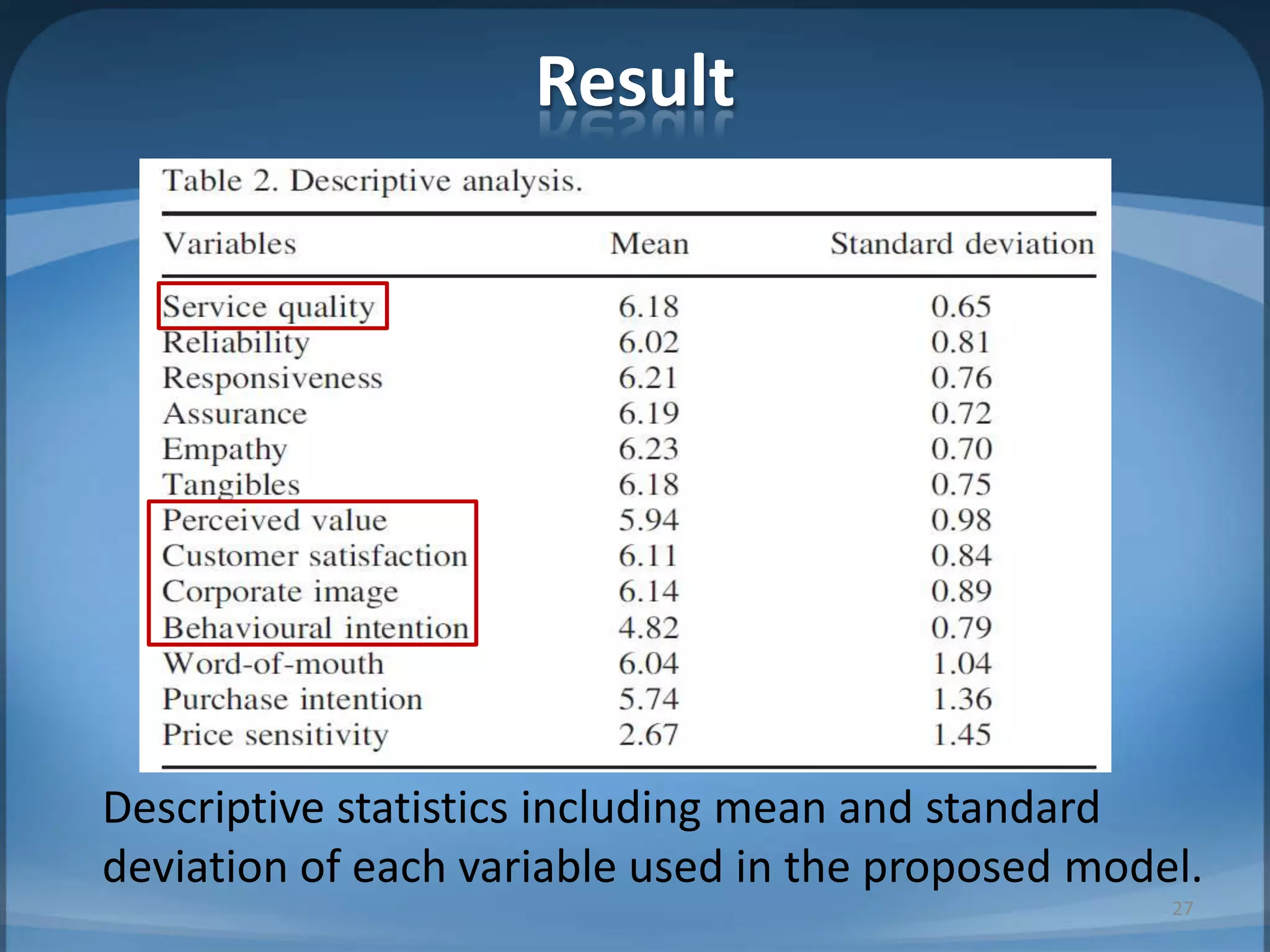
Descriptive statistics including mean and standard
deviation of each variable used in the proposed model.
Result
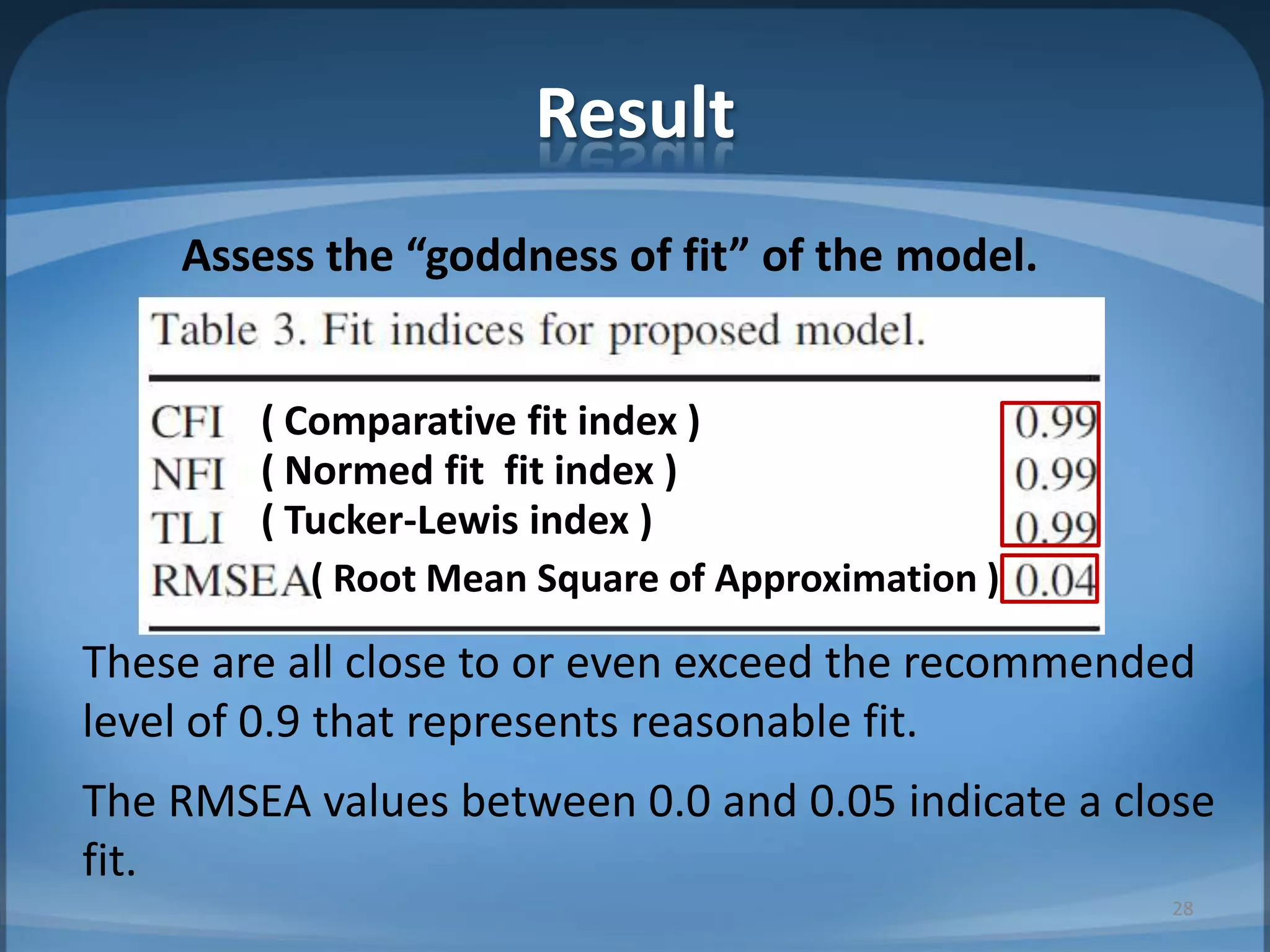
These are all close to or even exceed the recommended
level of 0.9 that represents reasonable fit.
( Comparative fit index )
( Normed fit fit index )
( Tucker-Lewis index )
The RMSEA values between 0.0 and 0.05 indicate a close
fit.
( Root Mean Square of Approximation )
Assess the “goddness of fit” of the model.
28
Result
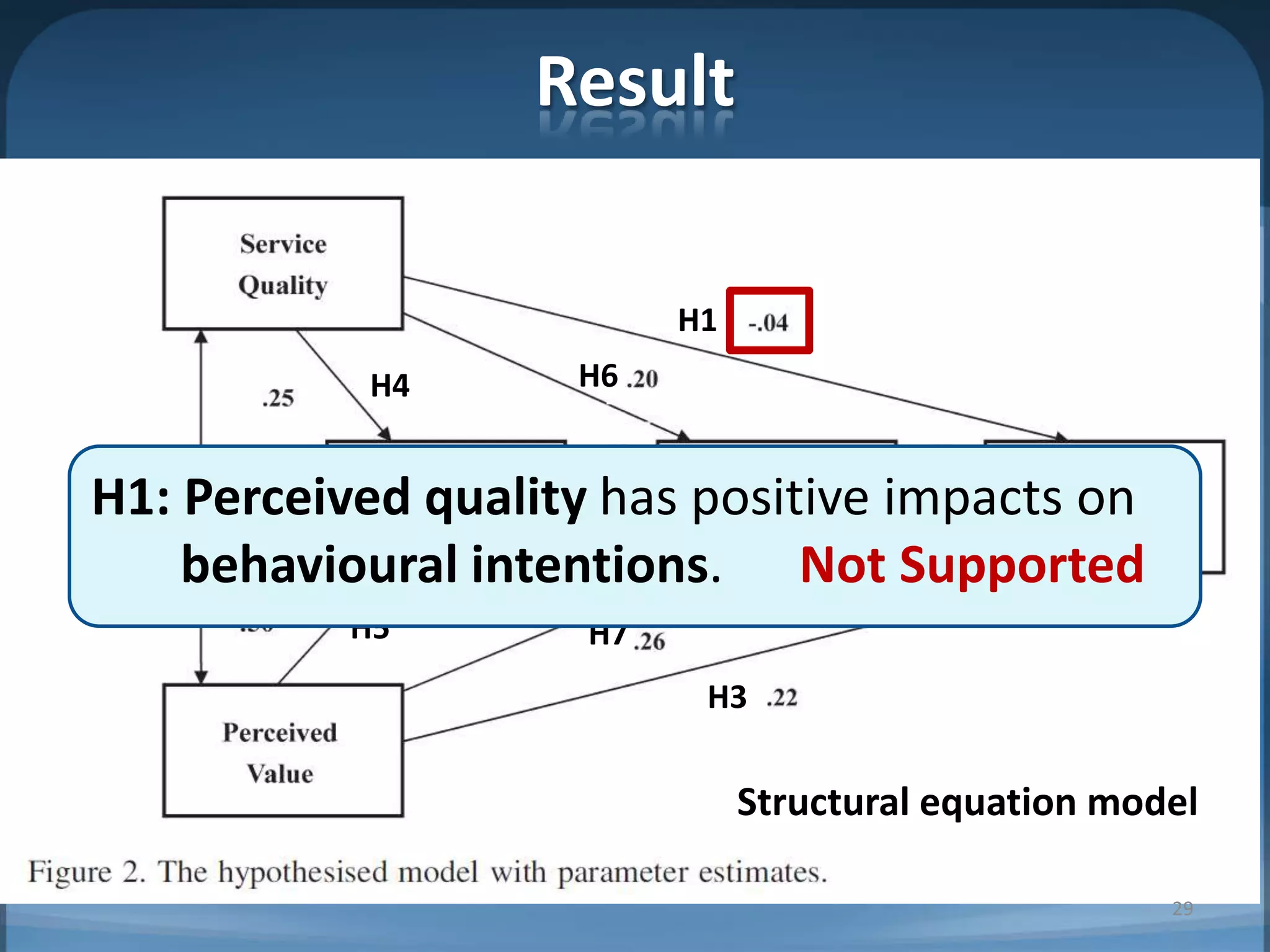
Structural equation model
H1
H2
H3
H4
H5
H6
H7
H8 H9H1: Perceived quality has positive impacts on
behavioural intentions. Not Supported
29
Conclusion
 High quality leads to superior perceived value,
customer satisfaction, and favourable perceptions
of corporate image.
Customers’ perceived value was found to affect
customer satisfaction, the image of the hotel, and
customers more likely to prefer the organisation
and recommend it to others.
30
Reflection
31
Reflection
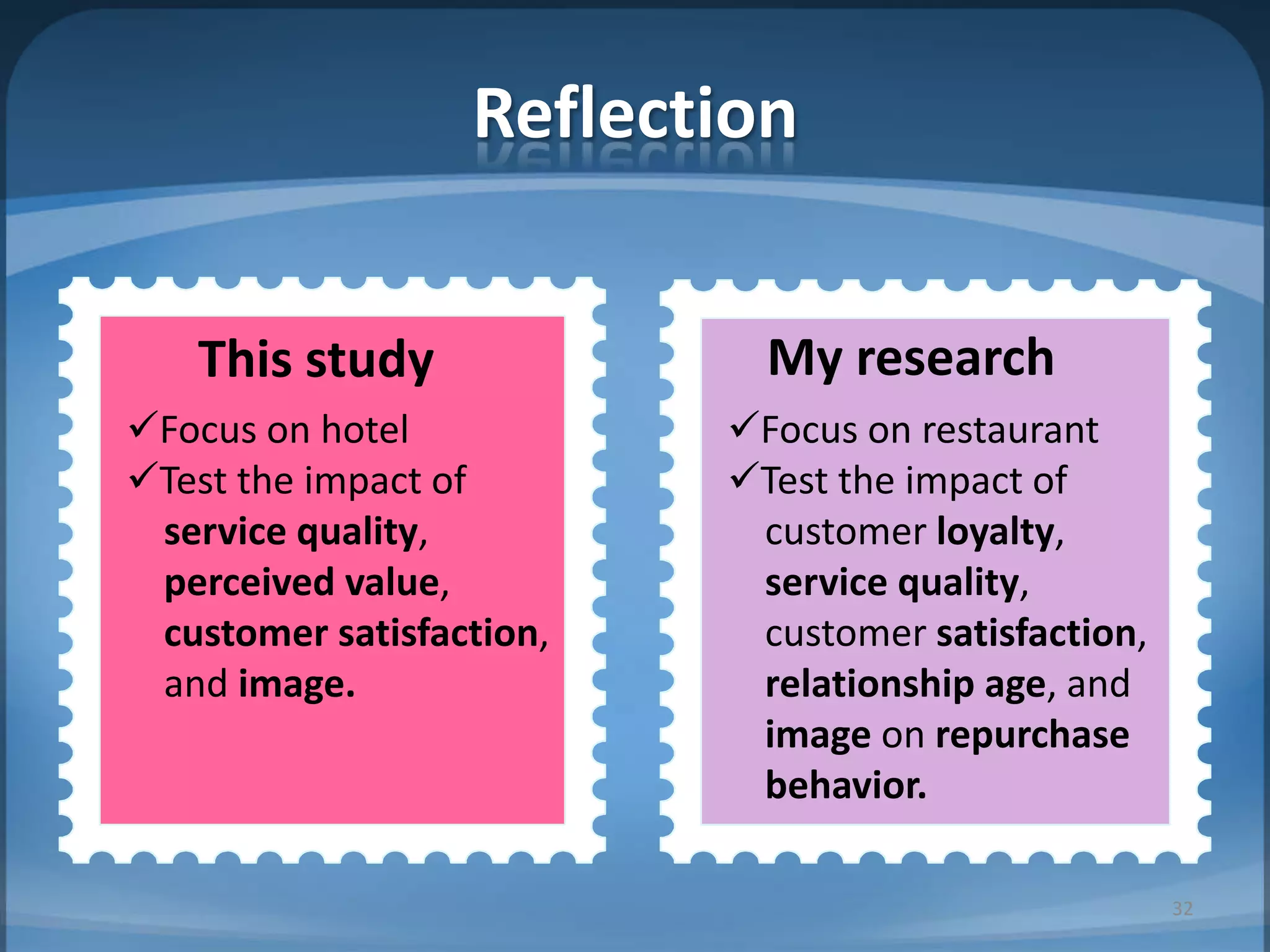
This study My research
Focus on hotel
Test the impact of
service quality,
perceived value,
customer satisfaction,
and image.
Focus on restaurant
Test the impact of
customer loyalty,
service quality,
customer satisfaction,
relationship age, and
image on repurchase
behavior.
32
33

The relationship & impacts of service quality, perceived value, customer satisfaction, and image

  • 1.
    Relationships & Impacts of Servicequality, perceived value, customer satisfaction, and image An Empirical Study Presenter: Sharon Chang Instructor: Dr. Pi-Ying Hsu Date: May 20, 20131
  • 2.
    Citation Hu, H.-H., Kandampully,J., Juwaheer, T. D. (2009). Relationships and impacts of service quality, perceived value, customer satisfaction, and image: An empirical study. The Service Industries Journal, 29(2), 111-125. 2
  • 3.
  • 4.
  • 5.
    Introduction Background Given the globalnature of the market, competing firms are constantly seeking to project their firms’ superior quality of service, customer-perceived value, and image in order to gain customer loyalty. 5
  • 6.
    Introduction Purpose This empirical studyseeks to understand the relationships that exist between service quality and perceived value and how they impact customer satisfaction, corporate image, and behavioural intentions. 6
  • 7.
  • 8.
    H1: Perceived qualityhas positive impacts on behavioural intentions. Literature Review The positive relationships between service quality and repurchase intentions and willingness to recommend. (Boulding & Karla & Staelin & Zeithaml, 1993) 8
  • 9.
    Literature Review Service qualityis an important driver of perceived customer value. (Cronin et al., 2000; Parasuraman & Grewal, 2000) H2: Service quality has positive impacts on perceived value. 9
  • 10.
    Literature Review Perceived valuecontributes directly to customer satisfaction which, in turn, leads to future intentions. (McDougall & Levesque, 2000) H3: Perceived value has positive impacts on behavioural intentions. 10
  • 11.
    Customer satisfaction isa post-consumption experience which compares perceived quality with expected quality, whereas service quality refers to a global evaluation of a firm’s service delivery system. (Anderson & Fornell, 1994) H4: Service quality has positive impacts on customer satisfaction. Literature Review 11
  • 12.
    Literature Review Service qualityand satisfaction are distinct constructs, and there is a causal relationship between the two, and that perceptions of service quality affect feelings of satisfaction which, in turn, influence future purchase behaviour. (Hurley & Estelami, 1998) H5: Perceived value has positive impacts on customer satisfaction. 12
  • 13.
    Literature Review Corporate imageis built mainly by technical quality what the customer receives from the service experience, and functional quality: the manner in which the service is delivered. (CrÖnroos, 1984) H6: Service quality has positive impacts on corporate image. 13
  • 14.
    Literature Review A companywill have a strong image if customers believe that they are getting high value when they buy from it. (Barich and Lotler, 1991) H7: Perceived value has positive impacts on corporate image. 14
  • 15.
    Literature Review H8: Customersatisfaction has positive impacts on corporate image. Satisfaction levels derived from each service encounter are viewed as having an effect on image assessments. (Nguyen & LeBlanc, 1998) 15
  • 16.
    Literature Review Corporate imageserves as an important factor influencing customer loyalty, and a favourable image can influence repeat patronage. (Andreassen & Lindestad, 1998; Dick & Basu, 1994) H9: Corporate image has positive impacts on behavioural intentions. 16
  • 17.
    Literature Review Zeithaml etal. (1996) H1 H2 H3 H4 H5 H6 H7 H8 H9 - Conceptual model - 17
  • 18.
  • 19.
    Methodology Sample Three categories • Namelyluxury (26%) • Mid-scale (64%) • Economy hotels (10%) Location • Participants • 1500 participants Bilingual country (French & English) 19
  • 20.
    Methodology 1 2 34 5 6 7 Completely disagree Disagree Disagree somewhat Undecided Agree somewhat Agree Completely agree - Instrument - Service quality – Multiple-item scale of SERVQUAL from Parasuraman et al. (1988) 20
  • 21.
    Methodology Perceived value – Threeitems were adapted from Cronin et al. (2000) 1 2 3 4 5 6 7 Strongly disagree Disagree Disagree somewhat Undecided Agree somewhat Agree Strongly agree 21
  • 22.
    Methodology Customer satisfaction - 12 3 4 5 6 7 Very dissatisfied Dissatisfied Dissatisfied somewhat Undecided Satisfied somewhat Satisfied Very satisfied Corporate image - Two dimensions: image attributes and image holistic 1 2 3 4 5 6 7 Strongly disagree Disagree Disagree somewhat Undecided Agree somewhat Agree Strongly agree 22
  • 23.
    Methodology 1 2 34 5 6 7 Not all likely Not likely Not likely somewhat Undecided likely somewhat likely Extremely likely Behavioural intentions – Three categories: repurchase intentions, willingness to recommend, and price sensitivity. 23
  • 24.
    Methodology Pilot study- Establish content validityof the questionnaire Collect the data- During a 6-week period Analyze the data- Cronbach’s alpha LISREL 8 Step2Step 1 Step 3 Procedure 24
  • 25.
  • 26.
  • 27.
    Result 27 Descriptive statistics includingmean and standard deviation of each variable used in the proposed model.
  • 28.
    Result These are allclose to or even exceed the recommended level of 0.9 that represents reasonable fit. ( Comparative fit index ) ( Normed fit fit index ) ( Tucker-Lewis index ) The RMSEA values between 0.0 and 0.05 indicate a close fit. ( Root Mean Square of Approximation ) Assess the “goddness of fit” of the model. 28
  • 29.
    Result Structural equation model H1 H2 H3 H4 H5 H6 H7 H8H9H1: Perceived quality has positive impacts on behavioural intentions. Not Supported 29
  • 30.
    Conclusion  High qualityleads to superior perceived value, customer satisfaction, and favourable perceptions of corporate image. Customers’ perceived value was found to affect customer satisfaction, the image of the hotel, and customers more likely to prefer the organisation and recommend it to others. 30
  • 31.
  • 32.
    Reflection This study Myresearch Focus on hotel Test the impact of service quality, perceived value, customer satisfaction, and image. Focus on restaurant Test the impact of customer loyalty, service quality, customer satisfaction, relationship age, and image on repurchase behavior. 32
  • 33.