1
Learning issues for Chapter One:
• Define Marketing and its importance
• Core concepts of Marketing
• Definition and tasks of Marketing
• Company’s orientations toward the
marketplace
• Major drivers of the new economy
• Customer database and Database Marketing
2
What is Marketing?
– The American Marketing Association:
“Marketing is an organizational function and a
set of processes for creating, communicating,
and delivering value to customers and for
managing customer relationships in ways that
benefit the organization and its stakeholders”.
– Essentially:
• Marketing deals with identifying and meeting human
and social needs. It is essentially about “meeting
needs profitably.”
3
What is Marketing Management?
Marketing management is the
art and science
of choosing target markets
and getting, keeping, and growing
customers through
creating, delivering, and communicating
superior customer value.
1- 4
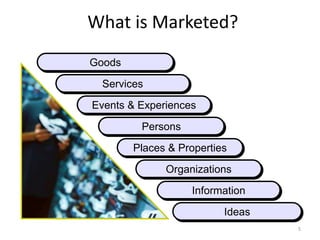
What is Marketed?
Goods
Services
Events & Experiences
Persons
Places & Properties
Organizations
Information
Ideas
5
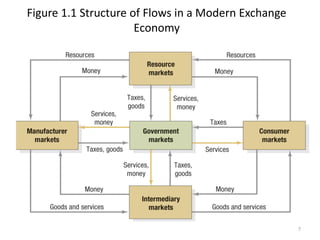
The concept of a ‘market’
• Economists describe a market as a collection of buyers and
sellers who transact over a particular product or product
class.
• Marketers use the term “market” to cover various groups of
customers. The five basic markets are:
A) Resource Markets
B) Government Markets
C) Manufacturer Markets
D) Intermediary Markets
E) Consumer Markets
6
Figure 1.1 Structure of Flows in a Modern Exchange
Economy
7
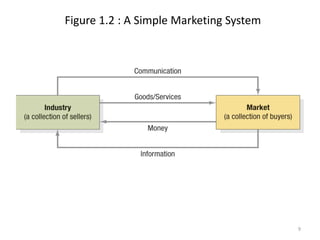
The flows in a market system
• Sellers and buyers are connected by flows:
– Seller sends goods, services, and
communications to the market.
– In return they receive money and information.
– There is an exchange of money for goods and
services.
– There is an exchange of information.
8
Figure 1.2 : A Simple Marketing System
9
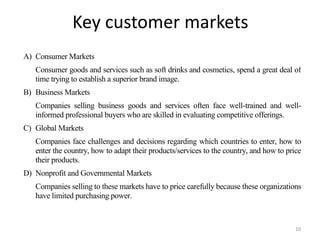
Key customer markets
A) Consumer Markets
Consumer goods and services such as soft drinks and cosmetics, spend a great deal of
time trying to establish a superior brand image.
B) Business Markets
Companies selling business goods and services often face well-trained and well-
informed professional buyers who are skilled in evaluating competitive offerings.
C) Global Markets
Companies face challenges and decisions regarding which countries to enter, how to
enter the country, how to adapt their products/services to the country, and how to price
their products.
D) Nonprofit and Governmental Markets
Companies selling to these markets have to price carefully because these organizations
have limited purchasing power.
10
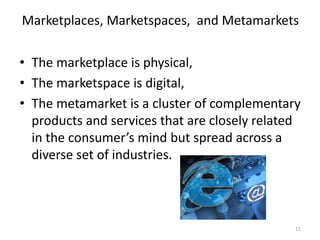
Marketplaces, Marketspaces, and Metamarkets
• The marketplace is physical,
• The marketspace is digital,
• The metamarket is a cluster of complementary
products and services that are closely related
in the consumer’s mind but spread across a
diverse set of industries.
11
Core Marketing Concepts
• Needs, wants, and demands
• Target markets, positioning, segmentation
• Offerings and brands
• Value and satisfaction
• Marketing channels
• Supply chain
• Competition
• Marketing environment
12
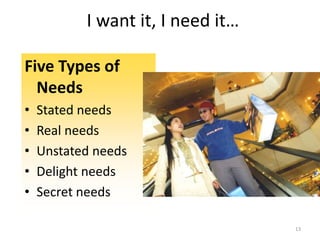
I want it, I need it…
Five Types of
Needs
• Stated needs
• Real needs
• Unstated needs
• Delight needs
• Secret needs
13
A. Identify and profile distinct groups of buyers who might prefer or
require varying products and services mixes by examining:
– Demographic information
– Psychographic information
– Behavioral information
B. Target market: which segments do we focus on?
C. Market offering – what do we offer? What proposition should we
make to customers?
D. Offering and Brands
– Value proposition: a set of benefits they offer to customers to
satisfy their needs
– Brand: is an offering from a known source
Core Marketing Concepts
14
E. Value and Satisfaction
– Successful if it delivers value and satisfaction to the target buyer
– Value is a central marketing concept
– Satisfaction reflects a person’s judgment of a product’s perceived
performance
F. Marketing Channels:
 Communication channels: different media used in promotions and
marketing communications
– Distribution channels: intermediaries
– Service channels: banks, logistics firms
Core Marketing Concepts
15
Core Marketing Concepts
G. Supply chain:
– The supply chain is a longer channel stretching from raw
materials to components to final products that are carried to
final buyers.
H. Competition and the Marketing Environment:
 Marketing doesn’t take place in a vacuum; there are many
uncontrollable forces and stakeholders that will impact on the
marketing firm
 Types of environmental factors: Competition, demographic,
social-cultural, political-legal and technological
16
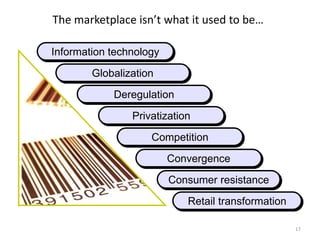
The marketplace isn’t what it used to be…
Information technology
Globalization
Deregulation
Privatization
Competition
Convergence
Consumer resistance
Retail transformation
17
New Consumer Capabilities
• A substantial increase in buying power
• A greater variety of available goods and services
• A great amount of information about practically
anything
• Greater ease in interacting and placing and receiving
orders
• An ability to compare notes on products and services
• An amplified voice to influence public opinion
18
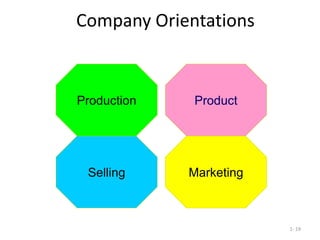
Company Orientations
Production
Selling Marketing
Product
1- 19
Company Orientations
• Production Concept
– The production concept holds that consumers will prefer
products that are widely available and inexpensive.
• Product Concept
– The product concept holds that consumers will favor those
products that offer the most quality, performance, or innovative
features.
• Selling Concept
– The selling concept holds that consumers and businesses, will
ordinarily not buy enough of the organization’s products,
therefore, the organization must undertake aggressive selling
and promotion effort.
20
The Marketing Concept
• The marketing concept holds that the key to achieving
organizational goals consists of the company being more
effective than competitors in creating, delivering, and
communicating superior customer value to its chosen target
markets.
– Reactive market orientation—understanding and meeting
consumers’ expressed needs.
– Proactive marketing orientation—researching or imagining latent
consumers’ needs through a “probe-and-learn” process.
• Companies that practice both reactive and proactive marketing
orientation are implementing a total market orientation.
21
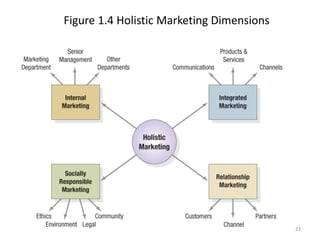
Holistic Marketing Concept
• Holistic marketing can be seen as the development, design,
and implementation of marketing programs, processes, and
activities that recognizes the breath and interdependencies of
their efforts.
• Holistic marketing recognizes that “everything matters” with
marketing—the consumer, employees, other companies,
competition, as well as society as a whole.
– Holistic marketing
– Internal marketing
– Socially responsible marketing
– Integrated marketing
– Relationship marketing
22
Figure 1.4 Holistic Marketing Dimensions
23
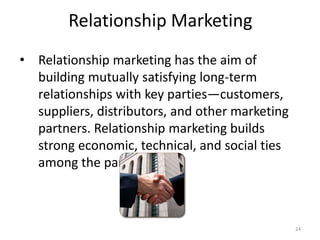
Relationship Marketing
• Relationship marketing has the aim of
building mutually satisfying long-term
relationships with key parties—customers,
suppliers, distributors, and other marketing
partners. Relationship marketing builds
strong economic, technical, and social ties
among the parties.
24
Relationship Marketing
– Marketing must not only do customer
relationship management (CRM) but also
partnership relationship management (PRM).
– Four key constituents for marketing are:
» Customers.
» Employees.
» Marketing partners (channel partners).
» Members of the financial community.
» The ultimate outcome of relationship
marketing is the building of a unique
company asset called a marketing network
25
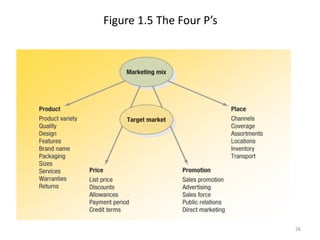
Figure 1.5 The Four P’s
26
Integrated Marketing
– The marketer’s task is to devise marketing activities and assemble fully
integrated marketing programs to create, communicate, and deliver value
for consumers.
– The Four Ps of Marketing: Product, Price, Place and Promotion
– SIVA
• Solution
• Information
• Value
• Access
– Two key themes of integrated marketing are:
• Many different marketing activities communicate and
deliver value
• When coordinated, marketing activities maximize their
joint efforts.
27
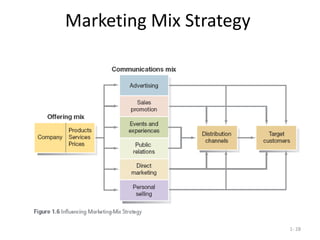
Marketing Mix Strategy
1- 28
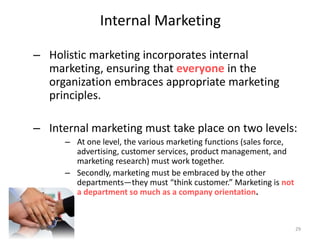
Internal Marketing
– Holistic marketing incorporates internal
marketing, ensuring that everyone in the
organization embraces appropriate marketing
principles.
– Internal marketing must take place on two levels:
– At one level, the various marketing functions (sales force,
advertising, customer services, product management, and
marketing research) must work together.
– Secondly, marketing must be embraced by the other
departments—they must “think customer.” Marketing is not
a department so much as a company orientation.
29
Performance Marketing
• Financial Accountability
• Social Responsibility
Marketing
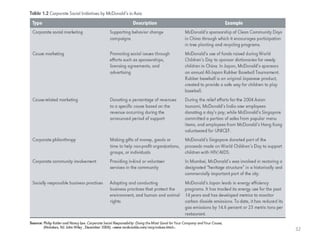
Social Initiatives
• Corporate social marketing
• Cause marketing
• Corporate philanthropy
• Corporate community
involvement
• Socially responsible business
practices
Holistic marketing incorporates performance marketing and understanding
the returns to the business from marketing activities.
30
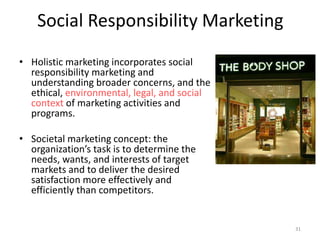
Social Responsibility Marketing
• Holistic marketing incorporates social
responsibility marketing and
understanding broader concerns, and the
ethical, environmental, legal, and social
context of marketing activities and
programs.
• Societal marketing concept: the
organization’s task is to determine the
needs, wants, and interests of target
markets and to deliver the desired
satisfaction more effectively and
efficiently than competitors.
31
32
Marketing Management Tasks
• Develop market strategies and plans
• Capture marketing insights
• Connect with customers
• Build strong brands
• Shape market offerings
• Deliver value
• Communicate value
• Create long-term growth
33
Customer Database and Database
Marketing
• Customer Database contains the customer’s past
purchases, demographic, psychographic
(activities, interests and opinion), mediagraphics
(preferred media) and other useful information.
• Database Marketing is the process of building,
maintaning and using customer databases and
other databases for the purpose of contacting,
transacting and building customer relationships.

Chap1 smm

  • 1.
  • 2.
    Learning issues forChapter One: • Define Marketing and its importance • Core concepts of Marketing • Definition and tasks of Marketing • Company’s orientations toward the marketplace • Major drivers of the new economy • Customer database and Database Marketing 2
  • 3.
    What is Marketing? –The American Marketing Association: “Marketing is an organizational function and a set of processes for creating, communicating, and delivering value to customers and for managing customer relationships in ways that benefit the organization and its stakeholders”. – Essentially: • Marketing deals with identifying and meeting human and social needs. It is essentially about “meeting needs profitably.” 3
  • 4.
    What is MarketingManagement? Marketing management is the art and science of choosing target markets and getting, keeping, and growing customers through creating, delivering, and communicating superior customer value. 1- 4
  • 5.
    What is Marketed? Goods Services Events& Experiences Persons Places & Properties Organizations Information Ideas 5
  • 6.
    The concept ofa ‘market’ • Economists describe a market as a collection of buyers and sellers who transact over a particular product or product class. • Marketers use the term “market” to cover various groups of customers. The five basic markets are: A) Resource Markets B) Government Markets C) Manufacturer Markets D) Intermediary Markets E) Consumer Markets 6
  • 7.
    Figure 1.1 Structureof Flows in a Modern Exchange Economy 7
  • 8.
    The flows ina market system • Sellers and buyers are connected by flows: – Seller sends goods, services, and communications to the market. – In return they receive money and information. – There is an exchange of money for goods and services. – There is an exchange of information. 8
  • 9.
    Figure 1.2 :A Simple Marketing System 9
  • 10.
    Key customer markets A)Consumer Markets Consumer goods and services such as soft drinks and cosmetics, spend a great deal of time trying to establish a superior brand image. B) Business Markets Companies selling business goods and services often face well-trained and well- informed professional buyers who are skilled in evaluating competitive offerings. C) Global Markets Companies face challenges and decisions regarding which countries to enter, how to enter the country, how to adapt their products/services to the country, and how to price their products. D) Nonprofit and Governmental Markets Companies selling to these markets have to price carefully because these organizations have limited purchasing power. 10
  • 11.
    Marketplaces, Marketspaces, andMetamarkets • The marketplace is physical, • The marketspace is digital, • The metamarket is a cluster of complementary products and services that are closely related in the consumer’s mind but spread across a diverse set of industries. 11
  • 12.
    Core Marketing Concepts •Needs, wants, and demands • Target markets, positioning, segmentation • Offerings and brands • Value and satisfaction • Marketing channels • Supply chain • Competition • Marketing environment 12
  • 13.
    I want it,I need it… Five Types of Needs • Stated needs • Real needs • Unstated needs • Delight needs • Secret needs 13
  • 14.
    A. Identify andprofile distinct groups of buyers who might prefer or require varying products and services mixes by examining: – Demographic information – Psychographic information – Behavioral information B. Target market: which segments do we focus on? C. Market offering – what do we offer? What proposition should we make to customers? D. Offering and Brands – Value proposition: a set of benefits they offer to customers to satisfy their needs – Brand: is an offering from a known source Core Marketing Concepts 14
  • 15.
    E. Value andSatisfaction – Successful if it delivers value and satisfaction to the target buyer – Value is a central marketing concept – Satisfaction reflects a person’s judgment of a product’s perceived performance F. Marketing Channels:  Communication channels: different media used in promotions and marketing communications – Distribution channels: intermediaries – Service channels: banks, logistics firms Core Marketing Concepts 15
  • 16.
    Core Marketing Concepts G.Supply chain: – The supply chain is a longer channel stretching from raw materials to components to final products that are carried to final buyers. H. Competition and the Marketing Environment:  Marketing doesn’t take place in a vacuum; there are many uncontrollable forces and stakeholders that will impact on the marketing firm  Types of environmental factors: Competition, demographic, social-cultural, political-legal and technological 16
  • 17.
    The marketplace isn’twhat it used to be… Information technology Globalization Deregulation Privatization Competition Convergence Consumer resistance Retail transformation 17
  • 18.
    New Consumer Capabilities •A substantial increase in buying power • A greater variety of available goods and services • A great amount of information about practically anything • Greater ease in interacting and placing and receiving orders • An ability to compare notes on products and services • An amplified voice to influence public opinion 18
  • 19.
  • 20.
    Company Orientations • ProductionConcept – The production concept holds that consumers will prefer products that are widely available and inexpensive. • Product Concept – The product concept holds that consumers will favor those products that offer the most quality, performance, or innovative features. • Selling Concept – The selling concept holds that consumers and businesses, will ordinarily not buy enough of the organization’s products, therefore, the organization must undertake aggressive selling and promotion effort. 20
  • 21.
    The Marketing Concept •The marketing concept holds that the key to achieving organizational goals consists of the company being more effective than competitors in creating, delivering, and communicating superior customer value to its chosen target markets. – Reactive market orientation—understanding and meeting consumers’ expressed needs. – Proactive marketing orientation—researching or imagining latent consumers’ needs through a “probe-and-learn” process. • Companies that practice both reactive and proactive marketing orientation are implementing a total market orientation. 21
  • 22.
    Holistic Marketing Concept •Holistic marketing can be seen as the development, design, and implementation of marketing programs, processes, and activities that recognizes the breath and interdependencies of their efforts. • Holistic marketing recognizes that “everything matters” with marketing—the consumer, employees, other companies, competition, as well as society as a whole. – Holistic marketing – Internal marketing – Socially responsible marketing – Integrated marketing – Relationship marketing 22
  • 23.
    Figure 1.4 HolisticMarketing Dimensions 23
  • 24.
    Relationship Marketing • Relationshipmarketing has the aim of building mutually satisfying long-term relationships with key parties—customers, suppliers, distributors, and other marketing partners. Relationship marketing builds strong economic, technical, and social ties among the parties. 24
  • 25.
    Relationship Marketing – Marketingmust not only do customer relationship management (CRM) but also partnership relationship management (PRM). – Four key constituents for marketing are: » Customers. » Employees. » Marketing partners (channel partners). » Members of the financial community. » The ultimate outcome of relationship marketing is the building of a unique company asset called a marketing network 25
  • 26.
    Figure 1.5 TheFour P’s 26
  • 27.
    Integrated Marketing – Themarketer’s task is to devise marketing activities and assemble fully integrated marketing programs to create, communicate, and deliver value for consumers. – The Four Ps of Marketing: Product, Price, Place and Promotion – SIVA • Solution • Information • Value • Access – Two key themes of integrated marketing are: • Many different marketing activities communicate and deliver value • When coordinated, marketing activities maximize their joint efforts. 27
  • 28.
  • 29.
    Internal Marketing – Holisticmarketing incorporates internal marketing, ensuring that everyone in the organization embraces appropriate marketing principles. – Internal marketing must take place on two levels: – At one level, the various marketing functions (sales force, advertising, customer services, product management, and marketing research) must work together. – Secondly, marketing must be embraced by the other departments—they must “think customer.” Marketing is not a department so much as a company orientation. 29
  • 30.
    Performance Marketing • FinancialAccountability • Social Responsibility Marketing Social Initiatives • Corporate social marketing • Cause marketing • Corporate philanthropy • Corporate community involvement • Socially responsible business practices Holistic marketing incorporates performance marketing and understanding the returns to the business from marketing activities. 30
  • 31.
    Social Responsibility Marketing •Holistic marketing incorporates social responsibility marketing and understanding broader concerns, and the ethical, environmental, legal, and social context of marketing activities and programs. • Societal marketing concept: the organization’s task is to determine the needs, wants, and interests of target markets and to deliver the desired satisfaction more effectively and efficiently than competitors. 31
  • 32.
  • 33.
    Marketing Management Tasks •Develop market strategies and plans • Capture marketing insights • Connect with customers • Build strong brands • Shape market offerings • Deliver value • Communicate value • Create long-term growth 33
  • 34.
    Customer Database andDatabase Marketing • Customer Database contains the customer’s past purchases, demographic, psychographic (activities, interests and opinion), mediagraphics (preferred media) and other useful information. • Database Marketing is the process of building, maintaning and using customer databases and other databases for the purpose of contacting, transacting and building customer relationships.