Finite Element Analysis
Introduction
Computer-Aided Design, Analysis and
Prototyping
FEA Introduction
 Numerical method used for solving problems
that cannot be solved analytically (e.g., due to
complicated geometry, different materials)
 Well suited to computers
 Originally applied to problems in solid
mechanics
 Other application areas include heat transfer,
fluid flow, electromagnetism
Finite Element Method Phases
 Preprocessing
 Geometry
 Modeling analysis type
 Mesh
 Material properties
 Boundary conditions
 Solution
 Solve linear or nonlinear algebraic equations
simultaneously to obtain nodal results
(displacements, temperatures)
 Postprocessing
 Obtain other results (stresses, heat fluxes)
FEA Discretization Process - Meshing
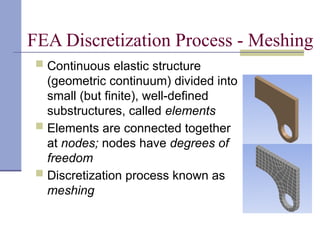
 Continuous elastic structure
(geometric continuum) divided into
small (but finite), well-defined
substructures, called elements
 Elements are connected together
at nodes; nodes have degrees of
freedom
 Discretization process known as
meshing
Spring Analogy
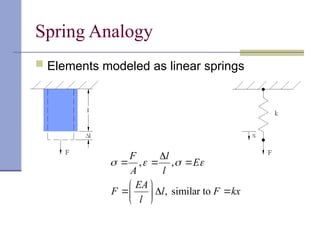
 Elements modeled as linear springs
, ,
, similar to
F l
E
A l
EA
F l F kx
l
   

  
 
  
 
 
Matrix Formulation
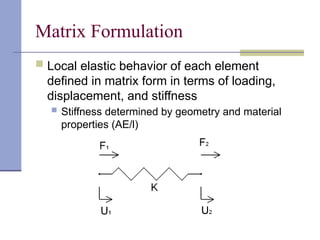
 Local elastic behavior of each element
defined in matrix form in terms of loading,
displacement, and stiffness
 Stiffness determined by geometry and material
properties (AE/l)
Global Matrix Formulation
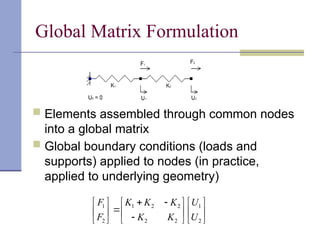
 Elements assembled through common nodes
into a global matrix
 Global boundary conditions (loads and
supports) applied to nodes (in practice,
applied to underlying geometry)
1 1 2 2 1
2 2 2 2
F K K K U
F K K U
 
     

     

     
Solution
 Matrix operations used to determine unknown
dof’s (e.g., nodal displacements)
 Run time proportional to #nodes/elements
 Error messages
 “Bad” elements
 Insufficient disk space, RAM
 Insufficiently constrained
Postprocessing
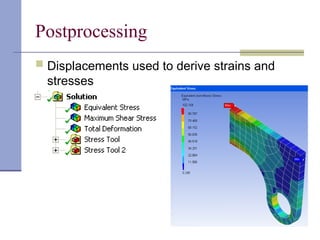
 Displacements used to derive strains and
stresses
FEA Prerequisites
 First Principles (Newton’s Laws)
 Body under external loading
 Area Moments of Inertia
 Stress and Strain
 Principal stresses
 Stress states: bending, shear, torsion, pressure,
contact, thermal expansion
 Stress concentration factors
 Material Properties
 Failure Modes
 Dynamic Analysis
See Chapter 2 of Building Better Products with FEA, Vince Adams and
Abraham Askenazi, Onward Press, 1999
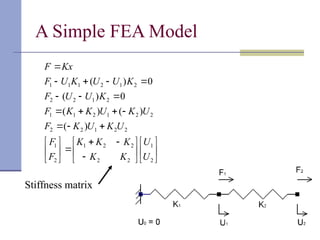
A Simple FEA Model





































2
1
2
2
2
2
1
2
1
2
2
1
2
2
2
2
1
2
1
1
2
1
2
2
2
1
2
1
1
1
)
(
)
(
)
(
0
)
(
0
)
(
U
U
K
K
K
K
K
F
F
U
K
U
K
F
U
K
U
K
K
F
K
U
U
F
K
U
U
K
U
F
Kx
F
Stiffness matrix
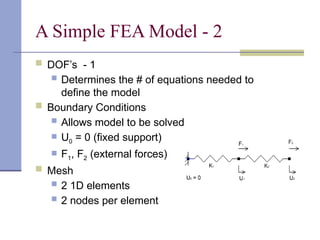
A Simple FEA Model - 2
 DOF’s - 1
 Determines the # of equations needed to
define the model
 Boundary Conditions
 Allows model to be solved
 U0 = 0 (fixed support)
 F1, F2 (external forces)
 Mesh
 2 1D elements
 2 nodes per element
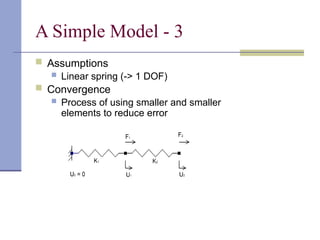
A Simple Model - 3
 Assumptions
 Linear spring (-> 1 DOF)
 Convergence
 Process of using smaller and smaller
elements to reduce error
Finite Element Analysis
Introduction

FEA Introduction- Finite element analysis of engineering

  • 1.
  • 2.
    FEA Introduction  Numericalmethod used for solving problems that cannot be solved analytically (e.g., due to complicated geometry, different materials)  Well suited to computers  Originally applied to problems in solid mechanics  Other application areas include heat transfer, fluid flow, electromagnetism
  • 3.
    Finite Element MethodPhases  Preprocessing  Geometry  Modeling analysis type  Mesh  Material properties  Boundary conditions  Solution  Solve linear or nonlinear algebraic equations simultaneously to obtain nodal results (displacements, temperatures)  Postprocessing  Obtain other results (stresses, heat fluxes)
  • 4.
    FEA Discretization Process- Meshing  Continuous elastic structure (geometric continuum) divided into small (but finite), well-defined substructures, called elements  Elements are connected together at nodes; nodes have degrees of freedom  Discretization process known as meshing
  • 5.
    Spring Analogy  Elementsmodeled as linear springs , , , similar to F l E A l EA F l F kx l                 
  • 6.
    Matrix Formulation  Localelastic behavior of each element defined in matrix form in terms of loading, displacement, and stiffness  Stiffness determined by geometry and material properties (AE/l)
  • 7.
    Global Matrix Formulation Elements assembled through common nodes into a global matrix  Global boundary conditions (loads and supports) applied to nodes (in practice, applied to underlying geometry) 1 1 2 2 1 2 2 2 2 F K K K U F K K U                      
  • 8.
    Solution  Matrix operationsused to determine unknown dof’s (e.g., nodal displacements)  Run time proportional to #nodes/elements  Error messages  “Bad” elements  Insufficient disk space, RAM  Insufficiently constrained
  • 9.
    Postprocessing  Displacements usedto derive strains and stresses
  • 10.
    FEA Prerequisites  FirstPrinciples (Newton’s Laws)  Body under external loading  Area Moments of Inertia  Stress and Strain  Principal stresses  Stress states: bending, shear, torsion, pressure, contact, thermal expansion  Stress concentration factors  Material Properties  Failure Modes  Dynamic Analysis See Chapter 2 of Building Better Products with FEA, Vince Adams and Abraham Askenazi, Onward Press, 1999
  • 11.
    A Simple FEAModel                                      2 1 2 2 2 2 1 2 1 2 2 1 2 2 2 2 1 2 1 1 2 1 2 2 2 1 2 1 1 1 ) ( ) ( ) ( 0 ) ( 0 ) ( U U K K K K K F F U K U K F U K U K K F K U U F K U U K U F Kx F Stiffness matrix
  • 12.
    A Simple FEAModel - 2  DOF’s - 1  Determines the # of equations needed to define the model  Boundary Conditions  Allows model to be solved  U0 = 0 (fixed support)  F1, F2 (external forces)  Mesh  2 1D elements  2 nodes per element
  • 13.
    A Simple Model- 3  Assumptions  Linear spring (-> 1 DOF)  Convergence  Process of using smaller and smaller elements to reduce error
  • 14.

Editor's Notes

  • #2 Analytical -> exact solution Numerical -> approximate solution
  • #10 Mostly from solid mechanics