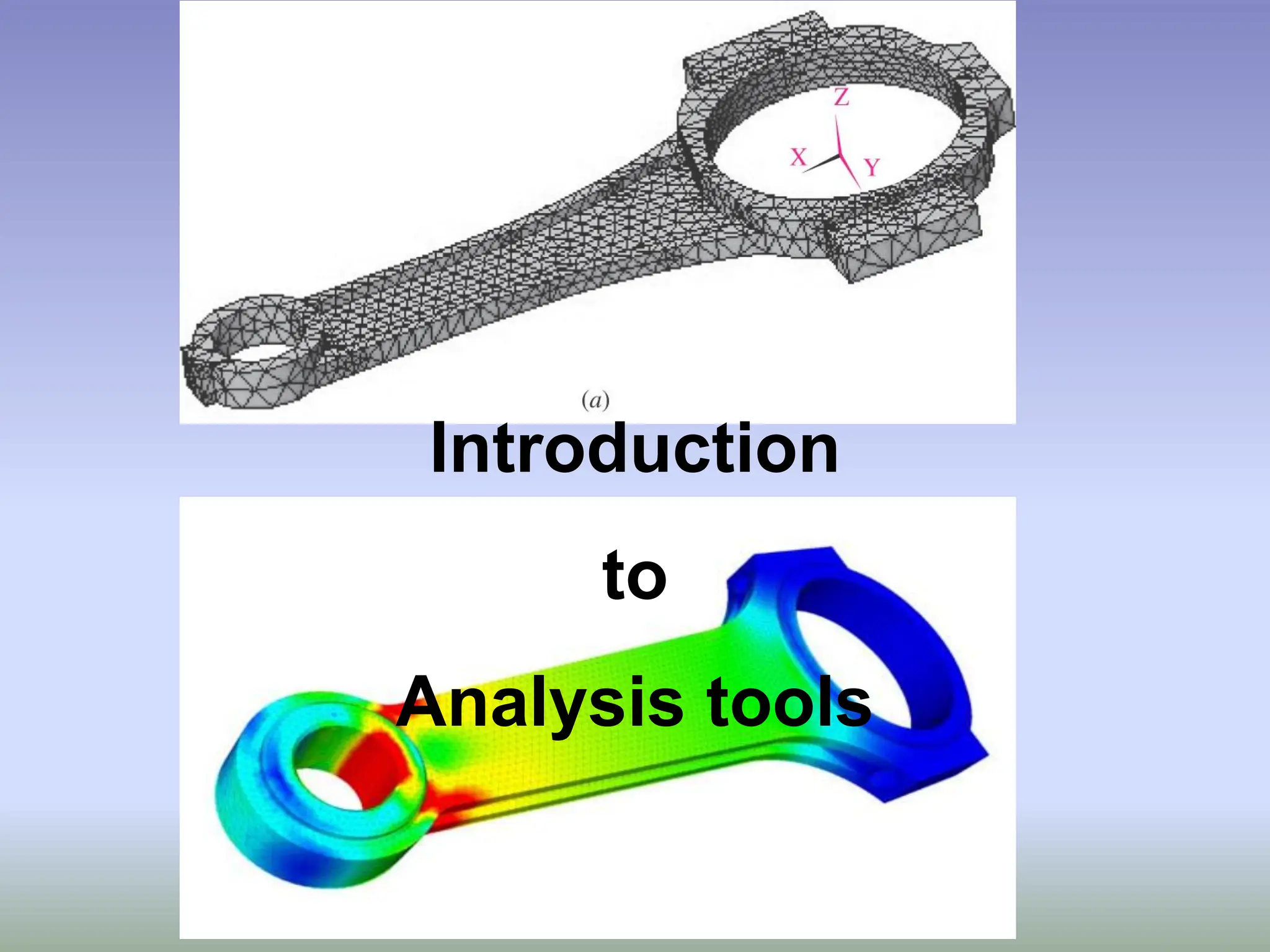
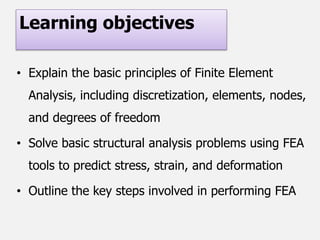
Meshed model
Introduction
to
Analysis tools
Learning objectives
• Explain the basic principles of Finite Element
Analysis, including discretization, elements, nodes,
and degrees of freedom
• Solve basic structural analysis problems using FEA
tools to predict stress, strain, and deformation
• Outline the key steps involved in performing FEA
1. Introduction to Analysis Tools
1.1 Introduction
• There are a great number of analysis tools used in
engineering applications to predict the behavior of
mechanical components
• The three basic methods commonly applied to
provide solutions to various engineering problems
includes:-
 Experimental methods
 Analytical methods
 Numerical methods (or) Approximate methods
1. Cont…
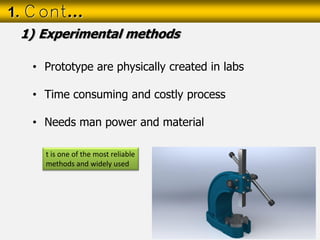
• Prototype are physically created in labs
• Time consuming and costly process
• Needs man power and material
1. Cont…
1) Experimental methods
t is one of the most reliable
methods and widely used
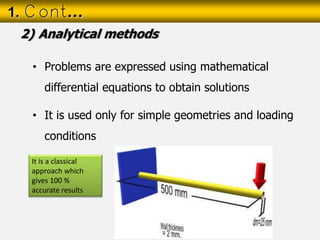
• Problems are expressed using mathematical
differential equations to obtain solutions
• It is used only for simple geometries and loading
conditions
1. Cont…
2) Analytical methods
It is a classical
approach which
gives 100 %
accurate results
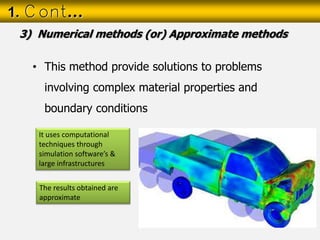
• This method provide solutions to problems
involving complex material properties and
boundary conditions
1. Cont…
3) Numerical methods (or) Approximate methods
It uses computational
techniques through
simulation software’s &
large infrastructures
The results obtained are
approximate
• There are four common numerical methods used
to solve engineering problems are:-
 Finite Element Analysis (FEA)
 Boundary Element Method (BEM)
 Finite Difference Method (FDM)
 Finite Volume Method (FVM)
1. Cont…
1.2 Numerical methods (or) Approximate methods
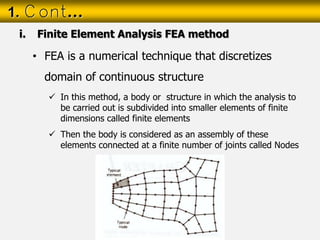
• FEA is a numerical technique that discretizes
domain of continuous structure
 In this method, a body or structure in which the analysis to
be carried out is subdivided into smaller elements of finite
dimensions called finite elements
 Then the body is considered as an assembly of these
elements connected at a finite number of joints called Nodes
1. Cont…
i. Finite Element Analysis FEA method
• Based on application, finite element problems are
classified as follows:
Structural Problems
Stress and Strain in each element can be calculated
Non-structural Problems
Temperature (or) Fluid pressure at each nodal
point is obtained
1. Cont…
1. Cont…
1. Cont…
General Steps of the Finite Element Analysis
• The following two general methods are associated
with the FEA:-
 Force Method:
 Internal forces are considered as the unknowns
of the problem
 Displacement or stiffness method:
 Displacement of the nodes are considered as
the unknowns of the problem
1. Cont…
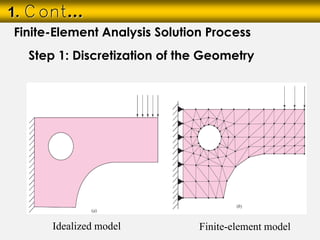
Finite-Element Analysis Solution Process
Idealized model Finite-element model
Step 1: Discretization of the Geometry
• Smaller elements are classified as follows
– One dimensional elements
– Two dimensional elements
– Three dimensional elements
1. Cont…
Element Geometries Categories
1. Cont…
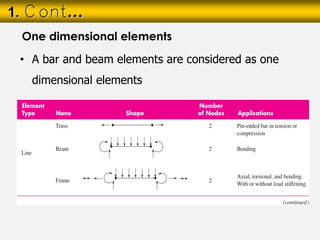
One dimensional elements
• A bar and beam elements are considered as one
dimensional elements
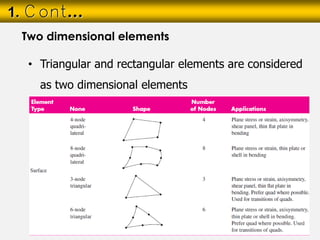
• Triangular and rectangular elements are considered
as two dimensional elements
1. Cont…
Two dimensional elements
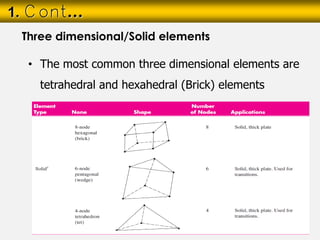
• The most common three dimensional elements are
tetrahedral and hexahedral (Brick) elements
1. Cont…
Three dimensional/Solid elements
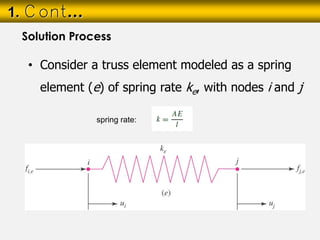
• Consider a truss element modeled as a spring
element (e) of spring rate ke, with nodes i and j
1. Cont…
Solution Process
spring rate:
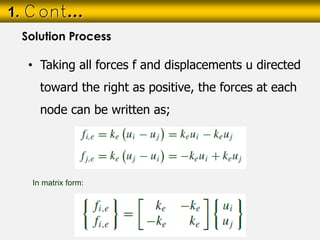
• Taking all forces f and displacements u directed
toward the right as positive, the forces at each
node can be written as;
1. Cont…
Solution Process
In matrix form:
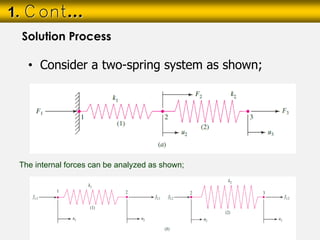
• Consider a two-spring system as shown;
1. Cont…
Solution Process
The internal forces can be analyzed as shown;
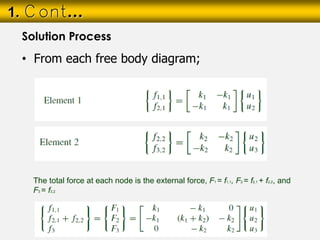
• From each free body diagram;
1. Cont…
Solution Process
The total force at each node is the external force, F1 = f1,1, F2 = f2,1 + f2,2, and
F3 = f3,2
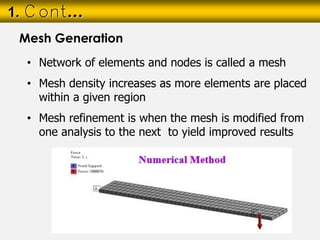
• Network of elements and nodes is called a mesh
• Mesh density increases as more elements are placed
within a given region
• Mesh refinement is when the mesh is modified from
one analysis to the next to yield improved results
1. Cont…
Mesh Generation
• Results generally improve when mesh density is
increased in areas of high stress gradients
• Mesh generation techniques includes;
– Manual
– Semiautomatic
– Fully automated
1. Cont…
Mesh Generation
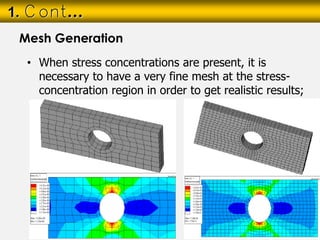
• When stress concentrations are present, it is
necessary to have a very fine mesh at the stress-
concentration region in order to get realistic results;
1. Cont…
Mesh Generation
• Loads are applied at the nodes
• Element loads such as weight, thermal effects,
surface pressure, etc. are automatically converted to
equivalent nodal loads
• The results very near the nodal forces may be
unrealistic
1. Cont…
Load Application
1.1 Cont…
Boundary Conditions
• Constraints at the nodes can be placed to model
boundary conditions
• Typical boundary conditions include fixed, simply
supported, and constrained in one direction
1. Cont…
• CAD packages and automatic mesh generators make
model creation relatively painless
• Computing speeds are sufficient to allow for dense
meshes
• The model only needs to be as detailed as needed
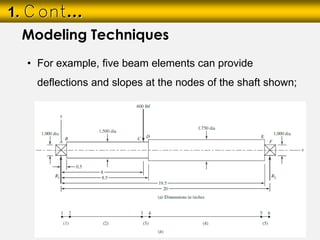
• For example, five beam elements can provide
deflections and slopes at the nodes of the shaft shown.
Modeling Techniques
1. Cont…
• For example, five beam elements can provide
deflections and slopes at the nodes of the shaft shown;
Modeling Techniques
1. Cont…
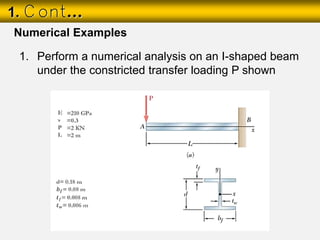
1. Perform a numerical analysis on an I-shaped beam
under the constricted transfer loading P shown
Numerical Examples
1. Cont…
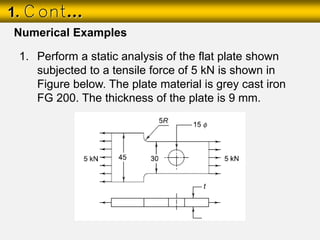
1. Perform a static analysis of the flat plate shown
subjected to a tensile force of 5 kN is shown in
Figure below. The plate material is grey cast iron
FG 200. The thickness of the plate is 9 mm.
Numerical Examples
Acknowledgements
2. R.L. Mott (2007), Machine Elements in Design, Fourth
Edition
3. J.E Shigley & C.R. Mischke, Mechanical Engineering
Design, 6th Edition, Tata McGraw-Hill, New Delhi, India,
2003, ISBN: 0-07-049462-2
1. V. B. Bhandari (1994), Design of Machine Elements, third
Edition
THE
END

L3-1 Introduction to Analysis tools.pdf

  • 1.
  • 2.
    Learning objectives • Explainthe basic principles of Finite Element Analysis, including discretization, elements, nodes, and degrees of freedom • Solve basic structural analysis problems using FEA tools to predict stress, strain, and deformation • Outline the key steps involved in performing FEA
  • 3.
    1. Introduction toAnalysis Tools 1.1 Introduction • There are a great number of analysis tools used in engineering applications to predict the behavior of mechanical components
  • 4.
    • The threebasic methods commonly applied to provide solutions to various engineering problems includes:-  Experimental methods  Analytical methods  Numerical methods (or) Approximate methods 1. Cont…
  • 5.
    • Prototype arephysically created in labs • Time consuming and costly process • Needs man power and material 1. Cont… 1) Experimental methods t is one of the most reliable methods and widely used
  • 6.
    • Problems areexpressed using mathematical differential equations to obtain solutions • It is used only for simple geometries and loading conditions 1. Cont… 2) Analytical methods It is a classical approach which gives 100 % accurate results
  • 7.
    • This methodprovide solutions to problems involving complex material properties and boundary conditions 1. Cont… 3) Numerical methods (or) Approximate methods It uses computational techniques through simulation software’s & large infrastructures The results obtained are approximate
  • 8.
    • There arefour common numerical methods used to solve engineering problems are:-  Finite Element Analysis (FEA)  Boundary Element Method (BEM)  Finite Difference Method (FDM)  Finite Volume Method (FVM) 1. Cont… 1.2 Numerical methods (or) Approximate methods
  • 9.
    • FEA isa numerical technique that discretizes domain of continuous structure  In this method, a body or structure in which the analysis to be carried out is subdivided into smaller elements of finite dimensions called finite elements  Then the body is considered as an assembly of these elements connected at a finite number of joints called Nodes 1. Cont… i. Finite Element Analysis FEA method
  • 10.
    • Based onapplication, finite element problems are classified as follows: Structural Problems Stress and Strain in each element can be calculated Non-structural Problems Temperature (or) Fluid pressure at each nodal point is obtained 1. Cont…
  • 11.
  • 12.
    1. Cont… General Stepsof the Finite Element Analysis • The following two general methods are associated with the FEA:-  Force Method:  Internal forces are considered as the unknowns of the problem  Displacement or stiffness method:  Displacement of the nodes are considered as the unknowns of the problem
  • 13.
    1. Cont… Finite-Element AnalysisSolution Process Idealized model Finite-element model Step 1: Discretization of the Geometry
  • 14.
    • Smaller elementsare classified as follows – One dimensional elements – Two dimensional elements – Three dimensional elements 1. Cont… Element Geometries Categories
  • 15.
    1. Cont… One dimensionalelements • A bar and beam elements are considered as one dimensional elements
  • 16.
    • Triangular andrectangular elements are considered as two dimensional elements 1. Cont… Two dimensional elements
  • 17.
    • The mostcommon three dimensional elements are tetrahedral and hexahedral (Brick) elements 1. Cont… Three dimensional/Solid elements
  • 18.
    • Consider atruss element modeled as a spring element (e) of spring rate ke, with nodes i and j 1. Cont… Solution Process spring rate:
  • 19.
    • Taking allforces f and displacements u directed toward the right as positive, the forces at each node can be written as; 1. Cont… Solution Process In matrix form:
  • 20.
    • Consider atwo-spring system as shown; 1. Cont… Solution Process The internal forces can be analyzed as shown;
  • 21.
    • From eachfree body diagram; 1. Cont… Solution Process The total force at each node is the external force, F1 = f1,1, F2 = f2,1 + f2,2, and F3 = f3,2
  • 22.
    • Network ofelements and nodes is called a mesh • Mesh density increases as more elements are placed within a given region • Mesh refinement is when the mesh is modified from one analysis to the next to yield improved results 1. Cont… Mesh Generation
  • 23.
    • Results generallyimprove when mesh density is increased in areas of high stress gradients • Mesh generation techniques includes; – Manual – Semiautomatic – Fully automated 1. Cont… Mesh Generation
  • 24.
    • When stressconcentrations are present, it is necessary to have a very fine mesh at the stress- concentration region in order to get realistic results; 1. Cont… Mesh Generation
  • 25.
    • Loads areapplied at the nodes • Element loads such as weight, thermal effects, surface pressure, etc. are automatically converted to equivalent nodal loads • The results very near the nodal forces may be unrealistic 1. Cont… Load Application
  • 26.
    1.1 Cont… Boundary Conditions •Constraints at the nodes can be placed to model boundary conditions • Typical boundary conditions include fixed, simply supported, and constrained in one direction
  • 27.
    1. Cont… • CADpackages and automatic mesh generators make model creation relatively painless • Computing speeds are sufficient to allow for dense meshes • The model only needs to be as detailed as needed • For example, five beam elements can provide deflections and slopes at the nodes of the shaft shown. Modeling Techniques
  • 28.
    1. Cont… • Forexample, five beam elements can provide deflections and slopes at the nodes of the shaft shown; Modeling Techniques
  • 29.
    1. Cont… 1. Performa numerical analysis on an I-shaped beam under the constricted transfer loading P shown Numerical Examples
  • 30.
    1. Cont… 1. Performa static analysis of the flat plate shown subjected to a tensile force of 5 kN is shown in Figure below. The plate material is grey cast iron FG 200. The thickness of the plate is 9 mm. Numerical Examples
  • 31.
    Acknowledgements 2. R.L. Mott(2007), Machine Elements in Design, Fourth Edition 3. J.E Shigley & C.R. Mischke, Mechanical Engineering Design, 6th Edition, Tata McGraw-Hill, New Delhi, India, 2003, ISBN: 0-07-049462-2 1. V. B. Bhandari (1994), Design of Machine Elements, third Edition
  • 32.