• BY
• ABRAHAM MARANGU
• TRAINER
• PROJECTS
Project
Project Management Skills 2
 I – Definitions
 II - History
 III – Project Management’s Purpose
 IV – Project Types
I
DEFINITIONS
Project Management Skills 3
I -DEFINITIONS (1)
Project Management Skills 4
 A project is an individual or collaborative enterprise that
is carefully planned to achieve a particular aim
 A project is a temporary endeavor undertaken to create a
unique product, service, or result.
 A project is a temporary organization that is created for a
purpose of delivering one or more business products
according to an agreed business case.
 A project is a time and cost constrained operation to
realize a set of defined deliverables (the scope to fulfill
project’s objectives) up to quality standards and
requirements
I- DEFINITIONS
Typical project characteristics:
Project Management Skills 5
 Clear goals (e.g. new product or solution to a problem)
 Fixed schedule, settled START and END date
 Own resources, fixed budget
 Works according to the settled project plan
 Own project organization
 Divided in sequences which are dependent on each other
 Might be wide and complex, consisting of several sub-projects
 Unique
 Learning process
 Includes risks and uncertainty
I - DEFINITIONS
Project Management Skills 6
 Project is
 Once-off activity, organized process making input and
output to achieve the certain goal(s).
 ”Project has series of complex and interdependency
sequences, which have a common goal or aim. Project
should be implemented in a certain time period, by a
certain budget and should follow the project
specifications. “
 ”Project is a temporary organization, which will be
collapsed when the goal has been achieved”.
I - DEFINITIONS
Project Management Skills 7
 ”Crazy people try to make the unwilling people to do
impossible things”
 Project in the Finnish region Savo (North-Savo, South Savo):
“It’s almost finished, only needs to be started”
 ”In principle, common sense should be enough for any project
- but it is not always enough”.”
Projektiosaaminen
8
Project Management Skills
I - DEFINITIONS
Project Story
Project Management Skills 9
This is a short story about four people,
Everybody, Somebody, Anybody and Nobody.
There was an important job to be done and
Everybody was asked to do it.
Everybody was sure that Somebody would do it.
Anybody could have done it, but Nobody would.
Somebody got angry about that because it was
Everybody's job to do it.
Everybody thought that Anybody could do it, and
Nobody realized that Everybody wouldn't. It
ended up that Everybody blamed Somebody. In
the meantime, Nobody got the job done..
II
HISTORY
Project Management Skills 10
HISTORY (1)
Project Management Skills 11
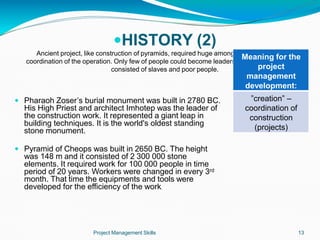
Academic research history of project management is young.
In real life, a human being has implemented project
thousands of years. The starting point in human history has
been construction field and still today we have many of them
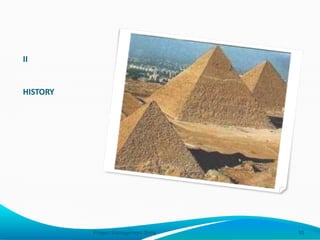
•pyramids
•monuments
•Roman aqueducts and canalization systems
•castles
It is not surprising that project has quite often symbolic,
political or even religious importance.
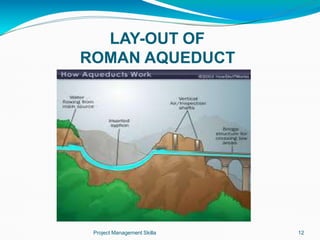
LAY-OUT OF
ROMAN AQUEDUCT
Project Management Skilla 12
HISTORY (2)
Ancient project, like construction of pyramids, required huge among of human labor and
coordination of the operation. Only few of people could become leaders of the operation. Labor
consisted of slaves and poor people.
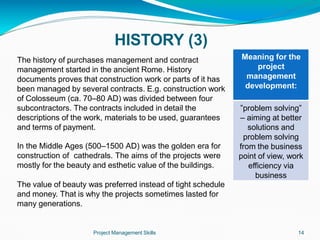
 Pharaoh Zoser’s burial monument was built in 2780 BC.
His High Priest and architect Imhotep was the leader of
the construction work. It represented a giant leap in
building techniques. It is the world's oldest standing
stone monument.
 Pyramid of Cheops was built in 2650 BC. The height
was 148 m and it consisted of 2 300 000 stone
elements. It required work for 100 000 people in time
period of 20 years. Workers were changed in every 3rd
month. That time the equipments and tools were
developed for the efficiency of the work.
Meaning for the
project
management
development:
Project Management Skills 13
”creation” –
coordination of
construction
(projects)
HISTORY (3)
The history of purchases management and contract
management started in the ancient Rome. History
documents proves that construction work or parts of it has
been managed by several contracts. E.g. construction work
of Colosseum (ca. 70–80 AD) was divided between four
subcontractors. The contracts included in detail the
descriptions of the work, materials to be used, guarantees
and terms of payment.
In the Middle Ages (500–1500 AD) was the golden era for
construction of cathedrals. The aims of the projects were
mostly for the beauty and esthetic value of the buildings.
The value of beauty was preferred instead of tight schedule
and money. That is why the projects sometimes lasted for
many generations.
Meaning for the
project
management
development:
Project Management Skills 14
”problem solving”
– aiming at better
solutions and
problem solving
from the business
point of view, work
efficiency via
business
HISTORY (4)
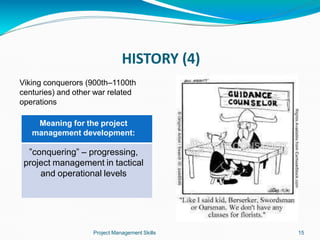
Viking conquerors (900th–1100th
centuries) and other war related
operations
Meaning for the project
management development:
”conquering” – progressing,
project management in tactical
and operational levels
Project Management Skills 15
HISTORY (5) – INDUSTRIAL ERA
Since 19th century technical and industrial
development projects became more common, e.g.
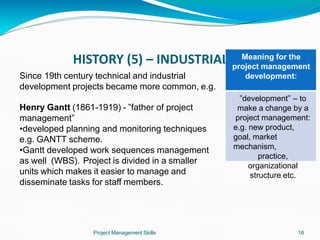
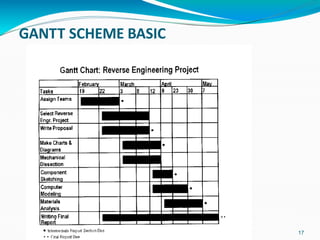
Henry Gantt (1861-1919) - ”father of project
management”
•developed planning and monitoring techniques
e.g. GANTT scheme.
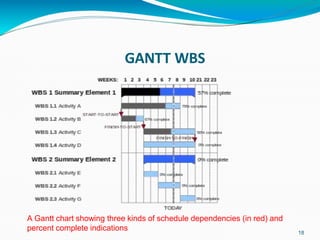
•Gantt developed work sequences management
as well (WBS). Project is divided in a smaller
units which makes it easier to manage and
disseminate tasks for staff members.
Meaning for the
project management
development:
Project Management Skills 16
”development” – to
make a change by a
project management:
e.g. new product,
goal, market
mechanism,
practice,
organizational
structure etc.
GANTT SCHEME BASIC
Projektiosaaminen
17
GANTT WBS
A Gantt chart showing three kinds of schedule dependencies (in red) and
percent complete indications 18
III
PROJECT
MANAGEMENT’S
PURPOSE
Project Management Skills 19
Project Management Skills 29
III PROJECT MANAGEMENT PURPOSE
Project Management Skills 21
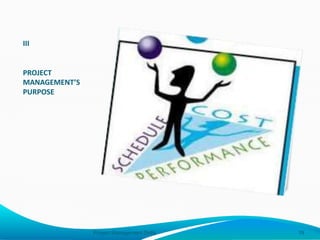
 Project Management is
 to plan, lead and monitor resources (people, equipment and
materials) in such way, that technical, budgetary and
timeliness of the project will be achieved.
 Principles of project management remains the same in all
projects
 ”Project management is to apply leadership methods to
gain the project’s aims and goals”” (Artto et al. 2006)
 Project Management in Business
 The business is more and more organized so that the work
is organized to be done in project teams (because of the
need for tailor made solutions to the clients)
III PROJECT MANAGEMENT PURPOSE
Project Management Skills 22
Project management enables to organize resources
so that the project can be implemented according to
the project plan.
•Quality
•Schedule
•Budget
•Resources; money, staff, materials, machinery and
equipment, premises, energy
III PROJECT MANAGEMENT PURPOSE
Project Management Skills 23
• Project definition
• Planning of goal and work
• Analyzing goals
• Risk management
• Project scope management
• Evaluation of resources
• Dividing resources
• Set-up of project organization
•Organizing the work
• Catch up of resources
• Dividing the tasks
• Project general management and
follow-up
• Analyzing results
• Quality management
• Preventing mistakes
• Close-up of project
• Stakeholders’ need analysis
• Project communication
III PROJECT MANAGEMENT PURPOSE
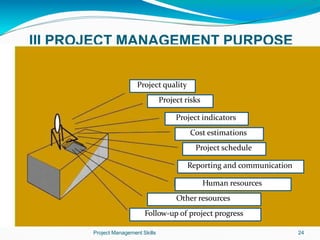
Project quality
Project risks
Project indicators
Cost estimations
Project schedule
Reporting and communication
Human resources
Other resources
Follow-up of project progress
Project Management Skills 24
IV
PROJECT TYPES
Project Management Skills 25
SOME PROJECT TYPES
Project Management Skills 26
 Company’s internal development project
 Delivery project
 Research and development (R&D) project
 Technical implementation project
 Construction project
 Product development project
 Pre-feasibility and feasibility projects
COMPANY’S INTERNAL DEVELOPMENT
PROJECTS
Project Management Skills 27
 Examples:
 Taking into use a new information
system
 Company development, change
or turnover
 Opening new distribution channel
 Moving to new premises
 New product and it’s launch
 To new markets
(internationalization)
 Characteristics:
 Project staff works a part-
time in a project
 Project reflects the
general team spirit and
motivation
 Brings often required
change to routine work
 Time resources are usually
small ones as routine work
keeps also going
 External expertise is quite
much in
 Amount of meetings
increases
 Aim is to make a specific
change to an operation or
products
DELIVERY PROJECT
Project Management Skills 28
 Examples :
 Assembling and taking in the use
of a software
 Delivery of machinery
 Delivery of computers
 Repairing projects
 Characteristics:
 Delivered to an external
customer
 Unique to a customer, routine
to a seller/deliverer
 ”basic operation”
 Project duration varies (days-
years)
 Often deliveries to abroad
 Delivery is made by several
contractors/sellers
 Much parallel tasks, multi-
tasks
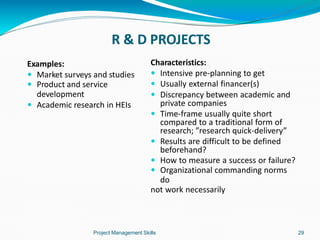
R & D PROJECTS
Project Management Skills 29
Examples:
 Market surveys and studies
 Product and service
development
 Academic research in HEIs
Characteristics:
 Intensive pre-planning to get
 Usually external financer(s)
 Discrepancy between academic and
private companies
 Time-frame usually quite short
compared to a traditional form of
research; ”research quick-delivery”
 Results are difficult to be defined
beforehand?
 How to measure a success or failure?
 Organizational commanding norms
do
not work necessarily
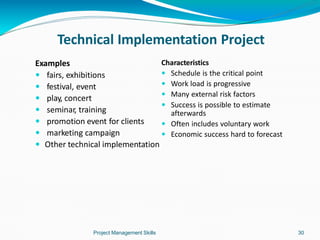
Technical Implementation Project
Project Management Skills 30
Examples
 fairs, exhibitions
 festival, event
 play, concert
 seminar, training
 promotion event for clients
 marketing campaign
 Other technical implementation
Characteristics
 Schedule is the critical point
 Work load is progressive
 Many external risk factors
 Success is possible to estimate
afterwards
 Often includes voluntary work
 Economic success hard to forecast
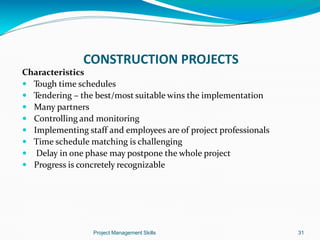
Characteristics
 Tough time schedules
 Tendering – the best/most suitable wins the implementation
 Many partners
 Controlling and monitoring
 Implementing staff and employees are of project professionals
 Time schedule matching is challenging
 Delay in one phase may postpone the whole project
 Progress is concretely recognizable
Project Management Skills 31
CONSTRUCTION PROJECTS
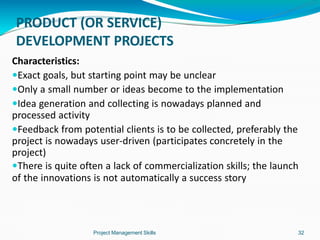
PRODUCT (OR SERVICE)
DEVELOPMENT PROJECTS
Project Management Skills 32
Characteristics:
Exact goals, but starting point may be unclear
Only a small number or ideas become to the implementation
Idea generation and collecting is nowadays planned and
processed activity
Feedback from potential clients is to be collected, preferably the
project is nowadays user-driven (participates concretely in the
project)
There is quite often a lack of commercialization skills; the launch
of the innovations is not automatically a success story
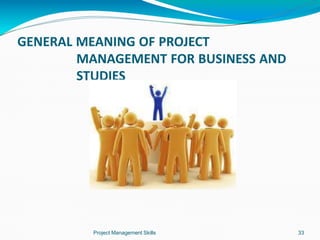
GENERAL MEANING OF PROJECT
MANAGEMENT FOR BUSINESS AND
STUDIES
Project Management Skills 33
Why are projects needed ?
 Growing requirements in operational environment:
 Increased competition
 Today’s work includes several collaborants like
subcontractors, distributors etc. which nowadays
locate abroad as well
 Information flow is harder to manage
 Rapid development of information systems
 Other standards, like quality systems, create new
requirements
MORE EFFECTICITY
Project Management Skills 34
Why to learn project management skills?
Project Management Skills 35
 Develops skills which help in operating in unexpected and
real world situations
 Coaches to project work and collaboration
 Helps to create more work contacts
 Enriches studies and make studies more versatile
 Projects are essential part of today’s working life
 The first engineering salary work is easier (and more
likely) to get from a project
Project based learning (PBL)
Project Management Skills 36
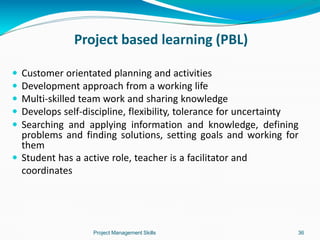
 Customer orientated planning and activities
 Development approach from a working life
 Multi-skilled team work and sharing knowledge
 Develops self-discipline, flexibility, tolerance for uncertainty
 Searching and applying information and knowledge, defining
problems and finding solutions, setting goals and working for
them
 Student has a active role, teacher is a facilitator and
coordinates
Project based learning (PBL)
Project Management Skills 37
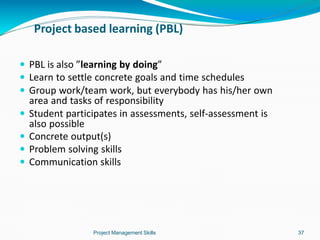
 PBL is also ”learning by doing”
 Learn to settle concrete goals and time schedules
 Group work/team work, but everybody has his/her own
area and tasks of responsibility
 Student participates in assessments, self-assessment is
also possible
 Concrete output(s)
 Problem solving skills
 Communication skills
PROs of project work…?
Project Management Skills 38
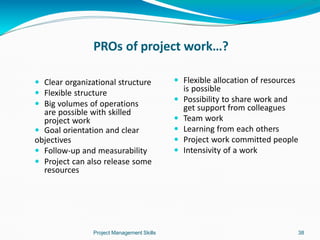
 Clear organizational structure
 Flexible structure
 Big volumes of operations
are possible with skilled
project work
 Goal orientation and clear
objectives
 Follow-up and measurability
 Project can also release some
resources
 Flexible allocation of resources
is possible
 Possibility to share work and
get support from colleagues
 Team work
 Learning from each others
 Project work committed people
 Intensivity of a work
 Battle for resources
 Contradicted goals of key
persons
 Plan is not realistic
 Milestone schedules change
continuously – delays
 Lack of project leaderhsip
 Continuous change
 Discontinuity
 Short term partial
optimization
Project Management Skills 39
 Project is ”a box” inside the
organization
 Stress peaks
 Lack of project management
skills among staff
 Disability to work in teams
 Transfer of knowledge
 Internal communication
 Dissemination to target
groups
 Too high and long-term work
intensity
CONs of project work…?
Challenging factors
Project Management Skills 40
 Big size of the project (many partners, big budget, strategic
importance)
 Long duration
 Heavy interdependency between activities
 No pre-knowledge or experience about new solutions
 Exceptional quality requirements
 Publicity, political factors
 New operational environment, new cultures
 Too big pressure to succeed
Project pitfalls (1)
41
 Action is just called as a project
 Action is called project but is managed by a
division manager
 Project is somebody’s parallel job; side job
 Project management tools are not known or used
 Systemic approach and follow-up are missing
Project pitfalls (2)
42
 No project guidelines, everybody works as likes
 Attitudes like ”It is not possible to schedule mywork”
 Communication is not a tool; managers don’t know the
project implementation and work load concretely
 Unclear START and END dates
 No professional project manager
to conclude…a good project is or has:
Projektiosaaminen 43
1) Based on the real need and it makes the required change
2) Clear goals and activities to achieve the goals
3) Realistic project plan
4) Cost-efficient and efficiently implemented
5) It results to the future activities
6) There are more beneficiaries than an implementing body
solely.

INTRODUCTION AND DEFINITION TO PROJECT MANAGEMENT.ppt

  • 1.
    • BY • ABRAHAMMARANGU • TRAINER • PROJECTS
  • 2.
    Project Project Management Skills2  I – Definitions  II - History  III – Project Management’s Purpose  IV – Project Types
  • 3.
  • 4.
    I -DEFINITIONS (1) ProjectManagement Skills 4  A project is an individual or collaborative enterprise that is carefully planned to achieve a particular aim  A project is a temporary endeavor undertaken to create a unique product, service, or result.  A project is a temporary organization that is created for a purpose of delivering one or more business products according to an agreed business case.  A project is a time and cost constrained operation to realize a set of defined deliverables (the scope to fulfill project’s objectives) up to quality standards and requirements
  • 5.
    I- DEFINITIONS Typical projectcharacteristics: Project Management Skills 5  Clear goals (e.g. new product or solution to a problem)  Fixed schedule, settled START and END date  Own resources, fixed budget  Works according to the settled project plan  Own project organization  Divided in sequences which are dependent on each other  Might be wide and complex, consisting of several sub-projects  Unique  Learning process  Includes risks and uncertainty
  • 6.
    I - DEFINITIONS ProjectManagement Skills 6  Project is  Once-off activity, organized process making input and output to achieve the certain goal(s).  ”Project has series of complex and interdependency sequences, which have a common goal or aim. Project should be implemented in a certain time period, by a certain budget and should follow the project specifications. “  ”Project is a temporary organization, which will be collapsed when the goal has been achieved”.
  • 7.
    I - DEFINITIONS ProjectManagement Skills 7  ”Crazy people try to make the unwilling people to do impossible things”  Project in the Finnish region Savo (North-Savo, South Savo): “It’s almost finished, only needs to be started”  ”In principle, common sense should be enough for any project - but it is not always enough”.”
  • 8.
  • 9.
    Project Story Project ManagementSkills 9 This is a short story about four people, Everybody, Somebody, Anybody and Nobody. There was an important job to be done and Everybody was asked to do it. Everybody was sure that Somebody would do it. Anybody could have done it, but Nobody would. Somebody got angry about that because it was Everybody's job to do it. Everybody thought that Anybody could do it, and Nobody realized that Everybody wouldn't. It ended up that Everybody blamed Somebody. In the meantime, Nobody got the job done..
  • 10.
  • 11.
    HISTORY (1) Project ManagementSkills 11 Academic research history of project management is young. In real life, a human being has implemented project thousands of years. The starting point in human history has been construction field and still today we have many of them •pyramids •monuments •Roman aqueducts and canalization systems •castles It is not surprising that project has quite often symbolic, political or even religious importance.
  • 12.
  • 13.
    HISTORY (2) Ancient project,like construction of pyramids, required huge among of human labor and coordination of the operation. Only few of people could become leaders of the operation. Labor consisted of slaves and poor people.  Pharaoh Zoser’s burial monument was built in 2780 BC. His High Priest and architect Imhotep was the leader of the construction work. It represented a giant leap in building techniques. It is the world's oldest standing stone monument.  Pyramid of Cheops was built in 2650 BC. The height was 148 m and it consisted of 2 300 000 stone elements. It required work for 100 000 people in time period of 20 years. Workers were changed in every 3rd month. That time the equipments and tools were developed for the efficiency of the work. Meaning for the project management development: Project Management Skills 13 ”creation” – coordination of construction (projects)
  • 14.
    HISTORY (3) The historyof purchases management and contract management started in the ancient Rome. History documents proves that construction work or parts of it has been managed by several contracts. E.g. construction work of Colosseum (ca. 70–80 AD) was divided between four subcontractors. The contracts included in detail the descriptions of the work, materials to be used, guarantees and terms of payment. In the Middle Ages (500–1500 AD) was the golden era for construction of cathedrals. The aims of the projects were mostly for the beauty and esthetic value of the buildings. The value of beauty was preferred instead of tight schedule and money. That is why the projects sometimes lasted for many generations. Meaning for the project management development: Project Management Skills 14 ”problem solving” – aiming at better solutions and problem solving from the business point of view, work efficiency via business
  • 15.
    HISTORY (4) Viking conquerors(900th–1100th centuries) and other war related operations Meaning for the project management development: ”conquering” – progressing, project management in tactical and operational levels Project Management Skills 15
  • 16.
    HISTORY (5) –INDUSTRIAL ERA Since 19th century technical and industrial development projects became more common, e.g. Henry Gantt (1861-1919) - ”father of project management” •developed planning and monitoring techniques e.g. GANTT scheme. •Gantt developed work sequences management as well (WBS). Project is divided in a smaller units which makes it easier to manage and disseminate tasks for staff members. Meaning for the project management development: Project Management Skills 16 ”development” – to make a change by a project management: e.g. new product, goal, market mechanism, practice, organizational structure etc.
  • 17.
  • 18.
    GANTT WBS A Ganttchart showing three kinds of schedule dependencies (in red) and percent complete indications 18
  • 19.
  • 20.
  • 21.
    III PROJECT MANAGEMENTPURPOSE Project Management Skills 21  Project Management is  to plan, lead and monitor resources (people, equipment and materials) in such way, that technical, budgetary and timeliness of the project will be achieved.  Principles of project management remains the same in all projects  ”Project management is to apply leadership methods to gain the project’s aims and goals”” (Artto et al. 2006)  Project Management in Business  The business is more and more organized so that the work is organized to be done in project teams (because of the need for tailor made solutions to the clients)
  • 22.
    III PROJECT MANAGEMENTPURPOSE Project Management Skills 22 Project management enables to organize resources so that the project can be implemented according to the project plan. •Quality •Schedule •Budget •Resources; money, staff, materials, machinery and equipment, premises, energy
  • 23.
    III PROJECT MANAGEMENTPURPOSE Project Management Skills 23 • Project definition • Planning of goal and work • Analyzing goals • Risk management • Project scope management • Evaluation of resources • Dividing resources • Set-up of project organization •Organizing the work • Catch up of resources • Dividing the tasks • Project general management and follow-up • Analyzing results • Quality management • Preventing mistakes • Close-up of project • Stakeholders’ need analysis • Project communication
  • 24.
    III PROJECT MANAGEMENTPURPOSE Project quality Project risks Project indicators Cost estimations Project schedule Reporting and communication Human resources Other resources Follow-up of project progress Project Management Skills 24
  • 25.
  • 26.
    SOME PROJECT TYPES ProjectManagement Skills 26  Company’s internal development project  Delivery project  Research and development (R&D) project  Technical implementation project  Construction project  Product development project  Pre-feasibility and feasibility projects
  • 27.
    COMPANY’S INTERNAL DEVELOPMENT PROJECTS ProjectManagement Skills 27  Examples:  Taking into use a new information system  Company development, change or turnover  Opening new distribution channel  Moving to new premises  New product and it’s launch  To new markets (internationalization)  Characteristics:  Project staff works a part- time in a project  Project reflects the general team spirit and motivation  Brings often required change to routine work  Time resources are usually small ones as routine work keeps also going  External expertise is quite much in  Amount of meetings increases  Aim is to make a specific change to an operation or products
  • 28.
    DELIVERY PROJECT Project ManagementSkills 28  Examples :  Assembling and taking in the use of a software  Delivery of machinery  Delivery of computers  Repairing projects  Characteristics:  Delivered to an external customer  Unique to a customer, routine to a seller/deliverer  ”basic operation”  Project duration varies (days- years)  Often deliveries to abroad  Delivery is made by several contractors/sellers  Much parallel tasks, multi- tasks
  • 29.
    R & DPROJECTS Project Management Skills 29 Examples:  Market surveys and studies  Product and service development  Academic research in HEIs Characteristics:  Intensive pre-planning to get  Usually external financer(s)  Discrepancy between academic and private companies  Time-frame usually quite short compared to a traditional form of research; ”research quick-delivery”  Results are difficult to be defined beforehand?  How to measure a success or failure?  Organizational commanding norms do not work necessarily
  • 30.
    Technical Implementation Project ProjectManagement Skills 30 Examples  fairs, exhibitions  festival, event  play, concert  seminar, training  promotion event for clients  marketing campaign  Other technical implementation Characteristics  Schedule is the critical point  Work load is progressive  Many external risk factors  Success is possible to estimate afterwards  Often includes voluntary work  Economic success hard to forecast
  • 31.
    Characteristics  Tough timeschedules  Tendering – the best/most suitable wins the implementation  Many partners  Controlling and monitoring  Implementing staff and employees are of project professionals  Time schedule matching is challenging  Delay in one phase may postpone the whole project  Progress is concretely recognizable Project Management Skills 31 CONSTRUCTION PROJECTS
  • 32.
    PRODUCT (OR SERVICE) DEVELOPMENTPROJECTS Project Management Skills 32 Characteristics: Exact goals, but starting point may be unclear Only a small number or ideas become to the implementation Idea generation and collecting is nowadays planned and processed activity Feedback from potential clients is to be collected, preferably the project is nowadays user-driven (participates concretely in the project) There is quite often a lack of commercialization skills; the launch of the innovations is not automatically a success story
  • 33.
    GENERAL MEANING OFPROJECT MANAGEMENT FOR BUSINESS AND STUDIES Project Management Skills 33
  • 34.
    Why are projectsneeded ?  Growing requirements in operational environment:  Increased competition  Today’s work includes several collaborants like subcontractors, distributors etc. which nowadays locate abroad as well  Information flow is harder to manage  Rapid development of information systems  Other standards, like quality systems, create new requirements MORE EFFECTICITY Project Management Skills 34
  • 35.
    Why to learnproject management skills? Project Management Skills 35  Develops skills which help in operating in unexpected and real world situations  Coaches to project work and collaboration  Helps to create more work contacts  Enriches studies and make studies more versatile  Projects are essential part of today’s working life  The first engineering salary work is easier (and more likely) to get from a project
  • 36.
    Project based learning(PBL) Project Management Skills 36  Customer orientated planning and activities  Development approach from a working life  Multi-skilled team work and sharing knowledge  Develops self-discipline, flexibility, tolerance for uncertainty  Searching and applying information and knowledge, defining problems and finding solutions, setting goals and working for them  Student has a active role, teacher is a facilitator and coordinates
  • 37.
    Project based learning(PBL) Project Management Skills 37  PBL is also ”learning by doing”  Learn to settle concrete goals and time schedules  Group work/team work, but everybody has his/her own area and tasks of responsibility  Student participates in assessments, self-assessment is also possible  Concrete output(s)  Problem solving skills  Communication skills
  • 38.
    PROs of projectwork…? Project Management Skills 38  Clear organizational structure  Flexible structure  Big volumes of operations are possible with skilled project work  Goal orientation and clear objectives  Follow-up and measurability  Project can also release some resources  Flexible allocation of resources is possible  Possibility to share work and get support from colleagues  Team work  Learning from each others  Project work committed people  Intensivity of a work
  • 39.
     Battle forresources  Contradicted goals of key persons  Plan is not realistic  Milestone schedules change continuously – delays  Lack of project leaderhsip  Continuous change  Discontinuity  Short term partial optimization Project Management Skills 39  Project is ”a box” inside the organization  Stress peaks  Lack of project management skills among staff  Disability to work in teams  Transfer of knowledge  Internal communication  Dissemination to target groups  Too high and long-term work intensity CONs of project work…?
  • 40.
    Challenging factors Project ManagementSkills 40  Big size of the project (many partners, big budget, strategic importance)  Long duration  Heavy interdependency between activities  No pre-knowledge or experience about new solutions  Exceptional quality requirements  Publicity, political factors  New operational environment, new cultures  Too big pressure to succeed
  • 41.
    Project pitfalls (1) 41 Action is just called as a project  Action is called project but is managed by a division manager  Project is somebody’s parallel job; side job  Project management tools are not known or used  Systemic approach and follow-up are missing
  • 42.
    Project pitfalls (2) 42 No project guidelines, everybody works as likes  Attitudes like ”It is not possible to schedule mywork”  Communication is not a tool; managers don’t know the project implementation and work load concretely  Unclear START and END dates  No professional project manager
  • 43.
    to conclude…a goodproject is or has: Projektiosaaminen 43 1) Based on the real need and it makes the required change 2) Clear goals and activities to achieve the goals 3) Realistic project plan 4) Cost-efficient and efficiently implemented 5) It results to the future activities 6) There are more beneficiaries than an implementing body solely.