PROJECT MANAGEMENT
Laura Sivula laura.sivula@aalto.fi
www.linkedin.com/in/laurasivula
What is project work?
How to do project work?
Doing things hands on
What is a project?
WHAT IS A PROJECT?
A specified amount of work to be performed
during a certain period of time at a specified
cost.
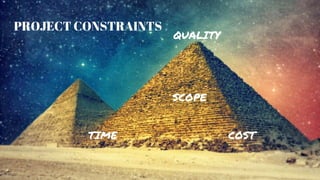
PROJECT CONSTRAINTS
TIME COST
QUALITY
SCOPE
PROJECT OBJECTIVES
WHAT?
Scope,
product
WHEN?
Time,
schedule
HOW?
Budget,
resources
Project management is the
application of processes,
methods, knowledge, skills
and experience to achieve the
project objectives.
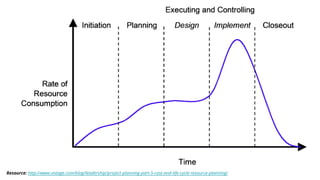
Project Life Cycle
Resource: http://www.vistage.com/blog/leadership/project-planning-part-5-cost-and-life-cycle-resource-planning/
Examples of projects
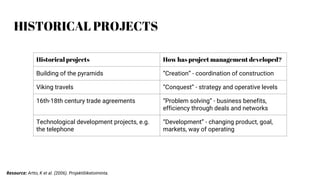
HISTORICAL PROJECTS
Historical projects How has project management developed?
Building of the pyramids “Creation” - coordination of construction
Viking travels “Conquest” - strategy and operative levels
16th-18th century trade agreements “Problem solving” - business benefits,
efficiency through deals and networks
Technological development projects, e.g.
the telephone
“Development” - changing product, goal,
markets, way of operating
Resource: Artto, K et al. (2006). Projektiliiketoiminta.
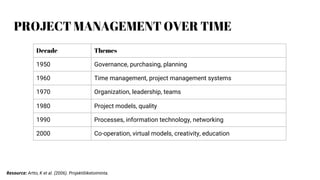
PROJECT MANAGEMENT OVER TIME
Decade Themes
1950 Governance, purchasing, planning
1960 Time management, project management systems
1970 Organization, leadership, teams
1980 Project models, quality
1990 Processes, information technology, networking
2000 Co-operation, virtual models, creativity, education
Resource: Artto, K et al. (2006). Projektiliiketoiminta.
EXAMPLES OF PROJECTS
❏ Developing a new product or service
❏ Implementing a change in the structure, staffing or culture of an
organization
❏ Developing or acquiring a new or modified information system
❏ Constructing a building or infrastructure
❏ Implementing a new business process or procedure
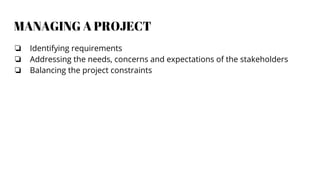
MANAGING A PROJECT
❏ Identifying requirements
❏ Addressing the needs, concerns and expectations of the stakeholders
❏ Balancing the project constraints
PROJECT CHARACTERISTICS
❏ A target outcome
❏ A defined life span
❏ Cross organisational participation
❏ Stakeholder participation
❏ New or unique
❏ Time, cost and performance requirements
TYPICAL DOWNFALLS
❏ Client not committed enough
❏ Project time frame too long
❏ Risk management
❏ Poor testing
❏ Constraints: time, budget, quality, scope
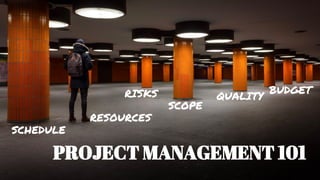
PROJECT MANAGEMENT 101
SCOPE
QUALITY
SCHEDULE
BUDGET
RESOURCES
RISKS
Project Planning
IDENTIFYING TASKS
❏ Identify project goal, schedule, budget and tasks
❏ Define milestones and subtasks
❏ Identify talent in project team
❏ Allocate tasks
Making a
Project Plan
WHY? WHAT? WHO? WHEN?
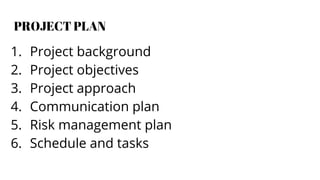
PROJECT PLAN
1. Project background
2. Project objectives
3. Project approach
4. Communication plan
5. Risk management plan
6. Schedule and tasks
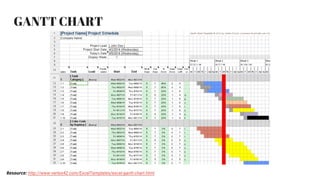
GANTT CHART
Resource: http://www.vertex42.com/ExcelTemplates/excel-gantt-chart.html
www.teamgantt.com
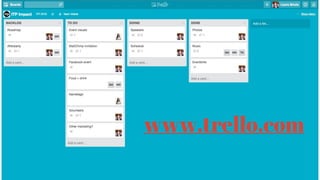
TO DO DOING DONE
LAURA
TONI
M
ARKO
HEINI
KANBAN BOARD
www.trello.com
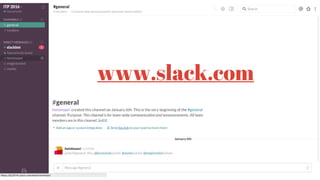
www.slack.com
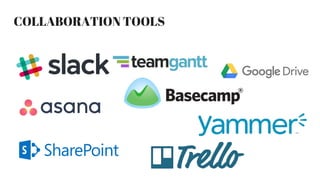
COLLABORATION TOOLS
TIME MANAGEMENT
❏ Time management is essential in project planning and allocating tasks
❏ Team’s time management is only as good as its’ members
❏ Keeping promised times and deadlines is important
❏ Open and honest communication prevents conflicts
WHEN TASKS PILE UP
❏ Constant evaluation of schedule and tasks
❏ Feeling of control reduces stress levels
❏ Be action orientated and prioritize
❏ Know your goals and how progress is measured
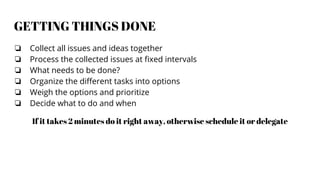
GETTING THINGS DONE
❏ Collect all issues and ideas together
❏ Process the collected issues at fixed intervals
❏ What needs to be done?
❏ Organize the different tasks into options
❏ Weigh the options and prioritize
❏ Decide what to do and when
If it takes 2 minutes do it right away, otherwise schedule it or delegate
Project Management
PROJECT
MANAGER
SHARED
VISION
COMMUNICATION
SKILLS
ENTHUSIASTIC
EMPHATETIC
PROFESSIONAL
ABILITY TO
DELEGATE
STRESS
MANAGEMENT
TEAM PLAYER
PROBLEM SOLVER
KNOW-HOW
Project Manager
Project
team Customers/
end users
Society
Specialists
Project
sponsor
Media
Internal
customers
INTERNAL STAKEHOLDERS EXTERNAL STAKEHOLDERS
Stakeholders are individuals,
groups or organizations, who
are affected by the project or
can affect the project
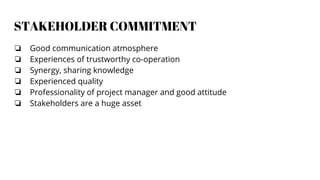
STAKEHOLDER COMMITMENT
❏ Good communication atmosphere
❏ Experiences of trustworthy co-operation
❏ Synergy, sharing knowledge
❏ Experienced quality
❏ Professionality of project manager and good attitude
❏ Stakeholders are a huge asset
Project Models
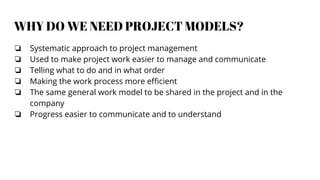
WHY DO WE NEED PROJECT MODELS?
❏ Systematic approach to project management
❏ Used to make project work easier to manage and communicate
❏ Telling what to do and in what order
❏ Making the work process more efficient
❏ The same general work model to be shared in the project and in the
company
❏ Progress easier to communicate and to understand
WHY SHOULD YOU USE PROJECT MODELS?
Careful planning is crucial for project success
WHY SHOULD YOU USE PROJECT MODELS?
❏ Careful planning is crucial for project
success
Executing needs to be efficient to get things
done
WHY SHOULD YOU USE PROJECT MODELS?
❏ Careful planning is crucial for project
success
❏ Executing needs to be efficient to get
things done
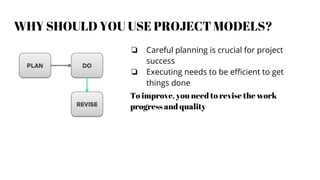
To improve, you need to revise the work
progress and quality
WHY SHOULD YOU USE PROJECT MODELS?
❏ Careful planning is crucial for project
success
❏ Executing needs to be efficient to get
things done
❏ To improve, you need to revise the work
progress and quality
Act if there is room for improvement
WHY SHOULD YOU USE PROJECT MODELS?
❏ Careful planning is crucial for project
success
❏ Executing needs to be efficient to get
things done
❏ To improve, you need to revise the work
progress and quality
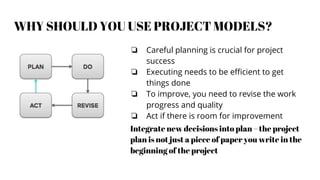
❏ Act if there is room for improvement
Integrate new decisions into plan – the project
plan is not just a piece of paper you write in the
beginning of the project
Classic models
WATERFALL
1.
2.
3.
4.
5.
Requirements
Design
Implementation
Verification
Maintenance
Agile models
https://www.youtube.com/watch?v=oyVksFviJVE
WHAT IS SCRUM?
❏ Agile software development methodology
❏ A flexible and holistic approach to project management
❏ Team works as a unit to reach a common goal
❏ Customers can change their minds about what they want and need
during a project
❏ Easier to address unpredicted challenges
❏ Focusing on the team’s ability to deliver quickly
Product owner, development team, Scrum Master...
Product
backlog
Sprint
backlog
Sprint
End
product
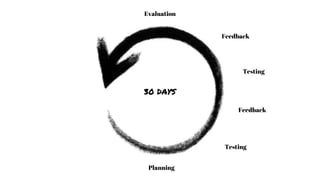
SCRUM
Evaluation
Planning
Testing
30 DAYS
Feedback
Testing
Feedback
Scrum Master
A looser role than Project Manager
Facilitator
Manages process of how
information is exchanged
Makes sure workloads are equal
Makes sure deadlines and
milestones a reached
Key events
➔ Sprint planning
◆ What work is to be done?
◆ Identify and communicate how much work to be
done
➔ Weekly scrum meeting
◆ All members come prepared
◆ What did I do last week that helped the team?
◆ What will I do next week to help the team?
➔ Sprint review
◆ Review the work that has been completed and
uncompleted
◆ Present the completed work to stakeholders
◆ What went well? What could be improved?
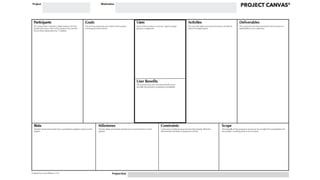
Project Management
Canvas
EXAMPLE
CASE
Platform for marketing Finnish higher
education to international students
Thank you!
Laura Sivula
laura.sivula@aalto.fi
www.linkedin.com/in/laurasivula

Boost Dropout Academy: Project Management