SERVICE CHARTER
PRESENTED
BY
MARANGU NCUNGE
LECTURER KSG BARINGO
1
INTRODUCTION
• The new constitution has placed new demands in the
provision of services to the citizenry both at the National
and County level.
• Article 174(c) of the constitution gives powers of self-
governance to the people and enhance participation of
the people in the exercise of the powers of the State and
in making decisions affecting them.
Introduction cont….
 Article 46 (1) (a) & (b) gives the consumers the right to
goods and services of reasonable quality and to
information necessary for them to gain full benefit from
the goods and services and Article 232 provides for the
values and principles of public service which are:
 High standards of professional ethics,
 Efficient, effective and economical use of resources
 Involvement of people in the process of policy making
Accountability for administrative acts
 Responsive, prompt, effective, impartial and equitable
provision of services.
Introduction cont….
• These demands as set out in the Constitution,
therefore, require that all MDAs governments
put in place a Performance Management
systems that will allow them to focus on citizen,
results, equitable development and create an
empowered and innovative workforce which is
transparent, accountable and able to collaborate
with all stakeholders.
WHAT IS A SERVICE CHARTER
-A service charter is a short publication that describes the
service experience a client can
expect from an organisation.
-It is a brief public document that provides
key information about an agency’s service delivery
approach and the relationship the client will have with
the organisation..
- A Service Charter clarifies what customers should expect
from an organization in terms of the type, quantity and
quality of services provided.
5
including:
-what the organisation does;
- how to contact and communicate with the agency;
-the standard of service clients can expect;
-clients’ basic rights and responsibilities; and
-how to provide feedback or make a complaint.
• A charter need not cover every function and service an
agency provides, or detail every aspect of service
delivery. Rather, it should focus on the key areas seen
as important
6
Importance of Citizens’ Service Delivery
Charters
• Empowers citizens to hold institutions and
individual officers accountable for quality,
timely and responsive services- value addition
to taxes
• Reduces corruption
• Changes culture and attitude at work place
by focusing efforts to customer satisfaction
• Ensures public officers are conscious about
quality of services offered
• Enables systems to continuously re-engineer
Importance Cont…
• To continually improve the quality of public
services for the people of Kenya.
• To secure better value and enhance
accountability in service provision.
• Promote public trust in Government
services
• Promote recognition of the citizen as a
customer to public services
8
Nature of service charter
• A service charter is a public document that should be
used as the driver for cultural change within the
organisation. This change can encompass client-focus,
changed business practices, outcomes rather than
process, better and more responsive communications,
and improved relationships with clients.
• Organisations might consider having their charter
reviewed by a legal expert to ensure that the wording
used does not inadvertently give rise to legal liability.
9
• For a Service Charter to be effective,
customers must be aware of its
existence. It should therefore be in
the public domain e.g. on internet,
brochures
10
HOW TO DEVELOP
A
CUSTOMER SERVICE CHARTER
11
INVOLVE YOUR STAFF
• Your staff are the people who know your
customers best and have close contact
with them. This results in buy-in and
ownership of the service charter.
12
IDENTIFY AND REVIEW CURRENT
SERVICES
• Reviewing the services offered is part of
your strategic planning process.
• It refocuses your direction when
developing and refining your service
charter.
13
IDENTIFY YOUR CUSTOMERS
• A customer is someone who is the recipient of
the services you provide.
• They need to be identified in terms of core
services and major consumer groups. They can
be both internal as well as external.
14
LINK SERVICE CHARTER TO STRATEGIC
PLAN
• Service delivery standards should
reflect your organization’s strategic
priorities and financial capability.
15
ESTABLISH FEEDBACK MECHANISMS
• To identify customer needs and the
particular features of service they
value, undertake research and develop
mechanisms to capture feedback.
16
COMMUNICATE FEEDBACK
TO STAFF
• Develop mechanisms to give all customer feedback,
both positive and negative to staff.
• Publicize positive feedback more widely and take
corrective measures on negative feedback .
17
IDENTIFY SERVICES OFFERED AND
DEVELOP
SERVICE STANDARDS
• For each service, ask what it means to
perform the service well. Standards should
be linked to the strategic plan as well as the
performance contract;
• Initiatives such as best practices and
benchmarking can be used in developing the
standards.
18
WRITE, PUBLISH AND PROMOTE
CHARTER
• Our Charter should be an easy to read
document that is readily available to
customers. It should be displayed in
prominent public areas within the
organization.
19
• Service charter launch
• Organisations should consider a strategy for
launching their service charter to achieve
maximum
• exposure. This may include:
• high-profile launch by the Minister or
appropriate dignitary;
• managing a media campaign and an ongoing
communications strategy;
20
Maintaining and reviewing a charter
• The service charter should be a living
document that evolves in line with changes
that occur within the agency and that affect
its clients. This means that agencies must
regularly reviewtheir charter to ensure its
ongoing relevance and effectiveness.
Questions to address are:
21
• whether the charter continues to reflect the
agency’s approach to client service and any
• significant new initiatives in that area;
• whether the service commitments and standards
are still aligned to the needs and
• priorities of the agency’s clients and key
stakeholders.
• whether the charter continues to meet the client
service principles;
22
• whether the current content is accurate (e.g.
Agency information on function and contact
details);
• whether the format, design and availability
meet client needs;
• whether there is reliable and effective data
collection on client feedback, service
• standards and complaints;
• whether changes should be made to the
complaint handling processes
23
• Apart from direct
• agency/client processes, consider the impact of
third party review for unresolved
• complaints, such as:
• in-house review by an independent officer, or
• through external avenues, such as the:
• Ombudsman;
• Administrative Appeals Tribunal; or
• Human Rights Commission.
24
Triggers for reviewing a charter
• changes to the agency’s organisation structure;
• changes to Administrative Arrangement Orders;
• changes to the client profile;
• changes to service delivery mechanisms;
• unsolicited feedback from clients on the Charter
25
CONTENTS OF A
SERVICE CHARTER
26
• Preamble
• Mandates
• Vision
• Mission
• Core Values
• who the clients or potential clients are
27
• Avenues of communication
A service charter is to contain statements on how
clients and stakeholders can communicate
with the organisation.
—key contact details; postal or street address,
phone, fax or toll free number, email and Web
site address
-appropriate avenues to meet client needs including
people with disabilities
•
28
Client rights and responsibilities
• A service charter should set out the rights of
clients and what they can expect from an
agency. Similarly, it should set out the
responsibilities of clients to abide by certain
codes of behaviour, to help the agency
provide good service to them
29
Examples of Client rights
• Clients have:
• the right to review and appeal;
• the right to lodge a complaint;
• the right to privacy and confidentiality;
• the right to see information (i.e. Freedom of
Information obligation);
• he right to access services, facilities and
information in a manner which meets theirneeds.
30
Examples of common Client responsibilities
Clients are obliged:
• to treat staff with courtesy;
• to attend scheduled meetings punctually;
• to respond to requests for information
accurately, thoroughly and in atimely manner;
• to abide by any legal requirements and other
obligations that clients are to meet in orderto be
eligible for payments or services sought.
31
• Client feedback and complaints
• Organisations must have avenues for clients
to provide feedback and make complaints and
have mechanisms to report on that data.
• A service charter must contain information on
the feedback and complaints processes.
Aspects to consider are:
• That the organisation welcomes feedback
(complaints, compliments and suggestions
32
• how to make a complaint, including relevant
postal and email addresses, and phone and
fax numbers. Include options (e.g. in person,
comment card, on-line feedback form, by
phone, letter,
• how to give feedback specifically about the
Charter itself;
• that the feedback and complaints handling
process is accessible, easy to use and free;
33
• that the organisation records data on
complaints, compliments and suggestions and
this is used to help improve client service;
• that using the agency’s complaint handling
system does not prevent the client from using
external dispute handling and appeal
mechanisms at any time and should list
contact details for these services;
34
• It is important for all client contact staff to be
trained in receiving feedback, including
assisting
• clients to articulate their concerns as well as
processing and actioning that feedback. Staff
• training should also cover dealing with
members of the public, especially those who
are likely to be distressed.
35
36
SERVICE DELIVERY STANDARDS
• A good service charter should set,
publicize explicit standards for the
services individual customers can
reasonably expect.
Model Service Charters
GOODS/SERVI
CES
RENDERED
CUSTOMER
REQUIREMNE
TS
COST Timeline
The charter should include names and contact of persons to be
contacted in the event the services rendered do not meet the
service standards contained in the charter.
i.e complaints handling
37
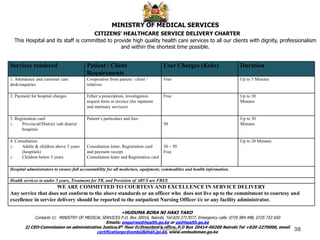
Services rendered Patient / Client
Requirements
User Charges (Kshs) Duration
1. Attendance and customer care
desk/enquiries
Cooperation from patient / client /
relatives
Free Up to 5 Minutes
2. Payment for hospital charges Either a prescription, investigation
request form or invoice (for inpatient
and mortuary services)
Free Up to 30
Minutes
3. Registration card
o Provincial/District /sub district
hospitals
Patient’s particulars and fees
50
Up to 30
Minutes
4. Consultation
o Adults & children above 5 years
(hospitals)
o Children below 5 years
Consultation letter, Registration card
and payment receipt
Consultation letter and Registration card
30 – 50
Free
Up to 20 Minutes
Hospital administrators to ensure full accountability for all medicines, equipment, commodities and health information.
Health services to under 5 years, Treatment for TB, and Provision of ARVS are FREE
WE ARE COMMITTED TO COURTESYAND EXCELLENCE IN SERVICE DELIVERY
Any service that does not conform to the above standards or an officer who does not live up to the commitment to courtesy and
excellence in service delivery should be reported to the outpatient Nursing Officer i/c or any facility administrator.
MINISTRY OF MEDICAL SERVICES
CITIZENS’ HEALTHCARE SERVICE DELIVERY CHARTER
This Hospital and its staff is committed to provide high quality health care services to all our clients with dignity, professionalism
and within the shortest time possible.
•HUDUMA BORA NI HAKI YAKO
Contacts 1): MINISTRY OF MEDICAL SERVICES P.O. Box 30016, Nairobi, Tel:020 2717077, Emergency calls: 0735 984 498, 0725 733 650
Emails: enquiries@health.go.ke or ps@health.go.ke
2) CEO-Commission on administrative Justice,6th floor D/President’s office, P.O Box 20414-00200 Nairobi Tel +020-2270000, email
certificationpc@ombudsman.go.ke, www.ombudsman.go.ke
38
Stephen Mbithuka
Services rendered Patient / Client
Requirements
User Charges (Kshs) Duration
1. Attendance and customer care
desk/enquiries
Cooperation from patient / client /
relatives
Free Up to 5 Minutes
2. Payment for hospital charges Either a prescription, investigation
request form or invoice (for inpatient
and mortuary services)
Free Up to 30
Minutes
3. Registration card
o Provincial/District /sub district
hospitals
Patient’s particulars and fees
50
Up to 30
Minutes
4. Consultation
o Adults & children above 5 years
(hospitals)
o Children below 5 years
Consultation letter, Registration card
and payment receipt
Consultation letter and Registration card
30 – 50
Free
Up to 20 Minutes
Hospital administrators to ensure full accountability for all medicines, equipment, commodities and health information.
Health services to under 5 years, Treatment for TB, and Provision of ARVS are FREE
WE ARE COMMITTED TO COURTESYAND EXCELLENCE IN SERVICE DELIVERY
Any service that does not conform to the above standards or an officer who does not live up to the commitment to courtesy and
excellence in service delivery should be reported to the outpatient Nursing Officer i/c or any facility administrator.
MINISTRY OF MEDICAL SERVICES
CITIZENS’ HEALTHCARE SERVICE DELIVERY CHARTER
This Hospital and its staff is committed to provide high quality health care services to all our clients with dignity, professionalism
and within the shortest time possible.
•HUDUMA BORA NI HAKI YAKO
Contacts 1): MINISTRY OF MEDICAL SERVICES P.O. Box 30016, Nairobi, Tel:020 2717077, Emergency calls: 0735 984 498, 0725 733 650
Emails: enquiries@health.go.ke or ps@health.go.ke
2) CEO-Commission on administrative Justice,6th floor D/President’s office, P.O Box 20414-00200 Nairobi Tel +020-2270000, email
certificationpc@ombudsman.go.ke, www.ombudsman.go.ke
39
Stephen Mbithuka

THE ROLE OF SERVICE CHARTER IN AN ORGANISATION AT THE WORKPLACE.ppt

  • 1.
  • 2.
    INTRODUCTION • The newconstitution has placed new demands in the provision of services to the citizenry both at the National and County level. • Article 174(c) of the constitution gives powers of self- governance to the people and enhance participation of the people in the exercise of the powers of the State and in making decisions affecting them.
  • 3.
    Introduction cont….  Article46 (1) (a) & (b) gives the consumers the right to goods and services of reasonable quality and to information necessary for them to gain full benefit from the goods and services and Article 232 provides for the values and principles of public service which are:  High standards of professional ethics,  Efficient, effective and economical use of resources  Involvement of people in the process of policy making Accountability for administrative acts  Responsive, prompt, effective, impartial and equitable provision of services.
  • 4.
    Introduction cont…. • Thesedemands as set out in the Constitution, therefore, require that all MDAs governments put in place a Performance Management systems that will allow them to focus on citizen, results, equitable development and create an empowered and innovative workforce which is transparent, accountable and able to collaborate with all stakeholders.
  • 5.
    WHAT IS ASERVICE CHARTER -A service charter is a short publication that describes the service experience a client can expect from an organisation. -It is a brief public document that provides key information about an agency’s service delivery approach and the relationship the client will have with the organisation.. - A Service Charter clarifies what customers should expect from an organization in terms of the type, quantity and quality of services provided. 5
  • 6.
    including: -what the organisationdoes; - how to contact and communicate with the agency; -the standard of service clients can expect; -clients’ basic rights and responsibilities; and -how to provide feedback or make a complaint. • A charter need not cover every function and service an agency provides, or detail every aspect of service delivery. Rather, it should focus on the key areas seen as important 6
  • 7.
    Importance of Citizens’Service Delivery Charters • Empowers citizens to hold institutions and individual officers accountable for quality, timely and responsive services- value addition to taxes • Reduces corruption • Changes culture and attitude at work place by focusing efforts to customer satisfaction • Ensures public officers are conscious about quality of services offered • Enables systems to continuously re-engineer
  • 8.
    Importance Cont… • Tocontinually improve the quality of public services for the people of Kenya. • To secure better value and enhance accountability in service provision. • Promote public trust in Government services • Promote recognition of the citizen as a customer to public services 8
  • 9.
    Nature of servicecharter • A service charter is a public document that should be used as the driver for cultural change within the organisation. This change can encompass client-focus, changed business practices, outcomes rather than process, better and more responsive communications, and improved relationships with clients. • Organisations might consider having their charter reviewed by a legal expert to ensure that the wording used does not inadvertently give rise to legal liability. 9
  • 10.
    • For aService Charter to be effective, customers must be aware of its existence. It should therefore be in the public domain e.g. on internet, brochures 10
  • 11.
    HOW TO DEVELOP A CUSTOMERSERVICE CHARTER 11
  • 12.
    INVOLVE YOUR STAFF •Your staff are the people who know your customers best and have close contact with them. This results in buy-in and ownership of the service charter. 12
  • 13.
    IDENTIFY AND REVIEWCURRENT SERVICES • Reviewing the services offered is part of your strategic planning process. • It refocuses your direction when developing and refining your service charter. 13
  • 14.
    IDENTIFY YOUR CUSTOMERS •A customer is someone who is the recipient of the services you provide. • They need to be identified in terms of core services and major consumer groups. They can be both internal as well as external. 14
  • 15.
    LINK SERVICE CHARTERTO STRATEGIC PLAN • Service delivery standards should reflect your organization’s strategic priorities and financial capability. 15
  • 16.
    ESTABLISH FEEDBACK MECHANISMS •To identify customer needs and the particular features of service they value, undertake research and develop mechanisms to capture feedback. 16
  • 17.
    COMMUNICATE FEEDBACK TO STAFF •Develop mechanisms to give all customer feedback, both positive and negative to staff. • Publicize positive feedback more widely and take corrective measures on negative feedback . 17
  • 18.
    IDENTIFY SERVICES OFFEREDAND DEVELOP SERVICE STANDARDS • For each service, ask what it means to perform the service well. Standards should be linked to the strategic plan as well as the performance contract; • Initiatives such as best practices and benchmarking can be used in developing the standards. 18
  • 19.
    WRITE, PUBLISH ANDPROMOTE CHARTER • Our Charter should be an easy to read document that is readily available to customers. It should be displayed in prominent public areas within the organization. 19
  • 20.
    • Service charterlaunch • Organisations should consider a strategy for launching their service charter to achieve maximum • exposure. This may include: • high-profile launch by the Minister or appropriate dignitary; • managing a media campaign and an ongoing communications strategy; 20
  • 21.
    Maintaining and reviewinga charter • The service charter should be a living document that evolves in line with changes that occur within the agency and that affect its clients. This means that agencies must regularly reviewtheir charter to ensure its ongoing relevance and effectiveness. Questions to address are: 21
  • 22.
    • whether thecharter continues to reflect the agency’s approach to client service and any • significant new initiatives in that area; • whether the service commitments and standards are still aligned to the needs and • priorities of the agency’s clients and key stakeholders. • whether the charter continues to meet the client service principles; 22
  • 23.
    • whether thecurrent content is accurate (e.g. Agency information on function and contact details); • whether the format, design and availability meet client needs; • whether there is reliable and effective data collection on client feedback, service • standards and complaints; • whether changes should be made to the complaint handling processes 23
  • 24.
    • Apart fromdirect • agency/client processes, consider the impact of third party review for unresolved • complaints, such as: • in-house review by an independent officer, or • through external avenues, such as the: • Ombudsman; • Administrative Appeals Tribunal; or • Human Rights Commission. 24
  • 25.
    Triggers for reviewinga charter • changes to the agency’s organisation structure; • changes to Administrative Arrangement Orders; • changes to the client profile; • changes to service delivery mechanisms; • unsolicited feedback from clients on the Charter 25
  • 26.
  • 27.
    • Preamble • Mandates •Vision • Mission • Core Values • who the clients or potential clients are 27
  • 28.
    • Avenues ofcommunication A service charter is to contain statements on how clients and stakeholders can communicate with the organisation. —key contact details; postal or street address, phone, fax or toll free number, email and Web site address -appropriate avenues to meet client needs including people with disabilities • 28
  • 29.
    Client rights andresponsibilities • A service charter should set out the rights of clients and what they can expect from an agency. Similarly, it should set out the responsibilities of clients to abide by certain codes of behaviour, to help the agency provide good service to them 29
  • 30.
    Examples of Clientrights • Clients have: • the right to review and appeal; • the right to lodge a complaint; • the right to privacy and confidentiality; • the right to see information (i.e. Freedom of Information obligation); • he right to access services, facilities and information in a manner which meets theirneeds. 30
  • 31.
    Examples of commonClient responsibilities Clients are obliged: • to treat staff with courtesy; • to attend scheduled meetings punctually; • to respond to requests for information accurately, thoroughly and in atimely manner; • to abide by any legal requirements and other obligations that clients are to meet in orderto be eligible for payments or services sought. 31
  • 32.
    • Client feedbackand complaints • Organisations must have avenues for clients to provide feedback and make complaints and have mechanisms to report on that data. • A service charter must contain information on the feedback and complaints processes. Aspects to consider are: • That the organisation welcomes feedback (complaints, compliments and suggestions 32
  • 33.
    • how tomake a complaint, including relevant postal and email addresses, and phone and fax numbers. Include options (e.g. in person, comment card, on-line feedback form, by phone, letter, • how to give feedback specifically about the Charter itself; • that the feedback and complaints handling process is accessible, easy to use and free; 33
  • 34.
    • that theorganisation records data on complaints, compliments and suggestions and this is used to help improve client service; • that using the agency’s complaint handling system does not prevent the client from using external dispute handling and appeal mechanisms at any time and should list contact details for these services; 34
  • 35.
    • It isimportant for all client contact staff to be trained in receiving feedback, including assisting • clients to articulate their concerns as well as processing and actioning that feedback. Staff • training should also cover dealing with members of the public, especially those who are likely to be distressed. 35
  • 36.
    36 SERVICE DELIVERY STANDARDS •A good service charter should set, publicize explicit standards for the services individual customers can reasonably expect.
  • 37.
    Model Service Charters GOODS/SERVI CES RENDERED CUSTOMER REQUIREMNE TS COSTTimeline The charter should include names and contact of persons to be contacted in the event the services rendered do not meet the service standards contained in the charter. i.e complaints handling 37
  • 38.
    Services rendered Patient/ Client Requirements User Charges (Kshs) Duration 1. Attendance and customer care desk/enquiries Cooperation from patient / client / relatives Free Up to 5 Minutes 2. Payment for hospital charges Either a prescription, investigation request form or invoice (for inpatient and mortuary services) Free Up to 30 Minutes 3. Registration card o Provincial/District /sub district hospitals Patient’s particulars and fees 50 Up to 30 Minutes 4. Consultation o Adults & children above 5 years (hospitals) o Children below 5 years Consultation letter, Registration card and payment receipt Consultation letter and Registration card 30 – 50 Free Up to 20 Minutes Hospital administrators to ensure full accountability for all medicines, equipment, commodities and health information. Health services to under 5 years, Treatment for TB, and Provision of ARVS are FREE WE ARE COMMITTED TO COURTESYAND EXCELLENCE IN SERVICE DELIVERY Any service that does not conform to the above standards or an officer who does not live up to the commitment to courtesy and excellence in service delivery should be reported to the outpatient Nursing Officer i/c or any facility administrator. MINISTRY OF MEDICAL SERVICES CITIZENS’ HEALTHCARE SERVICE DELIVERY CHARTER This Hospital and its staff is committed to provide high quality health care services to all our clients with dignity, professionalism and within the shortest time possible. •HUDUMA BORA NI HAKI YAKO Contacts 1): MINISTRY OF MEDICAL SERVICES P.O. Box 30016, Nairobi, Tel:020 2717077, Emergency calls: 0735 984 498, 0725 733 650 Emails: enquiries@health.go.ke or ps@health.go.ke 2) CEO-Commission on administrative Justice,6th floor D/President’s office, P.O Box 20414-00200 Nairobi Tel +020-2270000, email certificationpc@ombudsman.go.ke, www.ombudsman.go.ke 38 Stephen Mbithuka
  • 39.
    Services rendered Patient/ Client Requirements User Charges (Kshs) Duration 1. Attendance and customer care desk/enquiries Cooperation from patient / client / relatives Free Up to 5 Minutes 2. Payment for hospital charges Either a prescription, investigation request form or invoice (for inpatient and mortuary services) Free Up to 30 Minutes 3. Registration card o Provincial/District /sub district hospitals Patient’s particulars and fees 50 Up to 30 Minutes 4. Consultation o Adults & children above 5 years (hospitals) o Children below 5 years Consultation letter, Registration card and payment receipt Consultation letter and Registration card 30 – 50 Free Up to 20 Minutes Hospital administrators to ensure full accountability for all medicines, equipment, commodities and health information. Health services to under 5 years, Treatment for TB, and Provision of ARVS are FREE WE ARE COMMITTED TO COURTESYAND EXCELLENCE IN SERVICE DELIVERY Any service that does not conform to the above standards or an officer who does not live up to the commitment to courtesy and excellence in service delivery should be reported to the outpatient Nursing Officer i/c or any facility administrator. MINISTRY OF MEDICAL SERVICES CITIZENS’ HEALTHCARE SERVICE DELIVERY CHARTER This Hospital and its staff is committed to provide high quality health care services to all our clients with dignity, professionalism and within the shortest time possible. •HUDUMA BORA NI HAKI YAKO Contacts 1): MINISTRY OF MEDICAL SERVICES P.O. Box 30016, Nairobi, Tel:020 2717077, Emergency calls: 0735 984 498, 0725 733 650 Emails: enquiries@health.go.ke or ps@health.go.ke 2) CEO-Commission on administrative Justice,6th floor D/President’s office, P.O Box 20414-00200 Nairobi Tel +020-2270000, email certificationpc@ombudsman.go.ke, www.ombudsman.go.ke 39 Stephen Mbithuka