An Introduction to Ant
Overview
• What is Ant?
• Installing Ant
• Anatomy of a build file
– Projects
– Properties
– Targets
– Tasks
• Example build file
• Running a build file
What is Ant?
• Ant is a Java based tool for automating the build
process
• Similar to make but implemented using Java
– Platform independent commands (works on Windows,
Mac & Unix)
• XML based format
– Avoids the dreaded tab issue in make files
• Easily extendable using Java classes
• Ant is an open source (free) Apache project
Automating the Build (C & make)
• The goal is to automate the build process
a.out: driver.o foo.o bar.o
gcc driver.o foo.o bar.o
driver.o: driver.c foo.h bar.h
gcc -c driver.c
foo.o: foo.c foo.h
gcc -c foo.c
bar.o:
gcc -c bar.c
linux3[1]% make
gcc -c driver.c
gcc -c foo.c
gcc -c bar.c
gcc driver.o foo.o bar.o
linux3[2]%
foo.c foo.h bar.h bar.cdriver.c
foo.o bar.odriver.o
a.out
gcc -c foo.c gcc -c bar.cgcc -c driver.c
gcc driver.o foo.o bar.o
Installing Ant
• Ant can be downloaded from…
– http://ant.apache.org/
• Ant comes bundled as a zip file or a tarball
• Simply unwrap the file to some directory
where you want to store the executables
– I typically unwrap the zip file into C:Program
Files, and rename to C:Program Filesant
– This directory is known as ANT_HOME
Ant Setup
• Set the ANT_HOME environment variable to
where you installed Ant
• Add the ANT_HOME/bin directory to your path
• Set the JAVA_HOME environment variable to
the location where you installed Java
• Setting environment variables
– Windows: right click My Computer  Properties 
Advanced  Environment Variables
– UNIX: shell specific settings
Project Organization
• The following example assumes that your
workspace will be organized like so…
build.xml
Project Directory
src
*.java
bin
*.class
doc
*.html
Anatomy of a Build File
• Ant’s build files are written in XML
– Convention is to call file build.xml
• Each build file contains
– A project
– At least 1 target
• Targets are composed of some number of tasks
• Build files may also contain properties
– Like macros in a make file
• Comments are within <!-- --> blocks
Projects
• The project tag is used to define the
project you wish to work with
• Projects tags typically contain 3 attributes
– name – a logical name for the project
– default – the default target to execute
– basedir – the base directory for which all
operations are done relative to
• Additionally, a description for the project
can be specified from within the project
tag
Build File
<project name="Sample Project" default="compile" basedir=".">
<description>
A sample build file for this project
</description>
</project>
Properties
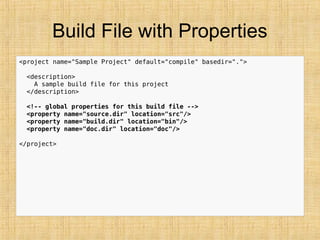
• Build files may contain constants (known
as properties) to assign a value to a
variable which can then be used
throughout the project
– Makes maintaining large build files more
manageable
• Projects can have a set of properties
• Property tags consist of a name/value pair
– Analogous to macros from make
Build File with Properties
<project name="Sample Project" default="compile" basedir=".">
<description>
A sample build file for this project
</description>
<!-- global properties for this build file -->
<property name="source.dir" location="src"/>
<property name="build.dir" location="bin"/>
<property name="doc.dir" location="doc"/>
</project>
Targets
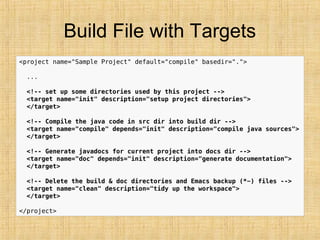
• The target tag has the following required attribute
– name – the logical name for a target
• Targets may also have optional attributes such as
– depends – a list of other target names for which this task is
dependant upon, the specified task(s) get executed first
– description – a description of what a target does
• Like make files, targets in Ant can depend on some
number of other targets
– For example, we might have a target to create a jarfile, which
first depends upon another target to compile the code
• A build file may additionally specify a default target
Build File with Targets
<project name="Sample Project" default="compile" basedir=".">
...
<!-- set up some directories used by this project -->
<target name="init" description="setup project directories">
</target>
<!-- Compile the java code in src dir into build dir -->
<target name="compile" depends="init" description="compile java sources">
</target>
<!-- Generate javadocs for current project into docs dir -->
<target name="doc" depends="init" description="generate documentation">
</target>
<!-- Delete the build & doc directories and Emacs backup (*~) files -->
<target name="clean" description="tidy up the workspace">
</target>
</project>
Tasks
• A task represents an action that needs execution
• Tasks have a variable number of attributes which are
task dependant
• There are a number of build-in tasks, most of which are
things which you would typically do as part of a build
process
– Create a directory
– Compile java source code
– Run the javadoc tool over some files
– Create a jar file from a set of files
– Remove files/directories
– And many, many others…
• For a full list see: http://ant.apache.org/manual/coretasklist.html
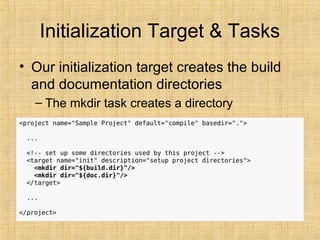
Initialization Target & Tasks
• Our initialization target creates the build
and documentation directories
– The mkdir task creates a directory
<project name="Sample Project" default="compile" basedir=".">
...
<!-- set up some directories used by this project -->
<target name="init" description="setup project directories">
<mkdir dir="${build.dir}"/>
<mkdir dir="${doc.dir}"/>
</target>
...
</project>
Compilation Target & Tasks
• Our compilation target will compile all java
files in the source directory
– The javac task compiles sources into classes
– Note the dependence on the init task
<project name="Sample Project" default="compile" basedir=".">
...
<!-- Compile the java code in ${src.dir} into ${build.dir} -->
<target name="compile" depends="init" description="compile java sources">
<javac srcdir="${source.dir}" destdir="${build.dir}"/>
</target>
...
</project>
Javadoc Target & Tasks
• Our documentation target will create the
HTML documentation
– The javadoc task generates HTML
documentation for all sources
<project name="Sample Project" default="compile" basedir=".">
...
<!-- Generate javadocs for current project into ${doc.dir} -->
<target name="doc" depends="init" description="generate documentation">
<javadoc sourcepath="${source.dir}" destdir="${doc.dir}"/>
</target>
...
</project>
Cleanup Target & Tasks
• We can also use ant to tidy up our
workspace
– The delete task removes files/directories from
the file system
<project name="Sample Project" default="compile" basedir=".">
...
<!-- Delete the build & doc directories and Emacs backup (*~) files -->
<target name="clean" description="tidy up the workspace">
<delete dir="${build.dir}"/>
<delete dir="${doc.dir}"/>
<delete>
<fileset defaultexcludes="no" dir="${source.dir}" includes="**/*~"/>
</delete>
</target>
...
</project>
Completed Build File (1 of 2)
<project name="Sample Project" default="compile" basedir=".">
<description>
A sample build file for this project
</description>
<!-- global properties for this build file -->
<property name="source.dir" location="src"/>
<property name="build.dir" location="bin"/>
<property name="doc.dir" location="doc"/>
<!-- set up some directories used by this project -->
<target name="init" description="setup project directories">
<mkdir dir="${build.dir}"/>
<mkdir dir="${doc.dir}"/>
</target>
<!-- Compile the java code in ${src.dir} into ${build.dir} -->
<target name="compile" depends="init" description="compile java sources">
<javac srcdir="${source.dir}" destdir="${build.dir}"/>
</target>
Completed Build File (2 of 2)
<!-- Generate javadocs for current project into ${doc.dir} -->
<target name="doc" depends="init" description="generate documentation">
<javadoc sourcepath="${source.dir}" destdir="${doc.dir}"/>
</target>
<!-- Delete the build & doc directories and Emacs backup (*~) files -->
<target name="clean" description="tidy up the workspace">
<delete dir="${build.dir}"/>
<delete dir="${doc.dir}"/>
<delete>
<fileset defaultexcludes="no" dir="${source.dir}" includes="**/*~"/>
</delete>
</target>
</project>
Running Ant – Command Line
• Simply cd into the directory with the build.xml file
and type ant to run the project default target
• Or, type ant followed by the name of a target
Running Ant – Eclipse
• Eclipse comes with out of
the box support for Ant
– No need to separately
download and configure Ant
• Eclipse provides an Ant view
– Window  Show View  Ant
• Simply drag and drop a build
file into the Ant view, then
double click the target to run

Intro to-ant

  • 1.
  • 2.
    Overview • What isAnt? • Installing Ant • Anatomy of a build file – Projects – Properties – Targets – Tasks • Example build file • Running a build file
  • 3.
    What is Ant? •Ant is a Java based tool for automating the build process • Similar to make but implemented using Java – Platform independent commands (works on Windows, Mac & Unix) • XML based format – Avoids the dreaded tab issue in make files • Easily extendable using Java classes • Ant is an open source (free) Apache project
  • 4.
    Automating the Build(C & make) • The goal is to automate the build process a.out: driver.o foo.o bar.o gcc driver.o foo.o bar.o driver.o: driver.c foo.h bar.h gcc -c driver.c foo.o: foo.c foo.h gcc -c foo.c bar.o: gcc -c bar.c linux3[1]% make gcc -c driver.c gcc -c foo.c gcc -c bar.c gcc driver.o foo.o bar.o linux3[2]% foo.c foo.h bar.h bar.cdriver.c foo.o bar.odriver.o a.out gcc -c foo.c gcc -c bar.cgcc -c driver.c gcc driver.o foo.o bar.o
  • 5.
    Installing Ant • Antcan be downloaded from… – http://ant.apache.org/ • Ant comes bundled as a zip file or a tarball • Simply unwrap the file to some directory where you want to store the executables – I typically unwrap the zip file into C:Program Files, and rename to C:Program Filesant – This directory is known as ANT_HOME
  • 6.
    Ant Setup • Setthe ANT_HOME environment variable to where you installed Ant • Add the ANT_HOME/bin directory to your path • Set the JAVA_HOME environment variable to the location where you installed Java • Setting environment variables – Windows: right click My Computer  Properties  Advanced  Environment Variables – UNIX: shell specific settings
  • 7.
    Project Organization • Thefollowing example assumes that your workspace will be organized like so… build.xml Project Directory src *.java bin *.class doc *.html
  • 8.
    Anatomy of aBuild File • Ant’s build files are written in XML – Convention is to call file build.xml • Each build file contains – A project – At least 1 target • Targets are composed of some number of tasks • Build files may also contain properties – Like macros in a make file • Comments are within <!-- --> blocks
  • 9.
    Projects • The projecttag is used to define the project you wish to work with • Projects tags typically contain 3 attributes – name – a logical name for the project – default – the default target to execute – basedir – the base directory for which all operations are done relative to • Additionally, a description for the project can be specified from within the project tag
  • 10.
    Build File <project name="SampleProject" default="compile" basedir="."> <description> A sample build file for this project </description> </project>
  • 11.
    Properties • Build filesmay contain constants (known as properties) to assign a value to a variable which can then be used throughout the project – Makes maintaining large build files more manageable • Projects can have a set of properties • Property tags consist of a name/value pair – Analogous to macros from make
  • 12.
    Build File withProperties <project name="Sample Project" default="compile" basedir="."> <description> A sample build file for this project </description> <!-- global properties for this build file --> <property name="source.dir" location="src"/> <property name="build.dir" location="bin"/> <property name="doc.dir" location="doc"/> </project>
  • 13.
    Targets • The targettag has the following required attribute – name – the logical name for a target • Targets may also have optional attributes such as – depends – a list of other target names for which this task is dependant upon, the specified task(s) get executed first – description – a description of what a target does • Like make files, targets in Ant can depend on some number of other targets – For example, we might have a target to create a jarfile, which first depends upon another target to compile the code • A build file may additionally specify a default target
  • 14.
    Build File withTargets <project name="Sample Project" default="compile" basedir="."> ... <!-- set up some directories used by this project --> <target name="init" description="setup project directories"> </target> <!-- Compile the java code in src dir into build dir --> <target name="compile" depends="init" description="compile java sources"> </target> <!-- Generate javadocs for current project into docs dir --> <target name="doc" depends="init" description="generate documentation"> </target> <!-- Delete the build & doc directories and Emacs backup (*~) files --> <target name="clean" description="tidy up the workspace"> </target> </project>
  • 15.
    Tasks • A taskrepresents an action that needs execution • Tasks have a variable number of attributes which are task dependant • There are a number of build-in tasks, most of which are things which you would typically do as part of a build process – Create a directory – Compile java source code – Run the javadoc tool over some files – Create a jar file from a set of files – Remove files/directories – And many, many others… • For a full list see: http://ant.apache.org/manual/coretasklist.html
  • 16.
    Initialization Target &Tasks • Our initialization target creates the build and documentation directories – The mkdir task creates a directory <project name="Sample Project" default="compile" basedir="."> ... <!-- set up some directories used by this project --> <target name="init" description="setup project directories"> <mkdir dir="${build.dir}"/> <mkdir dir="${doc.dir}"/> </target> ... </project>
  • 17.
    Compilation Target &Tasks • Our compilation target will compile all java files in the source directory – The javac task compiles sources into classes – Note the dependence on the init task <project name="Sample Project" default="compile" basedir="."> ... <!-- Compile the java code in ${src.dir} into ${build.dir} --> <target name="compile" depends="init" description="compile java sources"> <javac srcdir="${source.dir}" destdir="${build.dir}"/> </target> ... </project>
  • 18.
    Javadoc Target &Tasks • Our documentation target will create the HTML documentation – The javadoc task generates HTML documentation for all sources <project name="Sample Project" default="compile" basedir="."> ... <!-- Generate javadocs for current project into ${doc.dir} --> <target name="doc" depends="init" description="generate documentation"> <javadoc sourcepath="${source.dir}" destdir="${doc.dir}"/> </target> ... </project>
  • 19.
    Cleanup Target &Tasks • We can also use ant to tidy up our workspace – The delete task removes files/directories from the file system <project name="Sample Project" default="compile" basedir="."> ... <!-- Delete the build & doc directories and Emacs backup (*~) files --> <target name="clean" description="tidy up the workspace"> <delete dir="${build.dir}"/> <delete dir="${doc.dir}"/> <delete> <fileset defaultexcludes="no" dir="${source.dir}" includes="**/*~"/> </delete> </target> ... </project>
  • 20.
    Completed Build File(1 of 2) <project name="Sample Project" default="compile" basedir="."> <description> A sample build file for this project </description> <!-- global properties for this build file --> <property name="source.dir" location="src"/> <property name="build.dir" location="bin"/> <property name="doc.dir" location="doc"/> <!-- set up some directories used by this project --> <target name="init" description="setup project directories"> <mkdir dir="${build.dir}"/> <mkdir dir="${doc.dir}"/> </target> <!-- Compile the java code in ${src.dir} into ${build.dir} --> <target name="compile" depends="init" description="compile java sources"> <javac srcdir="${source.dir}" destdir="${build.dir}"/> </target>
  • 21.
    Completed Build File(2 of 2) <!-- Generate javadocs for current project into ${doc.dir} --> <target name="doc" depends="init" description="generate documentation"> <javadoc sourcepath="${source.dir}" destdir="${doc.dir}"/> </target> <!-- Delete the build & doc directories and Emacs backup (*~) files --> <target name="clean" description="tidy up the workspace"> <delete dir="${build.dir}"/> <delete dir="${doc.dir}"/> <delete> <fileset defaultexcludes="no" dir="${source.dir}" includes="**/*~"/> </delete> </target> </project>
  • 22.
    Running Ant –Command Line • Simply cd into the directory with the build.xml file and type ant to run the project default target • Or, type ant followed by the name of a target
  • 23.
    Running Ant –Eclipse • Eclipse comes with out of the box support for Ant – No need to separately download and configure Ant • Eclipse provides an Ant view – Window  Show View  Ant • Simply drag and drop a build file into the Ant view, then double click the target to run