The Gangs of
Three
Ciao
ciao
Vai a fare
ciao ciao
Dr. Fabio Fumarola
Maven, Gradle and SBT
Java Project related questions
• How do we create a java project?
• How do we add dependencies?
• How do we create a runnable jar?
• How do we create a war?
• How do we execute tests?
2
Contents
• Maven
• Gradle
• Sbt
3
What is Maven?
• Apache Maven is a software project management.
• It is based on the concept of a Project Object Model
(POM)
• Maven can mange a project’s build, reporting a
documentation form a central piece of information
But it isn’t a mere build tool
4
Maven features
• Dependency System
• Multi-module builds
• Consistent project structure
• Consistent build model
• Plugin oriented
• Project generated sites
5
Advantages over Ant
• Eliminate complicate scripts
• All the functionality required to build your project,
i.e., clean, compile, copy, resources, install, deploy
• Cross Project Reuse – Ant has no convenient way to
reuse target across projects.
6
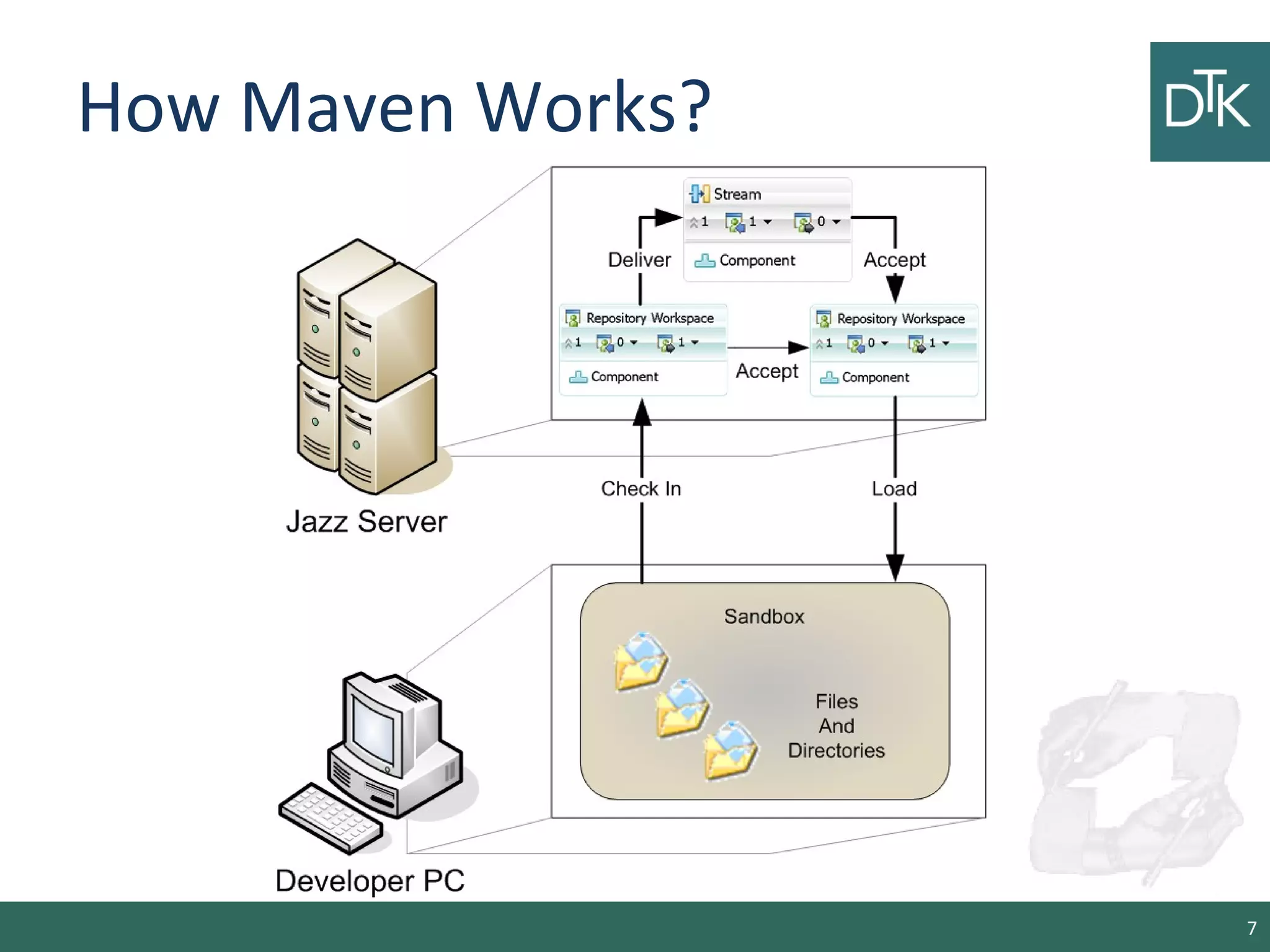
How Maven Works?
7
Maven keywords
• POM
• Archetype
• Artifact or dependency
• Plugin
• Goal
8
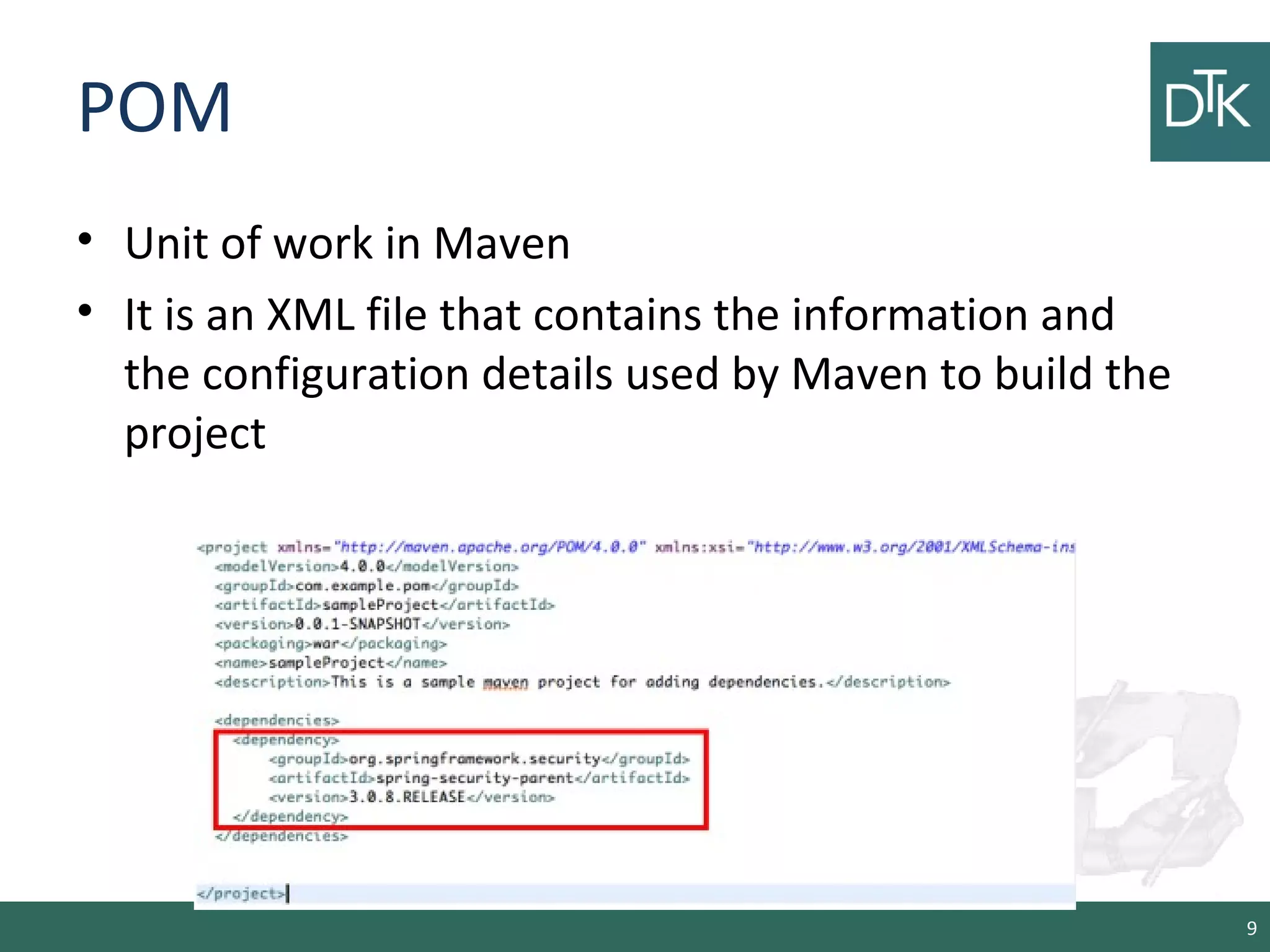
POM
• Unit of work in Maven
• It is an XML file that contains the information and
the configuration details used by Maven to build the
project
9
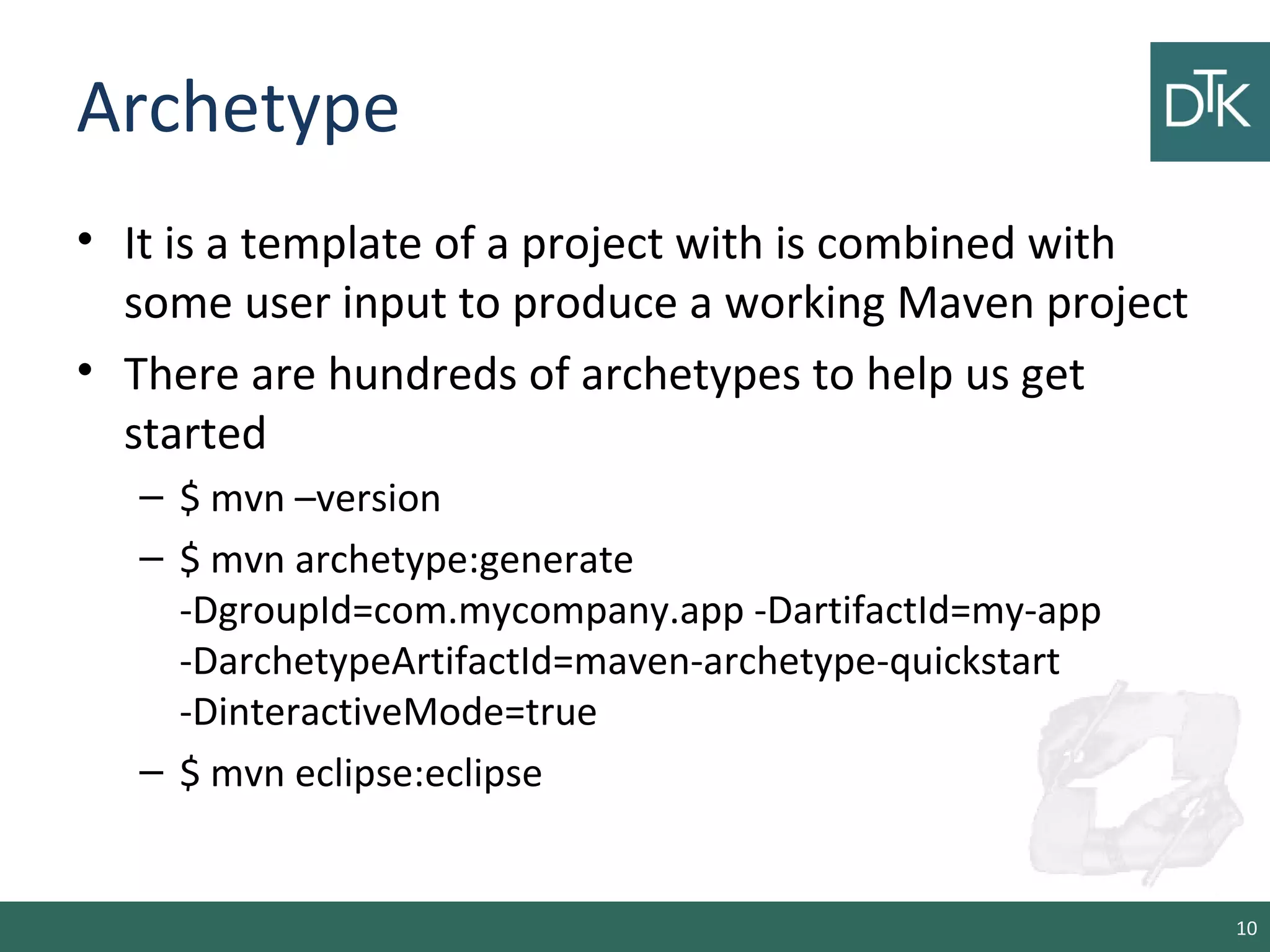
Archetype
• It is a template of a project with is combined with
some user input to produce a working Maven project
• There are hundreds of archetypes to help us get
started
– $ mvn –version
– $ mvn archetype:generate
-DgroupId=com.mycompany.app -DartifactId=my-app
-DarchetypeArtifactId=maven-archetype-quickstart
-DinteractiveMode=true
– $ mvn eclipse:eclipse
10
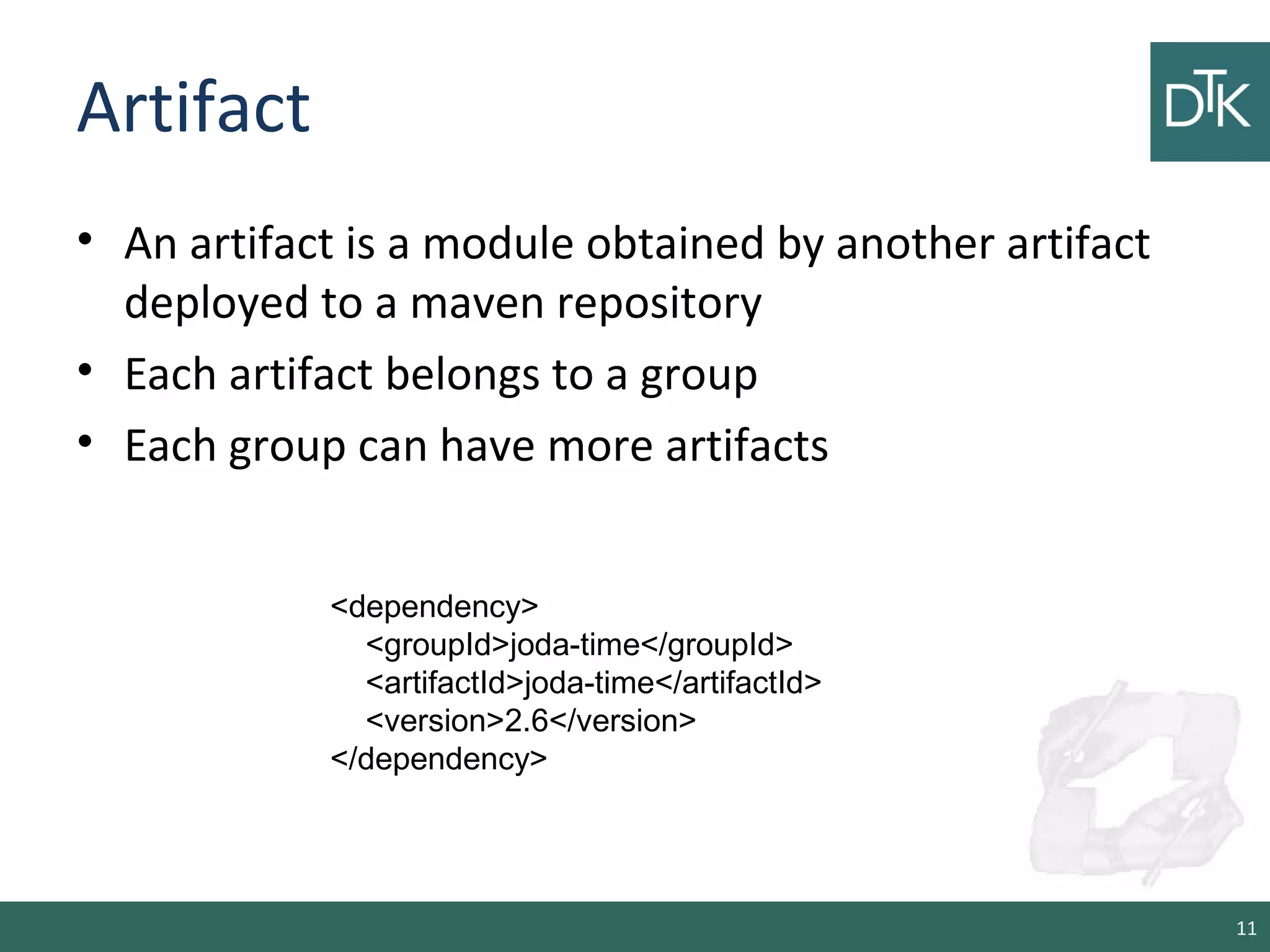
Artifact
• An artifact is a module obtained by another artifact
deployed to a maven repository
• Each artifact belongs to a group
• Each group can have more artifacts
11
<dependency>
<groupId>joda-time</groupId>
<artifactId>joda-time</artifactId>
<version>2.6</version>
</dependency>
Goals and Plugins
• Are an extension of the standard maven lifecycles
steps.
– Clean, compile, test, package, install and deploy
• There are plugin to do other steps such as
12
<plugins>
<plugin>
<artifactId>maven-assembly-plugin</artifactId>
<version>2.5.3</version>
<configuration>
<descriptorRefs>
<descriptorRef>jar-with-dependencies</descriptorRef>
</descriptorRefs>
</configuration>
[...]
</plugin> </plugins>
What is Gradle?
• Gradle is a general purpose build system
• It comes with a rich build description
• language (DSL) based on Groovy
• It supports ”build-by-convention” principle
• But it is very flexible and extensible
• It has built-in plug-ins for Java, Groovy, Scala, Web
• Groovy as a base language allows imperative
programming in the build file.
13
Advanced features
• Parallel unit test execution
• Dependency building
• Incremental build support
• Dynamic tasks and task rules
• Gradle daemon
14
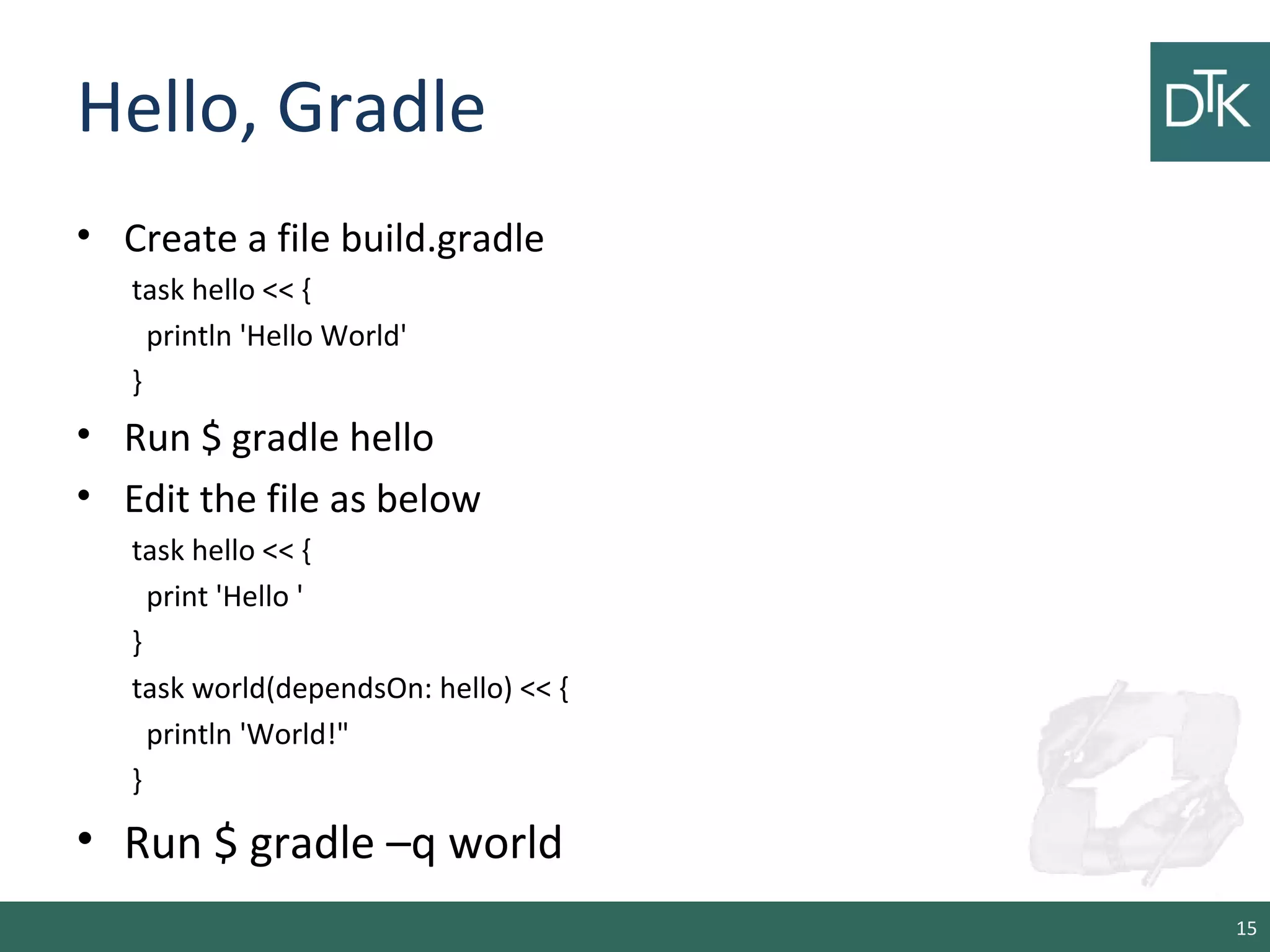
Hello, Gradle
• Create a file build.gradle
task hello << {
println 'Hello World'
}
• Run $ gradle hello
• Edit the file as below
task hello << {
print 'Hello '
}
task world(dependsOn: hello) << {
println 'World!"
}
• Run $ gradle –q world
15
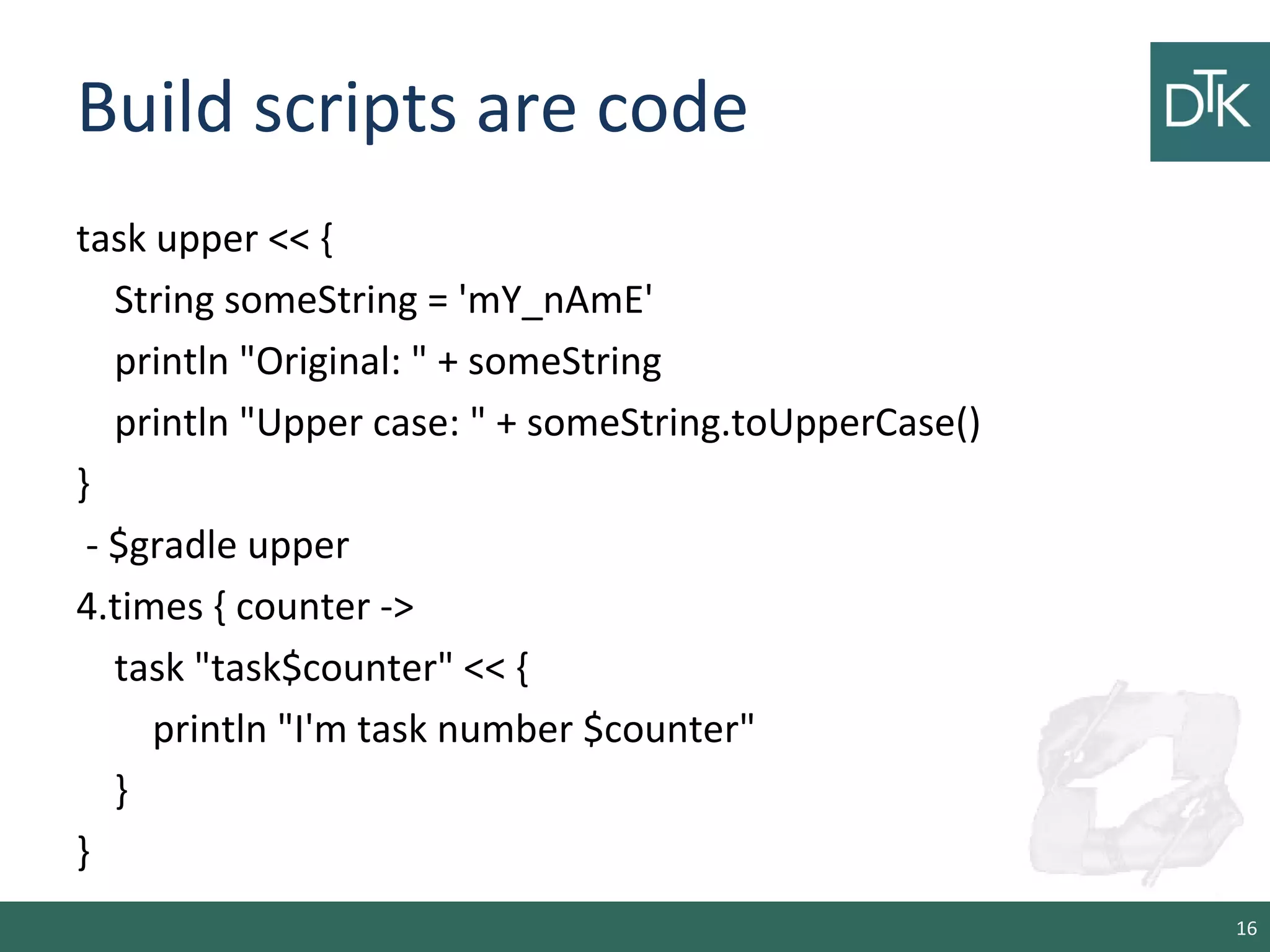
Build scripts are code
task upper << {
String someString = 'mY_nAmE'
println "Original: " + someString
println "Upper case: " + someString.toUpperCase()
}
- $gradle upper
4.times { counter ->
task "task$counter" << {
println "I'm task number $counter"
}
}
16
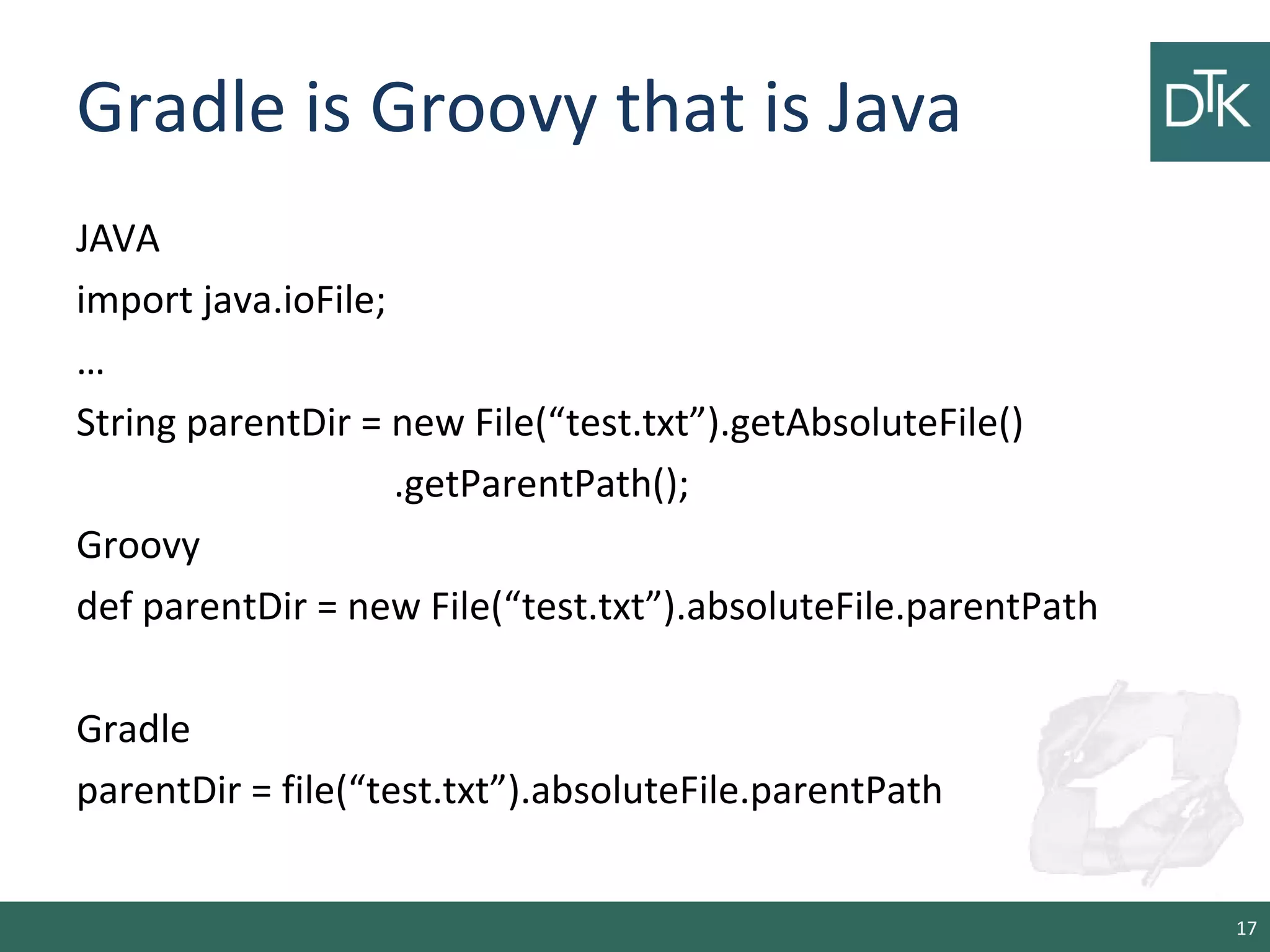
Gradle is Groovy that is Java
JAVA
import java.ioFile;
…
String parentDir = new File(“test.txt”).getAbsoluteFile()
.getParentPath();
Groovy
def parentDir = new File(“test.txt”).absoluteFile.parentPath
Gradle
parentDir = file(“test.txt”).absoluteFile.parentPath
17
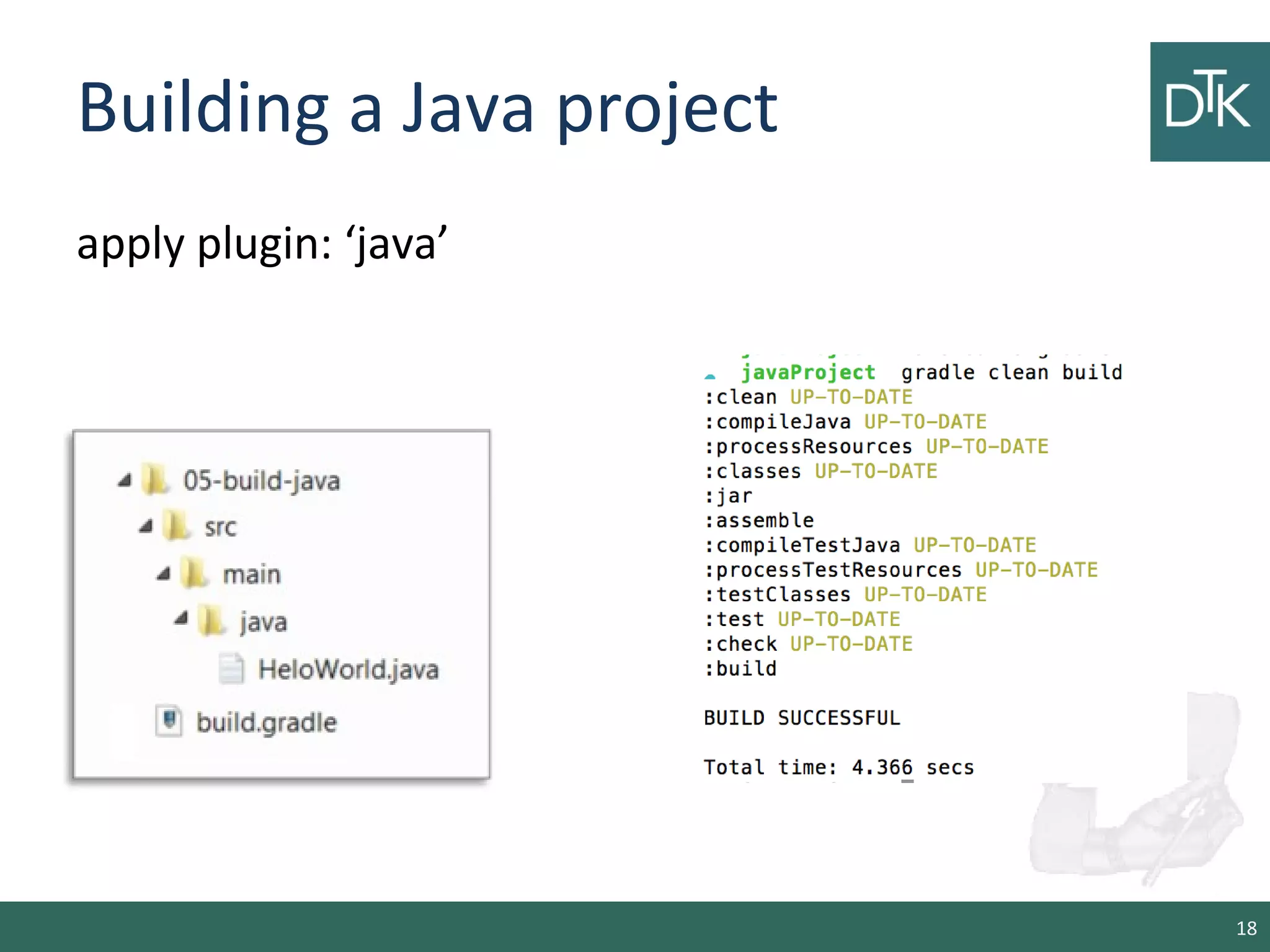
Building a Java project
apply plugin: ‘java’
18
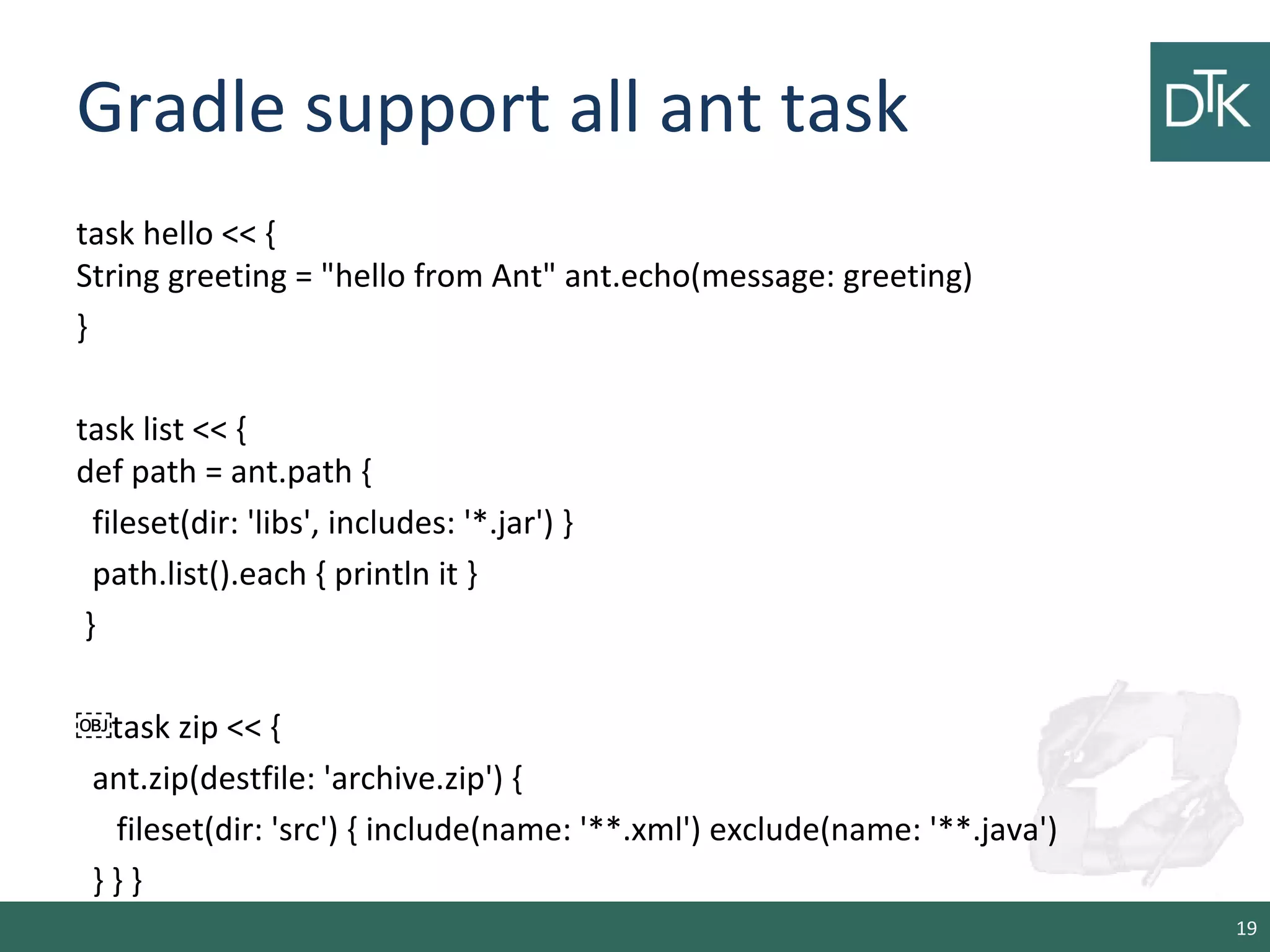
Gradle support all ant task
task hello << {
String greeting = "hello from Ant" ant.echo(message: greeting)
}
task list << {
def path = ant.path {
fileset(dir: 'libs', includes: '*.jar') }
path.list().each { println it }
}
task zip << {
ant.zip(destfile: 'archive.zip') {
fileset(dir: 'src') { include(name: '**.xml') exclude(name: '**.java')
} } }
19
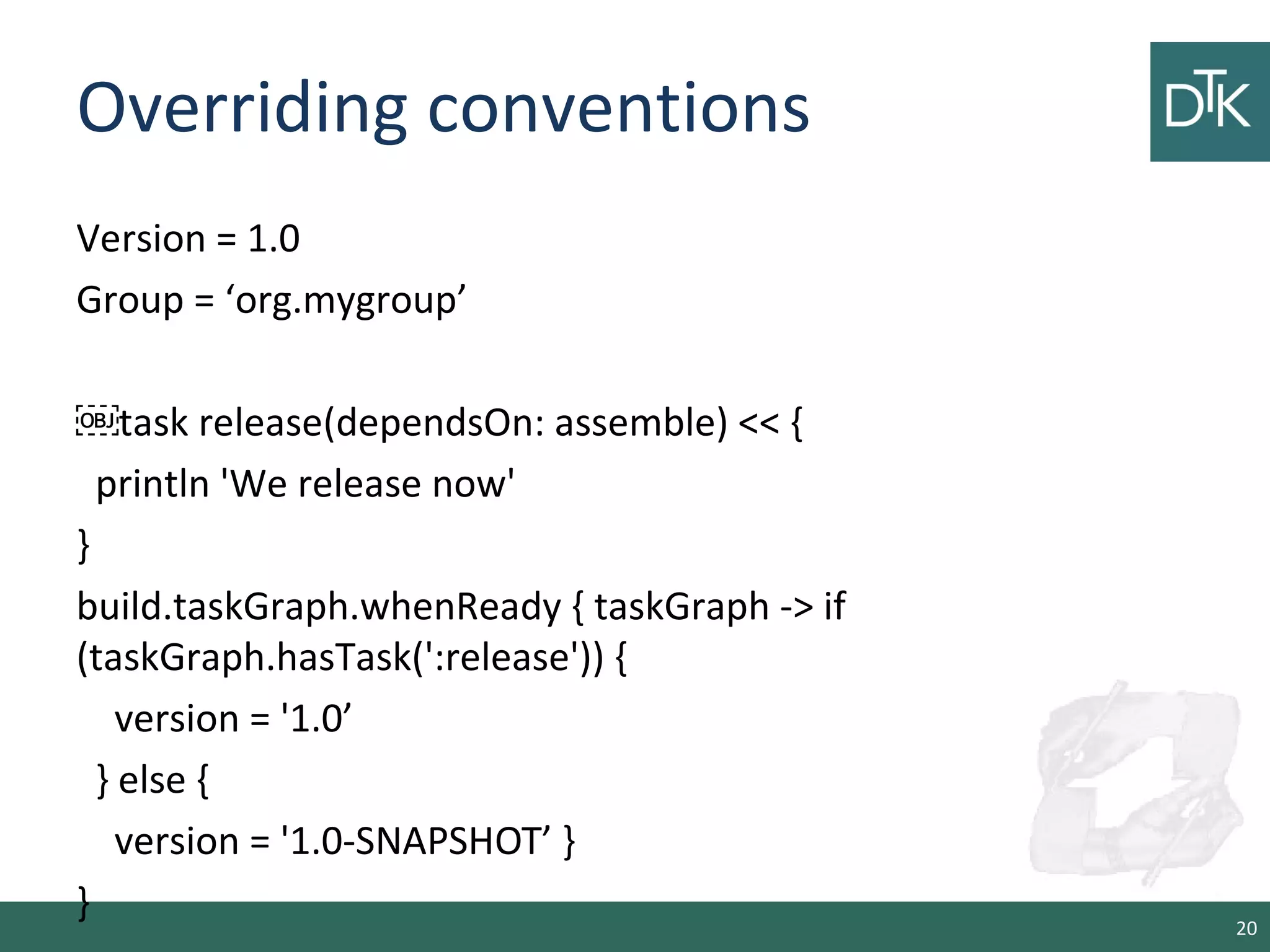
Overriding conventions
Version = 1.0
Group = ‘org.mygroup’
task release(dependsOn: assemble) << {
println 'We release now'
}
build.taskGraph.whenReady { taskGraph -> if
(taskGraph.hasTask(':release')) {
version = '1.0’
} else {
version = '1.0-SNAPSHOT’ }
} 20
Referencing files & file
collections• Groovy-like syntax:
File configFile = file('src/config.xml')
• Create a file collection from a bunch of files:
 FileCollection collection = files( 'src/file1.txt',
new File('src/file2.txt'), ['src/file3.txt', 'src/file4.txt'])
• Create a files collection by referencing project
properties:
 collection = files { srcDir.listFiles() }
• Operation on collections
def union = collection + files('src/file4.txt')
def different = collection - files('src/file3.txt')}
21
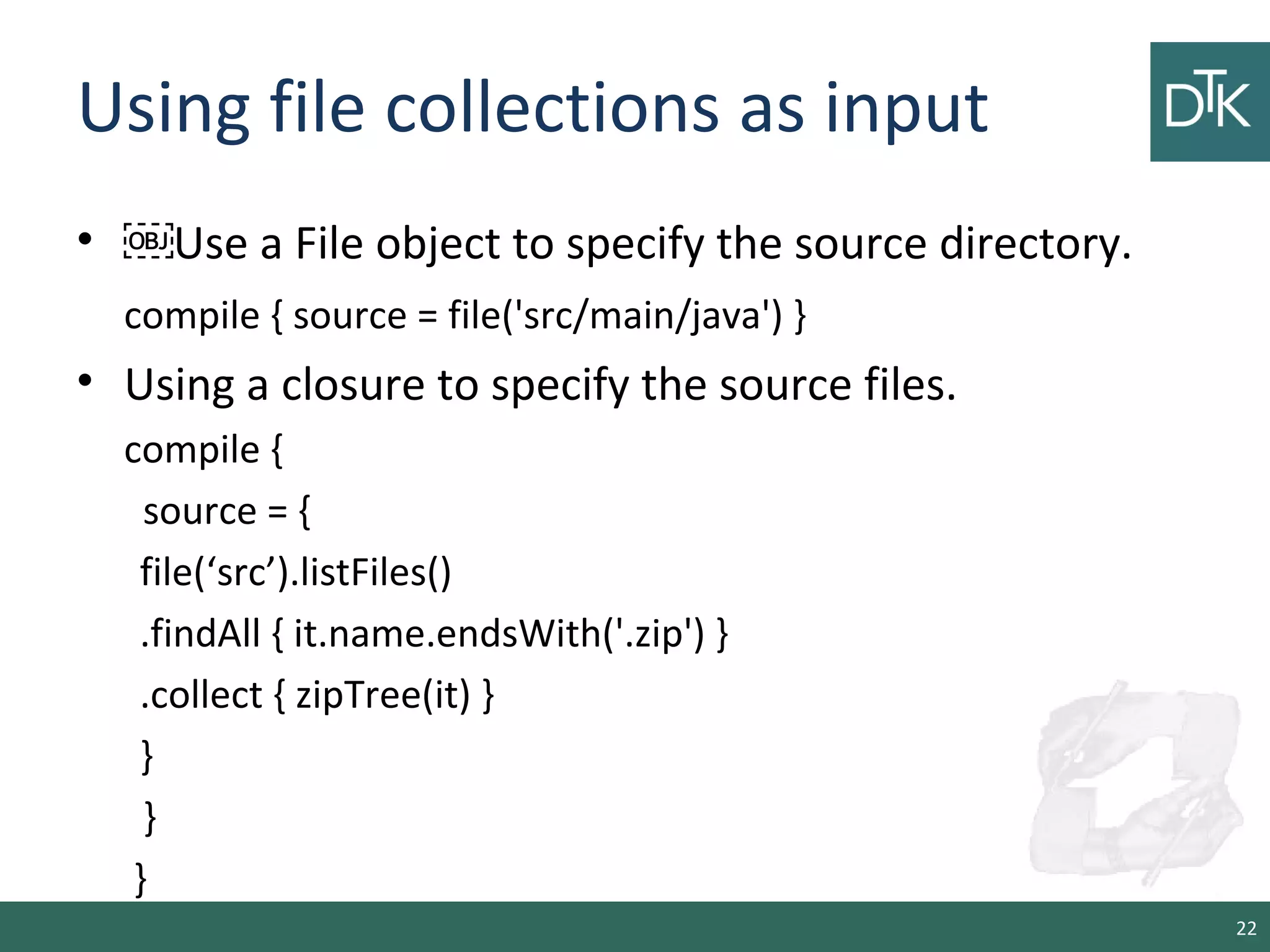
Using file collections as input
• Use a File object to specify the source directory.
compile { source = file('src/main/java') }
• Using a closure to specify the source files.
compile {
source = {
file(‘src’).listFiles()
.findAll { it.name.endsWith('.zip') }
.collect { zipTree(it) }
}
}
}
22
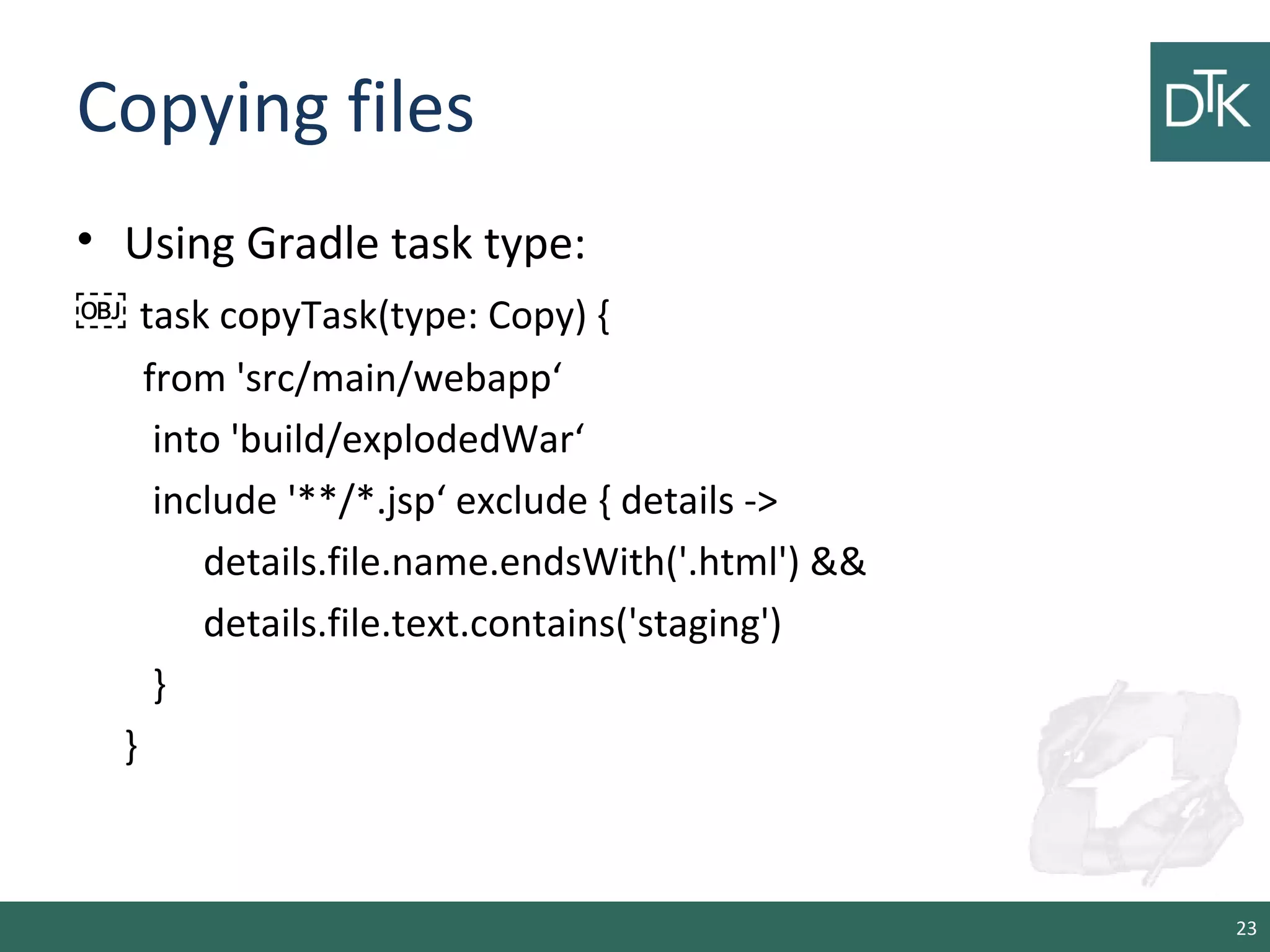
Copying files
• Using Gradle task type:
 task copyTask(type: Copy) {
from 'src/main/webapp‘
into 'build/explodedWar‘
include '**/*.jsp‘ exclude { details ->
details.file.name.endsWith('.html') &&
details.file.text.contains('staging')
}
}
23
Dependency management
24
Repository configuration
• Remote Repos
repositories {
mavenCentral()
mavenCentral name: 'multi-jar-repos', urls:
["http://repo.mycompany.com/jars1",
"http://repo.mycompany.com/jars1"]
}
• Local Repos
repositories {
flatDir name: 'localRepository',
dirs: 'lib' flatDir dirs: ['lib1', 'lib2']
} 25
Referencing dependencies
dependencies {
runtime files('libs/a.jar', 'libs/b.jar’)
runtime fileTree(dir: 'libs', includes: ['*.jar'])
}
dependencies {
compile 'org.springframework:spring-webmvc:3.0.0.RELEASE'
testCompile 'org.springframework:spring-test:3.0.0.RELEASE'
testCompile 'junit:junit:4.7'
}
26
Referencing dependencies
List groovy = ["org.codehaus.groovy:groovy-all:1.5.4@jar",
"commons-cli:commons-cli:1.0@jar",
"org.apache.ant:ant:1.7.0@jar"]
List hibernate = ['org.hibernate:hibernate:3.0.5@jar',
'somegroup:someorg:1.0@jar']
dependencies {
runtime groovy, hibernate
}
27
Plugins
28
Extending your build
• Any Gradle script can be a plug-in:
apply from: 'otherScript.gradle'
apply from: 'http://mycomp.com/otherScript.gradle’
• Use many of the standard or 3rd-party plug-ins:
apply plugin: 'java'
apply plugin: 'groovy'
apply plugin: 'scala'
apply plugin: 'war'
29
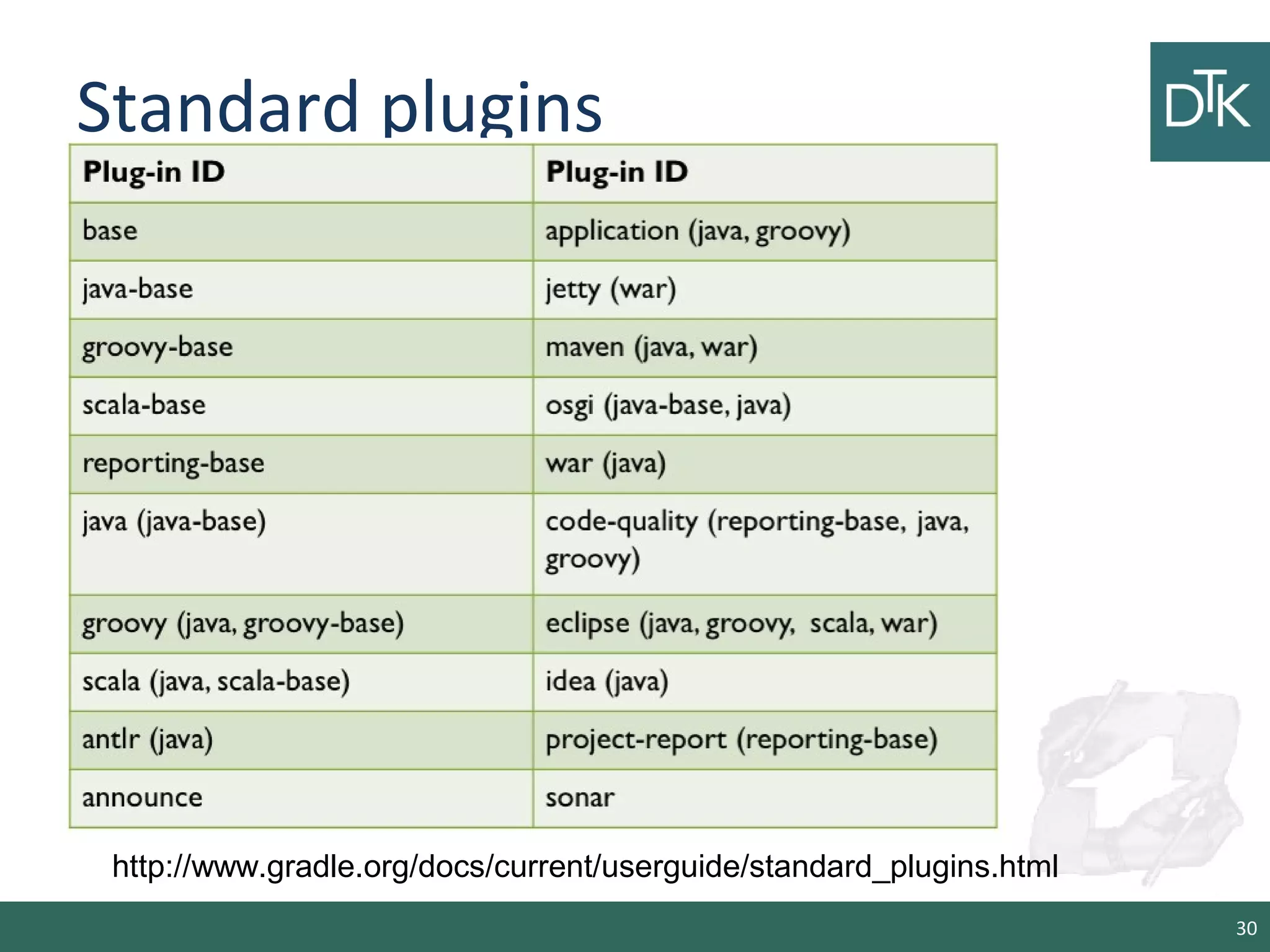
Standard plugins
30
http://www.gradle.org/docs/current/userguide/standard_plugins.html
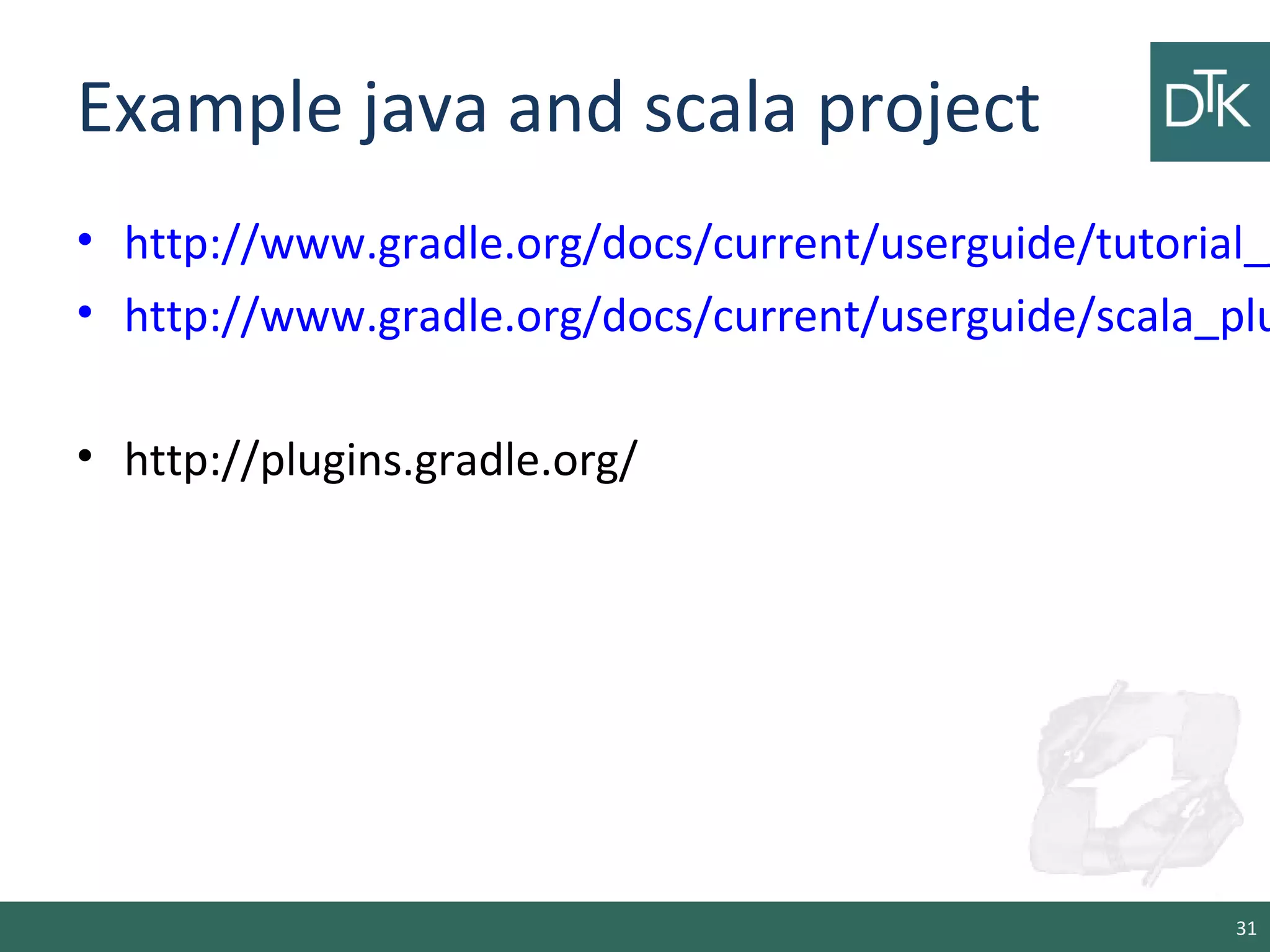
Example java and scala project
• http://www.gradle.org/docs/current/userguide/tutorial_j
• http://www.gradle.org/docs/current/userguide/scala_plu
• http://plugins.gradle.org/
31
Sbt
The interactive build tool
32
Sbt
• It is a tool to define task and then run them from the
shell
• To install on linux grab the
– rpm: https://dl.bintray.com/sbt/rpm/sbt-0.13.7.rpm
– deb: https://dl.bintray.com/sbt/rpm/sbt-0.13.7.deb
33
Starting with sbt
• It is based on the file build.sbt
• Create a directory hello_scala
• Edit a file and add
lazy val root = (project in file(".")).
settings(
name.:=("hello”),
version := "1.0",
scalaVersion := "2.11.4"
)
• Create an HelloWorld class
34
Project Structure
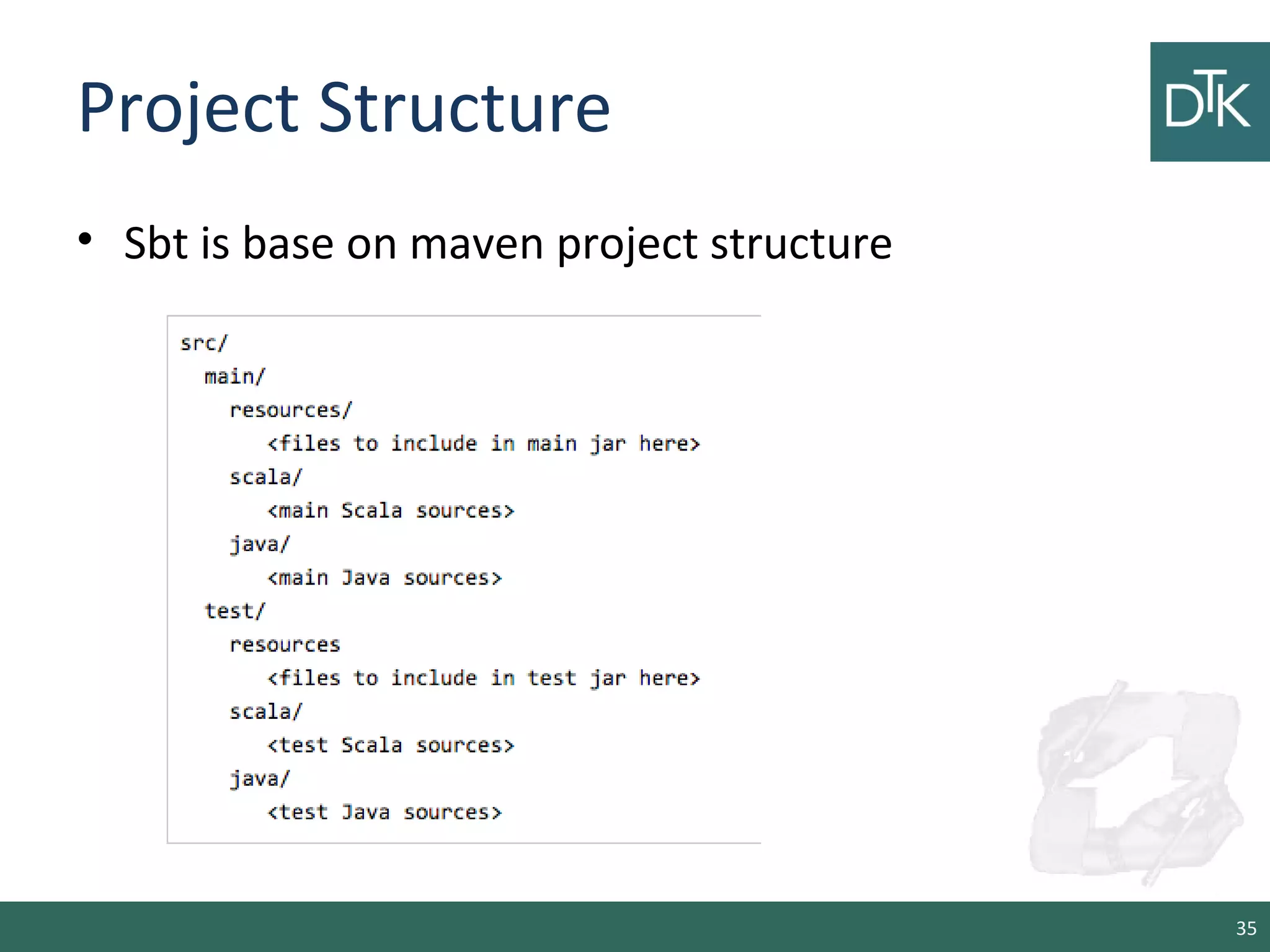
• Sbt is base on maven project structure
35
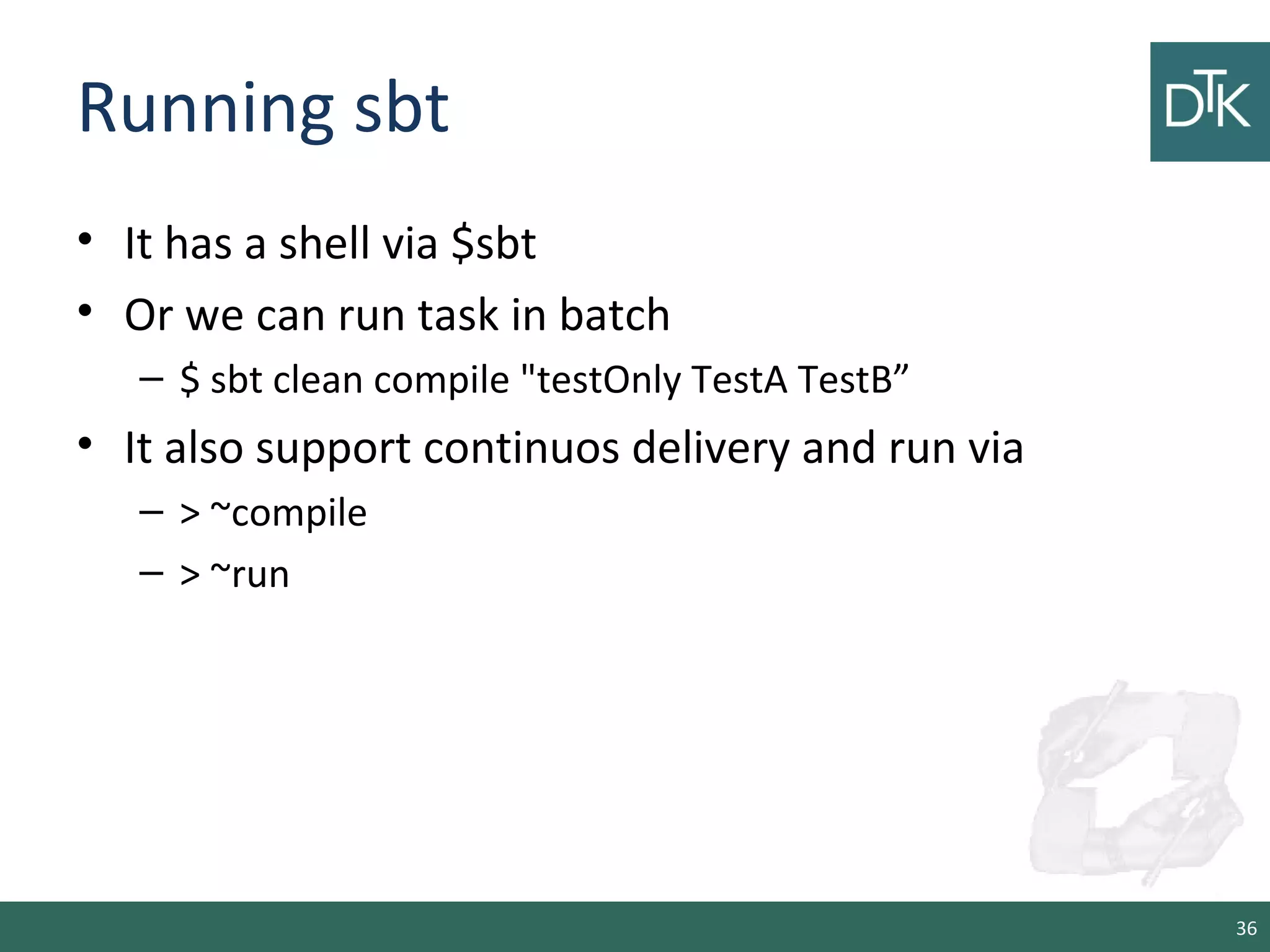
Running sbt
• It has a shell via $sbt
• Or we can run task in batch
– $ sbt clean compile "testOnly TestA TestB”
• It also support continuos delivery and run via
– > ~compile
– > ~run
36
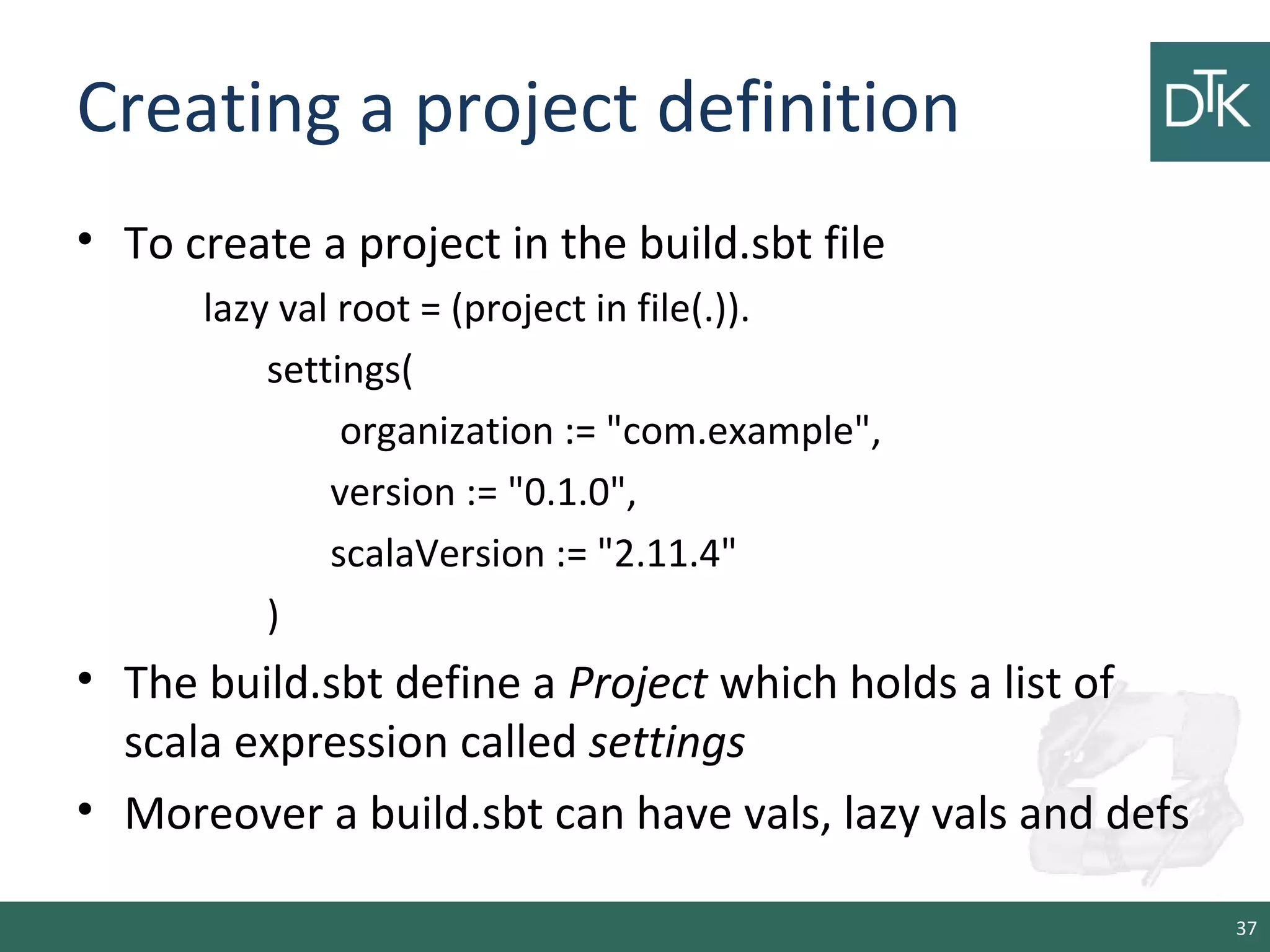
Creating a project definition
• To create a project in the build.sbt file
lazy val root = (project in file(.)).
settings(
organization := "com.example",
version := "0.1.0",
scalaVersion := "2.11.4"
)
• The build.sbt define a Project which holds a list of
scala expression called settings
• Moreover a build.sbt can have vals, lazy vals and defs
37
SettingKey, TaskKey and InputKey
lazy val root = (project in file(".")).
settings(
name.:=("hello")
)
•.:= is a method that takes a parameter and return s
Setting[String]
lazy val root = (project in file(".")).
settings(
name := 42 // will not compile
)
•Does it run?
38
Types of key
• SettingKey[T]: a key for a value computed once (the
value is computed when loading the project, and
kept around).
• TaskKey[T]: a key for a value, called a task, that has
to be recomputed each time, potentially with side
effects.
• InputKey[T]: a key for a task that has command line
arguments as input. Check out Input Tasks for more
details.
• The built-in key are field of the object Keys
(http://www.scala-
sbt.org/0.13/sxr/sbt/Keys.scala.html) 39
Custom Keys
• Can be created with their:
– settingKey, taskKey and inputKey
lazy val hello = taskKey[Unit](“An example task”)
• A TaskKey[T] can be used to define task such as
compile or package.
40
Defining tasks and settings
• For example, to implement the hello task
lazy val hello = taskKey[Unit]("An example task”)
lazy val root = (project in file(".")).
settings(
hello := { println("Hello!") }
)
• Imports in build.sbt
import sbt._
import Process._
import Keys._
41
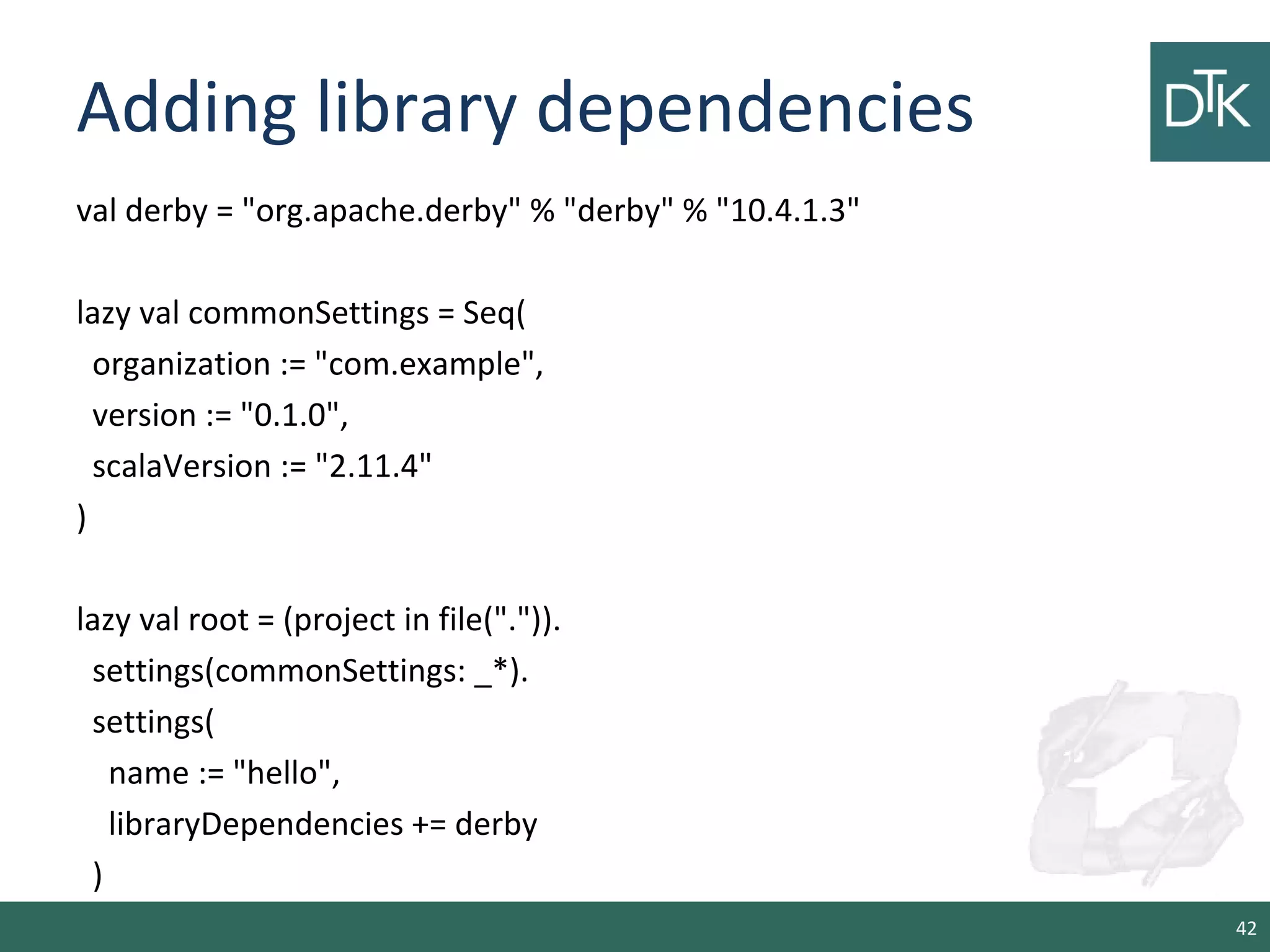
Adding library dependencies
val derby = "org.apache.derby" % "derby" % "10.4.1.3"
lazy val commonSettings = Seq(
organization := "com.example",
version := "0.1.0",
scalaVersion := "2.11.4"
)
lazy val root = (project in file(".")).
settings(commonSettings: _*).
settings(
name := "hello",
libraryDependencies += derby
)
42
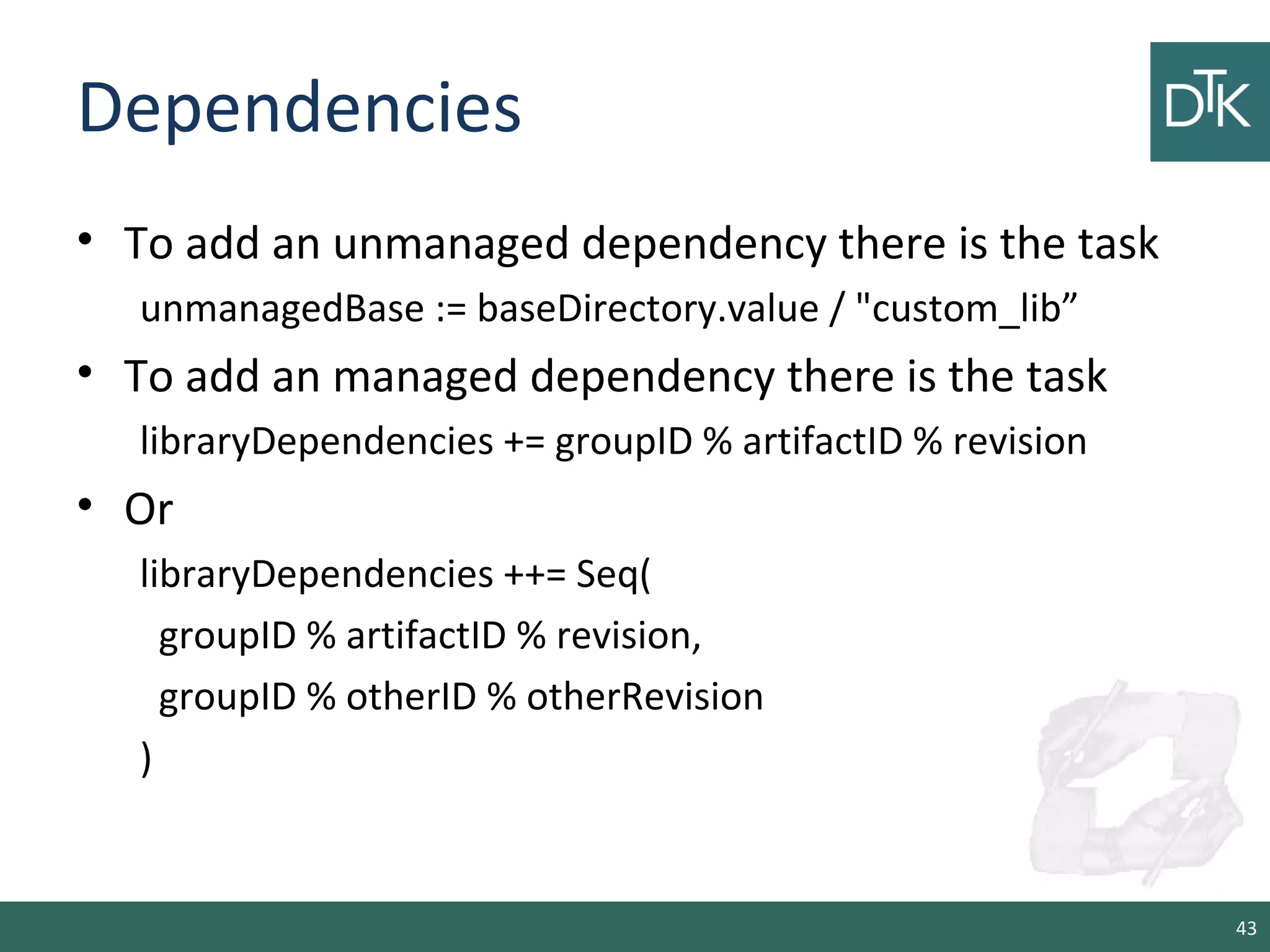
Dependencies
• To add an unmanaged dependency there is the task
unmanagedBase := baseDirectory.value / "custom_lib”
• To add an managed dependency there is the task
libraryDependencies += groupID % artifactID % revision
• Or
libraryDependencies ++= Seq(
groupID % artifactID % revision,
groupID % otherID % otherRevision
)
43
Resolvers
• To add a resolver
1. resolvers += name at location
2. resolvers += Resolver.mavenLocal
3. resolvers ++= Seq(name1 at location1, name2 at
location2)
• Is it possible also to define if the dependency is for
test
libraryDependencies += "org.apache.derby" % "derby" %
"10.4.1.3" % Test
44
Plugins
• To declare a plugin add a directory project/Build.sbt
45

An introduction to maven gradle and sbt

  • 1.
    The Gangs of Three Ciao ciao Vaia fare ciao ciao Dr. Fabio Fumarola Maven, Gradle and SBT
  • 2.
    Java Project relatedquestions • How do we create a java project? • How do we add dependencies? • How do we create a runnable jar? • How do we create a war? • How do we execute tests? 2
  • 3.
  • 4.
    What is Maven? •Apache Maven is a software project management. • It is based on the concept of a Project Object Model (POM) • Maven can mange a project’s build, reporting a documentation form a central piece of information But it isn’t a mere build tool 4
  • 5.
    Maven features • DependencySystem • Multi-module builds • Consistent project structure • Consistent build model • Plugin oriented • Project generated sites 5
  • 6.
    Advantages over Ant •Eliminate complicate scripts • All the functionality required to build your project, i.e., clean, compile, copy, resources, install, deploy • Cross Project Reuse – Ant has no convenient way to reuse target across projects. 6
  • 7.
  • 8.
    Maven keywords • POM •Archetype • Artifact or dependency • Plugin • Goal 8
  • 9.
    POM • Unit ofwork in Maven • It is an XML file that contains the information and the configuration details used by Maven to build the project 9
  • 10.
    Archetype • It isa template of a project with is combined with some user input to produce a working Maven project • There are hundreds of archetypes to help us get started – $ mvn –version – $ mvn archetype:generate -DgroupId=com.mycompany.app -DartifactId=my-app -DarchetypeArtifactId=maven-archetype-quickstart -DinteractiveMode=true – $ mvn eclipse:eclipse 10
  • 11.
    Artifact • An artifactis a module obtained by another artifact deployed to a maven repository • Each artifact belongs to a group • Each group can have more artifacts 11 <dependency> <groupId>joda-time</groupId> <artifactId>joda-time</artifactId> <version>2.6</version> </dependency>
  • 12.
    Goals and Plugins •Are an extension of the standard maven lifecycles steps. – Clean, compile, test, package, install and deploy • There are plugin to do other steps such as 12 <plugins> <plugin> <artifactId>maven-assembly-plugin</artifactId> <version>2.5.3</version> <configuration> <descriptorRefs> <descriptorRef>jar-with-dependencies</descriptorRef> </descriptorRefs> </configuration> [...] </plugin> </plugins>
  • 13.
    What is Gradle? •Gradle is a general purpose build system • It comes with a rich build description • language (DSL) based on Groovy • It supports ”build-by-convention” principle • But it is very flexible and extensible • It has built-in plug-ins for Java, Groovy, Scala, Web • Groovy as a base language allows imperative programming in the build file. 13
  • 14.
    Advanced features • Parallelunit test execution • Dependency building • Incremental build support • Dynamic tasks and task rules • Gradle daemon 14
  • 15.
    Hello, Gradle • Createa file build.gradle task hello << { println 'Hello World' } • Run $ gradle hello • Edit the file as below task hello << { print 'Hello ' } task world(dependsOn: hello) << { println 'World!" } • Run $ gradle –q world 15
  • 16.
    Build scripts arecode task upper << { String someString = 'mY_nAmE' println "Original: " + someString println "Upper case: " + someString.toUpperCase() } - $gradle upper 4.times { counter -> task "task$counter" << { println "I'm task number $counter" } } 16
  • 17.
    Gradle is Groovythat is Java JAVA import java.ioFile; … String parentDir = new File(“test.txt”).getAbsoluteFile() .getParentPath(); Groovy def parentDir = new File(“test.txt”).absoluteFile.parentPath Gradle parentDir = file(“test.txt”).absoluteFile.parentPath 17
  • 18.
    Building a Javaproject apply plugin: ‘java’ 18
  • 19.
    Gradle support allant task task hello << { String greeting = "hello from Ant" ant.echo(message: greeting) } task list << { def path = ant.path { fileset(dir: 'libs', includes: '*.jar') } path.list().each { println it } } task zip << { ant.zip(destfile: 'archive.zip') { fileset(dir: 'src') { include(name: '**.xml') exclude(name: '**.java') } } } 19
  • 20.
    Overriding conventions Version =1.0 Group = ‘org.mygroup’ task release(dependsOn: assemble) << { println 'We release now' } build.taskGraph.whenReady { taskGraph -> if (taskGraph.hasTask(':release')) { version = '1.0’ } else { version = '1.0-SNAPSHOT’ } } 20
  • 21.
    Referencing files &file collections• Groovy-like syntax: File configFile = file('src/config.xml') • Create a file collection from a bunch of files:  FileCollection collection = files( 'src/file1.txt', new File('src/file2.txt'), ['src/file3.txt', 'src/file4.txt']) • Create a files collection by referencing project properties:  collection = files { srcDir.listFiles() } • Operation on collections def union = collection + files('src/file4.txt') def different = collection - files('src/file3.txt')} 21
  • 22.
    Using file collectionsas input • Use a File object to specify the source directory. compile { source = file('src/main/java') } • Using a closure to specify the source files. compile { source = { file(‘src’).listFiles() .findAll { it.name.endsWith('.zip') } .collect { zipTree(it) } } } } 22
  • 23.
    Copying files • UsingGradle task type:  task copyTask(type: Copy) { from 'src/main/webapp‘ into 'build/explodedWar‘ include '**/*.jsp‘ exclude { details -> details.file.name.endsWith('.html') && details.file.text.contains('staging') } } 23
  • 24.
  • 25.
    Repository configuration • RemoteRepos repositories { mavenCentral() mavenCentral name: 'multi-jar-repos', urls: ["http://repo.mycompany.com/jars1", "http://repo.mycompany.com/jars1"] } • Local Repos repositories { flatDir name: 'localRepository', dirs: 'lib' flatDir dirs: ['lib1', 'lib2'] } 25
  • 26.
    Referencing dependencies dependencies { runtimefiles('libs/a.jar', 'libs/b.jar’) runtime fileTree(dir: 'libs', includes: ['*.jar']) } dependencies { compile 'org.springframework:spring-webmvc:3.0.0.RELEASE' testCompile 'org.springframework:spring-test:3.0.0.RELEASE' testCompile 'junit:junit:4.7' } 26
  • 27.
    Referencing dependencies List groovy= ["org.codehaus.groovy:groovy-all:1.5.4@jar", "commons-cli:commons-cli:1.0@jar", "org.apache.ant:ant:1.7.0@jar"] List hibernate = ['org.hibernate:hibernate:3.0.5@jar', 'somegroup:someorg:1.0@jar'] dependencies { runtime groovy, hibernate } 27
  • 28.
  • 29.
    Extending your build •Any Gradle script can be a plug-in: apply from: 'otherScript.gradle' apply from: 'http://mycomp.com/otherScript.gradle’ • Use many of the standard or 3rd-party plug-ins: apply plugin: 'java' apply plugin: 'groovy' apply plugin: 'scala' apply plugin: 'war' 29
  • 30.
  • 31.
    Example java andscala project • http://www.gradle.org/docs/current/userguide/tutorial_j • http://www.gradle.org/docs/current/userguide/scala_plu • http://plugins.gradle.org/ 31
  • 32.
  • 33.
    Sbt • It isa tool to define task and then run them from the shell • To install on linux grab the – rpm: https://dl.bintray.com/sbt/rpm/sbt-0.13.7.rpm – deb: https://dl.bintray.com/sbt/rpm/sbt-0.13.7.deb 33
  • 34.
    Starting with sbt •It is based on the file build.sbt • Create a directory hello_scala • Edit a file and add lazy val root = (project in file(".")). settings( name.:=("hello”), version := "1.0", scalaVersion := "2.11.4" ) • Create an HelloWorld class 34
  • 35.
    Project Structure • Sbtis base on maven project structure 35
  • 36.
    Running sbt • Ithas a shell via $sbt • Or we can run task in batch – $ sbt clean compile "testOnly TestA TestB” • It also support continuos delivery and run via – > ~compile – > ~run 36
  • 37.
    Creating a projectdefinition • To create a project in the build.sbt file lazy val root = (project in file(.)). settings( organization := "com.example", version := "0.1.0", scalaVersion := "2.11.4" ) • The build.sbt define a Project which holds a list of scala expression called settings • Moreover a build.sbt can have vals, lazy vals and defs 37
  • 38.
    SettingKey, TaskKey andInputKey lazy val root = (project in file(".")). settings( name.:=("hello") ) •.:= is a method that takes a parameter and return s Setting[String] lazy val root = (project in file(".")). settings( name := 42 // will not compile ) •Does it run? 38
  • 39.
    Types of key •SettingKey[T]: a key for a value computed once (the value is computed when loading the project, and kept around). • TaskKey[T]: a key for a value, called a task, that has to be recomputed each time, potentially with side effects. • InputKey[T]: a key for a task that has command line arguments as input. Check out Input Tasks for more details. • The built-in key are field of the object Keys (http://www.scala- sbt.org/0.13/sxr/sbt/Keys.scala.html) 39
  • 40.
    Custom Keys • Canbe created with their: – settingKey, taskKey and inputKey lazy val hello = taskKey[Unit](“An example task”) • A TaskKey[T] can be used to define task such as compile or package. 40
  • 41.
    Defining tasks andsettings • For example, to implement the hello task lazy val hello = taskKey[Unit]("An example task”) lazy val root = (project in file(".")). settings( hello := { println("Hello!") } ) • Imports in build.sbt import sbt._ import Process._ import Keys._ 41
  • 42.
    Adding library dependencies valderby = "org.apache.derby" % "derby" % "10.4.1.3" lazy val commonSettings = Seq( organization := "com.example", version := "0.1.0", scalaVersion := "2.11.4" ) lazy val root = (project in file(".")). settings(commonSettings: _*). settings( name := "hello", libraryDependencies += derby ) 42
  • 43.
    Dependencies • To addan unmanaged dependency there is the task unmanagedBase := baseDirectory.value / "custom_lib” • To add an managed dependency there is the task libraryDependencies += groupID % artifactID % revision • Or libraryDependencies ++= Seq( groupID % artifactID % revision, groupID % otherID % otherRevision ) 43
  • 44.
    Resolvers • To adda resolver 1. resolvers += name at location 2. resolvers += Resolver.mavenLocal 3. resolvers ++= Seq(name1 at location1, name2 at location2) • Is it possible also to define if the dependency is for test libraryDependencies += "org.apache.derby" % "derby" % "10.4.1.3" % Test 44
  • 45.
    Plugins • To declarea plugin add a directory project/Build.sbt 45

Editor's Notes

  • #17 def times(i: Int)(f: (Int) =&amp;gt; Void)