Thinking about my target audience and
how each advert tries to attract and
appeal to them and match their needs
and interests
Successful advertising rarely succeeds through argument or calls to action.
Instead, it creates positive memories and feelings that influence our behavior over
time to encourage us to buy something at a later date. No one likes to think that
they are easily influenced. In fact, there is plenty of evidence to suggest that we
respond negatively to naked attempts at persuasion.
Use the following theories to help you identify which audiences needs, interest and
personality types etc. are reflected in your advert
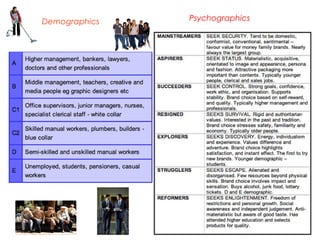
Demographics Psychographics
10. Need for autonomy-
within a crowded
environment; we want to
be singled out, to be a
"breed apart." This can also
be used negatively: you
may be left out if you don't
use a particular product
8. Need for prominence-
we want to be admired
and respected; to have
high social status.
9. Need for attention- we
want people to notice
us; we want to be looked
at.
11. Need to escape- flight is
very appealing; you can
imagine adventures you
cannot have; the idea of
escape is pleasurable
6. Need to achieve- the ability to
accomplish something difficult
and succeed identifies the
product with winning. Sports figures
as spokespersons project this
image.
7. Need to dominate- the
power we lack is what we
can look for in a
commercial "master the
possibilities.”
5. Need to aggress- (attack
first) we all have had a desire
to get even, and some ads
give you this satisfaction
4. Need for guidance- a
father or mother figure can
appeal to your desire for
someone to care for you.
3. Need to nurture- every time
you see a puppy or a kitten or
a child, the appeal is to your
paternal or maternal instincts
1. Need for sex-
surprisingly, only 2 percent
of the television ads he
surveyed used this appeal.
2. Need for affiliation- the
largest number of ads use this
approach: you are looking for
friendship? Advertisers can also
use this negatively, to make you
worry that you'll lose friends if
you don't use a certain product.
13. Need for aesthetic
sensations-beauty attracts us,
and classic art or dance makes
us feel creative, enhanced
12. Need to feel safe- to be free
from threats, to be secure is the
appeal of many insurance and
bank ads
14. Need to satisfy curiosity-facts
support our belief that
information is quantifiable and
numbers and diagrams make
our choices seem scientific
15. Psychological needs- Fowles
defines sex (item no.1) as a
biological need, and so he
classifies our need to sleep, eat,
and drink in this category.
Advertisers for juicy pizza are
especially appealing late at night
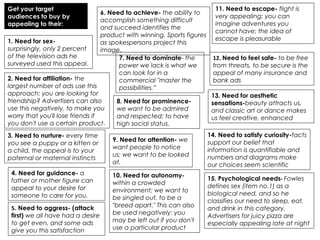
Get your target
audiences to buy by
appealing to their:
Intro to Target Audience Theory

Intro to Target Audience Theory

  • 1.
    Thinking about mytarget audience and how each advert tries to attract and appeal to them and match their needs and interests Successful advertising rarely succeeds through argument or calls to action. Instead, it creates positive memories and feelings that influence our behavior over time to encourage us to buy something at a later date. No one likes to think that they are easily influenced. In fact, there is plenty of evidence to suggest that we respond negatively to naked attempts at persuasion. Use the following theories to help you identify which audiences needs, interest and personality types etc. are reflected in your advert
  • 2.
  • 3.
    10. Need forautonomy- within a crowded environment; we want to be singled out, to be a "breed apart." This can also be used negatively: you may be left out if you don't use a particular product 8. Need for prominence- we want to be admired and respected; to have high social status. 9. Need for attention- we want people to notice us; we want to be looked at. 11. Need to escape- flight is very appealing; you can imagine adventures you cannot have; the idea of escape is pleasurable 6. Need to achieve- the ability to accomplish something difficult and succeed identifies the product with winning. Sports figures as spokespersons project this image. 7. Need to dominate- the power we lack is what we can look for in a commercial "master the possibilities.” 5. Need to aggress- (attack first) we all have had a desire to get even, and some ads give you this satisfaction 4. Need for guidance- a father or mother figure can appeal to your desire for someone to care for you. 3. Need to nurture- every time you see a puppy or a kitten or a child, the appeal is to your paternal or maternal instincts 1. Need for sex- surprisingly, only 2 percent of the television ads he surveyed used this appeal. 2. Need for affiliation- the largest number of ads use this approach: you are looking for friendship? Advertisers can also use this negatively, to make you worry that you'll lose friends if you don't use a certain product. 13. Need for aesthetic sensations-beauty attracts us, and classic art or dance makes us feel creative, enhanced 12. Need to feel safe- to be free from threats, to be secure is the appeal of many insurance and bank ads 14. Need to satisfy curiosity-facts support our belief that information is quantifiable and numbers and diagrams make our choices seem scientific 15. Psychological needs- Fowles defines sex (item no.1) as a biological need, and so he classifies our need to sleep, eat, and drink in this category. Advertisers for juicy pizza are especially appealing late at night Get your target audiences to buy by appealing to their: