3 Techniques
At the end of this lesson, you are expected to:
 Identify “Propaganda”;
 differentiate the three propaganda
  techniques (Transfer, Bandwagon, and
  Glittering Generalities) from each other;
 recognize the propaganda techniques used in
  different advertisements; and
 apply your knowledge about the
  characteristics of the 3 techniques by creating
  your own advertisement.
   According to the Merriam-Webster Online
     Dictionary, PROPAGANDA(noun) means:
      the spreading of ideas, information, or rumor for the
       purpose of helping or injuring an institution, a cause,
       or a person.
      ideas, facts, or allegations spread deliberately to
       further one's cause or to damage an opposing cause.
      a public action having such an effect

See: www.merriam-webster.com/dictionary/propaganda
Look at the following pictures. Do you think they are
examples of propaganda?
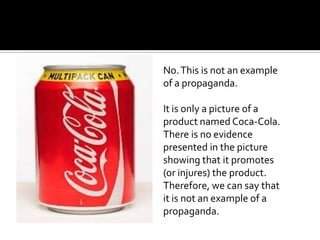
No. This is not an example
of a propaganda.

It is only a picture of a
product named Coca-Cola.
There is no evidence
presented in the picture
showing that it promotes
(or injures) the product.
Therefore, we can say that
it is not an example of a
propaganda.
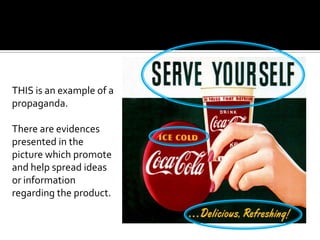
THIS is an example of a
propaganda.

There are evidences
presented in the
picture which promote
and help spread ideas
or information
regarding the product.
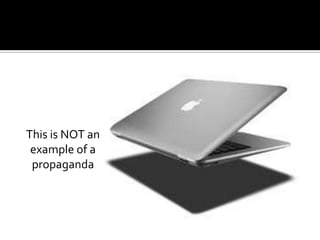
This is NOT an
 example of a
 propaganda
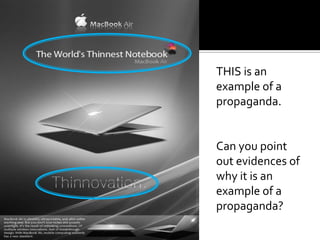
THIS is an
example of a
propaganda.


Can you point
out evidences of
why it is an
example of a
propaganda?
   Stimulates the target to identify with recognized
    authorities
   Often called "association", the target audience
    associates the product with something they like
    or respect.
   Because you like the person endorsing it, you
    end up liking the product, too.
   The advertisers try to make it sound like you are
    the one being talked about in the advertisement
    so that you can easily relate to the product being
    advertised. They transfer the authority to you.
   Here is a sample commercial of the Transfer
    technique. Take note of how the product was
    advertised:
What characteristics of the Transfer Technique
did you see in the commercial?
    Presence of a recognized authority: (paramedic,
     pilot, actor)

    You like/admire paramedics, pilots, and
     actors, so you start to like the product too.

    They made it sound like you were the
     paramedic, pilot, or the actor so that you
     can easily relate to the product
   Attempts to persuade the target audience to
    take a course of action "everyone else is
    taking”

   It reinforces your desire to be on the winning
    side.

   The idea is that, "everyone else is doing it, so
    you should do it, too"
   Here is a sample commercial of the
    Bandwagon technique. Take note of how the
    product was advertised:
What characteristics of the Bandwagon Technique
did you see in the commercial?
     A course of action that everyone else was
      taking (he mentioned that “ako, sila, halos
      lahat” had been cured by the product)

    The commercial made you want to be on
     their side, where everyone used the
     product and experienced positive effects.
    “Everyone else is doing it, so you should too”
     concept was present.
   The advertiser uses words to stir up positive
    feelings in the target audience.

   The words are often hard to define when
    used with the product.

   Their connotations always appear favorable
    to the audience.
   Here is a sample commercial of the Glittering
    Generalities Technique. Take note of how the
    product was advertised:
What characteristics of the Glittering Generalities Technique did
you see in the commercial?
      Some words (safe, effective, “ingat”/take care)stirred
       positive emotions in you.
      These words are hard to define and subjective. If you
       drank 20 tablets in an hour, would it still be safe? If
       you had a terrible migraine and needed 2 tablets to
       make it go away, would it still be effective if you only
       took one? If you drink the tablet on a day-to-day basis,
       would it mean that you are taking care of yourself?
      Though vague, these words appear to be very
       favorable to you.
Because of not having connection to the
internet, our activity will be offline. Here are
the instructions. Read the situation carefully
and do what is asked:
You were hired by LSCA to advertise their school. You
    were asked to make an advertisement which would
    effectively persuade PARENTS to enrol their children
    in the said school. They made it specific that you only
    use TRANSFER, BANDWAGON,or GLITTERING
    GENERALITIES as your technique in making the
    advertisement.

 Using the application PAINT, create an advertisement which will
  cater to the needs of your employer.
 Take note of the TARGET AUDIENCE of your advertisement.
 On the LOWER RIGHT CORNER of the advertisement you
  made, specify the TECHNIQUE you used. ”<your full name>
  9A.JPEG”.
 USE YOUR TIME WISELY!

Propaganda techniques in advertising

  • 1.
  • 2.
    At the endof this lesson, you are expected to:  Identify “Propaganda”;  differentiate the three propaganda techniques (Transfer, Bandwagon, and Glittering Generalities) from each other;  recognize the propaganda techniques used in different advertisements; and  apply your knowledge about the characteristics of the 3 techniques by creating your own advertisement.
  • 4.
    According to the Merriam-Webster Online Dictionary, PROPAGANDA(noun) means:  the spreading of ideas, information, or rumor for the purpose of helping or injuring an institution, a cause, or a person.  ideas, facts, or allegations spread deliberately to further one's cause or to damage an opposing cause.  a public action having such an effect See: www.merriam-webster.com/dictionary/propaganda
  • 5.
    Look at thefollowing pictures. Do you think they are examples of propaganda?
  • 6.
    No. This isnot an example of a propaganda. It is only a picture of a product named Coca-Cola. There is no evidence presented in the picture showing that it promotes (or injures) the product. Therefore, we can say that it is not an example of a propaganda.
  • 7.
    THIS is anexample of a propaganda. There are evidences presented in the picture which promote and help spread ideas or information regarding the product.
  • 8.
    This is NOTan example of a propaganda
  • 9.
    THIS is an exampleof a propaganda. Can you point out evidences of why it is an example of a propaganda?
  • 12.
    Stimulates the target to identify with recognized authorities  Often called "association", the target audience associates the product with something they like or respect.  Because you like the person endorsing it, you end up liking the product, too.  The advertisers try to make it sound like you are the one being talked about in the advertisement so that you can easily relate to the product being advertised. They transfer the authority to you.
  • 13.
    Here is a sample commercial of the Transfer technique. Take note of how the product was advertised:
  • 14.
    What characteristics ofthe Transfer Technique did you see in the commercial?  Presence of a recognized authority: (paramedic, pilot, actor)  You like/admire paramedics, pilots, and actors, so you start to like the product too.  They made it sound like you were the paramedic, pilot, or the actor so that you can easily relate to the product
  • 16.
    Attempts to persuade the target audience to take a course of action "everyone else is taking”  It reinforces your desire to be on the winning side.  The idea is that, "everyone else is doing it, so you should do it, too"
  • 17.
    Here is a sample commercial of the Bandwagon technique. Take note of how the product was advertised:
  • 18.
    What characteristics ofthe Bandwagon Technique did you see in the commercial?  A course of action that everyone else was taking (he mentioned that “ako, sila, halos lahat” had been cured by the product)  The commercial made you want to be on their side, where everyone used the product and experienced positive effects.  “Everyone else is doing it, so you should too” concept was present.
  • 20.
    The advertiser uses words to stir up positive feelings in the target audience.  The words are often hard to define when used with the product.  Their connotations always appear favorable to the audience.
  • 21.
    Here is a sample commercial of the Glittering Generalities Technique. Take note of how the product was advertised:
  • 22.
    What characteristics ofthe Glittering Generalities Technique did you see in the commercial?  Some words (safe, effective, “ingat”/take care)stirred positive emotions in you.  These words are hard to define and subjective. If you drank 20 tablets in an hour, would it still be safe? If you had a terrible migraine and needed 2 tablets to make it go away, would it still be effective if you only took one? If you drink the tablet on a day-to-day basis, would it mean that you are taking care of yourself?  Though vague, these words appear to be very favorable to you.
  • 24.
    Because of nothaving connection to the internet, our activity will be offline. Here are the instructions. Read the situation carefully and do what is asked:
  • 25.
    You were hiredby LSCA to advertise their school. You were asked to make an advertisement which would effectively persuade PARENTS to enrol their children in the said school. They made it specific that you only use TRANSFER, BANDWAGON,or GLITTERING GENERALITIES as your technique in making the advertisement.  Using the application PAINT, create an advertisement which will cater to the needs of your employer.  Take note of the TARGET AUDIENCE of your advertisement.  On the LOWER RIGHT CORNER of the advertisement you made, specify the TECHNIQUE you used. ”<your full name> 9A.JPEG”.  USE YOUR TIME WISELY!